Ralph Towner’s Solstice: Sound And Shadows (ECM 1095)

ECM 1095

Ralph Towner’s Solstice
Sound and Shadows

Ralph Towner 12-string and classical guitars, piano, French horn
Jan Garbarek soprano and tenor saxophones, flute
Eberhard Weber bass, cello
Jon Christensen drums
Recorded February 1977 at Talent Studio, Oslo
Engineer: Jan Erik Kongshaug
Produced by Manfred Eicher

If Ralph Towner’s classic Solstice was an overland journey, then Sound And Shadows is a subterranean dream. Featuring the same lineup as its predecessor—Jan Garbarek on saxophones, Eberhard Weber on bass and cello, Jon Christensen on drums, and Towner himself behind an arsenal of instruments—the results are perhaps not as focused. Then again, they don’t need to be.

Amid the spacious 12-string considerations of “Distant Hills,” we cannot help but feel a rich and complex topography curling into slumber above our heads. Weber’s electronic touches here deepen what is already clothed in darkness. The tighter “Balance Beam” is, like its titular object, steady and reassuring yet something to which one must pay respect if one is to navigate it successfully. Garbarek’s sopranic accents teeter across it, bringing with them the idea of light where there can be none. “Along The Way” is a collection of invisible snapshots animated by the life force of the musical gesture. Towner reprises his deft pianism in “Arion.” Caressed by the fluid unity of Christensen and Weber, he unhinges unspoken memories into the soil. “Song Of The Shadows” ends the album in a blend of classical guitar and flute over receding strings.

Along with Garbarek’s open splendor and admirable restraint, Weber’s snake-like pedal points comprise the ideal complement to Towner’s pinpoint metallic precision. Christensen’s cymbal work glistens as ever, proving that rhythm can be just as effective in a whisper. This is an album of sensations without images, one that reminds us that in order to have light, we must have umbrage, and this it brings in great quantity.

<< Steve Kuhn and Ecstasy: Motility (ECM 1094)
>> Collin Walcott: Grazing Dreams (ECM 1096)

Barre Phillips: Mountainscapes (ECM 1076)

ECM 1076

Barre Phillips
Mountainscapes

Barre Phillips bass
John Surman soprano and baritone saxophones, bass clarinet, synthesizer
Dieter Feichtner synthesizer
Stu Martin drums, synthesizer
John Abercrombie guitar
Recorded March 1976, Tonstudio Bauer, Ludwigsburg
Engineer: Martin Wieland
Produced by Manfred Eicher

In his classic case study of Melanesian cargo cults, Mambu, anthropologist Kenelm Burridge introduced the concept of the myth-dream, which he reduces to “a series of themes, propositions, and problems which are to be found in myths, in dreams, in the half-lights of conversation, and in the emotional responses to a variety of actions, and questions asked.” According to Burridge, what makes any such cult successful is the immediacy with which its figurehead is able to articulate the myth-dream, unleashing a barely conscious longing to know and resolve that which lurks in our mental shadows. The resulting destabilization is a shared process of salvation. I dare to claim the music of Barre Phillips as providing that same function. It embodies a psychological imperative to bring into focus that which inhabits the half-light of our awareness, and fulfills that need through sound. The only difference is that, here, there is neither the promise of salvation nor of migration, but rather the simple need to soak in the immediate essence of wherever one may stand.

Mountainscapes is divided into eight parts of spirit-tugging magnificence, products of a mind that, though only cursorily represented on ECM, has done us a great service in recording his sounds for posterity. Mountainscape I hovers at the margins before unleashing a crackling free groove. The beautifully synthesized sounds and enthralling bass playing, not to mention an absolutely captivating soprano solo from reedman extraordinaire John Surman, give us a rich taste of resolution. It is an unexpected transition, one that jolts the heart into awareness every time. II is a quieter follow-up, enigmatic, peripheral. Like the myth-dream, it lingers just beyond our reach, baiting our desire to know it in full. III is an exquisite piece enhanced by organ and electronics. In IV, the bass becomes a huge rope hefted and swung like a mast cord in a seasoned shipmate’s hands before a saxophonic wind illuminates its sails. The drums never quite stand upright, crossing their feet instead in a continual swagger. V fades in with a synthesized arpeggio. Some sinuous bass notes and a stellar saxophone peek out from the woodwork here. The bass thrums like a groaning in the earth. Meanwhile, a synthesizer bubbles to the surface before fading into transfiguration. VI begins with a lavish wash of electronics embroidered by Phillips’s harmonic threads. It’s a short track, but for me the most effective on the album. VII begins with more pulchritudinous arpeggiation. The sax trails along, trying to place its footsteps in the same imprints as the bass trails not to far behind: the trio as mise-en-abyme. An electric guitar surprises us in the final part, wound by an enthralling sax to feverish heights and playing us out in a gentle finale.

In the end, this is music to be experienced rather than described. And so, I will stop trying.

<< Jan Garbarek: Dansere (ECM 1075)
>> Edward Vesala: Nan Madol (ECM 1077)

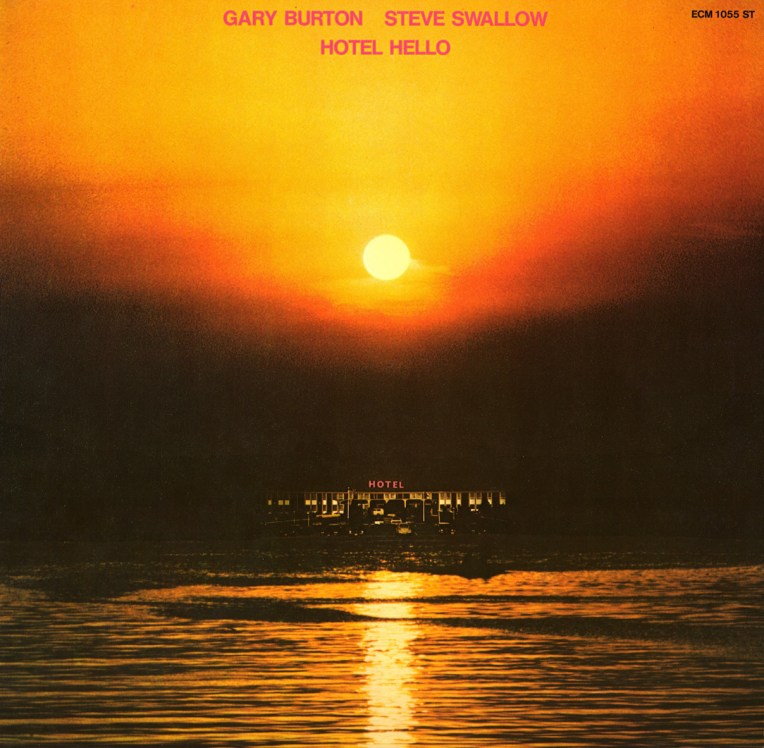
Gary Burton/Steve Swallow: Hotel Hello (ECM 1055)

ECM 1055 LP

Gary Burton
Steve Swallow
Hotel Hello

Gary Burton vibraharp, organ, marimba
Steve Swallow bass, piano
Recorded May 13/14, 1974 at Aengus Studio, Fayville, Mass.
Engineer: John Nagy
Produced by Manfred Eicher

The stirring piano and vibes of “Chelsea Bells (For Hern)” open this long-forgotten jewel among ECM’s many fruitful duo recordings. Lithe and nocturnal, its only light can be found in the sourceless reflections of its watery surface. Herein lie the beginnings of a shaded affair that shelters the most distant promise of love. “Hotel Overture + Vamp” pairs vibes with a tight constituent of guitar, bass, and Fender Rhodes for a full sound honed in metal. Swallow assumes a dual identity in the title track, playing both bass and piano. We get the only “un-Swallowed” motif with Mike Gibbs’s “Inside In,” a short and sweet number complete with wah-wah infusions, plenty of changes to keep our ears in check, and some fantastic vibe work to boot. The quaintly titled “Domino Biscuit” is a pleasant segue to the prismatic mood and lyrical bass of “Vashkar.” The most moving piece on the album, it is vividly evocative and honed to a mysterious edge. “Sweet Henry” is a more upbeat, jovial affair, sounding almost like the theme song for a seventies television show sans kitsch (or perhaps with just enough kitsch to satisfy our morbid curiosity). The “Impromptu” that follows is a lovely meditation in which each instrument blends into the other in a swell of monochrome.

Hotel Hello is a unique entry in the Burton catalogue, for it is the only one that feels as if it were painted in black and white. What it lacks in vibrancy (no pun intended) of color, it makes up for, if not surpasses, in its visceral sentiment. We feel this most acutely in the final track, “Sweeping Up,” which faithfully evokes the cleanup that follows any given event, so that no matter how beautiful an experience it is, one is bid to appreciate its refuse.

This is a consistently solid effort and arousing in its many changes. Built on the raw materials of studio trickery, its overdubbed experiments speak to the revelry of both musicians. Burton solos in such a way that while his tone and sound do soar, they always remain firmly embedded and connected to the surrounding thematic motivations. Burton plays on at least three simultaneous levels: anticipating the next note while striking the current one, having already written it in his mind during the one just passed. Swallow is equally exacting and works with a no less expansive vocabulary.

This is an album about alienation and the promise of its demise.

<< Richard Beirach: Eon (ECM 1054)
>> Ralph Towner/Gary Burton: Matchbook (ECM 1056)

Michael Naura/Wolfgang Schlüter: Country Children (ECM 2305 803 SP)

Michael Naura
Wolfgang Schlüter
Country Children

Michael Naura piano
Wolfgang Schlüter vibraharp, marimba
Recorded June 1977 at Radio Bremen
Engineer: Dietram Köster
Produced by Peter Schulze

Oftentimes, when pouring through the back catalogue of any label’s out-of-print releases, one stumbles on a few clunkers before arriving at any forgotten monuments. In my listening experiences thus far, ECM has flipped this dynamic considerably, offering a wealth of musical history to explore and appreciate. Among the ruins, however, is this humble little project, lost to the age of the label’s brief SP imprint, which lasted all of three albums. Country Children brings together pianist Michael Naura, whose music graces most of this set, and Wolfgang Schlüter. Originally trained as a drummer before a knee injury led him to mallet instruments, Schlüter cites Lionel Hampton (who he heard live in Berlin in 1952) and Milt Jackson as early influences. After a stint with the Michael Naura Quintet, which dissolved due to Naura’s illness, he played with the NDR Bigband for three decades. Since then, he has focused on teaching and remains one of Germany’s most formative vibraphonists.

“Ballade für eine Silberhochzeit” is a lush opener, almost the shadow of Gershwin’s “Summertime.” Over a beautiful two-chord ostinato, vibes dance exuberantly in a tightly restricted space, but with resplendent melodic freedom. “Schlafen” is a heavily improvised stem with the occasional blossom of composed material. Whereas its heavily convoluted beginnings might elsewhere seem a turgid dream from which one awakens into consonant resolution, here they imply the opposite: an opening of eyes within in sleep’s promised dream. “Take Us Down the River” is more exuberant, much in the vein of Keith Jarrett in the throes of a re-imagined standard. “Argentina” is alive with urban energy, a subdued elegy for remembered villages and mountains. The piano here is paired with a sprightly marimba, making for a drier and more evocative sound.

A flip of the record to Side B brings us to one of the most heartfelt renditions of Krzysztof Komeda’s theme from “Rosemary’s Baby” you are ever likely to hear. This is followed by the title track, which feels steeped in an unnamed nostalgia. “Sad Queen” is another stunner, and my favorite among the album’s originals. “Variation auf »Abendlied«” is dedicated to Peter Rühmkorf, the highly influential German writer whose voice appears alongside Naura and Schlüter in the first two ECM SP titles. It is another lovely offering, consolatory in its gentle persuasion, a track of subtle boisterousness filled with an abiding energy. The final track, “Call,” ends the album on a bittersweet note.

These musicians are like two halves of the same instrument. Their collaborations are beautifully conceived and executed, and make for a fitting complement to such likeminded pairings as Chick Corea and Gary Burton. It’s a wonder this album has yet to be reissued. I would think that, especially with the nod to Komeda, it would fit snugly alongside François Couturier’s Nostalghia and Tomasz Stanko’s Litania. This is a gorgeous and wide-ranging album, one equally fit as the background to other activities or for relaxed deep listening. An unsung gem, and easily one of my top picks currently vying for freedom from the ECM vault.

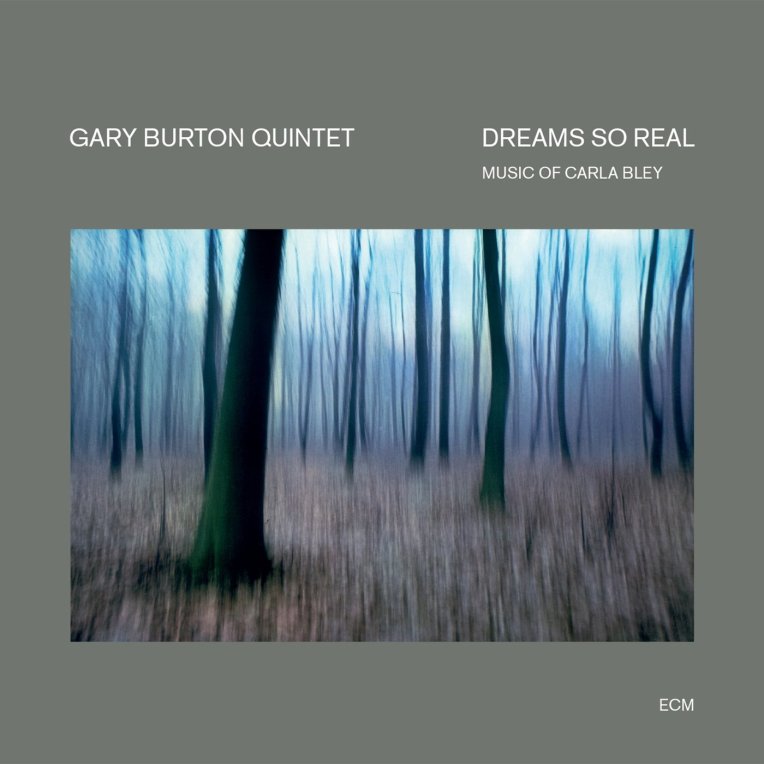
Gary Burton Quintet: Dreams So Real (ECM 1072)

ECM 1072

Gary Burton Quintet
Dreams So Real – Music of Carla Bley

Gary Burton vibraphone
Mick Goodrick guitar
Pat Metheny electric 12-string guitar
Steve Swallow bass
Bob Moses drums
Recorded December 1975, Tonstudio Bauer, Ludwigsburg
Engineer: Martin Wieland
Produced by Manfred Eicher

Gary Burton is one of those rare artists whose sound is immediately recognizable, yet who always manages to surprise and delight with his commitment to personal transformation. He is an artist of metamorphosis and of acknowledgment. Like Keith Jarrett, even at his most selfless moments he places each note as one would an important relic on an altar, such that his transitions from improvised to thematic material are hardly noticeable in the grander scheme of things. Fold into this batter of this already delectable recipe the music of Carla Bley, and you get an irresistible cake layered with energy and melody. We see this right away in the title opener, which spreads a thin layer of frosting over this metaphorical confection. “Ictus / Syndrome / Wrong Key Donkey” plays with the frantic jumps at which Burton is so skilled, beautifully accented by Pat Metheny’s electric 12-string. The tender vibraphone solo of “Jesus Maria” cradles the heart with its song, priming us for the gorgeousness that is “Vox Humana,” one of Bley’s crowning statements and interpreted here to perfection. After a modicum of resistance, the aptly titled “Doctor” heals the weary mind like good medicine. Burton shows off more fractured skills here, while Metheny swings in his virtuosic hammock. In spite of its title, “Intermission Music” is hardly a throwaway soundtrack to your break from more important activities. It is, rather, a beautiful flight into melodic skies, a lasting homage to the cinematic screen when it was still silver.

Bley’s tunes, with their chameleonic flair and peerless sense of forward motion, challenge any performer to be at his or her best. With this recording, the present assembly did much more than that by enlivening the music for an unsuspecting audience. As one of her most ardent champions, Burton has taken the soulful sounds of this one-time struggling waitress into that coveted place in our hearts where it belongs. Like skillfully sustained notes on a bowed instrument, Bley’s compositions are drawn in tight circles rather than in straight lines. Burton articulates every nuance, crossing dimensions with the ease of breathing. Metheny and mentor Goodrick are two leaves on the same stalk, each bowing to the wind to let sunlight peek through. Swallow’s presence is tender yet always palpable. And the attentive skills of Bob Moses shine at every rhythmic turn. While each of these musicians is easily spotted in any auditory congregation, they are immeasurably impressive as a collective unit. The album is recorded with ECM’s usual attentiveness, the vibes comfortably embracing the listener from both channels. Bley changed the landscape of jazz, quietly and one vamp at a time. And yet, hers a sound to which many have turned a deaf ear. One could hardly ask for a better wakeup call.

<< Tomasz Stanko: Balladyna (ECM 1071)
>> Pat Metheny: Bright Size Life (ECM 1073)

Jan Garbarek: Dis (ECM 1093)

ECM 1093

Jan Garbarek
Dis

Jan Garbarek tenor and soprano saxophones, wood flute
Ralph Towner 12-string and classical guitars, windharp
Brass Ensemble
Recorded December 1976 at Talent Studio, Oslo
Engineer: Jan Erik Kongshaug
Produced by Manfred Eicher

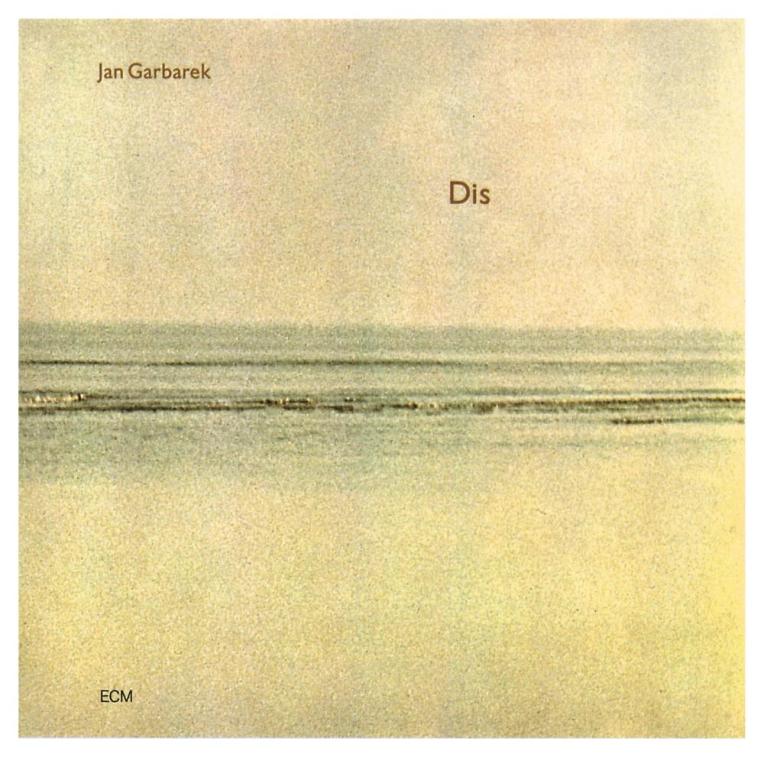
Debates over the “ECM sound” continue, though thankfully with waning fervor, in attempts to define that which never needed definition in the first place. Meanwhile, critical pundits are missing out on some spectacular music that would easily silence their concern over arbitrary categories. On Dis, his eighth album for the label, Jan Garbarek slipped off his extroverted garments and into a deep look inward. One immediately notices the windharp, one of the last instruments one might expect to hear on an album filed under “Jazz,” and which would make an ECM reappearance on Arvo Pärt’s Te Deum. The windharp anchors the album into place, appearing at its center and outer edges. Added to this are the extended soliloquies of guitarist Ralph Towner, whose unmistakable 12-string graces three of the album’s six tracks. For the rest, he casts longer shadows with nylon. Garbarek plays like a blind scribe, scoring his runes into ephemeral surfaces: water, earth, and air. Garbarek and Towner cover about as much territory as two musicians can. From the somber duet of “Krusning” (Ripple), cradled gently like a breaking tide into which footsteps are pressed and filled again with brine, to the wooden intonations of the title track, Dis enamors with its varied terrain. In the powerful “Skygger” (Shadows), Garbarek alternates between bold gestures and more unified punctuations. A brass section (Den Norske Messingsekstett) adds ceremony and locality. The guitar lifts its weary head and flutters its eyes in the glare of sunset, offering a solitary call for closure.

This album marked a formative transition for Garbarek, who wrings out here a soulful sound that is variously airborne and submerged. Comparing the cover art to his equally captivating Dansere, one is tempted to link them as a complementary pair. Where the latter is firmly planted in a wide and arid plain, Dis is downright oceanic, and questions its own division from the sky. The mystique of Dis puts me in mind of a film like Ron Fricke’s Baraka, in which words are superfluous, and melody and images reign as supreme forms of communication. We are never just listeners, but wayfarers in its deeply internal landscape, where space is no longer a viable marker of location, and only breath comes to define the presence of consciousness.

<< The Gary Burton Quartet with Eberhard Weber: Passengers (ECM 1092)
>> Steve Kuhn and Ecstasy: Motility (ECM 1094)

Kuára at RootsWorld

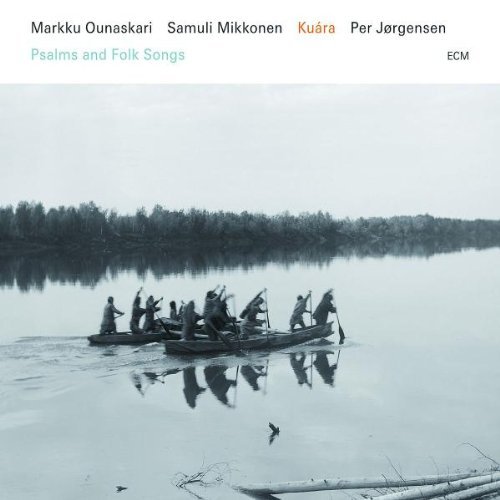
My review of ECM’s latest, Kuára, has just recently been published in RootsWorld online magazine. Please click here to read it. And while you’re there, explore RootsWorld’s many fabulous offerings, including other ECM-related reviews and interviews, not to mention a wealth of hidden treasures.

Eberhard Weber: Colours (ECM 2133-35)

ECM 2133-35

Eberhard Weber
Colours

Eberhard Weber bass
Charlie Mariano soprano saxophone, shenai, nagaswaram, flutes
Rainer Brüninghaus keyboards, piano, synthesizer
Jon Christensen drums
John Marshall drums, percussion

“I would not be you, El-ahrairah. For Frith has given the fox and the weasel cunning hearts and sharp teeth, and to the cat has given silent feet and eyes that see in the dark, and they are gone awry from Frith’s place to kill and devour all that belongs to El-ahrairah.”
–Richard Adams, Watership Down

For six years, Eberhard Weber’s Colours enthralled the European tour circuit. A unique entry into the growing number of fusion outfits of the seventies, Weber charted a distinctly introspective path into jazz’s most unanswerable questions. The ensemble’s inimitable blend of improvisational and chamber music aesthetics was a perfect fit for ECM, not so much filling a gap as defining one. By the time he had recorded for the label, Weber had already honed a most distinctive skill, brought to its worthiest fruition on his custom electrobass, and was even present in Wolfgang Dauner’s much-neglected Output. Without a doubt, Colours created some of the label’s most mellifluous music. The sound is unmistakable, coiling like a snake around some of the most gorgeous atmospheres to grace your ears.
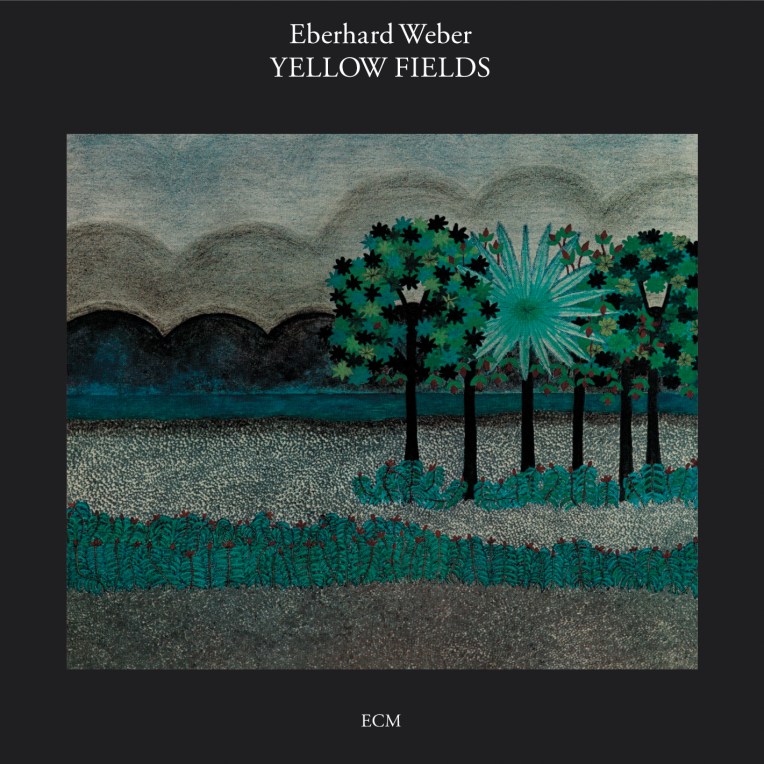
ECM 1066

Yellow Fields (ECM 1066)

Recorded September, 1975 at Tonstudio Bauer, Ludwigsburg
Engineer: Martin Wieland
Produced by Manfred Eicher

With “Touch” we are immediately privy to a groove-oriented game between piano and bass. The lush, open sound is heightened by the presence of synth strings, prefiguring Weber’s later orchestral collaborations. Charlie Mariano’s soprano floats with positive energy and unbounded enthusiasm as the strings morph into trembling sirens. Jon Christensen adds backbone to otherwise invertebrate music. Weber is subdued in this first track, leaving Mariano to take the lead with a soulful stride toward a quick fadeout, leaving us wanting more of what could have been.

“Sand-Glass” begins with water droplets and the occasional artfully placed rim shot. High notes on bass provide a constellatory framework. Within these borders, seemingly drawn but only imagined, Mariano solos like a comet, his sentiment flaring against a limpid night. Mariano flaps his wings around the fuselage of Weber’s bass line before being rocked to sleep in an electric piano cradle. Inspirations grow more pronounced as Mariano picks up the shenai, a quadruple-reed North Indian oboe that tunnels into the brain like a shawm. We ride this wave until the drums pick us up and drop us back into a shattered world of aftershocks and quieting energy.

The title track is an auditory hermit. With the theme quickly dispensed with, improvisation turns joyful fancy into gorgeous abandon. All the while, discipline reigns as abstractions build into a more melodic whole in which the sound and the message are one and the same. Weber takes a more supportive tack, allowing Brüninghaus a cosmic solo on electric piano. Statements conveyed and time regained, the band wraps up with a fleeting thematic revival amid an interlacing of rhythms and supportive flourishes.

Lastly, we merge onto the “Left Lane,” which opens with a pensive bass, soon joined by electric piano. Christensen defibrillates, turning this slow drive into a cruise. The piano sings in its higher regions before trickling down like rain on a window. Weber returns to spark a new groove, moving from elegiac to jazzy in a flash. A seemingly tame sax solo quickly turns dramatic, opening our hearts to a visceral farewell.

<< Keith Jarrett: The Köln Concert (ECM 1064/65)
>> Terje Rypdal: Odyssey (ECM 1067/68)

… . …
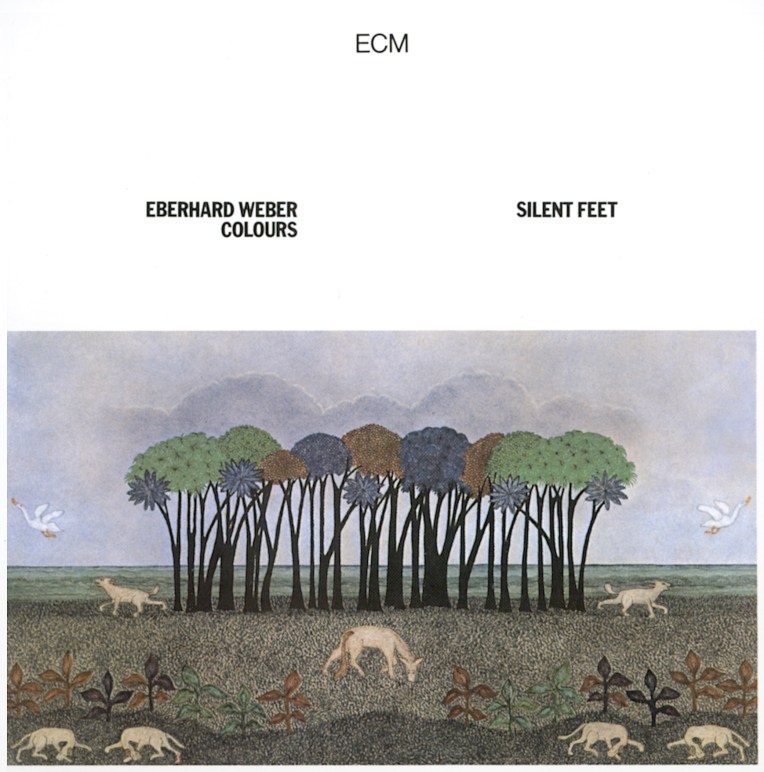
ECM 1107

Silent Feet (ECM 1107)

Recorded November 1977 at Tonstudio Bauer, Ludwigsburg
Engineer: Martin Wieland
Produced by Manfred Eicher

“Seriously Deep” throws a light blanket of tender drones and electric piano, quilted with gorgeous solos on soprano sax and bass. Steady rhythms (hereon provided by ex-Soft Machine drummer John Marshall) turn something otherwise mournful into life-affirming joy. The title is not a pretentious statement of the music’s emotional cache, but rather a description of its physical path as it digs toward the center of the earth. The second, and title, track of the album’s modest three is an ironic one, requiring active hands to evoke silent feet. The helix that is Weber and Brüninghaus spirals in place as cymbals connect like base pairs within, thus leading to one of the latter’s most captivating pianistic passages. It is the kind of balanced exuberance that characterizes Pat Metheny at his most potent stretches of imagination. Stellar breath control from Mariano plays beautifully off Weber’s every move, making for one of the finest cuts in the collection. We end nocturnally, watching with “Eyes That Can See In The Dark.” A smattering of percussion sets off a wooden flute in a floating auditory reverie. While one might think that an electric bass would upset this delicate atmosphere, Weber is one of the few who can pull it off with such fluid precision. From this pool arises a specter of winds, blown like gusts of air from pursed lips across outstretched hands. Again, Mariano turns out some incredible soloing to finish.

Those who, like me, grew up reading Watership Down will doubly appreciate the occasional references Weber draws from the classic novel. “Silent Feet” and “Eyes That Can See In The Dark” both refer to a central creation myth among the story’s protagonists, a herd of rabbits fleeing in exodus from the warren they once called home. Storytelling becomes a central diversion in these hard times, and the origins narrative is a favorite: At a council of the animals, Frith the creator and sun god gives each its own ability to forever pursue the wily and celeritous rabbit. To the cat, he gives Weber’s cited traits, all the better to seek out its foe under cover of night. Respectfully, Weber takes a more romantic view of the hunt and allows us into the animal mind without malice.

<< Art Lande and Rubisa Patrol: Desert Marauders (ECM 1106)
>> Paul Motian Trio: Dance (ECM 1108)

… . …

ECM 1186

Little Movements (ECM 1186)

Recorded July 1980 at Studio Bauer, Ludwigsburg
Engineer: Martin Wieland
Produced by Manfred Eicher

The vast drone of “The Last Stage Of A Long Journey” cuts a thick line below the Steve Kuhn-esque intro. Like the silent monolith of 2001: A Space Odyssey, it mystifies as it enlightens. Saxophonic clusters punctuate a deep recurring thrum. Brüninghaus introduces a plaintive ostinato behind Weber’s crisp solo over brushed drums. Every gesture therein lifts us into cloudier airspace. “Bali” gives us more drone, until Marshall and Weber lock us into a solid trek to outlying territories. Like a train through the mountains that suddenly part to reveal a lively village, it shows passengers an idyllic vision of life on the margins. The piano keeps us moving forward, however, so that we only get a glimpse. Weber provides the coal, while Mariano lights a fire to feed it. A beautiful arpeggiator opens the door on a transcendent detour before bringing us back on track. The energy and motivic clarity remind one instantly of Steve Reich’s Tehillim. Next, Colours weaves “A Dark Spell” over us. Over a distant cascade of piano, bass and sax congregate in thematic clusters. Mariano outdoes himself, performing back flips in the sky as our speed increases in the last stretch. Engaging harmonies between bass and sax offer an incredible display of dynamic control that recedes like a classical riff. The title track begins with a repeated motif on piano as random sounds—accordion, gongs, and breaking glass—populate the background. From this, we get a thematic highlighting by Mariano against Weber’s delightful counterpart. The smooth and easy ending sweeps up any remaining debris with every repetition. “‘No Trees?’ He Said” is a straightforward track that appears smooth from every angle. From its tight rhythm to its reed doublings, this is simply stunning music. There is nothing little about these movements.

Though palpable in every amplified note, Weber’s legacy is about more than just assembling a handful of incredibly talented beads and threading them with smooth production. “Telepathic” is hardly the word to describe the sound of Colours, but it steers us in the right direction. The music in this set remains untouched, a sign of its far-reaching clarity of purpose. It is chaos theory epitomized in sound: every note goes where it must, never to be repeated. Weber’s music not only soars, it transcends the atmosphere. I like to think that, somewhere, an extra-terrestrial is glowing with delight at these sounds, pulsing through space-time with the energy of all creation.

<< Miroslav Vitous Group: s/t (ECM 1185)
>> Rainer Brüninghaus: Freigeweht (ECM 1187)

Egberto Gismonti: Dança Das Cabeças (ECM 1089)

ECM 1089

Egberto Gismonti
Dança Das Cabeças

Egberto Gismonti 8-string guitar, piano, wood flutes, voice
Nana Vasconcelos percussion, berimbau, corpo, voice
Recorded November 1976 at Talent Studio, Oslo
Engineer: Jan Erik Kongshaug
Produced by Manfred Eicher

Egberto Gismonti’s first ECM appearance is also his most understated. Dança das Cabeças (Dance of the Heads) was to be a solo album, due to the fact that the Brazilian government had inflated travel expenses for he and his band to the questionable figure of 7000 dollars a head. Gismonti was the only among them able to make the journey, but as fate would have it, he met Nana Vasconcelos quite by accident while in Norway to prepare for this recording. According to Alvaro Neder, when Vasconcelos asked him to describe the concept behind this project, Gismonti told him it was “the history of two boys wandering through a dense, humid forest, full of insects and animals, keeping a 180-feet distance from each other.” It was a history the two musicians shared without articulation, and Vasconcelos immediately agreed to join, thereby bringing another visionary into the label’s fold.

“It sounds just like a rain forest!” Perhaps you have heard this assessment being made in reference to many a New-Age album, sporting lush trees on its cover and layered within with preprogrammed synthesizers and wooden flutes. Dança, by contrast, is as far as one can get from the contrived exotica that haunt our commercial soundscapes. We are fully situated in the acoustic benefits of live musicianship, captured in all their immediacy in ECM’s standard-setting clarity. And so, while the birdlike sounds of Part I do indeed evoke a forest practically dripping with fecundity, it is populated with more than a few brightly colored animals. Like Marion Brown’s Afternoon Of A Georgia Faun, its sound is as deliberate as it is organic. From these canopied beginnings, we get some jangly strums from Gismonti’s guitar, slaloming between frenzied hand drums. Rhythms and melodies build to infectious heights, diving into our blood with every fluted moment. The musicians raise their cries, from which Gismonti spins a free-flowing grace, as if to trace lines of varying distance in a vast topographic map. Vasconcelos returns in all his fullness with drums, maracas, and shakers, while Gismonti’s fingers move on in their quiet persistence. Changes in syncopation and a few helpings of dissonant harmonies enact a skeleton dance of sorts, soaring resolutely into the music’s ritual heart. Gismonti’s classical training shines through in Part II, for which he puts his fingers to keys in a spacious and revelatory stroll through Keith Jarrett territory. From this heartwarming nostalgia, built in arcs with only the occasional angles, Gismonti morphs into a bellowed vocalise and storm of handclaps. He returns to the guitar before closing with another pianistic statement in improvised space.

This remains the Brazilian multi-instrumentalist’s most direct effort. In it, we find him without masks. It is the kind of music that makes one glad to be alive, a breath of clarity in polluted air. Essential for anyone who appreciates what music can bring to the heart, mind, and body.

<< Edward Vesala: Satu (ECM 1088)
>> Keith Jarrett: Staircase (ECM 1090/91)