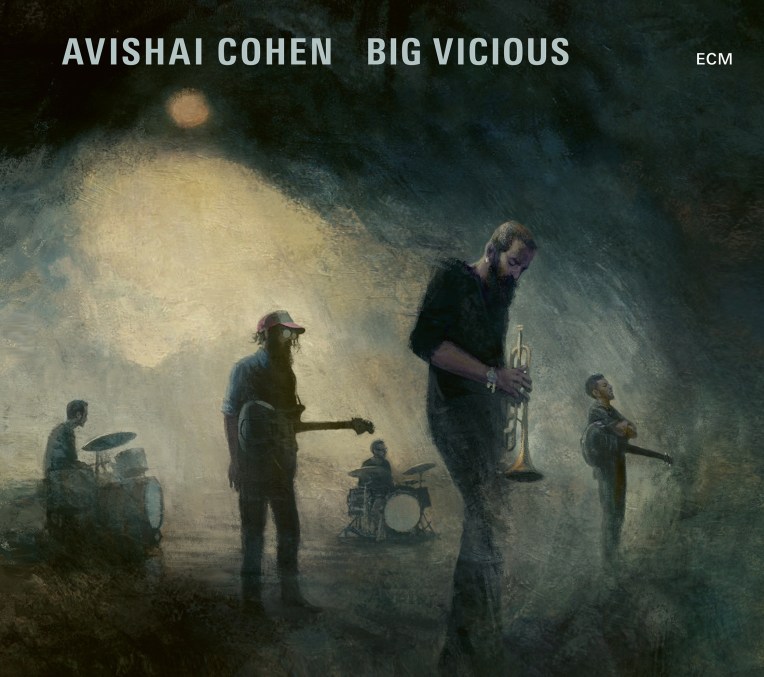
Ralph Alessi: Quiver (ECM 2438)

Quiver

Ralph Alessi
Quiver

Ralph Alessi trumpet
Gary Versace piano
Drew Gress double bass
Nasheet Waits drums
Recorded September 2014 at Rainbow Studio, Oslo
Engineer: Jan Erik Kongshaug
Mixed October 2015 at Avatar Studios, New York by James A. Farber (engineer), Manfred Eicher, and Ralph Alessi
Produced by Manfred Eicher
Release date: February 19, 2016

Trumpeter Ralph Alessi returns to ECM, following his leader debut for the label, with an ace band of pianist Gary Versace, bassist Drew Gress, and drummer Nasheet Waits. This time around, his signature balance of openness and angularity is in fuller effect, made even more prosaic by Versace’s touch. Gress brings his own thorough palette to the studio, while Waits—with whom Alessi first played in Fred Hersch’s quintet—walks a delicate seam both inside and outside the pocket.

Alessi Solo

Over the course of ten originals, Alessi guides his painterly cohort through a gamut of hues. From the primer of “Here Tomorrow,” he moves ever-onward toward the next brushstroke before the current one has even the slightest chance to dry. As a player of genuine dynamism, Alessi treats the melancholy of “Window Goodbyes” (the title references his five-year-old daughter’s habit of waving from the window as he leaves for a tour) and “Shush” with as much rapt attention as any upbeat blending (of which the album is bereft until the closing “Do Over”).

The rubato “Smooth Descent” is a wondrous exhibition for Versace and Gress, both of whom widen its scope with every note they choose. “Gone Today, Here Tomorrow” and “Scratch” are the most cubist detours of the set, although both leave plenty of room between Alessi’s blasts of exposition to find our own way. Through it all, he shows narrative purpose in his playing. Whether in the somber intro of “Heist” or colorful exegesis of “I to I,” he understands the value of any language—in this case, music—to provoke meaning in the flesh. We might therefore think of the album’s blushing title track as the trembling of a body, although it makes just as much sense to imagine it as a bag slung across the back, each arrow it holds a melodic weapon rounded to heal rather than harm.

Michael Formanek’s Ensemble Kolossus: The Distance (ECM 2484)

2484 X

Michael Formanek’s Ensemble Kolossus
The Distance

Ensemble Kolossus
Loren Stillman alto saxophone
Oscar Noriega alto saxophone, clarinet, bass clarinet
Chris Speed tenor saxophone, clarinet
Brian Settles tenor saxophone, flute
Tim Berne baritone saxophone
Dave Ballou trumpet
Ralph Alessi trumpet
Shane Endsley trumpet
Kirk Knuffke trumpet, cornet
Alan Ferber trombone
Jacob Garchik trombone
Jeff Nelson bass trombone, contrabass trombone
Patricia Franceschy marimba
Mary Halvorson guitar
Kris Davis piano
Michael Formanek double bass
Tomas Fujiwara drums
Mark Helias conductor
Recorded December 2014 at Systems Two, Brooklyn, NY
Engineer: Jon Rosenberg
Mixing: David Torn
Mastering: Christoph Stickel and Manfred Eicher at MSM Studios, München
Executive producer: Manfred Eicher
Release date: February 12, 2016

After two eminent quartet outings for ECM, The Distancedemonstrates Michael Formanek’s redefinition of big band jazz. Although the bassist and composer cites influences as diverse as Olivier Messiaen and Charles Mingus, his music is more than the sum of its parts, a palette that yields fresh hues with every listen. Drawing on talents both within and without his usual camp, the album pays equal tribute to the known and unknown and activates the sound of each and every player.

Most of this sonic continent is inhabited by denizens of Formanek’s octagonal Exoskeleton Suite. The suite is introduced by a prelude that embodies its title better than anything that follows it. The bandleader’s soloing indeed acts like a protective shell around the many chemical reactions taking place within it. Analyzing them with scientific precision are pianist Kris Davis and drummer Tomas Fujiwara, both of whom turn method into esotery in compact sweeps of accord.

In light of this opening statement, “Part I – Impenetrable” feels like newfound freedom. Pewter cloudbursts give way to Loren Stillman’s nostalgic altoism, which like a child overturning a log uncovers a wriggling ecosystem that would otherwise remain hidden. “Part II – Beneath the Shell” fast-forwards into evening, where a groove inhales the secrets exhaled by its predecessor. Chris Speed works his tenor into the very heart of things, while Kirk Knuffke’s cornet flickers like a candle in a room that smells of rum and ink. “Part III – @heart” is a showpiece for trombonist Ben Gerstein, whose elicitation of harmonics and other peripheral signatures works into a string-bending, metallic fringe of extreme beauty.

“Part IV – Echoes” is a rift in vast ocean waters, of which trumpeter Ralph Alessi and trombonist Alan Ferber are master navigators. Where Alessi cuts his map with an X-ACTO knife, Ferber glues those pieces into a new one, leaving guitarist Mary Halvorson to recalibrate the compass in “Part V – Without Regrets.” Taking the flow into unexpected directions, she forges a chamber aesthetic to the rhythms slithering between her strings. “Part VI – Shucking While Jiving” features a string of brilliant soloists, including Tim Berne on baritone saxophone, Brian Settles on tenor, Jacob Garchik on trombone, and Jeff Nelson on bass trombone. This one marks a tectonic shift in place and time. Smooth yet also pockmarked with worthy interruptions, its atmosphere combusts by influence of ecstatic kinesis. “Part VII – A Repitle Dysfunction” returns to the fragmentary intimacies of Part V, only now with the wall-breaking marimba of Patricia Franceschy and clarinet of Oscar Noriega. Fujiwara and Davis, too, shine through the ruins with their ancient light, as precise as an eclipse. All of which funnels into “Part VIII – Metamorphic,” a collective improvisation for the full ensemble that describes a landscape formed as if through-composed.

EK
(Photo credit: John Rogers)

The suite’s prelude is itself preluded by the title track, which eases Settles onto a locomotive track of horns and brushed drums. The force of it moves just so, blurring trees on its journey toward empty coastline. In a development so misty and cinematic that it could almost be mistaken for a Gavin Bryars ensemble piece, it interlocks with its surroundings—less like a puzzle and more like a leaf among a spray of others.

Formanek has always been unafraid to bend his scores to their limits and let their rougher edges flap for want of new connections, but here his art achieves even deeper relevance in that regard. The result is not a message in a bottle, but a bottle in a message.

Miranda Cuckson/Blair McMillen: Bartók/Schnittke/Lutosławski (ECM New Series 2446)

Bartók:Schnittke:Lutosławski

Bartók/Schnittke/Lutosławski

Miranda Cuckson violin
Blair McMillen piano
Recorded January 2015, Auditorio Stelio Molo RSI, Lugano
Engineer: Markus Heiland
Produced by Manfred Eicher
Release date: April 15, 2016

Violinist Miranda Cuckson and pianist Blair McMillen make their ECM New Series debut in a program of three 20th-century Slavic masterworks. The two-part Sonata No. 2, Sz 76, of Béla Bartók (1881-1945) was composed in 1922, a time when Bartók was deeply into expressionism yet content in mapping two idiosyncratic detours for every step he took in someone else’s shoes. It opens with a profoundly simple statement, intoning the same note on the violin six times across the palimpsest of a piano key strike. Cuckson makes each iteration distinct before swimming against the delicate cascade that ensues.

Bartók’s folk influences are by turns clear and obscure, weaving with playful assurance throughout his compositional fabric, and the push and pull between the instruments has never sounded so continuous as in this rendition. The dancing Allegretto gives a range of insights into the composer’s distilling process, which by virtue of its underlying force makes an overlying confidence necessary to carry it across in performance. In that regard, Cuckson’s bow feels like two feet: separate yet guided by the same brain. McMillen’s artful exuberance likewise uproots colorations with systematic abandon. The piece ends as intimately as it began, forgetting every leap as a temporary severance from the gravity of mortality.

Cuckson and McMillen
(Photo credit: Caterina di Perri)

The Sonata No. 2 “Quasi una sonata” of 1967/68 is a brilliant dip into the font of Alfred Schnittke (1934-1998), whose previous ECM appearances have been equally marvelous. The subtitle here means “like a sonata,” thus betraying the composer’s disdain for the constraint of something so pedantic. Its brazen chords, exaggerated silences, and whimsical details showcase the spaciousness of Markus Heiland’s engineering. Cuckson’s navigations of every angle are wonderous to behold, and McMillen’s presence feels at once responsive and directive. From the airy and mysterious to the grounded and profane, vignettes cohere by the unwavering creativity of both artists. The more insistent and programmatic the music becomes, the less one needs to cloak it in expectations. The default mode of this anti-sonata, then, isn’t pretty entertainment but on-the-ground activism. Ending as it does, violin alone and swooning, it has no qualms over dissolution.

From the pen of Witold Lutosławski (1913-1994) comes the Partita for Violin and Piano (1984), finishing the program with something conceptually between its two predecessors. Comprised of three through-composed pillars and garlanded by two ad-libbed sections between, it is a somewhat gloomier yet no-less-playful exposition of plurality. The first movement, marked “Allegro giusto,” is distinguished by its vertigo-inducing glissandi. Such meticulous imbalances work their way through everything that follows, finding only partial traction in the final Presto, as if resolution were the very antithesis of happiness. This leaves us with a wealth of impressions to choose from, any one of which might describe these pieces just as well, yet which falls short of touching fingers around motifs that have no use for category.

ECM Radio Shows

For those interested, I have consolidated all six ECM radio shows I did last year for WKCR. The first five provide offerings from ECM’s catalog on a decade-by-decade basis, from the 1970s to the present, while the sixth is a special compilation of world- and folk-leaning favorites:

ECM by the Decades: The 1970s

ECM by the Decades: The 1980s

ECM by the Decades: The 1990s

ECM by the Decades: The 2000s

ECM by the Decades: The 2010s

ECM: Between the Lines

Tord Gustavsen Trio: The Other Side (ECM 2608)

2608 X

Tord Gustavsen Trio
The Other Side

Tord Gustavsen piano, electronics
Sigurd Hole double bass
Jarle Vespestad drums
Recorded January 2018 at Rainbow Studio, Oslo
Engineer: Peer Espen Ursfjord
Produced by Manfred Eicher
Release date: August 31, 2018

Following the success of three earlier ECM recordings and reeling from the death of bassist Harald Johnsen, Norwegian pianist Tord Gustavsen decided to pursue other sources of light. Here his trio is relit, carrying over the torch of drummer Jarle Vespestad and adding the new flame of bassist Sigurd Hole for a veritable candelabrum of poetic originals, folk songs and church music. Although 11 years separates this from the last trio session, Gustavsen’s self-styled approach of “radical listening” is more vibrant than ever—a mood only confirmed by the crispness of this album’s engineering and the humbling interactions it documents.

TGT
(Photo credit: Hans Fredrik Asbjørnsen)

Like a prism, colors change throughout The Other Side as a matter of perspective. Upon first listen, I find myself drawn to an anthemic subtlety such as only Gustavsen can articulate. It’s all there in the inaugural “The Tunnel,” which feels like a slow-motion flashback into the deepest corners of my happiest memories.

A slight change of angle highlights the band’s newest member. Hole is an intrepidly lyrical bassist whose approach to folk tunes and hymns alike reveals a buoyant physicality of execution. His spirited contributions to folklorist Ludvig Mathias Lindeman’s “Kirken, den er et gammelt hus,” for instance, reveal a heart rooted deeply in tradition. His arco whispers in “Duality” and “Taste and See,” both of which float on softest beds of electronics, are haunting and precise and the continuity of his playing in “Re-Melt” is nothing short of romantic.

Another shift brings out the deeper hues of three Bach chorales, lovingly arranged in dramatic braids. Of these, “Schlafes Bruder” teases out great joy from solemn hymnody and frames butterfly-winged drumming. The piano solo “Left Over Lullaby No. 4” is yet another band of a spectrum that speaks for itself and, like the title track and the concluding “Curves,” has a classic feel that beckons us into Gustavsen’s back catalogue. All of which yields a life-affirming record and a profound leap of faith for one of ECM’s most indelible trios. Welcome home.

(This review originally appeared in the September 2018 issue of The New York City Jazz Record, a full PDF of which is available here.)

Mark Turner/Ethan Iverson: Temporary Kings (ECM 2583)

2583 X

Temporary Kings

Mark Turner tenor saxophone
Ethan Iverson piano
Recorded June 2017, Auditorio Stelio Molo RSI, Lugano
Engineer: Stefano Amerio
Produced by Manfred Eicher
Release date: September 7, 2018

Following two appearances on ECM as part of the Billy Hart Quartet, saxophonist Mark Turner and pianist Ethan Iverson return to the fold as a duo. Their speculative blend of chamber jazz is a nod to the Lennie Tristano/Warne Marsh school, yet every listen reveals layers of spontaneous design.

Marsh’s own “Dixie’s Dilemma” is a thematic centerpiece, which in its present form feels like a jazz message shot into space, scrambled by the universe and dropped back through the Earth’s atmosphere with exacting lyricism. The lion’s share of credit, though, goes to Iverson, who penned six of the album’s nine selections. Set opener “Lugano” is an ode to the place of its recording as well as the state of mind it conveys. It’s a feeling that could exist nowhere and nowhen else and finds Turner’s tone, fleshier than ever, sprouting wings from the spine of an aching altissimo. The title tune and darker “Third Familiar” are soundtracks of the soul while the tighter knots of “Turner’s Chamber of Unlikely Delights” unravel with playful extroversion. Against the cloudy backdrop of “Yesterday’s Bouquet,” a piano solo oozing with remembrance, the bluesier “Unclaimed Freight” puts a spirited ice cube in the cocktail. Turner’s contributions, for their part, constitute a binary star of personal expression. Where “Myron’s World” is a masterfully realized tangle of associations given credence by the profundity of their grammar, “Seven Points” is the album’s creative apex. Its balance between focus and surrender is indicative of open communication. Turner navigates every change of direction and terrain with eyes closed and heart open, yielding massive returns from investments of experience.

Although the musicians were recorded in the same room, they seem to inhabit their own planetary orbits. Bound by the gravitation of a serious whimsy, they finish each other’s sentences even as they begin to cast new lines into the galactic pond on which they’ve anchored their boat for an hour’s duration. And while their kingship may be temporary, whatever they’re tapping into is anything but.

(This review originally appeared in the September 2018 issue of The New York City Jazz Record, a full PDF of which is available here.)

Playing Pärt

Playing Pärt

Playing Pärt

Directed and filmed by Dorian Supin
Release date: October 12, 2012

In 2011, the Old Town Music School of Collegium Educationis Revaliae and the International Arvo Pärt Centre put on a student concert of Pärt’s music at St Michael’s Church in Tallinn. Playing Pärt documents both this historic performance and the rehearsals leading up to it, supplemented by interviews with the composer and his wife, Nora.

02

Said concert is a charming, in-depth survey of Pärt’s legacy, and of the beauty that gives it resonance. Many pieces on the program will be familiar to ECM listeners: organ works Trivium and Pari Intervallo (the latter arranged here for four guitars), Da Pacem Domine (arranged for four recorders), and the solemn Für Alina are standouts among them. Spiegel im Spiegel, for its balance of tension and prayer, is another. Throughout, a quiet respect prevails by way of a “local” feeling that cannot be replicated in the international concert hall. These melodies, however familiar, paint even more direct lines to the heart when so endearingly performed. Like fragrances in sound, they waft through the senses, following ancient channels of memory even while forging new ones.

14

Delightful surprises abound. First and foremost are “The Cycle of Four Easy Dances,” from the 1959 collection Music for Children’s Theatre, including the rarely heard “Butterflies” and the evocative “Dance of the Ducklings,” replete with dissonant splashes of webbed feet. Just as alluring is “I’m Already Big,” a children’s song composed when Pärt was a student. The focus on youth feels as poignant as it does inevitable, and makes indelible impressions in such choral settings as Veni Creator (a 2006 commission from the German Bishops’ Conference), Bogoróditse Djévo (a 1990 commission from Cambridge King’s College Choir, based on a Church Slavonic hymn to the Virgin Mary), and Vater Unser (composed in 2005 and based on a German translation of the Lord’s Prayer), for which the composer at the piano accompanies a quartet of singers.

18

Other highlights are Ukuaru Waltz, originally composed for the film Ukauru (1973, dir. Leid Laius) and performed on two chromatic kannels (plucked zithers), the aleatoric Diagramme (Pärt’s opus 11), and Variations for the Healing of Arinushka, a solo piano piece composed in 1977 while daughter Ariina was recovering from an appendix operation. Trepidations and hope of light breathe through every note.

16

Yet it’s in the rehearsals where Pärt’s humilities come out in full attendance. More than providing insight into the mind of a world-renowned composer, they reveal the soul of a man whose entire concept of art is nothing without faith in eternity. He understands the quality of sound, and the beauty of it being played with heart. If anything, and for that very reason, he’s more demanding of the children’s pieces, which in all their etudinal simplicity allow the interpreter’s soul to resound. During a rehearsal of “Butterflies,” for instance, he says, “It’s essential for the music to have some kind of secret. That’s the case of the butterfly as well. It’s a mysterious creature.” For him, the rudiment is sacred.

04

His music has materiality, and he treats it accordingly. Whether stressing the positions of a pianist’s hands while playing Für Alina or chiding himself for inclusion of inappropriate dynamics in the original score to “Dance of the Ducklings” (upon hearing which, he exclaims, “A beautiful piece. Did I compose it?”), he upholds the value of any given moment to shape something unexpected, personal, and true.

12

We encounter echoes of this philosophy in his conversations with Nora. In these, the subject of the interpreter is a red thread, pulling at questions of authority versus idiosyncrasy, and concluding that one must be both strong and gentle in order to play music with genuine feeling. “It has to be born in the soul of the interpreter,” he says, for in the body thereof is something concrete and in the metaphysical thereof is something ineffable. “The composer,” he goes on to say, “can learn a lot from the interpreter.” Most musicians, Nora agrees, are unresponsive to this suggestion. It’s like trying to explain how the sun shines. Hardship, Pärt adds, helps people understand this. Children notice it, too. Hence, the concert. They are straightforward, avers Nora, whereas professionals are contending with “a thousand different traditions.” Innocence allows performers to take notes seriously. She further likens music to the optical effect of two binocular images merging into one, a simile I would extend to the listener’s relationship to what’s being heard. Countless motifs out there are waiting to blend into our own. Let this film be a reminder of our openness to the spiritually healthiest ones.

11