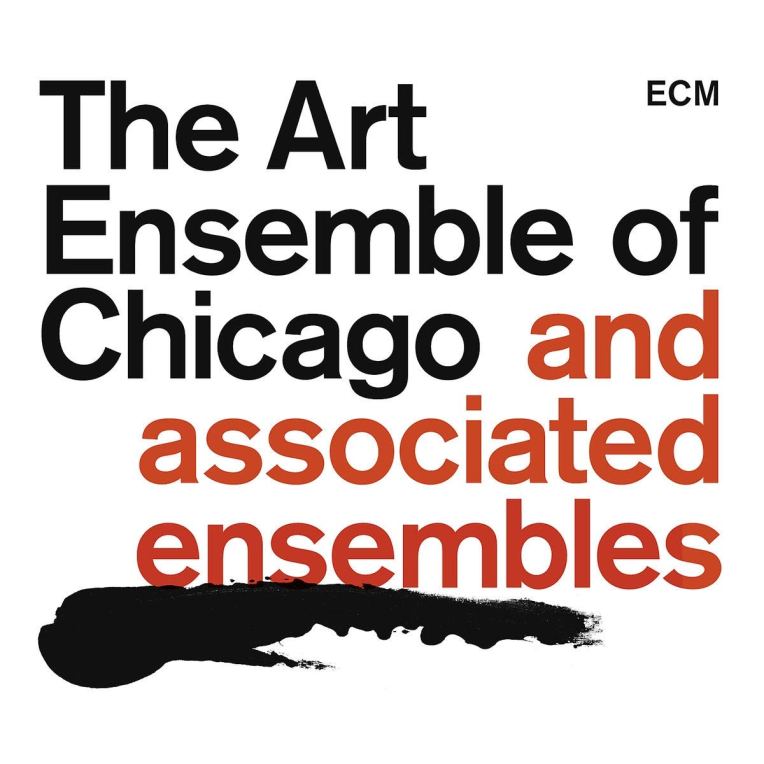
The Art Ensemble of Chicago and Associated Ensembles (ECM 2630)

AEC Boxed Set

The Art Ensemble of Chicago and Associated Ensembles
Recorded 1978-2015

As the peoples of the Earth move into the
21st century, where hi-tech moves them deeper
and deeper into realms of the unknown, visions
of the ancient chime and bell remind us of
the lyrical power that remains at the heart
of mankind’s quest for fulfillment.

–Joseph Jarman

If ever there was a boxed edition that needs your attention, it’s The Art Enemble of Chicago and Associated Ensembles. If ever there was a boxed set that doesn’t need your attention, it’s also The Art Enemble of Chicago and Associated Ensembles, because the music it contains exists on a level so far beyond us that the very universe is already listening to it in infinite regression. What we have in this 21-disc treasure trove is something as metaphysical as it is satisfying in the hands: a legacy made wieldable in crisp lines of typography and cardboard.

ECM Records and the Art Ensemble of Chicago were both founded in 1969, and so it seems inevitable that their kinship should extend beyond numerological coincidence into the realm of audio. In the words of multi-reedist and founding member Roscoe Mitchell, “It has been amazing to have taken this journey together,” and make no mistake: This journey can be savored however one wishes to approach it, inserting life experiences into the music’s nooks and crannies, just as the music leaves its traces in those experiences in return.

The recordings gathered here span from 1978 to 2015, and are accompanied by a 300-page book that contains all of the original album materials along with newly unarchived photographs, paratexts, and essays written specifically for the occasion. In a preface by Manfred Eicher, ECM’s founder and lead producer speaks of his first encounters with this “polystylistic” collective as both sonically and visually unforgettable experiences. Having wanted to record them for some time, it wasn’t until 1978 when, in a six-month flurry of activity, he recorded the AEC’s Nice Guys, Jack DeJohnette’s New Directions, and Wadada Leo Smith’s Divine Love, all of which revolved around the genius of trumpeter Lester Bowie. Vijay Iyer describes in a liner note the “disruptive vocality” of Bowie’s trumpet as “discursive, declamatory, mischievous, and yet welcoming, as though he were somehow speaking to and for everyone.” As such, it marks this collection’s topography with the itinerant precision of a cartographer whose only dream is to show and never tell.

Producer Steve Lake, in a heartfelt tribute of his own to this roving constellation, calls Bowie and Mitchell “two of the most strikingly individual players in creative music of the post-Coltrane era.” To make good on that statement, one could spin this set like a globe and land a finger anywhere. Lake discusses the significance of the Association for the Advancement of Creative Musicians, and of what began as the Roscoe Mitchell Art Ensemble (with Bowie, reedman Joseph Jarman, and bassist Malachi Favors) in particular to reveal its compositional acuity and vivid individualism. As the first AACM project to sink its teeth into Europe (by that time acquiring percussionist Don Moye), the AEC had a lot to say. As Lake so delectably puts it: “On any given night, a set’s components might include gong-splashed ancestral meditations and go-for-broke collective improvising, throbbing drum choirs, parodic parade marches, fiery post-bop, vertiginous silences, classical paraphrases, prayer meeting invocations, hints of Chicago blues and country blues and old timey folk song, down-home funk and radical urban sound-collage with impatient bike horns and sirens, all underlining the ‘ancient to the future’ claim which mighty bassist Malachi Favors, in a moment of inspiration, had appended to the Great Black Music slogan.” All the while, labels were trying to capture the uncapturable, but it wasn’t until ECM came along that the AEC’s sonic panorama could be set free.

Nice Guys, being the ECM debut of the AEC, is lacquered in legend. A Rolling Stone Guide capsule review describes it as follows: “A Miles Davis tribute, a hint of reggae, percussion labyrinths, formidable saxophone solos and incredibly sensitive group dynamics are some of the ingredients that make Nice Guys essential.” The keywords are “some” and “essential.” The first because the album is a mélange of old influences and new creations alike; the second because no one who appreciates jazz as a living history should be without this watershed record. In Moye’s words, “In the ancient tradition of art and black music, a musical presentation was not just about music. It was about all the different elements of life.” Indeed, what the AEC achieves, whether in the studio or on stage, is nothing short of life itself. As pianist Craig Taborn, heard as part of Mitchell’s Bells for the South Side, likewise says of Nice Guys: “The melodies moved through actual environments that seemed palpable and teeming with life and energy.”

While Nice Guys is certainly a keystone in the AEC’s discography, I cradle it as a compass through some personal favorites. Highest among those is Full Force, a ball of fire and ice wrapped in one engaging package. From the ephemeral to the everlasting, its moods span the gamut of human experience and etch the soul with its contrasts. Without hesitation, I would direct any and all newcomers to this album as a point of initiation. Another immutable entry into this canon is Smith’s Divine Love, which matches the trumpeter’s depth and breadth with a formidable lineup that includes Bowie, trumpeter Kenny Wheeler, and bassist Charlie Haden. There is a muted quality to this album—both literally and figuratively—that hints at veils beyond veils to the emotional vibrations beyond them still. It is music as language, turned inward until it binds itself as a book of heartbeats.

A hop and skip bring us to Bowie’s All The Magic!, which blends tributes and the tribute-worthy, culminating in a fascinating solo session that approaches resonance and whimsy with equal sanctity. Peter Kemper characterizes this unusual album as a space in which “[c]areful movements must be made, with small steps forward and a watchful eye to the rear. The investigation of the path being taken appears more important than the goal at the end of the path.” In light of this apt description, and because Bowie is such a primary force, I bow to the dedicatory charisma of the AEC’s Tribute to Lester, which unfurls from every strike of the gong a spirit of undying breath.

Among the Mitchell outings included, I would uphold Composition/Improvisation Nos. 1, 2 & 3 as a vivid example of what he is capable of in his element. Like a strand of DNA broken and regrown into a widening family, every note births another by grand experimental design. That Mitchell makes it all sound so intuitive is testament to his ability to reign forces as a precondition for liberating them.

The self-titled effort from DeJohnette’s New Directions receives a welcome reissue among these other gems. Featuring guitarist John Abercrombie, drummer Eddie Gomez, and a perennial Bowie, it frames the trumpeter as lyrical griot and takes full advantage of the afforded space. All of this and more funnel into Made In Chicago, in which DeJohnette joins saxophonist Henry Threadgill, pianist Muhal Richard Abrams, bassist Larry Gray, and Mitchell. Jack DeJohnette was never part of the AACM proper, but his introduction of Abrams to Mitchell was the first sneeze in a creative avalanche unlike any other. Like old friends turning the same page, this live document rejoices in the very act of rejoicing and yields one of ECM’s most masterful turns in recent memory.

Music is, as Thomas Staudter phrases it, “the human experience in its full glory.” In the hands of the AEC, music means also a dance between the symbiosis of structure and freedom. In absence of said dance, we can make no truth claims about the AEC and its offshoots, for we are nothing more than the wind shaking the boughs of a tree whose fruit is forever ripe.

Tell of the rustling. Speak of horizons. Practice, practice the strength of beautiful telling from one generation to another so that the beautiful does not pass again into oblivion. Tell each other of life’s scenes. What was good shall be. Slow down to enjoy with the help of colors—and discover. See the greenness and hear the droning and transform your spontaneous sighs into a powerful song.
–Peter Handke, “Über die Dörfer” (“On Villages”)

AEC Boxed 3D

Below is a list of all 18 albums contained in this essential collection, linked to my full review of each. Keep in mind, however, that no matter how many words I and others have spilled in honor of this hallowed assembly and its tandem galaxies, there’s nothing so cosmically rewarding as opening your ears and letting these lightyears of creative spirit flow where they will.

ECM 1126 Art Ensemble of Chicago: Nice Guys (May 1978)
ECM 1167 Art Ensemble of Chicago: Full Force (January 1980)
ECM 1211/12 Art Ensemble of Chicago: Urban Bushmen (May 1980)
ECM 1273 Art Ensemble of Chicago: The Third Decade (June 1984)

ECM 1143 Leo Smith: Divine Love  (September 1978)

ECM 1209 Lester Bowie: The Great Pretender (June 1981)
ECM 1246/47 Lester Bowie: All The Magic! (June 1982)
ECM 1296 Lester Bowie’s Brass Fantasy: I Only Have Eyes for You (February 1985)
ECM 1326 Lester Bowie’s Brass Fantasy: Avant Pop (March 1986)

ECM 1808 Art Ensemble of Chicago: Tribute to Lester (September 2001)

ECM 1651 Roscoe Mitchell & The Note Factory: Nine To Get Ready (May 1997)
ECM 1872 Transatlantic Art Ensemble/Mitchell: Composition/Improvisation 1, 2 & 3 (September 2004)
ECM 1873 Transatlantic Art Ensemble/Parker: Boustrophedon (September 2004)
ECM 2087 Roscoe Mitchell & The Note Factory: Far Side (March 2007)
ECM 2494/95 Roscoe Mitchell: Bells for the South Side (September 2015)

ECM 1128 Jack DeJohnette’s New Directions (w/Lester Bowie): New Directions (June 1978)
ECM 1157 Jack DeJohnette’s New Directions (w/Lester Bowie): In Europe (June 1979)
ECM 2392 Jack DeJohnette (w/Roscoe Mitchell, Muhal Richard Abrams, Henry Threadgill): Made In Chicago (August 2013)

Craig Taborn: Daylight Ghosts (ECM 2527)

Daylight Ghosts

Craig Taborn
Daylight Ghosts

Craig Taborn piano, electronics
Chris Speed tenor saxophone, clarinet
Chris Lightcap double bass, guitar
Dave King drums, electronic percussion
Recorded May 2016 at Avatar Studios, New York
Engineer: James A. Farber
Assistant: Tim Marchiafava
Produced by Manfred Eicher
Release date: February 3, 2017

In the footsteps of two successful leader dates for ECM, pianist Craig Taborn rolls the die of paradigm once again and hits a solid four with Chris Speed on tenor saxophone and clarinet, Chris Lightcap on bass and guitar, and Dave King on drums and electronic percussion. Opener “The Shining One” is sure to delight fans of label mate Tim Berne, whose penchant for complex geometry is echoed here. Comparison aside, there’s a DNA helix all its own down which these musicians slide toward endings as abrupt as their beginnings. Speed navigates the bandleader’s genetic code as if it were his own back yard, while Lightcap and King engage in sequencing that feels at once parasitic and parthenogenetic.

“Abandoned Reminder” unravels its story from whispering electronics, as Taborn narrates a ballad-turned-trip down a stairway of psychological proportion. Such changes are indicative of an overall constitution, which by suggestion of an unusual fluidity activates proteins in underused listening muscles. The title track and “The Great Silence” are remarkable in this regard. Their enmeshment of soft virtue and hard truth is the quartet’s calling card. Like the arpeggios that thread both in their final phases, they treat predictability as a springboard for its own undoing.

Says Taborn of working with such widely accomplished musicians, “This music trades on transparency. I wanted all the elements to be crystalline, so that the layers of the music work like a prism.” Indeed, prismatic effects abound throughout“New Glory,” in which Taborn and Speed exchange unveiled conversation, and “Ancient.” The latter’s transition from bass monologue to ritual confluence shows a band working with patience and detail. As the parts, so the whole. Whether in the resonant piano-drums duet of “Subtle Living Equations” or the cosmic textures of “Phantom Ratio,” which floats Speed’s tenor on an ocean of nostalgic loops, the effect is consistently appropriate to the theme at hand. And while Taborn’s writing tends to pay homage to those themes at microscopic levels, his nod to Roscoe Mitchell’s “Jamaican Farewell” sees the jewel for the facets, and shines a methodical light of appreciation through a heart whose every beat is musical gospel. This is good news indeed.

Roscoe Mitchell: Bells for the South Side (ECM 2494/95)

2494|95 X

Roscoe Mitchell
Bells for the South Side

Roscoe Mitchell sopranino, soprano, alto and bass saxophones, flute, piccolo, bass recorder, percussion
James Fei sopranino and alto saxophones, contra-alto clarinet, electronics
Hugh Ragin trumpet, piccolo trumpet
Tyshawn Sorey trombone, piano, drums, percussion
Craig Taborn piano, organ, electronics
Jaribu Shahid double bass, bass guitar, percussion
William Winant percussion, tubular bells, glockenspiel, vibraphone, marimba, roto toms, cymbals, bass drum, woodblocks, timpani
Kikanju Baku drums, percussion
Tani Tabbal drums, percussion
Recorded September 2015 at Museum of Contemporary Art Chicago by David Zuchowski
Mixed May 2016 at Studios La Buissonne, Pernes-les-Fontaines by Gérard de Haro with Steve Lake
Mastered by Nicolas Baillard
Produced by Steve Lake
Release date: June 16, 2017

To celebrate the 50th anniversary of the Association for the Advancement of Creative Musicians (AACM), Roscoe Mitchell presented a cornucopia of trios at the Museum of Contemporary Art Chicago in conjunction with the exhibition The Freedom Principle: Experiments in Art and Music, 1965 to Now. Said exhibition included percussion set-ups favored by Art Ensemble of Chicago legends Don Moye, Malachi Favors, Lester Bowie, Don Moye, and the reed-favoring multi-instrumentalist himself, all incorporated into the present double-disc recording.

Mitchell is the alpha and omega of this project, spearheading a series of designated trios to explore different organs of his immense compositional body. With Hugh Ragin (trumpet) and Tyshawn Sorey (here on trombone), he offers “Prelude to a Rose,” a somewhat funereal dirge that pops a cathartic blister about midway through.

With Jaribu Shahid (double bass) and Tani Tabbal (drums), Mitchell presents an unabashedly soulful sermon in “Prelude to the Card Game, Cards for Drums, and the Final Hand.” By force of his muscular alto, he punches holes in the time cards printed and cut by Shahid’s thick bowing before Tabbal turns the very concept of time inside out in an extended soliloquy, leaving a brief trio to throw some light at the end of the tunnel. Mitchell continues down that same introspective avenue in “Six Gongs and Two Woodblocks.” For this he’s joined by James Fei (reeds, electronics) and William Winant (percussion) for what may just be the album’s most brilliant turn of events. Its balance of outer and inner is at the very core of what Mitchell does best as a composer.

Even with pen laid aside, as in “Dancing in the Canyon,” a group improvisation with Craig Taborn (piano, organ, electronics) and Kikanju Baku (drums, percussion), he’s still the catalyst for an otherwise impossible chemical reaction. His sopranino dances as if it’s on fire and the only way to keep itself from turning to ashes is to sing until its throat runs dry. The sheer musicality of this unscripted dive inward is lucid to the extreme.

The album’s remainder is as shuffled as its musicians, for throughout it Mitchell recasts his trio actors in new roles and configurations. From the picturesque latticework of “Spatial Aspects of the Sound” to the nearly 26-minute blend of ambience and explosions that is “Red Moon in the Sky,” the latter segueing into the AEC’s calling card, “Odwalla,” played by the entire nonet, sound is substance. Connective tissue along the way spans a world of apparent influences, from Pierre Boulez and Iannis Xenakis to Anthony Braxton and Edgard Varèse. Taborn (electronics) and Shahid (bass guitar) unearth haunting ore in “EP 7849,” while in the title track Ragin slings precise arrows of piccolo trumpet over the “percussion cage” Mitchell created for the AEC and which is resurrected here to wonderous effect by Sorey. But even at its most explosive, as in the drums- and piano-heavy “The Last Chord,” there’s more Genesis than Revelation at play. Let there be music.

Jakob Bro: Streams (ECM 2499)

2499 X

Jakob Bro
Streams

Jakob Bro guitar
Thomas Morgan double bass
Joey Baron drums
Recorded November 2015, Studios La Buissonne, Pernes-les-Fontaines
Engineers: Gérard de Haro and Nicolas Baillard
Produced by Manfred Eicher
Release date: September 23, 2016

The title of Streams, guitarist Jakob Bro’s second leader date for ECM, could hardly be more appropriate to describe music that flows with the quiet charm of a forest creek, bubbling all the way from childhood to whatever here and now you happen to inhabit when encountering it.

“Opal” touchingly opens the album’s inner sanctum: a sacred gift for profane times. As the first of seven layers, it peels back just enough of life’s opacity to sense a shared humanity deeper within. Bro zooms in on filaments of memory, each a wire drawn from one biographical telephone pole to another. Bassist Thomas Morgan is so attuned to these electrical impulses that the possibility of a power outage seems a distant fantasy. Drummer Joey Baron marks their trail with care, ending with raindrops on a silo.

“Heroines” is one of Bro’s most patient confections. Morgan shuttles through the composer’s loom, soloing with restraint and focus, while the guitar folds itself in layers of cosmic radiation until the night itself begins to glow. This tune is further recast in a solo guitar version later in the set. Like a plant regressing to seed, it has all the world in its mouth before it opens to sing.

“PM Dream” is a free improvisation dedicated to Paul Motian. As in the music of its namesake, its heart beats somewhere between veiled ambience and solid ground. Morgan and Baron dot its continent with runes of memory, as they do in “Full Moon Europa,” which through its quiet substructure yields achingly dramatic elicitations from Bro. “Shell Pink” is another stunner, tracing its nautilus spiral into origins. Morgan is wonderous and sincere, enhancing that locomotive quality, inherent to all of Bro’s finest, along a parabola of ice to fire to ice.

Nowhere is geologic force so thoroughly studied as in “Sisimiut.” Where normally Bro is more interested in following a burning fuse than chronicling the explosion it foreshadows, this time he allows a little of that fire to spill over. But because destruction would be antithetical to the loving atmosphere he has so painstakingly created, we never encounter a bang, going out instead with a hush.

Dominique Pifarély: Time Before And Time After (ECM 2411)

2411 X

Dominique Pifarély
Time Before And Time After

Dominique Pifarély violin
Recorded in concerts in September 2012
at Auditorium Saint-Germain, Poitiers (France)
and in February 2013
at Cave Dimière, Argenteuil (France)
Engineer: Gérard de Haro
Produced by Manfred Eicher
Release date: August 28, 2015

Here is a place of disaffection
Time before and time after
In a dim light: neither daylight
Investing form with lucid stillness
Turning shadow into transient beauty…
–T. S. Eliot, “Burnt Norton”

After leading a string of caravans across the sands of ECM, Dominique Pifarély enchants on this set of solo recordings taken from French concerts in 2012 and 2013 at Auditorium Saint-Germain (Poitiers) and Cave Dimière (Argenteuil). Although nearly everything is improvised, the violinist dedicated each piece in retrospect to a certain poet, from whose verses he also chose a title. More than highlighting personal connections between literature and music, this artistic decision reveals an agency of spontaneous creation.

The Near Eastern quality of “Sur terre” (for Mahmoud Darwich) makes for a poignant introduction to this border zone where motifs converse for want of being equally heard. Every color and texture is like the seed of a new community, touched by horizons yet to be unfolded, and in this respect shares kindship with “L’air soudain” (for André du Bouchet). The latter’s robust yet plaintive cry yearns to be acknowledged in a place uninhabited except by its own singing. Arid climates are evoked in the rasp of a bow: a gargantuan tongue scraping along the earth in search of nourishment but finding only dust and ruins.

“Meu ser elástico” (for Fernando Pessoa) and “D’une main distraite” (for Henri Michaux) are both jagged wonders, wherein leaping suggestions of dance are constantly pulled back to origins, while the masterful“Gegenlicht” (for Paul Celan) shows us thefull scope of Pifarély’s technical and artistic capabilities. Like a prisoner who succeeds in digging his way through a wall with bare hands, he peels away the barrier to freedom one granule at a time. But before he inhales fresh air again, he must pass through “Violin y otras cuestiones” (for Juan Gelman). A struggle that is as political as it is personal, it finds temperance only in the sul ponticellosalvations of “Avant le regard” (for Jacques Dupin) and “L’oubli” (for Bernard Noël).

If shades of the Baroque are present, they’re no illusion, as even Pifarély admits: “[O]f course Bach is in the air because Bach is polyphonic, and the violin is polyphonic.” Bach also informs his decision to close his solo performances with a standard—in this instance Victor Young’s “My Foolish Heart”—to assert the violin’s autonomy. His interpretation thereof looks in the proverbial mirror, hoping to recognize itself but instead finding awe in what it has become.

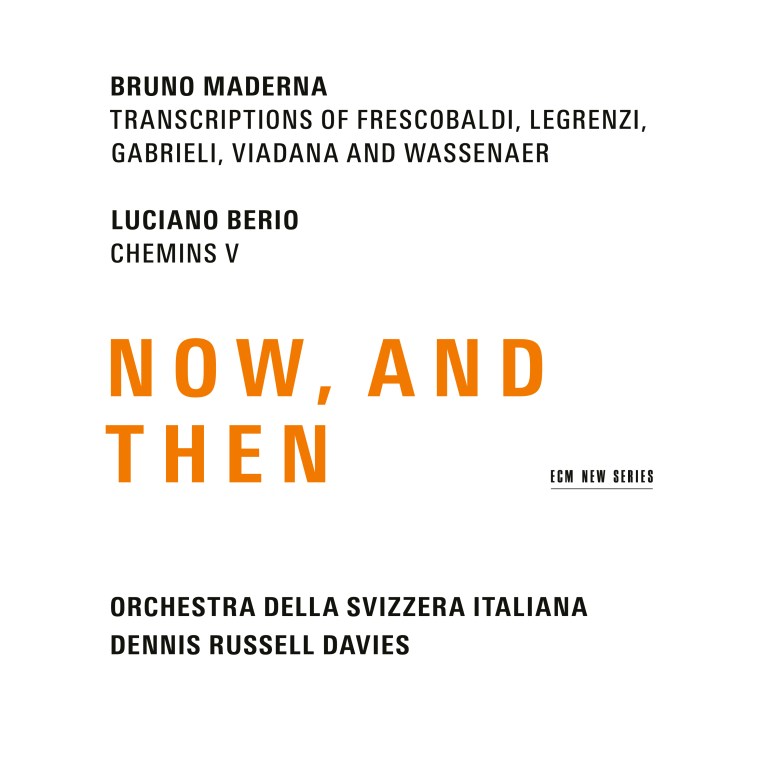
Bruno Maderna/Luciano Berio: Now, And Then (ECM New Series 2485)

2485 X

Bruno Maderna
Luciano Berio
Now, And Then

Orchestra della Szizzera italiana
Dennis Russell Davies
conductor
Pablo Márquezguitar
Recorded August 2015, Auditorio Stelio Molo RSI, Lugano
Engineer: Michael Rast (RSI)
Editing and mixing: Michael Rast and Manfred Eicher
Produced by Manfred Eicher
Release date: October 27, 2017

Bruno Maderna (1920-1973) was an instrumental force in contemporary music throughout the 1950s, when composers of “modern” persuasion were still struggling to at once uphold and break open the secrets of bygone masters. Maderna was no stranger to the past and had a particular fondness for the clarity of the Italian Baroque, as evidenced in his transcriptions of Girolamo Frescobaldi, Giovanni Legrenzi, Giovanni Gabrieli, Tommaso Lodovico da Viadana, and Unico Wilhelm van Wassenaer presented by the Orchestra della Szizzera italiana under the baton of Dennis Russell Davies.

It should come as no surprise that Maderna had a love for the theatre, as these pieces breathe like dramaturgical backdrops to well-studied action. While nearly all of them date from 1952, the sole exception is Gabrieli’s Canzone a tre cori (1969/72), of which Maderna’s recrafting turns glory into lyrical shadow. Frescobaldi’s Tre Pezzi (1952), by contrast, constitute an exercise in contradiction. Robust yet naïve, they move fluidly across and between planes of exposition. The liturgical center, comprised of a brief “Christe” and “Kyrie,” hints at a spiritual undercurrent before deferring to a regal finish. Against this, La Basadonna (1951-52) is a delightful interlude that dances with delicate assurance across this dioramic stage. As heartbeats of golden ages mesh into an elegy for silver futures, Viadana’s Le Sinfonie (1952) reads like an archive of memory. It’s portrait of Italian cities bustles with life and character. Of these, the buoyant “La Venetiana” recalls the programmatic brilliance of Carlo Farina. Last is the “Palestrina-Konzert” (1952) by Wassenaer. Once attributed to Pergolesi, this gorgeous triptych sets up an alluring Vivace through two slower precursors. Enchanting sonorities abound.

From all of these, we know that Maderna understood Baroque music as a giant wheel, sporting a clearly defined center from which regular spokes extended to an more open perimeter. His respect for that underlying architecture reveals its own.

Lodged therein, between the Legrenzi and Gabrieli, is Chemins V, a self-transcription of Sequenza XI (1987-88) by Luciano Berio (1925-2003), with whom Maderna founded Europe’s first electronic music studio, the Studio de fonologia musicale di Radio Milano. This piece, composed in 1992, receives its premiere recording here. Featuring guitarist Pablo Márquez on the instrument for which it was originally written, it’s a deeply psychological journey. Márquez navigates every topographical change with confidence, finding purchase on the narrowest of cliffs and staying grounded on the slipperiest of terrain. Brimming with Berio’s uncanny ability to make the beautiful eerie and vice versa, it treats the guitar as leading voice and internal percussion, ambulating without apparent direction until the subdued, shimmering finale. Worth the price of entry alone, this rare morsel in an already-rich covering speaks to the core of our being as a species at a time when uncertainty rules the day.

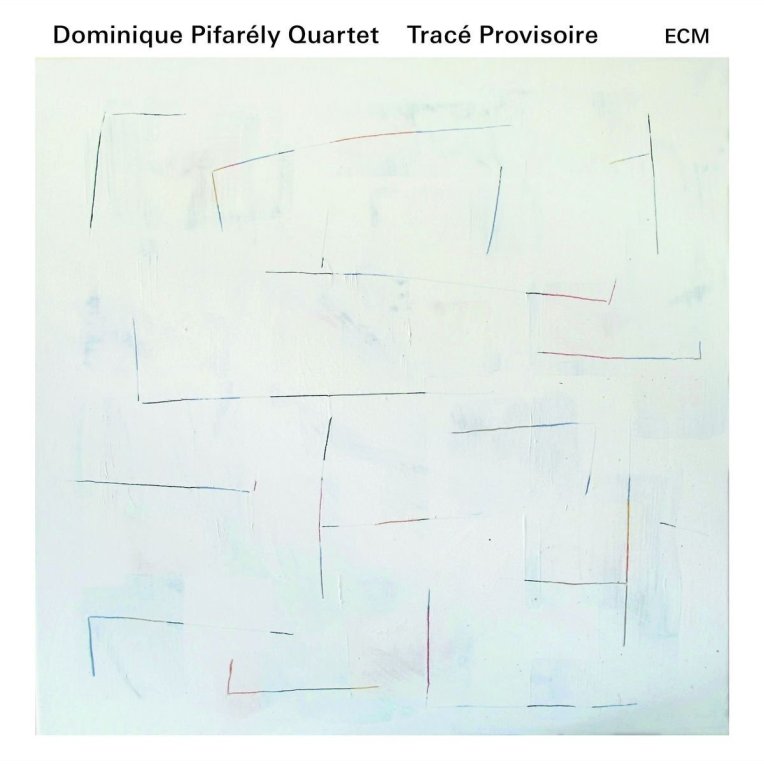
Dominique Pifarély Quartet: Tracé Provisoire (ECM 2481)

Tracé Provisoire

Dominique Pifarély Quartet
Tracé Provisoire

Dominique Pifarély violin
Antonin Rayon piano
Bruno Chevillon double bass
François Merville drums
Recorded July 2015, Studios La Buissonne, Pernes-les-Fontaines
Engineers: Gérard de Haro and Nicolas Baillard
Produced by Manfred Eicher
Release date: June 3, 2016

In the immediate wake of his solo album Time Before And Time After, violinist Dominique Pifarély returns to ECM leading a fearless quartet with pianist Antonin Rayon, bassist Bruno Chevillon, and drummer François Merville. The album’s title, which translates into English as “Provisional Layout,” is at once accurate and a misnomer. Accurate because Pifarély’s stoic humility allows no leeway for ego. Misnomer because this music is anything but provisional, archived as it is for posterity in this crisp recording.

The album is mostly populated by three diptychs, each split throughout the program. “Le peuple effacé” opens the ears to an honest exploration of space, Pifarély’s bow trembling like the feeler of an insect. Its second part extends a steadier hand, hennaed with designs and motifs that, despite having lost their original meanings, take on new ones by virtue of clinging to flesh. With rhythmic acuity in spades, Pifarély navigates every twist without so much as grazing his instrument along the way. Just as forthrightly, he settles into a lethargic meditation.

DPQ
(Photo credit: Jean-Baptiste Millot)

The title dyad abides by an even more exploratory grammar, wherein orthography is found lurking in every pause. The groovier settlement into which once-nomadic impulses find themselves collapsing is as haunting as it is energizing. The rhythm section is on point here, transitioning from robust to delicate maneuvers with nary a blink to be sensed. Part II is Rayon’s realm. Here the pianist diverts attention to shadow with light, and vice versa, before leaving the other three to dance until their bodies disappear.

“Vague” is a rich soundscape of breathy violin and percussive details, a progression from womb to tomb that consumes philosophies as if they were food. This leaves two standalones. Where “Le regard de Lenz” is an exploded geometry of pent-up force, and as such is the album’s fulfillment of rupture, “Tout a déjà commencé” is a thirteen-and-a-half-minute mosaic of elegiac and celebratory influences. Chevillon ups the bassing quotient significantly, leaving room for a ripple effect to sing. In this regard, the band’s willingness to go as deep as they need to in order to unearth what it is they’re searching for is admirable, and leaves us feeling filled to the brim.

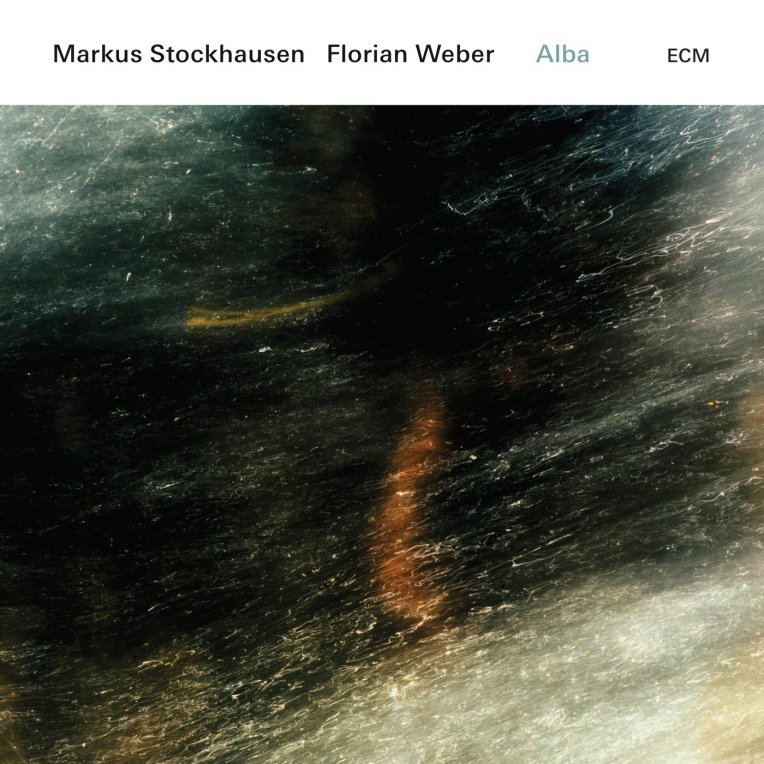
Markus Stockhausen/Florian Weber: Alba (ECM 2477)

Alba

Alba

Markus Stockhausen flugelhorn, trumpet
Florian Weber piano
Recorded July 2015, Auditorio Stelio Molo RSI, Lugano
Engineer: Stefano Amerio
Produced by Manfred Eicher
Release date: April 1, 2016

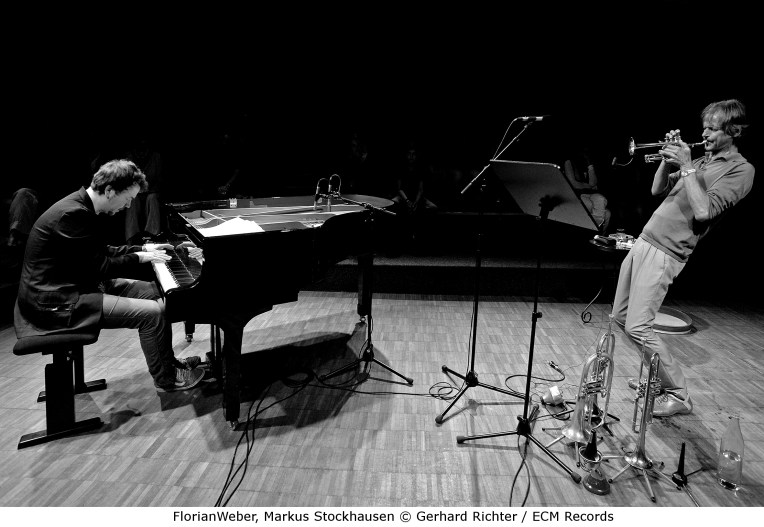
Markus Stockhausen has walked a jagged path through the annals of ECM, but the German trumpeter can always be counted on to provide an experience that is unique, unforced, and above all genuine. On Alba, he presents for the first time in studio his collaboration with pianist Florian Weber. Six years in the making, this music and the interactions built around it are vessels of experiential intensity rounded by currents of thoughtfulness.

Weber Stockhausen

The album’s 15-track program shuffles originals and improvisations from both musicians in a stacked deck of melodic beauty. Weber’s end of the spectrum is concerned with honor and past reflections. In the latter vein, his opener “What can I do for you?” is dedicated to the late John Taylor, a vital ECM presence under whom he first studied as a young piano student. Like Taylor, he realizes that, in order to access the piano’s inner voice, those playing it must be willing to let go of their own.

Weber is a painter in sound. Whether evoking shifting granules of sand in “Emergenzen” or fantastical impressions in “Die weise Zauberin,” he wields every key as one would a brush. He’s also more prone to playfulness, as in “Surfboard,” a tune that precisely illustrates the duo’s creative process. As musical surfers, they know firsthand the value of a reliable board and choice wave, but use those parameters as prerequisites for joyful freedom. Weber’s “Emilio” is a highlight for turning a familiar arpeggio into a surprising vehicle for Stockhausen, who reaches expansively across intimate geographies.

Stockhausen Weber

Stockhausen’s universe combines the theoretical and the spontaneous. His “Mondtraum,” “Synergy Melody,” and “Zehpir” have their genesis in classical contexts, but here are pared to their base elements. His own whimsy emerges in “Befreiung,” albeit in a more cleanly predetermined vein, while “Better World” serves as a poignant expression of hope, transitioning from mournful reflection to twirling dance in a masterful turn of phrase.

Scattered improvisations round out the proceedings. Of these, the duetted “Ishta” is heartfelt to the extreme. In “Resonances,” Stockhausen plays directly into the piano, wherein untouched strings reverberate sympathetically, while “Barycenter,” “Possibility I,” and “Today” finds Weber alone with nothing but intuition to lead the way.

In addition to the richly flowing music, Alba is significant for being Stockhausen’s first for ECM in 16 years and for being Weber’s label debut. A release to be treasured.