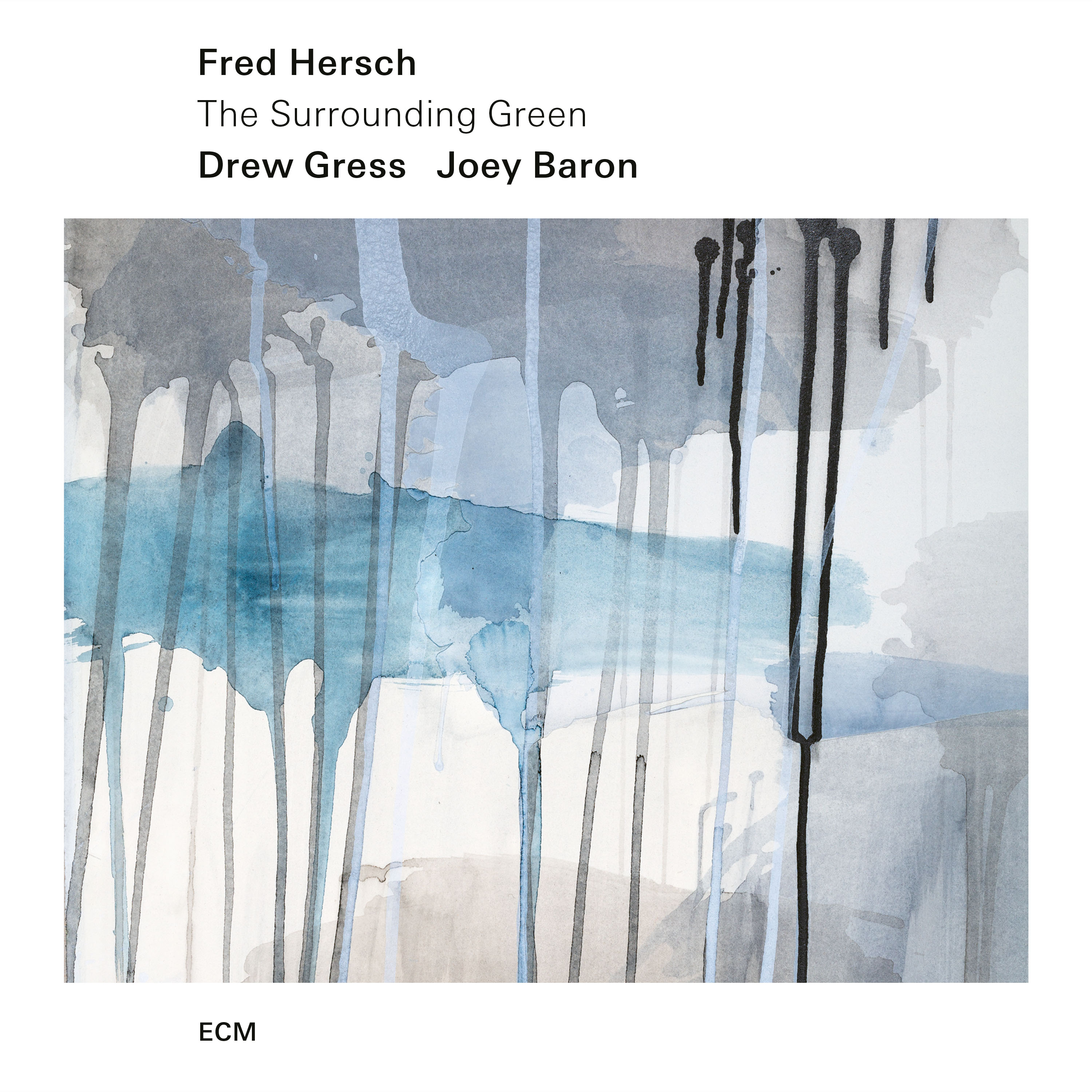
Fred Hersch piano Drew Gress double bass Joey Baron drums Recorded May 2024 Auditorio Stelio Molo RSI, Lugano Engineer: Stefano Amerio Cover: Andreas Kocks Produced by Manfred Eicher Release date: June 27, 2025
Pianist Fred Hersch’s ECM journey, brief as it has been so far, already feels like a lifetime in its emotional scope. Beginning in duet with legendary trumpeter Enrico Rava, followed by a solo album, he now returns to Lugano’s Auditorio Stelio Molo RSI for a trio session with bassist Drew Gress and drummer Joey Baron. Despite having played with either musician in various contexts for decades, this is their first studio album as a trio, and the result has all the makings of a classic—not by mere virtue of its talented assembly (which is reason enough to rejoice) but also for the easy confidence of its touch.
Hersch contributes three tunes to the proceedings, of which “Plainsong” is our port of entry. Its introductory lines are so nostalgic, you’d be forgiven for thinking you grew up with them. As the variegated spectrum of autumn gives way to winter, Hersch rides a slow-motion wave in search of warmer shelter, which he finds in the title track. The breadth of Hersch’s melodic sensibilities is breathtaking here, hinting at faraway places while remaining intimate. And in the Latin-tinged beauty of “Anticipation,” the piano dances in midair without a worry to weigh it down.
That Hersch’s writing holds its own alongside “Law Years” is a wonder in and of itself. Ornette Coleman’s untanglings contrast with the measured melancholy of the bandleader with an even freer charge. In addition to the geometrically astute interplay from Gress and Baron, what impresses is the amount of space Hersch folds into his soloing, which, despite being a mighty stream of consciousness, allows for plenty of pauses, breaths, and exploratory surprises.
“First Song” by Charlie Haden feels like an inevitable choice. It opens with a solo from Gress, melting into Hersch’s lines like butter before Baron’s brushes baste that flavor in one stroke at a time. Egberto Gismonti’s “Palhaço” is another, and one that ECM aficionados will recognize from the Magico trio sessions and a smattering of Carmo recordings. Its childlike whimsy speaks through rainlike washes of chords from the keys. But it is in the Gershwin brothers’ “Embraceable You” that the band finds the biggest depths to plumb. With a light touch but deep roots, Hersch unlocks a powerful energy that one must fight to escape.
One thing that distinguishes Hersch in the world of jazz piano is his way with endings. Having the destination written in his heart, he is that rare magician who, even after telling us how the trick is done, still leaves us astonished.
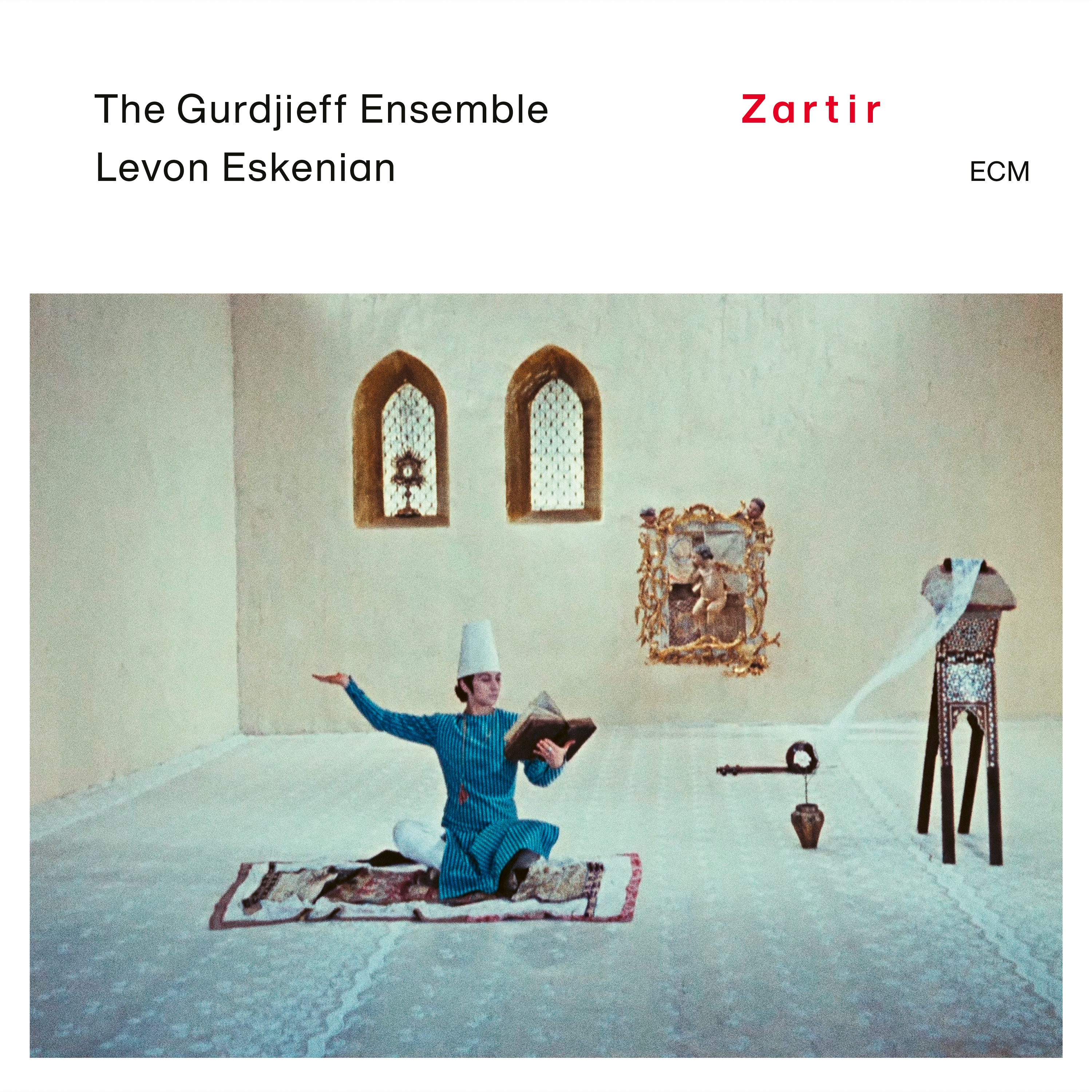
The Gurdjieff Ensemble Levon Eskenian artistic director Vladimir Papikyan voice, santur, burvar, tmbuk, singing bowls Emmanuel Hovhannisyan duduk, pku Meri Vardanyan kanon Armen Ayvazyan kamancha, cymbal Gagik Hakobyan duduk Norayr Gapoyan duduk, bass duduk, pku Avag Margaryan blul Aram Nikoghosyan oud Astghik Snetsunts kanon Davit Avagyan tar Mesrop Khalatyan dap, tmbuk, bells, triangle Orestis Moustidis tombak National Chamber Choir of Armenia Robert Mlkeyan director Recorded December 2021 at Radio Recording Studio, Yerevan Engineer: Tigran Kuzikyan Mixed November 2022 by Manfred Eicher, Levon Eskenian, Michael Hinreiner (engineer), and Tigran Kuzikyan (engineer) at Bavaria Musikstudio, Munich Cover photo: Still from Sergei Parajanov’s film The Color of Pomegranates Album produced by Manfred Eicher Release date: October 27, 2023
“Who can say that I will live from dawn till dusk? Man’s entry and man’s exit is simple work for the hand of God.” –Sayat-Nova
Continuing the journey on which they first embarked for ECM in 2011, Levon Eskenian and The Gurdjieff Ensemble deepen their relationship with the enigmatic Georges I. Gurdjieff (c. 1877-1949). Given the mystery surrounding the Armenian-born teacher/philosopher, one can hardly say that the music on Zartir is a historically informed recreation. Rather, writes Steve Lake, “Eskenian’s ensemble resituates the music along the paths of its possible interpretations.” On said paths, one encounters travelers of Armenian, Assyrian, Greek, Caucasian, Kurdish, Persian, and Arabic persuasion, each a reflection of the other in the grander sense yet simultaneously individual enough to lend historico-cultural insight. Given that the bulk of Gurdjieff’s music is preserved in 250 pieces for piano (an instrument he saw as a compromise at best), Eskenian has once again brought new life (or is it old life?) to melodies that speak of their lineage more deeply than whatever we might glean from biographical speculations. Lake calls these “triple-distilled reverse transcriptions,” reflecting how they might have been intended to sound on the folk instruments that would surely have been a familiar soundtrack to Gurdjieff’s own itinerancy.
The album’s title, which means “Wake up!”, seems to evoke the Zen concept of satori, referring to a sudden enlightenment of mind, body, and spirit. However paltry that comparison might be, it nevertheless points to the undeniable alignment of this trifecta in the music arranged for us by Eskenian here. For example, in the twilit sagacity of “Pythia,” the first of many tears in the veil of obscurity, the mood is almost regal, as if welcoming some great royalty to step on a carpet woven just for the occasion, only to be torn to shreds and burned after so that no mere mortal feet dare taint it. At the same time, however, the palace and any tokens of grandeur it might contain are not on display. Rather, this is music that lives in the nooks and shadows of its architecture, so that we might know its inner secrets before sharing them with the world. Even in the briefest glimpses, including “Sayyid Chant and Dance No. 41” and “Oriental Dance,” we stand at the edge of a precipice with an eye seeking the unsettled territories as yet before us, ignoring the opulence at our backs. In “Introduction and Funeral Ceremony,” flight becomes possible so that we might leave the trappings of men in favor of the natural resources they all too often neglect. Whether in the sound of the duduk or the touch of percussion, the listener is rendered a spirit in search of a body, if only to feel the burden of gravity once again.
Beyond Gurdjieff himself, the program expands its reach to invoke the bards and troubadours of Aremania known as the ashughs, a tradition to which Eskenian’s father, Avedis (to whom this album is dedicated), was a vital link. This introduction of voices to the milieu adds another layer of fragile humanity. Ashugh Jivani (1846-1909) gives us
“Kankaravor Enker” (Friend of Talents), a poignant lament on the weaponization of humility in the land of the self-righteous. “Ee Nenjmanet Arkayakan Zartir” (From your royal slumber, awake) by Baghdasar Dbir (1683-1768) is a song of love from a distance (always from a distance). Nothing is ever touched, felt, or tasted; nothing more than an impression that must be concretized in music. And in the sound paintings of the legendary Sayat-Nova (1712-1795), namely “Dard Mi Ani (Do Not Fret)” and “Ashkharhes Me Panhjara e” (The World Is a Window), the mortality of love serves as a prayer against entropy.
Speaking of prayer, we end with Gurdjieff’s “The Great Prayer,” for which the National Chamber Choir of Armenia joins the ensemble. Eskenian calls this “one of the most profound and transformative pieces I have encountered in Gurdjieff’s work.” Indeed, it unfolds like a metastatement among metastatements. A culmination of life and death into a single neutral point, it is existence for its own sake, divine yet without doctrine, the lifeblood of our every waking hour.
Jon Balke piano, Spektrafon Recorded November 2023 The Village Recording, Copenhagen Engineer: Thomas Vang Mixed by Sven Andréen and Job Balke at Klokkereint Studios in Gjøvik Cover: Jan Groth, Sign I (1973-74) Produced by Manfred Eicher and Jon Balke Release date: February 28, 2025
Although billed as the latest solo recording from pianist Jon Balke, the instrument here doubles as its own accompanist by virtue of the “Spektrafon.” Created by Balke in collaboration with music technology professor Anders Tveit at the Norwegian Academy of Music, this new tool captures ambient sounds in real time as the performer draws out chords of harmonic material via a tablet interface. “In a way,” Balke notes, “the player enters into a dialogue with a live active reverberation to the piano sound – a dialogue with oneself.” The result is his most meditative offering to date.
On Skrifum (“handwriting” in Icelandic), what we encounter is a series of mostly monophonic miniatures that frees his other hand to manipulate the effect of his keystrokes accordingly. Thus, Balke writes the music into being with that most ancient of gestural impulses to leave a record of one’s existence, only instead of cave walls and pyramids, he chooses the multiverse as his canvas. Pulling on the thread of Warp (2016) and Discourses (2020), both electro-acoustic explorations of the keyboard, he continues to unravel new metaphysical possibilities from wood, felt, and string.
“Calligraphic” and “Tegaki” (another word for handwriting, this from the Japanese) reiterate the theme as much in name as in execution, tapping the shadows cast by the primitive utterances we make. But it is in “Traces” where we are welcomed into the inner sanctum of the Spektrafon, which speaks as if it were only being spoken to. It is not an echo chamber but echo incarnate, self-sustaining and sentient. As the ink moves into “Lines” and “Streaks,” origins reveal themselves more clearly, emerging as afterglows of implied chords. If the piano is the soil, these are the crops it yields in digital harvest. All of which reminds us that contemplative gestures always leave their remnants, each with a life of its own. Such are the often-unrendered impulses of performance.
“Sparks” and “Strand” communicate in sporadic bursts, breaching realms out of which we are normally locked. From the finger-dampened strings of “Rifts” and the unsettled foundations of the title track to the almost-forbidden secrets of “Stripes,” there are more than enough articulations to spin a narrative that feels like our own. When Balke plays with two hands (as in “Ductus” and “Kitabat”), memories we never experienced start to become normal.
We often talk about improvisation coming from the ether. Skrifum makes that notion duly real. The pianism itself is of the past, as if played by the most conscientious children in an attic with no audience but themselves. Their explorations give way to unbridled dreams that manifest in the waking world, extending their tendrils to whoever will grab them.
Signum Quartett Florian Donderer violin Annette Walther violin Xandi van Dijk viola Thomas Schmitz violoncello Recorded March 2022, Sendesaal Bremen Engineer: Christoph Franke Design: Sascha Kleis An ECM Production Release date: July 18, 2025
A Dark Flaring marks the second ECM New Series appearance of the Signum Quartett, following their renditions of Erkki-Sven Tüür’s chamber music on 2020’s Lost Prayers. With an even more evocative title through which to guide our listening, they present a singular program of selections from South Africa. In her liner notes, journalist and music critic Shirley Apthorp sets the stage for us most vividly:
“In both Xhosa and Zulu tradition, a healthy relationship with your ancestors is a prerequisite for wellbeing in the present; modern psychology is still catching up with much of what older cultures have known for centuries. While it remains a challenge to find a common thread between South Africa’s many and diverse cultures, this awareness could be said to knit together both the rainbow nation’s populace and the works on this recording.”
And in Komeng (2002), by Mokale Koapeng (b. 1963), we begin to understand just how wide the gap between mind and body can be. The piece takes its inspiration from “Umyeyezelo,” a celebratory song by Thembu musician Nofinishi Dywili (1928-2002). Dywili was a master of the uhadi, a single-stringed bow played with a stick akin to the Brazilian berimbau (an effect replicated here con legno). The song’s title means “ululation” and refers to a Xhosa coming-of-age ritual, the circular nature of which is organically expressed in the music’s structure. A play of sunlight on a child’s face, a swaying reed, a tree standing tall on the horizon: images of past and future comingle in the present, rendering such divisions of time meaningful beyond measure (to say they do away with them would be to undermine the music’s committed sense of time). A rocking motion in the cello, fragile pizzicato, and other liminal gestures from the higher strings add vital details.
Next is (rage) rage against the (2018) by Matthijs van Dijk (b. 1983), which begins innocently enough before imploding. It is directly connected to loss (the composer having lost his mother when he was 18) and personal trauma, paying homage to both the Dylan Thomas poem “Do Not Go Gentle Into That Good Night” and the band Rage Against the Machine. Toeing the line between fury and dark resignation, it exploits the limits of the string quartet’s capacity for depth and breadth. Stomping feet add necessary punctuation. The piercing sirens of its final act are thrilling, like a rock song being fed through the meat grinder of Penderecki’s Threnody for the Victims of Hiroshima until the bleeding slows to a trickle. A subliminal drone woven into the ending gives hope of a life beyond the chaos.
From the newest to one of the oldest of the program, we switch to the Five Elegies for String Quartet (1940-41) of Arnold van Wyk (1916-1983), who, in the late 1930s, became the first South African composer to study at the Royal Academy of Music in London. He also knew loss, having suffered the death of his mother and oldest sister by age 17. Despite being his first compositions for string quartet, these elegies immediately evoke Shostakovich in their fiercely shaded lyricism and were among a handful of early works that earned him great renown in his day. The balance of fluidity and razor-sharp insight is immediately apparent in his examination of war. The lively second movement, marked Allegro feroce, grabs the hem of joy but never manages to defrock the dark zeitgeist that flaunts it. The central Adagio is the mournful heart of it all, a forlorn viola solo against a backdrop of aftereffect: bomb smoke, fire ash, and tear stains. Only toward the end does the cello answer the call as if from the grave. And in the final movement, we encounter the most lyrical motifs, which build into a Beethovenian drama before ending in a near whisper.
Péter Louis van Dijk (b. 1953) is the father of Xandi van Dijk, violist of the Signum Quartett. His iinyembezi (2000) draws from John Dowland’s “Flow My Tears” (1596), as indicated by the Xhosa title (meaning “tears”), refracting the theme until it becomes a chain of half-starts and unrequited remorse. At one point, pizzicato playing evokes the mbira (African thumb piano), and the musicians even tap their instruments in kind. Over the course of 16 and a half minutes, it traverses continents’ worth of terrain, giving itself over to jubilation but always falling back into a bed of tentative truth claims. Despite the expressive depth at hand, it draws an ever-tighter circle of influence around itself until, like an ouroboros, it must stop just shy of self-extinction.
Robert Fokkens (b. 1975), who also studied at the Royal Academy of Music and has lived in the UK ever since, gives us Glimpses of a half-forgotten future (2012). An elegy to deaths in his own life, it too evokes the uhadi but bears further imprints of Cage, Feldman, Bach, and the French spectralists. Spaced out in three movements, the second of which leaps as if in an attempt to escape the clutches of grief, it finishes with microtonal contemplation, seemingly at odds with its surroundings.
The finale is an astonishing discovery in the form of the Quartet for Strings (1939) by Priaulx Rainier (1903-1986), another Royal Academy of Music graduate who studied with Nadia Boulanger, among others. Inspired by the music she grew up with in Zululand, she stayed on at the Academy as a professor of composition. Being a relatively early work, the Quartet for Strings eschews some of the technical challenges that would beset much of her later pieces, but it’s no less challenging for its emotional demands. Its opening movement, for one, teeters between lyricism and skepticism—or, if you will, between looking us straight in the eye and askance—while the trembling second movement dances at the edges of a fading memory. The third movement, marked Andante tranquillo, makes artful use of pizzicato cello and moves in flowing chords attached at the hip. Finally, a spirited Presto chews hard until it reaches bone in the viola. Sliding strings share the air with muted harmonics, a textural quality that makes me wonder whether she didn’t make an impression on composers like Boucourechliev later on.
If A Dark Flaring has a soul partner there in the universe, it is the Kronos Quartet’s seminal Pieces of Africa from 1992. If you admire that album as much as I do, then you’ll find plenty to savor in this one as well. Although born of a different stripe and spirit, it holds equally deep roots in its hands and refuses to let go of them from start to finish.
Yuval Cohen soprano saxophone, melodica Tom Oren piano Alon Near double bass Alon Benjamini drums Recorded September 2023 Studios La Buissonne Engineer: Gérard de Haro Mixed April 2024 by Manfred Eicher and Gérard de Haro Cover: Fidel Sclavo Produced by Manfred Eicher Release date: February 14, 2025
Yuval Cohen, brother of ECM veteran Avishai Cohen, makes his debut for the label with Winter Poems. Over the course of eight originals, he elicits a flowing and unsettled realm with pianist Tom Oren, bassist Alon Near, and drummer Alon Benjamini. As the opening “First Meditation” indicates, the quartet’s interplay is one of loosely sewn borders, of bonds just strong enough to offer a sense of cohesion while allowing for expressive individuality in the afterglow of stated themes.
The soprano saxophonist attributes his clean tone and sense of attunement to his classical training. In tracks like “The Dance of the Nightingale” and “Avia,” each the emotional opposite of the other, he showcases the breadth of his technical precision in creating blossoming narratives with minimal means. But where the former tune’s smoky balladry and the latter’s childlike exuberance seem worlds apart on paper, in execution, they share that special form of veracity that only freedom within constraints allows.
The title track is anchored by a river’s current of an arpeggio in the piano. At the same time, the bass and cymbals provide an all-encompassing mesh through which the air of Cohen’s reed can pass without obstruction to fuel a gorgeous collectivity that tugs at the heart. Speaking of heart, “Song for Lo Am” takes its influence from the playing of Charles Lloyd, whose unadulterated songcraft comes through. At Cohen’s fingertips, the saxophone communicates without fear, letting its bluesy shades speak for themselves across the night. “For Charlie” references Chaplin. It examines the film icon’s inner charm, the tender way about him that viewers can’t help but connect with on an empathetic level. Oren’s pianism is golden, and Near’s bassing lumbers in that same endearing way, all enhanced by Cohen’s nostalgic turns on the melodica.
“The Unfolding Nature of Iris” is another affectionate scene, this one perhaps more rooted in the present, as if being written in real time. Near’s solo is pure poetry and a highlight of the session, while the delicacy of Benjamini’s brushed drums adds detail only where needed. Lastly, “Helech Ruach” draws inspiration from Sasha Argov’s “Hu Lo Yada Et Shma,” adopting an open approach as the band sways telepathically into a joyful rest.
Dino Saluzzi bandoneón Jacob Young acoustic steel-string guitar, electric guitar José Maria Saluzzi classical guitar Recorded April 2023 at Saluzzi Music Studio, Buenos Aires Recording engineers: Néstor Diaz and Lobo Zepol Mixed February 2025 by Néstor Diaz at La Montaña Studio, Madrid Cover photo: Woong Chul An Executive producer: Manfred Eicher Release date: July 11, 2025
I can think of few souls who exude such innate musicality as Dino Saluzzi. At his fingertips, the bandoneón turns photographs into cinema, working its way into corners of the heart one never knew existed—or, more accurately, those we’ve long forgotten but only now recall. That he still has so much to say at age 90 is a testament not only to his endurance but also to the infinite power of music to link the lives of performers and listeners in an unbroken chain. The appropriately titled El Viejo Caminante (The Old Wanderer) finds him in the company of his son, José Maria Saluzzi (on classical guitar), and Jacob Young (on acoustic steel-string and electric guitars).
The project was seeded in 2022 when Young came to Argentina to perform a series of concerts with José. After hearing them on stage in Buenos Aires, Dino invited the Norwegian guitarist to come back the following year, resulting in the present record. But if the opening strains of “La Ciudad De Los Aires Buenos” are any indication, their sound is far deeper in the making than a chance encounter would have us believe. Father Saluzzi primes this canvas with a yielding gesso before the guitarists render their scenery in real time, never missing a single stroke in their duetting. The color contrasts between steel and nylon are a sunflower and its shadow swaying in unison with the wind. As the bellows return, the clouds cast their veil against the sun so that we can till the land just a little longer.
From this inward reflection, we expand into outward travels in “Northern Sun.” Without a hint of coercion, the guitars glide and tumble as if they were made for the terrain of this Karin Krog classic. At the whim of a creative gravity, they move in concert with every change. Like the standard “My One And Only Love” that closes out the set, the tune lays down its cards with a twinkle of the eye.
Dino contributes a broad selection of pieces, including the nostalgia-laden “Buenos Aires 1950” and the title track. The fullness of the latter’s inner dialogue is made possible only by the space its composer allows. Even more heartfelt moments are to be found in “Mi Hijo Y Yo,” a duet with José that speaks in a language born of shared triumphs and tribulations. The son’s muted touch lends an air of reverence for the father. Their tenderness continues in “Someday My Prince Will Come,” turning this standard into a mellifluous anthem. Between them is “Tiempos De Ausencias,” which adopts a slightly abstract form of hindsight. As Young joins in, what began as a private conversation turns into the delicate banter of old friends. More of the same flows into “Y Amo A Su Hermano,” in which every line plays an equal role. With the utmost empathy, it ebbs and flows with the tide.
Young adds his own touch to the proceedings with three originals. In “Quiet March,” his electric adds nocturnal depth. “Dino Is Here” was written for the occasion and provides ample room for the musicians to coalesce into a dynamic tango. Meanwhile, “Old House” epitomizes the art of listening, each player given time to say exactly what they need to say.
As freely flowing as this music is, it is by no means carefree. Indeed, great attention to detail has gone into every turn of phrase, and not a single note feels wasted. Such economy of expression is what elevates the session as a wonder. Through the lens of personal experience, it brings forth truth, knowing that when we look back on things, certain details inevitably cut into frame. Though painful at the time, they become a necessary part of the landscape of our lives, songs waiting to be sung when we are old enough to handle them without fear.
Rune Tonsgaard Sørensen violin Frederik Øland violin Asbjørn Nørgaard viola Fredrik Schøyen Sjölin violoncello Recorded November 2022 The Village Recording Studio, Copenhagen Engineer: Thomas Vang Recording supervision: Guido Gorna Mixed at Bavaria Musikstudios, München by Rune Tonsgaard Sørensen, Guido Gorna, and Michael Hinreiner (engineer) Cover photo: Nadia F. Romanini Executive producer: Manfred Eicher Release date: August 30, 2024
Folk music and its sensibilities have always been the Danish String Quartet’s guiding star, as they likely were for many of the composers whose works they champion. Over the years, they’ve amassed a collection born of their love for songs of the people, and at last, in Keel Road, we have an ECM New Series program dedicated to this facet of their creative spirit. Through a selection of tunes themed around the North Sea, touching not only Scandinavia but also the Faroe Islands and beyond to Ireland and England, and featuring additional instruments (including spinet, harmonium, bass, and clog fiddle, all played by the DSQ), we are treated to a cornucopia of colors and flavors.
“Mabel Kelly” by Turlough O’Carolan (1670-1738) eases us into this sound-world with a simple fable rendered with deep reflection. Other melodies by the legendary Celtic harpist from County Meath trailmark the journey that follows. From the programmatic “Carolan’s Quarrel With The Landlady” (Terry Riley after a little too much Jameson, perhaps?) to “Planxty Kelly,” his penchant for emotionally attuned textures is only heightened in the present renderings, fitting snugly in the company of the English traditionals “Lovely Joan,” in which pizzicato intersections cast a net for dreams, and “As I Walked Out,” where delicacy and sharpness mesh harmoniously.
Denmark gets placed under the microscope of “Pericondine,” a dance that moves with tender force. Despite the clean, modern production, it conveys a raw quality before shifting into the joyful “Fair Isle Jig” by lead violinist Rune Tonsgaard Sørensen. It’s one of a few such mashups, including an old archival recording of “En Sokamger Har Jeg Været” that presages Sørensen’s denouement thereof in “Once A Shoemaker.” Wordless vocals add to the cinematic tint of its imaginativeness. The pinnacle of this form, and of the album as a whole, is the triptych formed by “Marie Louise” (Danish traditional), “The Chat” (co-written by Sørensen and cellist Fredrik Schøyen Sjölin), and “Gale Warning” (Sørensen). Starting with mid-tempo urgency, it rides the rails through mountains in search of something lost before resolving into an oncoming storm.
Even with such gems as “Når Mitt Øye, Trett Av Møye,” in which a harmonium enhances the hymnal qualities of the DSQ’s haunting arrangement, one might hardly tell the past apart from the future as eras intermingle in the studio. A most welcome surprise in this regard is the tune “Stormpolskan” by Ale Carr, who joins on cittern alongside Nikolaj Busk on piano, thus bringing together one of my favorite folk ensembles, Dreamers’ Circus. How wonderful to see them under the ECM banner, doing what they do best.
Estonian National Symphony Orchestra Olari Elts conductor German Hornsound Christoph Eß Marc Gruber Stephan Schottstädt Timo Steininger Recorded September 2022 Estonian Concert Hall, Tallinn Engineer: Tammo Sumera Cover photo: Jan Kricke Executive producer: Manfred Eicher Release date: May 23, 2025
If thou, LORD, shouldest mark iniquities, O Lord, who shall stand? But there is forgiveness with thee, that thou mayest be feared. –Psalm 130:3-4
In the book of 1 Samuel, the Bible records the birth and rise of the eponymous prophet who becomes a great mouthpiece for the God of Israel, only to end up appointing his two sons as judges at a time when such roles were divinely chosen in times of need, not by bloodlines. Seeing how his progeny are swayed by bribery and other improprieties, their subjects seek kingship instead. Although God warns that this will bring about nothing but bigger government and restricted freedoms, they double down on their decision. For that kingly role, he chooses Saul, who eventually crumbles under the weight of so much power—a tale all too familiar to us today and proof that there is indeed nothing new under the sun. And yet, none of this has stopped others from letting their faith speak through art in the face of regimes bent on crushing it underfoot.
A case in point is the Soviet empire, during which the inherent impulse to create was channeled into the service of the state. Echoes of this history are implicitly examined here by Erkki-Sven Tüür on Aeris. In his liner notes for the Estonian composer’s latest ECM New Series program, musicologist Kerri Kotta situates the importance of the symphonic form in the USSR, where the genre came to be upheld as high art. “If the motivation was largely propagandistic,” he writes, “composers still found opportunities in the symphony’s complex but abstract musical semantics to express their worldview and even be covertly critical of the authorities.” Such statements were worlds unto themselves, each a circle of birth, life, contemplation, and death. Tüür’s symphonies, Kotta goes on to say, “are musical journeys towards a wholeness which does not overlook the conflict of its parts but rather glimpses in them a means of moving forward towards greater inclusiveness.” In that respect, we can read his sonic language as one of liberation, to be sure, but also of substantiation. We must regard the sacraments of these offerings reverentially, knowing that they are as ephemeral as the words uttered over them yet as eternal as the resurrection to which they ping our internal compasses. Thus, even in the face of supremacy, music manages to speak more freely than (and in place of) those who compose it.
Tüür’s Symphony No. 10 “ÆRIS” (2021), which forms the centerpiece of this album, may be best read not as an expansion of all that came before in earthly majesty but rather as a reckoning of the shadows lurking within its rafters. Scored for a quartet of French horns and orchestra, it follows nature from creation to unity to dispersion. Opening with the low hum of darkness giving way to light, it separates the water from the firmament and cuts the Earth from its tether, like a newborn from its umbilical cord. A single piccolo sounds the first fowl of the air, and others join it to enliven the scene. Land animals open their eyes and hearts. Forests and gardens tangle into life. Bright slashes of light in the percussion and strings reveal open wounds of sin, while the horns blend even at their most commanding, ever the voices of prophecy. The clopping of a mule brings us into an era of agriculture, while martial tendencies hover all around. Rhythmic cross-cuts and tubular bells speak of the responsibility of kingship we were never meant to handle. Quiet passages of high mist and deeper contemplations funnel into a climax of harmonic flute, stretching out the heavens like a piece of paper on which the names of every believer are written before ending with a shiver and giving way to the inevitable entropy of time.
On either side of this juggernaut are two major orchestral works. Phantasma (2018) is an indirect homage to Beethoven, featuring time-traveling echoes of the Coriolan Overture. It sings in timpani and tremors, a veil through which one can see just enough of reality to believe it’s still there. As a leitmotif, these constitute a darkness that doesn’t oppress so much as float just beyond reach in dreams. As the atmosphere builds, and fluid runs of vibraphone and winds skirt the edges of our perception, climbing strings only make the fall that much harder. The piano haunts the background like a vestige of the past seeking physical contact in the present but never finding a body to inhabit.
De Profundis (2013) is based loosely on Psalm 130. The English horn introduces its arid theme before patterns of leaves imprint themselves on the ground as if to memorialize the trees that shed them. As a monument to fear (the beginning of all wisdom), it is the epitome of ashes to ashes.
This is Tüür’s most mature program to date, even without pulling on the theological threads running through it. Its power is self-sufficient enough to carry the full weight of its life force. In the end, however, it’s hard to avoid its piercing eyes, asking, “Has the proof of hindsight yet convinced you that God was right all along?”
Savina Yannatou voice Lamia Bedioui voice Primavera en Salonico Kostas Vomvolos qanun, accordion Harris Lambrakis nay Kyriakos Gouventas violin Yannis Alexandris oud Michalis Siganidis double bass Dine Doneff percussion, waterphone Recorded March 2022 at Sierra Studios, Athens Engineer: Yiorgos Kariotis Mastering: Christoph Stickel Cover photo: Woong Chul An Album produced by Manfred Eicher Release date: April 11, 2025
For her fifth ECM album, Greek singer Savina Yannatou returns with a collection of songs themed around water. Spanning the European continent and beyond, her sources draw from wells of uniquely situated cultures and traditions, where the elemental force that sustains us can be at once beatific and menacing. Along with her mainstay musicians, Primavera en Salonico, she is joined by Tunisian singer Lamia Bedioui, last heard alongside Yannatou on Terra Nostra, and whose Arabic inflections lend interlocking contrast to the Mediterranean flavors.
The soul of the set list is to be found in the Greek material, of which “The Song of Klidonas” brings that distinctive voice into frame, while violin and oud dot the sky with extra stars. Yannatou links these into a storyboard of constellations. Similar vibrations abound in “The Immortal Water,” which moves like a body in the throes of unrequited love, while “Kalanta of the Theophany” turns a solemn carol into a jazzy free-for-all. Yannatou and her band further skirt the edges of interpretation in “Perperouna,” which describes water as something prayed for to ensure a harvest for survival. A percussive backdrop lends uplift, violin and nay soaring as birds catching a tailwind.
While island hopping from Cyprus (“Ai Giorkis,” a hymn to Saint George) to Corsica (“O onda,” a paean to ocean waves and distant storms by G. P. Lanfranchi), we encounter a gallery of moods, times, and places, including “Sia maledetta l’acqua” (Cursed Be the Water), a playful 15th-century gem, plus two journeys farther north. In the Gaelic “An Ròn” (The Seal), the qanun plays the role of harp, filling the air with shades of green and blue. And in “Full Fathom Five,” Robert Johnson’s 17th-century setting of words from Shakespeare’s The Tempest, percussionist Dine Doneff plays the waterphone for a haunting evocation of entropy. But nowhere is the beauty so deep as in “A los baños del amor” (At the Baths of Love). This anonymous ballad from 16th-century Spain configures water as a sign of loneliness, a space to drown one’s sorrows. It is also something of a sister to “Con qué la lavaré?” (With What Shall I Wash It?) by El Cançoner del Duc de Calabria (1526-1554), another astonishingly lyrical melody, held in the most delicate of frames. It expresses that same sense of solitude, but with a hint of resignation to fate.
Bedioui’s contributions are worlds unto themselves, especially because of the bridges they build. “Naanaa Algenina” (Garden Mint), an Egyptian traditional from Aswan, finds a suitable partner in “Ivana” from North Macedonia. Where one opens in duet as a moonflower, the other turns mystical in its freer geographies. “Mawal” (To the Mourning Dove, I Said) sets the poetry of Aby Firas al-Hamdani (10th century) to music by Iraqi singer-songwriter Nazem al-Ghazali, meshing Bedioui’s spoken word with Yannatou’s improvisational underlayment, hand drums marking the unprimed canvas with their ink. Finally, “Alla Musau” (God of Moses), a Nubian song about baptizing infants in the Nile, is interwoven with the African American spiritual “Wade in the Water.” The result is unexpected and wondrous.
As always, Primavera en Salonico’s chameleonic abilities are as free as they are precise. Playing both an anticipatory and reflective role, the band unpacks as many vocal implications as possible without the aid of words. Of the same mind, they walk in unison, even as their speech draws lines between increasingly disparate tongues.