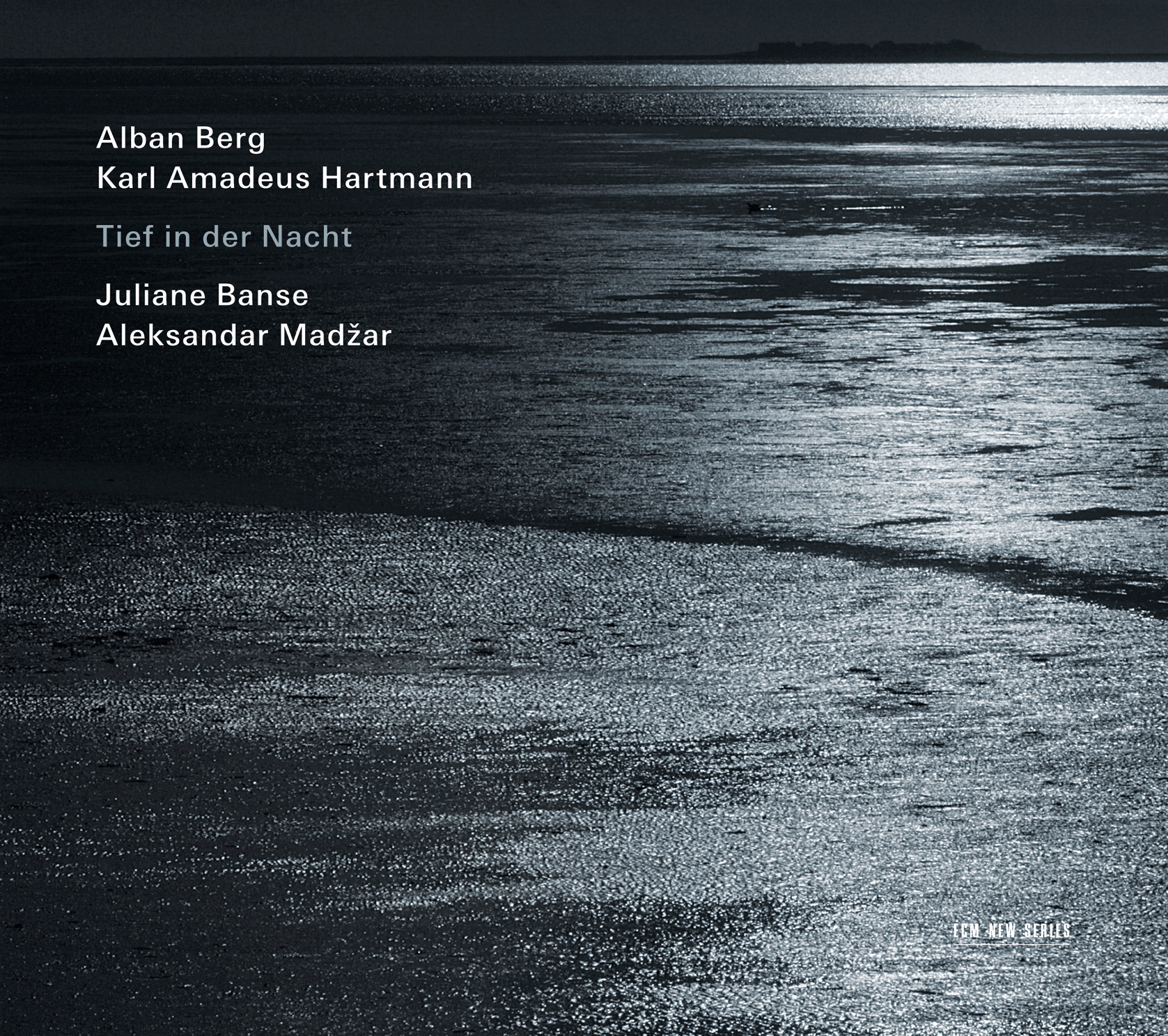
Alban Berg/Karl Amadeus Hartmann: Tief in der Nacht (ECM New Series 2153)

Tief in der Nacht

Alban Berg
Karl Amadeus Hartmann
Tief in der Nacht

Juliane Banse soprano
Aleksandar Madžar piano
Recorded March 2009, Historischer Reitstadel, Neumarkt
Engineer: Peter Laenger
Produced by Manfred Eicher

A grey man goes through the silent wood
singing a dismal song.
The birds at once fall silent.
The spruces tower so mute and sultry
with the heavy turmoil of their branches.
A sound rumbles in distant depths.
–Johannes Schlaf, “Rain”

When discussing Alban Berg, it’s almost impossible not to include Arnold Schoenberg, a mentor of whom he was the brightest protégé. While Berg grew into his own as a defining composer of the early 20th century, in scholarship and on record his early songs were relatively ignored at the time of this release. More than a transition stage, these songs embody key qualities of the composer’s output to come. The hand of Schoenberg is felt less in the music, which still has a foot in the waning Romantic era, and more in the assembly, as the Sieben frühe Lieder (1905–1908) that open the program were extracted from a set of thirty written under his teacher’s careful scrutiny. Setting the poetry of Carl Hauptmann, Nikolaus Lenau, Theodor Storm, Rainer Maria Rilke, Johannes Schlaf, Otto Erich Hartleben, and Paul Hohenberg, these seven songs are stippled with shadows and patches of forest, and the apparent ease with which soprano Juliane Banse and pianist Aleksandar Madžar weave through them enriches the listening experience. With titles like “Nacht” (Night) and “Traumgekrönt” (Crowned in Dreams), one can already sense the nocturnal imagery before a single word is sung. “You came,” goes a verse of the latter, “and softly as in a fairy tale the night resounded.” Thus the lyrics lead us into a world of fantasy. Whether carried on the back of “Die Nachtigall” (The Nightingale) or brightened in the final clip of “Sommertage” (Summer Days), each word turns charcoal to ash and ash to flame.

Rilke, Schlaf, and Storm further populate the Jugendlieder (1904-08) of the same period, along with poetry by Johann Wolfgang von Goethe, Carl Busse, and Peter Altenberg. Now the verses as well as the music are more colorful and, in light of Berg’s compact developments, genuinely impressionistic. From melancholic lullabies—“I mourn lost happiness,” sings Banse in “Erster Verlust” (First Loss)—to the Mozartian patterning of “Hoffnung” (Hope), composer and musicians draw from a nuanced palette of evocative pigments. Schlaf’s “Regen” (Rain) makes for a beautiful highlight, finding in the music a life only implied in the text. All of this culminates in “Mignon,” which expresses a longing for some idyllic land that, while beyond the reach of flesh, blooms across the landscape of art.

Two settings of the same poem—“Schließe mir die Augen beide” (Close Both My Eyes) by Storm—complete the Berg selections. The first, written in 1907, is already a masterful explosion and re-piecing of utterance, while the 1925 version works almost scientifically to balance freedom and precision. What was once a telescope now becomes a microscope.

Banse is extraordinary, not only for her diction but also for the steadiness of her footing as she journeys across Madžar’s constantly shifting topography. Berg is always felt, and Schoenberg over his shoulder, assuring that every change happens in mutual understanding, so that densities and clarities alike always share a strand.

One of those strands surely leads to Karl Amadeus Hartmann’s Lamento (1955), a work that in its original 1936/37 form bore dedication to Berg. Like Hartmann, it survived the war—during which time he studied with another Schoenberg protégé, Anton Webern, in Vienna—with not a few dark clouds in its memory. For this, Hartmann sets three poems of 17th-century Silesian dramatist Andreas Gryphius. One may not feel this as a trilogy, but as a continuous gradation of dusk to dawn. “Elend” (Misery) compares earthly and heavenly troops, and engages the wonder of God’s non-action. Although the light flowers in Banse’s delivery, the geometric diffusion that follows casts a pessimistic shadow to be obliterated in the central song, “An Meine Mutter” (To My Mother). This eulogistic prayer acknowledges the potency of the divine in the realm beyond, a realm in which grace leaks out through Banse’s powerful highs. In the final “Friede” (Peace), she emphasizes the core message: “We once were dead; now peace a life is giving.” The pianism throughout is exquisitely written and executed, and leaves us, like the album as a whole, to reckon with the authority of silence.
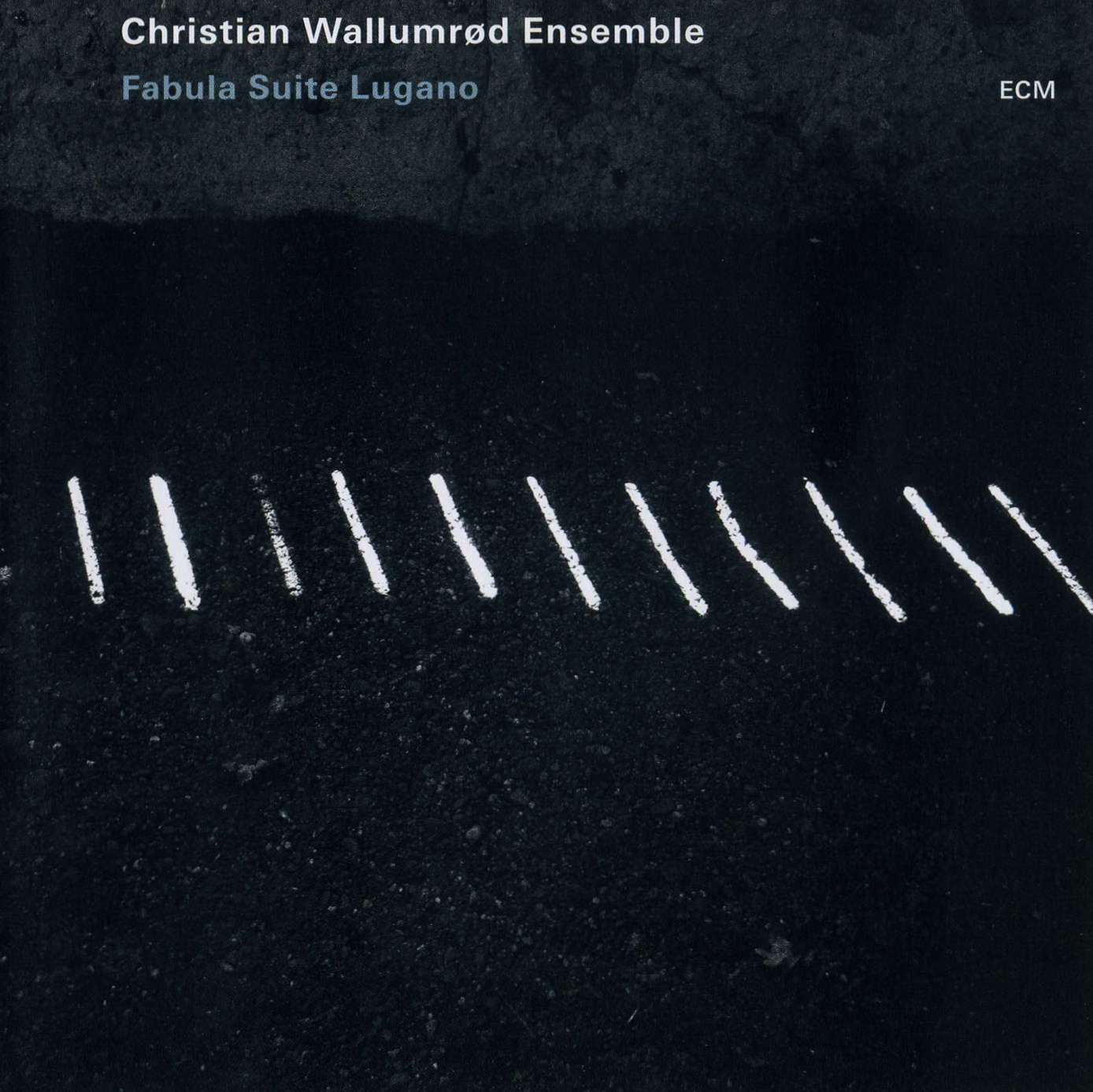
Christian Wallumrød Ensemble: Fabula Suite Lugano (ECM 2118)

Fabula

Christian Wallumrød Ensemble
Fabula Suite Lugano

Christian Wallumrød piano, harmonium, toy piano
Eivind Lønning trumpet
Gjermund Larsen violin, Hardanger fiddle, viola
Tanja Orning cello
Giovanna Pessi baroque harp
Per Oddvar Johansen drums, percussion, glockenspiel
Recorded June 2009, Auditorio Radio Svizzera, Lugano
Engineer: Markus Heiland
Produced by Manfred Eicher

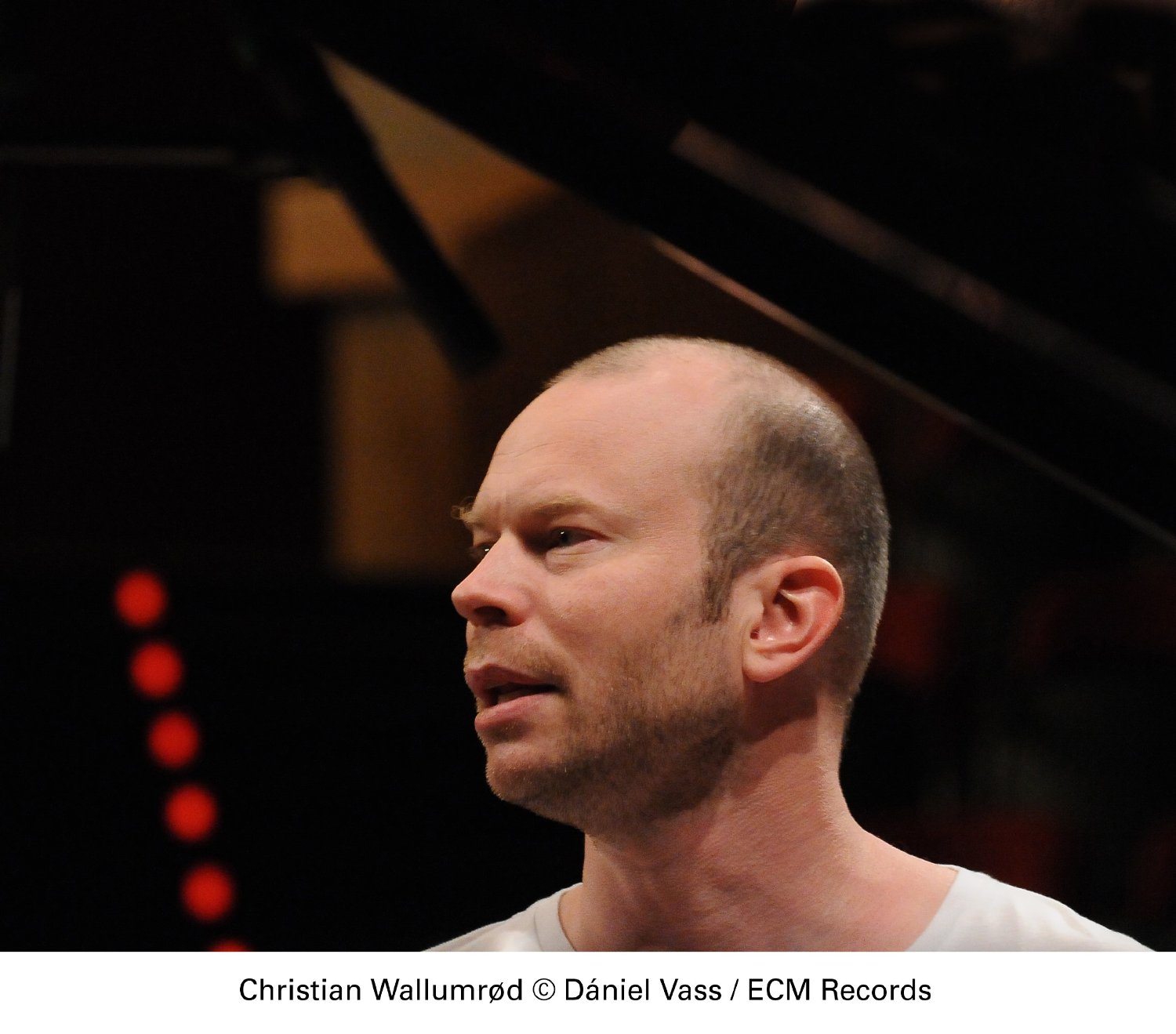
Christian Wallumrød is a court composer of our time, and we are his servants. His distinctly crafted chamber pieces on The Zoo Is Far ushered in a certain specificity and microcosmic style. Replacing trumpeter Arve Henriksen from that previous session is newcomer Eivind Lønning, whose lungs brighten the patina of Giovanna Pessi’s Baroque harp in “Scarlatti Sonata” and lend rounded contrast to the violin of Gjermund Larsen in the modestly titled “Duo.” Regulars Tanja Orning on cello and drummer-percussionist Per Oddvar Johansen flesh out the palette with insight and exactitude.

Wallumrød

This time, as Wallumrød’s sound-world paints through a new galactic stencil, he and his bandmates show a deeper commitment to the integrity and possibilities of atmospheric improvisation. Reference points are as varied as the album’s 18 tracks. “Quote Funebre” takes its inspiration from the music of Olivier Messiaen and Morton Feldman, which Wallumrød spins into what he calls “small harmonic events,” each a stepping stone for Larsen’s commenting fiddle, while the Swedish folk-inspired “Jumpa” (in two versions) lifts off agile feet into the future. For the most part, however, the core of each piece is a solar system unto itself, blown to dust and melted down into a rough gem. Here an emerald, there a ruby.

Pessi’s harping constitutes a defining voice within this modest choir. Her affinity for description infuses pieces like “Dancing Deputies” and “Blop” with tactility, foiling percussive undercurrents like staples across the skin of time, while her pathways light the way through the barely-touched instruments of “Snake.” Johansen is another, catching wind with wings in the descending trills of “Solemn Mosquitoes” and pulsing through the veins of “I Had A Mother Who Could Swim.” Through all of this mimesis, Wallumrød himself shines like a broken firefly, its light turned to liquid. The effect is somehow otherworldly. Even his toy piano in “Valse Dolcissima” feels less like the remnant of a human childhood and more like the language of an alien race who anthem is his concluding “Solo”—the benediction of an artist at play in his telescopic wanderings.

Alexander Lonquich: Robert Schumann/Heinz Holliger (ECM New Series 2104)

Schumann:Holliger

Alexander Lonquich
Schumann/Holliger

Alexander Lonquich piano
Recorded November 2008 at Auditorio Radio Svizzera, Lugano
Engineer: Stephan Schellmann
Produced by Manfred Eicher

Alexander Lonquich follows up Plainte Calme, an all-French program that introduced ECM listeners to this erudite German pianist, with a pairing from which New Series aficionados are sure to derive much pleasure. Composers Robert Schumann and Heinz Holliger may have intersected more recently on Aschenmusik, but here’s where it all began.

Schumann’s 1838 Kreisleriana and Holliger’s 1999 Partita share much in common. Both bear dedications to pianists (Schumann’s to Frédéric Chopin and Holliger’s to András Schiff), both are overflowing with ideas, and both immerse themselves in narrative to the last measure. Lonquich traverses the original 1838 version of the Kreisleriana, which, according to the composer, was “heavily revised,” many of its intricacies elided or otherwise obscured in its now-standard 1850 print. Lonquich notes an ego shift from the pianistic Schumann to the symphonic Schumann, but argues for the psychic exactitude of the earlier version, less glossed by a man rightly concerned with his public image. Indeed, the later changes “sacrificed many subtleties to the need for simplicity and clarity,” making the Kreisleriana, in modern parlance, more user-friendly.

Schumann’s wildly popular performance piece presents to us, as Hans-Klaus Jungheinrich notes in the CD booklet, “the dark, nocturnal sides of romanticism: wild dreams, phantasms, obsession, insanity.” Taking E. T. A. Hoffmann’s The Life and Opinions of the Tomcat Murr and its protagonist, Johannes Kreisler, as inspiration (the novel shares another ECM connection with György Kurtág, whose Hommage à R. Sch. also makes reference), the music reveals a growing dissatisfaction with what Schumann saw as the piano’s limitations. Not that we have reason to agree. The sweeping cascades that open the collection make for some invigorating listening. From cautious steps to headlong rush, we are led up spiral staircases and over archways, following Lonquich’s expert navigations of quietude interspersed with flushes of activity. With such a robust palette at our scrutiny, there’s plenty to pique the interest of repeat customers—whether in the reflective fourth movement (every bit as enchanting as Beethoven’s Moonlight Sonata) or in the sportive seventh—all the way to the curlicue finish.

Schumann has long occupied the “true center” of Holliger’s music thoughts, and in the Partita it’s easy to see why. Jungheinrich argues for a romantic affinity in Holliger’s penchant for the “fractured and insecure,” a characterization that in this instance takes sometimes wistful, sometimes complex form. If the title seems to cast its net over Schumann into Bach, it’s only because it seeks a structural traction in the face of romanticism’s self-deprecating infrastructures. Shuffled into the usual Prelude, Fugue, and Chaconne—all of which reflect Holliger’s prodigious ability to twist templates into deeply personal effects—are a few brilliant additions. Most notable are two Intermezzi marked “Sphynxen für Sch.” These achieve the cavernous atmosphere of their namesake by strumming inside the piano, sometimes in the barest whisper of skin on string, amid a pollination of microscopic adjustments. Another clever insertion is the “Csárdás obstiné,” a strangely beguiling vignette of interlocking helixes that seems a nod to Franz Liszt: an intriguing choice, given the complicated nature of Liszt’s relationship with Schumann. Such strategies, however, are to be expected of Holliger, a composer who has always indulged in a wry sense of patterning.

In addition to being a unique recital performed by its ideal interpreter, this is one of the finest pianos ECM has ever recorded. The instrument simply shines at Lonquich’s fingertips, as if eager to feast on every note until only resonant midden remains.

François Couturier: Un jour si blanc (ECM 2103)

Un jour si blanc François Couturier
Un jour si blanc

François Couturier piano
Recorded September 2008 at Auditorio Radio Svizzera, Lugano
Engineer: Stefano Amerio
Produced by Manfred Eicher

After a handful of collaborative efforts (most notably with oudist Anouar Brahem) at last we encounter François Couturier unaccompanied, feeling his way through an artful selection of 17 (mostly) improvised vignettes. Although nominally distinct from his first leader date, Nostalghia – Song for Tarkovsky, it is in fact the continuation of that very project, the second in a trilogy completed in 2011 by the self-titled Tarkovsky Quartet. Continuing with the cinematic theme, Un jour si blanc takes its title from a poem by Arseny Tarkovsky, as recited in the 1975 film The Mirror, directed by son Andrei. Drawing from a distilled yet no less vivid palette, Couturier pursues themes spanning the robust and the fleeting across an ever-shifting terrain. The album traces a diurnal arc, waking in the soft hues of “L’aube” and “Un calme matin orange” and drifting off to sleep in the shadows of “Par les soirs bleus d’été” and “Moonlight.” Between them runs an elemental cross of fertility and fantasy. Couturier treats every note carefully at these outer margins, cradling it like a blown eggshell primed for his delicate scrim. Within that frame stretches a vast pond, the surface of which quivers with the raindrops of an oncoming storm. Reflections of trees are lifted like decals by his right hand in “Lune de miel” and stuck to sky in the highly charged “Le soleil rouge.” Yet despite my own vivid associations, the music is for the most part earthy and unmasked. In this regard, the program’s three homage pieces are clearest in their expressivity. Bearing dedications to Arthur Rimbaud (“Sensation”), J. S. Bach (“L’intemporel”), and Andrei Tarkovsky himself (the title track), each embraces a different fragment of the mirror, much like the film it honors, as if it were the cell of a larger, divine body. They harbor scents of memories, of places soon to be reduced to ashes…

The Mirror

While connections to certain images may be clear, also clear is that this is no soundtrack. Rather, it is a tracking of sound in a way only synaesthesists might fully appreciate. Much of it feels aquatic, for example, but only the subtlest of changes tells us whether we are floating in fresh or swimming in salt. Of the former flavor, we have the four-part “Colors,” which, unlike the piano on which it is played, echoes with the hymns of an amphibian cloister. Of the latter, the diptych “Clair-obscur” grinds a tangier brand of jazz against the crags. This intriguing album—one of ECM’s most intimate solo piano recordings to date—reveals an artist sensitive to the personal science of adaptation. Like the track “Voyage d’hiver,” it sails on waves of depth magic and brings forward a profound realization that, although experience and memories may be ephemeral, the past is infallible. (To hear samples of Un jour si blanc, click here.)

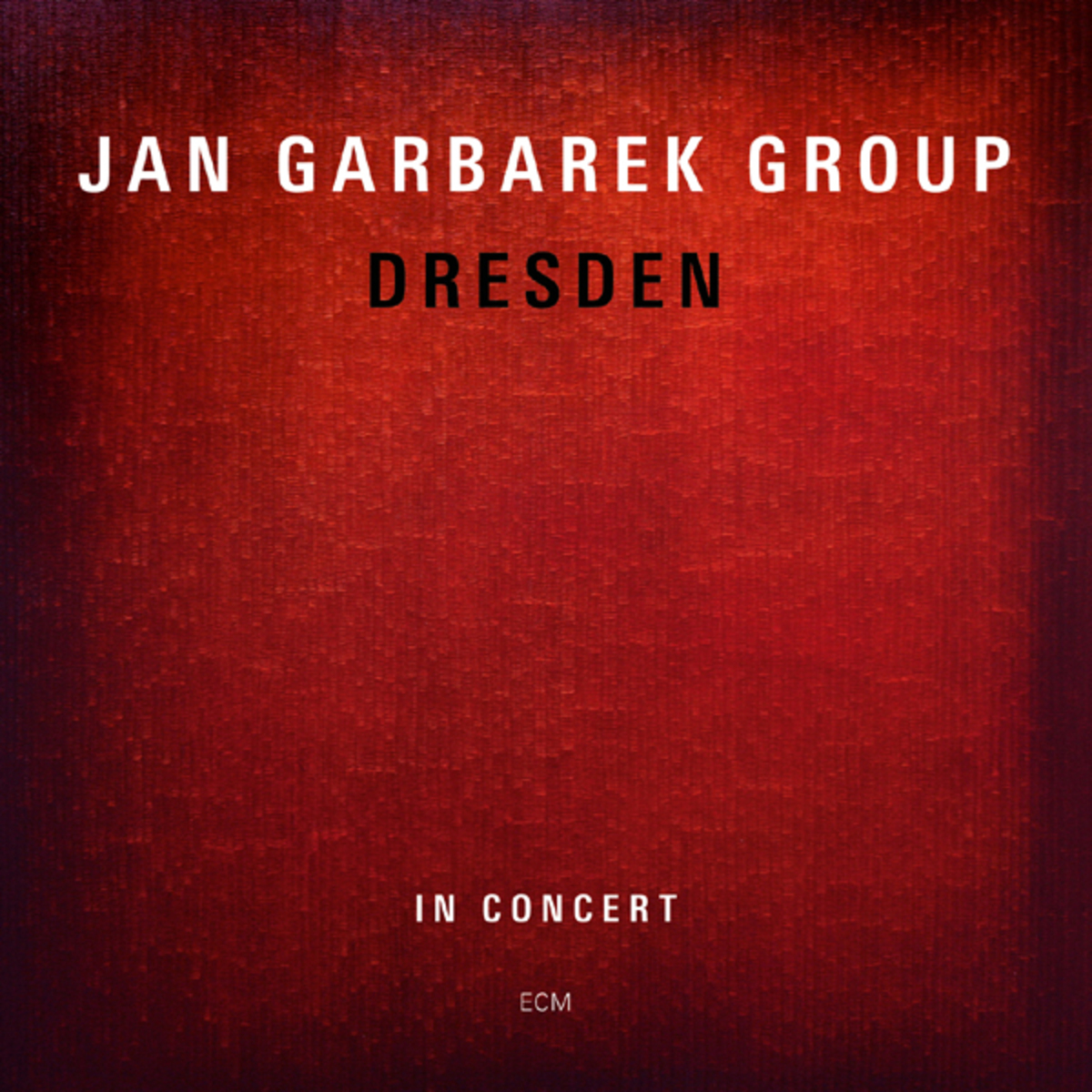
Jan Garbarek Group: Dresden – In Concert (ECM 2100/01)

Dresden

Jan Garbarek Group
Dresden – In Concert

Jan Garbarek soprano and tenor saxophone
Rainer Brüninghaus piano, keyboards
Yuri Daniel bass
Manu Katché drums
Recorded live October 20, 2007 at Alter Schlachthof, Dresden
Engineers: Gert Rickmann-Wunderlich and Rüdiger Nürnberg
Mixed by Jan Erik Kongshaug (engineer), Jan Garbarek, and Manfred Eicher
Produced by Jan Garbarek and Manfred Eicher

Dresden is monumental for being Jan Garbarek’s first live album. Monumental because, even as his crafted studio creations were capturing the hearts of countless listeners, so too were his performances across Europe and abroad. With his own group, the Norwegian saxophonist had crafted something special, and it was only a matter of time before its fire came through in the form of a less mitigated recording. Although it is unfortunate that Garbarek’s regular bassist, Eberhard Weber, was by this point too ill to join him on stage, he was formidably replaced by Yuri Daniel, interlocking with pianist Rainer Brüninghaus and drummer Manu Katché as if he’d always been among them.

With such an inventory of songs and experience from which to choose, Garbarek might have started in any number of places, but opens this concert with the lovely, free-flowing gem “Paper Nut.” First heard on Song for Everyone, one of two ECM collaborations with Indian violinist L. Shankar, it moves with all the synergy and assurance the present quartet has to offer. In addition to the unforgettable melody, sure to find a place in you the first time you hear it, it showcases some of Garbarek’s purest intonation on record. Clarion and unfalteringly naked, it cuts veins of mineral through the bedrock of jazz into the primal core beyond it.

The next point of reference is 1993’s Twelve Moons, from which the group renews three tunes: “The Tall Tear Trees,” “There Were Swallows,” and “Twelve Moons.” In each, the musicians interlock as listeners as much as players, Daniel’s bass laddering roots while Katché paints in a ritual filigree. The title tune is quintessential Garbarek, who finds himself lifted to new heights by Brüninghaus’s colorations as before riding an unaccompanied solo to finish. Legend of the Seven Dreams, from 1988, also gets a nod with the smoothly executed “Voy Cantando.”

The handful of new material introduced in this double-disc album is cause for celebration. From the forested pianism of “Heitor” to the beat-driven flights of “Nu Bein” (featuring Garbarek on the seljefløyte, or Norwegian overtone flute), there’s much to savor from everyone. Among these tunes is “The Reluctant Saxophonist,” which despite its tongue-in-cheek title (Garbarek’s playing is anything but reluctant) attains the most ambitious heights of the concert.

Non-Garbarek tunes include the pastoral “Rondo Amoroso,” arranged from the piece by Norwegian composer Harald Sæverud (1897-1992), and “Milagre Dos Peixes” (Miracle of the Fishes), written by Brazilian singer-songwriter Milton Nascimento and made famous by Wayne Shorter. Brüninghaus is again outstanding, pushing Garbarek to stronger depths, as also in “Transformations,” one of two remarkable solo interludes that rounds out the set. The other is “Tao,” Daniel’s moment in the sun. Balancing technical flourish with emotional flexibility, it proves him a worthy successor to the Weber legacy.

Dresden is, quite simply, the kind of album that makes one feel good to be alive. A classic before it was even recorded.

Steve Kuhn Trio w/Joe Lovano: Mostly Coltrane (ECM 2099)

Mostly Coltrane

Steve Kuhn Trio w/Joe Lovano
Mostly Coltrane

Joe Lovano tenor saxophone, tarogato
Steve Kuhn piano
David Finck double-bass
Joey Baron drums
Recorded December 2008, Avatar Studios, New York
Engineer: James A. Farber
Produced by Manfred Eicher

As John Coltrane’s original quartet pianist for eight weeks in the early months of 1960, Steve Kuhn is as qualified as anyone to assemble a fitting tribute to one of jazz’s eternal gurus. Despite his monumental significance in the field, ECM has reckoned with the Trane only sporadically—first on Dave Liebman’s Drum Ode and, most recently before this record, on Trio Beyond’s Saudades. Mostly Coltrane is, however, more than homage. It’s just as importantly a full-fledged portrait of the musicians bringing this music to renewed life. Saxophonist Joe Lovano has no pretensions of mimicking the man by whom 10 of the album’s 12 tunes were written or made famous. Bassist David Finck and drummer Joey Baron—the other sides of the Steve Kuhn Trio’s equilateral triangle—complete the group’s finely interwoven sound.

Kuhn, in that way he does, unpacks his solos one breath at a time, so that the considerations of “Welcome” offer a soft mapping of the road that lies ahead. Lovano is at the peak of his sentimentality, while Baron dances around the beat—Paul Motian in disguise. Lovano further threads the needle of “Song of Praise,” in which he tightens his grip on the higher notes like a dancing bird, touching wind one feather at a time until both wings sing in concert.

Kuhn may be the emotional center of the record, but his special sense of ebb and flow allows the crests of his bandmates to glint in the moonlight just as vividly. Lovano is irresistible in his luxuriant, chromatically infused takes on “Central Park West” and “Like Sonny,” while Baron provides gentlest uplift to his tarogato (a nod to Charles Lloyd?) in “Spiritual.” Other highpoints include two of Coltrane’s posthumous tunes: “Jimmy’s Mode” and “Configuration,” the former of which boasts an introspective solo from Finck, while the latter staircases its way into brilliance.

The two made-famous tunes—“I Want To Talk About You” and “The Night Has A Thousand Eyes”—are another remarkable pair. One traces its theme in retrograde, exuding sensuality in a trio-only setting. The other is a brisker tune in which the rhythmic section works a gorgeous telepathy, Finck the heartbeat of it all. Into this fray swoops Lovano like a bird who flies for sheer enjoyment, giant yet light on his feet. Marvelous.

Two more of a distant pair, this by Kuhn, rounds out the set. “With Gratitude” finds the composer solo, singing a song of dedication through his fingers. “Trance,” also solo, brings us full circle to his first ECM release of the same name, looking back in a rolling wave of light, thus signing off on a statement as timeless as the music it embodies.

Toshio Hosokawa: Landscapes (ECM New Series 2095)

Landscapes

Toshio Hosokawa
Landscapes

Mayumi Miyata shō
Münchener Kammerorchester
Alexander Liebreich conductor
Recorded October 2009, Himmelfahrtskirche, München
Engineer: Peter Laenger
Produced by Manfred Eicher

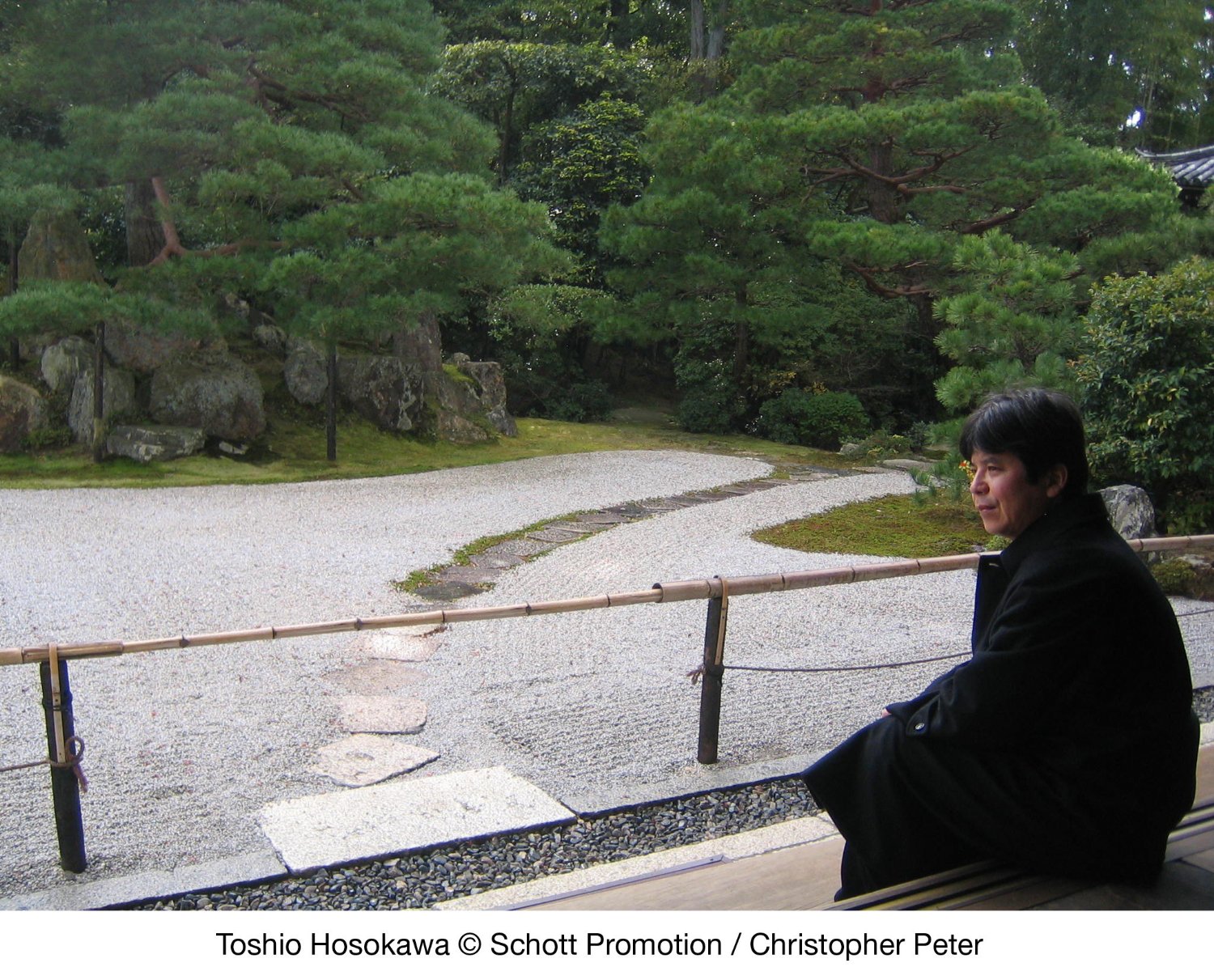
Toshio Hosokawa, born 1955 in Hiroshima, is a fisher of multiple ponds. On the one hand, he carries the torch of European modernism, having studied in Germany under Isang Yun and Klaus Huber. On the other, he professes a deep affinity for traditional Japanese music and Zen Buddhism.

Hosokawa

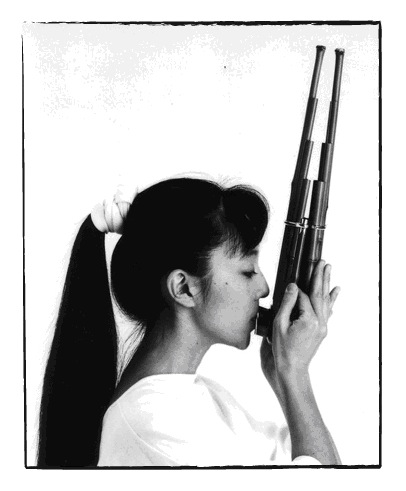
Landscapes is ECM’s only disc dedicated to the composer, who in three of the album’s four pieces employs the shō, or Japanese mouth organ. Here it is played by Mayumi Miyata. A pioneer in introducing the shō as a solo instrument in contemporary classical music, she plays a “concert” shō with a pitch range broader than its standard counterpart. It requires expert control of the lungs, including circular breathing and steady changes in dynamic intensity. In Miyata’s hands it sings like the very phoenix it was originally intended to mimic.

Miyata
Mayumi Miyata

As for Hosokawa’s music, it all too easily falls into an interpretive trap like so many characterizations of Japan in general, which tend to paint the culture as a uniquely enigmatic blend of the ancient and the modern. Yet such an image fails to acknowledge the immediacy of its creative arts, and in particular of Hosokawa’s sound-world, which for all intents and purposes seeks not a bridging of spaces and eras but a reckoning of their aesthetic and (sometimes) political intersections. In the latter vein, he has created massive works in memory of the victims of Hiroshima and the tragic tsunami/earthquake of 3.11. In the former we have this program of meticulous dreamscapes to whet our appetite for beauty. It is, however, a tainted sort of beauty, one not destined for the painter’s canvas but rather for the videographer’s resignation. In his liner notes, Paul Griffiths likens Hosokawa’s constructions to the amorphousness of clouds, and certainly we can feel that stretch of variation, play of sun and spectrum, and stormy grays manifesting throughout the program.

Landscape V, originally composed for string quartet in 1993 and later expanded to the current version for shō and orchestra, unfurls a veil as thin as an insect’s wing that conforms itself to the shō’s summery spirals. One might not expect breath through bamboo to mesh so well with the feel of horsehair drawn across strings, but in Hosokawa’s renderings at least they become harmony incarnate, the shō illuminating the flow of air through an orchestra’s sound holes. In this pairing one may hear voices, shifts of wind, the flow of water, the meeting of stones, and even the light of moon taking sonic shape. The music is, at the same time, crystal clear. It wears no pretension, puts on no airs. It is, rather, the full breadth of its titular landscape pulled through a wormhole of consistency, so that even the more explosive moments take form not as catharses but as opportunities for deeper contemplation.

The Ceremonial Dance (2000) that follows is for string orchestra only, but loses no texture in the shō’s elision. Its heart would seem to lie in the comportment of gagaku (traditional Japanese court music), which turns illusions of a floating world into hyper-articulate bodies. That being said, the “dance” is implied through effect rather than movement, hiding in the absent drum. There is a liminal quality to this piece, performing an indeterminable ritual of which the score is but a simulacrum.

Sakura (2008), for shō solo, acts as a prelude to a choral setting of Japan’s most ubiquitous folk song. Bearing dedication to the former music director of the Westdeutscher Rundfunk, Otto Tomek (who also commissioned the setting), it is intimate and drifting, more postlude than prelude, the afterimage of a fallen blossom’s path toward water. As luminescent as its chords are, they are also dappled by the shadows of an unbroken gaze.

Last is Cloud and Light (2008), which pairs the shō with a full orchestra, including some light yet impactful percussion. Like its predecessors, it never overwhelms with its style, but unpacks itself in real time with self-awareness and tactility. It enacts a sharing of spirit between water and air, between the shapeless and the shaping. Large brushstrokes of brass pull their hairs through ink, soaking up as much of the universe as they can before falling along with the rain into the pond where Hosokawa’s bob and lure continue their meditation, content in knowing that no fish need ever bite to bring meaning to their dangle.

(To hear samples of Landscapes, click here.)

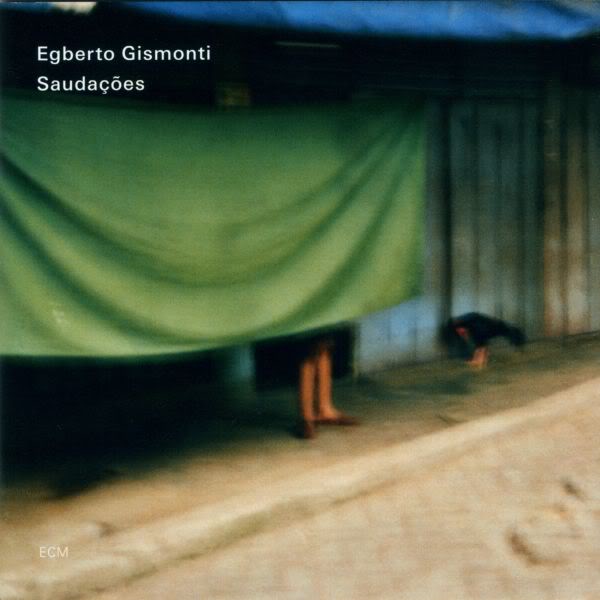
Egberto Gismonti: Saudações (ECM 2082/83)

Saudações

Egberto Gismonti
Saudações

Camerata Romeu
Zenaida Romeu conductor
Alexandre Gismonti guitar
Egberto Gismonti guitar
“Sertões Veredas”
Recorded August 2006, Teatro Amadeo Roldán, Havana
Engineer: Jerzy Belc
Assistant:  Argeo Roque Bernabeu
“Duetos De Violões”
Recorded April and May 2007, Mega Studio and Cecília Meireles Hall, Rio de Janeiro
Engineer: Márcio Gama
Assistant: Guthemberg Pereira
Executive producer: Manfred Eicher

Saudações, of which the title means “salutations,” marks the welcome end of a 12-year ECM hiatus for Egberto Gismonti since 1997’s Meeting Point. Whereas on that record he explored his conservatory training in a set of lively orchestral compositions with Gismonti as piano soloist, the first of this two-disc follow-up consists of Sertões Veredas, a suite in seven parts for strings alone, while the second disc features guitar duets and solos with the composer’s son Alexandre.

Seasoned Gismonti listeners will know what to expect from the program’s latter half. In addition to renditions of classic tunes, including “Lundú,” “Dança Dos Escravos,” and “Zig Zag”—each a bouquet of nimble, sparkling exposition—the duo soars through a veritable résumé of Father Gismonti’s uniquely tender ferocity. From subdued (“Mestiço & Caboclo”) to slipstream (“Dois Violões”), the performances emit a veritable brocade of fire. Alexandre contributes two solos to the program: the gentle, cyclical “Palhaço” (by Egberto) and the original “Chora Antônio.” Alexandre’s animations make them both album must-hears. After a few jagged turns, notably in “Dança,” Egberto ends by his lonesome with the title track, an adroit little bee of a tune that settles in a flower of harmonics.

Gismonti & Son play with freedom of detail, all the while holding fast to an underlying pulse that distinguishes so much of Egberto’s writing. Concentrated as they are, any one of these pieces might expand to an album’s length without loss of potency. In a sense, this is the feeling behind the orchestral suite that begins the album. As always, Gismonti paints a world proper, a landscape of vivid memories, childhood impressions, and mature reflections—all tied together by a love for his homeland and its peoples. Subtitled as a “Tribute to Miscegenation” (Tributo à miscigenação) and played with vivaciousness by Cuba’s Camerata Romeu, it is a heartfelt tribute to—and preservation of—times and places clearly dear to him, all intermingling in a new continent.

The cornucopia of influences from which he has drawn is already apparent in the first movement, of which the spirit remains very much rooted in the composer’s guitaristic panache (even his pianism, heard elsewhere, turns the keyboard into an enormous, fretted instrument). More than the instrument’s mechanics, its immediate tactility carries over into the scores, which sound like magnified string quartets. Gismonti’s attention to the orchestra’s lower end is especially robust, the double basses providing pulse, melodic undertow, and soil for botanical riches above ground. The occasional cello line acts as a link between dynamic extremes, leaving the violins to pollinate, as they will. Each movement is a suite of its own, moving from high to low, slow to fast, loud to soft in a heartbeat. The most obvious references are to Stravinsky (Part IV), John Adams’s Shaker Loops (Part V), and even the romantic touch of a Mendelssohn (Part VI), leaving the final part, an ode to folk traditions and dances, to bask in the resolution of camaraderie.

Speaking of attention, Saudações is recorded with just the right balance of intimacy and mountainous space. Peak slope into a valley of riches, each more scintillating than the last. A treasure trove for Gismonti fans. Even more so for newcomers. Either way: leave your shoes at the perimeter and step into the circle as you are.

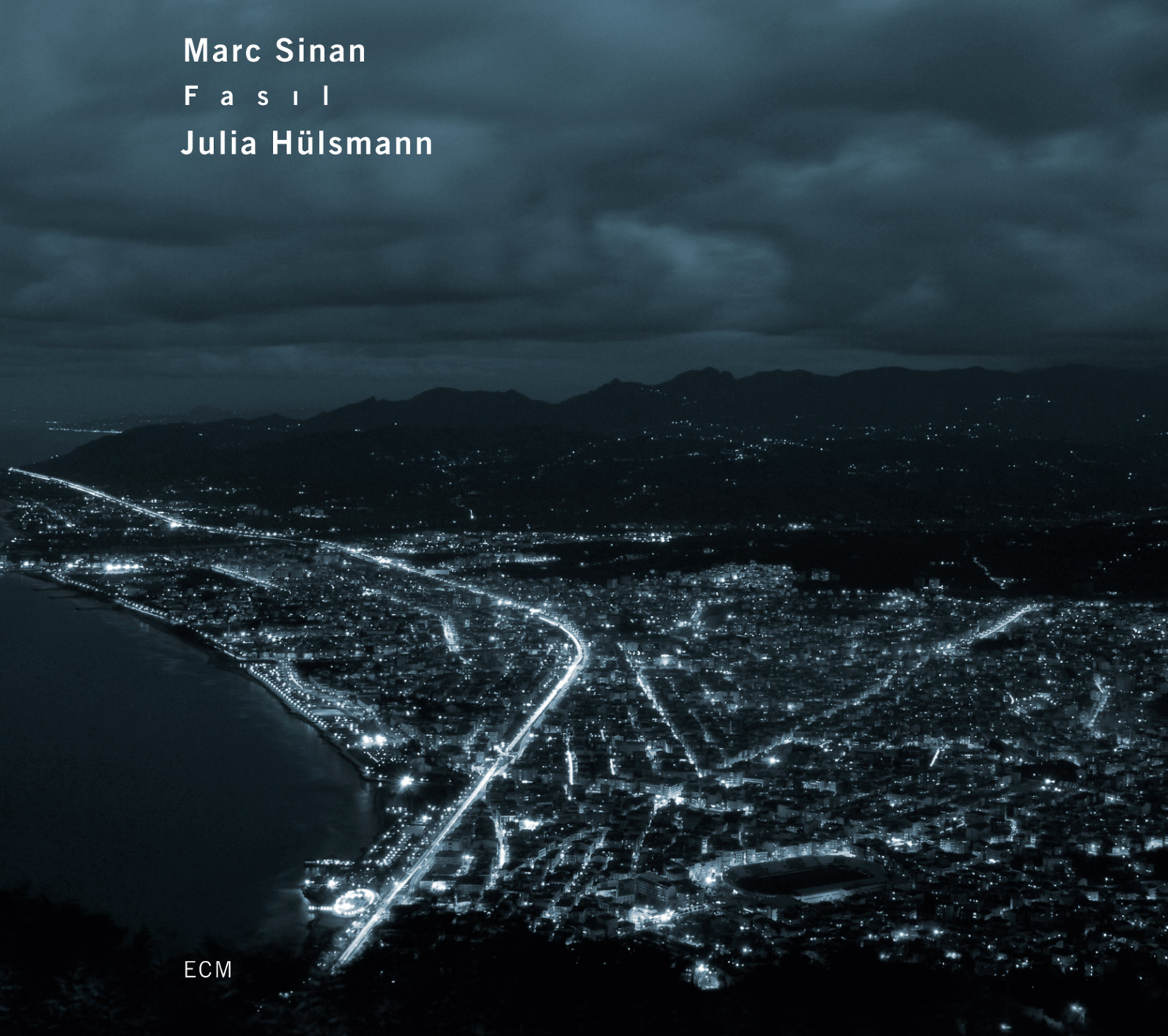
Marc Sinan/Julia Hülsmann: Fasıl (ECM 2076)

Fasıl

Marc Sinan
Julia Hülsmann
Fasıl

Marc Sinan guitar
Yelena Kuljic vocals
Lena Thies viola
Julia Hülsmann piano
Marc Muellbauer double-bass
Heinrich Köbberling drums, percussion
Recorded March 2008 at Rainbow Studio, Oslo
Engineer: Jan Erik Kongshaug
Produced by Manfred Eicher

Guitarist and composer Marc Sinan, recently of the (sadly) European-only release Hasretim, made his ECM debut with Fasıl, an album of enduring originality and refinement. The title refers to a suite form used in both classical and modern Ottoman ensemble music, and which here would seem to nod in both directions. It’s almost unfortunate that the Turkish word should so closely resemble the English “facile,” for the music here is anything but superficial. By way of comparison, one might pair it with Jon Balke’s SIWAN, as Balke illuminates and draws out likeminded ethnomusical connections with care.

Siwan’s own fasıl tells the story of ‘Ā’ishah bint Abī Bakr (613/14-678), youngest and favorite wife of the Prophet Muhammad. In this fresh musical context, her sentiments twirl and float by turns along a river’s current of rhythmic libations. Librettist Marc Schiffer weaves into those sentiments influences ranging from the Qur’an to ancient Persian poetry in search of common ground. Pianist Julia Hülsmann’s trio with bassist Marc Muellbauer and drummer Heinrich Köbberling—the subject of such later albums as The End of a Summer and Imprint—flexes the project’s instrumental spine. They are joined by violist Lena Thies, Sinan on guitar, and the Serbian-born, Berlin-based singer Yelena Kuljic in the role of ‘Ā’ishah.

The album begins, as does any fasıl performance, with an instrumental “Peshrev,” which lowers us gently into the waters of this emotionally dynamic world. It is a world of comfort and challenge, a quilt of geographical distances made immediate by design. Other traditional movements include iterations of the taksim, an improvisational interlude which unspools purple braids from Hülsmann’s interpretive fingers. Through these run the finer threads of Sinan’s flamenco-esque strumming and Thies’s spirited bowing. Sinan augments these with two movements based on transcriptions of an imam (Islamic cantor) he recorded while conducting research for this project in Turkey. “Sure 6/51” and “Sure 81 Taksimi” revolve around Hülsmann’s rhythm section, guitar and viola taking respective turns in the lead.

Yet it is by virtue of Kuljic’s portrayal of ‘Ā’ishah that the album comes into its own. Beginning with the drawing of desire that is “This Bloody Day” and ending with the affirmative “You Open My Eyes,” her voice sheds light by which to see. She explores themes as wide-ranging as agency and politics (“Taking Leave”), the body as landscape (“The Last Night”), and, couched in the album’s most entrancing melody, the intertwining of lives under Heaven (“The Dream”). Sinan rocks a lovely fulcrum in the latter through a smooth, jazzy core, and lends his flexible architecture to “The Struggle Is Over,” carving a sliver of moon into the sky.

All in all, these are songs of holdings on and lettings go. The instrumental elaborations are thoughtful (and thought-provoking), unraveling richly dyed sacraments in sound. At their heart is a song entitled “The Necklace.” It is a pivotal moment, both in the lives of its characters and of this cycle as a whole. It refers to story recounted in the Qur’an, in which ‘Ā’ishah, during one of Muhammad’s desert raids, is mistakenly left behind when she goes looking for a lost necklace and returns to camp to discover that her caravan has departed without her. She is found by a nomad under Muhammad’s employ named Sufwan and taken to the next campsite, only to be met with gossip of infidelity. Unbelieving of these rumors, Muhammad takes his wife’s word on faith (albeit after a revelation from Allah confirms her innocence), and her accusers are summarily punished. It speaks volumes about a woman whose strength thrived in her resolve, in her resistance to a world of men, and in her refusal to let her integrity fade into the dunes.