Arvo Pärt: Lamentate (ECM New Series 1930)

Lamentate

Arvo Pärt
Lamentate

The Hilliard Ensemble
Sarah Leonard soprano
David James counter-tenor
Rogers Covey-Crump tenor
Steven Harrold tenor
Gordon Jones baritone
Alexei Lubimov piano
SWR Stuttgart Radio Symphony Orchestra
Andrey Boreyko conductor
Lamentate recorded June 2004 at Stadthalle Sindelfingen
Engineers: Dietmar Wolf and Jürgen Buss
Da Pacem Domine recorded April 2005 at Propstei St. Gerold
Engineer: Peter Laenger
Produced by Manfred Eicher

Tempting as it may be, the typing of Estonian composer Arvo Pärt as a spiritual modernist hardly begins to assess the reach, import, and atmospheric integrity of his music. The more closely one listens to it, the more one hears between every heartbeat an alternating current, whereby shadows take solace in their own orientation of elements. Awareness of this dichotomy throws sanctity over the banal, and lends banality to the sacred, so that by the end of any Pärt listening experience one emerges changed yet profoundly the same—the self made clear under a magnifying glass polished by sound.

And so, while Lamentate may be said to represent a new direction for Pärt, whose music has hardly sounded this visceral since his formative dips into the avant-garde, it also feels like a reflection back to the womb, if only because the composer has so carefully woven into its basketry a conscious structural flaw. Said flaw is the essence of being human. It is what turns the visage of existence firmly away from the realm of fantasy toward the mirror of reality. This “lamento for the living” takes its inspiration from the enormous sculpture “Marsyas” by Anish Kapoor, at the time located in Turbine Hall of London’s Tate Modern, and anchors a piano soloist (here it is Alexei Lubimov at the keyboard) in an orchestral ocean. In the album’s liner notes, Pärt describes his first encounter with the sculpture: “My first impression was that I, as a living being, was standing before my own body and was dead—as in a time-warp perspective, at once in the future and the present.” Lamentate thus concerns itself with time—or, more precisely, with those who deal with time. The work was premiered at the sculptural site in London on February 7 and 8, 2003, and was recorded for ECM in 2004 at Germany’s Stadthalle Sindelfingen, near Stuttgart.

Before throwing us into these prophetic waters, the disc opens with the prayer for peace that is Da pacem Domine. Composed in 2004 on the basis of a ninth-century Gregorian antiphon and recorded here a year later at St. Gerold monastery near the Austrian mountains, it features the Hilliard Ensemble with soprano Sarah Leonard in a moving, timeless performance (the work reappears in updated form on In Principio). Like much of Pärt’s choral writing, its simplicity is its strength, requiring discipline from interpreters to bring out inner complexities. The antiphon is stretched to reveal a stratum unto itself, a melody to be born into and from. Its lines mark the binding of a book of experiences, the pages of which fade in one direction and become crisper in the other. All, however, bear equal wisdom of the divine hand that inscribed them.

With such pulchritude still warming the chest, Lamentate (2002) comes like a hit in the gut. Each of its ten movements is a monument—now fragile, now menacing—to some emotional shell. These surfaces act as palimpsests for the cellular activities that unspool from a brass incantation. A bass drum rumbles as would the hand of a god trapped beneath the earth’s surface pound for escape. In that frustration are flashes of a life confounded by lifelessness, declarations of dependence wrought in beat and bow. Over the piece’s own lifespan, the recording takes on a wavelength that cracks open intersections of space and time and spins from their yolks an entirely new cosmos. In this parallel universe, the winds are seemingly still yet utterly dynamic like nebulae as fetal kicks javelin fresh thought through a needle of questioning. The piano’s solitude provides the only answer it ever needed to breathe, for in the crafting of flesh lurks a question far beyond our articulation, and to which music nevertheless brings us steps closer. As relays of brass, piano, and percussion give way to whispering tides, echoes of earlier compositions (such as Psalom) make themselves known as a lilting oboe swims against the current. And even the nominal resolution treats alignment like a fantasy, leaving us by the end looking above for any sign of what it means to be below.

Marsyas
(Photo credit: Empics)

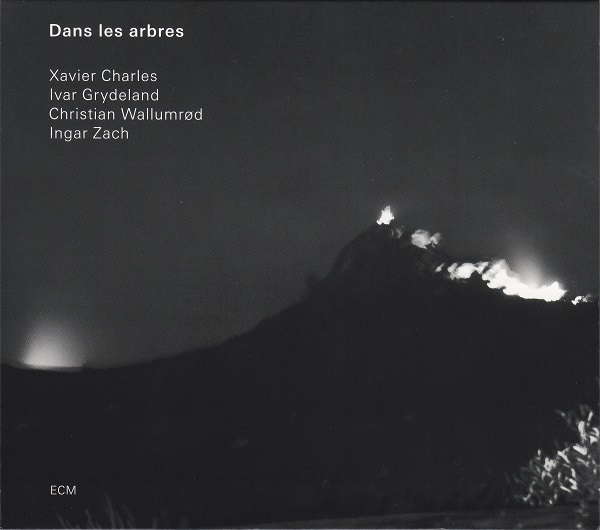
Dans les arbres: s/t (ECM 2058)

Dans les arbres

Dans les arbres

Xavier Charles clarinet, harmonica
Ivar Grydeland acoustic guitar, banjo, sruti box
Christian Wallumrød piano
Ingar Zach percussion, bass drum
Recorded July 2006 at Festiviteten, Eidsvoll, Norway
Engineer: Thomas Hukkelberg, Desibel
Produced by Dans les arbres

Dans les arbres (“In the trees”) is named for the collaboration of clarinetist Xavier Charles, guitarist Ivar Grydeland (who also plays prepared banjo and sruti box), pianist Christian Wallumrød, and percussionist Ingar Zach. Together they illuminate a microscopic diorama of improvisation, letting their inhibitions go in service of the moment. What comes of this is as unknowable as it is unscripted, a mystery that is yet naked before us, hiding nothing—only, we have forgotten its way of speaking.

Immediately striking about this all-acoustic quartet is its seemingly electronic blood flow, nonetheless letted by means unplugged. The feeling comes out in feather-light high tones, which caress the air like a hearing test administered by some distant deity. For much of the album’s duration, listeners are thus suspended at an intersection of thresholds: between motion and stillness, utterance and silence, melody and noise. Each of these is, of course, illusory at best, and this is the album’s greatest lesson.

With one exception—“Le Flegme” (Phlegm)—each movement of Dans les arbres describes a state of mind or being. Titles such as “La Somnolence” (Drowsiness) and “L’Engourdissement” (Numbness) are purely descriptive. They are not pretentious hints toward deeper intrigues, although one can hardly deny the music’s mysterious side effects. If anything, the sounds seem cryptic because of their warping of time. Hence, their pervading suspension. What we hear is what we hear.

The album’s initial stirrings paint a forest fire in its infancy, which sparks unnoticed and by the end reaches such force that it’s too far gone to quell. Nor would we ever think to, for by then the flames have already consumed us. Such dynamics come about through the expertise of the musicians, whose ability to listen to one another is mesmerizing, if only because often the instruments are unrecognizable in their extended play. An obvious piano motif might be overtaken by percussion or overblowing from the clarinet, and those in turn by less discernible soundings. In them is the whispering of the veins. Intimations of rhythm are occasional at best, giving way more often to stretches of aphasia and fitful dreams. As if to put a finer point on it, the self-obliterating prophecy that is “L’Assoupissement” (Slumber) echoes like a mournful gamelan for the inner sanctum.

What holds Dans les arbres together is the fact that every element remains crisply defined, each a key that doesn’t so much unlock as interlock. Whether by way of Wallumrød’s hymnody, Charles’s guttural language, Grydeland’s clicking gears, or Zach’s genetic incantations, the overall transmission comes through with messages intact. Throughout the album’s slow crawl toward the resonating chamber of the sun, where histories of inertia dwell in fantasies of their own design, the insistence of a struck gong or a splitting reed comes like a knock on the door, flowing from itself into itself in a cycle of renewal, residue, and retention.

The only comparison I can offer for reference is Nijiumu’s Era of Sad Wings, which may just be the most enchanting things ever committed to record. Whatever the analogue, this is an unusually beautiful creation from ECM, one well worth the risk of expanding your listening for its benefits.

Tord Gustavsen Trio: Being There (ECM 2017)

Being There

Tord Gustavsen Trio
Being There

Tord Gustavsen piano
Harald Johnsen double-bass
Jarle Vespestad drums
Recorded December 2006 at Rainbow Studio, Oslo
Engineer: Jan Erik Kongshaug
Produced by Manfred Eicher

There’s no mistaking a Tord Gustavsen Trio record. Intimate in measure yet profound in scope, each builds on the last like another level of a pyramid built from the capstone down. In this manner Being There follows Changing Places and The Ground as the last of a trilogy, though it is by no means the be all and end all of the trio’s capabilities. There’s so much to admire on Being There that one could see its vessel off contentedly were it never to return to shore. If the album’s title sounds familiar, that’s because it comes by way of a tune off The Ground. But this baker’s dozen casts two forward glances for every backward, always moving toward the goal of utter respect: for the notecraft, for the sound, for the moment.

Those who subscribe to the stereotype of contemplative Nordic jazz will be both rewarded and pleasantly surprised. On the one hand, there is “At Home,” which begins the album, as it has often done for the trio’s stage sets, with honed lyric intensity and lullaby charm. The brushed ruminations of Gustavsen’s bandmates—bassist Harald Johnsen and drummer Jarle Vespestad—buoy the pianist on inky currents. The downtempo mood holds true for much of the album’s hymnody, taking fullest (which is to say, spacious) form in the anthemic “Still There” and the veiled “Vesper.” With barest touch but also viable emotional weight, the trio moves further through the balladic changes of “Around You” and “Draw Near” with an embrace so warm that three become one. Each is a profession of faith in love through love of faith, drifting a hair’s breadth from the divine in “Sani.” This duet for piano and drums describes a blown feather. Free of wing in its own dream of flight, it wanders along a quiet storm’s path. These slower songs take full advantage of the acoustics, both live and post-processed, and build to a density of expression that nevertheless allows room to breathe. It’s as if the trio explores knots in wood, each a galaxy waiting to be sung. In them Gustavsen paints flowering worlds with every keystroke, as he does especially in the melodic orbit of “Karmosin” (penned by Johnsen and the only track not by the pianist) and the solo improvised “Interlude.” The latter is the modal hip at which the album flexes. Poetry flows from its deference, clear as sunlight on a river, across a brittle page, which is then folded, sealed, and held above a burning candle.

While much of the album is suited to closed-eye listening, there are a few breaks in the waves. Between the swooping wingspan of “Vicar Street” and the uplifting “Where We Went,” there is “Blessed Feet,” a masterful and obvious nod to Keith Jarrett. This swinging number proves Gustavsen a magician at the keyboard, by which he, ever the melodic herdsman, corrals every note in formation. Even the lethargic clouds of “Cocoon” abide by structural principles, at once conscious and free.

Yet it is on the waters of “Wide Open” that the trio finds what it’s been looking for: a step into the future, as yet unknown, with eyes fixed on the horizon. Where the album opened at home, here it ends with a homecoming. And it is in your home that this music belongs, right there on the shelf next to your most prized discs.

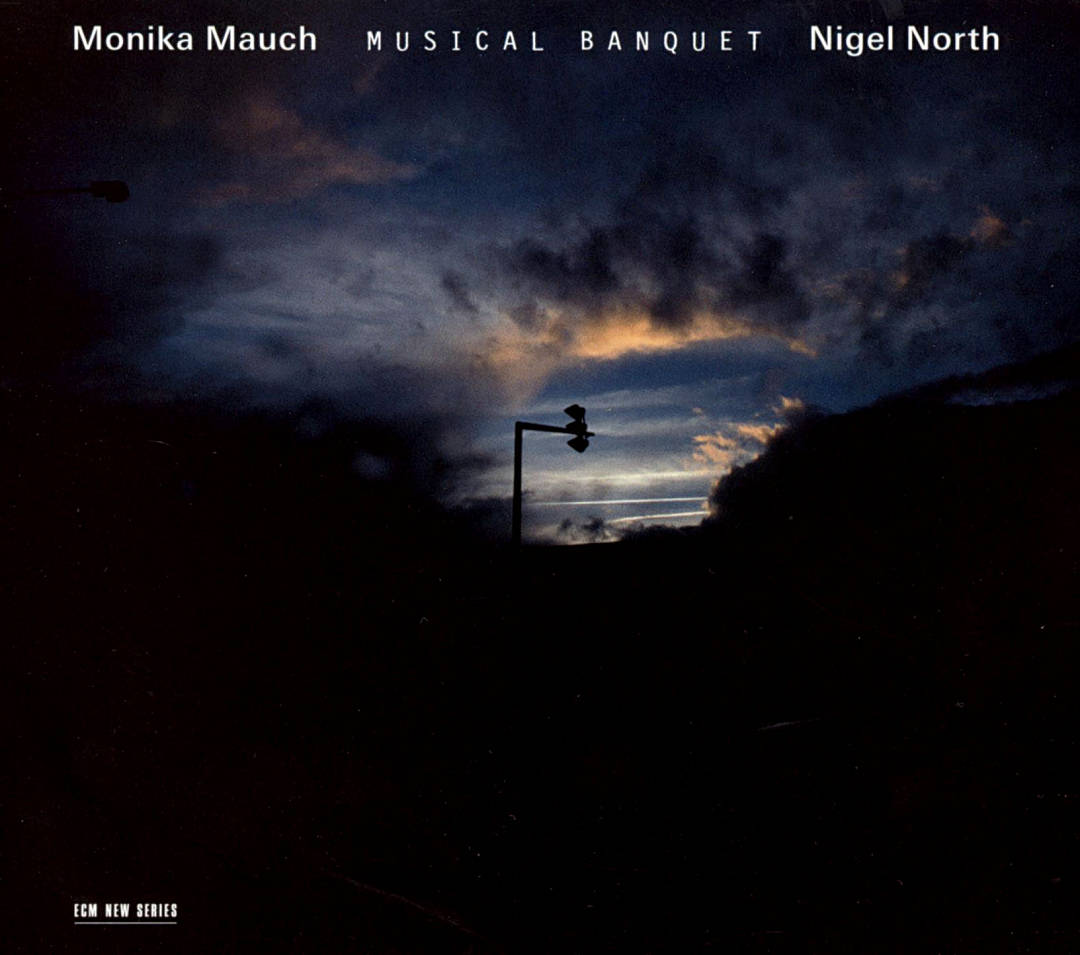
Monika Mauch/Nigel North: Musical Banquet (ECM New Series 1938)

Musical Banquet

Musical Banquet

Monika Mauch soprano
Nigel North lute
Recorded May 2005, Propstei St. Gerold
Engineer: Peter Laenger
Produced by Manfred Eicher

Named for an anthology of lute songs compiled in 1610 by Robert Dowland (1586-1641), son of John (1563-1626), Musical Banquet offers up exactly that. Lutenist Nigel North joins soprano Monika Mauch in an expert dovetailing of musicality, detail, and, above all, emotive power. Performing such songs is no small task. The separation of lutenist from the voice that must once have issued from the same—the result of a long recital tradition—means that singer and accompanist must balance poetry and setting with poise. One hears both throughout this spaciously engineered recording, which is to say that Mauch and North bring the precise intonation of classical rigor in harmony with the raw affect of the words.

To that end, Mauch’s diction is so crisp and finely scored that, were one to snap it anywhere, it would break off in cleanest lines. Whether bound by the tenderness of “Passava Amor su arco desarmado” (Love walked by unarmed) or freed by the self-pity of “Far from triumphing court,” respectively the program’s opening and closing songs, Mauch navigates a veritable maze of lovelorn dimensions with gorgeous uplift. North’s cogent luting is equally alluring, a pleasure to behold in its adaptive variety. Between their covers flip beautiful pages—some tattered, others gilded—dripping with sentiment.

In addition to French and English songs, the repertoire includes more from Italy by Giulio Caccini (1551-1618), as well as a handful of anonymous examples from Spain. Each stream has its own quality. The French songs are like necklaces, beads held true by strings of regard. The English, especially those by Father Dowland (Robert avoided inclusion of his own), weave contradictory tapestries. The lyrics might at one moment invite with a flirtatious lilt (“Lady, if you so spite me”), while at the next steep the narrative voice in claustrophobia. In the latter vein, consider your ears fortunate should you ever encounter a more heartrending rendition of his timeless “In darkness let me dwell.”

As for the Italian, and especially the ever-popular “Amarilli mia bella” (My fair Amaryllis), they tend to favor brevity, exerting all the more inertia for it. The Spanish encompass Mauch’s depth of range, making full use of her dynamic control. Furthermore, they challenge North to maintain intrigue by switching one backdrop after another in a gallery of rhythms and styles. Such colors nuance every mystery behind the words. Throughout them all, a peppering of lute solos by John Dowland is the glue that binds. Each is a gorgeous, multifaceted thing, carved with the geometrical precision of a Celtic knot.

Not only is the music of this collection brimming with allure; it also comes to us by the art of two peerless early music interpreters. Mauch’s singing combines the innocence of an Emma Kirkby with the passion of an Arianna Savall into something uniquely her own. North, for his part, looks longingly in the mirror and draws messages from the past. All it requires is a cadence or snatch of melody, and our hand has already been taken, led through a landscape where bodies once danced before they were buried to nourish the trees that to this day grow in their place.

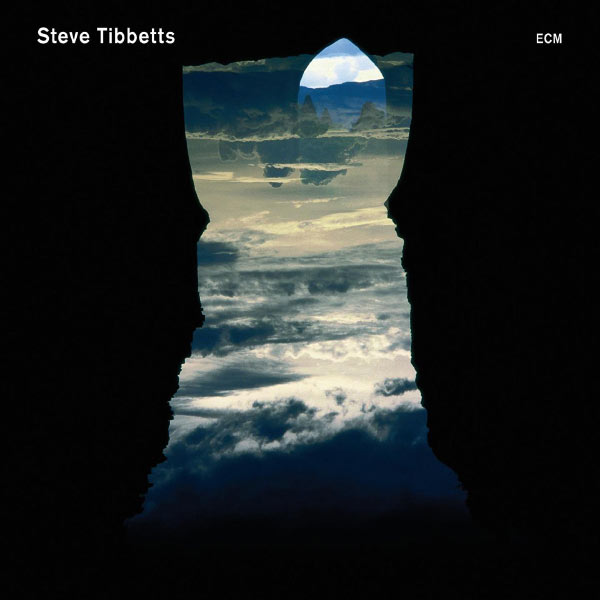
Steve Tibbetts: Natural Causes (ECM 1951)

Natural Causes

Steve Tibbetts
Natural Causes

Steve Tibbetts guitars, piano, kalimba, bouzouki
Marc Anderson percussion, steel drum, gongs
Recorded 2008 in St. Paul
Engineer: Steve Tibbetts
An ECM Production

If ever there was a case for quality over quantity, Steve Tibbetts is it. A full eight years after A Man About A Horse, the Minnesotan guitarist returns with his most intimate statement yet. Alongside percussionist Marc Anderson, collaborator of over three decades, Tibbetts crafts a geography so inward-looking that it becomes a parallel world. Tibbetts originally flirted with the idea of releasing Natural Causes as one single track. Were such the case, listeners would feel no less aware of its science. Either way, its 13 tracks are not variations on a theme, even if they do play with the theme of variation. He calls them, rather, “complex little cathedrals,” building them as he does stone by stone, if not string by string. Indeed, his trusted 12-string guitar is possessed of something divine, its frets pared down to almost nothing over years of playing, so that fingers glide freely.

In a rare turn, Natural Causes is nearly all acoustic and accordingly finds Tibbetts playing piano, kalimba, and bouzouki to flesh out the palette. In addition to these, he employs a midi interface, by which he triggers samples of gongs and metal-key instruments collected during his travels. Of these, “Lakshmivana” is the fullest integration of plugged and unplugged. Told in the language of prayer—i.e., of human artifice embracing sacrality—it is an astonishing meditation that is only deepened by the story told in “Chandogra.” Here the periphery is barely noticeable. Instruments peek from the shadows, seemingly incidental, and fade at the instant of regard.

From the back-porch motif that introduces “Sitavana,” the album’s gateway, and through the burgeoning field that follows toward the solo “Threnody,” it’s obvious that Tibbetts’s attention to detail has grown like the preceding metaphor. His playing, mellifluous as ever, establishes global reach with tracks like “Padre-Yaga,” in which Anderson’s hand drumming leaves trails on the beaten plains. It develops, as does the album as a whole, in distinct cells, every pause linking the body to the less tangible impulses that make fingers ache for the fretboard.

There is an almost keening quality to Tibbetts’s portamento. “Attahasa,” for one, is a tree shedding spores. For another, “Sangchen Rolpa” wavers on the precipice of some great abyss. Across that expanse Tibbetts extends brief, tender bridges, paved with inner fire. Between them, the album’s groundswells reveal texture and breadth.

Although this is Tibbetts’s most inward-looking record, it is also his farthest reaching. His art is as honest as the landscapes that inform it, changing form and color as he moves from one riverbank to the next. Whether you choose to walk with him or listen upon him from above, just know there is a home for you here to which you may always return.

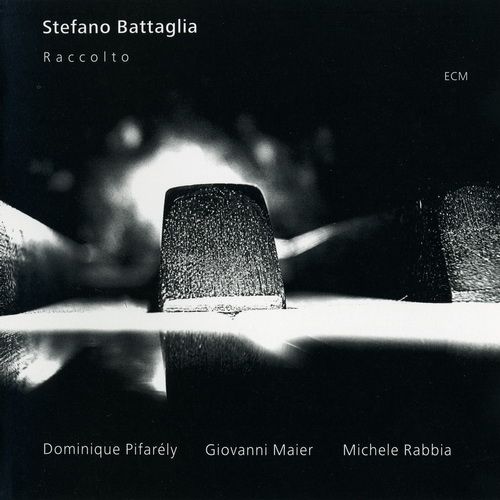
Stefano Battaglia: Raccolto (ECM 1933/34)

Raccolto

Stefano Battaglia
Raccolto

Stefano Battaglia piano
Giovanni Maier double bass
Michele Rabbia percussion
Dominique Pifarély violin
Recorded September/December 2003, Artesuono Recording Studio, Udine
Engineer: Stefano Amerio
Album produced by ECM

Raccolto is one of ECM’s most fascinating productions, though for some listeners surely also one of its most challenging. Significant enough for welcoming Italian pianist Stefano Battaglia to the label, it may be equally so for introducing percussionist Michele Rabbia, whose contributions are nothing short of revelatory throughout this double-disc effort. Battaglia and Rabbia are the common links to the album’s back-to-back trios, the first with bassist Giovanni Maier (better known as Triosonic) and the second with violinist Dominique Pifarély (a.k.a. Atem).

The standard jazz trio here is anything but in execution, as evidenced by the title track (meaning “harvest”), which opens the first session with Battaglia’s careful footsteps, joined by others in a dimly lit hall of mirrors. Striking here, aside from the rhythm section’s awakenings, are the Bach-like changes at play. It is as if the ensuing theatre of abstractions issues from the heart of history. With names like “All is language” and “In front of the fourth door,” it’s easy to get lost in each track’s spell, under which certainties become uncertainties and uncertainties become mantras. Motives seek rupture but find only a scrim of caution between them and full-on embodiment. And so, they dream of that embodiment instead, and this is the sound to which we are made privy, especially in the brief, and sometimes astonishing, culminations scattered throughout. Rhythms are thus implied more than they are directed, caught in virtuosic blips from the man at the keys or from Rabbia’s dustings of shrapnel and time. In these examples, as in “Our circular song,” the percussionist reveals worlds unto himself.

Not to be left behind, Maier grabs a lion’s share of spotlight in “L’osservanza,” which concludes the set in a vehicle of tender, lyric flashes. It’s a billowing weave that cups wind as a flower would sunlight. The bassist’s soloing in “Triangolazioni” adds depth to whispers and occupies a poetic center. He further inspires Battaglia to crystalline segues of call and response. “Coro,” then, can be nothing but a maze. Rabbia adds to it insect wings, hushes of children and slumber, of hiding and protection, so that Battaglia’s chording can find consummation only within. Hence, too, the two tracks marked “Triosonic,” in which the piano gives up its ghosts so that others might live.

Disc 2 swaps Maier for Pifarély for a dozen classically inflected improvisations built around abstract themes. As the go-to violinist of Louis Sclavis, Pifarély should surprise no one familiar with the violinist’s selective chamber appearances, each a window into another. His slippery playing recalls Luciano Berio’s Voci, especially in the folkish lilt of “Lys” and in the two “Cantos.” The latter feature prepared piano for a glassine effect, while Rabbia dips into more metallic streams of consciousness. And then, there is the obvious homage, “Recitativo in memoria di Luciano Berio,” which finds the trio mining the Italian landscape for ideas.

Surrounding moods range from frenetic to elegiac, achieving soul-digging brilliance in “Riconoscenza,” “Velario de marzo,” and “Pourquoi?” The last is tempered by Pifarély’s gravelly soothsaying in a showing of perfect restraint. Through various geometric configurations, the three musicians follow string paths as blood navigates veins until they reach the resonant frequency of “…Dulci declinant lumina somno…” It is the unforeseen view underlying everything, a vista within a vista, fragile as a moth’s wing.

It’s only appropriate that Battaglia should have found a home at ECM. The pianist cites Paul Bley’s Open, To Love and Keith Jarrett’s Facing You as defining encounters that pushed his classical rigor into dovetailed paths of improvisatory possibility. His Raccolto is one stubborn staircase, indeed, but well worth the climb. A debut to remember.

Stephan Micus: on the wing (ECM 1987)

on the wing

Stephan Micus
on the wing

Stephan Micus sattar, mudbedsh, classical guitar, nay, shō, hné, suling, Tibetan cymbals, gongs, hang, 14-string guitar, steel string guitar, shakuhachi, mandobahar, sitar
Recorded 2003-2006 at MCM Studios

For his 17th ECM album, multi-instrumentalist and world traveler Stephan Micus maps further paths along soft geographical borders. Whereas on his last trek, 2004’s Life, Micus sprouted vines around a Japanese Buddhist kōan, here the voice of the man behind the means comes through his playing rather than his singing. The narrative arc is yet firm beneath his step, even if its location remains undisclosed at the final breath. Indeed, breath is by no means less operative herein, flowing as it does through a wealth of reed instruments, including the Iraqi mudbesh, the Egyptian nay, the shō (Japanese mouth organ), the Balinese suling, and the Burmese hné. From them issue the voices of this 10-part suite of sentiment, from which a peaceful core unspools.

Much of the music occurs in intimate settings. Part 1, from which the album gets its name, threads the mudbesh through two droning sattar, a bowed instrument favored by the Uyghurs of western China. As is his way, Micus obscures the origins of these instruments by floating them on idiosyncratic currents. The wind of the mudbesh captures spirit and pulls it through tree leaves, each a feather trembling on a skeleton without direction or need, floating and falling in an unwritten cycle. “Winterlight” bolds the underlying silt with three sattar, trembling like a dream that clings to the body in a scrim of frost. There is something medieval, even Nordic, about the sound that leaves wolven footprints in snow. A sleek form trudges along the riverbanks, eyes glistening with a gold that can never be obtained without destroying the soul. And so, it hides behind a cloak of dawn, the tender glow of which outshines even the rarest mineral treasure.

“Gazelle” follows with a pairing of nay and classical guitar. The latter, for all its lilting hold on pitch, becomes koto-like in Micus’s hands. It seems to embody the comfort of a life lived on the ground, while the nay circles overhead in search of possible dangers in the open plains. Resigned to those dangers, its heart beats on, anticipating the moment when it will no longer sound its drum. In that alertness there is harmony, a certain calmness of mind that casts itself to the elements of which it is but a shred. This is not, despite my attempts at wording, a purely descriptive track. Its title, like all on the album, is a stepping-stone toward less overt associations.

Forces build through the reed-thickened “Blossoms in the Wind” (for 2 sattar, shō, 3 hné, and 2 suling) to the fulcrum of “The Bride.” One of two larger “ensemble” pieces (this for Tibetan cymbals, Korean gong, Burmese gong, 3 hang, 14-string guitar, steel string guitar, mudbesh, shakuhachi), its reed work draws folding lines across the sky in preparation for its origami transformation. The breathy shakuhachi slides its way into frame center, even as it magnifies the edges in kind. Thus united, the flutes ride waves of without fear, their sole cargo a dowry of ether.

“Ancient Trees” lessens the forces with 6 shakuhachi, 2 sattar, and 4 mandobahar (a rare Indian stringed bass) even as it seeds possibilities. Here the shakuhachi is the agency of the drone, climbing trees like stairways into cloud. “In the Dancing Snow” again fronts the shrill mudbesh, now over 3 sattar, in a dance of ice and flame.

In the shadow of such greatness, the intimacy of “The Gate” is astonishing. This sitar solo is decades in the making, for it would take as long before Micus felt comfortable enough to commit something like this to record, and shows the fruits of his efforts to tame its overwhelming web by paring it down to two strings. Every bend holds a key to entry and ushers the listener into a world of ghosts with lingering attachments, each with a story endlessly repeated in the hopes that someday, someone will hear it and grant peace. It is further proof that Micus’s most powerful pieces are unaccompanied. That said, we are left with the album’s second major expanse, “Turquoise Fields” (2 steel string guitars, 3 hné, 2 suling, 3 sattar, 3 nay), which is an astonishingly immersive experience. As strums of guitar shift like wind through barley, a chain of solos from sattar and high reeds marks the transfusion point between the sacred and the profane. Last is “Morning Sky,” a congregation of five hné in a dance of farewell, but also of greeting. Which is to say that it welcomes us even as it sends us on our way.

FLY: Sky & Country (ECM 2067)

Sky & Country

FLY
Sky & Country

Mark Turner tenor and soprano saxophones
Larry Grenadier double-bass
Jeff Ballard drums
Recorded February/June 2008 at Avatar Studios, New York
Engineer: James A. Farber
Produced by Manfred Eicher

The intimately democratic trio known as FLY encompasses the talents of saxophonist Mark Turner, bassist Larry Grenadier, and drummer Jeff Ballard. The expressiveness of each member takes flight not only in the playing, but also in the composing, and for a spell tilts ECM’s Europe-leaning scale Stateside.

Ballard pens three tunes, including opener “Lady B,” which sets the dial to a pervading, if understated, hipness. The vibe is at once robust and airy, equalizing Grenadier’s superb melodic sensibilities with Turner’s go-with-the-flow changes and Ballard’s spinning color wheel. Here, as throughout, the trio sways between dance and chance, taking its time to develop a slippery groove and overlapping just so before pulling its improvisational ripcord. Ballard also contributes the laddered title track and “Perla Morena,” in which the groove continues at the level of a subconscious whisper. The latter tune throws a spotlight on Turner, who braids tasteful, virtuosic arpeggios in his soloing.

From Grenadier we get two tunes. The ballad “CJ” is a turning point in the album. The composer is, rightly enough, its heart and soul, and against thought-splashes of cymbals offers his monologue as a open meditation on the question of love. “Transfigured” is a sparser dialogue between Turner and Ballard in which Grenadier fleshes the skeletal spaces between with arco tissue. These freer gestures grab some traction as the rhythm section blends into song, only to snap out of its self-induced spell with fibrillating shine.

Turner’s pen yields four tunes, ranging from buoyant chromatism (“Elena Berenjena”) to slick fantasy (“Anandananda”). Yet it’s his “Super Sister,” which closes the album with 11 minutes of flattering ruminations, that shows the band at its finest. Here arises the full instrumental palette. Between Ballard’s murmuring poetics, and the swinging DNA helixes spun by Turner and Grenadier, there’s so much to admire and tease apart that you may just want to put the album on again the moment it ends.

Encore!

(To hear samples of Sky & Country, click here.)

Eberhard Weber: Stages Of A Long Journey (ECM 1920)

Stages Of A Long Journey

Eberhard Weber
Stages Of A Long Journey

Gary Burton vibraphone
Jan Garbarek soprano and tenor saxophones
Rainer Brüninghaus piano
Eberhard Weber bass
Marilyn Mazur percussion
SWR Stuttgart Radio Symphony Orchestra
Roland Kluttig conductor
Recorded in concert, March 23/24, 2005, Theaterhaus Stuttgart
Engineer: Michael Sandner
Concert produced by Martin Mühleis

Stages Of A Long Journey documents the best moments of two March 2005 concerts in Stuttgart celebrating the 65th birthday of Eberhard Weber. The bassist has, of course, been a mainstay at ECM, where his comparable talents as composer and arranger have found room to flourish since his breakthrough “Colours” discs of the seventies. This is his first live record for the label he calls home.

The album’s roster represents decades of inter- and intra-musical friendship, and dots a compass of profound collaboration. Saxophonist Jan Garbarek, in whose self-named group Weber has performed alongside many of the other featured musicians, returns the favor by casting his nets back to tunes in which he was never originally involved. The elliptical nature of it all brews fresh ideas and colorations, especially in the duo track “Seven Movements,” in which Garbarek’s soprano rides the ember-glow of Weber’s arpeggios like a bird on the wing.

Another evocative duo comes in the form of “Yesterdays.” The 1930s show tune pairs Weber with surprise guest (and oldest ally of them all) Wolfgang Dauner, he of the elusive Output, at the keys. In this conversation, one encounters the joy with which the bassist emotes. This makes it the most nostalgic portion of the program, which is perhaps why Weber foregoes his trusty electrobass and, in a rare turn, goes unplugged for a spell on the standard upright.

Another wizard of the keyboard, Rainer Brüninghaus, is a necessary presence for such a performance. Having contributed atmospheric details to so many of Weber’s tapestries, he lifts the classic “The Colours of Chloë”—which opens the five-part Birthday Suite—to new heights. The combination of bass and piano here reaches across and beyond the ensemble’s stretched canvas. Brüninghaus furthers the suite with his original “Piano transition,” as does percussionist Marilyn Mazur in her “Percussion transition,” both satellites orbiting Weber’s dreamlike “Maurizius” in telepathic gravitation. Moreover, Vibraphonist Gary Burton makes his mark on “Yellow Fields,” the suite’s final offering. Here, too, is where the final pieces of the puzzle work most intuitively, as the 90-piece Stuttgart Radio Symphony Orchestra, under the baton of Roland Kluttig, transitions across newly fertilized surroundings with its unassuming blend.

Because there has always been something of an orchestral heart beating in Weber’s music, one should not put too much stock into its actualization herein. This is duly apparent in “Silent Feet.” As the album’s opener, it is as likely an introduction as any for those hearing these pieces for the first time, but on its waves bobs the unblemished torch of interpretation that Weber has carried all these years, reaching full conflagration in a new take on Carla Bley’s “Syndrome.” This pet tune takes listeners into exciting directions as Weber navigates a shifting mosaic—sometimes in triplicate, sometimes duplicate—with controlled heat.Percussionist Reto Weber and beatboxing phenomenon Nino G join in the fun for “Hang Around” (a wordplay on Reto’s hang drum), much to the audience’s obvious delight. It is a playful interlude, but an equally conducive facet of the bassist’s prism, as is “The Last Stage Of A Long Journey,” a veritable origami figure of wind, land, and, above all, light.

Eberhard Weber’s music is a process of translation. Through it all, his bass is a visceral, thrumming magnet that seems to emerge from the very earth even while burrowing into it. His musical language is interlocking yet contrapuntal. Like an open book, its pages contain infinite wisdom but come together at the spine. All the more appropriate that Weber should end solo with “Air.” A summation but also a beginning, it is a badge of honor as only he can wear it.