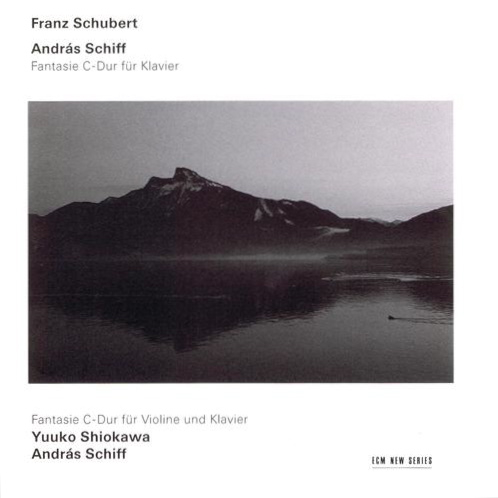
András Schiff: Schubert C-major Fantasies (ECM New Series 1699)

Schubert Fantasien

András Schiff
Franz Schubert C-major Fantasies

András Schiff piano
Yuuko Shiokawa violin
Recorded December 1998, Schloss Mondsee
Engineer: Stephan Schellmann
Produced by Manfred Eicher

It is tempting to say that the music of Franz Schubert (1797-1828) was ahead of its time. In the words of pianist András Schiff, “Schubert has such modernity—perhaps his time has only arrived now.” When encountering the 1822 “Wanderer” Fantasy for the first time, the characterization would seem to fit like a tailored suit. And yet, if we track its subsequent influence on composers as diverse as Liszt and Ligeti, it becomes clear that he was a composer of his moment, and it is this moment to which so many listeners have returned in their own wanderings. It might, then, be more accurate to say, “Modernity has such Schubert.”

In the first half of this recital disc for ECM, Schiff flows through the piece’s technical challenges like a river through a forest. As remarkable as this is, more intriguing are the ways in which he navigates its emotional mazes, for as a Schubert interpreter Schiff prefers poetry to drama. He gives requisite oomph to the magisterial introduction and from it elicits rounded gestures implying acres of pasture at a single touch of key. Yet his most commanding moments are the gentlest. Almost as still as mirrors, they reflect the leaf-patterned light that seeks them. Pulling away the vines, Schiff smells the moss, fecund with mystery. Knowledge of Schubert’s all-too-brief life inflects these passages darkly. From the spectral to the colloquial, the “Wanderer” spans the gamut of responses to landscape, though the Beethovenian desperation in the final fugue is undermined by an intermittent restraint that may sit oddly with fans of benchmark recordings like Richter’s or Pollini’s. Still, a resplendent sign-off gives the piece a total shape that is Schiff’s own.

His wife, violinist Yuuko Shiokawa, joins her partner for Schubert’s Fantasy D934, also in C major. Published posthumously in 1850, its proper score rested dormant beneath the recital stage until the 1930s. Emerging in a ghostly whisper, Shiokawa draws a spider’s thread through the piano’s microscopic tides. This is the dream to the former fantasy’s waking, made manifest through the strains of an inviting dance. Shiokawa brings appropriate balance of airiness and strident romanticism to what is arguably some of Schubert’s most beautiful writing. She partners well with the piano as a parallel voice—neither competing nor unified. Shiokawa also handles the technicalities with grace, particularly during a delightful passage that floats pizzicato in cascading undulations from Schiff’s fingers. Another flowery conclusion, if more succinct than the last, again closes the circle with confidence.

The recording here is noticeably soft in texture, heavy in the lower register. The combination sucks a bit of wind from Schubert’s sails in portions, especially in the finale of the “Wanderer.” Both Fantasies remain purest in their introductions and in their quieter turns. Such issues aside, with these two pieces Schubert shows that perhaps all music is fantasy.

<< Dave Holland Quintet: Prime Directive (ECM 1698)
>> Jan Garbarek/The Hilliard Ensemble: Mnemosyne (ECM 1700/01 NS
)

Dave Holland Quintet: Prime Directive (ECM 1698)

Prime Directive

Dave Holland Quintet
Prime Directive

Dave Holland double-bass
Robin Eubanks trombone
Chris Potter soprano, alto and tenor saxophones
Steve Nelson vibraphone, marimba
Billy Kilson drums
Recorded December 10-12, 1998 at Avatar Studios, New York
Engineer: James Farber
Produced by Dave Holland

Chris Potter replaces Steve Wilson as reedman in this follow-up to the Dave Holland Quintet’s Grammy-nominated Points of View. The band’s tremendous communication and obvious joy embolden a strong set of nine tracks, five of which come from Holland’s pen, starting with the title. The addictive rhythms are quintessential Holland and usher us into a sound-world that one hardly wants to leave. In this respect, drummer Billy Kilson rules the roost from start to finish. Working seamlessly with Holland as Potter and trombonist Robin Eubanks cast nets over Steve Nelson’s liquid crystal vibes, he engenders a pollinated groove without fail. Kilson further inspires his band mates to step up their rhythmic game, as in “Jugglers Parade,” which boasts a fine example of Holland’s ability to embolden even the most upbeat solos through an inborn lyrical power (not to mention some lovely sopranism from Potter on the recharge), and “Down Time,” the closing trio number with Eubanks in the lead. Potter takes up Kilson’s call most creatively in “Looking Up,” as does Nelson in an epic solo. The smoky rejoinder from Eubanks morphs into a percolating extravaganza and recedes for a quiet yet robust solo from Holland. The leader-bassist seems to deliver a caravan track in every session, and this time around “Make Believe” is it. A sandy and romantic excursion, it spreads the night sky like paper, across which Potter inscribes a love letter to the art of improvisation.

Holland’s coconspirators offer a tune each. Eubanks steals the show with his fireside dance, “A Searching Spirit,” pulling out a bubbling yet punchy solo, while Nelson gallivants through Kilson’s inescapable groove. The alto touches on the downswing foreshadow Potter’s equally upbeat “High Wire.” Nelson sweeps back with his forlorn “Candlelight Vigil,” which feels like an epilogue, a coda, an honest sigh. Kilson bows out here, while Holland picks up his bow for some fluid talk. The drummer returns on his “Wonders Never Cease,” which from a soulful intro by way of Holland looses a stream of inspired beats.

Prime Directive is a listener’s gift, wrapped and tied with a bow, and a viable contender for Holland’s finest ECM session.

<< John Dowland: In Darkness Let Me Dwell (ECM 1697 NS)
>> András Schiff: Schubert C-major Fantasies (ECM 1699 NS
)

Kenny Wheeler: A Long Time Ago (ECM 1691)

A Long Time Ago

Kenny Wheeler
A Long Time Ago

Kenny Wheeler flugelhorn
John Taylor piano
John Parricelli guitar
Derek Watkins trumpet
John Barclay trumpet
Henry Lowther trumpet
Ian Hamer trumpet
Pete Beachill trombone
Richard Edwards trombone
Mark Nightingale trombone
Sarah Williams bass trombone
David Stewart bass trombone
Tony Faulkner conductor
Recorded September 1997 and January 1998 at Gateway Studio, Kingston
Engineer: Steve Lowe
Produced by Evan Parker

A Long Time Ago takes another dip into the oceans explored on trumpeter-composer Kenny Wheeler’s Music For Large & Small Ensembles. Yet where that disc moved diaristically from one paragraph to another in an organic stream of consciousness, here the slant is toward Wheeler the essayist, toward his understanding of jazz as a space of melancholy theses.

At the album’s core is pianist John Taylor (whose years of experience with Wheeler in their Azimuth outfit with Norma Winstone bear clear fruit), guitarist John Parricelli (an eclectic talent whose dream of playing with Wheeler was at last realized with this recording), Derek Watkins (one of this project’s prime instigators), and Wheeler himself, who opts exclusively for flugelhorn. Aside from Taylor, there is no percussionist on the roster; only a sizable band of trumpets, trombones, and bass trombones. The resulting sound is multifarious, deep, and quintessentially Wheelerian.

Wheeler is a reassuring protagonist, and as he steps into the verdant morning fields of the album’s eponymous suite, painterly and brimming with feeling, he weaves a nostalgic tapestry of diamonds and circles. Between the lush arrangement and the synergistic nexus maintained by Taylor and Parricelli, the tone is generally somber and wood-grained. This does not, however, keep Wheeler from coloring outside the lines as the mood strikes him. These bright, squealing breaches are all the more vivid for their intermittence. “One Plus Three,” of which a second version ends the set on its most somber note, boasts further abstract moments in a distinct, naked voice.

If the album as a whole feels elegiac, then this feeling is brought home tenfold in “Ballad for a Dead Child,” a dirge which after a funereal intro opens into expansive duetting from Wheeler and Taylor. As the horns at large blend back in, they combine the here with the hereafter. While on a lonely train ride through twilit landscape in “Eight Plus Three,” the lively dream of “Alice My Dear” cracks its first smile. It is a smile of appreciation that sends positive energy into “Going for Baroque.” The latter has the quality of a royal fanfare and reveals the Renaissance sources that have long inspired Wheeler’s pen. It is also a vaulting segue into the “Gnu Suite,” which finds material from Wheeler’s ECM debut, Gnu High, dramatically re-imagined.

Wheeler is the photographer who, in a digital age, still prefers to step into a dark room, close the door, and let his music develop. His images embrace imperfections as a means of balancing all that is in focus. And so, while this is an album for brass lovers at heart and deserves a spot on any ECM collector’s shelf right next to the Surman/Warren Brass Project, it is also a prime example of how sound can transcend its means and become its own story.

<< Gudmundson/Möller/Willemark: Frifot (ECM 1690)
>> Eleni Karaindrou: Eternity and a Day (ECM 1692 NS
)

Gudmundson/Möller/Willemark: Frifot (ECM 1690)

Frifot

Frifot

Per Gudmundson fiddle, octave fiddle, Swedish bagpipes, vocal
Ale Möller mandola, natural flutes, hammered dulcimer, folk harp, shawm, vocal
Lena Willemark vocal, fiddle, octave fiddle, wooden flute
Recorded September 1998 at Rainbow Studio, Oslo
Engineer: Jan Erik Kongshaug
Produced by Manfred Eicher

When I smile my face shines like
Sunlight glittering on the water’s surface,
But when I cry my face is like
A dark pine forest under a cloudy sky.

Frifot are Per Gudmundson, Ale Möller, and Lena Willemark, the holy trinity of Swedish folk revivalism. The name means “footloose,” a word that locates their effortless playing in a realm of dance. Much of that spirit comes through in the handful of diptychs scattered throughout this epic self-titled program. These embody layered juxtapositions of sonority and exposition, of comet and tail, rushing through eons at the touch of plectrum and bow. Of them, the intimate pairing of “I hela naturen / Mjukfoten” (In All Nature / Light-foot) is an album highlight, its Robin Williamsonian waves flowing into the mandola’s rich speech acts. “Silder” (Still Waters), an ode from Willemark’s pen, glitters by kindred harp light and reaches out through the lighter “Bingsjö stora långdans.” From the uplifting polskas of fiddle-hunter Sjungar Lars to the brooding shores of “Om stenen” (The Stone), one feels a tireless will at work. The latter’s text by Swedish poet Bengt Berg paints it true: “Listen to the sound of the sun sinking into the lake.”

Surrounding all this merrymaking is deeply considered soil that takes first nourishment in the a cappella “Abba fader” (Abba Father), a song once preserved only in the memory of Baltic islanders whose Swedish ancestors emigrated to the Estonian coast during the Middle Ages. One hears earthen harmonies in the musicians’ voices, the gravel and scrape of time as it leaves its scars. A hammered dulcimer and rustic fiddle cradle “Stjärnan” (The Star), which evokes the miracle in Bethlehem, holding ancient vigil for those with a willing ear. “Tjugmyren” is composed of herding calls. The nasal, almost Bulgarian-sounding singing shows Willemark’s range of height and density. Calling through windswept grain, she plants her feet in the soil and grows where she stands. “Kolarpolskan” (The Charcoal-burner’s Polska) is another herding tune, this one more uplifting and with a bit of a Sephardic twist.

The listener hardly needs names to feel the stories. This is especially true in “Hemvändaren” (The Homecomer), which from hopeful beginnings spins a tale of bittersweet reunion and attempts to answer how one carries the hardships in the context of the resolution toward which they are endured. Another example of the album’s programmatic acuity is the agitated brushwork of “Fåfänglighet” (Vanity), while Gudmundson’s “Drömsken” (The Dreamer) evokes softer crosscurrents of instrumental expression. Yet another is “Skur Leja.” Written by Möller, it tells of a magically virtuous maiden whose purity puts not so virtuous men in their place and through its telling achieves a tense drama of flesh and intrigue. Other evocative standouts include “Metaren” (The Lazy Fisherman) and “Roligs Per-låtar,” a play on motives of itinerant fiddler and entertainer Roligs Per Persson.

As always, Willemark’s voice rings dependably through this cosmos with a palette like the very planet from which it springs: a swirl of blues, greens, and whites. The accompaniment is so much more than that, flapping as it does with all the conviction of a bird of prey even as it nestles, gentle as a lamb, in pasture. Notable also is the attention paid to selection and song order. Its flow runs deeper than a river in the thirstiest of land.

<< Heiner Goebbels: Surrogate Cities (ECM 1688/89 NS)
>> Kenny Wheeler: A Long Time Ago (ECM 1691
)

Jan Garbarek: RITES (ECM 1685/86)

RITES

Jan Garbarek
RITES

Jan Garbarek soprano and tenor saxophones, synthesizers, samplers and percussion
Rainer Brüninghaus piano, keyboard
Eberhard Weber bass
Marilyn Mazur drums, percussion
Jansug Kakhidze singer and conductor
Tbilisi Symphony Orchestra
Bugge Wesseltoft additional synthesizer and electronic effects, accordion
Recorded March 1998
Engineer: Jan Erik Kongshaug
Produced by Manfred Eicher

Our light is a voice.
We cut a road for the soul,
for its journey through death.

RITES is without question Jan Garbarek’s magnum opus. If not for the simple fact that it spans one and a half hours over two discs, it mines the deepest ores in the saxophonist-composer’s already vast oeuvre and polishes them just enough to let their colors speak. Every melody is a new stratum, a vein in the rock with a story to tell. The initiation begins with the cinematic title track. Accented by a light dusting of field recordings (taken during Garbarek’s travels in India), it follows a deep bass pulse and warm synths along an aerial view of mountainous terrain…barren, misty, and free. An eagle traverses these plains, the one who has seen it all: from ocean through volcanic eruption to solidification, from inhabitation through migration to desertion. Garbarek’s soprano peals like the lone survivor calling out to that eagle. The call goes unheeded. The eagle carries on, carrying nothing. In desperation, the survivor resigns himself to what must be and what never can. “Where the rivers meet” unspools his wayfaring in reverse, the last hopeful stage of a trek that brought him into the clearing. Like salmon leaping from the water, motives catch a glint of sun before they splash back into river’s flow. In that turgid reflection struggles the natural scope of “Vast plain, clouds,” where bassist Eberhard Weber leaves only the shadows of seedlings by way of drooping, willowed lines.

Garbarek flips back through the pages to his past with a haunting rendition of his quintessential “It’s OK to listen to the gray voice.” Its brushed cymbals and bubbling pianism invite us to look at our own lives anew. Keyboardist Rainer Brüninghaus provides epic touches to “So mild the wind, so meek the water” and “Her wild ways,” both of which give insight into the survivor’s maturation, while “It’s high time” brings us into the night of revelry that embraced his conception, further to the seat of his ancestry. The youthful candor of his discoveries, the newness of his faith, surprises one whose soles still bleed from the long journeys. And so, he bids, “Song, tread lightly,” cradling his own birth in a night vision.

The second disc thus replaces the survivor with a diary of things intangible. Here we come to know the profundity of joy. The memorable balance of “One Ying for every Yang” posits Garbarek and Weber against a shifting synth backdrop of liquid texture, while “Pan” and “Evenly they danced” enable likeminded playfulness. “Malinye” (written by, and offered in memory of, Don Cherry) is a distant carnival, an atmosphere emphasized in “The white clown,” which works its twisted spell in service of a childhood dream.

Two notable cameos come to us in the form of “We are the stars,” featuring the Norwegian youth choir Sølvguttene in a setting of a Passamaquoddy (Native American) poem, and another setting of Galaktion Tabidze’s “The moon over Mtatsminda” by Georgian composer Jansug Kakhidze. A tireless advocate of Giya Kancheli’s music, Kakhidze offers voice and baton in kind, conducting the Tblisi Symphony Orchestra in a heartrending song that hangs on a silver thread. This song is a rite unto itself, a window into cultural understandings that weave themselves into tapestries of experience until one day a tug sets off their colors just so. In light of this, “Last rite” rings prophetically. Though essentially a reprisal of the opening track, it elides the reed. With the survivor’s call now gone, we are left with a choice: implore the passing eagles in our lives for assistance or move on until we find what awaits us.

<< Ketil Bjørnstad/David Darling: Epigraphs (ECM 1684)
>> Veljo Tormis: Litany To Thunder (ECM 1687 NS
)

Ketil Bjørnstad/David Darling: Epigraphs (ECM 1684)

Epigraphs

Epigraphs

Ketil Bjørnstad piano
David Darling cello
Recorded September 1998
Engineer: Jan Erik Kongshaug
Produced by Manfred Eicher

Driven into the
terrain
with the unmistakable track:
grass, written asunder.
–Paul Celan, “The Straitening”

Until Epigraphs, the output from Norwegian pianist Ketil Bjørnstad and American cellist David Darling had been explicitly aquatic, as on The River the duo furthered ideas and atmospheres explored on the quartet project The Sea. Here there is a more grounded sense of architecture. And while some of it remains activated by water, for the most part it observes as it feels: on high ground. It is not a boat but an observatory, which allows the eyes to look freely into the heavens where feet and oars may not progress.

The resonance of the recording takes lantern shape. The “Epigraph” theme is its flame. As such, it flickers without ever losing hold of wick, a moment of dance lost as quickly as it fades. Much of this light comes through in song titles alone. There is enough dawn in “Wakening,” for one, to deny the imminence of dusk, so that the draw of “Silent Dream” moves with almost painful self-awareness. “The Lake” looks back through overtly drenched eyes toward a moving rite of passage. “Gothic,” too, sounds like a seed for The Sea that never sprouted, content in being self-contained. One can almost hear those distant cries, swooning electric between the clouds. In the spirit of balance, Darling digs low in “Upland,” reassuring us that Earth is not forgotten. He slips into the topography of Bjørnstad’s playing like a shoe to a foot, which follows wherever the wind may lead. Only at the end does he leap skyward through the narrow eye of a shooting star.

A smattering of Renaissance material by William Byrd, Orlando Gibbons, Guillaume Dufay, and Gregor Aichinger rounds out the disc and reveals itself as the core of everything that Bjørnstad and Darling have molded together. Byrd’s “Pavane” is replete with such gentility in the artists’ touch that one can almost taste the mythological impulses that nourish them. Aichinger’s “Factus Est Repente” ends with stark hymnal energy. Like the fountain pen that flows as long as there is ink, it fades only when the blood has left its poetry.

Epigraphs further yields two important tracks for both musicians and label. First is “After Celan,” which combines the shape of words and the shape of music. Second is “Song for TKJD,” a profound dip into Darling’s whirlpool of multi-tracked pathos. Here the landscape stretches, pixilates into a mosaic of monochrome. Like a lost traveler from his Cello, it comes to us fully bearded with the eternal youth of its message. It is a wavering tapestry in which Bjørnstad somehow finds purchase in the bones, a ladder of pages in absence of binding.

The quiet power of this music is its emphasis of reality over thought. It rounds the edges of our quotidian activities with intermittent variations, leitmotifs, and signposts. Bjørnstad and Darling share an ability to take something melancholy, even morose, and flood it with light to expose a spectrum in darkest hours. From the past to the present and back again, their path ties a loophole in space and cinches it until the moon closes her monocle.

<< John Abercrombie: Open Land (ECM 1683)
>> Jan Garbarek: RITES (ECM 1685/86
)

John Abercrombie: Open Land (ECM 1683)

Open Land

John Abercrombie
Open Land

John Abercrombie guitar
Mark Feldman violin
Kenny Wheeler trumpet, flugelhorn
Joe Lovano tenor saxophone
Dan Wall organ
Adam Nussbaum drums
Recorded September 1998 at Avatar Studios, New York
Engineer: James Farber
Produced by Manfred Eicher

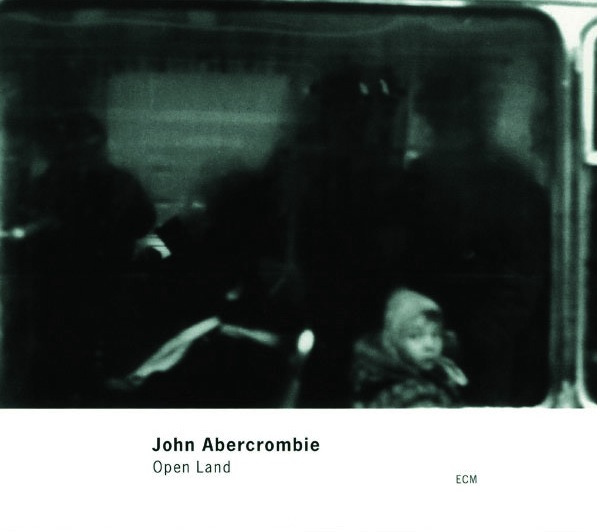
After a string of intriguing albums for ECM, John Abercrombie’s organ trio welcomes violinist Mark Feldman, trumpeter Kenny Wheeler, and tenor man Joe Lovano into the fold for Open Land, a leader-penned session of unusual sound colors and depth. Like all great albums, it reveals more with each listen, so that its augmentations grow more inextricably fused as the music becomes more familiar. From the first lilt of Wheeler’s brass in “Just In Tune,” it’s clear that the increased number of musicians hones the band’s spirit at a microscopic level. To be sure, the rising tide spun by Nussbaum and Wall paints smooth expanse across which Abercrombie stretches his webs—a magic formula that served well in While We’re Young, Speak Of The Devil, and Tactics. By the same token, here the mirage falls inward, catching the phosphorescence of every solo in a jar of fireflies. Even in tracks like the far-reaching “Speak Easy,” Abercrombie builds a tower to the sun but unlike Icarus stops short and looks down at the world for a while, quietly musing to itself before regressing into its core. The lush grooves are still there (“Gimme Five”), as are the featurettes (“Little Booker” and “That’s For Sure”), and the horns coalesce beautifully in tracks like “Remember When.”

Yet it is Feldman whose presence pays highest dividends. A heartfelt take on Felix Mendelssohn’s “Spring Song” gives life to the violinist’s quivering mastication, which breathes anew in the crystalline acoustics of Avatar Studios. This track stands out also for the method of its soloing, which finds each musician echoing another in a perfect circle. Wall is particularly effervescent, bouncing from Abercrombie’s chording like a paddle ball. Feldman sandwiches a crunchy guitar center, sharing bursting thematic lines with downright mitochondrial energy. “Free Piece Suit(e)” is, however, the most fascinating little puzzle of this date and thus finds Feldman in his element, jumping from ecstatic cries to chromatic undertows in the blink of a bow. Nestled in Abercrombie’s network of nerves, he sings a life neurotic as if it were poetry to be savored.

<< Franz Schubert: Sonate B-Dur op. posth. D 960 (ECM 1682 NS)
>> Ketil Bjørnstad/David Darling: Epigraphs (ECM 1684
)

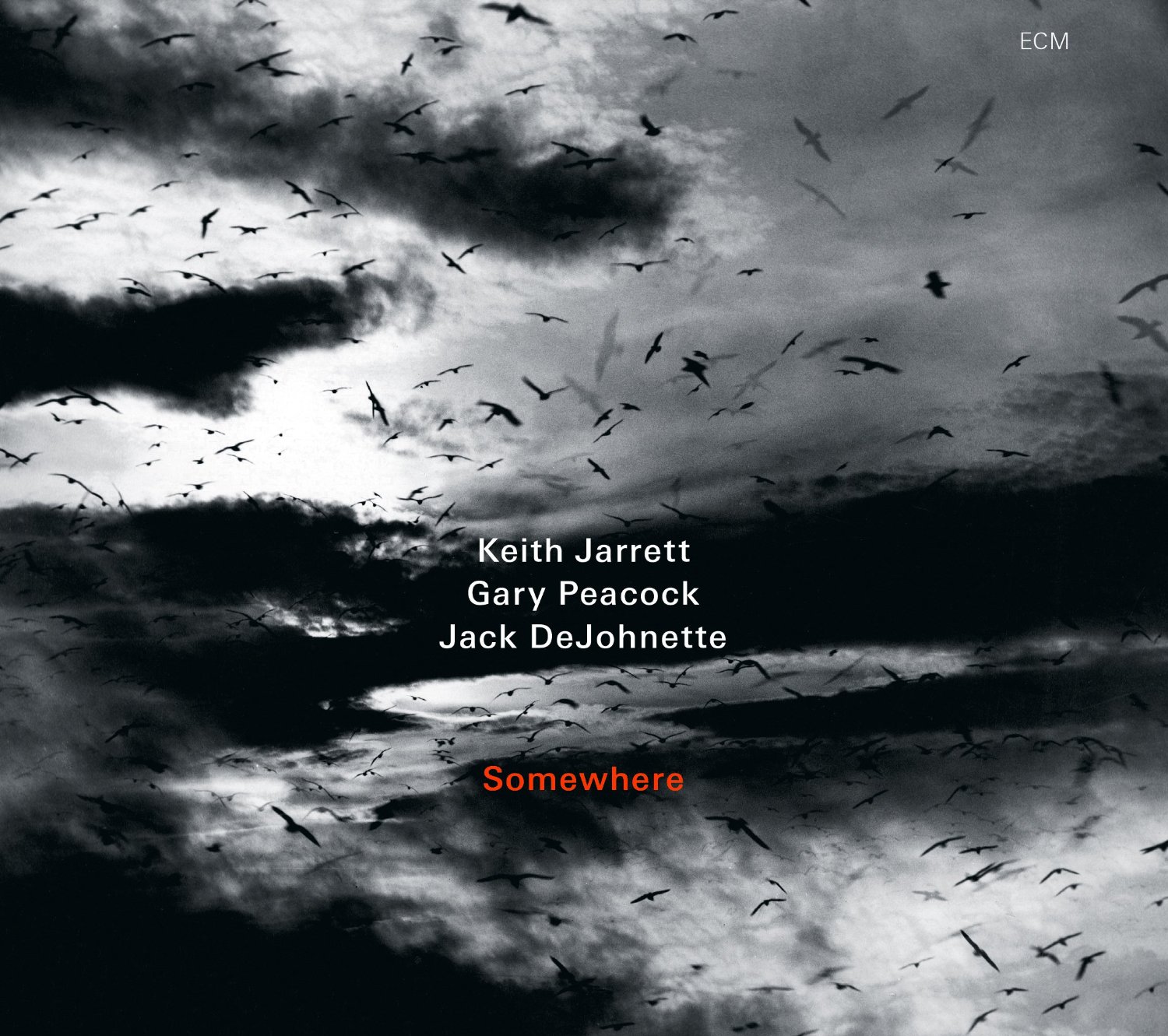
Keith Jarrett Trio: Somewhere (ECM 2200)

Somewhere

Keith Jarrett Trio
Somewhere

Keith Jarrett piano
Gary Peacock double bass
Jack DeJohnette drums
Recorded live July 11, 2009 at KKL Luzern Concert Hall
Engineer: Martin Pearson
Produced by Keith Jarrett
Executive producer: Manfred Eicher

In the same way that 2012 gave Keith Jarrett fans reason to celebrate with the awakening of Sleeper, so does 2013 bring light, placing us at the center of things in a magical new record from his nonpareil trio with Gary Peacock and Jack DeJohnette. More than any other, this joint proves they are no mere instrumentalists but also singers, each in his way.

Somewhere was recorded—not live but alive—in Lucerne, Switzerland in July of 2009. Though it comes to us after a four-year steep, it is as fresh as the day it hit the ether. Jarrett opens with “Deep Space,” a protracted solo that leads into the Miles Davis classic “Solar.” If the transition between the two reveals anything, it is that these three souls, lit as they are by unwavering musical pilot lights, have traveled so far together for so long that the album’s title might as well be “Everywhere.” A feeling of openness and suspension emphasizes the three decades’ worth of magic that came together for this performance, each note a glow-in-the-dark star that still phosphoresces when the lights go down. Lest we get lost in the pitch of night, Jarrett lays down his runway particle by particle, giving his band mates all the guidance they need to fly. Peacock elicits a highlight or two in this 15-minute wind-up, flapping through changes like one among the album cover’s flock.

Jarrett is, while a technical genius, above all a connoisseur of melody. As if to prove this, “Stars Fell On Alabama” gives voice to the dark side of the moon for a beauty that needs no sun to shine. Here Peacock swings from Jarrett’s vines into the loosely woven “Between The Devil And The Deep Blue Sea,” in which now DeJohnette stokes the fire. In the process, he does the impossible: emoting impressionistically with clearly delineated strokes. This only inspires Jarrett to passionate heights, every cluster from his fingers dotting the landscape with fresh flowers. Peacock’s ligament keeps us on track to a whimsical ending.

A 20-minute exposition of “Somewhere,” one of two tunes culled from West Side Story, finds every facet of its theatrical quality realized in the Jarrett addition “Everywhere.” Peacock moves like a throbbing heart in an early solo. Meanwhile, Jarrett’s left hand maintains a gentle metronome as the right tells its stories in the second person. The trio takes its second dip into the Bernstein songbook with a sparkling take on “Tonight.” Jarrett’s fingers dance up a storm, cascading into a rich solo from DeJohnette that leaves us floating along the strains of “I Thought About You,” which flows tenderly, sweetly, as it should.

Somewhere isn’t so much a homecoming as it is a shoring up of a structure that has already held firm against many tides. Jarrett’s ever-evolving pianism provides the aluminum siding, Peacock polishes the freshly installed hardwood floors, and DeJohnette fits new windows into every frame with until the house thrums with the presence of its longtime tenants. Being somewhere locates one not only in space, but also in time, and the album’s clip reminds us that improvisation is a luxury never to be taken for granted. In this spirit they sound more with it than ever, due in no small part to the recording, which stands comfortably at the lip of the stage and twirls with delight. The result is an album that holds its own alongside Still Live as one of the trio’s absolute finest.

KJT

(To hear samples of Somewhere, click here.)

Keith Jarrett: The Melody At Night, With You (ECM 1675)

The Melody At Night

Keith Jarrett
The Melody At Night, With You

Keith Jarrett piano
Recorded 1998 at Cavelight Studio
Engineer: Keith Jarrett
Produced by Keith Jarrett and Manfred Eicher

The Melody At Night, With You was my first Keith Jarrett solo album. And perhaps it was in a way for Jarrett, too. It interprets some of the greatest names in the American songbook—Duke Ellington, the Gershwins, Oscar Hammerstein and Jerome Kern, Oscar Levant, among others—yet tells their stories as if we’ve never heard them before. More than just another standards album in absence of his trio, this is the pianist at his purest. He approaches the music as a composer approaches a blank staff: which is to say, with wonder.

At the time of this recording, Jarrett was diagnosed with what was then known as fibromyalgia, a condition that variously affects muscles and nerves, leaving sufferers chronically fatigued. This meant that Jarrett was unable to perform, and for a while his fingers never touched a key. This in the wake of his highly successful Tokyo ’96, released after the affliction had taken root. Yet surely nothing could staunch the pilot light from which he had borrowed so much flame in his career, and it was this, along with his love for wife Rose Anne (to whom the album bears dedication), that informed his return to playing. To call this album intimate would be an understatement, recorded as it was under cover of darkness, gently, sweetly. Skin thus shed, he is a cause without a rebel, open to the vision of love that holds us in our darkest hour.

The album divides songs internally, balancing contradictory impulses in elegant weave. Gone are the transcendent moonwalks of yore. In their place are gravid statements of purpose. From the contact of “I Loves You Porgy,” the physicality of his playing is immediately apparent as every stretch of sinew and bone works itself back into flexible life. Treading a fine line between linear melody and cloudbursts of chords, between song and circumstance, it is the Rosetta Stone for all that issues from its stirrings. “I Got It Bad And That Ain’t Good” similarly mixes ecstasy into regret, thereby revealing a contradiction of love that cannot be shaken. Jarrett’s voice emerges, the groan of a waking giant. “Don’t Ever Leave Me” balances uncertainty and conviction by way of his fall-off-the-bone storytelling.

“Someone To Watch Over Me” sits at the fulcrum. An unadulterated gaze into the heart of things, it opens a window with every note and breathes light into the “Meditation” that flows from his touching rendition of “Blame It On My Youth.” With this one realizes, if not already, that something profound is going on—not only for the miraculous tinge of recovery that permeates, but also because of the way it emphasizes the vitality of music, as if it simply must be heard. This would also seem to be the message encoded into “Something To Remember You By.” Here the balance is of silt and crystal, while in “Be My Love” it is tears and laughter. “I’m Through With Love” ends on a bittersweet note, a fleeting coda that is anything but in its scope. Jarrett fleshes out the program with a pair of traditional favorites. In both, he pours his soul in the endings. What with the chromatic appliqué in the descending tail of “My Wild Irish Rose” and the string game of the heart that is “Shenandoah,” there is nothing more to do than close one’s eyes and breathe.

In this respect, The Melody At Night, With You is also a love letter to the songs themselves, for by the end the gift of performance gets lost in the billowing curtain of time, lingering as the memory of a dream, now dispelled in the morning light for an intensity that would otherwise obliterate us.

If this is where Jarrett’s heart lives, may it never die.

<< Charles Lloyd: Voice In The Night (ECM 1674)
>> András Schiff/Peter Serkin: Music for Two Pianos (ECM 1676/77 NS
)