Judith Berkson: Oylam (ECM 2121)

Oylam

Judith Berkson
Oylam

Judith Berkson voice, piano, Wurlitzer and Rhodes pianos, Hammond organ
Recorded April 2009 at Artesuono Studio, Udine
Engineer: Stefano Amerio
Produced by Steve Lake

Oylam marks the ECM debut of singer/composer/keyboardist Judith Berkson. Although the title denotes “world, universe, creation, reality, realm,” the music seems to append the word “inner” to each of these notions. As a cantor and teacher of liturgical music at New York’s Old Westbury Hebrew Congregation, Berkson is rooted in tradition, but also in the atonal composers that moved her in her teens. She also studied theory and composition with Joe Maneri, thus teasing out a label connection through this recording. Her solo work is a more recent development, the fruit of her time spent in various group contexts. Since 2003, she has focused her energies on her own accompaniment: “I’ve been trying to redefine, for myself, what that might mean, exploring new ways in which voice and piano can be combined and performed by one person, working on all the different possibilities of rhythm, melody, harmony, texture and so on.” Berkson employs a modest range of keyboards and effects, lending a distinctly personal cast to this set of mostly originals, with a stroll down Standards Lane for good measure.

Berkson
(Photo by Luca d´Agostino)

The solo piano “Goodbye Friend No.1” sets the tone for a program that is equal parts resignation and resentment, an honest and brooding look at the air of separations that binds us. Such are the ironies we ecnounter. In the insistence of Berkson’s right hand—especially in songs like “Brute” and “Mi Re Do,” where flashes of dissonance and curlicues of loss reside in every unanswered question—turns the tarnished crystal of experience through which not all light may pass. That same right hand also flits in and out of sync with the lead of “Inside Good Times.” Uncanny in its imagery of children, offerings, and vapor, this song is smoothly contradictory, the first in a peppering of aural sticky notes (see “Little Arrows,” “Fallen Innocent Wandering Thieves,” and “Burnt”) filled with poetic shorthand.

The piano more often takes on a vocal role, while the words, expressed through the inadequacies of lips and tongue, are the beggar’s accompaniment. The supposed angst of urban living lays the bedrock of a bond that almost screams: Labels of praise are their own opposites. Between the wordless flexion of “Clives” and the rounded phrasings of “All Of You,” Berkson echoes, not quite morosely, the feeling of that praise on keys. This Cole Porter classic, along with the jazzier “They Can’t Take That Away From Me” of George a& Ira Gershwin, drops like a stone in the liquid of its surroundings. The cantorial “Ahavas Oylam” and “Hulyet, Hulyet” (a Yiddisdh folk song from the Polish-born poet Mordekhai Gebirtig) betray the capacity of Berkson’s chest voice. Whether floating on a warm wave of organ or nestled a cappella, it needs no mirrors to know its expressions. Berkson’s English lyrics to “Der Leiermann” from Franz Schubert’s Winterreise provide a fairytale turned sour by the heat of retelling, superseded only by the touch of “Goodbye Friend No.2,” which brings the album full oval, not to where it started but to where it will speak.

This is certainly an eclectic program, so those on the fence about buying it would so well to sample it first. Oylam fits snugly beside Sidsel Endresen’s So I Write, ever its idiosyncratic sibling. Yet in spite of the lines one might draw from Berkson to such iconoclasts as Lydia Lunch, Diamanda Galas, Maggie Nicols, and even Shelley Hirsch, this is not a game of shadows. It is, rather, a diary that recognizes our mortal limitations.

A perfect one for a rainy day, for it illuminates the rain that drips in all of us.

(To hear samples of Oylam, click here.)

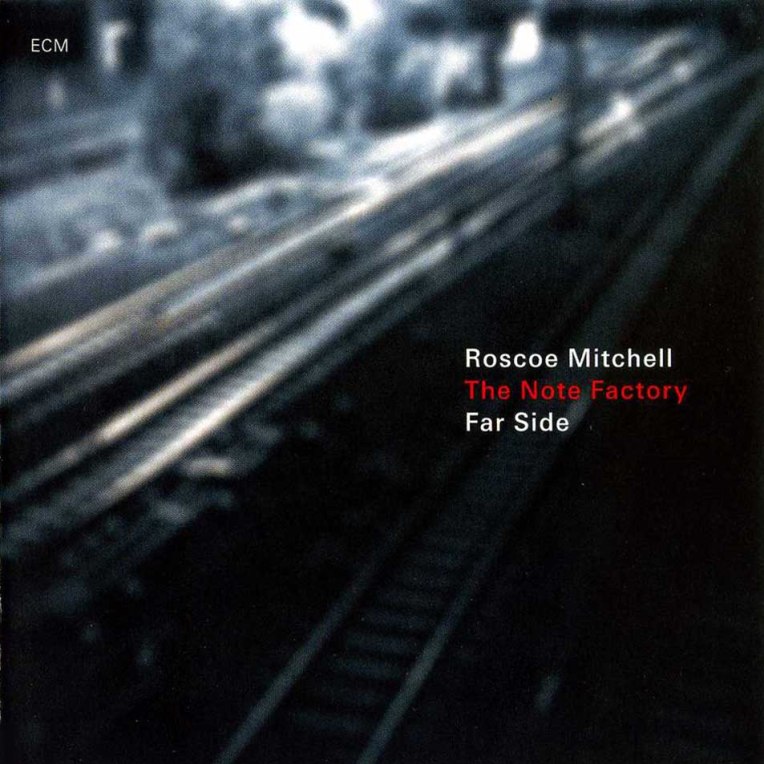
Roscoe Mitchell/The Note Factory: Far Side (ECM 2087)

Far Side

Roscoe Mitchell
The Note Factory
Far Side

Roscoe Mitchell saxophones, flutes
Corey Wilkes trumpet, flugelhorn
Craig Taborn piano
Vijay Iyer piano
Harrison Bankhead cello, double-bass
Jaribu Shahid double-bass
Tanni Tabbal drums
Vincent Davis drums
Recorded March 17, 2007 at Stadtsaal, Burghausen
Engineer: Gerhard Gruber (BR)
Radio producer: Roland Spiegel (BR)
Mixed at Artesuono Studio, Udine by Steve Lake and Stefano Amerio
Album produced by Steve Lake

Recorded live at the 2007 Burghausen Jazz Festival in Germany, Far Side documents Roscoe Mitchell’s expanding world of realizations. Working within his characteristically broad strokes is the Note Factory ensemble, something of a dream group for the saxophonist-composer and which includes the contributions of trumpeter Corey Wilkes, pianists Craig Taborn and Vijay Iyer, bassists Harrison Bankhead and Jaribu Shahid, and drummers Tanni Tabbal and Vincent Davis. The result of this coming together is a breaking apart: of expectation, of rigidity, of power. Bringing this approach to the saxophone renders Mitchell’s instrument at once ruler and ruled. We hear this especially in the three-dimensional title piece, for what begins as a lisp on the tongue of convention is methodically developed into full-blown, articulate language. Iyer’s keys rise in a droning arc, like a flipped page or vaulted pole in pathos, a breath at peace with its regularity. A muted Wilkes touches his blade to its mirror image and makes music of its shattered reflection. A kiss of cymbal and ivory unlocks the fringe nature of what swings within and activates a light source hitherto unseen. These torches shuffle themselves into the pack of cards at its center. As hands fan them, the pips dance, and Mitchell waits for the perfect moment of catharsis to wave the magic wand of his soprano and reveal our freely chosen selection. His effectual, sinewy line is a (literally) breathtaking display not only of technical dexterity but also of emotional integrity, matched sentiment for sentiment by a gurgling ascent from flugelhorn. Though translucent, the textures are dense and biologically attuned.

The two atonal pieces that follow take their inspiration from contemporary classical forms. In them one feels the thread reinforced by others less audible. Where the rubato, tenor-led contortions of Quintet 2007 A For Eight ply open spaces in which each instrument is deployed as its own cluster concept, the Trio Four For Eight leans toward the playful yet maintains graciousness. To this fire Wilkes adds fuel, trailing flute and drums that would be otherwise alone in the cognizance of their becoming. They would be heard as they are played, felt through the intermediary mallet and falling into the slumber of a brief coda in tutti.

Ex Flover Five is the most focused piece, for it allows the breadth of spontaneity to rear its magic within the predetermined frame. Taborn is especially terrific here, while Mitchell regales us with such intensity, it’s as if he’s placed a hand on a cold window and furiously scribbled in an attempt to remember its shape before it fades.

Mitchell

Those hoping for the kinetic synergies of Composition/Improvisation Nos. 1, 2 & 3 may initially feel disappointed in the Quintet and Trio, but upon closer inspection they allow naked insight into what lies at the core of Mitchell’s art. Either way, the composed sections will be, I think, refreshingly obvious to most listeners. And while the middle section may not be as “exciting” as the outers, it lends the album a concerto-like structure, with a contemplative center. Mitchell’s sound is not that of a proximate whisper but of a distant cry, one that reaches us before it withers. This is music for its own sake, present and accounted for. The congruousness of incongruity is alive and well.

(To hear samples of Far Side, click here.)

*For those following along: Iyer, Shahid, and Tabbal are leftmost in the stereo mix, while Taborn, Bankhead, and Davis are rightmost.

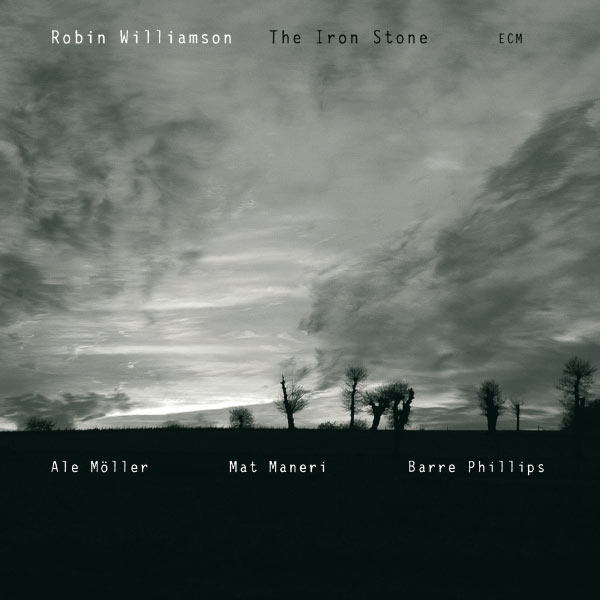
Robin Williamson: The Iron Stone (ECM 1969)

The Iron Stone

Robin Williamson
The Iron Stone

Robin Williamson vocals, Celtic harp, Mohan vina, Chinese flute, whistles, tabwrdd drum
Mat Maneri viola, Hardanger fiddle
Barre Phillips double-bass
Ale Möller mandola, accordion, clarino, shawm, natural flutes, drone flutes, whistles, jaw harps
Recorded September 2005, Mill House, Abergavenny
Engineer: Steve Lowe
Assistant: Dylan Fowler
Produced by Steve Lake

“Is it not strange that sheep’s guts could hail souls out of men’s bodies?”
–William Shakespeare, Much Ado About Nothing

From, but not to: this is the direction Robin Williamson travels by. For his third ECM outing, the man who puts the “true” in troubadour rejoins viola player Mat Maneri and fellow multi-instrumentalist Ale Möller, and plays for the first time alongside bassist Barre Phillips in tapping a trove of words by Sirs Walter Raleigh and Thomas Wyatt, Ralph Waldo Emerson, John Clare, and of course Williamson himself. “The Climber” offers a transportive introduction to this album’s relatively distant considerations, carrying us up through the clouds and into the moist particles of their origins. Improvised around the bard’s words, the music crawls and stretches, working its gnarled trunk around such shadows as “There Is A Music”—an ode to becoming that is played, as he sings, on the harp-haired gods by the fingers of tomorrow—and Emerson’s “Bacchus.” The last is the most heart-wrenching song of the set, a tale of forlorn tendrils and other fermentations caught in a butterfly’s wingspan.

There is an aged quality to the medieval Scots ballad “Sir Patrick Spens,” which through the arrangement here concedes to the palettes of coarser skies. It is not by mere virtue of Williamson’s years but fundamentally by perseverance of the tune itself that cuts the strings of time and marks wherever it may land. The fragility of Williamson’s telling gives impenetrable strength to the verses. Despite coming early in the program, this song drips with finality, drinking its vagaries through the scratching of bows and wistful sighs. The jaw harp trembles like the hearts of its characters, their lives tossed about the waves like discarded and shattered casks.

Williamson
(Photo by Jerry Young)

It is a stony and tender grave that harbors the melody of “Even Such Is Time,” which comes from “Lament For His Sister” by Rory Dall Morison—who, Williamson informs us in his liner notes, was one of the last traditional highland harpers—and replaces those words with Raleigh’s unconditional roundness. “Loftus Jones,” with music by Turlough O’Carolan, gets a vocal facelift. At Phillips’s suggestion, the group takes a “floating” approach to its wordless narrative. It calls to a different plane of our psyche, treading with carefully weighted soles on the sands of our adoration. Yet even these delicacies cannot help but dislodge a broken feeling or two from their interment, their bones having given up the ghost long ago for cloudy tragedies.

Also remarkable are this album’s evocations of animal life. A winding flute introduces us to “The Yellow Snake,” a somber tale of use and replenishment in a never-ending cycle of the elements of which the human body is composed and by which that same body does its deeds. “The Praises of the Mountain Hare” unearths a soothsayer’s gift, serrated like the mountain shawm that dances down its eastern slope, while in “The Badger” (Clare) Phillips’s scuttling phrasing mimes its eponym. A haunting instrumental epilogue draws us into “Political Lies,” among the more inescapable melodies of the Williamson songbook. In this tale of rearing recollections and broken realities, the history of mystery falls into its own rhyme and reason. The jangly slide guitar and thin-lipped poetry of the title track highlights a darkened wit about these follicles. “To God In God’s Absence” returns from its solo incarnation in The seed-at-zero in a fuller yet somehow more delicate version. No less intense for its adornments, it is Williamson at his finest. And there is, too, his stunning harp accompaniment to “Wyatt’s Song of Reproach,” a kiss to a visage half lit. “Verses at Ellesmere” is a flower of similar make. A ballad for his wife, Bina, if not also for love of balladry, it touches the ever green-ness of things and marks it with an insignia of most idiosyncratic design. These musings can only end with the open-ended “Henceforth,” which drops as a stone into a reflected sky, plying the reaches of dreams and bringing Williamson’s footprints full circle to the many copses and paths that hatch in his art.

The emphasis on spoken word and freer improvisatory elements on this record may polarize listeners. Nevertheless, let them not be a warning but an invitation. For in the grand scheme of sonic things, the truth of delivery reigns. The diction says it all: I am mortal, that I may sing of immortal things.

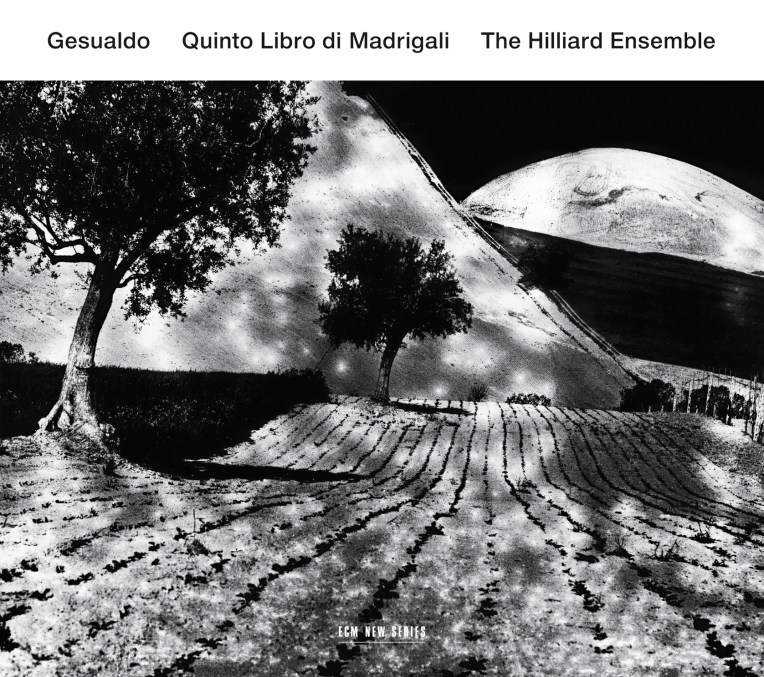
Gesualdo: Quinto Libro di Madrigali (ECM New Series 2175)

Gesualdo Madrigali

Carlo Gesualdo
Quinto Libro di Madrigali

The Hilliard Ensemble
Monika Mauch soprano
David James countertenor
David Gould countertenor
Rogers Covey-Crump tenor
Steven Harrold tenor
Gordon Jones baritone
Recorded November 2009 at Propstei St. Gerold
Engineer: Peter Laenger
Executive producer: Manfred Eicher

If my grief pains you,
only you, my soul,
can turn it all to joy.

On first hearing madrigals by Carlo Gesualdo (1566-1613), English writer Aldous Huxley proclaimed, “These voices—they’re a kind of bridge back to the human world.” In the mouths of the Hilliard Ensemble they certainly are. Baritone Gordon Jones cites the Prince of Venosa as a touchstone of the ensemble’s performing repertoire. And so, it is with practiced appreciation that they return to it as they take on his Fifth Book of Madrigals of 1611 in its entirety. Gesualdo finished his Sixth and final Book (he would leave fragments of an unfinished Seventh) in the same year, penning his first in 1594. Of the Fifth, Jones says, “The whole collection constitutes a gallery of dramatically lit portraits of human emotions with a heavy emphasis on the extremes of joy and despair.” On this note, the addition of soprano Monika Mauch and countertenor David Gould speaks to the range and color required of those extremes, and in this regard the ensemble emotes splendidly.

One can hardly discuss this music without mentioning its bold, mannerist dissonances. Written as it was by a man who had his wife and her lover murdered when he caught them in flagrante delicto and who subsequently receded into his own psycho-sonic cage, this can be no surprise. Even by today’s standards it rattles us. Yet to characterize Gesualdo’s output by so reductive a summation (dissonance, for example, was part and parcel of the madrigal idiom) would be to ignore the textually sensitive traditions of harmonic expansion upon which he built it. Despite being professedly “ahead of his time,” he was no enigma to his aristocratic contemporaries, being a particular favorite of Queen Christina of Sweden. For every gritty texture he loosed, a smoother one was in attendance, and we do well to remember the equal weight in both pans of the scale.

We have the Hilliard/ECM partnership to thank for already having done the composer justice with a sublime and direct rendition of his Tenebrae Responsories for the Christian Holy Week. Here that same trueness to the melodic line remains, and is so magnified by the bareness of its voices, by which the tortuousness we’ve come to expect lives by a more fluid name. If it lives anywhere, it is in the strange tenderness of Gioite voi col canto, which opens the collection with an autobiographical tinge:

Rejoice in song,
while I weep and sigh,
while tears choke my breath.
Alas, wretched heart of mine,
born for grief alone;
weep, but weep so much
that my mistress may be vanquished
by your tears, and then revert to seeing
my grief and pains in her.

The shifting tectonics of tenor lines and dulcet edge of Mauch’s gilding in the words’ weeping evocation is testament both to Gesualdo’s knack for comingling and to the sensitivity of the singers assembled at Propstei St. Gerold, where these works were so lovingly recorded. The charged weight of Itene, o miei sospiri rekindles these considerations, mixing “bitter weeping” with “loving song” in particularly adroit handling from the Hilliards. O dolorosa gioia falls into the same category of “painful joy,” a core theme of Book Five that finds further traction in Se vi duol il mio duolo. In both of these, the pathos of the text comes through tactfully. Death is another trope, as inescapable in the music as it is in us. From the heartfelt appeal of Occhi del mio cor vita (“Eyes, life of my heart”) and the lovesick resignation of Languisce al fin (“He who parts from his life languishes at last”) to the lachrymose accents of O tenebroso giorno (“O darkest day”), the music is practically dripping with it. Yet not all is so morose in this landscape, for there are also the flora of Felicissimo sonno, a heartfelt appeal to dreams as living threads to a love that cannot flourish in waking, and the intoxications of Correte, amanti, a prova (“Vie, lovers, in speed”) to soothe our weary countenances, to say nothing of the optimism that bids us a fond farewell in T’amo, mia vita (“I love you, my life”).

A small handful of these 21 madrigals stands out. The snaking turns of Mercè grido piangendo (“Have pity on me! I cry weeping”) showcase the coolness of the Hilliard’s peerless blend to the utmost, while the prototypically Gesualdan Tu m’uccidi, o crudele (“You are killing me, o cruel woman”) pulls out all the stops in its affective toolkit, achieving moments of sublime light. Finally, Se tu fuggi, io non resto, with its fluttering vowels and tight syncopations breathes with expert realization, even as its narrative voice bids us leave on the wings of cruelty.

Due to the subject matter and sheer variety of invention, and despite the pitch-perfect performances, this is no mere soundtrack for an idle afternoon. It asks us to steep in its brew until we begin to take on a bit of its flavor. Those who find beauty in the Tenebrae may encounter discomfort in these secular woes. But if this discomfort has anything to teach us, it is that the act of living depends on that very thing.

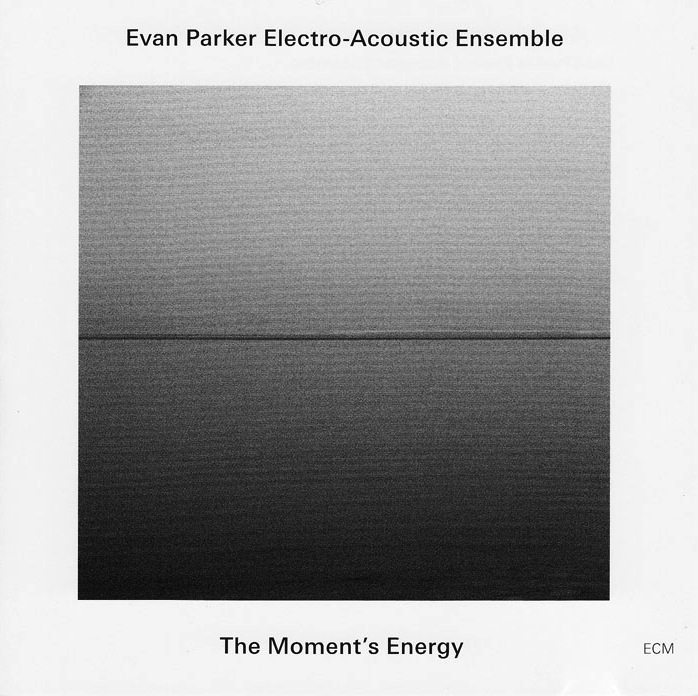
Evan Parker Electro-Acoustic Ensemble: The Moment’s Energy (ECM 2066)

The Moment's Energy

Evan Parker Electro-Acoustic Ensemble
The Moment´s Energy

Evan Parker soprano saxophone
Peter Evans trumpet, piccolo trumpet
Kō Ishikawa shō
Ned Rothenberg clarinet, bass clarinet, shakuhachi
Philipp Wachsmann violin, live electronics
Agustí Fernandez piano, prepared piano
Barry Guy double-bass
Paul Lytton percussion, live electronics
Lawrence Casserley signal processing instrument
Joel Ryan sample and signal processing
Walter Prati computer processing
Richard Barrett live electronics
Paul Obermayer live electronics
Marco Vecchi sound projection
Recorded November 2007, Lawrence Batley Theatre, Huddersfield
Engineer: Steve Lowe
Produced by Steve Lake

With the conviction of a fractal, this fifth ECM outing from Evan Parker’s Electro-Acoustic Ensemble unwinds in distorted, vastly interconnected replications. True to form, the ensemble welcomes three new members: trumpeter Peter Evans, reedman Ned Rothenberg (who also plays shakuhachi), and Kō Ishikawa playing the shō (Japanese mouth organ). As the growing roster (here numbering 14 members) simultaneously hones and fragments the ensemble’s dynamics, it likewise reshuffles Parker’s role as composer and bandleader in this commissioned piece for the 2007 Huddersfield Contemporary Music Festival. As with The Eleventh Hour, a wealth of intensities emerged in the rehearsal sessions leading up to the event in question, only now most of the selections are taken from behind those very scenes (only Part IV and the epilogue are live). A meticulously composed fuselage serves to enhance the spontaneity of its appendages.

Part 1 introduces us to the masterful cross-referencing of signatures that distinguishes this album from its predecessors as a work of superlative control. Waterspouts of piano (Agustí Fernández), soprano saxophone (Parker), and violin (Phillipp Wachsmann) leap and drown in a roiling ocean of sonic information, from which Part 2 draws out cartographic ingredients in the effervescent soup of Rothenberg’s bass clarinet. Part 3 pales into lachrymose shades, rubbed smooth by the sandpaper of a deep-throated awareness. Its echoes are more pre than post. Part 4 strikes the expressiveness of Ishikawa’s shō like a match to wick. If ever there was darkness in these halls, it is now dispelled by holy presence. This transmogrifies into a jangling exposition in Part 5 and on to the bowed details of Part 6. In a space where siren and unfinished business can stew and percolate, its string-heavy idols pirouette at the border of gut and reason before Part 7 evinces fantastic droning depth. The album’s most nourishing morsel comes last in the form of “Incandescent Clouds,” an electronic summation of all that has preceded, spliced and held together until it fuses anew.

As the most electro-centric of the EAE recordings, The Moment’s Energy embodies an exact and accomplished science. Yet no matter how technologically slanted the music becomes, it always retains an earthen quality. Interventions reveal the circuitry of life at large. Every element carries equal atomic weight. Thus it becomes the thing it never professes to be: naked sound. Like the repeated word, it sheds its associations, becomes its own entity.

This is energy’s moment.

Evan Parker Electro-Acoustic Ensemble: The Eleventh Hour (ECM 1924)

The Eleventh Hour

Evan Parker Electro-Acoustic Ensemble
The Eleventh Hour

Evan Parker soprano saxophone, voice
Philipp Wachsmann violin, live electronics
Paul Lytton percussion, live electronics
Agustí Fernández piano, prepared piano
Adam Linson double-bass
Lawrence Casserley signal processing instrument, persussion, voice
Joel Ryan sample and signal processing
Walter Prati computer processing
Richard Barrett sampling keyboard, live electronics
Paul Obermayer sampling keyboard, live electronics
Marco Vecchi sound projection
Recorded November 2004, Centre for Contemporary Arts, Glasgow
Mixed February 2005 at Gateway Studio, Kingston-upon-Thames
Engineer: Steve Lowe
Produced by Steve Lake

The birds have survived winter’s bane. Wind pulls their feathers northward. The cranes arch their necks. Let the awakening begin, they seem to say. Chickadees distort in and out of frame, radio stations at the whim of a quavering dial. The crows prune their ebony in the guise of indignation. The starlings weep electricity. Echoes of samples wound forward lift their minds while lowering their eyes. Hammers and strings convulse in riddles of expression. Ghosts become living. The analog becomes digital. There is always something of one in the other.

So begins The Eleventh Hour, the fourth album by saxophonist Evan Parker’s Electro-Acoustic Ensemble for ECM. Adding to his already growing menagerie are the voices of Richard Barrett and Paul Obermayer, both remarkable composers and electronic alchemists. Their extensive databank brings a gravid feeling that such manipulations often lack. In the same vein are knob-turners Lawrence Casserley, Joel Ryan, and Walter Prati, all of whom bring so much to “Shadow Play,” the opening track described above in which their real-time modifications expand upon Parker’s multilayered soprano solo. The latter’s relative absence thereafter speaks to his appreciation for space and his ability to mark its passage without uttering a note. And while we do hear ghosts of Barry Guy in the mix, it is American bassist Adam Linson who takes the stage in his place.

This vibrant record documents the 11-piece ensemble in performances commissioned by Glasgow’s Centre for Contemporary Arts, under whose auspices it developed the five-part title piece nightly for a week in early November 2004. The Parker solo is from November 3rd, the centerpiece from three days later. Part 1 begins in a flurry of zippers, catches, and locks coming undone in one glorious catharsis (then again, catharsis may not be the right word, for the end of every tunnel begins another). Violinist Phillipp Wachsmann is a prominent voice in Part 2. Jagged, cilial, and primordial, he playfully alludes to Arvo Pärt’s violin/piano version of Fratres amid a small explosion of squeals and giggles. The filaments of Part 3 wrap us in droning bliss, pianist Agustí Fernández continuing where he left off on Memory/Vision with deeply felt cartilage. The human voice (courtesy of Parker and Casserley) makes a rare EAE appearance in Part 4, adding considerable movement to the palette. Reeds crackle like logs in a settling fire, holding fast to the smoke that draws their spirit out, tendril by tendril. This leaves us with a taste of afterlife in Part 5, which glows among the embers left behind to a tune of humming sky, gilded by a veneer of high-pitched sweetness to the savory heart within.

The divisions between parts seem only nominal at first, sharing as they do the same blood in their veins, but upon closer listening they reveal distinct planes to the overall shape. The mounting electronic presence this time reveals the henna-patterned hand of technology in utterly glowing ways and forges an unforgettable experience that is atmospheric to the core. Like any EAE session, this will challenge as many as it delights. Either way, it’s worth taking a chance to see which camp you’ll fall in with.

Crossing Reeds: Roscoe Mitchell and Evan Parker on ECM

–Locution–

Jazz multi-instrumentalist Roscoe Mitchell has been called many things: technical genius, avant-garde pioneer, iconoclast. Although I may expound upon any of these assertions by way of proof, there seems to be a futility to the reviewer’s task when in the presence of his sound. Mitchell grew up on sound. His musical household was brimming with it, leading him to take up saxophone and clarinet as a young teen. While stationed in Germany in the 1950s, he met the great Albert Ayler and others, from whom he learned to develop his palette without fear. After returning to the States, he fell in with two Lesters (trumpeter Bowie and trombonist Lashley), bassist Malachi Favors, saxophonist Kalaparusha Maurice McIntyre, and drummer Alvin Fielder—a group first known as the Roscoe Mitchell Sextet and out of which grew the legendary Art Ensemble of Chicago. By no mere coincidence was their first path-breaking album entitled Sound (Delmark, 1966). It was, and remains, the alpha and omega of what he does.

Across the pond in England, one might tell a similar story about Evan Parker. The free jazz stalwart also picked up the saxophone in his early teens and sought inspiration in Ayler, Paul Desmond, and John Coltrane. If Mitchell is about sound, Parker is about breath. Since the 1960s, he has shared his characteristic love of extended techniques, of which his mastery of circular breathing has become something of a doctrine. His first defining efforts came with the Spontaneous Music Ensemble, with whom he cut his first record and which included drummer John Stevens, guitarist Derek Bailey, bassist Dave Holland, and trumpeter Kenny Wheeler. Parker and Bailey went on to form the Music Improvisation Company, the free wonders of which were documented on ECM’s fifth ever album of the same name. Subsequent decades have brought fresh collaborations across the board and the formation of his most influential, the Electro-Acoustic Ensemble. Formed in 1990, it remains the benchmark of his collaborative achievements.

In 2003, Munich’s Kulturreferat (one of twelve municipal departments responsible for the promotion of art and culture) invited Mitchell and Parker to participate in a symposium on the role of improvisation in the compositional process. Thus the Transatlantic Art Ensemble was born, pushing the boundary—fuzzy as it is—between predetermined and spontaneous music-making. Together, these master thespians of the reed present a double bill of “scored improvisations” that combine the cross-idiomatic interests of the one with the stimulatingly open approach to group performance of the other.

–Illocution–

In addition to his activities as a jazz artist, Mitchell has been a longtime classical composer (he would just as soon call it “music,” plain and simple). This work has led him to his current post at California’s Mills College, where he holds status as Distinguished Darius Milhaud Professor of Music, and comes across vividly in Composition/Improvisation Nos. 1, 2 & 3. Through nine “scenes” Mitchell instructs the musicians to improvise from: (a) prewritten cards (Nos. VIII and IV), (b) using only a certain set of notes (I, II, V, VI, VII, IX), and (c) through real-time manipulation of previously composed elements (III). If this sounds like a puzzle, it’s only because said elements fit together so complementarily. Along the way, Art Ensemble of Chicago members Corey Wilkes (trumpet, flugelhorn), Jaribu Shahid (bass), and Mitchell sideman Tanni Tabbal (drums, percussion) share the stage with pianist Craig Taborn, whose stylings have since caught the ECM wave in well-deserved projects both solo (Avenging Angel) and alongside bassist Michael Formanek (The Rub And Spare Change), not to mention Mitchell’s own Note Factory project (Far Side, Nine To Get Ready). Parker cohorts Philipp Wachsmann (violin), Paul Lytton (drums, percussion), and Barry Guy (bass) add spark to an already iridescent fire, along with a handful of classically trained talents.
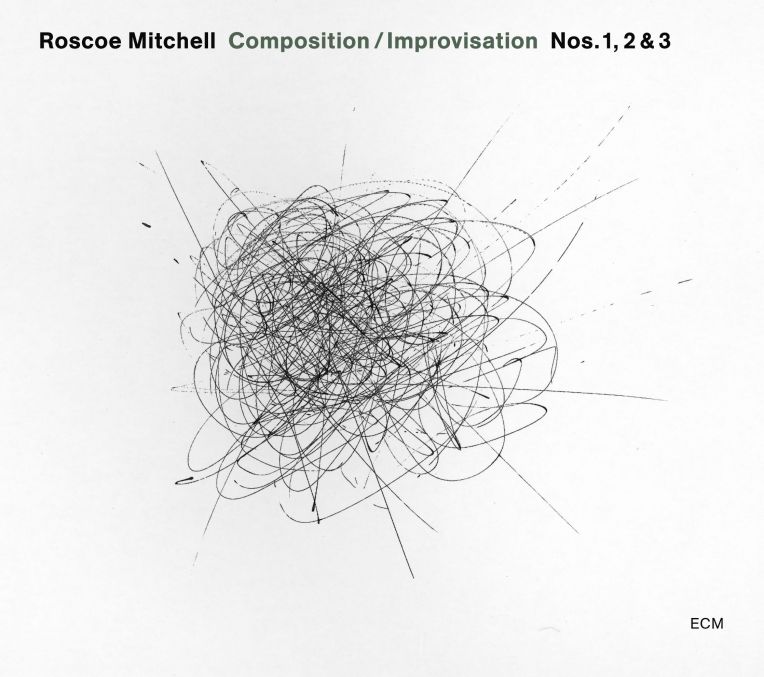
Roscoe Mitchell
Composition/Improvisation Nos. 1, 2 & 3 (ECM 1872)

Roscoe Mitchell soprano saxophone
Evan Parker tenor and soprano saxophones
Anders Svanoe alto and baritone saxophones
Corey Wilkes trumpet, flugelhorn
John Rangecroft clarinet
Neil Metcalfe flute
Nils Bultmann viola
Philipp Wachsmann violin
Marcio Mattos cello
Craig Taborn piano
Jaribu Shahid double-bass
Barry Guy double-bass
Tanni Tabbal drums, percussion
Paul Lytton drums, percussion
Recorded September 2004, Muffathalle, Munich
Engineers: Manfred Eicher and Stefano Amerio
Produced by Steve Lake

Stepping into the suite at hand, we recognize the variety of architectural turns, tempered by an idiosyncratic feel for harmony and appreciation for pause. The haunting viola of Nils Bultmann articulates the first of many monologues, which with increasing clarity map the genomes of the ensuing developments (Bultmann returns for the end, hub to a forlorn and longitudinal ode to losing oneself). When the helix breaks and the family grows, the conversation suspends its provocations from the beam of judgment, only to cut their strings and notate their descent into sanity. Percussion solos speak in riddles of color. Winds scour away the film of predestination and refill the basin with trust before carrying over into gorgeous turns from Parker on tenor, building with the group to a level of virtuosity so intense it can only be described as oneness incarnate. The pastoral clarinet of John Rangecroft leads us into a den of foxes, where the fear becomes flesh, and flesh an opportunity for reflection. Neil Metcalfe on flute reveals a subtly adorned canvas, while Wilkes flashes his notes like sunlight off a turning crystal. Anders Savanoe completes the picture with his spastic yet saintly contortions on baritone. Because everyone reacts, possibilities narrate themselves with humble authority, somehow jarring in its regularity toward the end. There is so much commitment to the moment that we can only follow along like shadows, filling the spaces left behind.

–Perlocution–

The second half of the Mitchell/Parker collaboration finds the Englishman laying compositional concepts before the same personnel while also leaving spaces for improvisation to flourish. The title is at once curious and instructive. Meaning “like an ox plowing,” it gives insight into six “Furrows,” each of which cultivates its own crop of fertile solos.

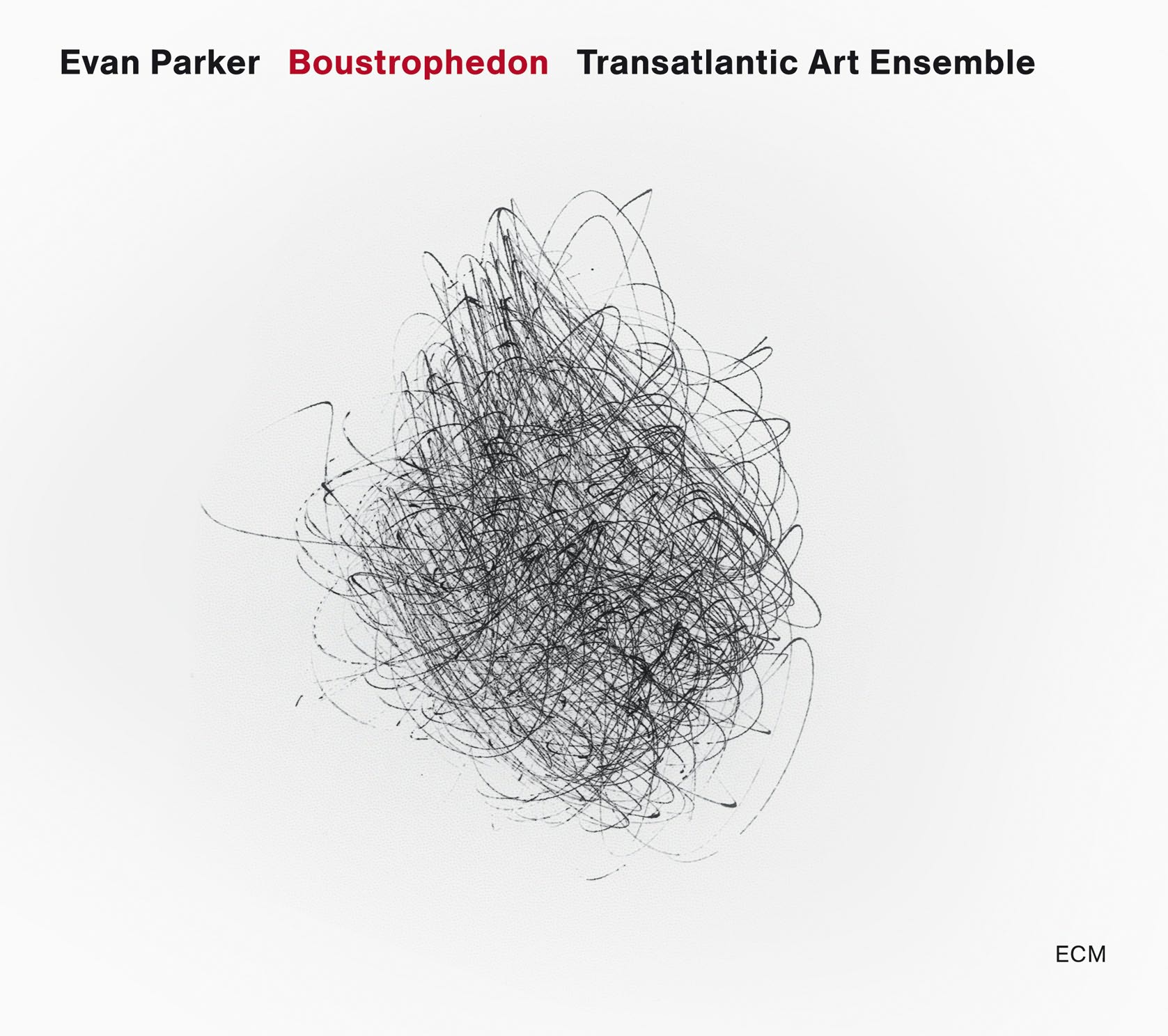
Evan Parker
Transatlantic Art Ensemble
Boustrophedon (ECM 1873)

Evan Parker soprano saxophone
Roscoe Mitchell alto and soprano saxophones
Anders Svanoe alto saxophone
John Rangecroft clarinet
Neil Metcalfe flute
Corey Wilkes trumpet, flugelhorn
Nils Bultmann viola
Philipp Wachsmann violin
Marcio Mattos cello
Craig Taborn piano
Jaribu Shahid double-bass
Barry Guy double-bass
Tanni Tabbal drums, percussion
Paul Lytton drums, percussion
Recorded September 2004, Muffathalle, Munich
Engineer: Manfred Eicher and Stefano Amerio
Produced by Steve Lake

A spiral staircase of percussion from Lytton and Tabbal in the “Overture” pairs one musician with his transatlantic counterpart in the watery expanse of the Furrows, each a different curl of octopus ink in the brine. The instruments take on their roles with surety and purpose. In this context said roles are not theatrical, but are (psychologically, at least) offstage. Rangecroft’s flute in “Furrow 1” is the knowing bird, conversational partner of Taborn’s keys. The latter elides the slide of its introspection and lays it to dry in the sun until it cracks underfoot—just one of countless leaves on the forest floor leading toward a sunlit grove. Violin and viola in “Furrow 2” are two travelers carrying histories in their satchels. The cello of Marcio Mattos in “Furrow 3” is the subterranean yearning to these aboveground wanderings (their protracted journey is a highlight of this live performance). Svanoe’s entrance on alto here is an awakening and reveals a voice of descriptive genius. The clarinet of “Furrow 4” becomes a base to the strings’ acid, the trumpet a distant commotion. The two basses in “Furrow 5” become a shadow of the past, which casts its lessons upon the yet to be and configures music-making decisions as would a breeze goad a butterfly’s path. Parker maintains notable restraint until the open sky of “Furrow 6.” He spreads the clouds like wings and gives his flight room to sing. But the compression of his playing is such that we feel more than an album’s distance in its shape. It is the sonic white dwarf, a single note of which weighs many scores yet which floats like a feather plucked from the cap of the Milky Way. His elliptical solo bleeds into a steamy rhythm section, bringing a flavor of the club to the dialogue at large. Hints of big-band ebullience shine through the tatters but are drowned by the density of the center. As the group fades, we hear that this density has resided all along in the drums. An intimate gallery of solos ensues in the oddly beautiful “Finale” (in order: Shahid, Metcalfe, Svanoe, Wachsmann, Taborn, Mattos, Bultmann, Rangecroft, Wilkes, Guy, Mitchell), tying a series of knots until they form a single ball of string.

The sense of flow imparted by the compositional elements in both albums is breathtaking, building textures organically and never indulging in extremes for too long. Rather, the continuity lies somewhere in the shadows, balancing on the fulcrum of surrender between static and whisper. In the end, such teetering of intuition becomes a way of life, a mantra for those whose ears flower with curiosity.


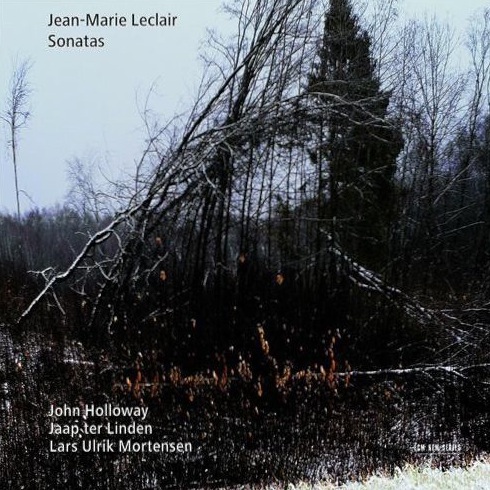
Jean-Marie Leclair: Sonatas – Holloway (ECM New Series 2009)

Jean-Marie Leclair
Leclair Sonatas

John Holloway violin
Jaap ter Linden violoncello
Lars Ulrik Mortensen harpsichord
Recorded November 2006 at Propstei St. Gerold
Engineer: Stephan Schellmann
Executive producer: Manfred Eicher

The biographies of composers can sometimes outweigh the notoriety of their music. Jean-Marie Leclair (1697-1764) is one such case. Born 1697 in Lyon, he left the city in his mid-twenties for Turin, where he sharpened his eye (and ear) for theatre and ballet and returned to Paris in 1723 to make a name for himself as a composer. Within a decade he was one of the most exciting violinists of his time, a pioneer in the French school of his instrument. By 1758 he had fallen on hard times. After leaving his wife, Leclair rejected the offers of his patron, the Duke de Gramont, to instead take lodgings unbefitting of his station in an unreputable part of the city. Six years later, a gardener would discover the composer stabbed to death in his vestibule. The gardener himself and Leclair’s nephew emerged as primary suspects, but no conclusive evidence was ever brought upon either (the most recent scholarship fingers the latter). One might think, in the wake of this tragedy, that the fruits of his endeavors would have bounded of their own accord into the public eye. This was not to be, and it is only with the advent of recording that his chamber works have grown into the recognition they deserve beyond musicological interest.

In a conversation included in the CD booklet, John Holloway is quick to place Leclair alongside the great violinist-composers under the bow of his acclaimed earlier ECM recordings: Biber, Muffat, Schmelzer, and Veracini. With cellist Jaap ter Linden and harpsichordist Lars Ulrik Mortensen, the British violinist takes on five selections from the opus 5 of 1734. Among the composer’s finest, the set yields a surplus of charm and virtuosity. While Holloway’s Leclair reads more conservatively than the fiery licks of his Biber, these sonatas are more about consistency than drama. To achieve this is no small feat, and requires fluid concentration of the musicians. That being said, the uniformity of dynamic patterning and phrasing will tire some listeners, who may feel it better suited as a light soundtrack to their activity. All the more reason to give it a deep listen the first time around.

Leclair’s time in Italy clearly rubbed off—not only because he follows the four-movement model of his predecessor, Arcangelo Corelli (in Turin, Leclair studied with Giovanni Battista Somis, himself a pupil of Corelli), but also because his deft blend of the Rococo and the Baroque sets him apart from the Parisian pack and speaks of a continental (known then as the gouts réunis, or “mixed taste”) perrsonality. The sonatas chosen here boast some of his subtlest inflections, and nowhere more so than the whimsical opening of the Sonata VIII in D major. This gives way to spirited color changes as the harpsichord continuo drops out for the tender Aria, only to make its triumphant return in the stately Andante before bristling with sprightly atmospherics in the dancing Allegro. Those wanting stronger excitements need look no further. This theatrical edge continues in the Sonata VII in a minor, in which a straightforward beginning yields two winged Allegros. Captivating harmonies between violin and harpsichord add to the airborne feel and give extra shine to Holloway’s trills.

One hears Italian pigments seeping through the opening Adagio of the Sonata I in A Major, the Aria of which weaves the more sensitive writing on this disc, as do the Largo and Aria of the Sonata III in e minor. The Sonata IV in B-flat Major carries this tender mission further in its Adagio, which sparks a fuse of complex proportions in an exhilarating Chaconna, a sonata unto itself.

This may not be as thrilling as Holloway’s previous recordings for ECM, and not one the newcomer may wish to start with, but Leclair’s music lives by its own rules of contrast. The intuitiveness of his harmonization and counterpoint, Holloway notes, begs for that same attentiveness in the performing. This becomes more obvious with each new listen, enfolding us in the depths of a music that breathes as it sings.

Maneri/Phillips/Maneri: Angles of Repose (ECM 1862)

Angles of Repose

Joe Maneri alto and tenor saxophones, clarinet
Barre Phillips double-bass
Mat Maneri viola
Recorded May 2002, Chapelle Sainte Philomèe, Puget-Ville
Engineer: Gérard de Haro
Produced by Barre Phillips and Steve Lake

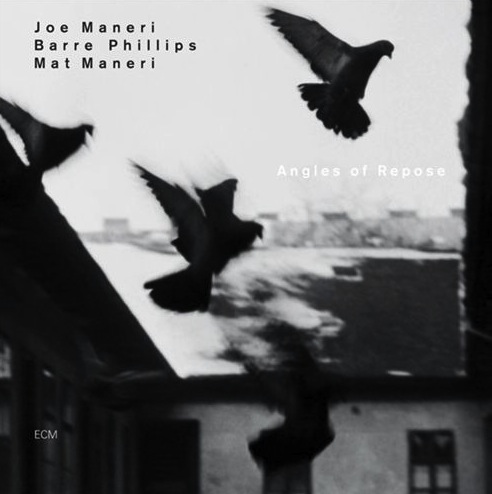
When Joe and Mat Maneri and Barre Phillips materialized in the studio to record Tales of Rohnlief, the result was a magical recipe of microtonal blues and other off-the-beaten-path catharses. The session begged for a sequel, and its name is Angles of Repose. This time around, our synergistic trio throws rules into the air like pigeon feed for the small frame of life that is the cover photograph (incidentally, my favorite ECM sleeve/title combination in the entire catalogue) in the name of integrity.

Number One
Phillips is a grounding force in this opener, adding as much as he takes away and saving the sawdust, so to speak, from his whittling. Joe snakes his prophetic way through vocal and instrumental languages in a veritable feast of biological rumination, tempered by analysis in the immediacy of discovery.

Number Two
The internal machine may be vast, but its weak spot is infinitesimal. Father and son patty-cake the earth into submission. You can skitter and flitter all you want, but you’ll never find the path unless it finds you, whether gelled by time or fragmented by the violence of discovery.

Number Three
Joe cracks the fountain with faith and signs his nameless art with dots and dashes. If he seems winded, it’s only because he is the wind. Ameliorated by the corona of experience, he tempers his weapons with air, that they might never pierce the skin of any mortal fear, along which flounders the death of discovery.

Number Four
Twisting between thumb and fingers, the night rolls the city into a cigarette and smokes it until it sleeps. Every noteless space only makes it stronger. Butterflies and rhinoceri now share the same breath, fraught with the wonder of discovery.

Number Five
A duet for strings of spacious mind channels the wastes of contradiction and melts them into a mold. As the sculpture cools, it becomes a shadow. Its visage weeps invisibility. The hands of passersby inadvertently float through it, so that all they are left with is the fallacy of discovery.

Number Six
The cup has tipped, its contents spreading in a partially eclipsed circle. In this pool where broken mirrors float, we see the multiplicity of our genetic code’s sonority. Harmonics are the edges of fingernails on glass, and further the edge of that glass on sky. Resonant beauty briefly surfaces—a dolphin’s back—before plunging into the brine of discovery.

Number Seven
Blood begets blood begets the onlooker, whose wayfarer soul quivers with the loss of discovery.

Number Eight
The metamorphosis has occurred, not from man to insect but from insect to man, still carrying the language of its forbearers, dribbling into the cupped hands of discovery.

Number Nine
Birdsong becomes liquid mercury in the room-temperature stare of indifference. It is here where music is born, shedding truth for its simulacrum in the hopes that it will be consumed more quickly and forgotten on the way to the core. When our ears spread their wings, they need only lift one talon to leave their carrion. All the screeching and scratching accomplishes one thing: activation. We can feel in the air a vibrant disturbance, which brings its own instructions, blank as October sky. There is a beginning in every end, the anode to galactic circuits in search of a name. And if you lean in close enough, it may just whisper it to you, for it is the breath of discovery.

Number Ten
The whale scratched by Ahab’s spear swims for a song. Its balanced lyric of play guides the sonar true. It wakes you up just to tell you to go to sleep. This is the dream of discovery.

Three lines make not a braid, but a single unbreakable filament plugged directly into the kundalini of any listener willing to close the mind and open the body to the possibility of its activation. Yes, the album has its highlights (Numbers Five and Nine, I’d say, if you asked me), and contains Joe’s most heart-wrenching playing on record, but its lowlights are just as expertly realized, for in this sound-world there is no hierarchy, only the contemplating line that wraps around us as it goes along its way. If pinnacles have restless dreams, these are their soundtracks.