ECM by the Decades: Final Installment Tonight

Join me and host Andrew Castillo tonight (May 21) on WKCR’s Jazz Alternatives program, from 6-9pm EST. We’re continuing where we left off, closing out our series with a selection of personal ECM catalog favorites from 2010 to the present. Click the logo below to be directed to the WKCR website, where you may stream us live by clicking the “LISTEN” icon on the top-right corner of the screen. As always, if you’re unable to tune in, we’ll be archiving the program here for future streaming and downloads.

WKCR

ECM by the Decades: Fourth Installment Tonight

Join me and host Andrew Castillo yet again tonight (May 7) on WKCR’s Jazz Alternatives program, from 6-9pm EST. We’re continuing where we left off, moving on to a selection of personal ECM catalog favorites from the 2000s. Click the logo below to be directed to the WKCR website, where you may stream us live by clicking the “LISTEN” icon on the top-right corner of the screen. As always, if you’re unable to tune in, we’ll be archiving the program here for future streaming and downloads.

WKCR

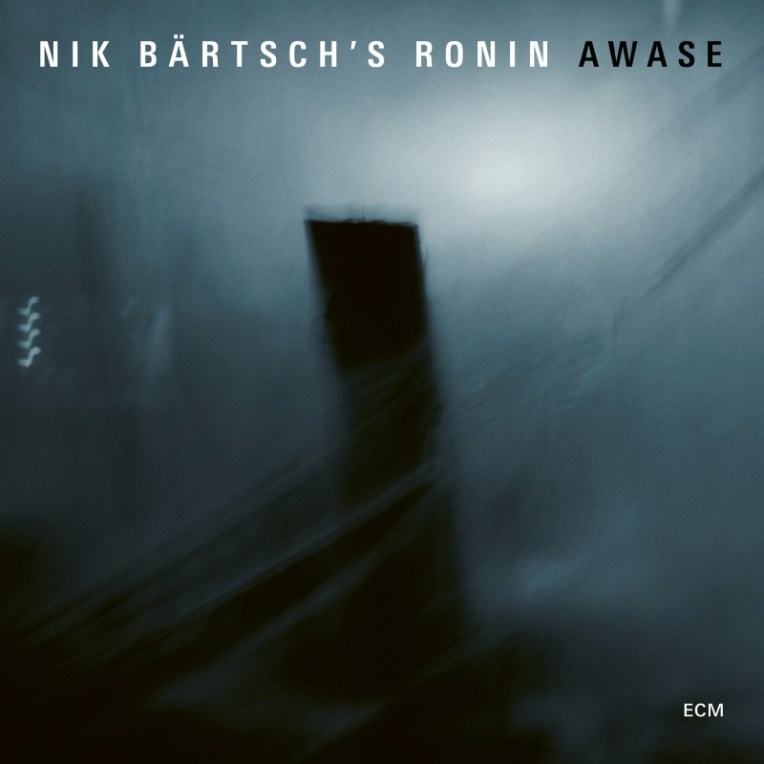
Nik Bärtsch’s Ronin: Awase (ECM 2603)

Awase

Nik Bärtsch’s Ronin
Awase

Nik Bärtsch piano
Sha bass clarinet, alto saxophone
Thomy Jordi bass
Kaspar Rast drums
Recorded October 2017, Studios La Buissonne, Pernes-les-Fontaines
Engineers: Gérard de Haro and Nicolas Baillard
Produced by Manfred Eicher
U.S. release date: May 4, 2018

The booklet for Awase, Swiss pianist Nik Bärtsch’s latest release with his band of Ronin, quotes French theorist Roland Barthes: “The sign is a fracture which only ever opens onto the face of another sign.” Perhaps no other statement better expresses the fractal nature of this music, for the more one zooms in on its precisions, the more one senses its freedoms expand. Joined by Sha (bass clarinet and alto saxophone), Kaspar Rast (drums) and newest recruit Thomy Jordi (bass), Bärtsch finds himself rooted in a familiar ethos while sprouting new verdure.

The album continues his “modular” approach, by which larger bodies coalesce from elemental forces. The newest of these, “Modul 60” and “Modul 59,” open and close the album with hints of a concentrated future. Where the latter emotes in liminal territory, the former is a direct link to Continuum, Bärtsch’s previous record for ECM with his Mobile project. Any nods to the past, however, are refracted through a brighter coming of age: a sound that once ran now leaps. The ritual groove of “Modul 58,” for instance, is at once what we might expect and a fresher take on group integration, a taste of perpetual motion shown in the band’s willingness to let details express themselves to the level of ecstasy. “Modul 36” reveals the deepest change; known to any longtime listener of Bärtsch, here it takes on the uniformly colored properties that would seem to extend the band’s evolutionary path. It’s a classic yet forward-thinking groove, one that feels like a childhood home renovated from the inside out. “Modul 34” is another early tune, only now making its studio debut. There’s an almost digital quality to it, nuanced by human touch.

Awase is also a departure for including a non-Bärtsch original by Sha: the enigmatically titled “A.” Gradually building an ocean out of a water droplet, its waves flow to the magnetic suggestions of an itinerant philosophical compass. Like the album as a whole, it toes the line between light and shadow with every intention of shedding its ego to both along (and by) the way.

(This article originally appeared in the May 2018 issue of The New York City Jazz Record, a full PDF of which is available here.)

Noa Fort Reviews for All About Jazz

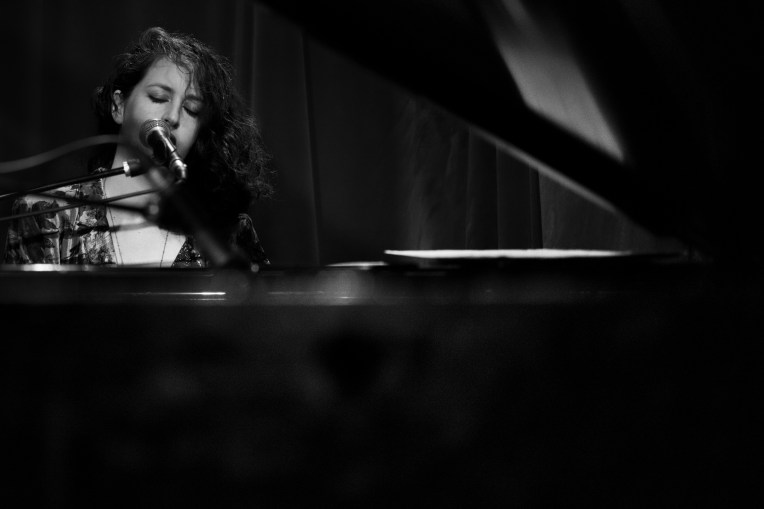
I recently attended a performance in celebration of No World Between Us, the debut album by pianist and vocalist Noa Fort, sister of ECM recording artist Anat Fort. Noa’s songwriting is insightful and touching, and in a live setting reached new heights of expression. Click the cover to read my thoughts on the album, and the live photo below that to read my review of the CD release concert.

No World Between Us

DSC01177-Edit

Jazz photography

As some of my readers may be aware, I’ve been photographing semi-professionally for a few years. Only recently, however, have I begun to photograph musicians. Below is a slideshow of recent images. Hope you enjoy them.

This slideshow requires JavaScript.

Ben Monder: Amorphe (ECM 2421)

Amorphae

Ben Monder
Amorphae

Ben Monder electric guitar, electric baritone guitar, Fender Bass VI
Pete Rende synthesizer
Andrew Cyrille drums
Paul Motian drums
“Oh, What a Beautiful Morning,” “Triffids,” and “Dinosaur Skies” recorded October 2010 at Sear Sound
Engineer: James A. Farber
“Tendrils,” “Tumid Cenobite,” “Gamma Crucis,” “Zythum,” and “Hematophagy” recorded December 2013 at Brooklyn Recording
Engineer: Rick Kwan
Mixing Engineer: Rick Kwan
Produced by Sun Chung
U.S. release date: October 30, 2015

For his ECM leader debut, New York guitarist Ben Monder brings his improvisational destinations to fruition with respect for every musical step in reaching them. The album’s circle is opened and closed by two solo arcs: “Tendrils” and “Dinosaur Skies.” Where the former comes out of the woodwork as if after a long and melodic hibernation, the latter is a dragon’s breath turned into music.

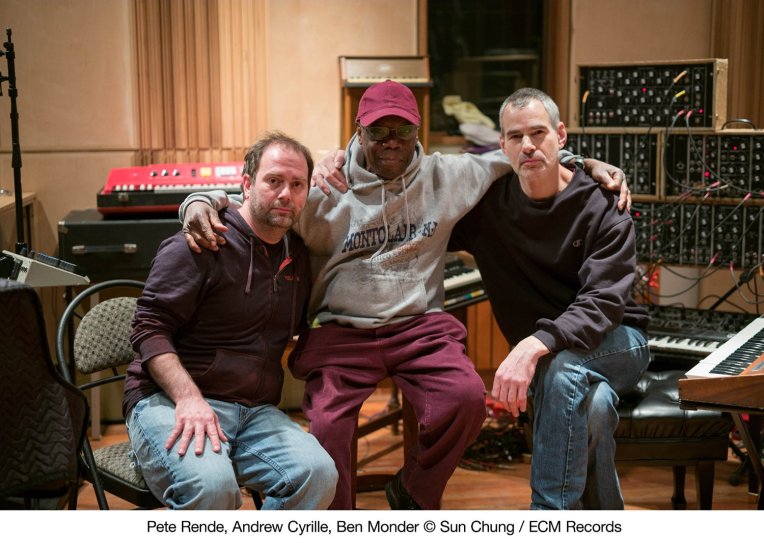
Constellations fill the spectrum between as Monder sings through a variety of guitars and tunings. “Gamma Crucis” and “Zythum” triangulate with Pete Rende on synthesizer and Andrew Cyrille on drums. Both pieces are geological surveys of highest order. Monder and Rende release so much likeminded stardust, it’s all they can do to clarify that they’re two nebulae working independently of time. Cyrille’s tracery is the dark matter between them, a dimension in which concrete rhythms have no gravity.

Guitarist and drummer make art as duo on “Hematophagy” and “Tumid Cenobite.” In the absence of electronics, their language feels closer to home, each his own weather front blending into collaboration. Although the landscape below them is desolate, it wavers with memories of rivers and greenery. Monder’s stirrings are like those of a creature in the leaves of Cyrille’s reforesting. With each sunrise, they dissolve dust into breathable air.

Monder Trio

Poignantly, late drummer Paul Motian joins Monder for two further duets. First is a starlit take on the Rodgers and Hammerstein classic “Oh, What a Beautiful Morning.” It’s beautiful indeed to hear Motian’s brushes, pulled as if from beyond some mortal curtain, springing to vibrant life of their own impulse. There’s something fully alive about this music—not only because of the tune, but also because of the way it rolls off the musicians’ proverbial tongues like a psalm. Recognition is not a precondition for enjoyment, however, as Monder’s ambience forges new relationships using familiar actors. His searing explosions make steam of ocean water, leaving lost cities exposed to sunlight for the first time in eons. Then there is “Triffids,” a spontaneous blush of tenderness that eludes capture by microphone and digitization. It is, rather, a force that knows us before we may consciously seek it out in the listening. Motian’s feel for internal rhythm is profound.

Motian

Monder navigates the paths before him with confidence because he defines them as he goes along. Leaving behind uncertainty, he uses gentility as fuel for a strong spirit. It’s perhaps no coincidence that the track titles recall the histrionic wordplay of the Cocteau Twins, for with likeminded boldness he does away with consensus articulations in favor of the emotional resonances beneath.

Sokratis Sinopoulos Quartet: Eight Winds (ECM 2407)

2407 X

Sokratis Sinopoulos Quartet
Eight Winds

Sokratis Sinopoulos lyra
Yann Keerim piano
Dimitris Tsekouras bass
Dimitris Emmanouil drums
Recorded April 2014 at Sierra Studios, Athens
Engineer: Giorgos Karyotis
Produced by Manfred Eicher
U.S. release date: January 15, 2016

Sokratis Sinopoulos is a master of the lyra, a bowed instrument whose lilt has polished a handful of ECM gems, including soundtracks of Greek composer Eleni Karaindrou (notably, The Weeping Meadow) and the Athens Concert of Charles Lloyd and Maria Farantouri. Despite its small size, the lyra is capable of painting holistic landscapes, and none so sweeping as those at Sinopoulos’s touch. After years of being a vital yet overshadowed sideman, Eight Winds finds the virtuoso making his debut as leader. Although the lyra comes preloaded with centuries of tradition, the music produced by the quartet assembled here— rounded out by pianist Yann Keerim, bassist Dimitris Tsekouras, and drummer Dimitris Emmanuel—is resolutely forward-looking. For this recording, as special in the listening as it was in the making, I sense a unity of purpose beating in the hearts of everyone involved. This is demonstrated by the album’s title alone, which charts not only the cardinal directions, but also the twin cross bisecting them. In each of the album’s 12 original tunes, the navigational freedom of those winds is palpable.

The title track opens with the bandleader’s distinctive sound. His lyra, as obvious to anyone tasked with analogizing it, has a distinctly vocal quality. Even before the jazz trio configuration in which Sinopoulos has situated himself becomes apparent, like a singer he has tasted the theme at hand and savored it to the brink of dissolution. All I can find myself thinking while absorbing the results of this collaboration in kind is that this is a first in jazz, an album that only Manfred Eicher and ECM could produce with such integrity of vision.

Sokratis Portrait

Much of this album moves at a pace of lives no longer lived. One strain of “Yerma” or “Lyric” is enough to reveal the folk roots feeding each improvisational leaf. Whether interacting with Keerim’s piano or Tsekouras’s bass, Sinopoulos puts his trust at the center. The melodies are so developed that they sound like ancient motifs rescued from obscurity, conjuring up images of a past you never knew was in you. In this respect, “Aegean Sea” is the most inviting tune of the set, if also for depicting an important location for its composer. Emmanuel’s hand-drumming brings it to an even earthier level.

Because the lyra is associated with dancing, tunes like “Street Dance” and “In Circles” inspire and energize. These are balanced buy “21st March” and “Forever,” which take stock of brokenness and find harmonies beneath its dissonant rubble. In both, Sinopoulos shows us just how many feathers his instrument has, while touching on the Byzantine musical interests of his formative years.

His delicacy is artfully supported by his bandmates. At no point do they drown out his whispers (a feat for which both musicians and engineer are praiseworthy). As the title track variation that ends the album, everything that precedes it is a gradient of oneness: an asymptote conquered by faith.