Louis Sclavis Quintet: L’affrontement des prétendants (ECM 1705)

L'affrontement

Louis Sclavis Quintet
L’affrontement des prétendants

Louis Sclavis clarinet, bass clarinet, soprano saxophone
Jean-Luc Cappozzo trumpet
Vincent Courtois cello
Bruno Chevillon double-bass
François Merville drums
Recorded September 1999, Studios La Buissonne, Pernes-les-Fontaines
Engineer: Gérard de Haro
Assistant engineer: Sylvain Thevenard
Produced by Louis Sclavis
Executive producer: Manfred Eicher

Multi-reedist Louis Sclavis unveils a new quintet with L’affrontement des prétendants, retaining only bassist Bruno Chevillon from his previous ECM sessions. Along for the ride are newcomers Jean-Luc Cappozzo on trumpet, Vincent Courtois on cello, and François Merville on drums. With them, he forges a distinctive jazz that never fails to titillate with its artful blend of composed and free elements. Like the wonderful Acoustic Quartet disc before it, this date immerses the listener in a refreshing, driven sound.

Despite the album’s title (one might translate it as “The clash of contenders”), the dynamics within the band are anything but contentious. Sclavis’s staid formula of spiraling, precisely notated bookends only serves to foil the brilliant unraveling occurring between them. Take the 17-minute “Hommage à Lounès Matoub,” for example. The masterpiece of the set, it honors its eponymous protest singer through an epic development of mourning into celebration. Bass shadows the solo cello that begins the piece before trumpet threads an alluring stretch of politics. Merville takes an indulgent look at the landscape before paving the way for Sclavis’s soprano. Like Dalí’s famous moustache, which the artist is said to have reserved for only the minutest detail, that pliant reed renders individual leaves, glints of sunlight, and footprints in the sand. Also indicative of the band’s unity is the opening title track, in which Cappozzo is the glue that binds. From growling catharsis to klezmer touches, its idiomatic merry-go-round hinges an exemplary doorway.

Despite the sometimes-dire associations, Sclavis surrounds himself with an eminently joyful milieu. The listener may feel this especially in brightness of “Possibles” and “Contre contre.” The latter’s groove-laden vista is a particularly fluid feature for Sclavis, who over a light percussive backdrop sparks a noteworthy exchange between cello and bass. Even more memorable is that between Sclavis and Courtois in “Distances,” as outgoing as it is crumpled to a pliant core. Yet another duet, this of clarinet and bass, develops full-bodied dances from merest whispers in “Le temps d’après.” Chevillon goes rogue in “Hors les murs,” a packed solo that stomps and pirouettes in turns, and links chains of forward-thinking energy into the stratosphere. Sclavis offers his own monologue via soprano, introducing the swinging “Maputo,” for which he switches to bass clarinet, running along a distinctly swinging backbone with fortitude and oddly graceful sibilance. Last is “La mémoire des mains,” a freely improvised spate he shares with Merville and Courtois: three birds in a cage chattering themselves to sleep.

<< Stockhausen/Andersen/Héral/Rypdal: Kartā (ECM 1704)
>> Jean-Luc Godard: Histoire(s) du cinéma (
ECM 1706-10 NS)

Stockhausen/Andersen/Héral/Rypdal: Kartā (ECM 1704)

Karta

Kartā

Markus Stockhausen trumpet, piccolo trumpet, flugelhorn
Terje Rypdal electric guitar
Arild Andersen double-bass
Patrice Héral drums, percussion, live electronics
Recorded December 1999 at Rainbow Studio, Oslo
Engineer: Jan Erik Kongshaug
Produced by Manfred Eicher

Although the title of Markus Stockhausen’s Kartā is Sanskrit for “higher power,” the music serving it suggests a path of regression from bird to egg. The trumpeter-composer fronts a superb trio that includes Arild Andersen and Patrice Héral (a percussionist whom Andersen characterizes as “a European equivalent to Nana Vasconcelos” and who can also be heard the bassist’s concept album, Electra). Guitarist Terje Rypdal guests, adding swirls of Technicolor to the band’s monochrome. True to collective spirit, much of the pre-arranged material was jettisoned in favor of the spontaneous improvisations that ensued for the recording session’s first ninety minutes. From this came the lion’s share of an 11-part set list. Of the four composed pieces that made the final cut, Andersen and Stockhausen each contributed two.

Looking out from “Legacy” (a sweet breaking of bread that evokes late-night Miles) at the album’s center, one sees Andersen’s pieces at the farthest reaches. Where “Sezopen” allures with its droning cries and floats Rypdal’s autumnal heart murmurs with ease, “Lighthouse” draws powerful arco lines, evoking not the structure itself but the rays of promise it emits and the vessels they rock to sleep. The resulting traction leaves us with a time-lapse photograph to cherish. One layer inward, in either penultimate position, are Stockhausen’s tunes, which between the rubato “Flower Of Now” and the amorphous “Choral” open various doorways of possibility into the ad-libbed nexus.

In said nexus reside creatures of great dexterity (viz: Andersen’s fingerwork in “Wood And Naphta” and Rypdal’s in the fiercely programmatic “Wild Cat”) and natural girth (“Sway”). Yet it is in freer tracks such as “Auma,” “Invocation,” and “Emanation” where the musicians’ sacred touchstones appear. Together they form the weight of a Foucault’s pendulum spun in resourceful filament. At times they reach fevered pitch at the suggestion of Andersen’s ebony ululations, while at others they slip into ghostly blur. Whatever the climate, they hold fast to their timekeeping in constantly shifting clockwork with admirable constancy.

Stockhausen is a player who bathes in outer space, finding freedom in the darkness between the stars. With Kartā he has crumpled a nebula back to its planetary state.

<< Gianluigi Trovesi/Gianni Coscia: In cerca di cibo (ECM 1703)
>> Louis Sclavis Quintet: L’affrontement des prétendants (
ECM 1705)

Dino Saluzzi Group: Juan Condori (ECM 1978)

Juan Condori

Dino Saluzzi Group
Juan Condori

Dino Saluzzi bandoneon
Felix “Cuchara” Saluzzi tenor and soprano saxophones, clarinet
José Maria Saluzzi acoustic and electric guitars
Matias Saluzzi double-bass, bass guitar
U.T. Gandhi drums, percussion
Recorded October 2005, Estudios Moebio, Buenos Aires
Engineer: Stefano Amerio
Produced by Manfred Eicher

A Dino Saluzzi album is the audio equivalent of looking through a family photo album. Not so allegorically in this case, as Dino’s brother Felix (saxophones and clarinet), son José Maria (guitars), Felix’s son Matias (basses), and honorary kin U.T. Gandhi (drums and percussion) join the bandoneón virtuoso for this set of 12 moving pictures, each with its own thumb-worn page. Although named for a childhood friend whose free spirit holds special place in his heart, Juan Condori is less a personal portrait than it is a biography of a time and place preserved in memory. Indeed, from memory come the building blocks of Saluzzi’s music, the very blood without which it might never reach those bellows.

The themes of Juan Condori cross a few historical hairs, from the dying wisdom of South American indigenous peoples (“La Vuelta De Pedro Orillas” and “Chiriguano”) and the 1994 bombing of the Jewish Community Center in Buenos Aires (“Memoria”) to the life force of music itself (“La Parecida”). If any such references describe a world we know, then it is all we can do to seek hope in these instruments of light: not only memory, but also remembrance. Aside from the acoustic “Soles” by José, written metallic on wind carrying an attic’s scent, the Pedro Laurenz tango classic “Milonga De Mis Amores,” and the spontaneous “Improvisacion,” all the music here is Saluzzi Sr.’s own. Father and son share moments of clear telepathy, as in the airy dance movements of “La Parecida,” in which they paint starbursts of light around the Matias’s deep axis. José enchants further in “A Juana, Mi Madre,” in which his electric evokes the nocturnal stylings of John Abercrombie, and in the title track, while Felix’s pastoral clarinet in “Las Cosas Amadas” and “Los Sauces” deepens the feeling of locality. These and more comprise a set one can only admire for its thematic integrity, its emotive charge, and the quiet flow of its sustenance.

Pay close attention to this one. It brings water to the desert.

Dave Holland Quintet: Extended Play – Live At Birdland (ECM 1864/65)

Extended Play

Dave Holland Quintet
Extended Play: Live At Birdland

Chris Potter soprano, alto and tenor saxophones
Robin Eubanks trombone, cowbell
Steve Nelson vibraphone and marimba
Billy Kilson drums
Dave Holland double-bass
Recorded live at Birdland, November 21-24, 2001
Engineer: James Farber
Produced by Dave Holland

That Dave Holland ends his brief frontispiece in the CD booklet for Extended Play: Live At Birdland by acknowledging the commitment and uncompromising creativity of his band mates is proof positive of the bassist’s own. Everything he had recorded for ECM up to this point, starting with the label’s ninth release (A.R.C.) in 1971, comes to a head in this double-disc live recording from New York’s famous Birdland jazz club some three decades later. The quintet featured here is to date Holland’s best-oiled machine: saxophonist Chris Potter, trombonist Robin Eubanks, mallet man Steve Nelson, and drummer Billy Kilson work together with such professionalism, respect, and synchronicity that one needn’t even have been there to acknowledge it. And because the album’s nine tunes (averaging 15 minutes each) are all of such a massive piece, it fares better to speak of the men behind the music.

Kilson shines on “Prime Directive” (as he does on the album it titles), backing the spine-tingling negotiations of the horns and bringing the full gamut of his sound to bear on “The Balance,” which opens barely, tenderly: the last gasp of sunset before the dusk draws its curtain. At 21 minutes, this is no shy cat but a lion ready to pounce yet who would rather sing for the sheer pleasure of it. Holland’s intimate solo against Kilson’s beetle-wing cymbals makes for some beautiful downtime. Bassist and drummer also pair off nicely in “Claressence,” where they lay down a confident groove beneath the harmonized theme, leaving Potter to unleash a kennel’s worth of playful pets.

As for Potter and Eubanks, they are so well integrated that it’s all one can do to analytically separate them, though Potter edges out in the slumbering “Make Believe,” playing North Star to Holland’s seafaring. “Free for All” realizes deepest integration of this duo, and of the quintet at large. Soprano and trombone make a perfect pair, Holland the solid triangle at the fulcrum of their seesaw. Eubanks gets his soliloquy at the start of “Bedouin Trail,” for which he dons the storyteller’s hat and kicks off an especially flowing take on this quintessential journey, and dialogues superbly with both Potter and Holland in “Jugglers Parade.” He also stands out for the occasional moments of intensity during which he sings into his trombone in pure, incendiary brilliance.

Holland’s bass is an unbreakable tendon, showing off its flexibility in the Potter-penned “High Wire,” another fine display of congruence. His flip-flopping salts the rim of the alto margarita that ensues. Hip and then some, Kilson provides a splash of Cointreau, Nelson a Grand Marnier infusion. Going down just as smoothly is the gargantuan ender: “Metamorphos.” This one comes from the mind of Eubanks and finds Holland lyrical and ebullient, establishing at the outset the perfect conditions for transformation. His cell divides, and those further into a full-blown 20-minute experience, of which the night’s most engaging few are shared in triplicate between Eubanks, Kilson, and Holland.

And let us not forget Nelson, whose deft cross-hatching throughout—but especially in “Bedouin Trail,” “Free For All,” and “Claressence”—is so omnipresent, so slick and attentive, that without it the other four planets would fling wildly from their sun.

Extended Play is a rebirth of cool and about as perfect as live albums get. It is also a veritable résumé at a high point in the band’s career. The five intersecting planes on the cover say it all. If you only ever buy one Holland album (and I hope you don’t stop there), your choice is clear.

Arild Andersen Group: Electra (ECM 1908)

Electra

Arild Andersen Group
Electra

Arve Henriksen trumpet
Eivind Aarset guitars
Paolo Vinaccia drums, percussion
Patrice Héral drums, percussion, voice
Nils Petter Molvær drum programming
Savina Yannatou vocal
Chrysanthi Douzi vocal
Elly-Marina Casdas chorus vocal
Fotini-Niki Grammenou chorus vocal
Arild Andersen double bass, drum programming
Recorded 2002/03 at home, 7. Etage in Oslo, Kæv Studio in Copenhagen, Les productions de l’érable in Montpellier and Spectrum Studio in Athens
Engineers: Reidar Skår (7. Etage), Kæv Gliemann (Kæv Studio), Christophe Héral (Les productions de l’érable), and Vangelis Katsoulis (Spectrum Studio)
Mixed by Reidar Skår at 7. Etage (tracks: 1, 10, 14, 18), Jock Loveband at Barracuda Studio (tracks: 3, 9, 11, 13, 16), and Kæv Gliemann at Kæv Studio
Produced by Arild Andersen

In the beginning was the word and the word was breath, brought to life through life, as life. This is the message written in “Birth Of The Universe,” a guiding of human expression through honed elements and air. It is a cursory introduction, nevertheless packed with voids and stardust, opening into the slow-motion formations of “Mourn,” which begin the set list proper of Arild Andersen’s Electra. Originally composed for a production of the Sophocles play directed by Yannis Margaritis at Spring Theatre in Athens, this concept album par excellence shows the Norwegian bassist at his most lyrically contemplative. Lying somewhere between the all-acoustic ruminations of Voice of Eye and the electronic infusions of Khmer, it belongs squarely beside the latter as a classic alchemy of jazz, digitalia, and less definable sources. The Khmer comparison is no coincidence, for Electra in fact borrows that groundbreaking session’s leader, Nils Petter Molvær (moonlighting here as drum programmer) and the versatile guitarist Eivind Aarset. Drummers Paolo Vinaccia and Patrice Héral cross the t’s and dot the i’s, leaving trumpeter and ECM veteran Arve Henriksen to feel his way through tight spaces and alleyways by virtue of his melodic whiskers. Completing the cast is vocalist Savina Yannatou, singing as Electra, and her Greek chorus: Elly Casdas, Chrysanthi Douzi, and Fontini Grammenou. Yannatou evokes the album’s lifeblood in the title song, which is bookended by a fluid Intro and Outro. Thus embraced by Andersen’s thematic leadership, her soliloquies form the hub of this karmic wheel.

At its most meditative moments (e.g., “The Big Lie”) Electra journeys inwardly and without judgment, while at its most extroverted (the guttural “Clytemnestra’s Entrance” and, surprisingly enough, the robust unfolding that is “Whispers”) it tears down the fourth wall and grabs the listener at point blank. Along the way, four “Choruses” dot the landscape with their walkabouts, each an atmospheric soul-search with a hermetic, percussive feel. Those beats echo in empty shells of a life aquatic, each a bead threaded by the dreadlock of a lumbering deity whose arms swing like lightning bolts slowed to the pathos of dreams. Such are the types of figures that shape-shift with every track.

Yet it is Andersen whose wayfaring leaves the most indelible footprints throughout. So profound is his drifting that the appearance of drums often feels like the storms of a distant planet, swirling in an indecipherable calligraphy. Whether laying down heady grounds against Héral’s beatboxing in the droning “Opening” or stitching the edges of “7th Background,” he pulls worlds of feeling into the crucible, which reduces every sonic ingredient into the sputtering electronic fuse of “Big Bang.” Dying like a depressed piano key, it sounds in the eco-verse.

If you love Khmer, then you’re sure to enjoy getting to know Electra. It represents Andersen the structuralist, an artist as compositionally as he is instrumentally present in a program of deep, flavorsome music with a clear sense of dramaturgical motion and a keen interest in unseen worlds.

Enrico Rava: Easy Living (ECM 1760)

Easy Living

Enrico Rava
Easy Living

Enrico Rava trumpet
Gianluca Petrella trombone
Stefano Bollani piano
Rosario Bonaccorso double-bass
Roberto Gatto drums
Recorded June 2003 at Artesuono Recording Studio, Udine
Engineer: Stefano Amerio
Produced by Manfred Eicher

Enrico Rava has singlehandedly defined Italian jazz as a technical wizard. More importantly, he has also enlivened its soundscape with a playbook that balances verve and thoughtfulness. After a 17-year hiatus, the trumpet champion returns to ECM among his trusted quintet with what might just be his finest album yet (an opinion shared by Rava at the time of its recording). Wherever it may rank in your mental charts, it is a comfortably burnished standout in his discography, due in no small part to the artful brilliance of engineer Stefano Amerio.

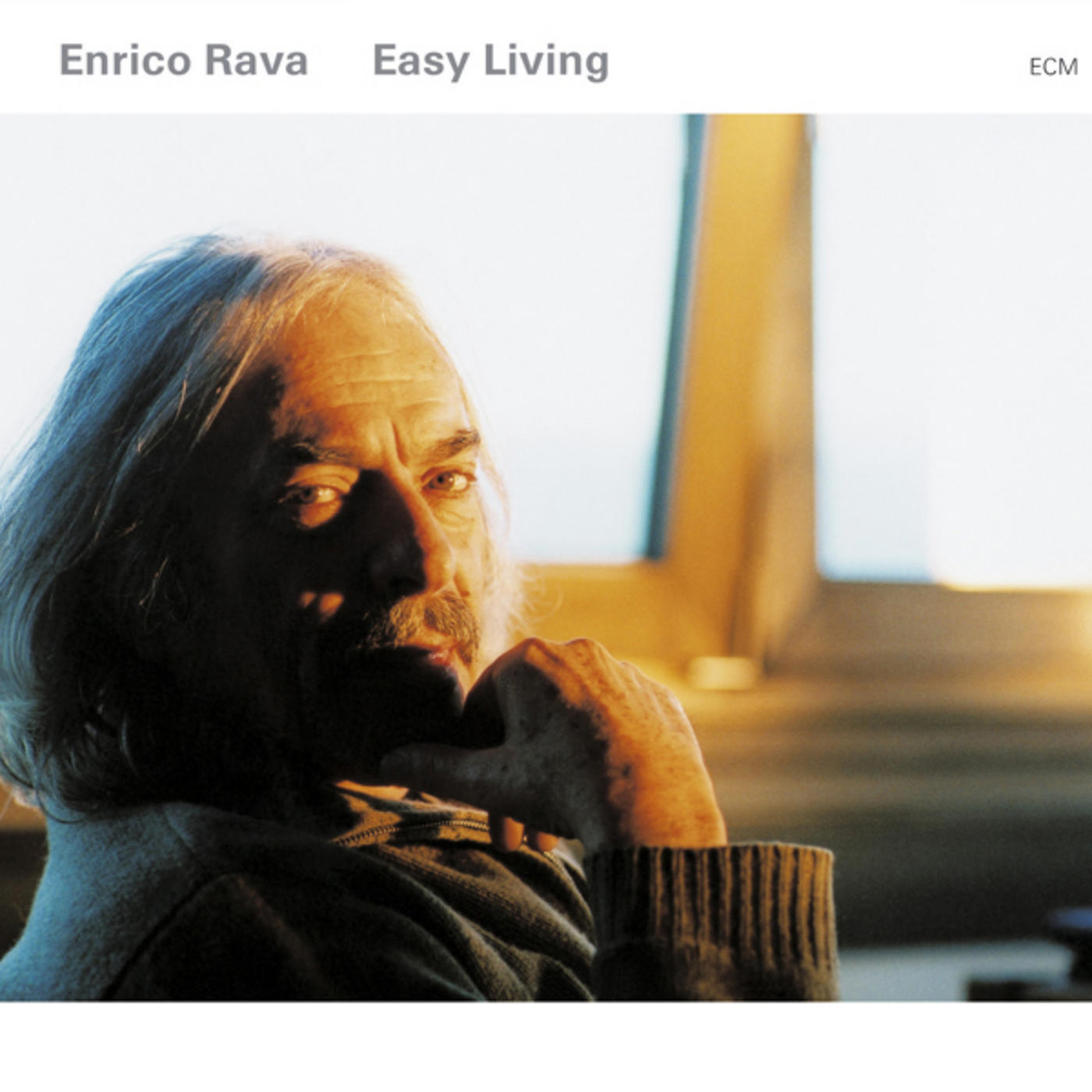
Perhaps not since Annette Peacock’s an acrobat’s heart has an ECM cover portrait so well captured the atmosphere of the music behind it. Indeed, the thoughtful sincerity of “Cromosomi” unfurls a palette befitting of Roberto Cifarelli’s warmly hued portrait. Rava’s interaction with the young trombonist Gianluca Petrella is close-eyed, intuitive, and lays the groundwork for some crystalline reverberations. The pointillism of Stefano Bollani and coruscating accents of drummer Roberto Gatto paint the last rays of sunset. Make no mistake about the title’s significance: Rava’s approach is fiercely biological, so attuned is it to the mutual appreciation of his band mates. “Drops” follows with a handful of candy, turning the chromosomal into the chromatic at the touch of a keyboard and setting the stage for Rava’s soaring flights in “Sand.” Using a slack backdrop as trampoline, he devises lyrical acrobatics and microscopic exchanges galore. Rava continues in this vein throughout the title track, the only one not composed by him, backed by support that has the consistency of meringue and is just as sweet. “Blancasnow” is another brief exercise in pure intonation. Fans will recognize it as the concluding track of his ECM debut, The Pilgrim And The Stars, and here its austerity is even more heavily shaded.

Lest the listener think that Easy Living is all drift, “Algir Dalbughi” plots a hard swing at album center. From Petrella’s ebullient harmonizing comes a vast, big band sound and foils Rava’s extroverted heights with pale fire. Bassist Rosario Bonaccorso opens “Traveling Night” with a fluttering solo and leads the band into another flowing diary entry. Gatto communicates hyper-effectively with Bollani as Petrella fires off a round of humid motives. “Hornette And The Drums Thing” is the finest track of the set and an even finer vehicle for the drummer, who jumps, skips, and shuffles his way through the deck like a blindfolded magician—though he has some acutely observant spectators in Petrella and Bollani following his every move. Rava’s sweep is characteristically melodic and assured. His fingers stir up their own concert, notes singing by like arrows. Gatto’s full-on wizardry quiets into a lush carpet for the band’s legato breakdown, bringing us at last to “Rain,” which draws the curtains, breaks down the set, and bids farewell in style. Between Gatto’s cymbal-laden drizzle, Bonaccorso’s thick sags, and Bollani’s varietal drama, there is plenty to admire in this luxurious sendoff.

Easy Living is ideal for an afternoon drive or lethargic morning alike. Its verdant fields and canopied paths smell of a grandmother’s food: no matter how many times you eat it, it will always taste like home.

Essential listening.

<< Dave Holland Quintet: Not For Nothin’ (ECM 1758)
>> Harald Bergmann: Scardanelli (
ECM 1761 NS)

John Surman: Coruscating (ECM 1702)

Coruscating

John Surman
Coruscating

John Surman soprano and baritone saxophones, bass and contrabass clarinets
Chris Laurence double-bass
Rita Manning violin
Keith Pascoe violin
Bill Hawkes viola
Nick Cooper cello
Recorded January 1999 at CTS Studios, London
Engineer: Markus Heiland
Produced by Manfred Eicher

The title of John Surman’s Coruscating means sparkling. Yet with track names like “At Dusk,” “Moonless Midnight,” and “An Illusive Shadow,” we are squarely in a nocturnal realm. The multi-reedist, along with bassist Chris Laurence, puts his touch on this set of eight compositions, which over the album’s course blend into a seamless whole. At their center is an ad hoc string quartet, to which Surman and Laurence act as improvisatory satellites. The two aforementioned sections drop Surman’s oboe-like soprano into pre-written cuts of land, each a ripple in a lake that holds ebony sky in its cup.

Although it will not be surprising to any Surman fan, it is as baritonist—ever the rightful successor to Gerry Mulligan—that he comes closest to bringing the shine. Whether in the softly rolling sentiments of “Dark Corners” or the  muscular stirrings of “Stone Flower” (in memory of another baritone great, Harry Carney), his low reed dots the compass many times over through charcoal travels. “Winding Passages” is the most mature of these breeze-swept soliloquies and provides a solid platform for the composer’s bronzed hieroglyphs. Laurence shakes his most geometric ghosts out in “Crystal Walls,” while “For The Moment” mixes cello tracings into vibraphone, Surman’s restless gestures carrying us all the while into deeper pasture.

Those who weren’t quite feeling Proverbs and Songs might find Coruscating more accessible, if only because there is so much space for listeners to relax and, in spite of all the darkness, feel their way around. It is a dream of quotidian objects sleepwalking for want of a place to have purpose, only to discover that their wandering is that very thing.

<< Jan Garbarek/The Hilliard Ensemble: Mnemosyne (ECM 1700/01 NS)
>> Gianluigi Trovesi/Gianni Coscia: In cerca di cibo (
ECM 1703)

Arild Andersen: Celebration (ECM 2259)

Celebration

Arild Andersen
Celebration

Arild Andersen double-bass
Tommy Smith tenor saxophone
Scottish National Jazz Orchestra
Tommy Smith director
Recorded live October 2010 at Stevenson Hall, Royal Conservatoire of Scotland by Mark McKellen
Edited and mixed at Rainbow Studio, Oslo, September 2011 by Jan Erik Kongshaug, Arild Andersen, Tommy Smith, and Manfred Eicher
Produced by Manfred Eicher

Since debuting on Jan Garbarek’s Afric Pepperbird in 1970, bassist Arild Andersen has been a staple of the ECM diet. Forty years in the making, Celebration pays tribute to the label that has been his home for just as long with a live “best of” recorded 2010 at Glasgow’s Royal Conservatoire. Flanked by the Scottish National Jazz Orchestra under the direction of tenorist Tommy Smith, Andersen is as much the focal point in this set of six tunes as the music itself. His role as primary soloist materialized at the behest of Smith, the two of them already well acquainted in their trio work with Paolo Vinaccia, and it was Smith’s compositional prowess that led him to propose and shape the once-in-a-lifetime performance documented here.

“May Dance,” by fellow bassist Dave Holland, comes to us by way of the 1975 classic Gateway in a thoroughly swinging take replete with sulfuric interaction. Smith grabs us from breath one and throws us into a pit of melodious fire. Andersen and drummer Alyn Cosker—a team that becomes more vital as the set goes on—throw nets of excitement into the air and catch an entomologist’s worth of specimens. Compared to his essential Green In Blue, Andersen sounds as electrifying as ever in this concerted leadoff to an album of vivacious character. Part 1 of saxophonist Jan Garbarek’s “Molde Canticle” (I Took Up The Runes, 1990) is another fitting choice—all the more appropriate for also being a celebratory commission, this in recognition of the Molde Jazz Festival’s 30th year. Andersen floats here in a harmonic abyss, switching axes in slow tension with the horns. Smith’s muscled tone is an ideal match for Garbarek material, and his leadership of the larger forces at hand elicits some visceral making of music. “Crystal Silence,” off the eponymous 1973 classic by Chick Corea, is surely the album’s best known, though here it feels like the first time. The arrangement is decidedly aquatic. It places its feet on the shore, feeling wet sand between the toes, the scuttle of horseshoe crabs beneath, and the lapping of waves on the ankles. Before long, the world is submerged, blue in blue. Andersen’s robust brushstrokes evoke schools of fish, swimming as one.

From the most to least familiar, the program changes gears with “Ulrikas Dans” by saxophonist Trygve Seim, whose big band sensibilities come through rather gloriously in this selection from his 2000 album Different Rivers. Andersen and Cosker are again the main attraction. They build Seim’s forested themes in dense pockets, evocative and sure, dropping strings and cymbals in the form of dreams. These elements render Smith’s cathartic revelation in the final stretch that much more satisfying. Andersen cannot help but include his own work, and here he selects Part 4 of his “Independency” suite from Live At Belleville with the aforementioned trio. Having first appeared on disc only in 2008, it is the most recent of the music represented here. It opens with Andersen’s bass, drawn at the touch of a bow, in an electronically enhanced echoing universe. Brass resounds like foghorns, voices in the night treading water in want of moon. This eases into some intuitive free dialoguing between Andersen and Smith, who dominate the stage with their forthrightness. Their combination of fawning glissandi and whisky expulsions spins a fuse, which Andersen and Cosker light midway through. Smith’s tenorism is the implosion. The group encores with Keith Jarrett’s “My Song” (from the eponymous 1978 album). Andersen clearly finds poignancy in its tender summation of a life lived for art. He consciously approaches his bass as the piece’s composer approaches the keyboard, his fingers melding with the instrument. To underscore this point, pianist Steve Hamilton joins him for a spell: the draw of a slingshot that ultimately sends us reeling into the distance.

Andersen is duly enlivened by the atmosphere of his fellow musicians and of the timeless music in his hands. His voice leaps from the stage in sheer joy of creation, with every note proving his rightful seat in the pantheon of modern bassists. This is a fine recording as well, for it keeps the big band close enough to punch but far enough away so as not to overwhelm. The amplification of Andersen’s instrument has never sounded better. Credit must also be given to the fine arrangements, courtesy of Christian Jacob (Holland), Tommy Smith (Garbarek), Makoto Ozone (Corea), Øyvind Brække/Trygve Seim (Seim), Mike Gibbs (Andersen), and Geoffrey Keezer (Jarrett).

A celebration indeed of a consummate artist, but also more than that: a masterful affirmation of all that is good and true in jazz.

(To hear samples of Celebration, click here.)

Cyminology: As Ney (ECM 2084)

As Ney

Cyminology
As Ney

Cymin Samawatie vocals
Benedikt Jahnel piano
Ralf Schwarz double-bass
Ketan Bhatti drums, percussion
Recorded April 2008 at Rainbow Studio, Oslo
Engineer: Jan Erik Kongshaug
Produced by Manfred Eicher

My whole being is a dark chant
which will carry you
perpetuating you
to the dawn of eternal growths and blossoming
in this chant I sighed you sighed
in this chant
I grafted you to the tree to the water to the fire
–Forugh Farrokhzād (1935-1967)

When the title track of As Ney wraps around your heart, there’s almost no need for words. Piano and voice are locked, cymbals raining down in a sprinkle of fairy dust at the periphery of a magic circle. The feelings seek us out, like the bass that coats the band’s delicate tensions with gold. Incantations become translucent, inserting coins into an offering box that resonates with song. Spinning that song is Cymin Samawatie, vocalist and leader of the group Cyminology, which makes its ECM debut here. Samawatie draws on her Iranian heritage and the poetic tradition it embraces, touching vital pressure points at the 13th (Rumi) and 14th (Hafiz) centuries, while also building her own. Another vivid influence is Forugh Farrokhzād, the iconoclastic poet and filmmaker of Iran whose overtly female-centered voice forever transformed the face of Persian verse.

All of this she splashes through the prism of a fresh trio of improvisers. Vital to the group’s sound is Benedikt Jahnel. The Berlin-based pianist is a welcome addition to the ECM fold, having more recently released the groundbreaking Equilibrium, and brings that same open approach to the rhythms of Samawatie’s ruminant canto style. New Delhi-born drummer Ketan Bhatti is even more linguistically inclined, taking inspiration from the text and the moment in equal measure. Completing the circle is bassist Ralf Schwarz, the keystone of this sonic archway.

Press Photography / 2010 / Berlin Commissioned by ECM Records / Munich

What begins in “Niyaayesh” as dry land is, by the final “Ashkhaa,” a raindrop turned ocean. Every lap of wave becomes an ephemeral scale on the earth’s thirsty skin, a wish fulfilled through its disappearance. The road to getting there is riddled with dreams, some clock-like (“As Ssafar”), others halting (“Sendegi”), and still others brooding (“Por se ssedaa”). At their core is the triptych “Kalaam/Dassthaa/Delbasstegi,” which dovetails forces in rich synergy, every word the rib of a fan between which the instruments are sketches of webbing, amorphous yet firm. The keyhole into each new section opens by breath.

Despite the woven textuality of As Ney, “Naagofte” is Cyminology at its purest. Its aquatic wordless vocals nonetheless convey a story, a rite of passage from sober to possessed and back again. The melody is life, such that when words flip their pages toward the end in guise of morning light, they simultaneously caress the dead. Such border-crossing power is Samawatie’s forte. Without her, the shadows overwhelm. Why follow your eyes, she seems to ask. Let the echo be your footpath.