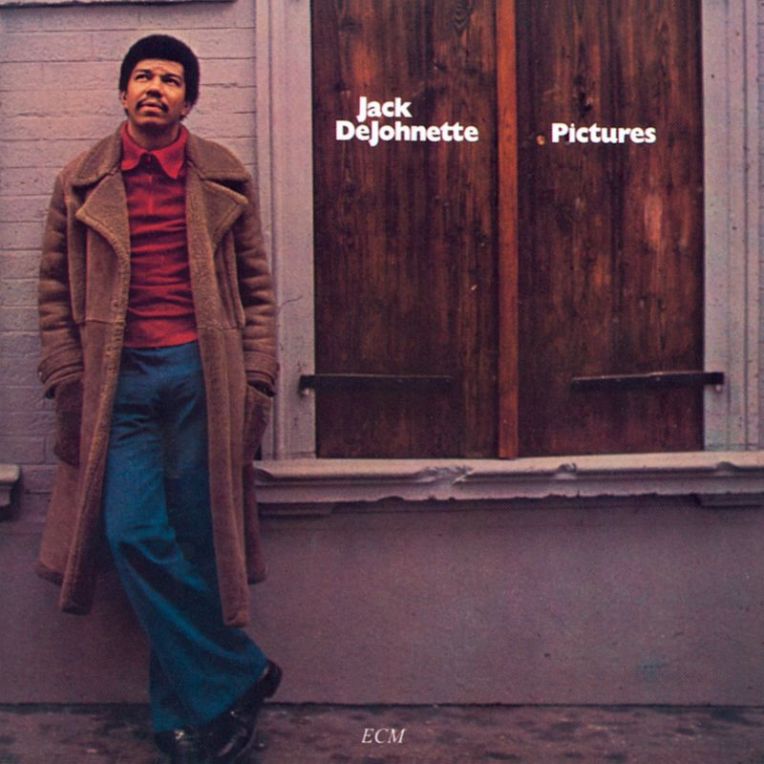
Jack DeJohnette: Pictures (ECM 1079)

ECM 1079

Jack DeJohnette
Pictures

Jack DeJohnette drums, piano, organ
John Abercrombie electric and acoustic guitars
Recorded February, 1976 at Talent Studio, Oslo
Engineer: Jan Erik Kongshaug
Produced by Manfred Eicher

Hot on the heels of his stellar Directions debut, drummer Jack DeJohnette settled down in the studio for this cool duo album with guitarist John Abercrombie. Less a side project than a chance to open the mind to more introverted images, Pictures is the spark behind the fire.

The steady beats of “Picture 1” grow in scope with every new added detour. What at first seems a drumming exercise quickly turns haunting as an organ rises up from the earthen tide. After the ode to toms and cymbals that is “Picture 2,” the following three Pictures feature Abercrombie’s improvisatory accents, which range from meandering to cathartic. But the real pièce de résistance is “Picture 6.” As its temperate piano introduction works its way into a swell of gongs, we begin to see the melody behind the fire. It is a Keith Jarrett moment if there ever was one, the Ruta and Daitya that could have been.

Like any good picture, DeJohnette’s curious little project has everything it needs in frame. Nothing extraneous; stripped-down music-making for its own sake, offered up to the listener with humility and respect. This is not an album meant to titillate or to excite or to make any sweeping statements on the nature of its own becoming. It professes to be nothing beyond the space implied, never the sum but the equation laid bare. Get this album for its stunning closer, and open yourself to its other intimacies. Pictures gives us unique insight into the craft of a musician more widely known for his equally arousing timing and delivery.

<< Enrico Rava: The Plot (ECM 1078)
>> John Abercrombie/Ralph Towner: Sargasso Sea (ECM 1080)

Collin Walcott: Cloud Dance (ECM 1062)

ECM 1062

Collin Walcott
Cloud Dance

Collin Walcott sitar, tabla
John Abercrombie guitar
Dave Holland bass
Jack DeJohnette drums
Recorded March 1975 at Tonstudio Bauer, Ludwigsburg
Engineer: Martin Wieland
Produced by Manfred Eicher

The late, great Collin Walcott made his proper ECM debut on Cloud Dance (after an appearance three years earlier on Trios/Solos), where he was joined by the Gateway trinity—John Abercrombie, Dave Holland, and Jack DeJohnette—for one of his most powerful albums ever to grace ECM’s vinyl (and later, digital, thanks to a vital Touchstone series reissue) grooves. The marrow-warming twang of Walcott’s sitar sets up the opening “Margueritte” to be a long raga, when suddenly Abercrombie’s electric appears in kind, beckoning a chill entourage of bass and drums and touching off a pair of graceful solos from Abercrombie and Holland. The album’s remainder is fleshed out by a variety of intimate configurations. “Night Glider” and “Vadana” both feature guitar, bass, and sitar, the latter two instruments feeding beautifully off one another, the guitar weaving in and out where it may. The two duets between Walcott and Holland, however, are really where this album gilds its worth. Our frontman lays out plush carpets of tabla and sitar on “Prancing” and “Eastern Song,” respectively, over which Holland takes stock of every variation of pattern and thread count. The second of these pieces, while the briefest of the album, is also one of its most mesmerizing. Contrary to what the titles might have us believe, these are all genuinely realized pieces where the word “exotic” is but another puff of smoke in the breeze. And so, the heavy tabla and shawm-like guitar of “Scimitar” describes not the weapon wielded in the hands of countless white actors in uninformed filmic productions, but rather an exploration of the object on its own terms, tracing forms and histories, battles and silences alike, with due abandon. So, too, with the final and title cut that brings DeJohnette back into the mix for an animated closer.

The telephone wires on the cover are like the strings of some large instrument, with the sky as its sound box. Its clouds don’t so much dance as perform, caressing endless waves of voices careening through the ether. The joy of Cloud Dance is that it makes those voices intelligible. Fans of Oregon, of which Walcott was of course an integral part, need look no further for likeminded contemplation.

<< Abercrombie/Holland/DeJohnnette: Gateway (ECM 1061)
>> Enrico Rava: The Pilgrim And The Stars (ECM 1063)

Dave Liebman: Drum Ode (ECM 1046)

ECM 1046 CD

Dave Liebman
Drum Ode

Dave Liebman soprano and tenor saxophones, alto flute
Richard Beirach electric piano
Gene Perla basses
John Abercrombie guitars
Jeff Williams drums
Bob Moses drums
Patato Valdez congas
Steven Satten percussion
Barry Altschul percussion
Badal Roy tablas
Collin Walcott tablas
Ray Armando bongos
Eleana Steinberg vocal
Recorded May 1974, Record Plant, New York
Engineer: Jay Messina
Produced by Manfred Eicher

“Drums and drummers. For me, they’ve been the moving force and inspiration, a reason to live, and celebrate life through playing music. Thanks to the men who play the drums. This music is dedicated to you.”
–Dave Liebman

It was the summer of 1997. I was fresh out of high school and settling into my new life at Goddard College (of Phish fame) in Plainfield, Vermont. The transition was sudden, but I was fortunate enough to have been placed in the music dorm, where dwelled lovers of all things audible. Late one night, during an emotionally exhausting orientation week, I was awoken by a sound coming from downstairs. Rubbing the sleep from my eyes, I descended to the common room to find my dorm mates deep in the throes of an impromptu drum circle. Congas, djembes, pots, tabletops, human bodies: everything was fair game. With nothing but a tin cup and a spoon at my disposal, I joined in with cathartic joy. I don’t think any of us remember how long the session went on after that (I’m not sure we even slept). Sadly, the school itself wasn’t what I had expected. After a long conversation with the group, I decided to return home and incubate for a year. Although this taxing decision eventually put me on a straighter academic path, I do think fondly of the profoundly attuned synergy we of the musical persuasion had forged in those dense seven days surrounded by the region’s denser foliage. Since coming across Dave Liebman’s seminal Drum Ode in reissued form, I have rediscovered something of that physical feeling of surrender one so rarely gets from a laser scanning a concealed silver disc.

Piggybacking on this success of Lookout Farm, Liebman surrounds himself with likeminded company. The rhythmic core of the 1973 joint remains intact, with a minus here and some additions there. The dedicatory introduction of “Goli Dance,” quoted above, leaves no mystery as to the album’s philosophical goals. “Loft Dance” comes closest to reenacting my anecdotal experience, and counts among its actors an animated Richard Beirach on electric piano, a lively John Abercrombie on guitar, and Liebman himself laying down some infectious rhythms of his own. The playing is baked to a crisp, and scathingly uplifting. Gene Perla deploys a heavy anchor, offset by the whimsy of whistles, all of which tethers the soloing to its immediate territory. “Oasis” is the odd one out for its vocal cameo, courtesy of Eleana Steinberg. A beautifully soulful sax solo is rendered all the more so for the songstress’s curious presence, her uneven edges and off-key honesty a sobering foil to the otherwise instrumental sound. Liebman lights a veritable box of matches in “The Call,” a revelatory pyramid with Bob Moses and Jeff Williams at its bottom corners. Its martial snares and echoing sax are the heart and soul of the album, hands down. “Your Lady” (an oft-neglected page from the Coltrane songbook) darkens the mood with a rain-drenched bass and nocturnal soprano sax. “The Iguana’s Ritual” continues in the same vein, save for the noticeable additions of electric guitar and the soothing grace of Collin Walcott’s tabla. Here, atmosphere becomes the primary melody. A trebly bass then ushers in a raunchier solo from Abercrombie and a kinetic finish from Liebman. A fluttering of guitar harmonics begins the end in “Satya Dhwani (True Sound).” Flute and tabla expand the sound further, carrying us out on an enigmatic path to stillness.
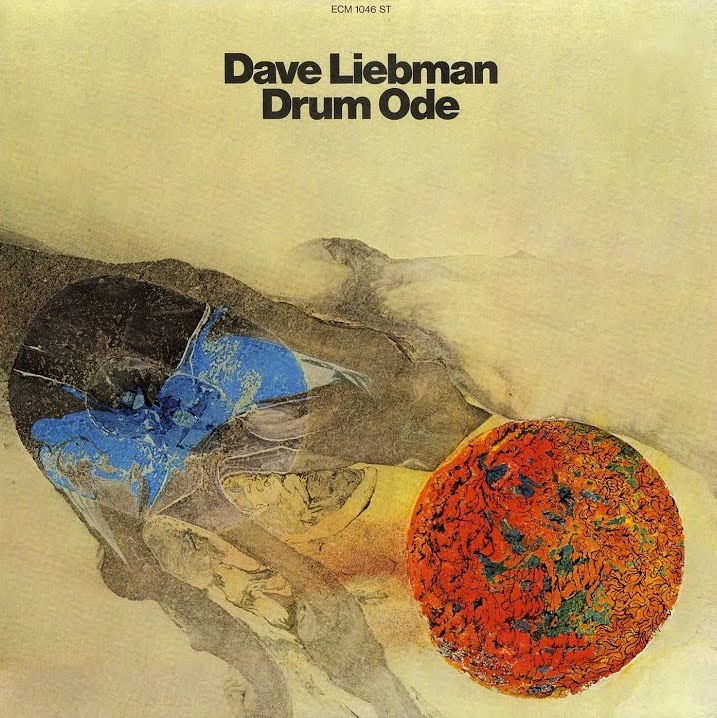
ECM 1046 LP
Original cover

The contrast in covers between the original vinyl and the CD could hardly be greater. The latter’s block list of names, while typographically pleasing, obscures the vibrant colors that said roster produces. One look at the former, however, reveals all in a single perusal: a brilliant sun, cradled in the arid landscape of its own desires, has found a voice where shadows intersect, and waits to share it with any in search of oasis.

<< Terje Rypdal: Whenever I Seem To Be Far Away (ECM 1045)
>> John Abercrombie: Timeless (ECM 1047)

Dave Liebman: Lookout Farm (ECM 1039)

ECM 1039

Dave Liebman
Lookout Farm

Dave Liebman soprano, tenor saxes, alto c flute
Richard Beirach electric, acoustic piano
Frank Tusa electric, acoustic bass
Jeff Williams drums
John Abercrombie acoustic, electric guitar
Armen Halburian percussion
Don Alias congas, bongos
Badal Roy tablas
Steve Sattan tamburine, cowbell
Eleana Sternberg voice
Recorded October 10/11, 1973 at Generation Sound Studios
Engineer: Tony May
Produced by Manfred Eicher

Saxophonist, flutist, and all-around wunderkind Dave Liebman—who only last year received an NEA Jazz Masters lifetime achievement award for his tireless efforts in music and instruction—made his ECM debut with Lookout Farm, his first of only two albums for producer Manfred Eicher as leader (the other being the enthralling Drum Ode; he would also guest on Steve Swallow’s Home some six years later) and a trendsetter for fledgling improvisers seeking their voices in the seventies and beyond. Here, he is joined by a telepathic ensemble that includes regulars Richie Beirach and John Abercrombie, in addition to a pointed percussion section. Abercrombie’s quasi-flamenco arpeggios open the evocative “Pablo’s Story.” Liebman leads in on flute, establishing an intimate flywheel from which is spun a most democratic mosaic of intersections, solos, and rhythmic ecstasy. Liebman (switching to soprano sax) and Beirach provide the skeleton of the track’s flexible physiology. An intuitive pattern of tension and release ensues, thus maintaining a solid unity throughout. Frank Tusa’s understated yet richly emotive bass lines bring out a vital inner depth, and one can hardly remain static during the hand-drummed interlude. “Sam’s Float” introduces a more hardened sound, cut to the core by Leibman’s alto squeals and Abercrombie’s biting electricity. The 24-minute “M.D./Lookout Farm” closes this humble set of three. The first half turns down the lights with its elegiac piano and tender reeds, while the title half transports us with Jeff Williams’s downright flammable drumming.

A spectacular sense of curiosity would seem to be de rigueur in Liebman territory, its infectiousness inescapable. This is a milestone album, not only for the liberating musicianship and timeless sounds, but also for its production value. With Lookout Farm, Eicher channeled the reverberant specter that has haunted the label’s sound ever since, and with it an entirely new way of listening emerged.

A pilgrimage for the ECM enthusiast.

<< Art Lande/Jan Garbarek: Red Lanta (ECM 1038)
>> Gary Burton: Seven Songs For Quartet And Chamber Orchestra (ECM 1040)

Gateway (ECM 1061)

ECM 1061

Gateway

John Abercrombie guitar
Dave Holland bass
Jack DeJohnette drums
Recorded March 1975 at Tonstudio Bauer, Ludwigsburg
Engineer: Martin Wieland
Produced by Manfred Eicher

With this record, John Abercrombie both repaved and detoured from his staid path. He could hardly have been in finer company, and the combination seems to have fanned all sorts of flames within him. DeJohnette and Holland string an array of tightropes across which Abercrombie balances his way into previously uncharted territory.

“Back-Woods Song” evokes a mood that would come to define some of the later work of Bill Frisell. To be sure, the sound lives up to its name here as it awakens like an alligator poking its head above some swampy surface. Holland solos wonderfully here, after what some have rightly remarked to be a rather “creepy” turn from Abercrombie, ricocheting delightfully off the cymbals. This is very muddy jazz: viscous, opaque, and teeming with unseen life. “Waiting” is essentially a slow trek for bass that ushers us into “May Dance,” in which Abercrombie’s fingers frolic across the fretboard. Thus he brings a clear sense of continuity and of dynamic energy, scraping away at the surface of possibility and peering into its inner depths without fear of censure. The ensuing frenzy of activity resolves into a delicate bass solo, during which Abercrombie takes a much-needed breather. Holland cleverly mimics Abercrombie’s style, underscoring that same cluster concept of note value and melodic ascendency. “Unshielded Desire” is exactly what it claims to be. It starts with a percussive bang like the finale of a fireworks display and Abercrombie runs with all his might to capture every dying spark as it trails in the sky. The music goes around in spirals, flirting with a center it can never reach no matter how far down it goes, until it is like a compass gone haywire in the Bermuda Triangle. Next is “Jamala,” the most downtempo cut on the album. This is a moody masterpiece and a fine lead-in to the magical, epic, and incendiary “Sorcery I,” which rounds out the set.

I actually fell asleep the first three times I tried listening to this record. For whatever reason, its quirky energy seems to have had a soothing effect on me. Odd, seeing as I cannot imagine a more invigorating guitar trio. Abercrombie has such a distinctive sound and it has to do not only with the amplification and choice of instrument (or pairing thereof), but more importantly with the fragmented aesthetic he brings to his playing. Abercrombie is a “sensual” musician—that is, a musician of the senses. He seems to rattle his own bones, bringing to his improvisation a sense of detached wonder. Those looking for the laid-back Abercrombie may find this an unexpected outing. I do think it’s worth taking a chance on, however, as the freer moments herein might very well surprise and inspire. Despite a seemingly haphazard approach, Abercrombie remains tightly knit to the music’s immediacy. His is an electric sound that stays close to its acoustic roots, while Holland’s solos rise and fall, never straying from the core beat, as if strung to DeJohnette’s limbs.

It’s difficult to explain this kind of jazz to someone who has never heard it, and almost as difficult to describe it as someone hearing it for the first time. It is chameleonic music of the highest order. The wealth of possibility represented here in the art of improvisation expands the ear, the mind, and the heart of the listener, cracking the window of one’s worldview open just that much more to reveal the joys of lived experience. And maybe that’s what jazz is all about: experiencing the human spirit and the infinite ways in which it contorts itself to the tune of some intangible creativity.

<< Ralph Towner: Solstice (ECM 1060)
>> Collin Walcott: Cloud Dance (ECM 1062)

John Abercrombie: Timeless (ECM 1047)

Timeless

John Abercrombie
Timeless

John Abercrombie guitar
Jan Hammer organ, synthesizer, piano
Jack DeJohnette drums
Recorded June 11 & 12, 1974, Generation Sound Studios, New York
Engineers: Tony May and Jan Erik Kongshaug
Produced by Manfred Eicher

On Timeless, guitarist John Abercrombie spearheads a session with keyboardist Jan Hammer and drummer Jack DeJohnette for a melding of minds in the first degree.

The trio kicks things off in high gear with “Lungs,” a heaping pile of kindling set ablaze by Hammer’s high-octane staccato, DeJohnette’s explosive hi-hat, and Abercrombie’s unusually frenetic fretwork. A sublime energy is maintained throughout and the payoff is supremely satisfying—all the more so for its brevity, as the music suddenly changes avenues just a few minutes in. Hammer relays between organ and synth, keeping the pace (and the funk) through trailing guitar solos that send notes like cosmic fingers flicking galaxies into outer space. The organ smolders quietly in the background before clinching a new groove, which Abercrombie laces with lines flanged just right for the mix. It all ends in a game of musical jump rope, with Abercrombie skipping over the alternation of drums and organ. “Love Song” is true to its name and is the first of two exquisite conversations between piano and acoustic guitar. Just as the organ trailed long rows in the soil of our attention, the piano comes as a welcome rain for our crop and the guitar like the sun that infuses it. This brings us to “Ralph’s Piano Waltz,” a highlight of these six fine offerings. Like the album as a whole, this track is a superlative balancing act. It’s a construct so seamless that if you don’t find your foot tapping during this one, you might want to make sure it’s still attached. The electric leads speak in their respective languages, but also mimic each other along the way. “Red And Orange” is what might result if Bach had survived into the 1970s as a closeted jazz musician, and is another standout in a set of many. “Remembering” is an alluring chain of tableux and the second of the two duets. Abercrombie sustains details the piano seems content to ignore, loosening those threads from their weave. We end with the title track, which builds slowly from a synth drone peppered with guitar musings to a full-on embrace of space.

This evergreen stands tall in the ECM forest. There is no sense of competition, only mutual reveling in a distinctly nuclear sound. One could easily call it fusion, but if anything it is fused with itself, for it has created every element it seeks to combine. Timeless indeed.

<< Dave Liebman: Drum Ode (ECM 1046)
>> Paul Motian: Tribute (ECM 1048)