John Surman: Coruscating (ECM 1702)

Coruscating

John Surman
Coruscating

John Surman soprano and baritone saxophones, bass and contrabass clarinets
Chris Laurence double-bass
Rita Manning violin
Keith Pascoe violin
Bill Hawkes viola
Nick Cooper cello
Recorded January 1999 at CTS Studios, London
Engineer: Markus Heiland
Produced by Manfred Eicher

The title of John Surman’s Coruscating means sparkling. Yet with track names like “At Dusk,” “Moonless Midnight,” and “An Illusive Shadow,” we are squarely in a nocturnal realm. The multi-reedist, along with bassist Chris Laurence, puts his touch on this set of eight compositions, which over the album’s course blend into a seamless whole. At their center is an ad hoc string quartet, to which Surman and Laurence act as improvisatory satellites. The two aforementioned sections drop Surman’s oboe-like soprano into pre-written cuts of land, each a ripple in a lake that holds ebony sky in its cup.

Although it will not be surprising to any Surman fan, it is as baritonist—ever the rightful successor to Gerry Mulligan—that he comes closest to bringing the shine. Whether in the softly rolling sentiments of “Dark Corners” or the  muscular stirrings of “Stone Flower” (in memory of another baritone great, Harry Carney), his low reed dots the compass many times over through charcoal travels. “Winding Passages” is the most mature of these breeze-swept soliloquies and provides a solid platform for the composer’s bronzed hieroglyphs. Laurence shakes his most geometric ghosts out in “Crystal Walls,” while “For The Moment” mixes cello tracings into vibraphone, Surman’s restless gestures carrying us all the while into deeper pasture.

Those who weren’t quite feeling Proverbs and Songs might find Coruscating more accessible, if only because there is so much space for listeners to relax and, in spite of all the darkness, feel their way around. It is a dream of quotidian objects sleepwalking for want of a place to have purpose, only to discover that their wandering is that very thing.

<< Jan Garbarek/The Hilliard Ensemble: Mnemosyne (ECM 1700/01 NS)
>> Gianluigi Trovesi/Gianni Coscia: In cerca di cibo (
ECM 1703)

John Surman: Proverbs and Songs (ECM 1639)

Proverbs and Songs

John Surman
Proverbs and Songs

John Surman baritone and soprano saxophones, bass clarinet
John Taylor organ
John Surman
Howard Moody conductor
Recorded live at Salisbury Cathedral, 1 June 1996
Engineer: Mike Walter
Produced by Derek Drescher and Manfred Eicher

Multi-reedist John Surman returns to his chorister roots and lays bare his compositional prowess with this oratorio commissioned by the Salisbury Festival and premiered in June of 1996. The Salisbury Festival Chorus, founded in 1987 by Howard Moody (of whose compositions the Hilliard Ensemble and Trio Mediaeval have been strong proponents) approaches its Old Testament sources as the composer sets them: that is, with panache, a flair for syncopation, and raw intensity. Add to this pianist John Taylor in an unexpected turn on cathedral organ, and you’ve got a recipe for one of Surman’s most intriguing catalogue entries to date.

Despite the forces assembled, it is he who dominates the palette. The “Prelude” immediately places his cantorial baritone amid a wash of organ in a free-flowing Byzantine mode, thereby establishing a rich narrative quality from the start. Our first foray into choral territory comes in the form of “The Sons,” a robust piece that works men’s and women’s voices in an iron forger’s antiphony toward genealogical harmony. At first, the thicketed singing feels more like a shoreline along which reed and pipes crash in pockets of light and bas-relief. Yet as the “The Kings” soon proves, it is capable of the jaunty togetherness at which Surman excels. “Wisdom” has its finger most firmly on this pulse of greater fellowship, for there is a wisdom of Surman’s own in the brushwork of his soprano, which dances for all the world like the world.

This being a live BBC Radio 3 recording that was later mixed down at Oslo’s Rainbow Studio, the quality is rather compressed. Then again, so is the music, the message of which is as dense as its King James texts. The album’s space is left to Taylor, its images to the voices, its method to Surman’s winds. There is a rusticity to the album’s sound that matches the unadulterated emotions of the music. We hear this especially in “Job,” which like its scripture upholds divine reason in the face of hardship. The chanting here is a form of punctuation, the snaking baritone lines its restless grammar.

“No Twilight” continues to unravel the sopranic weave in what amounts to the heart of the album, both in spirit and in execution, and places the voices at the slightest remove to haunting effect. Surman’s streaks of sunlight—here the voices of reason—add depth of field to this vision, so that the whimsical shallows of “Pride” emphasize the frivolity and fragility of their eponym. The truth comes out in the ruminative organ solo that epilogues the piece. “The Proverbs,” with its ominous recitation, is the freest and builds eddies of judgment and self-reflection (note Surman’s brilliant evocation of the dissenter) until the rays of sacrifice blind with “Abraham Arise!”

In light of the stellar body of choral work that ECM has produced, Surman’s forays into the same are not life-changing, if only because they are about unchanging life. True to the lessons at hand, it is more descriptive than it is aesthetic. Its juxtaposition of distinct sonic color schemes is pure Surman, and represents not a detour from but a dive into the kaleidoscope of his discography…and one well worth taking, at that.

<< Dino Saluzzi/Rosamunde Quartett: Kultrum (ECM 1638 NS)
>> Keith Jarrett: La Scala (ECM 1640
)

John Surman/Jack DeJohnette: Invisible Nature (ECM 1796)

John Surman
Jack DeJohnette
Invisible Nature

John Surman soprano and baritone saxophones, bass clarinet, synthesizers
Jack DeJohnette drums, electronic percussion, piano
Recorded November 2000, Tampere Jazz Happening and Berlin JazzFest
Engineers: Ralf Sirén and Ekkehard Stoffregen
Produced by Steve Lake and John Surman

Since first recording for ECM as a duo on The Amazing Adventures Of Simon Simon, multi-reedist John Surman and drummer Jack DeJohnette have maintained a connection that finds deeper traction on the seven enhancements of Invisible Nature. Surman gurgles his way through the organ drone of “Mysterium,” which combined with a plodding bass line sounds like the seed of Jan Garbarek’s RITES. It is a silvery tapestry unspooling in flourishes that escape our ken. The music is so much of its own world that to hear applause segueing into “Rising Tide” is jarring. It reminds us that we’re still on Earth, that what we’ve been hearing has come from human hands and breath. The fantastic sweep of baritone amid DeJohnette’s frenetic pacing here elicits a wide spectrum, and charts the same balance of delicacy vs. punch that makes tracks like “Underground Movement” and “Ganges Groove” such inspiring excursions. Painting his snare like the eye of a hurricane, DeJohnette crystallizes steady grooves for Surman’s cerebral and biologically direct highs in the former, while in the latter he paints with his tabla generator a scene as lush as it is arid. “Outback Spirits” makes gorgeous use of digital delay in a trip filled with cinematic tension, equal parts Nicolas Roeg and Stanley Kubrick. It is the elegance of uninhibited joy, the patter of the disembodied. A welcoming freedom of expression prevails. “Fair Trade” is the masterwork of the collection and shows the depth and breadth that these two legends are capable of when the gloves come off and all that’s left to feed on is fire. Between the crunchy baritone and DeJohnette’s astonishing ear for space, there is more than enough to savor for future listening. “Song For World Forgiveness,” the only piece not entirely improvised, floats a swanky bass clarinet on a river of lipstick and smoky alleyways: an homage to roots, to loves, and to new beginnings.

For all the trickery, there is at this album’s core a duo of infinite potential, one that walks a tightrope—blindfolded—across wide canyons. The nature of this music may be invisible, but man, is it ever audible.

<< Arvo Pärt: Orient & Occident (ECM 1795 NS)
>> Trygve Seim: Sangam (
ECM 1797)

Surman/Krog/Rypdal/Storaas: Nordic Quartet (ECM 1553)

Nordic Quartet

John Surman soprano saxophone, baritone saxophone, alto clarinet, bass clarinet
Karin Krog voice
Terje Rypdal guitar
Vigleik Storaas piano
Recorded August 1994 at Rainbow Studio, Oslo
Engineer: Jan Erik Kongshaug
Produced by Manfred Eicher

Nordic Quartet bonds an unconventional roster of musicians and conceptual approaches. John Surman reaches into his usual toolkit, favoring the lower range, while vocalist Karin Krog sews her Sheila Jordan-like vibrato into Terje Rypdal’s electric swoons and pianist Vigleik Storaas’s intimate embraces. One can expect Surman to shine above any group he might be a part of, but in “Traces” it is Rypdal and Krog who slink like the wolves of our interest through abandoned factories, such that piano and reeds seem to drop from the ceiling, each a spider invisibly tethered. And indeed, the album is about nothing if not traces, smeared on the windowpanes of childhood homes, one-bedroom apartments, and coffee shops. We hear this most in Surman’s duets: “Unwritten Letter” (w/Krog), “The Illusion” (w/Storaas), and “Double Tripper” (w/Rypdal), the latter a battle-scarred stumble into post-traumatic memory. Rypdal steps up the mood in “Gone To The Dogs,” where his softly rocking chording anchors us in a hammock knotted by soprano (like floss through silver teeth) and lit by a kiss of pianistic sun. It is in these instrumental tracks that the album takes off in more exciting directions—surprising in light of the healthy pathos Krog wove into Such Winters Of Memory. Her most intuitive contributions to this session are wordless, as in the ghostly overtones of “Ved Svørevatn,” which blisters like an underwater volcano. Lost to its own philosophies, it is a voice guided only by (and into) itself. “Wild Bird” is the last breath, a quiet account of dark thoughts and darker thinkers. A heat rash of organ spreads across Krog’s lyrical skin, itself a half-remembered cry, windy and chopped beyond recognition. This is our solitude realized in sound, naked as the moment we are born.

<< Heiner Goebbels: Ou bien le débarquement désastreux (ECM 1552)
>> Terje Rypdal: If Mountains Could Sing (ECM 1554)

John Surman Quartet: Stranger Than Fiction (ECM 1534)

John Surman Quartet
Stranger Than Fiction

John Surman soprano and baritone saxophones, alto and bass clarinets
John Taylor piano
Chris Laurence double-bass
John Marshall drums
Recorded December 1993 at Rainbow Studio, Oslo
Engineer: Jan Erik Kongshaug
Produced by Manfred Eicher

Reedist John Surman has laid much of his ECM path with the polished stones of his solo work. Whatever the setting, he is one who listens to his surroundings, be they atmospheric or human. In the latter vein comes “Canticle With Response,” which opens this wintry quartet date with pianist John Taylor, bassist Chris Laurence, and drummer John Marshall. Its sparse, porous mood is a leitmotif on Stranger Than Fiction. Yet rather than something to which the musicians return, it is something that returns to them, a ghost that finds movement where there is stillness. Like a sage’s hair in twilight, the group’s sound is gray yet aglow, worn to the bone by reflection in “A Distant Spring.” Surman sets his soprano to flight in the watercolors of “Tess,” for which Taylor splashes stories, each a step in river water. Those gray strands continue to bend and stretch, winding around the memorable theme of “Promising Horizons.” This haunting afterimage of Beethoven’s Ode to Joy bows to distillations of baritone and bass.

In this forest, dark with age, one can only travel “Across The Bridge,” guided by Surman’s prowess on the bass clarinet. His improvisations on said unwieldy instrument glisten despite the shadows of which they are composed. “Moonshine Dancer” welcomes us to a nocturnal circus, where performer and spectator number two in the night, their hands and laughter for each other alone, while “Running Sands” flows, like its namesake, at the touch of wind and water. A pliant solo from Laurence lifts us into the clouds, each topped like a sundae with delicious baritone caramel. Everything above funnels into the final “Triptych.” Like a fiber optic cable, it flows through the earth, hidden and dormant until the flick of a creative switch sets its veins thrumming with information—only here, you need nothing more than your ears to cup the light into oblivion.

<< Gavin Bryars: Vita Nova (ECM 1533 NS)
>> Giya Kancheli: Exil (ECM 1535 NS)

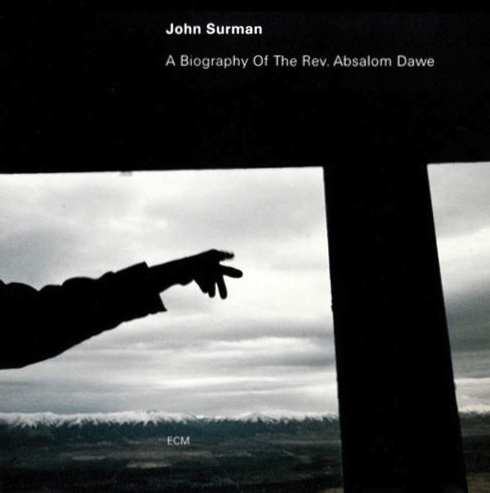
John Surman: A Biography Of The Rev. Absalom Dawe (ECM 1528)

John Surman
A Biography Of The Rev. Absalom Dawe

John Surman alto and bass clarinets, soprano and baritone saxophones, keyboards
Recorded October 1994 at Rainbow Studio, Oslo
Engineer: Jan Erik Kongshaug
Produced by Manfred Eicher

I would venture to say that anyone who has dug into the trove of ECM’s 1980s output has a soft spot for John Surman’s lone outings. The English reedman brings a signature sense of purpose to every musical line he touches, whether it’s by mouth through his favored baritone or by hand, laying down tasteful electronic contexts for looser improvisations. Now well into the 1990s, Surman outdid himself with A Biography Of The Rev. Absalom Dawe, treating listeners to his most deeply realized solo experience yet. Named for a cousin of Surman’s great-great grandmother, Biography employs the usual studio trickery for a sound that is wood-grained, born of earth and sky. “First Light” highlights another preferred tool in his kit—the bass clarinet—and grows from it feathers like no one else can. Following this dawn chorus for one, he plucks out yet another, drawing the needle of his soprano—honeyed but never saccharine—through the diaristic airs of “Countless Journeys.” Moods vary thereafter, cycling through the orthodox (“A Monastic Calling”), the pagan (“Druid’s Circle”), the questioning (“The Long Narrow Road”), and back into the unity of “Three Aspects,” which braids a trinity of sopranos, from which one breaks strays like a firefly to the far side of a darkening field. In addition to these evocative poems, “Wayfarer” and “The Far Corners” are among Surman’s best, the one somehow dancing bass clarinet on the head of a pin, the other paying homage to tone in a soprano solo for the ages. This leaves only “An Image,” refracting baritone lines through an echoing prism.

Surman brings out, especially through this album, a distinct sort of programmatic expression, which through its inflections evokes environments so internal they cannot be rendered, except through the gift of his interpretations.

<< Steve Tibbetts: The Fall Of Us All (ECM 1527)
>> Krakatau: Matinale (ECM 1529)

Bley/Peacock/Oxley/Surman: In The Evenings Out There (ECM 1488)


In The Evenings Out There

Paul Bley piano
Gary Peacock bass
Tony Oxley drums
John Surman baritone saxophone, bass clarinet
Recorded September 1991 at Rainbow Studio, Oslo
Engineer: Jan Erik Kongshaug
Produced by Manfred Eicher

This wondrous date finds pianist Paul Bley, reedman John Surman, bassist Gary Peacock, and drummer Tony Oxley in a blissful state of affairs. Not since the deeply felt Fragments had a quartet so honestly captured the spirit of free jazz at its most humbling. The music on In The Evenings Out There, punning on the Carla Bley tune “In The Mornings Out There,” is a canyon in ECM’s vast improvisatory continent. “Afterthoughts” sets the tone with a voice that whispers like memory yet speaks of the here and now. It moves from somber tears to insistent runs, from horizontal planes to sharp and rugged inclines, in the space of a heartbeat. With “Portrait Of A Silence,” we find that the album is more about space than time, for each facet of this misted jewel is made of various combos. This, the first of two solos from Peacock, reveals a player who knows his instrument like his own body. He explores architectural details of jazz that others too often neglect and grinds them down into handfuls of prayers.

Some of the titles seem arbitrary. “Soft Touch,” for one, brings out some of the album’s sharpest points. Yet one doesn’t listen to such music for track listings. One surrenders instead to the lovely geometric exercise of “Speak Easy” or the full quartet musings of “Interface.” Surman’s timeworn baritone seeks nourishment in the latter’s shadows, bringing us into “Alignment,” which recalls his self-referential solo work elsewhere. His bass clarinet in “Article Four” speaks that same nocturnal language, tracing its own demise like a shooting star. “Fair Share” is a buoyant duet between Bley and Peacock that breathes by the edge of understanding and drops us into a bog of sentiment. Bley offers the album’s final words. The solo “Married Alive” crosses over into explorations with Oxley in “Spe-cu-lay-ting” before ending with “Note Police,” breaking through the clouds at last with unfettered light.

This is an intuitive sort of music-making, brimming with lessons of hardship. Utterly remarkable.

<< Paul Giger: Schattenwelt (ECM 1487 NS)
>> John Abercrombie Trio: While We’re Young (ECM 1489)

John Surman/John Warren: The Brass Project (ECM 1478)


John Surman
John Warren
The Brass Project

John Surman saxophones, alto and bass clarinets, piano
Henry Lowther trumpet
Stephen Waterman trumpet
Stuart Brooks trumpet
Malcolm Griffiths trombone
Chris Pyne trombone
David Stewart bass trombone
Richard Edwards bass trombone
Chris Laurence bass
John Marshall drums, percussion
John Warren conductor
Recorded April 1992 at Angel Studios, London
Engineer: Gary Thomas
Produced by John Surman and Steve Lake

John Surman makes an indelible statement with The Brass Project, for which conductor John Warren leads a fine set of ensemble interpretations of the English saxophonist’s engaging compositions. The result is an album of many moods, beginning with the pensive horns and bass clarinet mesh of “The Returning Exile” and ending with the likeminded haunts of “All For A Shadow.” The filling is equally rich, boasting such deftly realized swings as the Wheelerian “The New One Two,” of which Part 2 showcases Surman’s uplifting soprano work. With the grace of a falcon, he navigates the great brass divide, casting a far-reaching shadow with his outstretched wings. That same soprano mesmerizes in “Mellstock Quire/Tantrum Clangley,” which despite its quiet sheen enables the album’s most spirited playing. The Brass Project is not without its surreal moments, as in the burnished drones of “Spacial Motive,” but for the most part we get such groovier shades as “Wider Vision” (a.k.a., baritone chocolate) and some straightforward balladry in “Silent Lake.”


Original cover

As with the last, the arrangements here explore the full benefit of Surman’s music with the musicians at hand and give us unique insight into the mind of an artist who never ceases to grow. Fans of his solo work wanting to branch out: look no further.

<< Thomas Demenga: J. S. Bach/Sándor Veress (ECM 1477 NS)
>> Jens-Peter Ostendorf: String Quartet (ECM 1479 NS)

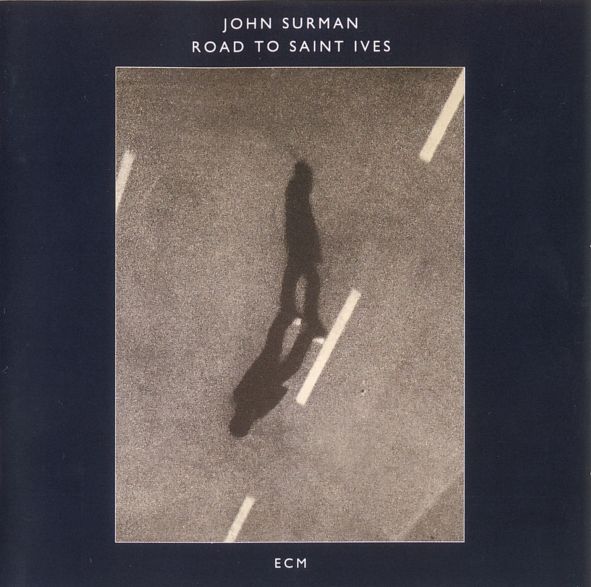
John Surman: Road To Saint Ives (ECM 1418)


John Surman
Road To Saint Ives

John Surman bass clarinet, soprano and baritone saxophones, keyboards, percussion
Recorded April 1990 at Rainbow Studio, Oslo
Engineer: Jan Erik Kongshaug
Produced by Manfred Eicher

Although we might feel tempted to take Road To Saint Ives, one of John Surman’s most stunning solo albums to date, as a portrait of its titular coastal town, Surman states in his liner notes that such is not the case. Aside from the peppering of folk-inspired melodies in the soprano solos, the music breaks its own ground on the way toward unique improvisatory continents. Among those solos, “Polperro” makes for a transportive opener, while the echo effect of “Perranporth” dances on a cloud of whimsy. These solos are the heart of everything that makes Surman such a listeners’ gift. Their quality of tone and pitch speaks of the supremely nuanced command he has over his instruments. Each has the makings of antiquity blown through its core, as if webs of time were being pulled into all-encompassing songs. Surman is likewise a master of the miniature, as exemplified by the album’s shortest track, “Trethevy Quoit,” in which a crunchy flock of low reeds sounds one of the most memorable congregations in the program. Building up from these are the ensemble pieces in which he overdubs a chain of settings. From Michael Nyman-esque forest walks (“Rame Head”) to flirtations with his favored sequencer (“Mevagissey”), he explores the contours of the most lyrical baritone one can imagine. One moment we are gliding through a classic sci-fi cityscape while the next finds us skirting the edge of a piano-infused drone (“Bodmin Moor”). And one can hardly ignore the multifaceted sound of his bass clarinet, which floats playfully on every ripple of “Piperspool” but which weeps liquid gold against the prayerful organ of “Tintagel.” Surman’s lyricism seems to mourn the extent of its own beauty in this, his deepest nod. So too may we lose ourselves in gamelan feel of “Bedruthan Steps,” where that unmistakable soprano darts in and out of every temple as if the entire complex were but an ocean reef, every note a fish that swims its coves as nature itself must breathe.

Like all of Surman’s solo albums, this is a dream made real.

<< Kenny Wheeler Quintet: The Widow In The Window (ECM 1417)
>> Jan Garbarek: I Took Up The Runes (ECM 1419)