Bill Frisell/Kit Downes/Andrew Cyrille: Breaking the Shell

With Breaking the Shell, the sixth release from the groundbreaking Red Hook label, producer Sun Chung has offered not merely a trio but a quietly seismic realignment of possibility. Electric guitar (Bill Frisell), pipe organ (Kit Downes), and drums (Andrew Cyrille) form a constellation that feels, paradoxically, at once unprecedented and long familiar, like discovering a new moon only to realize its gravity has pulled our tides all along. Chung, having cultivated relationships with all three musicians through previous ECM projects, sensed a convergence before any of the participants could name it. As Philip Watson writes in his liner notes, the trio exists “in a deep state of not-knowing,” a phrase that might just as easily describe the listener’s condition of being suspended between recognition and estrangement.

Recorded at St. Luke in the Fields in New York’s Greenwich Village, the music bears the acoustics of a space built for a resonance of spiritual persuasion. Here, sound doesn’t merely travel outward but returns, circling back like a question that grows more meaningful the farther it wanders. The trio treads honestly without ever falling over, even as it allows trips and stumbles to become part of its gait. There is no fear of imbalance. Instead, there is trust in the materials of the moment. And while one could easily linger on the rare combo or the grandeur of hearing the pipe organ in a chamber-like setting, once the album begins, such considerations dissolve. The instruments become porous vessels for a collective intuition.

The opening track, “May 4th,” emerges in a slow-rolling fog, the organ releasing a detuned drone that tilts gently against the ear. Higher notes graze the air with the soft certainty of fingertips tracing an old, half-forgotten symbol. Frisell and Cyrille enter as if waking from the same dream, their gestures swelling and receding in a space where time loops back on itself. The music feels exploratory—not in the sense of searching for what is missing but in allowing what is already present to unfold without resistance.

From there, the trio slips into “Untitled 23,” a meditation that cycles through scenes like a zoetrope, each revolution shifting character just enough to remind us of the fragile illusions we call continuity. The trio invites the imagination to wander alongside them, not as spectators, but as co-conspirators in the act of making sense of the flickering.

The journey then turns extraterrestrial with “Kasei Valles,” named for the vast valley system etched across the Martian surface. The music reaches outward with similar breadth: Downes’s organ stretches into horizonless zones while Frisell’s guitar, distorted into an adventurous rasp, scratches the underbelly of atmosphere. One can almost sense distance itself, not only as measurement but as emotional terrain.

On “El,” cellist Lucy Railton joins the ensemble, her tone a shaded river cutting through the organ’s cathedral-like glow. The track breathes with the warmth of a melody as an offered hand rather than a distant signal. Cyrille’s brushes sketch spontaneous star paths, while Frisell’s detailing elicits messages whispered from within.

The mood deepens further with “Southern Body,” perhaps the album’s most quietly radiant piece. It is an earth swell of potential energy, the sound of something enormous choosing rest over detonation. Downes releases ocarina-like tones from the organ’s upper registers that seem to summon the wildness nestled in even the most domesticated corners of ourselves.

The first of two traditionals, “Sjung Herte Sjung,” arrives as a turning point. Translating from the Norwegian as “Sing Heart Sing,” it mirrors the ethos animating the entire project: a willingness to let the voice rise unforced. Frisell’s modal wanderings feel like steps taken along an ancient footpath, one that continues to reshape itself beneath each traveler.

Between these landmarks lie hints of discovery, including the swirling interplay of “Two Twins,” whose energies braid together like strands of DNA before dissolving in a delicately percussive fade. “July 2nd” is a drifting lantern, its tender, fluttering textures slipping briefly into an electronic-sounding mirage, as if a synthesizer were dreaming of being an organ, or vice versa.

Cyrille’s own “Proximity” appears near the album’s end, its tender-footed steps guided by the composer’s trademark sensitivity. The brushes move not to clear a path but to reveal it. Finally, another traditional, “Este a Székelyeknél” (“Evening in Transylvania”), closes the circle. Its Hungarian melody (one that passed under Bartók’s orchestrating hand) dissolves into the trio’s shared air, a cultural imprint carried forward not by preservation but by transformation.

By the end of Breaking the Shell, the title reveals its shape. What breaks is not the world but the hard surface of clinging to familiar forms. Frisell, Downes, and Cyrille do not present answers, nor do they ask us to seek them. Instead, they remind us that unknowing can be a place of shelter, and that music—when allowed to move through its players rather than be moved by them—can form a thematic circle in which every beginning contains its end, and every ending nods softly back to the beginning.

Here, in this luminous setting, the shell breaks not with force, but with attention. And what slips out feels like truth.
Norma Winstone/Kit Downes: Outpost of Dreams (ECM 2811)

Norma Winstone
Kit Downes
Outpost

Norma Winstone voice
Kit Downes piano
Recorded April 2023 at Artesuono Recording Studio, Udine
Engineer: Stefano Amerio
Mixed January 2024
by Manfred Eicher and Stefano Amerio
at Bavaria Musikstudios, Munich
Cover photo: Fotini Potamia
Produced by Manfred Eicher
Release date: July 5, 2024

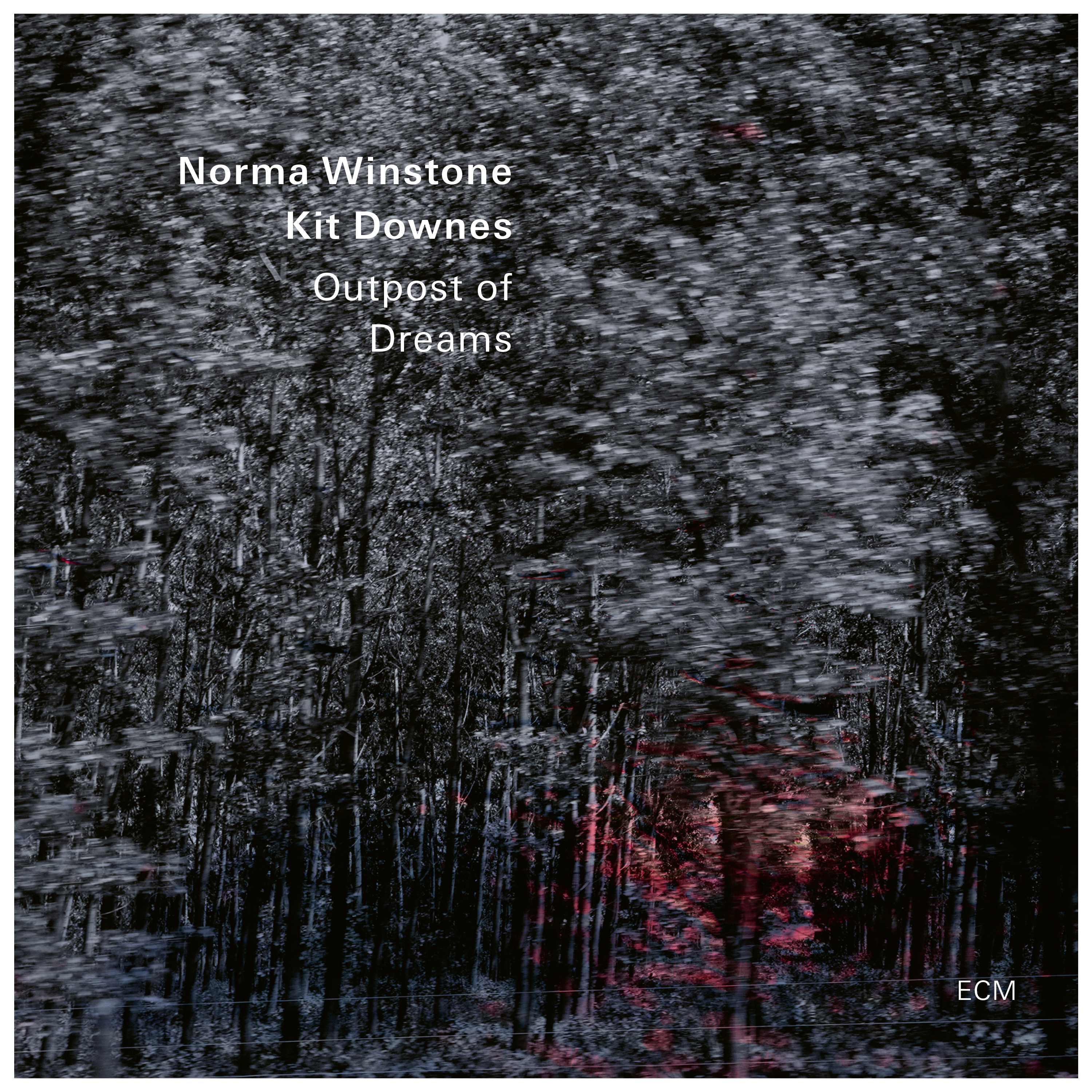
The duo on this recording of vocalist Norma Winstone and pianist Kit Downes came about by chance when Winstone’s go-to accompanist, Nikki Iles, was unable to participate in a London gig, resulting in Downes sitting in as a last-minute replacement. And yet, one would never guess at such a backstory given the openness of heart and communication shared between these two luminaries in their own right. The resulting binary star of their collaboration makes for a tender yet powerful examination of emotional landscapes that feels like it has been around for aeons.

Especially revelatory is hearing Downes’ settings of Winstone’s characteristically astute words. The first of four, “El,” opens the set with the piano’s inner resonance, extended by a faint shimmer from a Hammond B3 organ. The lyrics, written for Downes’ daughter, turn the environment into a reflection of the inner self—and vice versa. Her voice is one of a kind, not only because it belongs to her, body and soul, but also because she gives it so freely to the bodies and souls of her listeners. It exposes its strengths and vulnerabilities in equal measure, knowing that each needs the other in mutual regard. Nowhere is this clearer than in “The Steppe,” where what she calls the “slow drip, drip of a fantasy” becomes the time signature of our existence. Downes expands on this in an instrumental passage, as if the only way out is the path leading back to itself. “Nocturne” peeks beyond the curtain of human folly to the core of truth it so often obscures, while the spoken word of “In Search Of Sleep” touches the darkness with its psychological acuity. Between them is “Black Is the Colour,” one of two traditionals on the album. Winstone digs deep into her vocal register, exploring that ashen beauty she carries inside. Downes makes it all the more poignant with his adventurous harmonizing. The Scandinavian folk tune, “Rowing Home” (in an arrangement by Bob Cornford) becomes a song of desire. Winstone carries its fire into the foreground, casting a shadow over the face of fate.

But just as these feel as fresh as yesterday, the application of her wordcraft turns modern themes into timeless constructions. The music of John Taylor takes center stage in “Fly The Wind,” showing that the late pianist’s spirit is still very much alive in Winstone’s heart. For Carla Bley’s “Jesus Maria,” she replaces the original lyrics with those of her own making, telling of a man whose presence defies the laws of physics by working through the narrowest emotional crevices toward solace from misguided worlds. Winstone’s ability to draw out scenes that feel so inevitable speaks to her connection to melody, not as an aesthetic necessity but as a narrative skeleton to which her words are seamless flesh. In “Beneath An Evening Sky” (Ralph Towner), two lovers find their hearts intertwined no matter the distance between them. Meanwhile, in “Out Of The Dancing Sea” (Aidan O’Rourke), the inner self becomes a map to unfold in the outside world. With that as our guide, the more we travel, the more we begin to know ourselves as we inhabit different places of residence along the way.

Sebastian Rochford/Kit Downes: A Short Diary (ECM 2749)

Sebastian Rochford
Kit Downes
A Short Diary

Seb Rochford composition, drums
Kit Downes piano
Recorded at Waverley, Aberdeen
Recording engineer: Alex Bonney
Mixed by Manfred Eicher
Michael Hinreiner, engineer
Cover photo: Clare Rochford
Album produced by Sebastian Rochford and Manfred Eicher
Release date: January 20, 2023

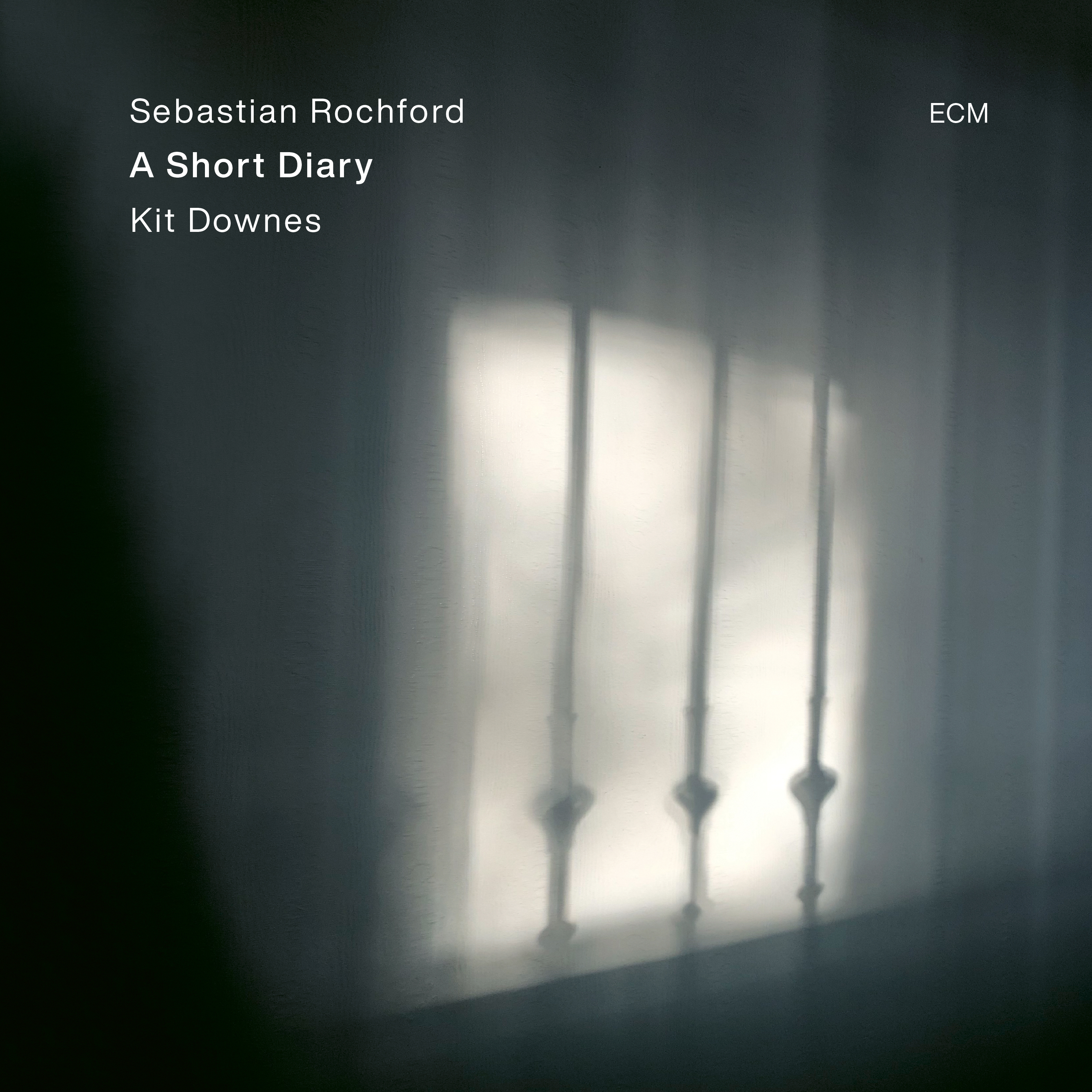
In 2019, Sebastian Rochford, who previously intersected with ECM on Andy Sheppard’s Trio Libero (2012), Surrounded By Sea (2015), and Romaria (2018), lost his father, Aberdeen poet Gerard Rochford. While mourning, the drummer found himself unable to staunch the melodies welling up from within. Recorded in collaboration with pianist Kit Downes at his childhood home in Scotland, A Short Diary reapproaches that music in dedication to his family and the man whose absence left an unfillable chasm. He then approached producer Manfred Eicher, who mixed and brought the album to fruition.

Despite the heartache that permeates “This Tune Your Ears Will Never Hear,” it opens with bursts of light as if to fight off the darkness of death. This feeling continues throughout, even in titles one might not expect, such as “Night Of Quiet.” Rather than slumbering away peacefully, it sits lucidly awake, opening the curtain of memory to reveal the sunlit scenes of “Love You Grampa,” wherein a tender nostalgia takes over, expressed in interlocking pianism and sewn by needle (snare) and threads (cymbals). Downes opens one photo album after another, discovering as much as Rochford about his history. “Silver Light” is the most poignant, its underlying pulse brushing past as an elusive reflection in the window.

In those asides where Downes is alone (namely, “Communal Decisions” and “Our Time Is Still”), the walls of the room close in. Like a mobile turning above a crib by the force of a baby’s breath, he moves in concert with life itself. This feeling is most foregrounded in “Ten Of Us” (a reference to Rochford and his nine siblings). Its slightly dissonant staircase leads us into the attic, drawn to the histories buried in its chests of toys, boxes of old books, and piles of clothes. Trying his best not to unsettle the dust with his footfalls, Rochford builds a gentle yet mountingly declarative hymn of survival.

Everything funnels into “Even Now I Think Of Her.” Rochford explains: “It’s a tune my dad had sung into his phone and sent me. I forwarded this to Kit. He listened, and then we started.” This swing hangs from a tree, overlooking a windswept field as the last remnant of green after cataclysm. It weeps, closing hands around nothing notions of what could have been. Thus baptized by mortality, lowered into a font of stillness, it gives up the ghost and shreds the present into countless pieces.

Throughout A Short Diary, each note births the possibility of others waiting to be heard. As one of the most touching recordings to come out on ECM this century, it is pure, sonic humanity. Despite (if not because of) being so personal, I dare say you could pull on any thread sticking out from it and find one in your own heart that matches.

PJEV/Kit Downes/Hayden Chisholm: Medna Roso

When using the word “inspire” today, we tend to think of it from an emotional perspective. If you look it up in a dictionary, however, you will find that it also means to inhale (think of it as a combination of “in” and “respire”). In that sense, the music documented on Medna Roso, the third and latest release on producer Sun Chung’s Red Hook Records, is inspired in the most physical way one could imagine. Recorded live at Cologne’s Agneskirche in the summer of 2021, and meshing the voices of Kit Downes (organ), Hayden Chisholm (alto saxophone, shruti box, analogue synthesizer, and throat singing), and Zagreb-based female vocal quintet PJEV, the program resituates songs from the Balkans, cultivating endangered traditions in the foreground of our attention in search of new growth.

Downes’s organ is firmament in which the album’s breaths flow from the pursed lips of invisible ancestors. The pipes, resonant and harmonic by virtue of their location, feel omnipresent—never close enough to touch yet never far enough to deny. What begins as a statement of heavenly creation reveals an earthly heart as PJEV churns the soil of “Listaj goro ne žali be’ara” (Bloom you mountain, don’t regret the blooming flowers). In combination with the subsequent “Ova brda i puste doline” (These hills and desolate valleys), it captures the carelessness of youth and the darker realities of adulthood. The titular landscapes and their features are the measures of a contemplation that pales in scope, always struggling to evoke the majesty of a universe so vast that, ultimately, death is required to comprehend it.

The ensuing journey takes us two steps inward for each outward. Through the solo strains of “Što si setna, nevesela” (Why are you sad and cheerless?) floating over a gong-like substrate, the haunting call and response of “Odkad seke nismo zapjevale” (Since when sisters, we haven’t sung), and the a capella “Službu služi viden dobar junak” (Been in service, a good hero), in which the singers hinge themselves in a massive temporal pivot, we can feel the immensity of things.

Connecting these songs are six instrumental interludes where the divisions of reed, metal, and breath melt in the crucible of singularity. The resulting alloy looks like silver, tastes like copper, sounds like gold. As with the throat singing that sometimes escapes Chisholm’s lips, it trembles in the presence of something formless. Settling beneath the weight of our transgressions, it takes shape in the listening while the terror and fury of nature, but also its quiet invitation, attune us for the time being—because time is only being.

Kit Downes: Vermillion (ECM 2721)

Kit Downes
Vermillion

Kit Downes piano
Petter Eldh double bass
James Maddren drums
Recorded May/June 2021
Auditorio Stelio Molo RSI, Lugano
Engineer: Stefano Amerio
Cover photo: Fotini Potamia
Produced by Manfred Eicher
Release date: February 11, 2021

On Vermillion, pianist Kit Downes continues guiding his chisel along ECM’s burnished surface. With bassist Petter Eldh and drummer James Maddren, he presents a mixture of ripe and freshly planted tunes, giving himself over to unforeseen impulses.

Downes and Eldh contribute five tunes apiece. The bandleader tries on outfits of various abstractions, finding each to be sleek and unrestrictive. The sound forged on “Minus Monks,” the album’s opener, is arboreal in its shade-providing abilities. Movements between colors, times, and places feel effortless beneath Downes’s fingertips. Paying homage to pianist John Taylor, he continues down that path of reverence with a sound that pushes as much as pulls. “Sister, Sister” takes an opposite approach, opening with exact measurements before tessellating into off-kilter rhythms, wherein his expressive body can flex without tripping over itself. It takes up no more space than it needs to, whispering its mantras of care only to those who ask to hear them. Such empathy can be hard to come by in a pandemic-scarred world, and it is a welcome gift. Further grace abounds in “Seceda” and “Bobbl’s Song.” In these, the trio shifts from wide-angle shots to close-ups, rendering the ears projection screens for the lives of others. Its breezy sentience finds solace in “Rolling Thunder” (Downes), wispy as clouds stretched translucent by the wind.

Alongside these graded plateaus, Eldh juxtaposes geometric rock formations. “Plus Puls” embraces quietly propulsive pianism while the rhythm section experiments with phonemes like a child rolling possibilities of meaning around in the brain. The upbeat fibrillations of “Sandilands” carry over that verve as its composer runs through a field of leaves without stepping on a single one of them. “Waders” is a high point for the trio’s organic changes, which do nothing to betray the difficulty of this music, rendered smooth as glass. What begins as an almost hesitant blues in “Class Fails” turns into a forthright exclamation of learning the hard way, leaving “Math Amager” to solve the Rubik’s cube of its self-regard.

In listening to Vermillion for the first time, I am moved by how these musicians treat light. Bright as our nearest star is, they manage to put a stained-glass window between it and us. This is most evident in their concluding rendition of Jim Hendrix’s “Castles Made of Sand,” an ode to the crumbling idols we call politics. If these reflections seem somber, it is only because those who’ve seen enough of life never stop drawing lines of awareness to the sun behind the clouds. There is always more to hope for.

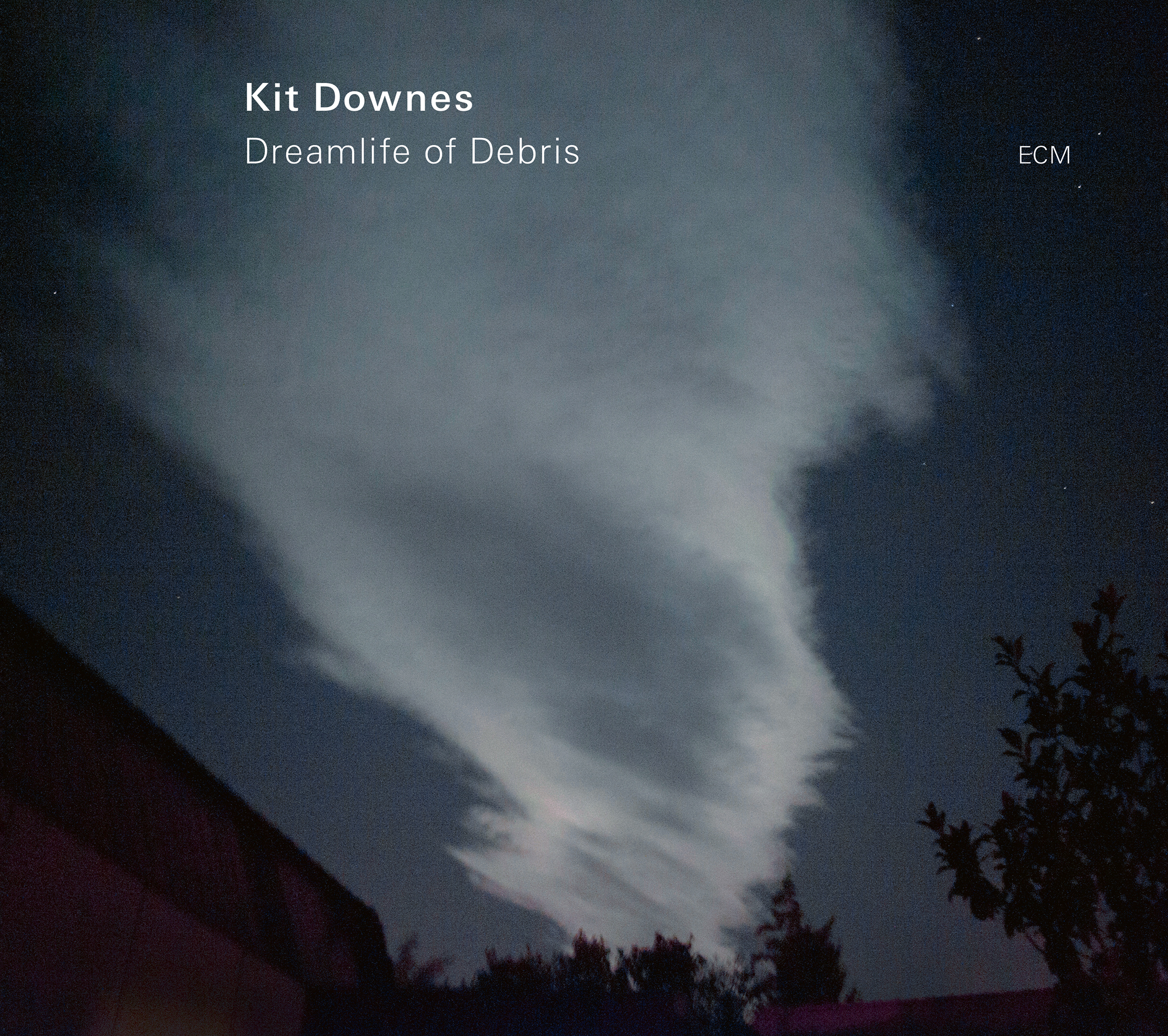
Kit Downes: Dreamlife of Debris (ECM 2632)

Dreamlife of Debris.jpg

Kit Downes
Dreamlife of Debris

Kit Downes piano, organ
Tom Challenger tenor saxophone
Lucy Railton cello
Stian Westerhus guitar
Sebastian Rochford drums
Recorded November 2018
at St. Paul’s Hall, University of Huddersfield
and St. John the Baptist, Snape
Engineer: Alex Bonney
Produced by Sun Chung
Release date: October 25, 2019

Following his 2018 ECM headliner debut, Obsidian, Kit Downes returns at the organ (and piano), this time among friends, including saxophonist Tom Challenger (heard for a spell on Obsidian), cellist Lucy Railton, and drummer Sebastian Rochford. The latter is heard prominently in the concluding “Blackeye,” a piece cowritten by Downes and Challenger. Its thicker brushstrokes fill a rather different sort of canvas than the ones preceding, albeit touched by the same palette.

“Sculptor” opens with Challenger’s bare tone, a kiss of sun on the morning glory of piano that then imbues the scene with its color. Also lurking is guitarist Stian Westerhus, a new addition to the Downes nexus who is rightly described by Steve Lake in his liner notes as, at times, a “near-subliminal participant.” Twinkling like starlight in “Bodes,” his guitar emotes under tension of utterly non-invasive strings. The latter tune is the album’s masterstroke: a fully narrative journey from cradle to grave that catches as many life experiences as it can before passing them on like an inheritance in faith of continuation.

Comforting about Downes as composer is his underlying sense of open-endedness. Titles such as “Pinwheel” and “Sunflower” suggest interconnections just beyond their titular surfaces—not only in Railton’s liquid threading, but also in their ability to turn melody into substance (if not the other way around). “Circinus” and “Twin” make sense of the organ as if it were a text to be interpreted in humility. Both elicit an undeniably cosmic feel, strangely rendered in textures of flesh and soil.

The only piece not by Downes is “M7.” Composed by his wife, bassist and vocalist Ruth Goller, this organ solo centers its energies in sustained pedal points while spreading open the periphery as one might a pair of hands. In its cradle, the entire album’s heart dents a pillow woven from old maps and cartographic sketches, each drawing closer to an undiscovered country but never quite reaching it. Content to float wherever the current may lead, it closes its eyes and redraws its path in the language of a dream, where the only songs that matter are those without words.

Kit Downes: Obsidian (ECM 2559)

2559 X

Kit Downes
Obsidian

Kit Downes organs
Tom Challenger tenor saxophone (on “Modern Gods”)
Recorded November 2016 at St. John, Snape, Suffolk
Union Chapel, London
Engineer: Alex Bonney
Produced by Sun Chung
Release date: January 19, 2018

Performed on three different organs across the UK, Obsidian chronicles the spatial and temporal travels of keyboardist Kit Downes. Were this album to be turned into a book, it would require a tooled leather cover and hand-sewn binding to do even partial justice to all the care gone into its narrative. Each instrument thus embodies its own backstory, the mechanisms of which become clear not only in the intimately engineered recording but also in the interactions catalyzed by Downes’s gestural storytelling.

That said, the floating arpeggios and leading lines of “Kings,” our first leg of this journey, actualize their images not by pen but by palette knife, treading across canvas as if it were a horizontal path turned upward in defiance of gravity. Despite this perspectival flip, however, the music feels weighted by the contrary motions of its performer, who balances forces of suggestion with spontaneous deference. One imagines a boy running over hills in search of any other destiny than the one chosen for him, yet leaving an audible path so that even the blind might find him should he ever get lost. Such feelings of liberation are only intensified in a multilayered rendition of the folksong “Black Is The Colour.”

Not all in this world of hardened lava, however, is spoken in earthly tones. In “Rings Of Saturn,” Downes awakens the pipes like an intergalactic shō, and from their arousal turns outer space into inner reality, while in “Flying Foxes” he reroutes wordless carriages of animality into every unfolding theme, as in the avian hymnody of “The Gift” (written by father Paul Downes).

“Seeing Things” practices what it preaches through a more pointillist doctrine. Its marginalia gild a scripture explored more deeply in “Modern Gods.” Here the saxophone of Tom Challenger inhales from the organ even as it exhales something back into it. With a fleeting sense of form, it scales from shadow into burning triumph.

“The Bone Gambler,” as the program’s most evocative, couldn’t be more appropriately titled. With sincerity of pitch and mood, it wraps its arms around a room so beautifully timeworn that one could almost expect Tom Waits to walk in at any moment and start rasping his soul. Through the window of that same room, we gaze out upon the waters of “Ruth’s Song For The Sea” and “Last Leviathan,” elegies both. With a sincerity that can only have resulted from years of hammering on an anvil of love, these finely wrought talismans warn of continental vagaries, offering in their place a chance to sail away in boats of our own fleshly making.

Obsidian is the musical equivalent of following behind Lucy Pevensie as she escapes her war-torn world through the wardrobe to find refuge awaiting her snow-cushioned step. Let this be your doorway into something equally salvific.