

Claude Debussy: Préludes (ECM New Series 2241/42)

Préludes

Claude Debussy
Préludes

Alexei Lubimov piano
Alexei Zuev piano
Recorded April 2011, Sint-Pieterskerk, Leut, Belgium
Engineer: Peter Laenger
Production coordination: Guido Gorna
Executive producer: Manfred Eicher
An ECM Production

My shadow glides in silence
over the watercourse
[…]
A glow arises in my breast,
the one mirrored in the water.
–Federico García Lorca, “Debussy”

Though unconventional in form, the two books of piano music known as Claude Debussy’s Préludes have withstood the test of time by means of their structural integrity and ordering—or, in the latter case, their lack thereof. For while their collective title conjures the well-tempered catalogs of composers as divergent as Bach, Chopin, and Shostakovich, in practice they bear little resemblance to those 24-part pantheons of keyboard literature. Whether by the descriptive titles famously appended to the ends individual pieces or by the fact that Debussy never intended for them to be played as a unified set, one can see that the Préludes were built as agents of a creative mind for whom fragments were worlds unto themselves. On the latter note, it’s easy to see why Debussy’s sound has so often been misconstrued as “impressionistic,” when in fact it was more closely aligned to the assured stroke of a pen than to the fleeting contact of a paintbrush. With such knowledge held firmly in mind, Russian pianist Alexei Lubimov roulettes the sonority of these emotionally charged miniatures by recording Book I on a 1925 Bechstein and Book II on a 1913 Steinway—the logic being that such instruments might better express Debussy’s own envisioning of how they should be played. This decision brings about surprising color shifts and, somehow, a keener feel for the rhythms therein.
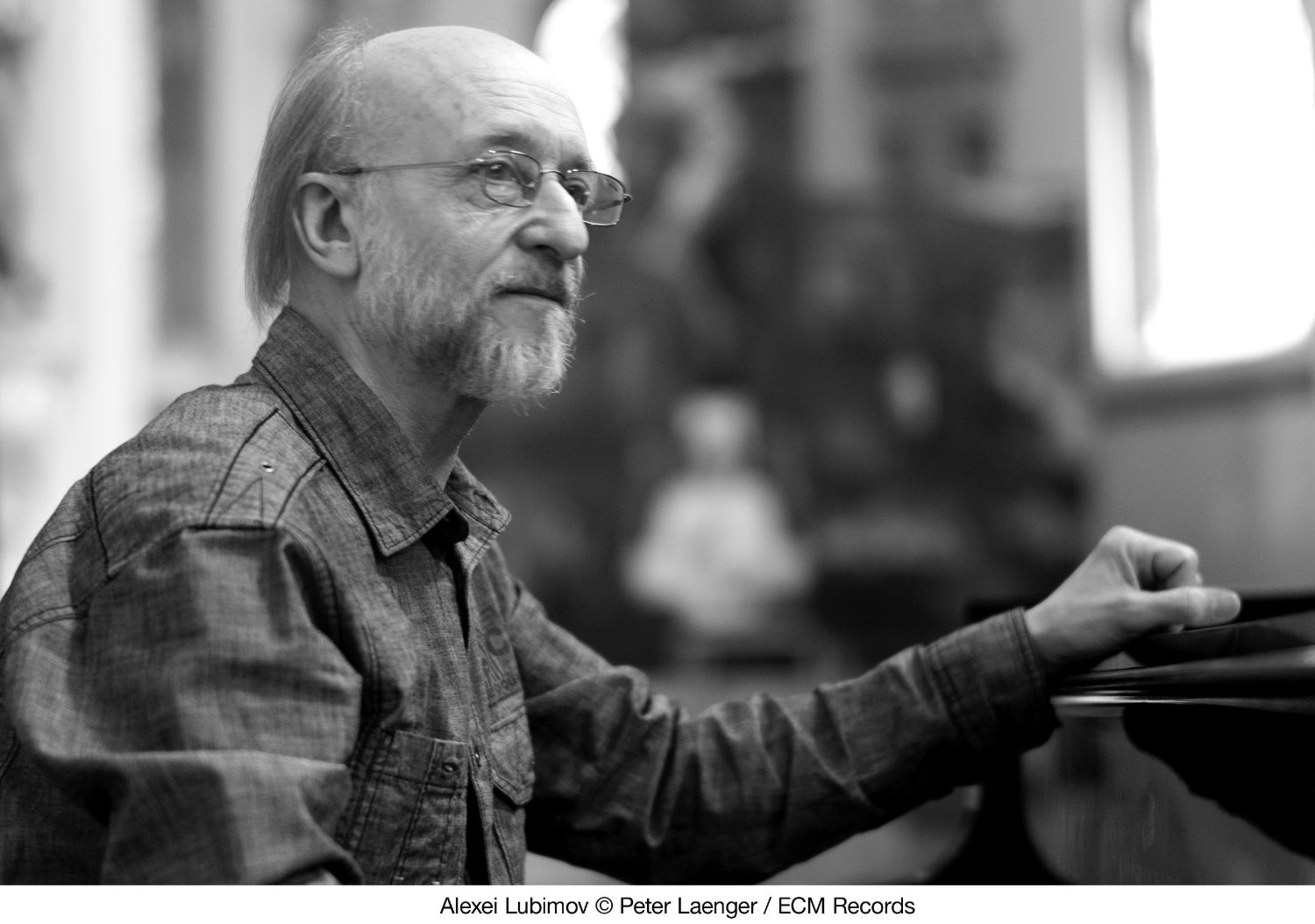
Lubimov

Book I, composed between 1909 and 1910, opens and closes with touches of cabaret, balancing the sweep of Debussy’s pastoral vision with “pingbacks” of striking modernism. Between them is nothing so dramatic as to bog down the listener’s response, so that even the most provocative spirals—viz: “Le vent dans la plaine,” “Ce qu’a vu le vent d’ouest,” and the flamenco-inspired “La sérénade interrompue”—seem but compressions of the more typified mysteries of “Les sons et les parfums tournent dans l’air du soir” and the echoing passage of “Des pas sur la neige.” Even the sportive “Les collines d’Anacapri,” while exuberant enough, only reinforces the reflective heart of this music. Nowhere do these two ends of the spectrum mesh so democratically than in the “La cathédrale engloutie,” which drips from Lubimov’s fingers like the anointing perfume from Mary Magdalene’s alabaster jar. Cutting across their timeworn densities, Lubimov lets those block chords sing with ecumenical clarity and hits that fated low note with perfect pressure.

Through this “inside-out” approach, Lubimov nurtures a sustainable ecosystem from Debussy’s already-organic notecraft, thus clarifying the bas-relief of Book II. Composed between 1911 and 1912, its elemental pathways range from watery swirls (“Brouillards,” “Ondine,” and “Canope”) and flowering dances (“La puerta del vino” and “Feux d’artifice”) to downright Bartókian diversion (“General Lavine – excentric”) and sweeping intimacies (“Les fées sont d’exquises danseuses” and “Bruyères”). A note-worthily deep point coheres around “La terrasse des audiences du clair de lune,” the exposition of which calls forth the composer’s opera Pelléas et Mélisande as if it were a lucid dream.

In addition to the Préludes, Lubimov’s student Alexei Zuev joins his teacher to traverse piano versions of two of Debussy’s most beloved orchestral works. Maurice Ravel’s transcription of the Trois Nocturnes cuts a tree of plaintive ornaments, swaying to increasingly fervent winds toward the final “Sirènes,” wherein seeps 11 minutes of nutrients for roots stretching far into the interpretive histories of those on either side of the score, the undercurrent of which teems with an oceanic abundance of life. To finish, the duo benchmarks Debussy’s own transcription of Prélude à l’après-midi d’un faune with a performance of such scope and vision that one need no effort trying to imagine the landscape burgeoning beneath its 20 fingers.
Franz Schubert: Moments musicaux (ECM New Series 2215)

2215 X

Franz Schubert
Moments musicaux

Valery Afanassiev piano
Recorded September 2010, Auditorio Radiotelevisione svizzera, Lugano
Engineer: Peter Laenger
Produced by Manfred Eicher

Valery Afanassiev returns to ECM with his second program dedicated to Franz Schubert (1797-1828). Whereas his much-lauded Lockenhaus disc reckoned with the massive final sonata, here focus is on the Moments musicaux (D. 780, Op. 94) and the Opus 53 D-Major Sonata, both late works of characteristically bipolar flavor. Also characteristic are Afanassiev’s interpretations of them, infused as they are with ebullience and melancholy in equal measure. In his liner notes, the Russian pianist muses on the notion of a “no-time’s land,” a momentary space that Schubert has filled with this music. It is a lingering moment, a moment to take pleasure in the details of one’s surroundings, a moment that is itself music. He notes also the tendency among (a certain number of) Japanese poets to unravel a moment, “driving it to the brink of eternity.”

Such aesthetics operate at turning points throughout the disc, first noticeable in the transition between the C-Major Moderato and A-flat Major Andantino of the Moments musicaux. Schubert composed its six miniatures sporadically between 1823 and 1828. That Mendelssohn called them “Songs without Words” should come as no surprise, for the block chords that pervade the first of the two sections in question lay down a solid foundation for all the melodies to follow. Emotionally vibrant yet somehow neutral (the notes shuffle one step back for each taken forward), these mercurial waters yield an Arthurian sword of innocent beauty. Neither parallel nor divergent, these streams meet in the solace of a universal unfolding. Following the charming, child-like storytelling of the f-minor Allegro moderato, the c-sharp minor Moderato owes its texture to Bach, whose keyboard style it expertly emulates but also colors with its own romantic flair before returning to f minor in a galloping Allegro vivace. Afanassiev excavates the latter with just the variety it needs to catch our archaeological regard. Last is an Allegretto in A-flat Major. Its statelier posture and chromatic inhalations make it the most mature moment of the set.

Characterized by Afanassiev as “an assortment of games,” the D-Major Sonata is something of a fountain of youth. “Unlike Schubert,” he goes on to say, “I shall never play hopscotch again except in some of his sonatas.” A relatively brisk sonata by Schubert standards, the Opus 53 can hold a candle to any of Beethoven’s and rests on the foundation of its massive first movement. A dense opening reveals flowery, delicate runs, alternating between drama and reflection within a naked stream of consciousness. The second movement, while longer, is more introspective. Afanassiev’s management of its densities depends on a feel for harmony as masterful as the composer’s. Like the Scherzo that follows, and even the concluding Rondo, it fuels its own ambition with transparency.

Afanassiev is an artist keyed into cinema, philosophy, and cultural difference. He brings this knowledge to his Schubert, which opens its eyes like sails and catches the wind of an interpretive spirit. Through this allegorical filter, he turns life into light and shines it on the keyboard without compromise. These pieces, then, become part of a brighter whole, wherein beats the heart of one who had many more songs to sing.

(To hear samples of Moments musicaux, click here.)

Paul Bley: Solo in Mondsee (ECM 1786)

Solo in Mondsee

Paul Bley
Solo in Mondsee

Paul Bley piano
Recorded April 2001 at Schloss Mondsee, Austria
Engineer: Jan Erik Kongshaug
Produced by Manfred Eicher

The release of Solo in Mondsee in 2007 marked the 75th birthday of Paul Bley, and his first solo recording since 1972’s Open, To Love. Like the first, it owes its existence to producer Manfred Eicher, who on both occasions lured Bley onto solitary terrain. This time, the Montreal-born pianist sits at a massive Bösendorfer last heard under the fingers of András Schiff in a New Series program of Schubert’s C-major Fantasies. The instrument equally suits Bley’s preference for long sustains, as made lucid in the album’s opening statement: a resonant hit of the lowest strings. From this he summons ghosts of familiar songbooks, and bodies of those more distant, across ten so-called “Variations,” whose only theme is the absence of one.

Bley’s craft is an admixture of the ethereal and the gravid. He works from a palette so expansive that perhaps only Keith Jarrett has matched it in this unaccompanied format, and with tenderness so beguiling it tightens the ribcage to hear it. The freedom of his exponentially refreshing playing imbues the first numbered section with declamatory sparkle. Like Variation IV, it evokes warmth in winter by a peerless ballet of touch and tendon.

In contrast to these sweeping narratives, Bley gives props to whimsy on a handful of Variations. There are the dissonances and chromatic ladders of II, the centrally focused III, and the busier V and VIII, the eddying of which evokes the end of a waterfall. Variation VI is an especially brilliant turn for its fusion of the epic and the intimate. Its densities never occlude, but allow the light to sing over a flourishing undercurrent. The tenth and final Variation possesses an almost teasing quality, but leads toward a fragile, shape-shifting meditation.

Bley finger-walks on water and gifts solace in return, turning the world into a chamber, and the chamber into a universe.

Georg Friedrich Händel: Die Acht Grossen Suiten – Smirnova (ECM New Series 2213/14)

Die Acht Grossen Suiten

Georg Friedrich Händel
Die Acht Grossen Suiten

Lisa Smirnova piano
Recorded May 2007, May-June 2008, and Feburary 2009 at Schloss Goldegg, Austria
Engineer: Jens Jamin
An ECM Production

This is not the first time that music from Georg Friedrich Händel’s Suites de Pieces pour le Clavecin (a.k.a. the “Eight Great Suites”) of 1720 has appeared on ECM. Pianist Keith Jarrett recorded for the label’s New Series imprint a selection of suites by Bach’s near contemporary in 1993, and with it endorsed an affirmative reassessment of these exceptional works. Several complete recordings have since been issued, and many more predate it on vinyl, so the press release’s claim that these pieces are “too rarely brought together on disc” is, in fact, moot. Paul Nicholson’s cycle for Hyperion, recorded on harpsichord a year after Jarrett and distinguished by its highly embellished repeats, was a notable companion. Two further accounts have been issued this year (2014) alone. The first, by Richard Egarr for Harmonia Mundi, also opts for harpsichord, while the second, by Danny Driver for Hyperion, joins this 2012 release from Vienna-based Russian pianist Lisa Smirnova as a formidable contender for piano renditions. Smirnova would seem to marry the best of those recent followers, combining Egarr’s charm and Driver’s vibrancy with idiosyncratic success.

Smirnova

Although Händel humbly called these pieces “lessons,” their exact purpose is unclear. Their difficulty is, however, anything but and comprises an earthly counterpart to J. S. Bach’s heavenward considerations at the keyboard. For Smirnova, it is timeless music all the same, as attested by the five years of preparation and careful study she poured into it before a single studio microphone was switched on. Just as intriguing and well considered as her performance of the suites is the order in which she plays them, beginning as she does with the Suite No. 2 F Major HWV 427. A subtle yet bold choice of introduction, it lowers us into Händel’s pond so that we might see the ripples for what they are: as beautiful disturbances brought to life by a human touch. In the latter vein, the suite highlights Smirnova’s technical prowess: her syllogistic approach to the binary Adagios, balance of fluttering trills and steady pacing in the Allegros, and exquisite pedaling throughout.

The suites are full of idiomatic variety and avoid formal suite structure altogether. Consequently, Smirnova’s immediate jump to the Suite No. 8 F Minor HWV 433 makes as much sense as the composer’s elision of a Sarabande in the same (this peculiarity also marks the set’s most Baroque Suite No. 1 A Major HWV 426, which Smirnova places second to last). Thus foregrounded, this final suite elegantly flaunts its darker, more mature wardrobe. The extraordinarily lovely Allemande exemplifies both Händel’s sensitivity as a composer and Smirnova’s as a performer, legato phrasings and all. The concluding Gigue, too, shows us her grace and her ability to be fortuitous without tripping over prosody.

The Suite No. 4 E Minor HWV 429 and Suite No. 5 E Major HWV 430 are the only consecutive pairing. The echoing beginnings and sportive finish of the one sit comfortably alongside the dreamy core of the other. Next, the Suite No. 3 D Minor HWV 428 proceeds with gusto. The fantastic keyboard coverage of its Prelude recalls the grandeur of Bach’s organ works and opens a multivalent interface toward the gargantuan Courante. Simple in design yet expansive in effect, its octave voicings in the left hand and spurring trills in the right keep the final Presto in its sights, inspiring some of the set’s most virtuosic control of dynamics. By contrast, the Suite No. 6 F Sharp Minor HWV 431 portions itself more conservatively, keeping its inner fire audible but in constant check.

Händel mixes things up yet again in the Suite No. 7 G Minor HWV 432, for which he adapts the Overture of his cantata Clori, Tirsi e Fileno HWV 96. Here Smirnova puts on the air of a harpsichordist, her style brisé lending bite to every tantalizing swerve. This fullest of the suites is a veritable summation of the whole. From the salon-like Andante to the affirmative Passacaglia, it draws on many autobiographical roots until a new tree is born. Smirnova may be just one of many leaves on its ever-growing branches, but among them holds the sun in frame, her heart glowing green against cloudless sky.

(To hear samples of Die Acht Grossen Suiten, click here.)

Robert Schumann: Geistervariationen – Schiff (ECM New Series 2122/23)

Geistervariationen

Robert Schumann
Geistervariationen

András Schiff piano
Recorded June 2010, Historischer Reitstadel, Neumarkt
Engineer: Stephan Schellmann
Produced by Manfred Eicher

Pianist András Schiff, best known for his surveys of Bach and Beethoven, combines the former’s austerity and the latter’s dynamism in this, his second ECM reckoning with Robert Schumann. More so than the first, the present program tracks a composer stepping out from Beethoven’s shadow and into a light very much his own. As any Schumann interpreter perhaps must, Schiff brings awareness of attendant shadows as well. These he evokes through a balance of restraint and transparency.

To be sure, the Papillons (1829-31) one of Schumann’s earliest piano works (it is his Opus 2), benefits from just such a well-rounded approach. This collection of 12 innovative vignettes linked in brazen montage is as colorful as it is compact. Indeed, each section would feel like the beginning of a longer excursion were it not already so elaborate. The C-sharp Waltz and Waltz in D are notably filigreed in this manner, while the playful chromatism of the Polonaise in D leaves a tannin-rich aftertaste.

The first sonata, his Opus 11, follows. Written in 1835 and dedicated to his future wife, Clara, it is an effusive and utterly heartfelt work, one from which Clara would draw themes for her own compositions. From the introduction alone, it’s clear that Schiff has hit upon the right formula. The modest Aria that follows is, at just over three minutes, a lovely foil to its 13-minute predecessor, and all the more enchanting for it. Even in his propriety, Schiff teases out an epic flow from its underlying fortitude. The final two movements pulse with theatricality. The last is engaging from the first, not least for Schiff’s handling of its quieter passages, the sonata’s most delicate. Through both jagged stitching and smoother threadings of the needle, a brocade of melody and atmosphere emerges that works lyrically, but with a certain sense of muscle that is distinctly Schumann.

The Kinderszenen or “Scenes from Childhood” (1838) are his most widely performed pieces and represent another innovation: children’s music for adults. Among the first of their kind, they have inspired many imitations but none quite so charming and musically direct. Moments of quietude and solitude increase among those of play as they drift onto darker, more dreamlike avenues, culminating in the grimly apportioned “Der Dichter spricht” (The Poet Speaks). Whether opaque or translucent, all 13 are suffused with a spirit that in Schiff’s hands feels as fresh as the ink drying on the original score.

On the subject of original scores, the Fantasy in C of 1836 will be either the decisive or divisive hinge, depending on your taste. Schiff works vitally through the first two movements, his left hand working overtime in support of the flowering right. Furthermore, he brings out that special stream of consciousness that pervades even the softest moments of Schumann’s writing at its most mature. In a brief liner note, Schiff delights in his possession of a first-version manuscript of the third and final movement. In this iteration, Schumann revives the final theme of the first movement—a strategy later scrapped for its pedantry. For the tried-and-true, Schiff tacks on the final, published version at the album’s end, leaving those used to the latter searching for it there. Perhaps a more useful strategy would have been to switch the two, but this is one pianist’s vision, and to it we are invited to abide. Whatever your preference, an inherent boldness perseveres.

The Waldszenen (1848-49) or “Forest Scenes” are similar in title to the Kinderszenen, but reflect a starkly different spirit. Schiff seems to draw energy directly from nature and experiences of observation for a reading that is understated yet lyrical. He brings enough insight to inspire but not to overwhelm, allowing the solace of each to occupy its respective niche with plenty of room to slumber.

Last on the program proper is Geistervariationen, or “Ghost Variations.” These pieces of 1854 are rarely performed, much less with such veracity, and comprise Schumann’s final piano work. Brokering some urgency here and there, the main theme and its five variations bespeak a tender privacy that is self-assured and wise, despite being written in the wake of a failed suicide attempt and soon before admission into an asylum. And yet, here it stands, calm and collected, in need of a wider circle of interpreters to make its visions known.

On the whole, this has the makings of a benchmark record, although some listeners will want to pair it with other classics in the field. These Kinderszenen, for instance, may not replace Horowitz’s beloved traversal of the same for CBS, but are a close second and well worth as much consideration as Schiff has put into them. Neither will Richter’s take on the C-Major Fantasy likely forfeit its place at the top for some (or any) time to come. Nevertheless, what we have here is another example of a profound relationship between artist and label, triangulating with a composer whose piano music glistens anew, as if of its own desire to be heard.

(To hear samples of Geistervariationen, click here.)

Alexander Lonquich: Robert Schumann/Heinz Holliger (ECM New Series 2104)

Schumann:Holliger

Alexander Lonquich
Schumann/Holliger

Alexander Lonquich piano
Recorded November 2008 at Auditorio Radio Svizzera, Lugano
Engineer: Stephan Schellmann
Produced by Manfred Eicher

Alexander Lonquich follows up Plainte Calme, an all-French program that introduced ECM listeners to this erudite German pianist, with a pairing from which New Series aficionados are sure to derive much pleasure. Composers Robert Schumann and Heinz Holliger may have intersected more recently on Aschenmusik, but here’s where it all began.

Schumann’s 1838 Kreisleriana and Holliger’s 1999 Partita share much in common. Both bear dedications to pianists (Schumann’s to Frédéric Chopin and Holliger’s to András Schiff), both are overflowing with ideas, and both immerse themselves in narrative to the last measure. Lonquich traverses the original 1838 version of the Kreisleriana, which, according to the composer, was “heavily revised,” many of its intricacies elided or otherwise obscured in its now-standard 1850 print. Lonquich notes an ego shift from the pianistic Schumann to the symphonic Schumann, but argues for the psychic exactitude of the earlier version, less glossed by a man rightly concerned with his public image. Indeed, the later changes “sacrificed many subtleties to the need for simplicity and clarity,” making the Kreisleriana, in modern parlance, more user-friendly.

Schumann’s wildly popular performance piece presents to us, as Hans-Klaus Jungheinrich notes in the CD booklet, “the dark, nocturnal sides of romanticism: wild dreams, phantasms, obsession, insanity.” Taking E. T. A. Hoffmann’s The Life and Opinions of the Tomcat Murr and its protagonist, Johannes Kreisler, as inspiration (the novel shares another ECM connection with György Kurtág, whose Hommage à R. Sch. also makes reference), the music reveals a growing dissatisfaction with what Schumann saw as the piano’s limitations. Not that we have reason to agree. The sweeping cascades that open the collection make for some invigorating listening. From cautious steps to headlong rush, we are led up spiral staircases and over archways, following Lonquich’s expert navigations of quietude interspersed with flushes of activity. With such a robust palette at our scrutiny, there’s plenty to pique the interest of repeat customers—whether in the reflective fourth movement (every bit as enchanting as Beethoven’s Moonlight Sonata) or in the sportive seventh—all the way to the curlicue finish.

Schumann has long occupied the “true center” of Holliger’s music thoughts, and in the Partita it’s easy to see why. Jungheinrich argues for a romantic affinity in Holliger’s penchant for the “fractured and insecure,” a characterization that in this instance takes sometimes wistful, sometimes complex form. If the title seems to cast its net over Schumann into Bach, it’s only because it seeks a structural traction in the face of romanticism’s self-deprecating infrastructures. Shuffled into the usual Prelude, Fugue, and Chaconne—all of which reflect Holliger’s prodigious ability to twist templates into deeply personal effects—are a few brilliant additions. Most notable are two Intermezzi marked “Sphynxen für Sch.” These achieve the cavernous atmosphere of their namesake by strumming inside the piano, sometimes in the barest whisper of skin on string, amid a pollination of microscopic adjustments. Another clever insertion is the “Csárdás obstiné,” a strangely beguiling vignette of interlocking helixes that seems a nod to Franz Liszt: an intriguing choice, given the complicated nature of Liszt’s relationship with Schumann. Such strategies, however, are to be expected of Holliger, a composer who has always indulged in a wry sense of patterning.

In addition to being a unique recital performed by its ideal interpreter, this is one of the finest pianos ECM has ever recorded. The instrument simply shines at Lonquich’s fingertips, as if eager to feast on every note until only resonant midden remains.

Vassilis Tsabropoulos: The Promise (ECM 2081)

The Promise

Vassilis Tsabropoulos
The Promise

Vassilis Tsabropoulos piano
Recorded January 2008 at Dmitri Mitropoulos Hall, Megaron, Athens
Engineer: Nikos Espialidis
Produced by Manfred Eicher

Vassilis Tsabropoulos’s sixth ECM disc proves that less is indeed more. The Greek pianist-composer offers 11 pieces of original and improvised material, most of it sketched just weeks before the recording session. As solo piano records go, this has none of the fire of a Keith Jarrett or the richness of a Richie Beirach, but what it foregoes in flourish it supplements with emotional fluency.

The album is tented by the first iteration and two equidistant variations of a song called “The Other,” the repetition of which links bed sheets like a child scaling from an orphanage’s high window. Enjoying the feeling of cool, damp grass between his toes, he looks around before taking that first fateful step into new life. Starlit and sweet, his face draws curtains with a single gaze, whispering a ghostly farewell. Between these support beams thrives an effective garden of ruminations, each with its own part to play. “Tale Of A Man” perhaps sees that same child grown into someone who has never forgotten the way his escape has shaped the here, the now, and the ever after. The left and right hands run parallel along opposite riverbanks, never touching across the watery path until they at last reach the ocean into which that river empties.

“Smoke And Mirrors” overlooks that calm, moonlit sea. Hints of dance drop their anchors and hold their vessel true in the afterglow of moonset, which registers as but a glimmer on the water. In “Pearl” Tsabropoulos jumps from that vessel seeking the titular jewel. He finds it not between two shells, but growing of its own desire to be held. And so he plucks it from the sandy floor, cradling it in a calloused palm to the surface, where eyes await to behold its beauty.

One might easily read such evocative associations into the program’s whole, but the music holds its own without them. Despite the fact that much of it follows the same formula, laying melodic improvisations over flowing ostinatos, one also feels spoken to in an honest, reflective way. In this regard, the title track is the heart of Tsabropoulos’s art. Other key moments emerge by way of the crystalline geometry of “Djivaeri” and the intensely cinematic “Promenade.” And Tsabropoulos’s ECM tenure bears traces on “The Insider,” which recalls Ketil Bjørnstad at his solitary best, while “Confession” moves mountains with its G. I. Gurdjieff-like meditation.

These are as much pieces of literature as of music, their language as vivid on the wind as it would be on the page. The recording is distant, seemingly on the verge of floating away, and suits the sounds as the sun suits the moon. At the risk of over-comparing, fans of Eleni Karaindrou’s soundtracks—indeed, The Promise reads like a book of lost dances from an Angelopoulos film—will not want to pass this one by. It’s a melodic oracle. In hearing it for the first time, we know that we’ve heard it before.

Keith Jarrett: Concerts – Bregenz/München (ECM 1227-29)

Concerts

Keith Jarrett
Concerts – Bregenz/München

Keith Jarrett piano
Recorded May 28, 1981 in Festspielhaus Bregenz (Austria) and June 2, 1981 in Herkulessaal München (Germany)
Engineer: Martin Wieland
Produced by Manfred Eicher

Concerts may just be the brightest star in the galaxy of Keith Jarrett’s live solo improvisations. Where previously one could get only a third of the nearly two-and-a-half-hour experience on CD (the entire experience was, of course, always available on vinyl), it has at last been restored to its celestial glory in digital form. Indeed, form is what this recording is all about, for its spins, seemingly from nothing, a fibrous body of sound. The first of the album’s concerts took place in Bregenz on 28 May 1981, the second in Munich on the 2nd of June that same year. Though markedly different, their kinship is overwhelming.

Bregenz is the meatier of the two, and comes into being, as Jarrett’s improvisations so often do, as if midstream, a reverie from which attention has been diverted by the circadian rhythms of life. A quiet and reverential tone pervades its initial stirrings, which sometimes dart into the sky like meteors in reverse. Yet one gets the feeling as Jarrett lays into jazzier motives that he is neither floating nor falling but emotes in softest paralysis. He intensifies urgency, stomping to a drum only he can hear. Within each solemn depression of key and spirited cluster alike, there is constant medi(t)ation. Like fingers uncurling, his music melts through tension and ego. Shostakovichian flourishes enable ecstatic transition into Part II, where the clockwork of his instrument further opens his performing self. He is a reflection of the interior, eliciting rolls that hum their way along the edges of unforeseeable futures into the stillness of bated breath. Were it not for the applause, the spell might never be broken. “Untitled” is terse and brightly syncopated, trail-marked by Jarrett’s paroxysms. These get a deservedly strong reaction from the crowd before ending on a soulful note with the anthemic, and iconic, “Heartland.”

Munich swaddles with its porous sound. Part I is likewise born to humble beginnings. Individual droplets spread into sheets of rain, in which one tastes a bittersweet concoction of trial and transcendence. Fingers slide into Gurdjieff-like homage, Jarrett grunting with intense joy between pauses, where breathes the generative energy that sustains his brilliance long into the enigmatic Part II. With this savory swing he mortars fractured arcs of time by way of uncontainable expectorations, every note emoting the staying power of a keystone. He breaks the stillness with his feet, easing into a liquid ostinato. Gently at first, then with more insistence, Jarrett gilds the frame with increasingly frenzied ornaments. At their center are the gospel sounds of Part III. Threaded by Jarrett’s singing on and off the keys, these bustle with a deep commitment to pastoral resolution, evoking the majestic patchwork of clouds as well as that of the land below them. This switches to rich ascending phrases and chord voicings, taking pleasure in the therapy of an unobstructed view, which Jarrett manages to describe to us as if we were blind. The little staircase of Part IV burrows deeper into the ear, opening into a full-blown lighthouse of sound before jumping off into the sparkling horizon. Abstract touches inside the piano break the monochromatic spell and pour us into the colorful world of “Mon Cœur Est Rouge,” in which Jarrett achieves such poignant balance that it might just be his most astonishing solo ever recorded. Running with the abandon of a child yet marked by experience, it beams a laser into a reprise of “Heartland.” The latter is the perfect title for Jarrett’s emotional geographies, inspired as they are by the terrain of love and photosynthesis that sustains them.

Most compelling about these solo concerts is that, no matter how epic their tales become, they never seem more than flecks of dew, noticeable only because Jarrett angles the sunlight on them just so. What stands out in these oceans of technical flourish, therefore, are those carefully rendered single notes. Whether finger-pedaled or hanging in space like gongs, each mitochondrial curlicue recedes into another life. That life may be yours or a stranger’s. Or maybe it’s trying to tell us that those lives are one and the same, and that a need for music has all along been the eternal chain of being from which we all swing and of which we all will one day let go.

<< Gary Burton Quartet: Picture This (ECM 1226)
>> Don Cherry/Ed Blackwell: El Corazón (ECM 1230)