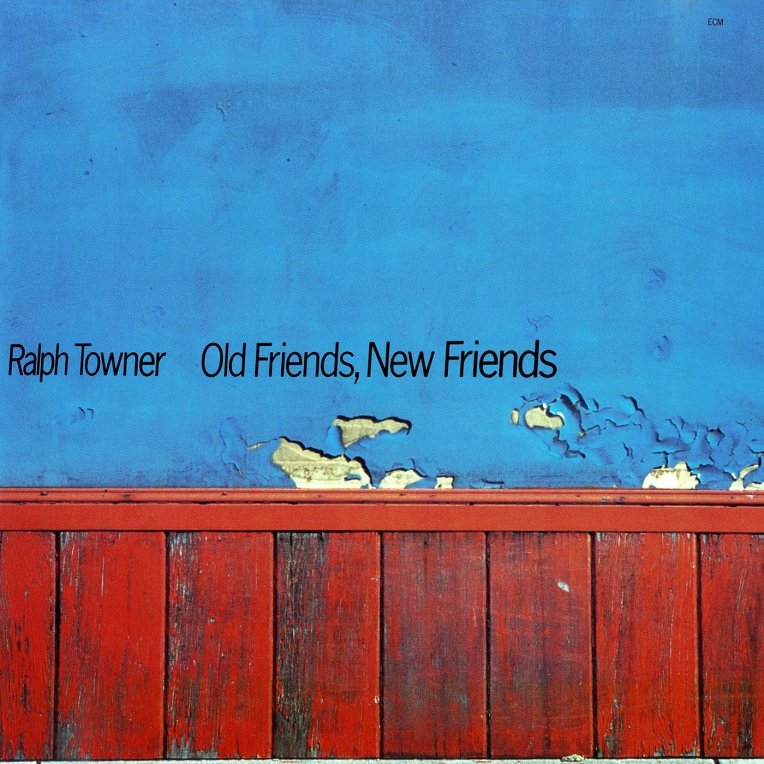
Ralph Towner: Old Friends, New Friends (ECM 1153)

ECM 1153

Ralph Towner
Old Friends, New Friends

Ralph Towner 12-string and classical guitars, piano, French horn
Kenny Wheeler trumpet, fluegelhorn
Eddie Gomez bass
Michael DiPasqua drums, percussion
David Darling cello
Recorded July 1979 at Talent Studio, Oslo
Engineer: Jan Erik Kongshaug
Produced by Manfred Eicher

This set of six extended pieces—each penned by Ralph Towner—is like the flipside of his classic Solstice. From the moment we step into its sound-world with the resplendent 12-string of “New Moon,” we know this will be a path from which we may never wish to stray. Towner’s unexpected French horn adds shading and depth to his already gossamer billows, leaving the fluegelhorn of Kenny Wheeler to snake through Michael DiPasqua’s lucid drumming as the unmistakable cello stylings of David Darling arise from the depths of our expectations. Darling, a personal favorite among ECM-represented artists, proves to be a welcome, if nearly ineffable, presence. One hears shades of his classic Darkwood unfolding like a meandering dream in “Yesterday And Long Ago,” while “Beneath An Evening Sky” weaves twelve strings through six over his ornamental crosshatchings.

Not unlike the album as a whole, “Celeste” forges an uplifting sort of melancholy, heard in Towner’s heartwarming pianism and in Wheeler’s boldly sketched lines. Moments of sheer majesty quickly succumb to underlying reveries, awaiting the “Special Delivery” of Eddie Gomez’s vocally infused commentary. This leaves only “Kupala,” which shows off Towner’s fine muting technique, brushed drums adding a touch of age. Running his fingernails along the edge of this sonic quarter, Towner opens the floor to a magic that only the listener can supply.

I know it’s nothing new to say, but albums like this always put me in awe of jazz, an art form in which a musician can surrender oneself so freely to the musical moment and yet just as easily anchor oneself in explicitly composed material. Likewise, Towner’s music, and especially that collected here, is something into which one can read experiences that are at once rooted in the physical world and firmly bound to a realm where physicality is a myth. Like its own mythology, it is creation and dissolution made one. It ends in a slow fall, laying itself down like a flower upon its own grave.

<< Jack DeJohnette: Special Edition (ECM 1152)
>> Old And New Dreams: s/t (ECM 1154)

Egberto Gismonti: Sol Do Meio Dia (ECM 1116)

ECM 1116

Egberto Gismonti
Sol Do Meio Dia

Egberto Gismonti guitars, piano, kalimba, percussion, flute, voice
Nana Vasconcelos berimbau, percussion
Ralph Towner guitar
Collin Walcott tabla
Jan Garbarek soprano saxophone
Recorded November 1977 at Talent Studio, Oslo
Engineer: Jan Erik Kongshaug
Produced by Manfred Eicher

Inspired by his time spent with the Xingu Indians of the Amazon, to whom the album is also dedicated, Sol Do Meio Dia (Midday Sun) is a consistently intriguing transitional album from multi-instrumentalist Egberto Gismonti. With him are percussionists Nana Vasconcelos and Collin Walcott and guitarist Ralph Towner, as well as Jan Garbarek on soprano saxophone for a brief spell. At this point in his career, Gismonti was beginning to fill in the porous sound of his 8-string guitar. To this end, Vasconcelos and Walcott flesh out much of the dizzying rhythmic space that defines his sound, while Towner’s 12-string laces the background with more explicit chording. Walcott traces magical circles in “Raga,” for which Gismonti engages us with nimble fingerwork on the guitar’s highest harmonics. Thus begins a chain of sporadic bursts acting in dialogue. With modest virtuosity, the musicians run hand-in-hand down this ecstatic path of music-making to an even more specific sound, this time marked by kalimba and thumb piano. Gismonti’s shrill flute and wordless chanting here recall the work of CODONA. “Coração” is a rich solo and, along with the album’s closer, is a perfect exposition of Gismonti’s notecraft. The disc finishes with a 25-minute suite. Garbarek makes his only appearance in the opening section, which glows with his mournful ululations. An inviting solo from Towner opens the ears to another fluted passage anchored by percussion and handclaps. One can feel the forest at such moments as if it were living and breathing all around us.

The combination of musicians is pure ECM and reflects the brilliant casting of producer Manfred Eicher. As airy as Sol Do Meio Dia sounds, it is also weighted with a certain nostalgia that is difficult to quantify. Like a memory, its actors are always out of focus even when their intentions ring clear. And in the end the intentions are what it’s all about.

<< Keith Jarrett: My Song (ECM 1115)
>> John Abercrombie: Characters (ECM 1117)

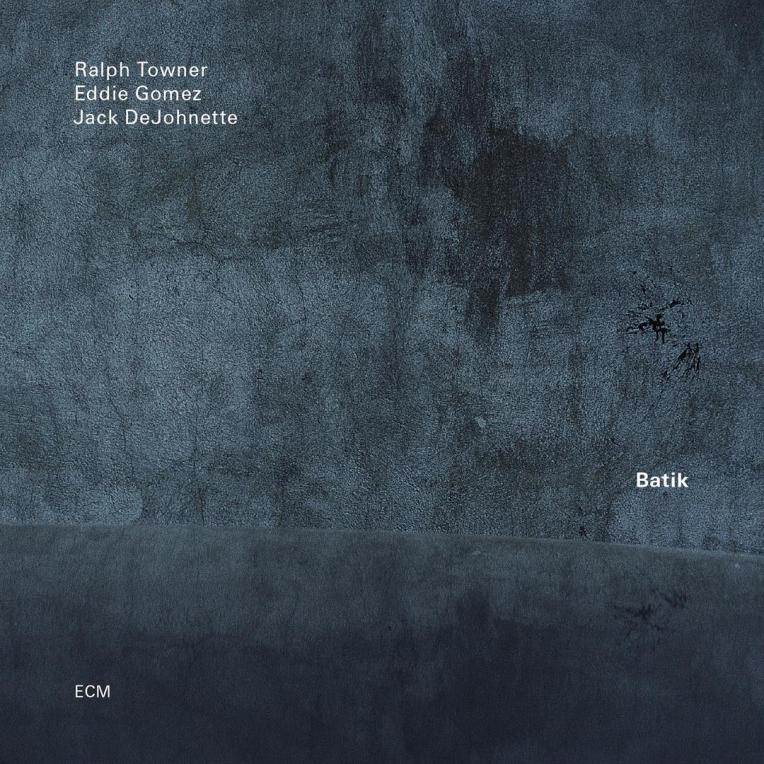
Ralph Towner: Batik (ECM 1121)

ECM 1121 CD

Ralph Towner
Batik

Ralph Towner 12-string and classical guitar, piano
Eddie Gomez bass
Jack DeJohnette drums
Recorded January 1978, Talent Studio, Oslo
Engineer: Jan Erik Kongshaug
Produced by Manfred Eicher

There are certain images that seem fail-proof when musically evoked. The “Waterwheel” that inaugurates us into guitarist Ralph Towner’s astonishingly beautiful Batik is one of them. Having since been painted for us by such varied talents as Hamza El Din (see the Kronos Quartet’s Pieces of Africa) and Marina Belica (former leader of the October Project, of which their self-titled debut is a personal all-time favorite), Towner’s particular configuration embodies the best of all worlds with the precision of his fingers magnified to great effect by Jack DeJohnette on drums and soothingly animated by the bass of Eddie Gomez. Towner’s democratic shifts in density allow for solos to shine through the haze unhindered, such as the enchanting bass that darts through his added splashes of 12-string. Towner rejoins in overdubbed costume, while amplified sustains peek like the sun from behind a cloud. Their passage through the sky is marked only by DeJohnette’s delicate metronome, allowing us one final glimpse of its thematic pool. “Shades of Sutton Hoo” is named for an Anglo-Saxon burial ground and haunts us with its reverberant lows and tinkling cymbals. A noticeably freer structure pervades, tracing every mound of earth with archaeological care. This delicate filler leads us up a “Trellis” of melody into ghostly afterthoughts. Gomez’s voice cuts with urgency through Towner’s ornamental stride. Their sumptuous counterpoint continues in the 16-minute title track and sets us down comfortably in Solstice territory. DeJohnette unleashes a noteworthy solo, while Gomez laces his quick fingers to support every hoisted footstep. We end in the “Green Room.” Painted with Towner’s mournful piano, it glows in a wash of potent commentary from bass and brushed drums, crumbling like spring snow into silence.

A classic to the nth degree.

<< Bill Connors: Of Mist And Melting (ECM 1120)
>> Enrico Rava Quartet: s/t (ECM 1122)

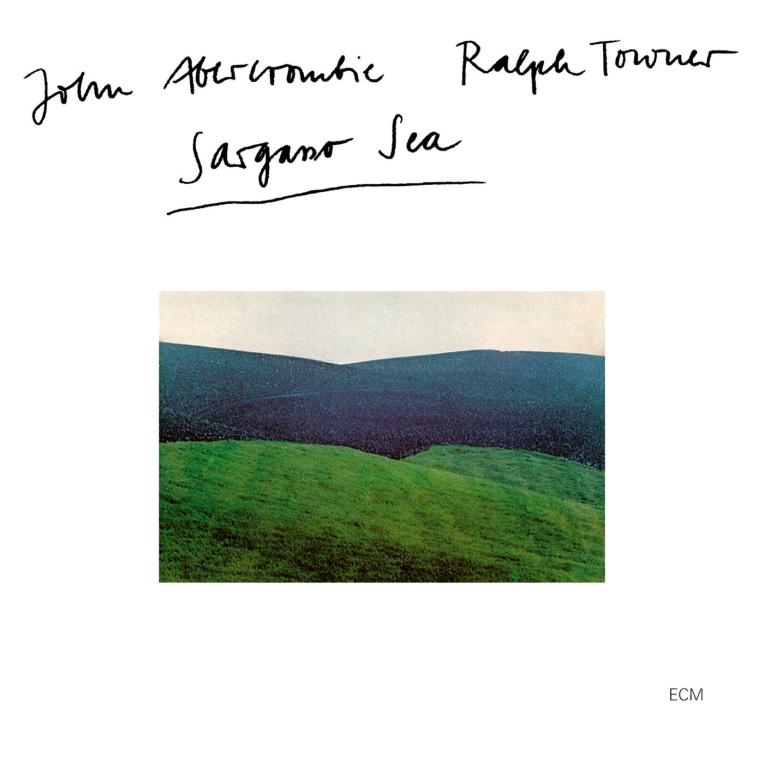
John Abercrombie/Ralph Towner: Sargasso Sea (ECM 1080)

ECM 1080

John Abercrombie
Ralph Towner
Sargasso Sea

John Abercrombie electric and acoustic guitars
Ralph Towner 12-string and classical guitars, piano
Recorded May, 1976 at Talent Studio, Oslo
Engineer: Jan Erik Kongshaug
Produced by Manfred Eicher

It was often raining when I woke during the night, a light capricious shower, dancing playful rain, or hushed muted, growing louder, more persistent, more powerful, an inexorable sound. But always music, a music I had never heard before.
–Jean Rhys, Wide Sargasso Sea

Given the contrasting but strikingly compatible talents of John Abercrombie and Ralph Towner, this album was bound to happen sooner or later. The aptly titled “Fable” best describes what these two musicians achieve together, for theirs is a tale that sounds as if it were written long ago, coalescing out of life’s improvisations into a memorable narrative. Its pairing of Towner’s 12-string with Abercrombie’s electric represents the duo in its most melodically satisfying comfort zone. We get more of the same in the title track, an uncertain travail with hints of soliloquies caressing our ears from either side, and in the relatively explosive moments of “Elbow Room.” Abercrombie opts for an echo effect here, the pulse of which dictates the piece’s rhythmic trajectory. And while I do think the effect weakens the track as its pathos becomes clearer, Towner compensates its contrivance with some flamenco-like body taps. “Staircase” features classical guitar and Abercrombie’s more directly amplified electric in the album’s most carefully realized blend of sound and circumstance. Towner then leaps to his 12-string amid Abercrombie’s own ascendant doodling. A few all-acoustic tracks enliven the mix, of which “Romantic Descension” is the loveliest. The final track, “Parasol,” is a triangular affair between 12-string, electric guitar, and Towner’s overdubbed piano.

Sargasso Sea is an enchanting reverie that has stood the test of time, and with an attractive patina to show for it. Like a kiss in deepening twilight, it loses its physical shape and becomes pure sensation, lost in the placation of a distant slumber.

<< Jack DeJohnette: Pictures (ECM 1079)
>> Art Lande: Rubisa Patrol (ECM 1081)

Ralph Towner’s Solstice: Sound And Shadows (ECM 1095)

ECM 1095

Ralph Towner’s Solstice
Sound and Shadows

Ralph Towner 12-string and classical guitars, piano, French horn
Jan Garbarek soprano and tenor saxophones, flute
Eberhard Weber bass, cello
Jon Christensen drums
Recorded February 1977 at Talent Studio, Oslo
Engineer: Jan Erik Kongshaug
Produced by Manfred Eicher

If Ralph Towner’s classic Solstice was an overland journey, then Sound And Shadows is a subterranean dream. Featuring the same lineup as its predecessor—Jan Garbarek on saxophones, Eberhard Weber on bass and cello, Jon Christensen on drums, and Towner himself behind an arsenal of instruments—the results are perhaps not as focused. Then again, they don’t need to be.

Amid the spacious 12-string considerations of “Distant Hills,” we cannot help but feel a rich and complex topography curling into slumber above our heads. Weber’s electronic touches here deepen what is already clothed in darkness. The tighter “Balance Beam” is, like its titular object, steady and reassuring yet something to which one must pay respect if one is to navigate it successfully. Garbarek’s sopranic accents teeter across it, bringing with them the idea of light where there can be none. “Along The Way” is a collection of invisible snapshots animated by the life force of the musical gesture. Towner reprises his deft pianism in “Arion.” Caressed by the fluid unity of Christensen and Weber, he unhinges unspoken memories into the soil. “Song Of The Shadows” ends the album in a blend of classical guitar and flute over receding strings.

Along with Garbarek’s open splendor and admirable restraint, Weber’s snake-like pedal points comprise the ideal complement to Towner’s pinpoint metallic precision. Christensen’s cymbal work glistens as ever, proving that rhythm can be just as effective in a whisper. This is an album of sensations without images, one that reminds us that in order to have light, we must have umbrage, and this it brings in great quantity.

<< Steve Kuhn and Ecstasy: Motility (ECM 1094)
>> Collin Walcott: Grazing Dreams (ECM 1096)

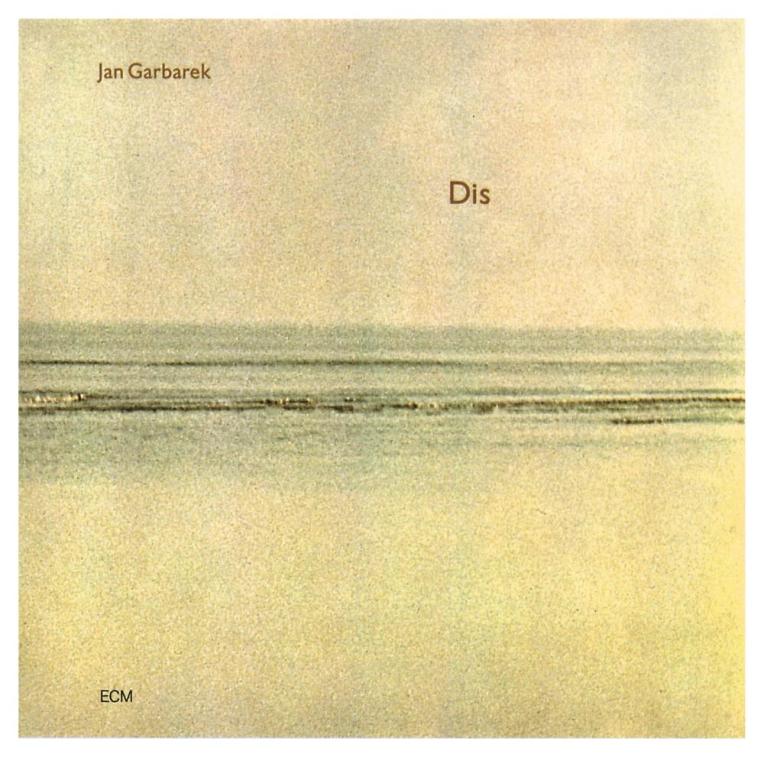
Jan Garbarek: Dis (ECM 1093)

ECM 1093

Jan Garbarek
Dis

Jan Garbarek tenor and soprano saxophones, wood flute
Ralph Towner 12-string and classical guitars, windharp
Brass Ensemble
Recorded December 1976 at Talent Studio, Oslo
Engineer: Jan Erik Kongshaug
Produced by Manfred Eicher

Debates over the “ECM sound” continue, though thankfully with waning fervor, in attempts to define that which never needed definition in the first place. Meanwhile, critical pundits are missing out on some spectacular music that would easily silence their concern over arbitrary categories. On Dis, his eighth album for the label, Jan Garbarek slipped off his extroverted garments and into a deep look inward. One immediately notices the windharp, one of the last instruments one might expect to hear on an album filed under “Jazz,” and which would make an ECM reappearance on Arvo Pärt’s Te Deum. The windharp anchors the album into place, appearing at its center and outer edges. Added to this are the extended soliloquies of guitarist Ralph Towner, whose unmistakable 12-string graces three of the album’s six tracks. For the rest, he casts longer shadows with nylon. Garbarek plays like a blind scribe, scoring his runes into ephemeral surfaces: water, earth, and air. Garbarek and Towner cover about as much territory as two musicians can. From the somber duet of “Krusning” (Ripple), cradled gently like a breaking tide into which footsteps are pressed and filled again with brine, to the wooden intonations of the title track, Dis enamors with its varied terrain. In the powerful “Skygger” (Shadows), Garbarek alternates between bold gestures and more unified punctuations. A brass section (Den Norske Messingsekstett) adds ceremony and locality. The guitar lifts its weary head and flutters its eyes in the glare of sunset, offering a solitary call for closure.

This album marked a formative transition for Garbarek, who wrings out here a soulful sound that is variously airborne and submerged. Comparing the cover art to his equally captivating Dansere, one is tempted to link them as a complementary pair. Where the latter is firmly planted in a wide and arid plain, Dis is downright oceanic, and questions its own division from the sky. The mystique of Dis puts me in mind of a film like Ron Fricke’s Baraka, in which words are superfluous, and melody and images reign as supreme forms of communication. We are never just listeners, but wayfarers in its deeply internal landscape, where space is no longer a viable marker of location, and only breath comes to define the presence of consciousness.

<< The Gary Burton Quartet with Eberhard Weber: Passengers (ECM 1092)
>> Steve Kuhn and Ecstasy: Motility (ECM 1094)

Ralph Towner/Gary Burton: Matchbook (ECM 1056)

ECM 1056

Ralph Towner
Gary Burton
Matchbook

Ralph Towner 12-string and classical guitars
Gary Burton vibraharp
Recorded July 26/27, 1974 at Tonstudio Bauer, Ludwigsburg
Engineer: Martin Wieland
Produced by Manfred Eicher

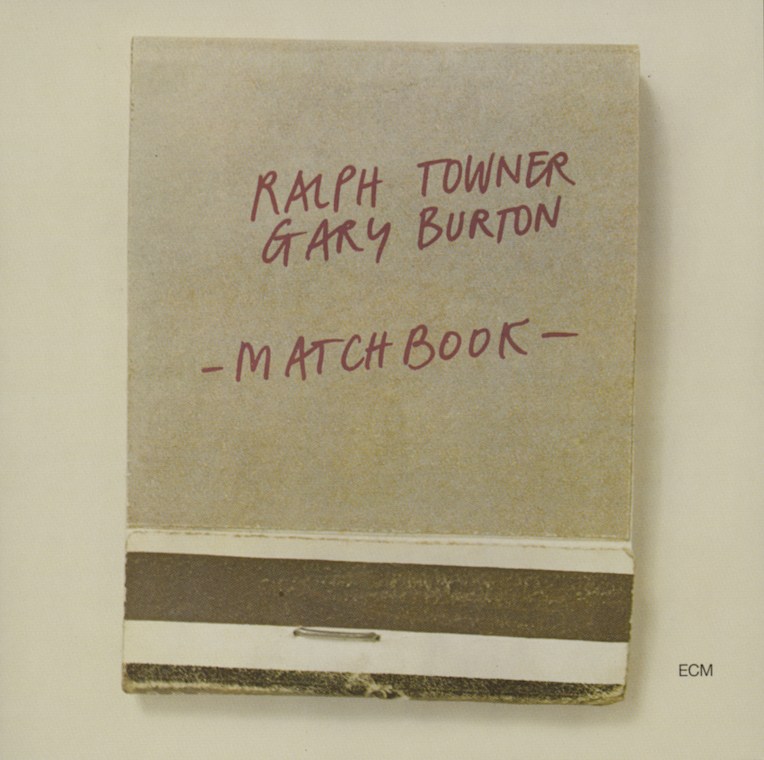
A matchbook doesn’t typically provide a surface for lasting statements. On its flap, one scrawls a phone number, an address, or any other piece of information as ephemeral as the flames for which it is mass-produced. Such is not the case with guitarist Ralph Towner and vibraphonist Gary Burton. Instead, we get indelible marks of grace and humility, each a brighter spark at the wick of our attention.

Towner originals form the bulk of this project, of which the opening “Drifting Petals” is a quintessentially evocative example. Between his 12-string and Burton’s plaintive returns, we get an emotive handful of light poured directly into our ears. This combination recurs in an intimately redacted version of “Icarus,” which paves new avenues of understanding through one of Towner’s most popular compositions. Burton’s touch adds a metallic fervor that contrasts well with the softer piano version on the previous year’s seminal Diary. Twelve strings of bliss continue in “Goodbye Pork Pie Hat.” In this delicate, dark arrangement, Mingus’s classic tune wilts into a devastating ending.

The album’s remainder gives us Towner in a more classical mode, thereby halving the number of strings at his disposal, but with no loss of distance. “Some Other Time” builds an enchanting synchronicity, throughout which both instruments connect and drift apart like memories and expectations. Burton’s plush chords give Towner’s fingers plenty of forgiving terrain. The two switch roles, as they often do, for their respective solos. “Song For A Friend” is a bleaker piece wrapped around a gentle persuasion. As an affirmation of beauty, it is sometimes painful, shaded by the same colors with which all relationships are rendered. Towner draws the album’s most endearing solo here across an ideal tidal accompaniment. A notable highlight is Towner’s buzzed introduction of the title track, achieved by weaving a matchbook into the strings of his guitar. This sets off a flurry of whimsical activity and attentive soloing, meshing in a tightly knit cloth that leaves no dangling thread.

Three instrumental angles converge in the triangular “Aurora”: classical and 12-string guitars occupy the left and right channels, while vibes bond them with living energy and song. In addition, Towner and Burton are each given their own moments in two brief, but beautiful, tracks. “Brotherhood” is a haunting piece by Burton alone, its musical nether regions fluttering in anticipation of the higher notes dropping into its dark pool, while “1×6” is a classical guitar solo that ends before it begins.

The sound of this album is like no other and unfolds itself with the delicacy of a morning glory, yet with melodies as indestructible as the sunlight that sustains them. Its many colors are provided not only through finely wrought melodies, but also through a wealth of rhythmic variations throughout. If you like either of these artists apart, then you can’t go wrong with them together.

<< Gary Burton/Steve Swallow: Hotel Hello (ECM 1055)
>> Bill Connors: Theme To The Gaurdian (ECM 1057)

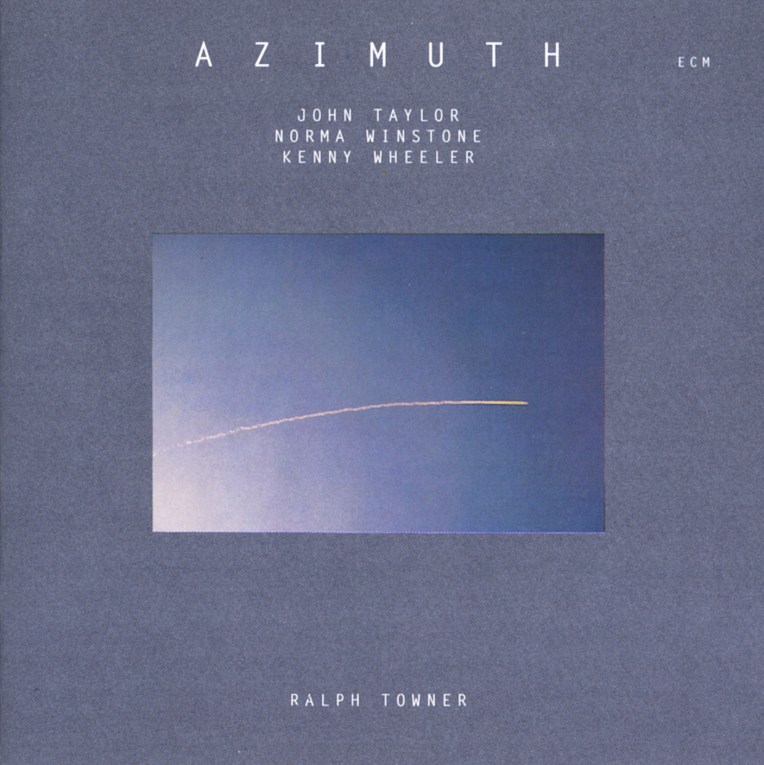
Azimuth (ECM 1546-48)

ECM 1546_48

Azimuth

John Taylor piano, organ, synthesizer
Norma Winstone voice
Kenny Wheeler trumpet, fluegelhorn
Ralph Towner 12-string and classical guitars

Azimuth:
1. The arc of the horizon measured clockwise from the south point, in astronomy, or from the north point, in navigation, to the point where a vertical circle through a given heavenly body intersects the horizon.
2. A group made up of vocalist Norma Winstone, husband John Taylor on keyboards, and trumpeter/fluegelhornist Kenny Wheeler whose music, measured from any point, draws an arc through countless heavenly bodies before intersecting with the enchanted listener.

Azimuth was (and remains) emblematic of the ECM label, marking its timelines from 1977 to 2000 with a handful of indelible punctuations. The group’s characteristically expansive sound was overshadowed only by its utter commitment to the melodic line and the trustworthiness of its expression. In the three albums collected for this timely rerelease, the journeys upon which we are taken are the same as those taken by the musicians themselves. Such immediate correspondence is a rare achievement in any vertical circle, and is to be cherished for its productive honesty.

ECM 1099

Azimuth (ECM 1099)

Recorded March 1977 at Talent Studio, Oslo
Engineer: Jan Erik Kongshaug
Produced by Manfred Eicher

The group that would become Azimuth began its journey on this self-titled album. “Siren’s Song” rests on the forgiving laurels of a repeated motif, gilded by a horn-flanked voice amid pianistic accents. Like a Steve Reich riff dropped in a pool of jazz, it treats the pulse as the animating force of its creation. Wheeler broadens Winstone’s palette in the melodic relays of “O.” The title track is buoyed by a stunningly gorgeous arpeggiator, over which Winstone sets to flight a pair of overdubbed birds. Once they have flown away, Wheeler draws between their pinpointed forms a sinuous trajectory, along which one is able to chart the album’s path with even more fluid precision. The synthetic backdrop builds in scope, turning what might otherwise be a repetitive New Age loop into an elegiac improvisational exercise. The plaintive piano introduction of “The Tunnel” extends this supportive electricity, into which Winstone begins to sow her potent words. Semantics trail off into further meanderings, reminiscent of the previous track, before the backdrop morphs into a stunning change of key. This makes “Greek Triangle,” a curious piece for brass, all the more whimsical for its appearance. Though outwardly incongruous, it breathes with the same focused spirit that animates the whole, thereby elevating it beyond the status of fanciful diversion. It also serves to refresh our palette for the lyricism of “Jacob,” in which Winstone’s braids and Wheeler’s fluid accents close an altogether fascinating mosaic of atmospheres.

<< Julian Priester and Marine Intrusion: Polarization (ECM 1098)
>> Keith Jarrett: Sun Bear Concerts (ECM 1100)

… . …

ECM 1130

The Touchstone (ECM 1130)

Recorded June, 1978 at Talent Studio
Engineer: Jan Erik Kongshaug
Produced by Manfred Eicher

Azimuth’s second ECM effort is also the group’s most enigmatic. The organ that underlies “Eulogy” gives just enough air for Wheeler to glide, and injects all that follows with deep, warm breath. The trio writes a more intimate letter in “Silver,” answered in the unsteady penmanship of “Mayday,” over which our soloists take great care to dot every i and cross every t. The distant muted trumpets of “Jero” mesh with Winstone’s ambulatory menageries. Taylor draws a fluid line through their incantations, ignoring the periphery all the way to the end of “Prelude,” a track so lovely that it makes one want to listen to the album backwards. This is an elusive set, to be sure, filled with quiet, seething power, but also one that builds its nests comfortably over our heads. It can only fly, because it knows no other way to travel.

<< Steve Reich: Music for 18 Musicians (ECM 1129 NS)
>> Pat Metheny: New Chautauqua (ECM 1131)

… . …
ECM 1163

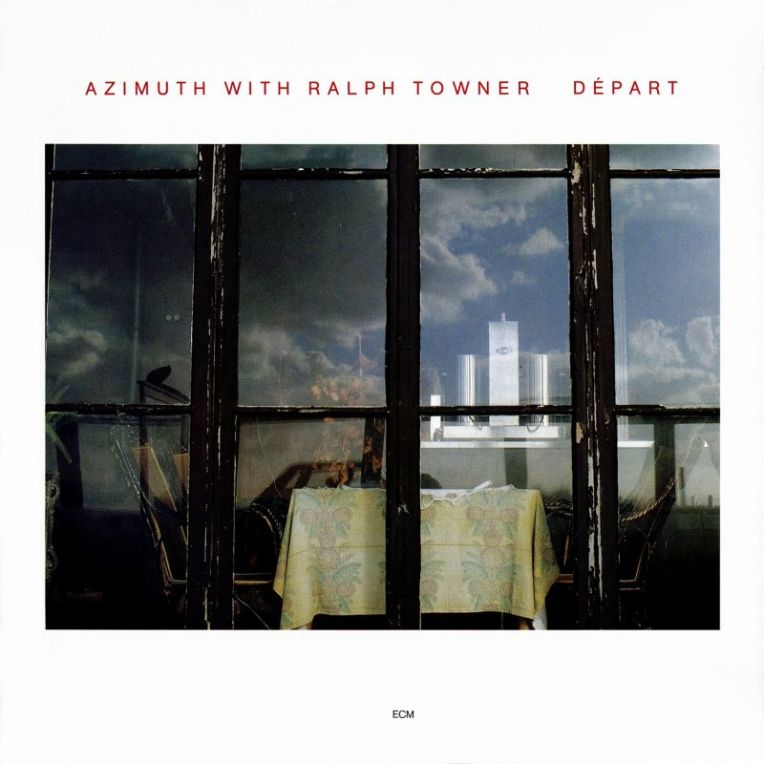
Départ (ECM 1163)

Recorded December 1979 at Talent Studios, Oslo
Engineer: Jan Erik Kongshaug
Produced by Manfred Eicher

For its third outing, Azimuth welcomed the strings of guitarist Ralph Towner. “The Longest Day” opens in Solstice territory, setting out through a drizzle of piano and 12-string. Winstone’s overdubs visualize gossamer veils of more distant storms, while Wheeler’s soulful trumpet shines like the sun beyond them. Winstone takes her voice to unexpected heights, pulling a banner of time across the sky into the contemplative piano introduction of “Autumn.” There is no falling. Rather, we get the stillness of those leaves before they die, hanging on with their last vestments of color as the winds arrive to shake them from their boughs. Winstone hangs words in the air amid Towner’s almost pianistic fingerings and Wheeler’s staccato cries. “Arrivée” is just that, but is one of many destinations in this sojourn. Incising solos leave their wounds, closed at last by the plasma of Winstone’s mellifluous protractions. This is followed by a quartet of so-called “Touching Points,” which further extrapolate vocal information from instrumental sources, and vice versa. Wordless fibers are at once spun and frayed in passages of intense physicality. Towner is put to improvisatory task, adding tentative yet appropriate ornaments of his own. The organ drone of the title track respires beneath Winstone’s dips into thermal bliss. Words spread their branches, wrought in tinsel and blown glass. The album ends with a reprise of “The Longest Day” for piano alone. Resplendent and far-reaching, it is a bittersweet ending to Azimuth’s most fully realized effort, through which the project honed its sound to an art.

Azimuth was one of ECM’s most deftly realized acts, and it continues to open like a slow cloudburst every time I immerse myself in it. Its malleable formula provides seemingly endless room for possibility. Winstone’s voice sparkles in the soft focus of consistently sensitive production, a slowly flapping bird with nowhere to go but up. She and Taylor are ideal partners, forging as they do a silent smolder of emotional bonds, while Wheeler heaves his own powerful feathers with conviction. The brief addition of Tower heightens their collective sound, even as it tethers them to the earth. This is a classic set of three seminal albums, each a movement in a larger suite, where souls can dance in motions so slow that they appear as still as ice, and are just as vulnerable to heat.

<< Sam Rivers: Contrasts (ECM 1162)
>> John Abercrombie Quartet: Abercrombie Quartet (ECM 1164)

… . …

<< Bjørnstad/Darling/Rypdal/Christensen: The Sea (ECM 1545)
>> hr-Jazzensemble: Atmospheric Conditions Permitting (ECM 1549/50)

Ralph Towner with Glen Moore: Trios/Solos (ECM 1025)

ECM 1025

Ralph Towner with Glen Moore
Trios/Solos

Ralph Towner guitar, piano
Glen Moore bass
Paul McCandless oboe
Collin Walcott tabla
Recorded November 27/28, 1972 at Sound Ideas Studio, New York City
Engineer: George Klabin
Produced by Manfred Eicher

Essentially an Oregon album under a different name, Trios/Solos consists mainly of Ralph Towner originals culled from the group’s Vanguard sessions. The opening “Brujo” is anchored by Towner’s twelve mighty strings and the late Collin Walcott’s tabla stylings, leaving a winding crevice through which Glen Moore works his whimsical bass. “Noctuary” features Paul McCandless on oboe, soaring loosely through the Towner/Moore fulcrum before the trio ties itself into a tightly improvised not. The Bill Evans tune “Re: Person I Knew” stands out in a gorgeous rendition. Towner doubles on piano and 12-string—laying down a sound that would soon crystallize into his classic ECM album Solstice—as Moore lurks in the background. “Raven’s Wood” continues the same configuration, only this time with nylon, darkening its pastoral modality with nocturnal visions.

Despite the intimate wonders of these trios, the album’s titular solos abound with some of its most focused and furthest-reaching moments. Moore’s “A Belt Of Asteroids” is a curious one at that. Seeming at first out of place in its present company, it carefully peels open the album’s outer layers with every twang. The remainders feature Towner doing what he does best. Take the compact “Suite: 3×12,” a carefully thought out composition in which his palpable picking and love for harmonics shines through at every turn, not to mention his consistently progressive energy. The last of the three movements is more aggressive in its attack and wound around a precise rhythmic core. “Winter Light” is heavily steeped in 6-string nostalgia, lonely but content in its solitude. “1×12” is, by contrast, a run along a blazing trail. Lastly, we have “Reach Me, Friend,” a snapshot of expectation that breathes with audible resolve.

As the driving force behind the album, Towner’s technique is mellifluous as usual, forging an aerial sound that constantly surveys the untouched lakes shimmering below like mirrors in the brilliance of his execution. Despite the lush performances throughout, the imagery is all so viscerally sere. And while there is no danger in what we see, there remains a threat unseen, lingering just beyond the horizon, quelled only by the arrival of the morning sun.

<< Gary Burton/Chick Corea: Crystal Silence (ECM 1024)
>> Stanley Cowell Trio: Illusion Suite (ECM 1026)