Dominique Pifarély violin François Couturier piano Recorded October 2023, Historischer Reistadel, Neumarkt Engineer: Markus Heiland Mixed April 2024 by Manfred Eicher and Michael Hinreiner (engineer) at Bavaria Musikstudios, Munich Cover photo: Woong Chul An Produced by Manfred Eicher Release date: January 24, 2025
What threw us together, shrieks apart, a worldstone, sun-distant, hums. –Paul Celan
The last duo session for ECM from pianist François Couturier and Dominique Pifarély was recorded in 1997 (Poros). Since then, these musicians have paved roads uniquely their own in span and material across the label’s catalog, but always with each other in sight. For this reunion, they explore an absorbing melange of originals and standards. Of the latter, we are treated to characteristically shifting interpretations of Jacques Brel’s “La chanson des vieux amants” and George Gershwin’s “I Loves You Porgy.” Pifarély’s instrument cuts a figure struggling to hold its shape in the wavering heat, its microtonal plasticity yielding haunting textures. Equal parts lyrical and contortional, both tunes find kindred company in Manning Sherwin’s “A Nightingale Sang in Berkeley,” which manages to stay soulful throughout every twist and turn. With a touch of rain and softness on the horizon, it sings of clearer and brighter days before giving way to Pifarély’s “Les ombres II,” a spiral staircase turned inside out. Its counterpart, “Les ombres I,” begins the album with string-forward resolve, morphing into a reflective take on J. J. Johnson’s “Lament,” which barely disturbs the water’s surface before it fades. Further highlights abound in the violinist’s “Vague” and “What Us.” By turns brooding and whimsical, they prove that contemplation isn’t always pretty—nor must it be, until the decorations of hindsight fall into hand. Couturier’s colorations are astute and adaptive throughout. From pressing chords to baptismal sprinklings, there is much to savor. His own “Le surcroît I” and “Le surcroît II” cut against the grain of reality in the most intriguing way, time capsules of impressions saying only what needs to be said, while “Song for Harrison” (co-composed with Pifarély and named for Couturier’s cocker spaniel) playfully breaks into Duke Ellington’s “Solitude” for an artful contrast of layers. Each is a cipher that also serves as its solution, spinning the cryptex into new possibilities with every listen.
Benjamin Lackner piano Mathias Eick trumpet Mark Turner tenor saxophone Linda May Han Oh double bass Matthieu Chazarenc drums Recorded March 2024 at Studios La Buissonne Engineer: Gérard de Haro Mastering: Nicolas Baillard Cover: Fidel Sclavo Produced by Manfred Eicher Release date: January 17, 2025
After leaving a sizable footprint in ECM soil with Last Decade, pianist Benjamin Lackner takes us one step further with a fresh quintet, bringing us closer to a vision of identity. Although the music is more through-composed in the present context, it lends itself to the spontaneous inventions of trumpeter Mathias Eick, saxophonist Mark Turner, bassist Linda May Han Oh, and drummer Matthieu Chazarenc (a member of Lackner’s trio prior to ECM). From all of this emerges a moving picture that is equal parts brooding and hope.
The title track bids welcome with a reed-forward introduction, as the piano sweeps up and down its registers in the twinkling of cymbals before a flowing denouement ensues. Lackner’s pianism is revelatory yet humble, never appropriating center stage. Rather, he lets his allies speak—and speak they do. Whether it’s Turner’s forthright turns of phrase or Oh’s chameleonic acuity, this brew remains communal to the last drop.
The breezy beginning of “Mosquito Flats” shifts into an even breezier theme, where the wishes of an entire generation fade in favor of a timeless desire for harmony amid a slow-motion urban swing. The two horns forge tempered fire in exchange for the final recapitulation. Their duetting continues in “More Mesa,” another unassuming tune that is nevertheless robust in its way.
Chazarenc contributes “Chambary,” a track smothered in upbeat textures and wild (yet subtle) leaps, without a shred of pretension. It’s a highlight for being as deep as it is concise. It finds a genuine companion in “See You Again My Friend,” an especially tender vehicle for Eick, who later converses with Oh in safe seclusion from the dissonant strains of “Murnau.” By contrast, the feeling of anticipation in “Fair Warning” is almost unsettling, as if the fabric of reality could tear at any moment, revealing a nightmare.
I so appreciate Lackner’s willingness to blow-dry notes before they become too wet. This holds the listener’s attention and enlivens mid-tempo pieces like “Anacapa,” which also elicits my favorite solo on the album from the bandleader (neither can one forget Oh on “Ahwahnee,” where her touch sings of the very earth). And yet, no matter how much shadow clouds our vision, “Out Of The Fog” leaves behind an intimation of light. As it resolves into a collective hymnody, we see that the characters in this story have been seeking healing individually, only to find it in one another.
Spindrift is a screen lit by a single projector in an otherwise dark room. By focusing on the narratives before our eyes, it gives us the luxury of ignoring what lies behind them. Many of the films that repeatedly run through our minds are traumatic reflections of the media we consume daily. Here, we have an opportunity to engage with stories of wholesome reflection in which the soul needs no likes counter to validate itself.
Oded Tzur tenor saxophone Nitai Hershkovits piano Petros Klampanis double bass Cyrano Almeida drums Recorded November 2023 at Studios La Buissonne, Pernes-les-Fontaines Engineer: Gérard de Haro Mastering Nicolas Baillard Produced by Manfred Eicher Release date: June 7, 2024
For his third ECM album as leader, following the shadowy Here Be Dragons and the short but sweet Isabela, saxophonist Oded Tzur returns alongside pianist Nitai Hershkovits and bassist Petros Klampanis, plus drummer Cyrano Almeida (replacing Johnathan Blake from the previous lineup). A few years ago, I interviewed Tzur but neglected to incorporate our conversation into a review. However, I find that his answers remain as relevant to the present session as they were when he so graciously offered them, so I felt it appropriate to include his insights to enhance our regard for this latest star in his emerging constellation.
Rather than try to put his music into a rigid box—Is it Raga? Is it Jazz?—I asked whether Tzur would ever ascribe a “genre” to his musical style. His response:
“I call it ‘Deep Structure,’ which is a reference to Noam Chomsky’s theory of linguistics. Chomsky claims all languages share certain features that are concealed by surface elements, which he calls ‘Surface Structure.’ Sometimes, it does seem a little limited to put things in categories, especially when a work’s influence spectrum ranges from South Asia to North America. However, it isn’t completely false to place a piece of music in a continuum so people have a frame of reference. It’s just that those continuums are getting trickier nowadays because the world moves in the direction of unification, at least if we compare it to 100, 500, or 1000 years ago. My personal journey has led me to feel strongly that all musical traditions share certain elements, and while they also have distinct features and differences, those shared elements are crucial and often hidden. Joseph Campbell’s views on religion make the same point, in a way, where the commonalities between different mythologies are simply too precise and striking to be dismissed as coincidence. What Raga—the Indian melodic universe—shows us about sound and melody can be seen in synagogue prayers as well as the Blues.”
Taking these reflections to heart empowers us to hear the alpha in every omega, as embodied in “Epilogue,” which happens to initiate the set. Tzur’s uniquely vocal tone elicits a brief and resounding call to gather the remnants of our speech as an offering to something so deeply communicative that we can only resort to the fluid intensities of “Child You.” The second of six intimate tracks casts his metaphysical virtuosity as an inevitability rather than a choice. He finds a graceful interplay with Klampanis, whose inner feelings correlate one by one. Furthermore, his entanglement with Hershkovits provides ample room for our ears to breathe, building tone upon tone as a gradual monument of stones.
With so much focus on his sound, it’s only natural to ask about the many years of discipline and refinement (or is it unrefinement?) that go into it. How has it, I wonder, changed over time, and how does he see it possibly changing in the future?
“The process certainly began in Jazz for me, transcribing Dexter Gordon, John Coltrane, and many others. The encounter with Indian classical music and my time with Hariprasad Chaurasia was a pivotal turn because I didn’t want to play an Indian instrument; I felt like the sound I was hearing was another way or another version of the saxophone sound. The influence of Indian instruments, for which the octave is a continuous spectrum rather than 12 dots, has had on me is very significant. I followed Chaurasia’s sound as closely as possible for a number of years and didn’t want to give myself the excuse of ‘I’m playing the saxophone.’ For the future, I hope to continue to work on ways in which microtonality can be accessed on the saxophone, as well as aligning those techniques efficiently with the more traditional sound of the instrument.”
Consider that goal embraced in “Through A Land Unsown,” where that same human timbre arises into waking. Despite the softness of articulation, it reveals a hard-won truth that can only be possible when shedding enough desire to block the past from assaulting the flesh. The brilliance of his playing is that it never forgets the past, either, taking what it has learned without succumbing to its temptations of self-glorification. Klampanis’s solo here draws inspiration from that spirit. Again, Hershkovits carries this basket down a river of unexpected turns and textural currents, ultimately landing in the reeds where it was meant to be discovered. Throughout, Almeida conveys an uncanny ability to foresee every move the others make. His drive continues in “Renata,” forging a pulse within a pulse that lends itself to the heart without force while Tzur’s tenor navigates all of this with purposeful intuition. The drummer’s brushes are flashes of heat lightning in the title track, a muscular gift from above that works its way through nocturnal shades of meaning.
With so much to interpret in these inward gazes, what is Tzur’s greatest wish for his listener?
“Music is a way to learn about ourselves because music can create experiences that are revelatory in their nature. Learning history is also an excellent—and perhaps more urgently needed—way to learn about ourselves. Music is a more abstract form, like prayer or meditation. If I can create music that would reveal to people things that they didn’t know before—or, even better, knew and forgot—I would have fulfilled an important musical goal.”
And in the concluding “Last Bike Ride In Paris,” we find that ethos in full display. With a joyful sound, sunlit and smiling, the rhythm section connects telepathically as a cage for Tzur’s bird to sing and—eventually—transcend in flight to the next journey beyond the mountains. Some of his most inspired playing is to be found here, watering every root with an inspired future.
Although nothing about My Prophet necessarily implies a trilogy, the progression of album covers suggests otherwise. Whereas Here Be Dragons features standard typography and photography, Isabela shows a bordered image with black and blue typography. And now, we get only the latter against a white background. It’s as if the ornaments have been stripped away with every iteration. All of which proves that even with the flurry of notes, there is stillness to be savored. Like a hummingbird, Tzur’s playing works hard and at great expense of energy to hover in place.
Arild Andersen double bass, electronics Recorded live June 18, 2020, Victoria Nasjonal Jazzscene, Oslo Engineer: Espen Høydalsvik Mixed June 2024 at Rainbow Studio, Oslo by Arild Andersen and Martin Abrahamsen (engineer) “Peace Universal” recorded at home Cover photo: Jean-Guy Lathuilière Executive producer: Manfred Eicher Release date: November 29, 2024
Even after an ECM recording career spanning half a century, Arild Andersen continues to surprise and does so brilliantly with his first solo album. Recorded live at the 2020 Victoria Nasjonal Jazzscene in Oslo, the program is as varied as the Norwegian bassist’s influence is wide. Despite being alone on stage, he is accompanied by an application of electronic loops in real time (courtesy of a Gibson Echoplex Pro Plus loop machine and a TC Electronic M 2000 signal processor). In that sense, it makes the album a sublime companion to Eberhard Weber’s Once Upon A Time and is just as important as a latter-day document.
The marriage of live electronic treatments isn’t new to Andersen, whose ensemble recordings have featured it in various contexts. With nothing else but the road ahead to guide—and the road behind to encourage—he makes classics from his own and others’ songbooks feel as relevant as when they were first committed to memory. From his canon, we get the sturdy “Dreamhorse,” a tune that arose from a solo improvisation he performed at the Kongsberg Festival in 1994 (and which has appeared on ECM on his trio album, Live At Belleville). With tapping providing the rhythmic undercurrent it needs to gallop, a fluid overlay gives us an ever-expanding image of travel and landscapes. “Mira” (a nod to another trio album of the same name) boasts a comparable wingspan.
Andersen always has a way about him that makes us feel duly situated, making the title track (harking all the way back to 1981’s Lifelines) all the more lucid as a lens of interpretation. The playful dissonances therein emerge from two interconnected pieces: “Ghosts” by Albert Ayler and “Old Stev,” a traditional Norwegian folk song that Arild learned in his Sagnproject with singer Kirsten Bråten Berg. In both, we find a soul perfectly at home in stretches of atmosphere where ends and beginnings become indistinguishable. His instrument represents points in time, while the electronics are the horizon in which they rise and fall like briefest lights of life.
The overall effect is such that even evergreens like “A Nightingale Sang in Berkeley Square” (written by Manning Sherwin for the 1940 musical, New Faces) and Ornette Coleman’s “Lonely Woman” find kinship at the touch of fingers and strings. The latter meshes beautifully with Charlie Haden’s “Song for Che,” where con legno tracings ring forth as a call to action. However, as I alluded to at the beginning of this review, we must look to where we came from to know where we are going, which is why I close with where the album opens: in “Peace Universal.” Ra-Kalam Bob Moses’s timeless hymn gives rise to birds, animal calls, and forest stirrings, its mist alive with intimations of ancestors whose lives were never recorded in the annals of history yet whose legacy lives on in the very earth. Each reverberation gives up the ghost even as it downloads a melody for the ages from the ether.
Tord Gustavsen piano, electronics Jarle Vespestad drums Steinar Raknes double bass Recorded October 2023 at Studios La Buissone Engineer: Gérard de Haro Mastering: Nicolas Baillard Cover photo: Fotini Potamia Produced by Manfred Eicher Release date: September 20, 2024
Thy word is a lamp unto my feet, and a light unto my path. –Psalm 119:105
Each new recording by the Tord Gustavsen Trio constructs an unassuming waystation for the ECM listener, and on Seeing, we are given the most rustic lodging yet. In addition to the usual attention to detail one has come to expect from this venture, there is a certain plasticity to the sound that, while always humming at the core, now rises to the surface after patiently compressing its diamond light beneath the earth. Thus, the album’s title is more than an equation of listening with how the eyes take in the world around them; it is also an expression of the music’s indefinite state of being.
From the stained glass scintillations of “Jesus, gjør meg stille” (a Norwegian traditional) to the bass-driven road trip of the bandleader’s own “Seattle Song,” we find ourselves in territories at once familiar and freshly rendered for the soul. Soul is precisely what the band has more than enough to spare in its artful blend of gospel pastels and jazzier charcoal. “The Old Church” is a prime example of how beautifully these mesh together and is distinct for bassist Steinar Raknes’s solo, which stands out in an album largely focused on the group’s collective vibe. It’s also a running spiritual theme in a context where such classic hymns as Lowell Mason’s “Nearer My God, To Thee” (rendered so beautifully alone at the piano) and the Bach chorales “Christ lag in Todesbanden” and “Auf meinen lieben Gott” feel just as much of the here and now as Gustavsen’s originals feel curated from some old codex. The lushness of Johann Sebastian’s creations is matched only by their brevity. Like Bible verses that cut right to the core when one needs them, each lays sins bare on the altar of forgiveness, cutting them into smaller and smaller pieces until they disappear from view. Thus, faith is shown also to be creative, so that touch becomes a way of life.
Among the remaining selections by Gustavsen, if “Piano Interlude – Meditation” is made of stone and wood, then the title track travels on the wind, knowing one’s place in the world by dislocation. As in “Extended Circle,” we know this embrace the moment we feel it, having encountered it in dreams, in memories, and in hopes for the future. And here they are before us, welcoming and forgiving, waiting for life to unfold with philosophical humility. This leaves us only with “Beneath Your Wisdom,” which is the heart of the band, in which opens a door to whatever may burn in the depths of human regard.
The pianist notes a theme of “cherishing” in this music. Thus, as a return to form, Seeing proves itself to be an affirmation. The quieter the play, the more we feel revived, ready to take on the demons of this world. As the psalmist says above, God shows us only a few steps ahead. The rest is for Him to know.
Nitai Hershkovits piano Recorded June 2022 at Auditorio Stelio Molo RSI, Lugano Engineer: Stefano Amerio Mastering: Christoph Stickel Cover photo: Jean-Guy Lathuilère Produced by Manfred Eicher Release date: November 10, 2023
After playing as a sideman in Oded Tzur’s quartet, pianist Nitai Hershkovits makes his solo ECM debut in a largely improvised recital. Its title pays homage to his former piano teacher, Suzan Cohen (the penultimate “For Suzan” bears her name), resulting in a total of 18 vignettes, each a variation on the theme of gratitude, heritage, and the creative spirit. From the first blush of “The Old Wise,” one feels a blend of past and future colors blending across the canvas of the present. Like much of what transpires thereafter, moments of sheer synchronicity give way to hints of breakdown, yet always manage to stay together. As cycles of commentary swirl around each other in one larger mixture of memories, feelings at once familiar and unfathomable dance in the foreground. Whether in the chromatic embrace of “A Rooftop Minuet” or the delightful games of “Intermezzo No. 4” and “Intermezzo No. 3,” Hershkovits fuses classical and jazz impulses. The latter sprout up even higher in “Majestic Steps Glow Far” and “Dream Your Dreams,” where desert flowers bloom. Whereas one sounds like a lost standard translated from fragments of memory into a coherent whole, the other (by Molly Drake) is only one of two covers (the other being Duke Ellington’s “Single Petal Of A Rose”) to grace the program.
In tracks like “Enough To Say I Will,” tender beginnings give way to subtle leaps of faith, each lasting the length of a breath or two, before gentle dissonances prevent us from falling into fantasy. The reality of things becomes clearer as virtuosity sheds one snake skin after another, texture taking precedence over key. “Mode Antigona” is among the set’s most lyrical turns (the others being “Of Trust And Remorse,” “Late Blossom,” and “In Satin”). Like the rest, however, it’s never content to stay in one place but rather gives itself over to the whims of the air currents in the room. It’s as if the flow of time itself were a conductor treating every deviation of the score as an opportunity for discovery. Further treasures abound in the rushing river of “Mode Brilliante” and the smoky piano bar vibes of “This You Mean To Me.” And in the quiet exuberance of “Of Mentorship,” we find remnants of all that came before, joy reigning supreme.
Zsófia Boros classical guitar, ronroco Recorded March/April 2022, Auditorio Stelio Molo RSI, Lugano Engineer: Stefano Amerio Cover photo: Fotini Potamia Produced by Manfred Eicher Release date: April 14, 2023
Guitarist Zsófia Boros returns with her third program for ECM’s New Series. Pairing selections from Argentina with those of French composer Mathias Duplessy, the result may just be her most meticulously constructed dollhouse yet. Indeed, it’s as if every track were either a room or a piece of miniature furniture placed artfully within it.
We begin at the entrance with Duplessy’s “De rêve et de pluie.” The use of harmonics here, alternating with liquid arpeggios, evokes an architectural awareness of the surroundings. Boros traces the contour of the doorway, takes her shoes off in the foyer, and steps carefully inside to take it all in. Next, she tiptoes up the stairs built by Joaquin Alem, whose “Salir adentro” cradles a brief rhythmic tapping in its tenderness. It breathes almost dramatically despite the near-stillness, burrowing as an animal preparing for hibernation. From this dreamy escape, we enter the reality of the nursery, in which Quique Sinesi’s “El abrazo” crochets its lullaby. For this, Boros wraps a rubber band around the guitar strings—a muting technique she developed to allow her to practice while her children were sleeping. The effect is warm and familiar.
From there, Boros recedes into the kitchen, where Alberto Ginastera is cooking lovingly at the stove. His take on the “Milonga” is a spider-webbed tango, as savory as it is sweet. Moving on, we are led into the study, where two books bound by Duplessy lie open for our scrutiny. Whereas “Le secret d’Hiroshigé” recalls the sound of the Japanese koto, moving through paper screens as if they were made of air, “Perle de Rosée” is more botanical. With an understated quality that eschews the pitfalls of virtuosity in favor of its grace, it navigates fields of crops on the verge of being harvested. Meanwhile, a fire burns softly in the fireplace, where the kindling of Sinesi’s “Tormenta de ilusión” leaves us to regard some more unexpected turns of phrase. Played on the ronroco (the 10-stringed instrument for which it was originally written), it destroys memories of the past the tighter it tries to hold to them.
As we wander into the gallery, Duplessy treats us to a modest yet captivating private collection. In “Le labyrinthe de Vermeer,” we can sense oils, pigments, and brushstrokes coalescing into a coherent image. Each section has its own fragrance and distinct perspective. His “Berceuse,” the album’s pinnacle, draws a poignant ebb and flow, while “Valse pour Camille” expresses childlike wonder, coming of age in resonant strums.
We end in the greenhouse, where the album’s title piece by Carlos Moscardini casts its light on a bonsai tree. As a marvel of curation, it doesn’t so much mimic its larger cousins but shows what music is capable of at its most cellular level.
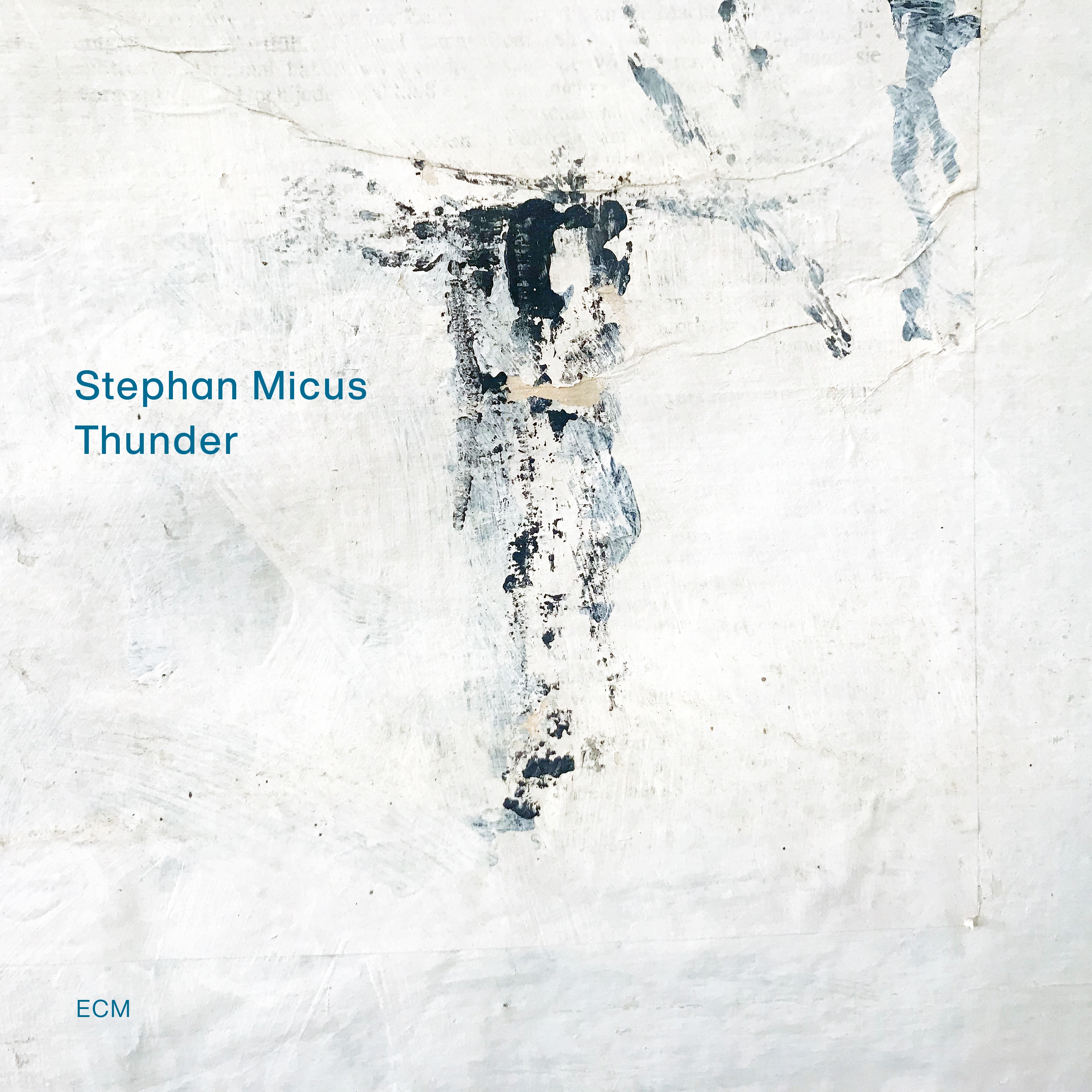
Stephan Micus frame drum, storm drum, dung chen, Burmese temple bells, Himalayan horse bells, ki un ki, bass zither, bowed dinding, kyeezee, shakuhachi, sarangi, nyckelharpa, kaukas, sapeh, voice, nohkan Recorded 2020-2022 at MCM Studios Cover art: Eduard Micus (1925-2000) An ECM Production Release date: January 20, 2023
Multi-instrumentalist Stephan Micus goes bigger than he ever has before on Thunder, his 25th solo album for ECM. Inspired by the dung chen, a four-meter-long trumpet heard booming from monasteries during his travels to Tibet, he long dreamed of incorporating it into a series of compositions. After immersing himself in its depths (only in Kathmandu did he find someone willing to teach him how to play this instrument normally reserved for monks), he settled on the ki un ki (a cane stalk common among the Udegey people of Siberia played by inhaling) and the nohkan (a transverse bamboo flute from the Japanese Noh theatre). From this trinity arose a series of nine compositions, each dedicated to a different god of thunder from different world traditions.
Despite the album’s concept, however, and the decidedly spiritual overtones, there is something undeniably elemental about the music itself. For while there are certainly far-reaching moments of great drama and development, others are intimate spirals of reflection that are just as content in staying where they are. Of the former persuasion are pieces like “A Song For Thor,” “A Song For Vajrapani,” and “A Song For Perun.” All three make use of dung chen, frame drums, Burmese temple bells, Himalayan horse bells, bass zither, and either the ki un ki or nohkan. The drums are the heartfelt griots of this primal tale, evoking the sound of footsteps on dirt and stone. The ki un ki moves with an eagle’s precision, so determined that every clod seems to get out of its way as it barrels through with a human soul firmly in its sights. As it traverses the landscape, passing through every dead object as if it were made of air, it finds its way to life itself. Through this transformation, it lingers on the edge of speech. Meanwhile, the dung chen move like elephants across the plains, each carrying a virtue known only by its ancestors.
So much of what we encounter here, however, is as reflective as a pond in moonlight. For example, “A Song For Raijin” and “A Song For Leigong” feature the storm drum, which, despite its name, betrays only the slightest hint of a climatic disturbance on the horizon. Both tracks also feature bowed sinding (a West African harp), kyeezee (bronze chimes from the Buddhist temples of Burma), and shakuhachi. With so much tenderness between them, each wrapped in the arms of a subcutaneous drone, the Japanese bamboo flute can only plant its prayers in whispers. It is a frail warrior that would be torn in the next violent rainfall, the possibility of which haunts every dream.
Of those dreams, we get two glimpses through the lenses of “A Song For Armazi” and “A Song For Zeus.” These share the same scoring (3 sarangi, 2 bass zithers, and nyckelharpa), opening spaces of translucent incantation. Speaking of which, Micus’s voice enters magnified in “A Song For Shango” and “A Song For Ishkur.” Accompanied by the sapeh (a lute from Borneo) and kaukas (a five-string lyre of the San people in Southern Africa), he traces the aftermath of nature’s fury. We can feel the humidity in the air, the sweet musk of precipitation in the nostrils, and the tang of love on the tongue. The sapeh shimmers, while the singing rolls across the mountains, flattening everything it touches with quiet power—not a ritual but a revelation that manifests itself as a footnote on the page of time.
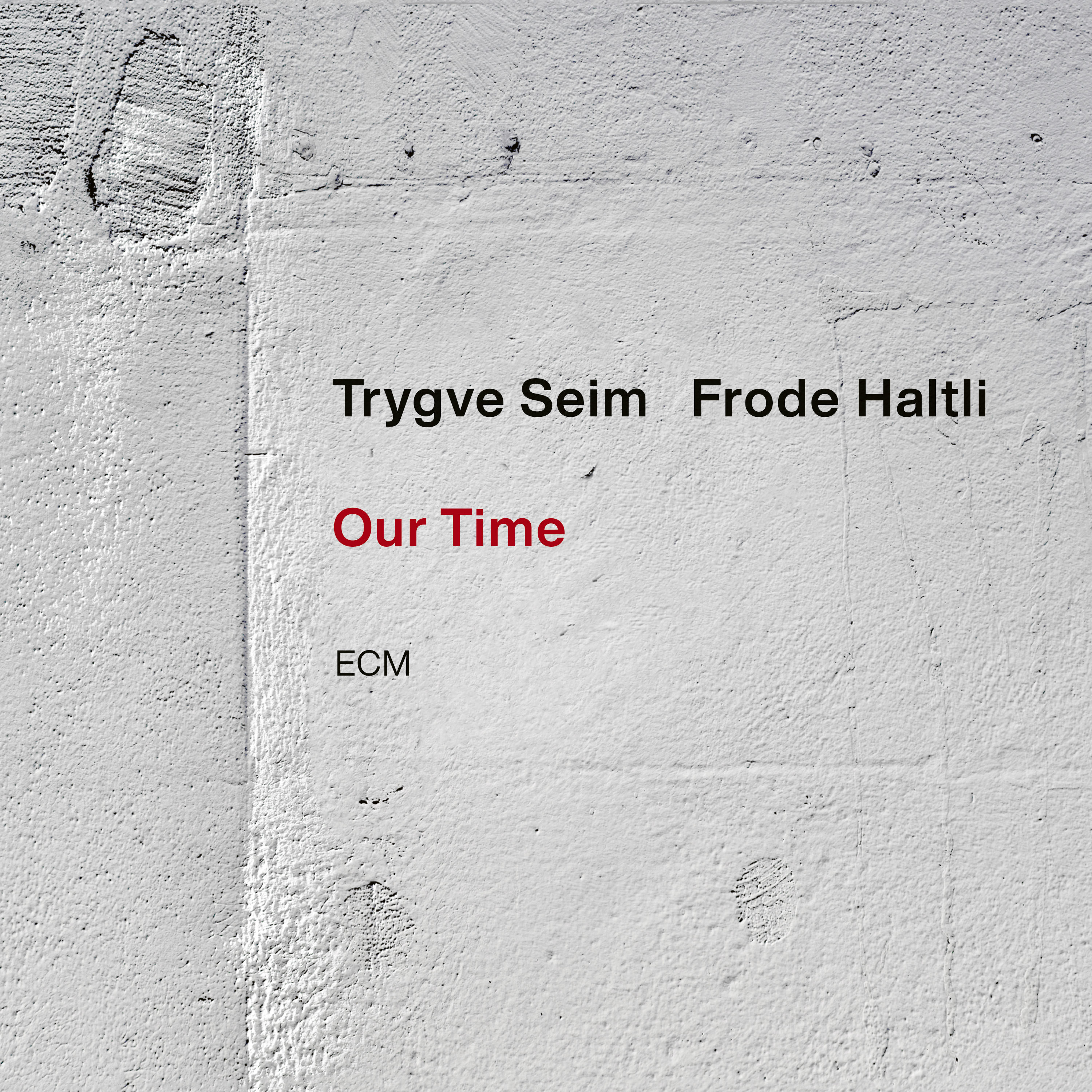
Trygve Seim soprano and tenor saxophones Frode Haltli accordion Recorded June 2023, Himmelfahrtskirche, Munich Engineer: Stefano Amerio Cover photo: Thomas Wunsch Produced by Manfred Eicher Release date: September 13, 2024
For the past 25 years, saxophonist Trygve Seim and accordionist Frode Haltli have compacted dirt together as musical allies one step at a time. In this successor to 2008’s Yeraz, the duo opens a new door of their advent calendar into a world of freshly tilled land.
The set is pillared by four improvisations, each of which blends into a through-composed selection. Across this spectrum, they carve into introspection and extroversion, and back again. Seim has such an ancient approach to the modern reed, which at his lips sounds like a duduk, as Haltli’s wingflaps take his uplift to heart. Delicacy abounds, along with mature textural contrasts, each of which elicits a mood, a picture, a song. In “Shyama Sundara Madana Mohana,” a North Indian folk song, higher notes seek transcendence, while colors come alive in Igor Stravinsky’s “Les Cinq Doigts No. 5.”
Aside from “Oy Khodyt’ Son, Kolo Vikon,” a traditional Ukrainian lullaby rendered with just as much freedom and love as anything unscripted between them, the album is largely self-composed. From Haltli’s “Du, mi tid” to Seim’s “Elegi,” they plant one careful seed after another, watering with patient listening. The gradualness of their hindsight pays commensurate deference to the subject matters at hand. It is as if theirs was a world of shadows whose existence is discernible only because of the light they carry. Although we cannot know for sure where they are going, the music hints at a destination known only to the subconscious mind. Rising tensions mingle with artful release as the landscape feels warmer and less distant, more human than before. Amid all of this emotional shading, “Arabian Tango” feels like a once-in-a-lifetime joy. The most delicate tenor notes from its composer mesh beautifully with Haltli’s solo of sorts, while the space of the room itself lends a voice to this dance of emergence and recession.
Taken as a whole, Our Time is a mountain compressed into breath and exhaled in words of snow.




 Between Sound and Space: ECM Records and Beyond