Mathias Eick trumpet, keyboard, voice Håkon Aase violin, percussion AndreasUlvo piano Audun Erlien bass Torstein Lofthus drums Helge Andreas Norbakken drums, percussion Stian Carstensen pedal steel guitar Recorded August 2020 at Rainbow Studio, Oslo Engineer: Martin Abrahamsen Cover: Fidel Sclavo Mastering: Christoph Stickel Produced by Manfred Eicher Release date: September 24, 2021
If you’ve ever reunited with an old friend, picking up where you left off as if no years had kept you apart, then you’ll know what it feels like to immerse yourself in the sounds of When we leave. The appropriately titled “Loving,” the first of seven mononymous originals by bandleader Mathias Eick, is a door that is always open to us. Whether we come bearing gifts of joy or bearing burdens of sadness, here we find a place to warm our bodies and spirits without the pretensions of the world at our backs. The familiar shape of Eick’s trumpet leans into Håkon Aase’s violin, which takes its scissors to the paper-thin pianism of Andreas Ulvo with the care of an artist who woke up with an entire scene in mind. Bassist Audun Erlien, whose arcing gestures in the subsequent “Caring” grace the bellies of the clouds even as Stian Carstensen paints rivers of steel guitar below, blows out the lantern of dreams and replaces it with the wick of self-sufficiency. The blessings of life reveal themselves with resolute humanity, folding every piece of sonic clothing like a napkin after the most humbling meal. All the while, a brushed undercurrent signals the input of drummers Torstein Lofthus and Helge Andreas Norbakken, whose binary star is as melodic as it is rhythmic in frequency.
If any of these impulses can be said to have brothers and sisters, they can be found roaming the architecture of the album’s predecessor, Ravensburg, the autobiographical shades of which find brighter counterparts throughout this sequel in everything but name. Whether in the overlapping territories of “Turning” or the intimate weave of “Flying,” the itinerant listener is likely to lose interest in maps, borders, and divisions of speech. Indeed, as Eick sings in “Arvo,” a below-the-radar tribute to the triadic harmonies of Estonian composer Arvo Pärt, the lack of words opens us to the possibility of a language with no other agenda than porous communication. From the opening tintinnabulation arises a band synergy that has a soul of its own and offers its worship without fear. The drumming is especially vibrant and warm to the touch, as are the contours of “Playing,” which is the living embodiment of equitable conversation. And if “Begging” can be said to be a farewell, its placement last in the sequence is as inevitable as its electricity is static. It relies on the contact of our listening to hold its charge, thus passing on timeless wisdom one electron at a time, for time itself may exist of nothing more than a spark drawn to the cadence of infinity.
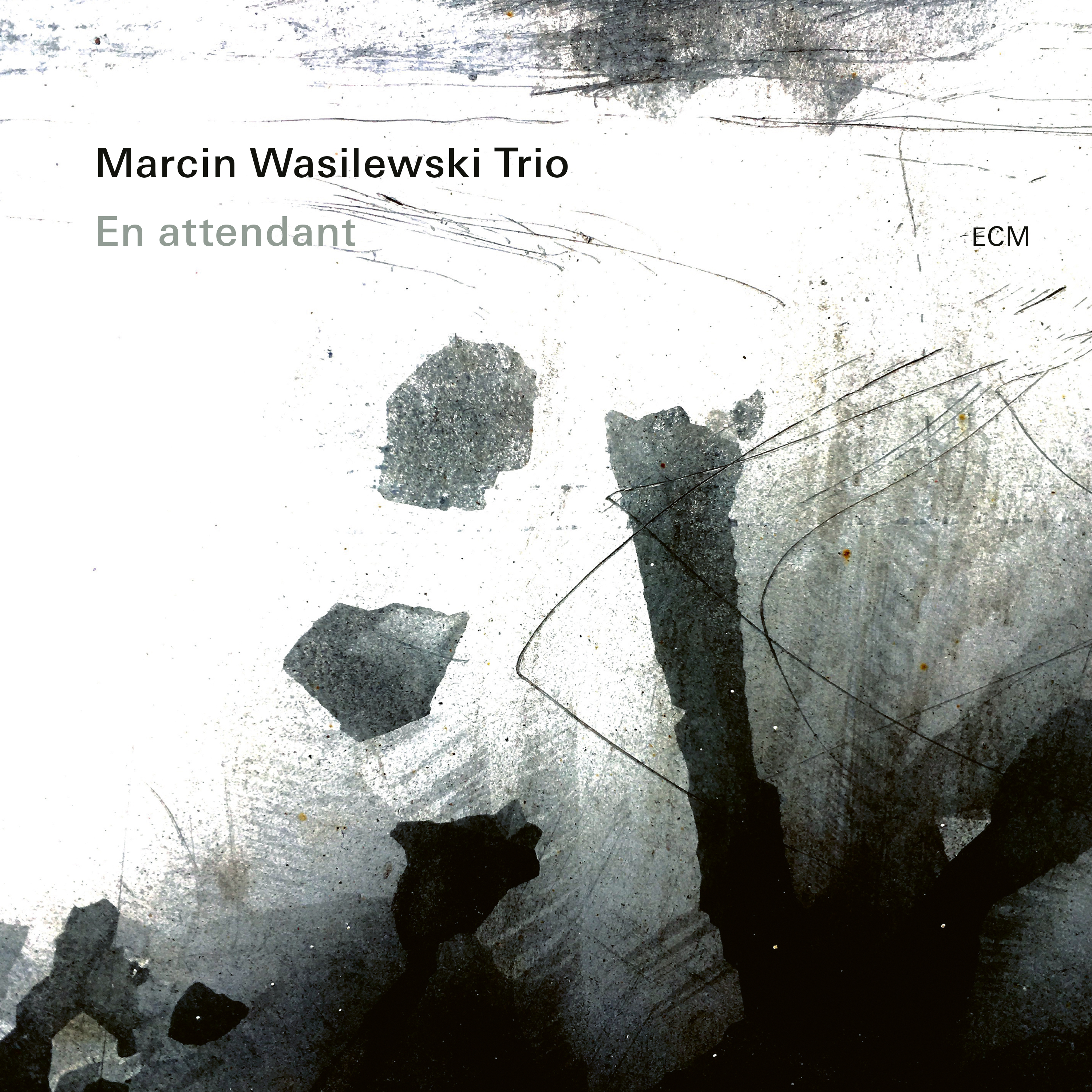
Marcin Wasilewski piano Slawomir Kurkiewicz double bass Michal Miskiewicz drums Recorded August 2019, Studio La Buissonne, Pernes-les-Fontaines Engineer: Gérard de Haro Mastering: Nicolas Baillard Cover photo: Max Franosch Produced by Manfred Eicher Release date: September 10, 2021
Although En attendant hit the airwaves after Arctic Riff, the Marcin Wasilewski Trio’s somewhat divisive collaboration with saxophonist Joe Lovano, it was recorded just before that earlier release. With brothers from another mother Slawomir Kurkiewicz on bass and Michal Miskiewicz on drums, the Polish pianist brings more than 25 years of deep listening into the studio for what might just be their most intuitive session to date. I make the latter claim if only because what we have been gifted here is more than a collection of memories in the making; it is a reflection of life’s supernaturally driven purpose to leave something of itself behind as a relic of its passing. Such instincts take their purest form, perhaps, in a subtle arrangement of J. S. Bach’s Goldberg Variation 25, the minor-keyed clothing of which reveals major-inflected whispers to be transcribed by the eager ear. That this melody reaches out to us centuries later is just as comforting as Carla Bley’s “Vashkar,” which, despite having decades under its wings, nevertheless spreads its blanket without so much as a bent corner. If jazz was ever to be organized as a novel, this tune would deserve a chapter all its own. As a touchpoint of the trio’s repertoire, it lends itself comfortably to this between-the-lines reading, inked by the quill of Kurkiewicz’s diaristic bassing.
Another calling card is the trio’s penchant for curating gems from the popular canon, and the present take on The Doors’ “Riders On The Storm” is no exception to this ethos. Like a coffee purist who sees latte art as a needless decoration, Wasilewski allows his bandmates to steep the grounds in which the tune’s familiar flavor originates. In anticipation of those dark clouds, Wasilewski’s “Glimmer Of Hope” shines as if it were the last utterance it ever wanted to offer. In this instance, we must submit the pages of our expectations to be erased, rewritten, and sealed by a lyricism so achingly precise that can only wander the train tracks of our collective vanishing point until it, too, ceases to be.
The album is tented by three freely improvised pieces entitled “In Motion.” From their searching vocabularies emerges an answer of sorts to an age-old debate: it was never about the chicken and the egg but about the inhalation and the exhalation. The cycle has always been infinite, and for the duration of a musical disc, we get cosmic blink’s worth of wisdom to revisit whenever we want. Such privilege does not go unrecognized for a single moment, either as performers or as listeners, and how fortunate that we can count ourselves among the living after its wonders have been revealed.
Anja Lechner violoncello François Couturier piano Recorded October 2019, Sendesaal Bremen Engineer: Christoph Franke Cover photo: Erieta Attali Produced by Manfred Eicher Release date: October 16, 2020
On Lontano, the cello of Anja Lechner and the piano of François Couturier play the roles of scenery and camera. As the lens bends the light into a discernible image yet changes that image in the process of fixing it within a frame, Couturier funnels Lechner’s sunbeams laden with stories that can only be heard with the eyes (and vice versa). If such a description seems too cerebral or even bogus, it’s only because the music it seeks to capture doesn’t accompany it. Even “capture” feels like an inappropriate word to interpret the relationships being explored by this symbiotic duo, especially when one considers that the music is half improvised and slips through the pores of any enclosure that surrounds it. Echoes reveal themselves to have been in the air they breathe all along, thus nullifying categorization as a political shadow that has no business casting itself here.
If the “Praeludium” tells us anything, it’s that awakening in this scenario can only take place when there is both sun and dew. Otherwise, the dawn might have nothing to kiss as it peers over the not-so-distant mountaintops. In so much of what follows, the inverted images in those pinhead orbs find themselves repeated in blissful aberration. Whether in the churning sediments of “Solar I” and “Solar II” or the flowering “Triptych” for two, there is a sense of agitation beneath the surface. The deepest point of these dialogues is mined in “Gratitude,” where Lechner skims the edges of notes as if to welcome melodic wanderers just long enough to feed and clothe them before sending them back into the wilderness, listless and without instruction until an ear catches them again—maybe tomorrow, maybe a millennium beyond.
That which is composed is carefully torn and folded from the pages of life itself. With each new crease, once-distant letters cohere into a new language. Among these homages, Anouar Brahem’s “Vague – E la nave va” inspires an astonishing piece of aural cinema, a tracking shot that shows us a wall and glimpses of the victims on the other side of it. The sensitivity of Henri Dutilleux’s “Prélude en berceuse,” too, reveals a pathway to revival, where awaits the closing door of the “Postludium.” Like the “Memory of a Melody,” which threads an excerpt from the Bach cantata aria “Wie zittern und wanken der Sünder Gedanken” (BWV 105) through the needle of the here and now, it reminds us that all melodies are memories.
Lontano is, above all, most wondrous for standing as a corrective to the phrase “effortless execution.” Tempting as this descriptor is, I find evidence of the untold hours of patient corporeal shaping and experience that feed every note. A flow like the one preserved here is made possible only by the sacrifices that dug its trenches.
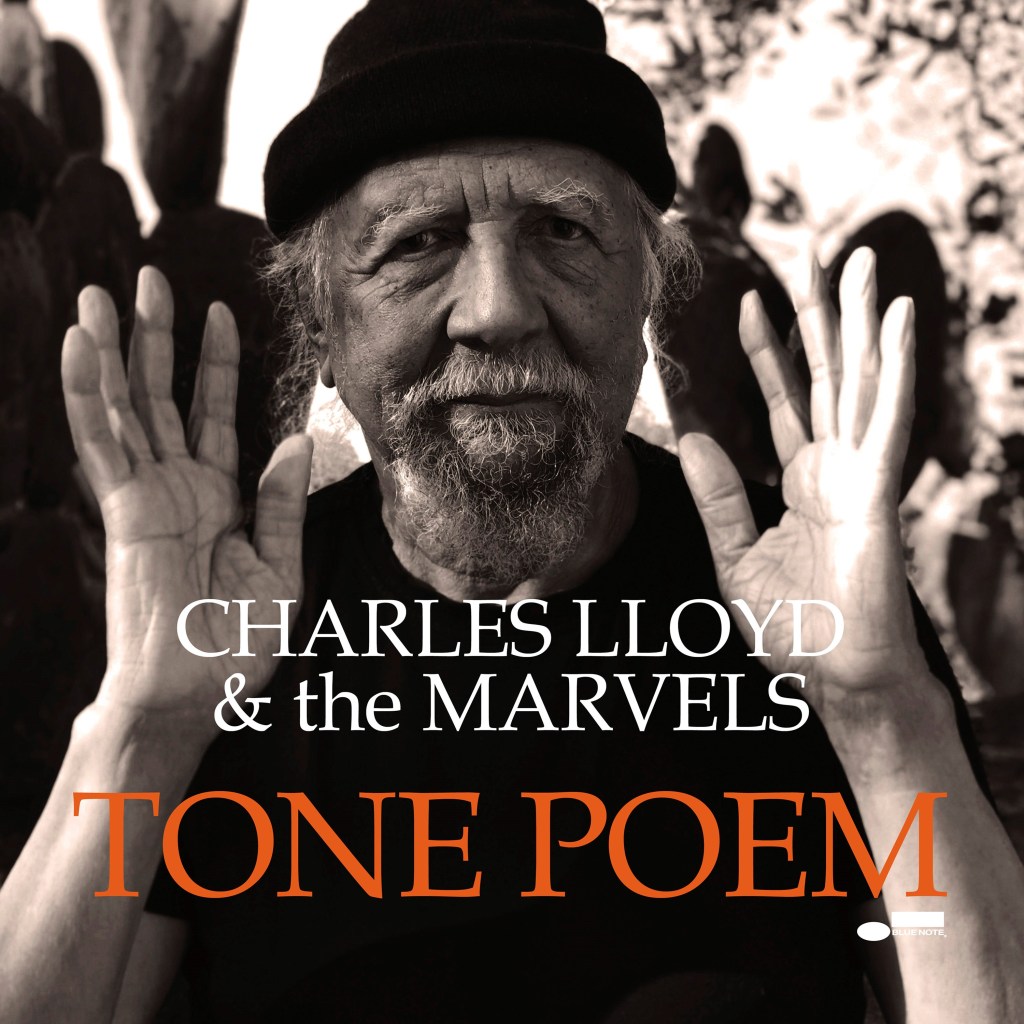
To regard a line of improvisation in the key of Charles Lloyd is to walk a spiral from the peaceful depths of one’s soul to the chaotic terrains beyond it. The tenor saxophone with which he is most commonly associated is a scepter that sounds, in his words, “a clarion call to truth and love.” A tender warrior committed to restoration, he sees no lines of demarcation in his music:
“That wouldn’t be right for the tradition I serve. You must have your elixir, and the elixir is in sound and tone. When you’re at the feet of the Universe, she will always bless and take care of us. It’s not politicians we need but sages. Many have their hand out for something, but I try to let my heart be filled so I want for nothing. I live in awe, drunk with the music.”
Hence the moniker of his latest collective The Marvels—featuring Bill Frisell on guitar, Greg Leisz on pedal steel guitar, Reuben Rogers on bass, and Eric Harland on drums—of whom Lloyd is at once leader and faithful servant, a vessel for languages without script. Lloyd debuted The Marvels on the 2016 album I Long To See You with special guests Norah Jones and Willie Nelson, and reconvened the band for 2018’s Vanished Gardens which featured Lucinda Williams on half the album. For his latest Blue Note release Tone Poem, Lloyd presents The Marvels without guest vocalists for the first time on a nourishing nine-course meal of spiritual food. Lloyd recalls the genesis of the group:
“I used to play at this club in Memphis, where a country band was always finishing up as we came in. Their pedal steel guitar player, Al Vescovo, fell in love with my playing, and I with his. He and I became friends, which wasn’t easy on account of the color lines. But the warmth of our friendship was pure. I eventually left for California, and we never saw each other again. Years later, I started performing with Bill Frisell—a seeker whose music, like mine, dances on many shores. On the road, between concerts, I was always reminiscing with him about this young musician from my teens. One night, he invited a pedal steel guitar player to sit in on a concert we played at UCLA’s Royce Hall. That turned out to be Greg Leisz. Hearing him brought full circle a childhood feeling of that instrument and its sonority. Thus, The Marvels were born, because what had happened was a marvel.”
Indeed, the fluid way in which Frisell and Leisz finish each other’s sentences speaks of a mastery that eschews boundaries in deference to flow. The same holds true of Lloyd’s rhythm section, which finds coherence in the absence of rules. If Harland is the heartbeat, Rogers fortifies the blood in its arteries. But how is that sound achieved?
“Don Was and the folks at Blue Note believe in me. The songs we create are my children. They come back home with me. There’s an old saying: What you’re looking for is looking for you. As the character of sound flows, the world drops away, allowing you to make a contribution. This is my offering, my inspiration and consolation. Music has always brought me that. It heals me; I hope I can heal others. Even in the wide cast of artists I’ve played with over this long life, I still have beginner’s mind. Only now, I have the benefit of experience to go along with it.”
If one were to see this album as a ship, then the album closer “Prayer” might be its dotted path across a map of time. Although the parchment on which it is marked is frayed at the edges, it has enough empty space left on it for voyages of reconciliation yet to come. The arco bass and pedal steel guitar herein constitute a longitude and latitude, while drums played by hand glow like a compass in the night. Lloyd and his crew sail forth on a raft culled from bits of nature, each ragged and sun-scorched on its own yet, in unity with others, stronger than the waves. In the midst of the vast waters of this quest stands a chain of islands that includes the album’s original title track, “Tone Poem,” which from rhythmless materials builds a gently grooving structure. Next, it swings from sonic rafters of Thelonious Monk (“Monk’s Mood”)—last heard in duo with Frisell on Vanished Gardens—and on to the shimmering beaches of Bola de Nieve (“Ay Amor”) and Gabor Szabo (“Lady Gabor”). The latter tune offers a taste of Eastern airs and harks to Lloyd’s legendary performance at Montreux in 1967. Out of the primordial soup of that past, it hits the ground running as a fully formed creature—scintillating and agile. Such is the wonder of Lloyd’s playing: he is a traveler weary of the world yet unwilling to let it pass without a song in which to wrap it. He understands the vision of life as having fallen like a teardrop from a cosmic eye in need of being wiped away. And with his horn, he does just that. This music is so comfortable that it feels like a second skin.
“When I think back on my life and how long I’ve been here. Most of my heroes left long before the age I’ve attained. I am always paying homage in a dream state of bringing a better world, a universe that heals and touches. The model of the world as it exists is very primitive to me. Man’s inhumanity to man continues to cause great pain and destruction. And yet, the fierceness of exploration stays fresh with me. I’m not here for roses. I’m still blessed and interested. The world continues to make history about generals…but my generals—Lester Young, Billie Holiday, Bird, and Trane—are lovers of the heart.”
This is especially apparent in two Ornette Coleman tunes (“Peace” and “Ramblin’”), neither of which were a part of Lloyd’s repertoire, yet which felt organically suited to the band. In both, the listener will find spirit-making sounds, all powered by the solar panel of Lloyd’s saxophone and released in melodic energy. The sense of forward motion here is phenomenally astute and something that, in these times of social distancing, crackles with a level of intimacy the pandemic has all but snuffed out.
“Some of the notes and cries you hear now on my instrument, I didn’t have as a young man. They articulate something. Then, I have these ensembles serving a higher goal. Sensitives are abundant on the planet; they just aren’t given credit for it. To be drunk while also being non-toxic and non-harmful to the world is a contribution worth making, a song worth singing.”
It’s also why poetry lingers even in the absence of words. In Leonard Cohen’s “Anthem,” it sings wordlessly and with a deep simplicity that needed to be explored in this context. And in the temperance of Lloyd’s own “Dismal Swamp,” it turns an individual truth into a universal one.
“I’m an archeologist and astronomer, trying to make a breakthrough. I have this dream that I’m going to melt into the music and I’ll become what it is. It’s such a beautiful gift that I’ve been given of being able to continue to explore. I pick up the instrument and I play and I can’t put it down. It takes me. I go out in nature and come home with these quantum mechanics in my heart.”
Music, because it is connecting to and opening up a spiritual purpose, brings about eternal effects, whereas everything we do in the flesh has a finite existence. But we’re so busy screaming at each other that we’ve forgotten how to sing. This is why Lloyd’s music has so much vitality: it is a gift in song form. It is a refuge.
“We speak the same heart. The heart of all hearts, we’re aligned with that. And the soul of all souls will bring us home. To be at Oneness. There are many windows into this house. You must be sincere and you must have a desire for truth, and somewhere you must have inspirations along the way, someone to guide you who knows the path. It’s incumbent upon all of us to sing that song of the infinite.”
A “dreamer of worlds” is how Lloyd describes himself. In that capacity, he offers inspiration and consolation to the named and unnamed alike. And now, with this sacred book, bound and stitched as an incantation of light, we can dream those worlds together as our own.
Tone Poem is available directly from Blue Note Records by clicking on the album cover below.
Joe Lovano tenor and soprano saxophones, tarogato, gongs Marilyn Crispell piano Carmen Castaldi drums Recorded November 2019 Auditorio Stelio Molo RSI, Lugano Engineer: Stefano Amerio Cover Photo: Caterina Di Perri Produced by Manfred Eicher Release date: January 29, 2021
Following in the footsteps of its 2019 self-titled debut, Trio Tapestry returns with an intensely meditative successor. Saxophonist Joe Lovano (playing tenor and soprano, as well as tarogato and gongs), pianist Marilyn Crispell, and drummer Carmen Castaldi take their atmospheric coherence to the next level with this set of eight Lovano originals. His lilting tenor in “Chapel Song” manifests spiritual possibilities from first breath. As piano and brushes render the sky at his back a canvas of lost hopes, keys and time signatures melt into an echo of their former meanings. This nexus of the two Cs functions as the album’s paper, across which Lovano keeps an honest diary in his flowing script.
The notes of “Night Creatures” speak with the power of a supernova, which through a satellite telescope appears peaceful and nebulous but in the moments of its birth was surely violent at the molecular level. Such are the dichotomies being sung, where something as unseeable as the transmission of a virus can bring the world to a virtual standstill. The title track is a melodic wonder, which Crispell cradles as a mother would the head of a newborn. Implications of life dance in “West of the Moon.” With all the understated charge of a Paul Motian tune (and by no force of comparison, given that Lovano played in the drummer’s trio with guitarist Bill Frisell for three decades), it finds contentment not in the fallback of a groove but in the ever-changing currents of air that a groove risks prematurely denying.
Lovano’s tenor enables a study in physical contrast. Between the delicate altissimo of “Sacred Chant” and guttural lows of “Dream on That,” he paints with a variety of liminal shades in the middle range. His soprano in “Zen Like” points to yet another register, speaking in haiku rather than tanka. Any quantifiable border between day and night, except for that delineated by the act of sleep, loses all importance. We are bid to listen with eyes open to the language of a distant solar system. With so much to discover on repeated listening, perhaps no other description could feel so apt as that which names track 5: “Treasured Moments.” Given its focus on the simple and the beautiful, we can take the album’s dedication to victims of COVID-19 as more than a reactionary statement but as a prayer within a prayer.
(A condensed version of this review originally appeared in the July 2021 issue of The New York City Jazz Record, a full PDF of which is available here.)
Despite, if not because of, the fact that David Virelles’ Transformación del Arcoiris was born in a time of social distancing, it feels close enough to smell the creativity in its breath. With a borderless aesthetic that pushes two hands outward for every foot planted inward, it treats the canvas of an album not as blank but as a living surface whose own imperfections must be articulated in the spirit of truth. As much an ambient sound collage as a musical object, it grinds expectation in the respective mortar and pestle of future and past until a mélange of the present reveals its fragrant spice. Playing a Roland Juno-6 synthesizer, piano and sampler and accompanied by Los Seres, a virtual percussion ensemble programmed by himself, Virelles begins the circle with “Cause and Effect,” in which the sounds of chickens activate a schism between history and its erasure. As in other tracks that follow, but especially the concluding “Fin del Cuento,” a found-sound aesthetic prevails. While there are moments of transcendence, including the sun-drenched blush of “Holy City,” there’s a sense that shadows are always lying in wait for the chance to sink their teeth into progress. It’s as if our pre-pandemic state was digital and the new normal was analog. Sensations of flesh and flora meet in “Babá la Paloma,” the tropical climate of which yields two distinct seasons. In the dry we encounter the goodness of “Tiempos” (made all the dreamier by guest Marcus Gilmore on MPC drumkit) while in the wet we inhale the spores of “De Cómo el Árbol Cantó y Bailó” as if they were life itself. Each of these requires the microscope of an ear and nowhere so magnified as in the cinematic wonder of “Babujal.” Here the piano feels like a relic in a sea of orchestral trembling. Virelles is always exploring, examining and analyzing genealogies that have lodged themselves within. This is music that does more than stand at a crossroads; rather, it ties those roads into a bow until their beginnings and endings are one and the same.
Transformación del Arcoiris is available on bandcamp.
(This review originally appeared in the November 2020 edition of The New York City Jazz Record, a full PDF of which is available here.)
Dominik Wania piano Recorded November 2019, Auditorio Stelio Molo RSI, Lugano Engineer: Stefano Amerio Cover: Fidel Sclavo Produced by Manfred Eicher Release date: September 18, 2020
After contributing so beautifully to two albums—Unloved and Three Crowns—as part of the Maciej Obara Quartet, pianist Dominik Wania offers this studio recording of solo improvisations. While Wania notes a range of influences drawing from his classical background, including Satie, Weber, Scriabin, Prokofiev, Ravel, and Messiaen, he seems to have taken cues from these composers as emotional rather than technical suggestions. In doing so, he unravels a trajectory that feels fresh yet familiar in the sense of reuniting with a friend one hasn’t seen in decades. Thus, the light step with which the title track opens seeks the future as if it were the past. As the atmosphere builds and more notes enter the scene, a narrative structure suggests itself. And yet, the characters seem not to know each other. They walk by without acknowledgement, meshing in their indifference.
“New Life Experience” is the first among a handful of expository wonders. If this and the sharper attack of “Relativity” feel more jarring, it’s only because they speak of a musician unafraid to examine himself. Each agitation unpacks itself with philosophical rigor. And if “Think Twice” and “AG76” are heard as darker autobiographies, then “Subjective Objectivity” and “Indifferent Attitude” reveal a playful side. The latter is especially virtuosic but uses its acumen to tell more than show.
To my ears, Wania understands that music is nothing if not a reifying force. Despite the ephemeral implications of “Melting Spirit” and “Liquid Fluid” in titles alone, their lyrical charge makes them fully present as entities in their own right. They guide us “Towards The Light” by reminding us of the fleshly struggles of which life itself is composed as we now search for something divine in a world bogged down by cloud of a pandemic. Opening our eyes to a brighter tomorrow, “All What Remains” suspends itself in prayer, the requiting of which will never materialize until we close our mouths and open our ears.
This music is a sentient river acknowledging the obstructions that define its winding trajectory. It would be nothing without impediment, each rock and fallen tree a challenge to redefine itself at every turn. This is precisely what Lonely Shadows can be at its freest moments—a continuity through the traumas we carry inside before the ocean of mortality swallows them whole.
Marthe Lea clarinet, voice, percussion Ayumi Tanaka piano Thomas Strønen drums, percussion Recorded August 2018, Stelio Molo RSI, Lugano Engineer: Lara Persia Cover photo: Caterina Di Perri Produced by Manfred Eicher Release date: April 9, 2021
From Thomas Strønen’s Time Is A Blind Guide emerges the drummer/bandleader alongside pianist Ayumi Tanaka, delineating a fresh triangle with clarinetist/vocalist/percussionist Marthe Lea. Though metaphysically grounded in free explorations of musical moments, Bayou has a rhizomatic quality that blends apparent influences ranging from Claude Debussy to Jimmy Giuffre. These genetic strands and more feel cohesive in their new body, intertwining in search of (and in fleeting possession of) wonder.
After immersing myself in this album’s details, I arranged a video chat with Strønen to explore its genesis and inner lives. I first asked him about the relationship between this trio and Time Is A Blind Guide. His response:
“It’s everything and nothing, in a way. I think the similarities are quite obvious in that I like working on space and all the things that are not said. But this trio is totally improvised, while Time Is A Blind Guide is my play garden. I see my role in it more as a composer than as a drummer. I know where the music is heading. The main idea of the trio was to explore ground rather than perform, without the pressure to be or turn into anything. By accident, we got asked to play somewhere. I recorded that concert on one microphone and played it for Manfred. He said it sounded very fresh and insisted that we bring it to the studio. We recorded for three hours in the morning. We had lunch, then started mixing. It was very relaxed. It was also the first time I recorded totally improvised for ECM and we were excited to see whether we could bring about the same interplay we had experienced during rehearsals.”
Having two different versions of the title track speaks to this multifaceted approach, through which one face reveals new features when illuminated differently. Yielding a Norwegian folk tune, it parallels the whisper of Strønen’s brushes with the raindrops of piano, bringing forth a touchless space in which breath becomes the language of primary communication. The song emerges on its own wings but hovers within sight like a hummingbird in dream-like slow motion—watching, waiting, and listening.
Strønen parallels this impression:
“Music is integral to their lives. I think you can hear that in the way they play. It’s not just skills or training but an extremely strong will to create an atmosphere and interplay that’s larger than all of us. We’re different musicians but we have the same attitude toward playing music, despite our distinct roles in a band. Ayumi and I are more delicate, but we never know what Marthe will pull out next. For example, this record was the first time she sung in the context of this trio. She is a free bird who stirs things up and makes them alive.”
“Pasha” skims wider waters, alighting at last on shore. The surface tension of the pond becomes the page for a delicate grammar, the arrangement of which etches its poetry where ink cannot remain. “Water was always with us,” says Strønen, who knew the trio and its music would be aquatic in nature. Beyond that, however, nothing was planned.
Lea’s clarinet in “Duryea” lends insight into the inner workings of flight as it navigates the tangle of forest brush it calls home. To that daylit scene “Nahla” and “Varsha” are the night—a tender submersion of cellular mapmaking for the impending dawn. The creaking of tired trees bracing themselves for winter melds with subtle changes in temperature and air current.
One aspect that makes this music so special is its lack of allegiance to dialogue. It renders different parts of a shared scene while finding sameness through difference. It has no other protagonist than the landscape itself, replete with waterways, pockets of lichen, and lives of its own. Such are the winding journeys of “Eyre” and the amphibious diary that is “Dwyn.” In these are whispers of distant climates as yet untouched by the trio’s collective dreaming. Strønen elaborates on the inner dynamics at play:
“What I like in this ensemble is that we are not necessarily talking to each other but always listening. Parallel musical ideas are going on at the same time with really big ears from all three of us. It’s a challenging way of communicating—trusting that what you do is essential to what the others do but not in a conventional way. The essence is still there whether I am present or not. Jazz is usually about leading to a special point; we are not searching for that. Ours is a more parallel way of communicating.”
Nowhere more so than in “Como” (an album highlight for its suspended qualities and understated glory), which coaxes the sun from its slumber before it dissipates the mist of “Chantara.” This is, perhaps, why Lea hums wordlessly, as no form of human meaning can capture that which refuses to be caged by semantics.
“It’s common for a record to define a band. This has the side effect of getting onto a one-way street. I can find myself wanting to recreate what we did on a record, but listening later I am happy to find out it didn’t. You play what you are.”
A profound reminder that we listen what we are as well. The bayou is a mirror and we are its reflection.
Sinikka Langeland kantele, vocal Recorded December 2019 at Rainbow Studio, Oslo Recording supervision: Sean Lewis Engineer: Martin Abrahamsen Cover photo: Christian Houge Executive producer: Manfred Eicher Release date: April 9, 2021
My eye and God’s eye is one eye, and one sight, and one knowledge, and one love. –Meister Eckhart
After a loosely bound series of five tablets, the most recent being 2015’s The Magical Forest, Sinikka Langeland chisels an authorial portrait of the highest order with her first solo album. With so many multicolored scenes in collaborative form behind her, the Norwegian singer and kantele storyteller offers this monochromatic wonder as an ode to becoming and dissolution.
For the opening “Moose Rune,” she attunes the acoustic signatures of Rainbow Studio through her 15-string kantele, playing it with a bow to bring every molecule into sacred order. So begins an extended prayer of which the 39-string sister instrument breathes like an elder of time perched on a stony crag to oversee the histories Langeland has been blessed to carry. Playing the traditional “Polsdance from Finnskogen,” she expands the sonority at hand with liquidity to spare. Such instrumentals carry themselves with a fleshly quality, leaving footprints in every patch of earth they traverse.
Two “Kantele Prayers” give solace. Played on a 5-string instrument, they are like a child cultivating a mature soul, waiting for the day when, as an adult, she can do the opposite. Thus do the strings resonate in “Winter Rune” with all the force of a life lived circularly—tender yet aware of the rigid climbs one must complete to survey paths of learning. Past traumas blush on the horizon, but the voice gives assurance that not a single drop of their storms will make itself known upon the skin of the here and now. And when Langeland’s bow opens its heart for the second time, she creates a portal of escape for anyone who wishes to follow.
While her heart pumps with the blood of tradition, as in the modest folk tune “The Girl In The Headlands” and the hymnal “I See Your Light,” it also chambers a deeply generative spirit. From the latter is birthed a handful of original melodies. Langeland composes with an ancient sensibility and gives a wealth of experience to every turn of phrase. In “Row My Ocean,” her setting of a text by poet and playwright Jon Fosse, she evokes the movement of oars more emotional than physical, extending every string as a current in its own right, while “The Eye Of The Blue Whale” curls its fingers around her own verses, describing a disembodied whale’s eye as a metaphor for songs that, once sung, belong only to themselves. Such observations take wing in “When I Was The Forest.” Every gesture encoded in these words after 13th-century philosopher Meister Eckhart contains sparkle and shadow in equal measure. At tip of finger and rim of lip, Langeland enacts wandering, supplication, and regard for the natural world in ways that blur the lines between flesh and fern.
The starlit melody of “Don’t Come To Me With The Entire Truth” practices what it espouses: a humbling exaltation of the drop before the ocean, content in knowing just enough to make every breath count. All that’s left to regard is the title track, a rendering of an old rune song in which the Trinity is loosed like a pack of light to roam the darkness of this world, devouring every demon in sight. The stepwise motions of the kantele here are beyond virtuosic: they are fully integrated into their environment.
This is the soul of the forest made clean, a hearth in which to hibernate until the clouds pass over us in search of dawn.










 Between Sound and Space: ECM Records and Beyond