My latest review for RootsWorld online magazine is of Mahsa Vahdat’s The sun will rise, a Norwegian coproduction that follows the Iranian singer unaccompanied in various locations around the world. A moving album about the power of song. Click the cover to read on and hear samples.
My latest review for RootsWorld online magazine is of Russian-born singer Zulya’s concept album, On Love and Science. Click the cover to read more and hear samples.
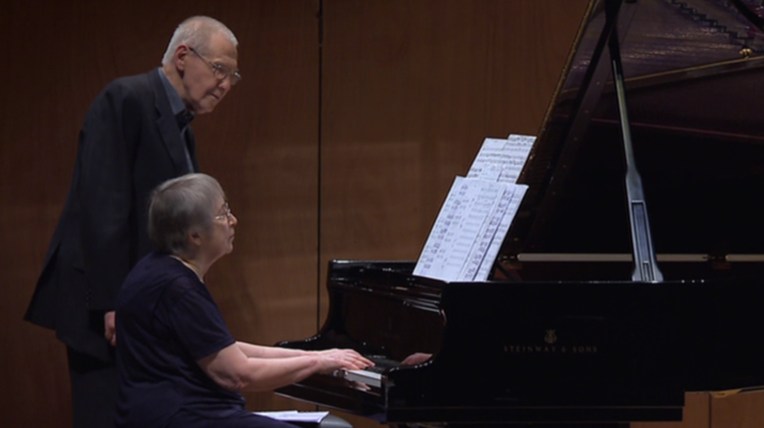
Márta and György Kurtág
In memoriam Haydée
Játékok – Games and Transcriptions for piano solo and four hands
Piano Recital
Cité de la musique, Paris
22 September 2012
Márta and György Kurtág piano
Filmed September 22, 2012 at Cité de la musique, Paris
Directed by Isabelle Foulard
An LGM Télévision production in association with Cité de la musique
Producer: Sabrina Iwanski
Executive producer: Pierre-Martin Juban
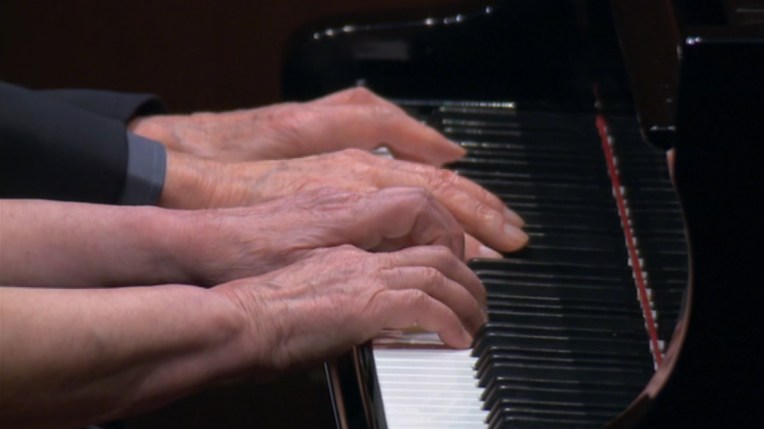
In September of 2012, Hungarian composer György Kurtág and his wife Márta gave a concert at Cité de la musique in Paris to honor the memory of a dear friend, musicologist Haydée Charbagi (1979-2008). Their program, as adventurous as it was delightful, combined piano transcriptions for two and four hands, exuding such intimacy that it’s a wonder the audience didn’t just melt away from all the love in the hall. For those not present, this DVD bears witness to the Kurtágs’ unbridled passion for each other and the music that passes between them. The program’s bulk is culled from György’s own Játékok (Games), an ever-growing miscellany of dedications to the living and dead alike. It’s also a tribute to classical roots on the whole, as indicated by the composer’s transcriptions of Bach chorales—each a towering trunk among his otherwise microscopic foliage.
There’s something dark yet wondrous about the first dissonances that creep from the stage. Saying hello with a farewell, György approaches the score as if it were a poem (such philosophies were, in fact, the subject of Charbagi’s thesis). And perhaps nothing so omnipresent as poetry could express either the compactness or vigor of each brushstroke. As observer, Márta stands like an appreciative statue before joining him at the keyboard. At times, she caresses him on the shoulder after he finishes a solo, an unspoken signal to connect the dots.
Those very points of light sparkle in pieces like Flowers we are…, which in conjunction with the pantheonic Baroque selections enables a poignant contradiction: namely, that Bach’s music eminently looks forward while György looks backward, leaving us in the middle like the binding of an open book. His own responsory is as much a reflection of the one to whom it is dedicated (Joannis Pilinszky) as the composer who vaulted the form.
With most at or under a minute, these concert selections are rife with inflection. There are moments of staggering beauty, especially in the Hommages, such as the Hommage à Christian Wolff, with its tip-toed notecraft, the resonant Hommage à Stravinsky – Bells, and the Hommage à Farkas Ferenc in its multiple incarnations, each more nuanced than the last and ideally suited to the composer’s greatest interpreter, Márta.
Campanule, as with so much of what transpires, expresses the pregnancy of emptiness, and the potential for healing amid broken motifs. This would seem to be the underlying message also of playful asides such as the fierce exchange of single notes that is Beatings – Quarelling and the kindred Furious Chorale. Another elliptical piece, Study to Pilinszky’s “Hölderlin,” gives musical interpretation of a poem written for Mr. Kurtág and reinforces the concert’s overarching theme, while the dramatic (Palmstroke) and the programmatic (Stubbunny and Tumble-bunny) trip over one another in search of continuity.
Director Isabelle Soulard focuses on these passages in close-cropped framings, allowing the tender lattice of Aus der Ferne, written for the 80th birthday of Alfred Schlee, and the confectionary first movement of Bach’s E-flat major Trio Sonata (BWV 525) to shine all the brighter among this crowd of lamentations. For if anything, György’s art is about remembrance—a point driven home by the three encores, all of which reiterate pieces featured in the main program: the Hommage à Stravinsky and two of the Bach arrangements. Were it not for programs and obsessive musical minds, we might not even notice the repetition, as life consists of nothing but.
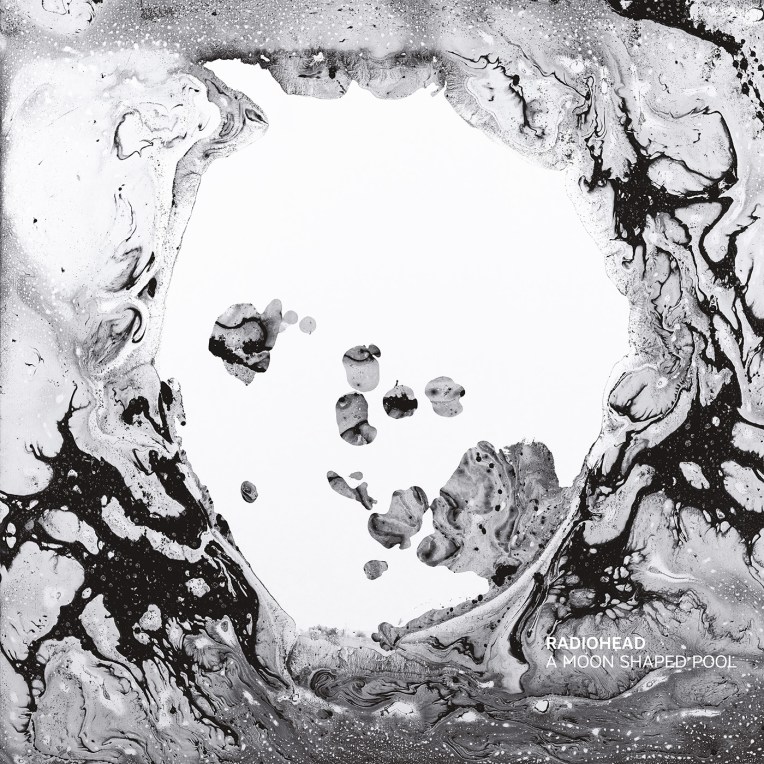
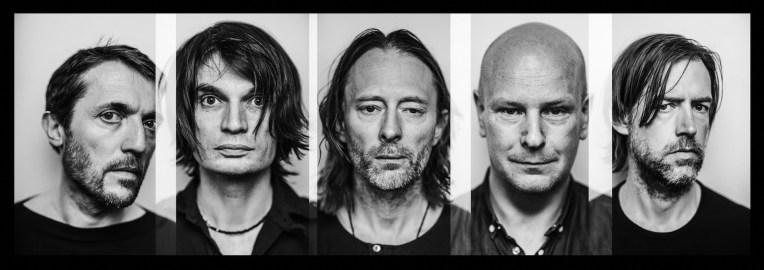
To experience A Moon Shaped Pool, the ninth studio effort from Radiohead, is to find treasure in a garbage can. It’s a beautiful rarity in an ugly world that appears when you least expect it. The album’s title alone indicates the contradictory forces swirling within its 53 minutes. Listeners cannot imagine such a pool because, from a terrestrial POV, the moon has no definite shape. It appears differently to us night by night, and even at its fullest shows no more than half of itself. Still, these musicians are up to the task of degaussing their waters in accordance with the phases, cupping hands to receive the wisdoms dripping from Thom Yorke’s mouth. Said pool is as amorphous as his singing, which ranges from waxing clarity to waning enunciation—not one in which to dive headfirst, but to ease into as a hot spring.
If the staccato pulse of “Burn The Witch” tells us anything about what we’re getting ourselves into, it’s that the Radiohead soundscape consists of consistencies. Where songs like this one stay crunchy even in milk, others were born to flop around, boneless and insecure. The witch hunt, for its part, is a red cross of medium and message. The tactility of guitarist Jonny Greenwood’s arrangement ensures that things remain three-dimensional from start to finish. The feel of keratin on woven gut and metal turns this musical inquisition into a flashing light in the neighboring village that never goes away. You stare and wonder into whose hands the mirror cuts, but no change of angle gets you any closer to discerning a face. The slackness of Yorke’s delivery belongs to the furniture of everyday life, where not every contour need be known in order to enjoy its function. The dust gathering beneath it is the ash of a dead messenger swept into anonymity by the broom of overlord politics. The fireplace roars, spottily as in the song’s video, trailing messages in the darkening sky, each a comet falling upward into extinction.
When Yorke paints the scene as “a low flying panic attack,” he hints not at faith but a watchful eye buried up to its pupil in denials of equality. The echoing chorus is a thing of such attraction that the flames begin to feel like your safest haven from oppression.
Electronic reverie and rounded pianism introduce the warmth of execution that butters “Daydreaming.” Yorke extends his body toward the blurry pessimisms of being fed upon and tasted. Boards of Canada-esque distortions yearn for a childhood in which the allergies of springtime actually meant something because they confirmed the platitude of staying indoors. Backward voices and strings snore like beasts grabbing handfuls of their own skin amid nightmares of wasting away.
The accompanying video is a revelation for revealing nothing. Its forced temporal adjacencies of spatially disconnected places leave much to be desired, for desire is its only valid emotion. In such context, dreamers can only be enablers, and at their center Yorke folds as the line “Half of my life” plays backward in the final laydown, very much aware that all of this is greater than the sum of our admirations.
And in your life, there comes a darkness There’s a spacecraft blocking out the sky
These opening lines of “Decks Dark” reveal a technological anxiety, half-quelled. Atmospheric blotting is a prediction of sunset, a faro-shuffled existence painstakingly restored to new deck order. Yes: decks not only of ships, but also of pasteboards—hearts and diamonds printed in the blood of expectation; spades and clubs in ashes of war.
The song further emphasizes a lingual idiosyncrasy, by which Yorke’s esses emerge as barest alveolar contacts. And it is a song about language:
Your face in the glass, in the glass It was just a laugh, just a laugh It’s whatever you say it is Split infinitive
The presence of choir, however, reduces potential roars to whispers.
All of which explains the acoustic matrix of “Desert Island Disk.” Obsessions with interface magnify the necessity of human language, and so the band must unplug them for hope of capturing them. This dust bowl is shaped in the studio, in post-production, in the very circuitry of the air. It is an affirmation of repetition as the locus classicus of psychological attachments. The feeling of ritual is out of sight, but blasts its Morse code across the windowpanes of the ears.
Waking, waking up from shutdown From a thousand years of sleep
So pining, Yorke succeeds in delivering a murder ballad where no one gets killed.
A wall stands between you and the destination you seek. It is “Ful Stop.” Peruse all you want for the missing el, but it will always tap you on the shoulder before disappearing. The laser blaster of ambiguity fires a few test rounds in order to gauge the thickness of communication, so that when Yorke exhales he knows exactly how to absorb the fumes on the uptake. He gives it to us straight (“Truth will mess you up”), compressing a coal of the stomach until it is a diamond of the mind.
Like the indefinable moon, “Glass Eyes” concerns artificial organs through which not even light may pass. A skipping beat and arcade progression give this song uplift, so that by the end Yorke has split into multiple voices. His falsetto is a bird on a wire, riding the shared border of floating and falling. “I feel this love turn cold,” he laments, never wanting to close his eyes until he is sure that others are gone from view.
Hence the return of panic, by now a leitmotif, in the self-pleasuring “Identikit,” which names a forensic tool used to draw composite portraits of criminals from a bank of predetermined features. It is connective tissue between fault and compliance. And as Yorke intones, “Broken hearts make it rain,” we think of monetary downpours imparting false images of who we are.
(Photo credit: Alex Lake)
The shared continuums of life are those we most abhor: our ability to slaughter, our want for personal gain, and our need to be remembered. Such are the conditions of a fashionable life, also running themes of “The Numbers.” A Jacob’s ladder of strings and strums captures the essence of adolescence in this prickly pear, shaken from its branch by daughters of ruin destined to become mothers of rebuilding, and by whose laughter the gas masks of subjugation will one day be fogged beyond use.
We call upon the people People have this power The numbers don’t decide
That this song was once known as “Silent Spring” is no surprise. Its well runs deep and its waters are thick with unuttered promises. And if we walk away from it thinking the system to be a lie, then we have fallen victim to that very thing. Such reminders of our constitutions are vital to holding this album in.
Like the Amnesiac sharpening that is “Knives Out,” “Present Tense” sings from a higher plane. Warped yet utterly literate, this bossa for supernovas thatches protection around the here and now, as if the very term were an abomination to evidences airbrushed between pulpits and podiums. The scrape of fingers on guitar strings is like the licking of a lion’s tongue across our collective backside: it grooms the hairs in perfect correlation but callouses the skin in the process. “It’s like a weapon” says Yorke of distance, which inters its social messages in fears of disability.
An electronica-oriented spin of the wheel lands on “Tinker Tailor Soldier Sailor Rich Man Poor Man Beggar Man Thief,” where at last the internal vocation of thought is given an external wage. You hope for balance between animal behaviors, only to find predatory favor in an indigenism gone awry.
All the holes at once are coming alive, set free Out of sight and out of mind, lonely And they pray
Or is it “prey”? For will not all teeth know the stain of blood eventually? If resonance equals proximity, then Radiohead is an abandoned cathedral. And in its reliquary: “True Love Waits,” a macramé of pianos drifting into summer. The lyrics are a skeleton rocked in a glass case until it spins flesh and begins to cry. Yet the love Yorke professes exists in a haunted attic, where he opens a box containing the final words, “Don’t leave.” But leave we must if we are ever to approach this music again, holding a suicide note written in a temporal hand.
The alphabetized song list represents the arbitrariness of order and the systematic breakdown of communication into its consensus parts. More than a critique, it is a critique of critique, a hammer taken to one’s own reflection in honor of the fragment. The interruption of time by space, then, is far more traumatic than the reverse, for at least in the former’s violence one can be sure of having lived. Otherwise, the meanings of all works and adorations grow sour. Day jobs turn into night sweats, and dreams take on a visceral truth. Darkness is common to both, exclusive to its self-imagining, and holds your hand down the mountain path. At its end: a match. And you are the kindling.
My latest review for All About Jazz should be of special interest to ECM fans. The compilation Magic Peterson Sunshine chronicles the history of the German MPS label, a vitally important predecessor to ECM Records on which many familiar artists (including John Taylor, Eberhard Weber, and John Surman) made key appearances. This album is a vital cross-section of music history and belongs on the shelf of anyone who cares about the history of jazz in Europe and beyond. Click the cover to read on!
My latest review for RootsWorld online magazine is of Finnish accordion virtuoso Kimmo Pohjonen’s Sensitive Skin. Featuring an all-star cast that includes the Kronos Quartet, this is about as adventurous as the bellows get. Click the cover to discover!
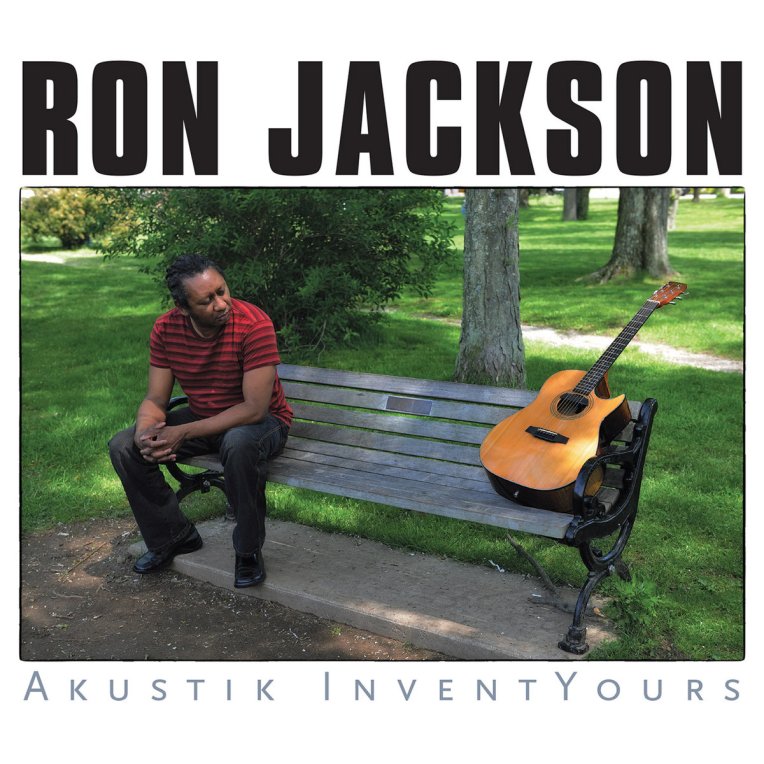
My latest review for All About Jazz is of New York-based guitarist Ron Jackson’s first solo album, Akustik InventYours. Fans of Ralph Towner may enjoy these evocative tunes. Click the cover to read on:
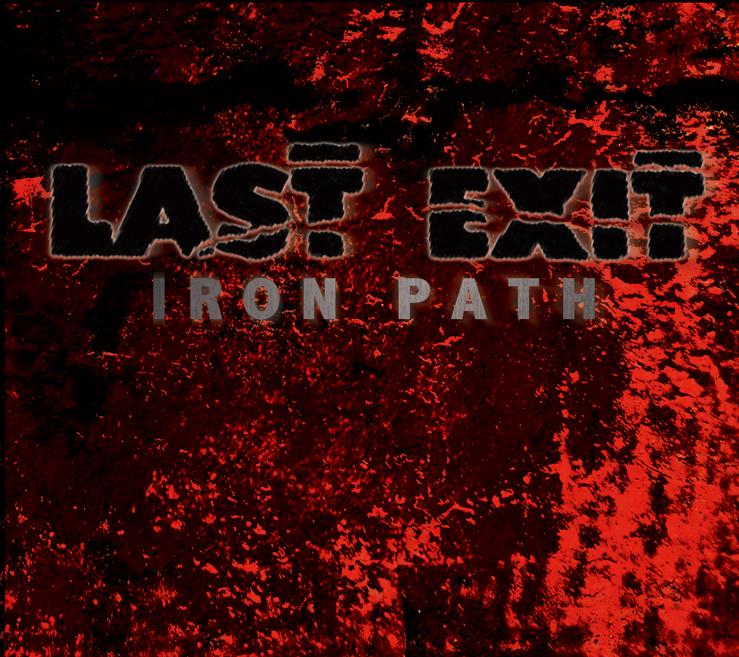
League-of-his-own guitarist Sonny Sharrock. Subterranean saxophonist Peter Brötzmann. Atmospheric bassist Bill Laswell. Former Albert Ayler drummer Ronald Shannon Jackson. Alone, each is a power tower of musical ideation. Together, they blind the sun. In 1988, these free-jazz atoms bonded to unleash their only studio molecule. Now remastered for the 21st century, it bleeds redder than ever.
Like Everyman Band before them or Krakatau after, Last Exit pummels through walls of expectation as if they were made of feathers. From these they fashion a giant pair of wings across 10 spines of reality. As Steve Lake so reverently describes in his liner notes: “There’s no false modesty in Last Exit, no false anything. The group is important precisely because its rush of sound is a heartfelt force. It sweeps away all the fakery that proliferates on both sides of the highbrow/lowbrow cultural divide.” None of that flavor has dulled these last three decades, and if anything has grown more piquant with age.
The most obvious politic at play on the scale of Iron Path is its balancing of opposites. “Prayer” feels like anything but as a growling bass eats into the foreground, one pathos-ridden chew at a time. But as the terminal illness of its build reaches a plateau, bells of immolation toll for those with water. Guitar and drums power through resistance like berserker prospectors panning for untranslated scriptures. And these they find in the proffered wisdom of Brötzmann’s horn, which by virtue of prophecy spews all of its treasures for the taking. So does “Marked For Death” reveal its hidden meanings with patience. Brötzmann’s soloing exemplifies the restraint required to unleash such morbid finality. In “Eye For An Eye,” too, Laswell blows smoke through gritted teeth: a mountain pushed through a chain-link fence, to the call of an interspace chant.
Some tracks are purposefully grounded in the everyday. “The Black Bat,” for instance, bears dedication to Japanese producer Aki Ikuta, who tragically died at the age of 33 as the result of a car accident the year this album was recorded. His restless spirit echoes throughout this piece, in which colors swirl into mournful timbre. Other passages are more obscure and require further peeling of the ears to appreciate. The title track, with its eastern infusions, whispers of simulacra slashed across time, while “Devil’s Rain” finds Sharrock rocking the cinematic edge as Brötzmann lobs the heart of a volcano into the exosphere.
“The Fire Drum” is one of two blatantly descriptive turns, boasting comet streaks of brilliance from the guitarist and reedman. “Sand Dancer,” on the other hand, is Laswell’s electric phoenix all the way. And if these seem too grounded in their spaces, one needn’t worry, as both “Detonator” and “Cut And Run” hybridize aggressive haunts with tidal preaching, until only one piece of advice remains: Structural failures are the birth of monumental impulse.
(For more information, and to hear samples, click here.)
The first studio duet of drummer Milford Graves and bassist Bill Laswell, both yielding warriors of their respective dark arts, is a selfless proclamation. Residing in their speech is the yin for the other’s yang, a drop of sun for moon.
In approaching this vessel, one does better to go below decks from the first sounding, interpreting this axis from its crux outward. And toward the end, we have that very intersection in the form of “Autopossession.” More than a title, it is a mission statement by which the body is rendered inert through spiritual process. Being a solo from Graves, it melts surrounding ice, stopping just before it reaches steam. Thought and action likewise turn into liquid. But the drummer’s is more than a beat-driven consciousness, for here the specter of regularity serves only as the reminder of a talismanic past. If the head nods at all, it is because the mind has left it behind.
Regressing a level of reality gives us “Eternal Signs,” one of four collaborative improvisations that include “Another Space” and “Another Time.” Each is a ring linked to the others in a multidirectional chain of being. Drums and bass serve as equal partners, connected by lightyears of shared experience. The energy seems violent in origin, even as it breeds nothing but harmony. A pliant strum or forceful tap: either closes the gate as easily as opening it, sealing terror exhaust from the inevitability of inhalation. The more such improvising develops, the more macroscopic it becomes, crumbling outward in an explosion of planetary dimensions. It is the repression of history, demystified in music.
Yet the most willful approach reverberates throughout the dedicatory “Sonny Sharrock,” which like its namesake unwinds the familiar into unexpected filament. Laswell applies an echo effect, allowing it to float above the ionosphere of influence over which his instrument’s dreams wander. Amid gamelan-like touches from Graves, he adds flame upon gnashing flame, so that oxygen expends itself at shaman’s touch. There is a shape to that fire, one that flits between human and animal with the unpredictability of an autumn leaf’s path. Percussive chemicals seep into those four heavy strings, while the drums eject prophecy from the pilot’s seat in favor of crash landings, leaving Laswell’s branch-bending scriptures to flutter alone in the final breeze.
There is no mystery, other than the space to which the album’s title refers. It would seem to be our own by virtue of our listening, organ-less and multiple, a mirror fogged by the breaths of gods too far away to see yet too close not to sense in the shifting of tress at night just before sleep shades your retinas. But on closer inspection the reflection is that of a star child breastfed on shadow, now spitting words of light for our foraging. It returns the gaze and whispers: Wings were not invented for flight, but flight for wings.









 Between Sound and Space: ECM Records and Beyond