Helmut Lachenmann: Das Mädchen mit den Schwefelhölzern (ECM New Series 1858/59)

The Little Match Girl

Helmut Lachenmann
Das Mädchen mit den Schwefelhölzern

Eiko Morikawa Sopran
Nicole Tibbels Sopran
Helmut Lachenmann Sprecher (“Zwei Gefühle”)
Mayumi Miyata shō
Yukiko Sugawara Klavier
Tomoko Hemmi Klavier
Experimentalstudio der Heinrich-Strobel-Stiftung des SWR Elektronische Realisation
André Richard Klangregie
SWR Vokalensemble Stuttgart
SWR Sinfonieorchester Baden-Baden und Freiburg
Matthias Hermann Musikalische Einstudierung
Sylvain Cambreling Leitung
Recorded July 2003 in Freiburg, Germany

Angst is the necessary form of the curse laid in the universal coldness upon those who suffer of it.
–Theodor W. Adorno, Negative Dialectics

Helmut Lachenmann’s Das Mädchen mit den Schwefelhölzern (The Little Match Girl) is a beguiling, albeit loosely contextualized, redaction of Hans Christian Anderson’s fairytale of the same name. The girl in question pedals matches on New Year’s Eve before seeking shelter from the cold. She lights one match after another to keep from freezing, fearing her father’s wrath for not having sold any. With every conflagration, she is visited by visions of warmth, sustenance, and love—the last things she ever sees before the climate takes her life. Lachenmann augments this frigid morality tale with other textual sources: Leonardo da Vinci’s The Desire for Knowledge, in which the artist stands before a volcanic chasm, and the writings of Gudrun Ensslin, Red Army Faction reactionary, and acquaintance of Lachenmann’s, who marked her life with fiery eruptions of her own. Each of these figures, marginally marked by forces beyond their control, cowers in its respective hovel, succumbing to the darkest edges of already shadowed words.

What we have in the present recording is the opera’s “Tokyo version,” which, according to the composer, is definitive. Lachenmann’s self-styled “music with images” is beyond meticulous. Its first part is overwhelming and impenetrable, lost in gusts of scrapings, percussive half-statements, and voices doomed to inhabit the borders of incoherence. A dust storm of pops, whistles, skips, whispers, yawns, sighs, shouts, grunts, flutters, clucks and clicks, open-mouthed slaps, and general aphasia shares a lung with an extra-sensory instrumental constituent. Unrealized dreams are its blood, unformed words and broken promises its skin. Speech curls into itself, like a radio dial constantly tuned from one station to the next, an effect only heightened by the presence of electronics. Every sound disguises indecisiveness as ardent exploration, even while achieving that very thing, inhabiting the mouths and heads of its characters, such that human voices and instrumental utterances become so closely allied that often one is hard-pressed to distinguish between the two (and, in fact, feels no need to do so). The drama comes to a head in “Die Jagd” (The Hunt), leading at last to fully articulated speech in “Auf Allen Fenstern” (On Every Window), before a monumental closure. The second part wavers like a flame caressed by frosty winds, hiccups, and choked sentiments. “In Einem Winkel” (At An Angle) provides some startlingly beautiful moments, of a piece with the alchemical precision of Stockhausen and Ligeti at their most meditative. “Zwei Gefühle” (Two Sentiments) gives us the longest stretch of speech, culminating in a prickly crescendo. The opera finishes with a long drone laced with sine waves and counted in time by the rapping of death at our door. Its barely articulated fade is an epilogue to end all epilogues.

One might feel compelled to criticize Das Mädchen as a nervous wreck unsuitable for any self-respecting listener, but the consistency with which it cracks itself open, like a suicidal egg, is so visceral that any negative reactions fall with it to their doom. It transcends the utterance at every turn, dissecting “taboo” into its meaningless phonemes. Like a workout after years of inactivity, it exercises muscles we never even knew we had. Having never seen the opera live, and with only the booklet’s cryptic black-and-whites to go on, I cannot speak with any surety for its potential production value. Suffice it to say that I will be in the front row should the opportunity ever present itself.

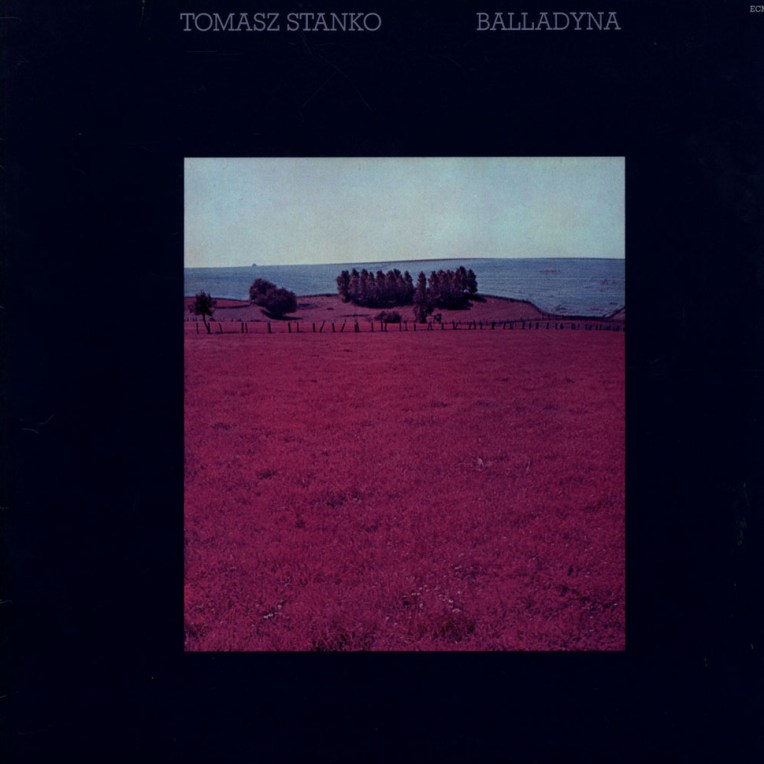
Tomasz Stanko: Balladyna (ECM 1071)

Balladyna

Tomasz Stanko
Balladyna

Tomasz Stanko trumpet
Tomasz Szukalski tenor and soprano saxophones
Dave Holland bass
Edward Vesala drums
Recorded December 1975, Tonstudio Bauer, Ludwigsburg
Engineer: Martin Wieland
Produced by Manfred Eicher

I can only imagine the reactions Tomasz Stanko garnered with Balladyna, his first recording for ECM. The no-holds-barred “First Song” jumps into action with that hard swing that can only come from Dave Holland. Add to this brew the wide-ranging percussion of Edward Vesala and the spicy solos of our frontman and Tomsaz Szukalski, and you have a jambalaya to savor and remember. After such a climactic opener, Stanko could play “Happy Birthday” for all I care. Thankfully (though who knows what this quartet might have done with such ubiquity?) we a get the Ornette Coleman-infused “Tale” that faithfully charts a key transition from raw to cooked jazz. One can feel the rapt attention with which each musician listens to the other.

Original Balladyna
Original cover

This live, interactive energy continues in “Num,” sustained by knitted cymbal work as the two Tomaszes go head to ecstatic head. A killer bass solo makes the cut complete. A lumbering Holland/Stanko interlude opens the door on the title number, anteing up in tutti before spreading its hand into a straight improvisatory flush. Stanko screeches above a pointillist rhythm section, Szukalski stepping into the footprints he leaves behind. A doleful, mocking tone returns in the tongue-in-cheekly titled “Last Song,” nodding like a head succumbing to sleep. The fine horn playing makes this one a standout. The actual last song, “Nenaliina,” is an effusive spring of percussion with a brassy tail.

After all these years, the teeth of Balladyna still make for quite a bite. Anyone wanting to hear the label’s heartbeat in its prime need place an ear to no other chest.

<< Keith Jarrett: Arbour Zena (ECM 1070)
>> Gary Burton Quintet: Dreams So Real (ECM 1072)

Terje Rypdal: After The Rain (ECM 1083)

ECM 1083

Terje Rypdal
After The Rain

Terje Rypdal electric and acoustic guitars, string ensemble, piano, electric piano, soprano saxophone, flute, tubular bells, bells
Inger Lise Rypdal voice
Recorded August, 1976 at Talent Studio, Oslo
Engineer: Jan Erik Konghaug
Produced by Manfred Eicher

With an incendiary initiation on Jan Garbarek’s Afric Pepperbird, and after successfully leading far-reaching experiments like his first self-titled project and the plush Whenever I Seem To Be Far Away, Terje Rypdal opened a new door for ECM when he stepped into the studio to record perhaps his most intimate statement to date. In spite of their brevity, the ten tracks on After The Rain flow in a single 38-minute ode to the almost painful depths of life’s greatest joys. Rypdal overdubs every instrument himself, with his then-wife, vocalist Inger Lise, providing the occasional organic touch. Shielded by a holy trinity of intimacy, sincerity, and fearlessness, Rypdal plunges with open eyes into the darkest eddies of his emotional waters. An electric keyboard provides much of the album’s supportive breadth, as in the heavily flanged gem that is “Air.” Rypdal gives us a rare acoustic taste in “Now And Then,” and in “Wind” an even rarer flute solo. The title track breathes in a cloudless sky, Rypdal’s electric cello-like in its weighted grace. Wind chimes complete the illusion of the cover art’s open plain. A string of vignettes, among them the utterly poignant “Little Bell,” leads us to “Like A Child, Like A Song,” bringing its hands together in humble elegy.

Hanging words such as “atmospheric,” “evocative,” or “lyrical” on this Christmas tree would only topple it in a shower of withered needles. One might say the title refers not to the music itself, which if anything feels drenched, but rather to its lingering effects. I sometimes imagine the synthesizer here as a substitute for an unavailable orchestra, the presence of which would have created an entirely different, Eberhard Weber-like, experience. As it is, its sedation lends a potent archival ascendency and distills the soaring solos within. Rypdal’s keening guitar percolates through the album’s semi-porous cloth like sunlight through the veil over a face of one who has seen the world only through the wavering screen of tears, and never in the clarity of day. It is a style of playing that falls even as it rises. At his profoundest moments, Rypdal inspires a humbling lack of vocabulary with which to describe what one hears. In which case, After the Rain is filled with silence.

<< Arild Andersen: Shimri (ECM 1082)
>> Eberhard Weber: The Following Morning (ECM 1084)

Kenny Wheeler: Gnu High (ECM 1069)

ECM 1069

Kenny Wheeler
Gnu High

Kenny Wheeler fluegelhorn
Keith Jarrett piano
Dave Holland bass
Jack DeJohnette drums
Recorded June 1975, Generation Sound Studios, New York
Engineer: Tony May
Produced by Manfred Eicher

Kenny Wheeler’s ECM debut cut against the grain of his previously avant-garde stylistics. Dispensing here with his trusty trumpet for fluegelhorn, Wheeler carved out a niche that still leaves room for no other. The heartening tone of “Heyoke” animates our very bodies with 22 minutes of bliss. After Wheeler’s prophetic intro, Jarrett is given free reign at the keyboard, uttering ecstatic cries as he threads through Holland’s solo while also buoying Wheeler’s instinctive pickups. “Smatter” injects this trio of compositions with a hefty dose of kinetic energy that is sustained by Wheeler’s fluid brass and the tireless volleys of Jarrett. Even as the latter takes his lone passage, one feels the energy lingering like a potential leap into flight. “Gnu Suite” begins smoothly before locking into a downtempo trajectory. An unrepeatable magic occurs as Holland’s magnetic solo opens into the wider ethereal territory of his bandmates’ consecutive reappearances. And as the voices realign themselves, we feel the release of arrival, of knowing that we’ve come home.

One could hardly smelt a more fortuitous combination of musical alloys, which in spite of (or perhaps because of) their intense respective powers, manage to cohere into a consistently visionary sound. Jarrett only seems to get better in the presence of others (this was to be his last album as sideman), feeding as he does off their energy and vice versa. Wheeler is another musician who easily stands his own ground, yet imbibes only the most saturated elixirs of mindful interaction. And I need hardly extol the wonders of having Holland and DeJohnette covering one’s back. Gnu High stands out also for the fact that many of its solos occur alone, so that we are able to place an ear to the heartbeat of every musician in turn. Their internal compasses share a magnetic north, pointing to a direction in sound that continues to drive the label some three-and-a-half decades later.

<< Terje Rypdal: Odyssey (ECM 1067/68)
>> Keith Jarrett: Arbour Zena (ECM 1070)

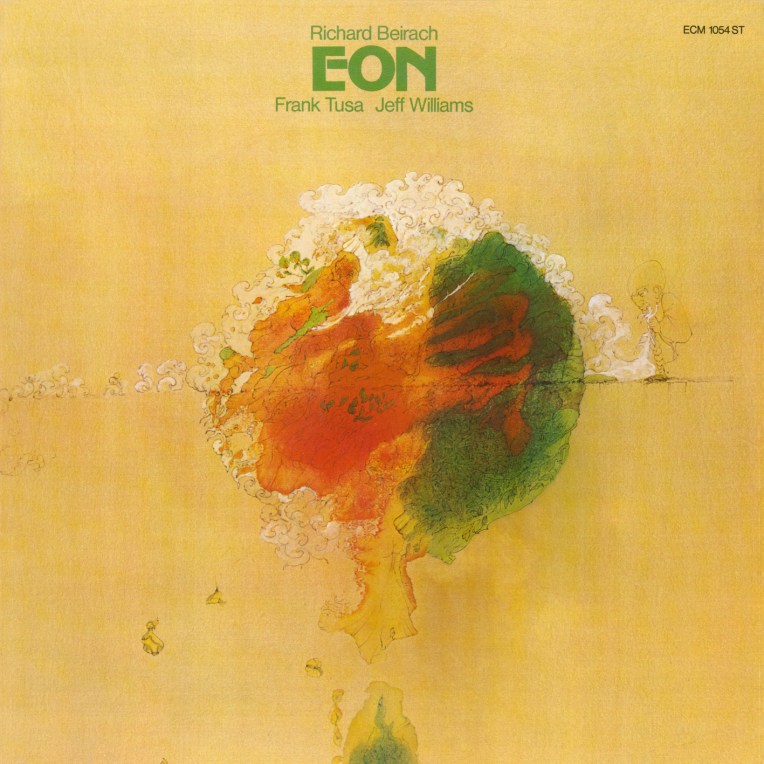
Richard Beirach: Eon (ECM 1054)

ECM 1054

Richard Beirach
Eon

Richard Beirach piano
Frank Tusa bass
Jeff Williams drums
Recorded November 1974 at Generation Sound Studios, New York
Engineer: Tony May
Produced by Manfred Eicher

Eon was the first album under the New York-born Richard Beirach’s name, and arguably still his best. Its balance of rhythm, melody, and reflection epitomizes the piano trio format, and nowhere more so than “Nardis” (Davis/Evans), the 14-minute epic that opens this set of six progressively far-reaching tunes. ECM listeners may recognize its lovely vamp as performed by Ralph Towner on his unparalleled Solo Concert of 1979. Here, it glows under a full and vibrant touch. Beirach keeps his fingers busily engaged, while allowing his rhythm section some glorious airtime, winding down like a rock band extending power chords, only here in a more intimate space in which that prolonging becomes not a dramatic farewell but the acceptance of a new beginning. “Places” (Dave Liebman) is an effervescent piano solo with all the romanticism one might expect from such a consummate musician. It also gives us a preview of his solo album Hubris, which would be soon to come. “Seeing You” (Tusa/Beirach) continues in much the same vein, but reintroduces the smooth glide of brushed drums and bass. A subtle rhythmic acuity and free and easy interplay suspend the listener in a swaying hammock of nostalgia. Block chords burrow through the title track with a hint of dissonance before flowering in calmer pastures. Fair, extended performances make this the culmination of the album’s surrounding gestures. Sentiments build into ecstasy before a final sprinkling from piano and cymbals is flicked into darkness like water from glittering fingertips. “Bones” at last puts more sticks to skin as Beirach recedes for tearful bass solo, hitting the occasional accent to keep us chordally ground. “Mitsuku” closes us out in style with a gratifying promise.

An easy album to get lost in, for at its gates one sees no need for maps.

<< Michael Naura: Vanessa (ECM 1053)
>> Gary Burton/Steve Swallow: Hotel Hello (ECM 1055)

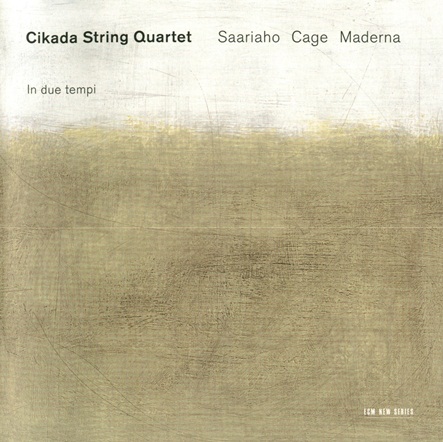
Cikada String Quartet: In due tempi (ECM New Series 1799)

Cikada String Quartet
In due tempi

The Cikada String Quartet
Henrik Hannisdal violin
Odd Hannisdal violin
Marek Konstantynowicz viola
Morten Hannisdal violoncello
Recorded August 2001 at Sofienberg Church, Oslo

“My music is as I am.”
–Kaija Saariaho

On April 10 of this year, I had the pleasure of meeting Kaija Saariaho after a lecture given at Mount Holyoke College. Her talk covered a range of topics, including her reclaiming of “compositrice” as a self-referential term; the conceptual tendrils that had coalesced into her third opera, Émilie; and the ever-present role of electronics in her music. She also waxed nostalgic about her many influences. Of these, her deep admiration for Witold Lutosławski stands paramount. The Polish composer once told her, “I am the first audience. I need to step back and see if I would accept the music as a listener.” These sentiments have since charged her music with a chameleonic energy, an energy that stems directly from Saariaho’s beloved dreams. Nymphéa (1987), for string quartet and live electronics, is like a breath of spectral wind in the trees. It is a fitting introduction of her work to the ECM catalogue, and one can only hope the conversation will continue. Where Saariaho stands out among contemporary composers is her ability to maintain a dense auditory palette without ever lapsing into distinctly melodic territory. The note becomes movement, a smile, an ankle in the shadows of the trees, a glimpse of a flowing dress upon the water. Together, they become a handful of medicinal tears, cast like seeds onto a lake’s fertile surface. Each gesture of the quartet is magnified in a fiery reverb, as the musicians are bid to whisper verses by Arseny Tarkovsky (father of director Andrei). Shades of Crumb’s Black Angels and André Boucourechliev’s Archipel II comingle in a magical incantation. And, like a whisper, the resulting sounds lay just beyond our reach. At points it flirts with cacophony, a composition in fast forward. A violin cracks its adolescent voice, cradled by echoes of former ghosts, and inaugurates a lilting series of responses, ending at the edge of our conscious field of vision.

After such a mind-altering experience, John Cage’s String Quartet in Four Parts (1949/50) wafts like a fragrance, familiar but forgotten. Its four seasonal movements consist of glassy block chords (what Cage called “gamuts”) in lateral formation, each casting a distinct shadow across the whole. Strings are played with minimal bow pressure, flowing with rapt neutrality until the last movement sheds its spring clothing. This makes for a fitting segue into Bruno Maderna’s more serial Quartetto per archi in due tempi (1955). Though one might not know it from this quartet (it is dedicated to Luciano Berio), Maderna much admired Cage and took it upon himself to pen one of the first analytical studies of his music. Here, slow and careful development leads to an increasingly fractured and nervous tale, rupturing into a more forcefully plucked affair before settling back into its quieter beginnings.

In due tempi is an album of transitory spaces, worth the price of admission for Nymphéa alone, after which the others seem to pale in comparison, yet which still provide more than enough intrigue for the open-eared listener. And while my bias obviously leans toward Saariaho, the album is, on the whole, a fascinating one. The Cikada Quartet, who made their label debut on Arild Andersen’s stellar Hyperborean, enact a clear, honed sound that works wonders with the chosen material. An overlooked New Series album, this deserves our full attention.

<< Morton Feldman: The Viola in My Life (ECM 1798 NS)
>> Keith Jarrett Trio: Always Let Me Go (
ECM 1800/01)

Michael Naura: Vanessa (ECM 1053)

ECM 1053

Michael Naura
Vanessa

Michael Naura piano
Wolfgang Schlüter vibraphone, marimba, percussion
Eberhard Weber bass
Joe Nay drums
Klaus Thunemann bassoon
Recorded September 1974 at Windrose Studios, Hamburg
Engineer: Martin Wieland
Produced by Michael Naura

Lithuanian-born Michael Naura is a German pianist, editor, and journalist. Capitalizing on a range of influences, from George Shearing to Horace Silver, his successful self-titled quintet LP of 1963 made him a household name in hard bop. If the benefit concerts arranged after his being diagnosed with polyserositis the following year are any indication, his brief absence caught many in its ripples. Central to Naura’s cadre in his formative years as recording artist was vibraphonist Wolfgang Schlüter, whose presence is keenly felt throughout Vanessa, his first and only album for ECM proper (he did release another, Country Children, as part of the label’s short-lived SP series). Even though last year saw Naura’s efforts recognized with a WDR Jazz Prize lifetime achievement award, this album remains etched in vinyl.

Naura’s set of six opens its eyes in the electric piano and marimba strains of “Salvatore.” The unmistakable electrobass of Eberhard Weber provides just enough ground for Klaus Thunemann’s stellar bassoon improvisations. This gorgeous opener sounds more like John Zorn’s Electric Masada on sleeping pills than anything else. The energy peters out over time and seems to trip on its own intentions, opening up a subtle improvisatory space in the process. From these murky depths arises the track’s thematic beginnings, passionately recapitulated with some superbly realized drumming from Joe Nay, amid a flanged wash of familiarity. “Hills” bustles like lunch hour in Burtonville, though it’s Weber’s nimble fingers that make it the album’s highlight. The next tune lumbers playfully like its titular “Baboon,” all the while emoting an intrinsic self-assurance. Thunemann adopts a vocal quality that is anything but primitive in a three-minute aside that’s sure to bring a smile to your prehensile lips. The title cut reaffirms Schlüter’s reign, billowing through the night like a curtain at an open window, where once wavered the silhouette of a love no longer here, and at which now stands the one left behind. Moments of synchronicity hint at a fleeting union shared under cover of neon and subterranean steam. The serrated contours of “Listen To Me” contrast alluringly with its straight-edged neighbors. Vibes thread the whole, culminating in a sustain-pedaled echo. Ultimately, the bassoon abstractions and soloing of the elegant “Black Pigeon” prove Thunemann to be the star performer of an altogether commendable group of musicians.

A rare video of the group from 1974:

The only downside to the album is its sometimes weak recording mix. One can almost feel the marimba solo in “Salvatore,” for example, being tweaked into the foreground (compare this with the more equitably balanced “Listen To Me”). Should a reissue ever be in the works, as I hope it will be, a remastering will also be in order. Nonetheless, a keeper if you can track down one of these hot pink, fishnet sleeves.

<< Steve Kuhn: Trance (ECM 1052)
>> Richard Beirach: Eon (ECM 1054)

Steve Kuhn: Trance (ECM 1052)

ECM 1052

Steve Kuhn
Trance

Steve Kuhn piano, electric piano
Steve Swallow electric bass
Jack DeJohnette drums
Sue Evans percussion
Recorded November 11/12, 1974 at Generation Sound Studios, New York
Engineer: Tony May
Produced by Manfred Eicher

Perhaps no one on the ECM roster, other than Keith Jarrett and Chick Corea, has as enlightened an understanding of the keyboard as Steve Kuhn. His debut album for the label only grows profounder with age. The elegant title track says it all: a trance of epic proportions etched into a set of almost impossibly modest length. Its prominent bass line lays down an airy ostinato, through which Kuhn digs straight into the album’s molten interior. The tender Fender in “A Change Of Face” lulls us into thinking we’re in for another methodical number, opening instead into some blazing percussive interplay between Steve Swallow and Jack DeJohnette. “Squirt” begins and ends with the same staccato declarations, strung together by a continual stream of sustain-pedaled galaxies and brightened by Sue Evans’s always-colorful accents. “The Sandhouse” rolls along the keyboard, collecting debris as it gathers speed toward the hip electric style of “Something Everywhere.” Kuhn lets Swallow do most of the talking here, taking charge only briefly through a series of quick key changes, all while DeJohnette keeps up his end of the bargain and then some. “Silver” is the only piano solo and shows Kuhn at his lyrical best, which hones the raunchy “The Young Blade” into an even darker edge. Kuhn plays us out with “Life’s Backward Glance,” a curious metaphysical experiment in which he intones: “It was a dark and stormy night at sea. The captain called his men on deck and said, ‘Men, I have a story to tell.’ And this is the story he told. It was a dark and stormy night at sea. The captain called his men on deck and said, ‘Men, I have a story to tell.’ And this is the story he told.” The mise-en-abyme of this tale only serves to analogize the haunting enigma of his craft.

An historic example of Kuhn’s lush, romantic style, Trance speaks of something beyond the realm of even the most intense study; beyond the possibilities of unchecked ability, technical prowess, and sheer finesse. It is a journey that has been faithfully recorded for all its hardships and triumphs alike. Kuhn fills every space with something fresh and palpable, allowing us total freedom in the listening.

<< The Gary Burton Quintet with Eberhard Weber: Ring (ECM 1051)
>> Michael Naura: Vanessa (ECM 1053)

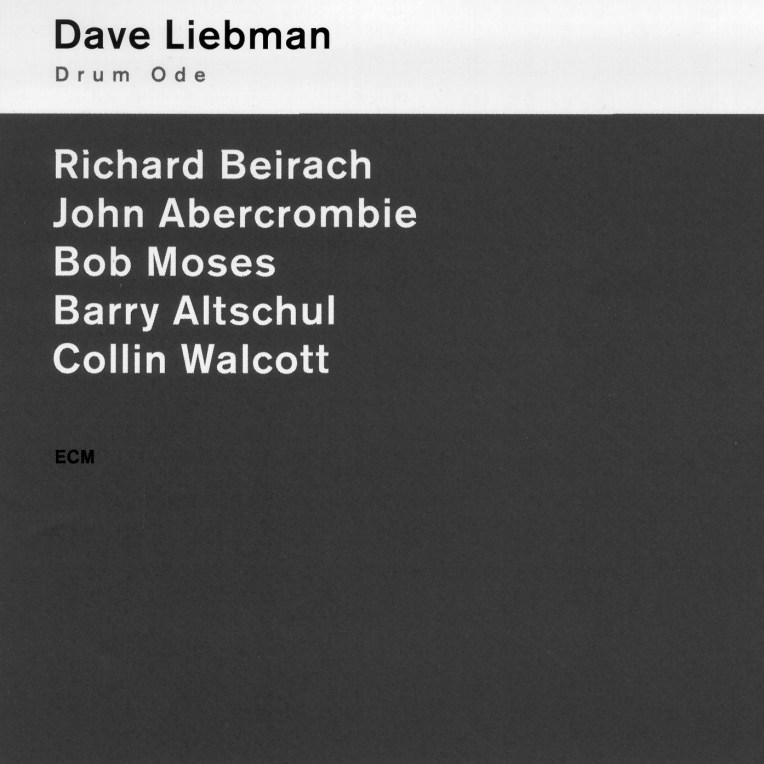
Dave Liebman: Drum Ode (ECM 1046)

ECM 1046 CD

Dave Liebman
Drum Ode

Dave Liebman soprano and tenor saxophones, alto flute
Richard Beirach electric piano
Gene Perla basses
John Abercrombie guitars
Jeff Williams drums
Bob Moses drums
Patato Valdez congas
Steven Satten percussion
Barry Altschul percussion
Badal Roy tablas
Collin Walcott tablas
Ray Armando bongos
Eleana Steinberg vocal
Recorded May 1974, Record Plant, New York
Engineer: Jay Messina
Produced by Manfred Eicher

“Drums and drummers. For me, they’ve been the moving force and inspiration, a reason to live, and celebrate life through playing music. Thanks to the men who play the drums. This music is dedicated to you.”
–Dave Liebman

It was the summer of 1997. I was fresh out of high school and settling into my new life at Goddard College (of Phish fame) in Plainfield, Vermont. The transition was sudden, but I was fortunate enough to have been placed in the music dorm, where dwelled lovers of all things audible. Late one night, during an emotionally exhausting orientation week, I was awoken by a sound coming from downstairs. Rubbing the sleep from my eyes, I descended to the common room to find my dorm mates deep in the throes of an impromptu drum circle. Congas, djembes, pots, tabletops, human bodies: everything was fair game. With nothing but a tin cup and a spoon at my disposal, I joined in with cathartic joy. I don’t think any of us remember how long the session went on after that (I’m not sure we even slept). Sadly, the school itself wasn’t what I had expected. After a long conversation with the group, I decided to return home and incubate for a year. Although this taxing decision eventually put me on a straighter academic path, I do think fondly of the profoundly attuned synergy we of the musical persuasion had forged in those dense seven days surrounded by the region’s denser foliage. Since coming across Dave Liebman’s seminal Drum Ode in reissued form, I have rediscovered something of that physical feeling of surrender one so rarely gets from a laser scanning a concealed silver disc.

Piggybacking on this success of Lookout Farm, Liebman surrounds himself with likeminded company. The rhythmic core of the 1973 joint remains intact, with a minus here and some additions there. The dedicatory introduction of “Goli Dance,” quoted above, leaves no mystery as to the album’s philosophical goals. “Loft Dance” comes closest to reenacting my anecdotal experience, and counts among its actors an animated Richard Beirach on electric piano, a lively John Abercrombie on guitar, and Liebman himself laying down some infectious rhythms of his own. The playing is baked to a crisp, and scathingly uplifting. Gene Perla deploys a heavy anchor, offset by the whimsy of whistles, all of which tethers the soloing to its immediate territory. “Oasis” is the odd one out for its vocal cameo, courtesy of Eleana Steinberg. A beautifully soulful sax solo is rendered all the more so for the songstress’s curious presence, her uneven edges and off-key honesty a sobering foil to the otherwise instrumental sound. Liebman lights a veritable box of matches in “The Call,” a revelatory pyramid with Bob Moses and Jeff Williams at its bottom corners. Its martial snares and echoing sax are the heart and soul of the album, hands down. “Your Lady” (an oft-neglected page from the Coltrane songbook) darkens the mood with a rain-drenched bass and nocturnal soprano sax. “The Iguana’s Ritual” continues in the same vein, save for the noticeable additions of electric guitar and the soothing grace of Collin Walcott’s tabla. Here, atmosphere becomes the primary melody. A trebly bass then ushers in a raunchier solo from Abercrombie and a kinetic finish from Liebman. A fluttering of guitar harmonics begins the end in “Satya Dhwani (True Sound).” Flute and tabla expand the sound further, carrying us out on an enigmatic path to stillness.

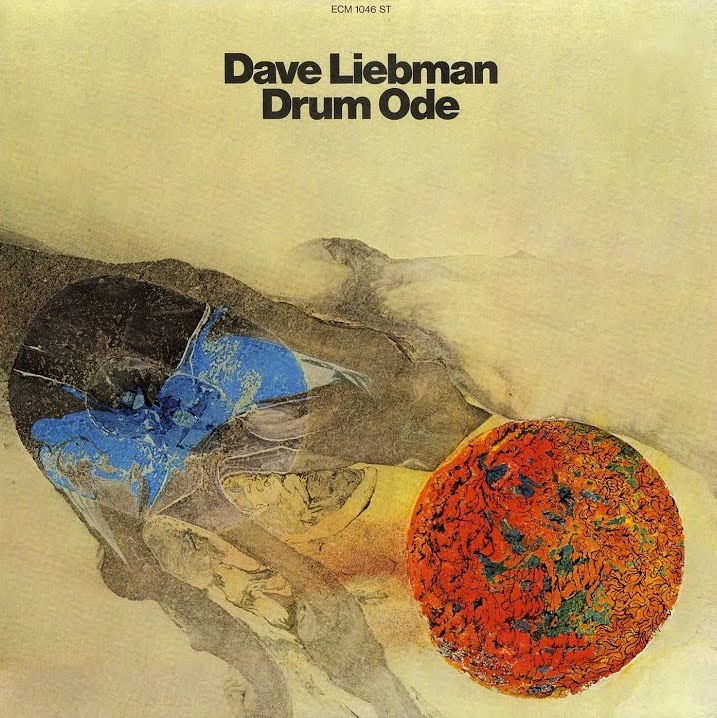
ECM 1046 LP
Original cover

The contrast in covers between the original vinyl and the CD could hardly be greater. The latter’s block list of names, while typographically pleasing, obscures the vibrant colors that said roster produces. One look at the former, however, reveals all in a single perusal: a brilliant sun, cradled in the arid landscape of its own desires, has found a voice where shadows intersect, and waits to share it with any in search of oasis.

<< Terje Rypdal: Whenever I Seem To Be Far Away (ECM 1045)
>> John Abercrombie: Timeless (ECM 1047)