

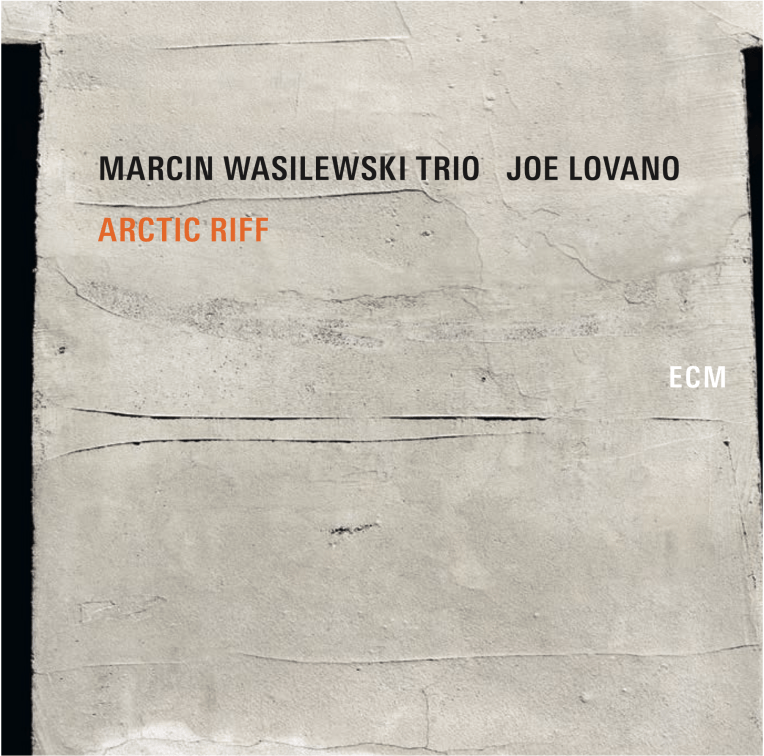
Marcin Wasilewski Trio
Joe Lovano
Arctic Riff
Joe Lovano tenor saxophone
Marcin Wasilewski piano
Slawomir Kurkiewicz double bass
Michal Miskiewicz drums
Recorded August 2019, Studios La Buissonne, Pernes-les-Fontaines
Engineer: Gérard de Haro
Mastering: Nicolas Baillard
Cover photo: Thomas Wunsch
Produced by Manfred Eicher
Release date: June 26, 2020
Too much time, it seems, has passed since pianist Marcin Wasilewski and his trio with bassist Slawomir Kurkiewicz and drummer Michal Miskiewicz graced the studio for our privileged scrutiny, and as soon as “Glimmer Of Hope” tickles the ear drum, we are reuniting with old friends. A glimmer is exactly what we encounter in Wasilewski’s pianism, which opens this tender vision with a play of light and shadow such as only he can render. In turning these movements into song, he opens a new portal through which to step on our way toward musical discovery. But then a new companion in Joe Lovano joins the shoulder-link of arms to block any who would even dream of passing across the double line of expectation. And so we trail behind, absorbing the language of their traversal. Three more selections by the bandleader, including the flowy sojourning of “Fading Sorrow” (a yielding stage for Kurkiewicz’s soloing) and the sparkler-to-fireworks groove of “L’Amour Fou,” along with Lovano’s “On The Other Side,” complete the in-group compositional picture. The latter tune unfurls a veritable tapestry from the tenorist’s bell and pictures the synergy of ears and fingers required to pull off this collaboration. Carla Bley’s “Vashkar” gets two treatments thereby. In keeping with its ever-deepening roots, and nourished by five decades of interpretation, the quartet taps into its historical embeddedness.
If these are the album’s bricks, then its mortar is mixed in freely improvised material. The nine-minute “Cadenza” is the most cohesive of the bunch, metaphysically speaking. Its balance of gentility and strength is downright beautiful, as is the linear unfolding of “Arco.” Where one moment might breed shimmering near-stillness and the next a fibrillation of darkness, neither mood dominates. Instead, the musicians follow where they are led without struggle. One hears it just as vividly in the nocturnal slink of “Stray Cat Walk” as in the restless leg syndrome of “A Glimpse.”
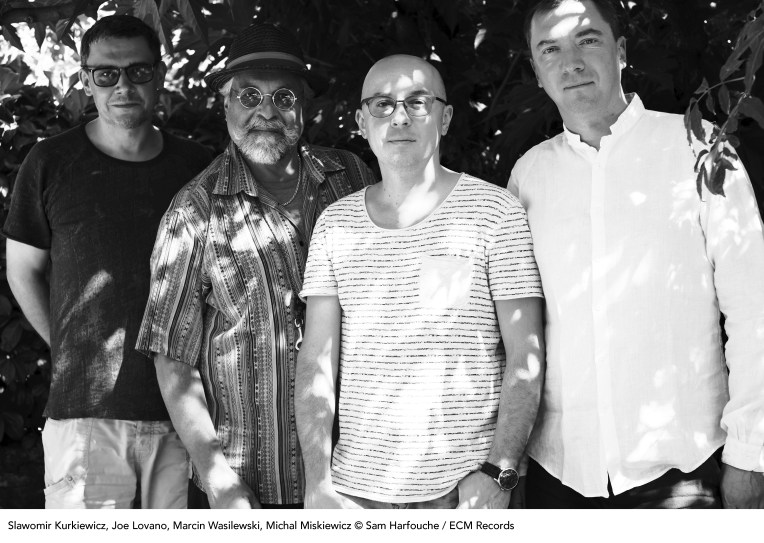
What really distinguishes this record, however, is the apparent gap between the trio’s interlocking poetry and Lovano’s hard-won prose. What at first may seem to be a disjunction actually opens up a space that can only be filled by the listener. By inserting ourselves into the equation, the proof becomes clear: our presence has been desired from inception to execution, our variable the final piece. And with that completion, we emerge on the other side of the equals side having carried the one of experience.
 Between Sound and Space: ECM Records and Beyond
I believe Marcin’s trio is not provided enough opportunity to melodically “shine” as they do on their trio outings.
Joe Lovano tends to overtake the trio on this recording and infrequently offers some melodic concepts.
Totally hear what you’re saying. It’s difficult to add to the trio’s already-honed sound without stepping on someone’s toes. That said, this quartet grows on me for its sheer boldness, which is a different animal. I enjoy the conversation, if you will.
To my ears, his best work for ECM is with the Trio Tapestry project. In that context, he meshes very well.
Tyran,
I would like to take this opportunity to commend you for your erudite reviews of all the ECM recordings that I have purchased for many years.
The reviews that you craft, are more insightful than many I have read from the critics at DownBeat and Jazz Times magazines.
I am pretty sure that Manfred Eicher shares my opinion.
Best Regards,
Diddy
I am honored by your words! I feel like every style has its place. I, for one, marvel at how reviewers in the publications you mentioned can so often pick up on time signatures, keys, allusions to classic tunes, etc., that I simply have no knowledge of. My primary goal is simply to convey what the music feels like rather than what it is, per se. I just hope it compels people to dive further into ECM. What are some of your favorites?
I agree wholeheartedly. A musician needs the technical knowledge to express what they feel and wish to express in a mode that achieves what music should inspire in all their listeners.
P.S. I am personally thrilled that Dino Saluzzi is performing with his son Jose and with one of my favorite guitarists, Jacob Young!
A thousand times yes to Dino! The new album is amazing — you’re going to love it. Hearing Jacob and José together, especially riffing on Jacob’s own pieces like “Old House,” is a real gift. And Dino sounds as smooth and effortless as ever.