

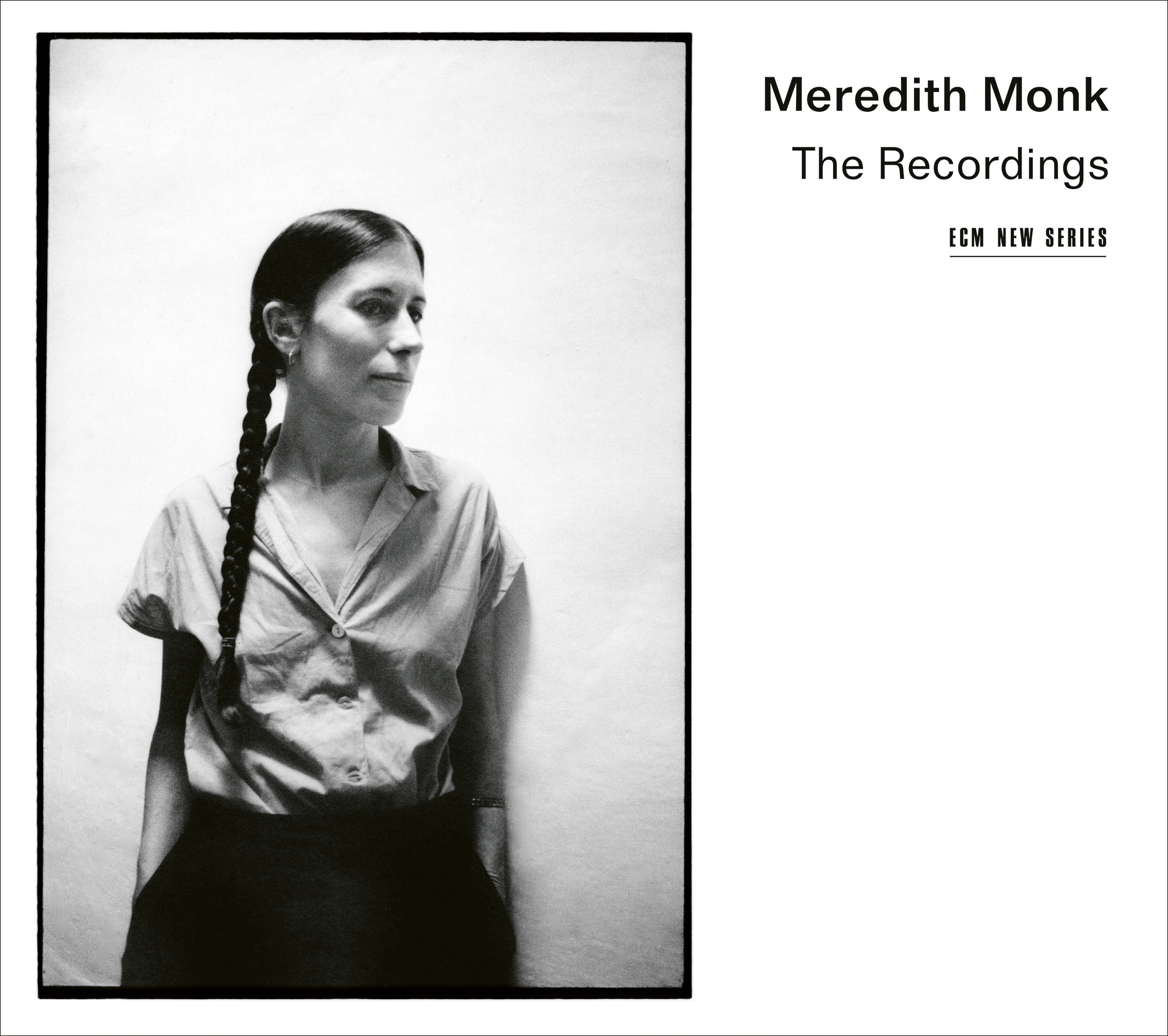
In November of 2022, ECM released this boxed edition compiling all 12 of Meredith Monk’s New Series discs to celebrate her 80th birthday. The set also includes a 300-page book reprising the original liner notes, along with new texts and interviews, photographs, archival documents, press quotes, and more. The result is more than a commemoration but a testament to the strength of the human spirit to make itself heard even in the face of inevitable entropy.
Manfred Eicher speaks of two important organs in the composer and singer’s oeuvre: their inspiration and their visual quality. In both, she finds a perfect partner in the producer, who has honed this approach across the territories of other singular artists, though none with quite the same combination of whimsy, ritual, and universalism.
In his essay, “The Worlds of Meredith Monk,” Frank J. Oteri characterizes the music as follows: “It paradoxically feels as if it was created at the very beginning of time and yet sounds completely new.” And while the works recorded here are scores in their own right since so much of her output defies standard notation, there is, he observes, a consistency that transcends the frameworks of their articulation. As part of a “living repertoire,” they seek out our ears as if they were extensions of themselves, thoughts on opposite sides of the brain spinning a seemingly impossible neural connection across oceans of time.
In an artist statement titled “The Soul’s Messenger,” Monk speaks of what the voice was able to reveal to her in the absence of its cultural reference points:
“Sometime in the mid 1960s, as I was vocalizing in my studio, I suddenly had a revelation that the voice could have the same flexibility and range of movement as a spine or a foot, and that I could find and build a personal vocabulary for my voice just as one makes movement based on a particular body. I realized then that within the voice are myriad characters, landscapes, colors, textures, ways of producing sound, wordless messages. I intuitively sensed the rich and ancient power of the first human instrument and by exploring its limitless possibilities I felt that I was coming home to my family and my blood.”
In other words, the voice was no longer an expression of the physical; it was physicality incarnate. “I began playing with what a vocal gesture would be,” she continues. “How would the voice jump, spin, spiral, fall? How would I abstract the sound of a laugh, of sobbing, of shouting, into a musical phrase?” Since then, her ”daily work” has not been to refine her singing so much as open it to its unadulterated imperfections, for in them are veins of possibility. These “gifts from a larger and wiser realm” are dug up like archaeological discoveries after long periods of waiting, each an old world made new.

At the age of three, Monk was diagnosed with strabismus, whereupon her mother enrolled her in a Dalcroze eurhythmics program, a technique that integrates music with movement. This experience, she recalls, “influenced everything I’ve done. It’s why dance and movement and film are so integral to my music. It’s why I see music so visually.” It’s also why the body has figured so viscerally in her live performances. Movement, dance, and shaping of sound all come across in the studio, not least of all because of Eicher’s attention to detail and Monk’s willingness to see where it leads. Without the shadow of infirmity hanging in the balance, questions of perfection become self-fulfilling prophecies.
Nowhere is the beauty of being off kilter expressed with such genuine poetry as in 1981’s Dolmen Music. In an excerpt from an interview by Ingo Bierman for his video series ECM50 | 1969-2019, Monk describes working with Eicher on this seminal session and how, after laying down Gotham Lullaby, she recorded a second take after concerns over her voice cracking in the first:
“It was technically perfect, but it really didn’t have that spirit, the kind of magic that the first take had. I have always respected Manfred for recognizing that, because you can edit yourself out of existence and get everything right, but there is something about the emotional continuity that communicates more deeply.”
The chamber program of which it is a part is quite varied and offers as full a portrait of Monk as you’re likely to find in one place. From the koan-like humor of The Tale to the 24-minute title piece, a larger narrative unfolds in almost liturgical fashion, each a step toward mortal awareness, with dashes of urban morbidity thrown in where it counts.
A touching piece of ECM lore worth mentioning is that Collin Walcott was a dear friend and frequent collaborator of Monk early on. He was, in fact, responsible for introducing her to Eicher and served as co-producer for Dolmen Music (playing violin and percussion on the album as well), which, along with Turtle Dreams, was thus shepherded into the ECM New Series stable after the imprint was created.
Speaking of Turtle Dreams, it makes for an enchanting companion. Although Monk’s performances used to confuse critics for their equal incorporation of dance, theater, and music, this 1983 follow-up shows her ethos to be based in the sounding body. Where this album’s predecessor regarded primordial realities, this one reflects the dissonance of living in the city through what she calls “Manhattan folk music.” Its intimate combination of keyboards and voices is nonetheless grand in its emotional scope, a dance with silence that sustains itself on contradictions and their resolutions and leaves room for what she calls “places to breathe, live, and play.”
All of this feels like a prelude to Do You Be. Released in 1987, Monk’s third album for ECM contains a melange of pieces from The Games: a science fiction opera and Acts from Under and Above, while the album’s title piece is from Vessel: an opera epic. Its incorporation of explicit words rather than the liminal spaces of and between feelings with which she was normally concerned places us at the center of a quiet storm of communication. The culminating effect is one of the voice as an instrument of memory, a beacon of futures that come to us as warnings.
Not coincidentally, Book of Days (1990) expands on that metaphor with even greater intensity in reimagining the incidental music to Monk’s film of the same name. Having seen the film, I can confirm its sense of dislocation and engagement with the human condition writ large. The story, set in Medieval times, tells of a young Jewish girl named Eva who is transfixed by visions of the modern world. Finding little comfort in her grandfather’s Torahic interpretations, she seeks solace in a local madwoman before her entire village succumbs to the plague. At the end, workmen who inadvertently unearth the village centuries later find Eva’s clairvoyant drawings of humanity’s demise. More than a soundtrack, the album is cinema in and of itself, morphing into weighted pathos.
Such ruminations of desolation were even more firmly on Monk’s mind when, at the end of 1989, while in residence at the Leighton Artists Colony in Banff, Monk found herself looking out her window at the Canadian Rockies. Despite being there to work on her opera ATLAS, she took inspiration from the scenery and produced a set of a cappella pieces that would become Facing North (1992). Conceived as a duet for her and Robert Een, it is a reflection of a place of cold uncoverings. The opera itself also made its way onto ECM. Over the course of three acts, ATLAS (1993) tells the life of Alexandra Daniels, an explorer who learns that the real journey is internal. This ambitious piece shows a transparent approach to instrumentation. Unlike the bombastic walls of sound that can dominate canonical opera, its accompaniment emerges from within instead of being forced from without. Interestingly, Eicher and Monk decided to cut the opera’s conclusion. “In the live performance,” she admits, “it was a crucial part of the whole. In the audio form, it became more of an epilogue, which seemed to both of us to make too much of a closure instead of letting the listener remain in motion at the end of the journey.” Such is the quintessential expression of movement through music, and how the soul breaks through the cracks in our voices is indicative of the necessity of imperfection to reveal self-worth.
Said cracks run even deeper in Volcano Songs (1997). As manifestations of human archetypes, these metaphysical pieces pay deference to Monk’s ongoing ethos of “always trying to explore forms that balance rigor with freedom.” Her melding with singer Katie Geissinger is astonishing to behold. Another program of strong variety, it includes such vital works as New York Requiem and Three Heavens and Hells, both of which deal with the transience of life and our regard for human suffering. Similar themes are explored in mercy (2002) and Songs of Ascension (2011), both of which represent collaborations with sculptor and installation artist Ann Hamilton. Whereas the former is built around the idea that the mouth can harm as much as heal, the latter was originally performed in an eight-story tower designed by Hamilton. In both, the instruments are just as vocal as the voices (and vice versa) in their explorations of fragility. As I wrote in my original review of mercy, “Monk’s is not a world in which the voice is primary but rather a voice in which the world is primary.” I stand by that statement and would point to these as Exhibits A and B. Nestled between them is 2008’s impermanence. A distinctly chromatic work, it eschews standard narrative in favor of a feeling, a connection to somewhere beyond the immediacy of experience.
Piano Songs, released in 2014, is a remarkable cross-section of Monk’s life and career, with purity and sameness through difference in mind, containing such touchstones as Paris, a piece from 1972 that marks her return to the piano after focusing intensely on the voice, and Ellis Island from 1981, which ties history and memory into one inexorable package. Last is On Behalf of Nature (2016), which speaks for the voiceless, the abused, and the forgotten. It has the most connective tissue of all, bleeding as much through the leaves as from the soil in which they are born.
If any red thread can be said to run through the above tapestry, it is that selves were made to expand. However, part of being human is realizing that with that expansion comes the responsibility of charting our way through all the extra space. With Monk at our side, we can feel sure of placing our feet on loving ground.
 Between Sound and Space: ECM Records and Beyond
I love the works of Meredith Monk that I’m familiar with, and this review only makes me want to buy this release all the more.
And…
Thank you so much for the work you are doing in these reviews – all of the revisiting of old releases, and providing further publicity for the newer releases on this label. Tyran Grillo, I think this is a truly significant task you’ve undertaken, and I’m a bit awestruck by the size of the commitment you’ve made in taking it on. I’ve never commented here before: not for lack of appreciation of your work in this gargantuan labour of love you’ve taken on, but rather because I’ve never felt that my comment would be in any way significant. But today, for whatever reason, I realised that this was a very silly emotional response on my part, and all it was doing was preventing you from receiving some fan mail! So here I am.
My very best wishes to you and yours, and long may you continue in this noble endeavour!
BM
Wow, Brendon, thank you so very much for the kind words! Monk is one of those artists whose work practically describes itself. Writing about her music is like going into a trance and coming out the other side somehow different than before. I am just glad people like you are willing to come along for the journey and share their changes in kind. There is a new album of her music, Cellular Songs, coming out soon, so stay tuned for that one.