

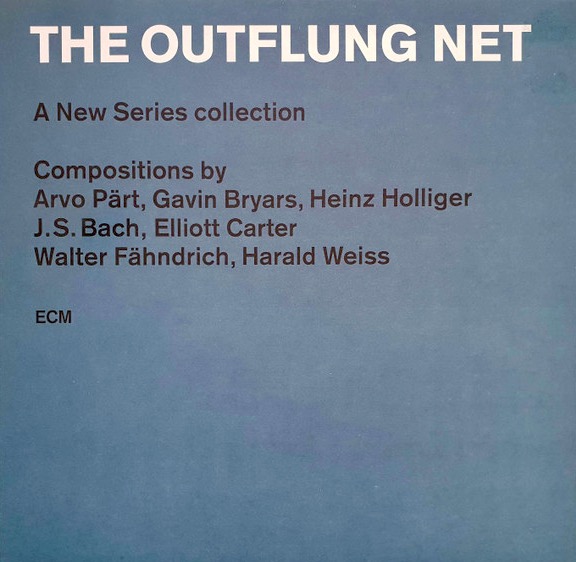
Issued in Germany in 1992, The Outflung Net is a rare six-LP box whose very lack of a conventional catalog number suits its elusive character. The title comes from Norman Maclean’s A River Runs Through It, where a fly cast spreads so widely that it seems to have “a center wherever you look.” That image is an ideal emblem for this gathering of ECM New Series recordings. Arvo Pärt may supply its spiritual center, but every disc becomes a center in turn, each extending a line toward Bach, modernism, improvisation, ritual, and the fertile silence for which producer Manfred Eicher’s label had become known. More than a sampler, the set is a compact aesthetic manifesto.
Pärt’s Miserere (ECM 1430) is its natural threshold. The Hilliard Ensemble under Paul Hillier, soprano Sarah Leonard, organist Christopher Bowers-Broadbent, percussionist Pierre Favre, the Western Wind Chamber Choir, and the Orchester der Beethovenhalle Bonn under Dennis Russell Davies inhabit music whose power lies in the tension between utterance and suspension. In the title work, Psalm 51 advances almost word by word, clarinet responses turning language into dialogue. The “Dies irae” erupts like a storm at the end of the world, yet the performance never mistakes volume for grandeur. Leonard’s ascents, David James’s countertenor radiance, Gordon Jones’s grave baritone, and the Hilliards’ collective purity lead from devastation toward an order glimpsed rather than possessed. Festina Lente spirals with stately paradox, while Sarah Was Ninety Years Old sets voices, organ, and Favre’s drums inside an austere arithmetic of awe. Few recordings make interrupted thought feel so complete.
Two albums by Swiss cellist Thomas Demenga place Bach beside living modernism, not as opposing camps but as mutually illuminating practices. On Bach/Holliger (ECM 1340), he is joined by violinist Catrin Demenga and oboist-composer Heinz Holliger. The latter’s Duo trembles and darts with sibling precision, his Studie über Mehrklänge turns circular breathing and multiphonics into a strangely lyrical anatomy of the oboe, and Trema makes the cello shiver as if pursued by its own shadow. After such exposed nerves, Bach’s Fourth Cello Suite arrives cleansed of familiarity. Demenga plays without decorative vanity, drawing a dark inward song from the Sarabande and allowing every fingerfall and resonance to enter the recording’s crystalline air.
Bach/Carter (ECM 1391) reverses the route, opening with the Third Cello Suite in a performance of warmth, mobility, and improvisatory lift before stepping into Elliott Carter’s quicksilver world. Demenga is joined by flutist Philippe Racine, clarinetist Ernesto Molinari, violinist Hansheinz Schneeberger, pianist Paul Cleemann, percussionist Gerhard Huber, and conductor Jürg Wyttenbach. Esprit rude, Esprit doux, Enchanted Preludes, and Riconoscenza per Goffredo Petrassi sketch compressed dramas of interruption and pursuit, but the Triple Duo is the summit: three instrumental pairs exchange ideas with the precarious grace of an intoxicated gymnast. Carter’s simultaneities can seem like scattered strata until time reveals their underlying geology. Heard after Bach, their density is not disorder but another species of counterpoint.
Gavin Bryars’s After the Requiem (ECM 1424) supplies the box’s most openly elegiac landscapes. Its title piece, written as an instrumental afterimage of the Cadman Requiem, brings Bill Frisell’s electric guitar together with the violas of Alexander Balanescu and Kate Musker and Tony Hinnigan’s cello. Frisell burns slowly through the strings like northern light, his sustained tones less a solo voice than a spirit learning the texture of mourning. Elsewhere, Balanescu, clarinetist Roger Heaton, pianist Dave Smith, Bryars on bass, and percussionists Martin Allen and Simon Limbrick navigate The Old Tower of Löbenicht and Allegrasco, while Evan Parker, Stan Sulzmann, Ray Warleigh, and Julian Argüelles form the saxophone choir of Alaric I or II. Bells, low reeds, spare ostinatos, and corroded melodies make the album feel antique without imitation.
The set then widens beyond the concert-hall frame. Trommelgeflüster (ECM 1249) is Harald Weiss alone on percussion and voice, though “alone” hardly describes its populous theater. Steel-toned steps, melismatic chants, whistles, outbursts, and distant twangs gather into a ritual that continually questions its own regularity. Weiss’s theatrical and intercultural imagination risks pastiche, yet the music’s physical conviction pulls its materials into one breathing organism. Part I moves as if across sun-struck earth before Part II enters darker, more dreamlike territory. The title means “Drum Whisper,” but the album whispers with an entire body.
Walter Fähndrich’s Viola (ECM 1412) closes the collection by reducing the field to a single instrument and opening it onto uncertainty. A composer, improviser, and sound-installation artist, Fähndrich gives his pieces only Roman numerals. Overtones sway, rapid arpeggios climb into spirals, sul tasto passages ring like buried bells, and scratches become avian calls and insect song. His precisely governed bow does not tame these sounds so much as release their inner ecology. The final, expanded return to “IV” refuses neat circularity, leaving the ear at the threshold of another possible performance.
Across these six records, ECM’s celebrated spaciousness is never merely atmospheric. Pärt’s prayer, Bach’s architecture, Holliger’s fractured breath, Carter’s restless syntax, Bryars’s weathered remembrance, Weiss’s embodied ritual, and Fähndrich’s improvisational earth all belong to the same outflung net. Its center is everywhere because attentive listening keeps moving it. Rare as an object and even rarer in the coherence of its vision, this box preserves a moment when New Series seemed less like a label imprint than a new way of organizing musical time.
Special thanks to Bernhard Liebenberg for bringing this collection to my attention.


Thank you, Tyran, for the nice review and your acknowledgement – you’re welcome! Curiously, the Harald Weiss release (ECM 1249) is not marked as “New Series” on its cover—even though it was sold here as part of this New Series collection—this only happened with the release of the CD nine years later.