

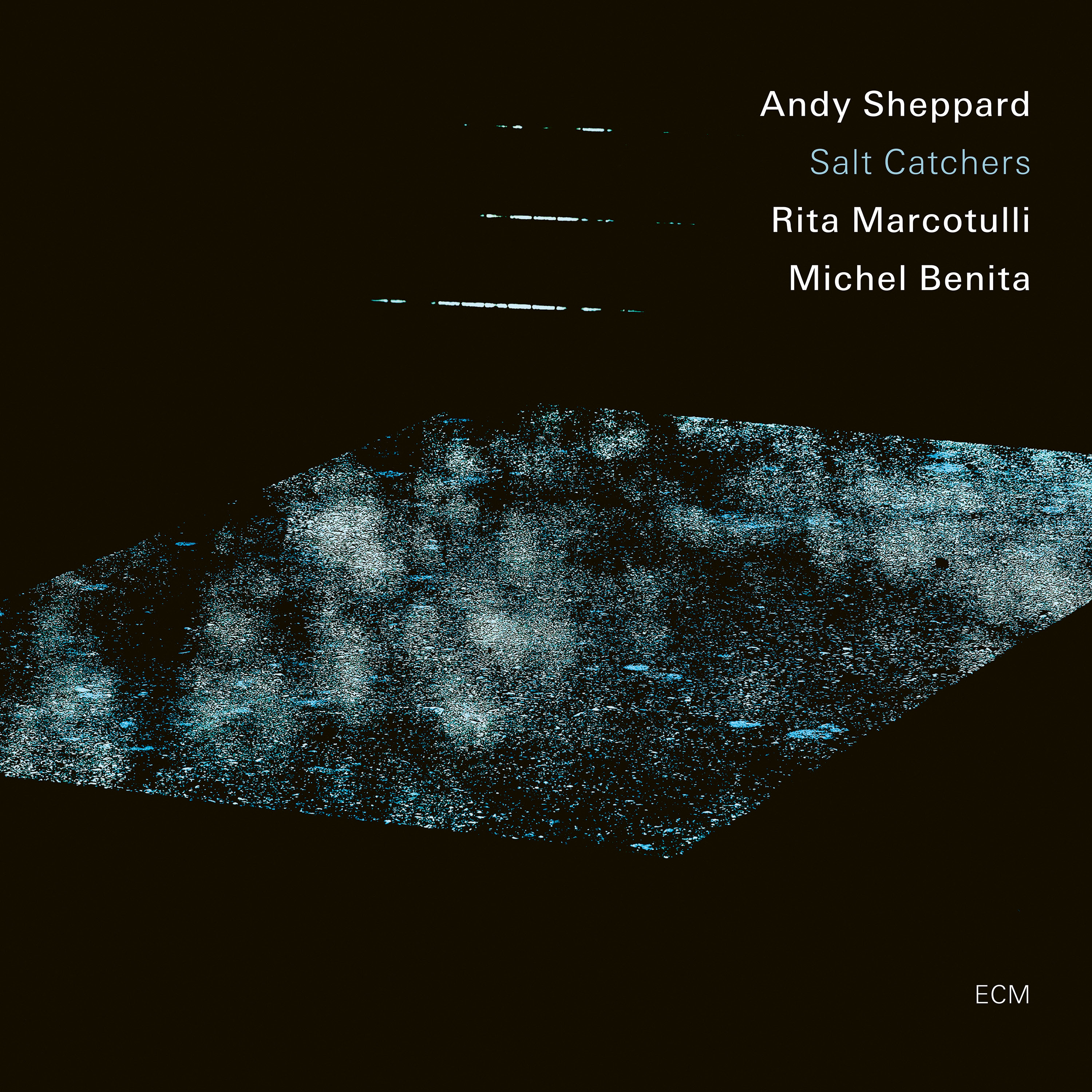
Andy Sheppard
Salt Catchers
Andy Sheppard tenor and soprano saxophones
Rita Marcotulli piano
Michel Benita double bass
Recorded March 2025, Auditorio Stelio Molo RSI, Lugano
Engineer: Stefano Amerio
Cover photo: Jan Kricke
Produced by Manfred Eicher
Release date: September 11, 2026
Across six ECM releases, Andy Sheppard has treated ensemble form as an instrument in and of itself, altering the ambient details around his reeds so each setting reveals a different nuance of his breath. The quintet on Movements in Colour surrounded him with shifting densities, Trio Libero pursued more intense conversation, and his quartet with Eivind Aarset opened electronic passageways through acoustic terrain. Most enduringly, the trio with Carla Bley and Steve Swallow placed his lyricism inside a world where wit could hold hands with pathos.
Salt Catchers begins another chapter, bringing the English saxophonist together with Italian pianist Rita Marcotulli and French bassist Michel Benita for the first time as a unit. Their cohesion suggests that certain ensembles exist before they are convened, awaiting only the studio in which their latent testimony can be documented. The drummerless format retains a trace of Sheppard’s years with Bley, whose “Lawns” is the sole nonoriginal among nine pieces, yet memory is a hidden foundation rather than a governing premise.
Most of the album was written during the pandemic, as Sheppard moved from the guitar-centered environments of earlier projects toward chamber music’s concentrated intimacy. Marcotulli opens fissures within composed material, while Benita touches the folkloric roots of Sheppard’s writing without disturbing the earth around them.
A Portuguese shadow passes through Salt Catchers. Now living near Lisbon, Sheppard draws on the gravity of saudade, allowing longing to organize melodies that function as complete emotional bodies rather than maps for improvisation. Their romanticism carries something of John Martyn, absorbed so thoroughly that its source has become molecular. Recorded in Lugano in March 2025 under Manfred Eicher’s direction, the album gathers geography and recollection into a deceptively calm surface, demanding that every note justify the silence it displaces.
“Elevation” establishes this economy with piano that raises a transparent structure around the listener. Sheppard’s tenor enters above its own shadow, offering a melody whose openness contains the ache of distance, while Benita traces the invisible contours that keep it suspended. An echo of Charles Lloyd inhabits Sheppard’s spacious tone, though time may be the deeper influence: decades of listening move through his sound as sediment, leaving the line clear as the past gathers beneath it.
Where “Elevation” offers a horizon, “Lawns” provides an address. Bley’s composition flowers into a suburban psalm, its chords carrying the holiness of ordinary refuge. Marcotulli’s phrases hold survival and repose within the same circumference, as Sheppard’s breath-softened lower register gives the melody human grain and Benita places each note with tender exactitude. With each iteration, the harmony resembles a childhood house whose rooms change dimensions whenever one tries to enter.
The title track begins beneath the keyboard’s conventional surface. Reaching into dampened piano strings, Marcotulli releases metallic murmurs and half-born harmonics. Sheppard’s soprano evokes salt as residue and preservative, the crystal in which an evaporated sea continues thinking. When the musicians reach the concluding unison, three private trajectories have discovered a single edge.
The Portuguese current nears the surface in “Encantos,” whose buoyancy gives Sheppard’s melody an unforced radiance. Enchantment survives through partial concealment: the tune gives itself freely while keeping a central chamber locked. Later, “Salgado” answers with understated montuno inflections and geometric harmonizations.
“Draw You In Stars” opens with a luminous piano arpeggio, a spiral staircase whose destination recedes as it rises. Sheppard’s tenor exposes a vulnerable grain before he and piano meet, then part for Benita’s restrained, quick-minded solo. Marcotulli moves farther from the harmonic center, seeking a truth faithful to instability.
Marcotulli opens “This Too – Three Hills” like a book at an unknown page, and Sheppard enters carrying the next sentence in his breath. The hills become folds in memory, elevations made by all the mind has buried unevenly. As the playing dissolves into breath and pause, each phrase embraces uncertainty instead of converting it into drama.
Absence takes intimate form in “Those That Left.” Piano and bass communicate across a missing center, exchanging signals whose tenderness derives from what they decline to resolve. Marcotulli’s dream logic brings light to grief’s edges without making loss decorative. “Irene” then gathers bass and soprano into a supple dance before piano widens the emotional field. Elegant without sweetness, it draws darkness inside radiance, knowing beauty does not cancel sorrow but grants it another form of circulation.
Marcotulli is the session’s revelation, turning modest gestures into portals through which whole emotional cartographies appear. She does not decorate the music; she alters its physics. Benita gives every contour a quiet gravitational center, allowing Sheppard’s melodies to travel without losing human proportion.
The title contains the key. Salt preserves by entering what it preserves, becoming inseparable from the body it protects. These musicians practice a related attention: each voice receives the others deeply enough to be changed, yet no identity dissolves. Listening becomes a willingness to let another person’s silence speak for itself. Perhaps civilization begins there, in the discipline required to let another person’s unfinished phrase live.

