

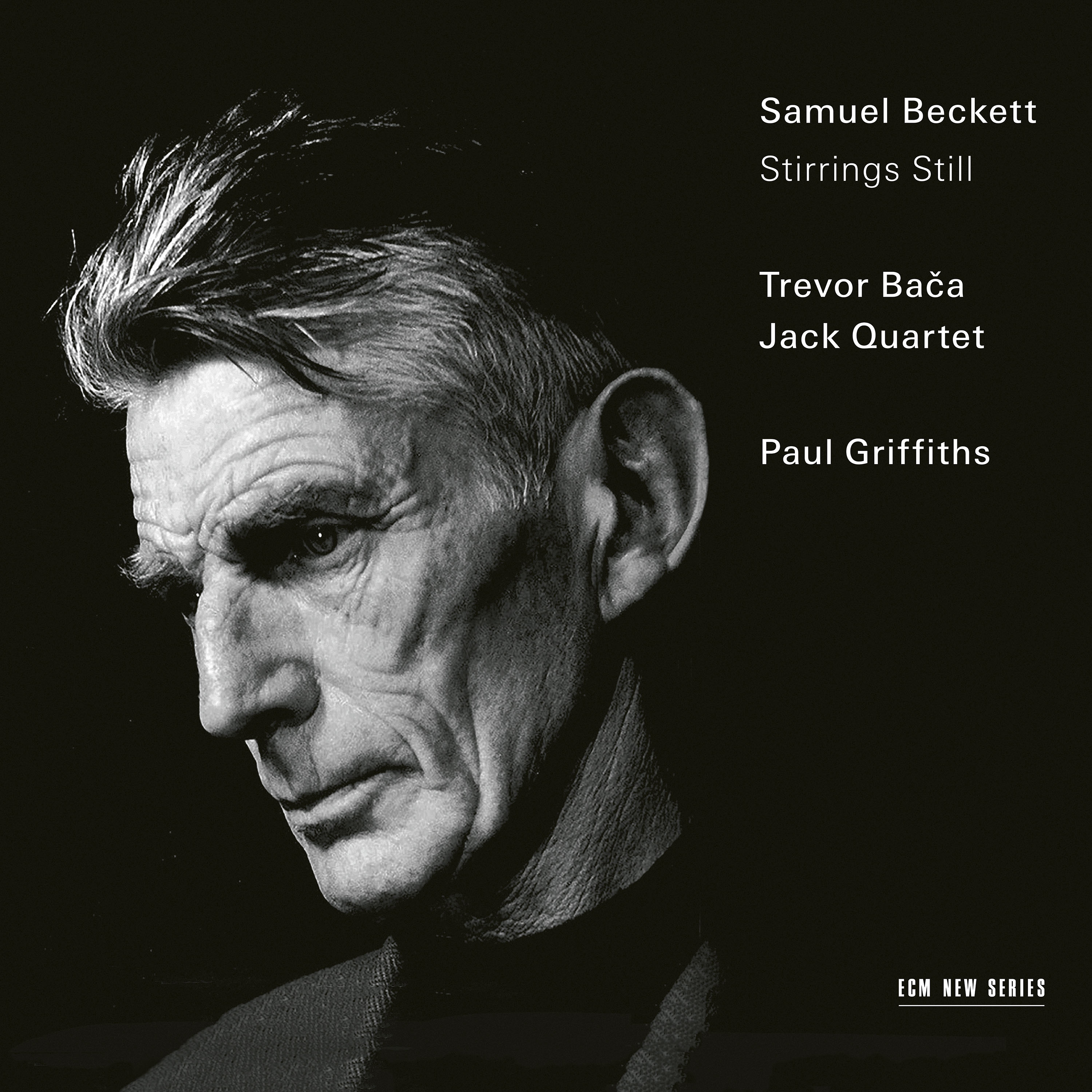
Samuel Beckett
Trevor Bača
Stirrings Still
Paul Griffiths narrator
JACK Quartet
Christopher Otto violin
Austin Wulliman violin
John Pickford Richards viola
Jay Campbell violoncello
Recorded 2023 and 2024, Auditorio Stelio Molo RSI, Lugano
Engineers: Michael Rast, Lara Persia, and Michael Hinreiner (mix)
Cover photo: Rosemarie Clausen
Produced by Manfred Eicher
Release date: September 4, 2026
Completed in 1987 and first published the following year, Stirrings Still was Samuel Beckett’s last message in prose, a dispatch from that uncertain border where the voice survives even as the self begins to lose its outline. More monologue than story, it finds an unnamed man whose passage may lead through a vast wheatfield drained into black and white, or deeper into the stumbling grain of memory itself. The distinction gradually ceases to matter. Life and what lies beyond become double exposures on the same strip of film, each haunting the other with the possibility that consciousness is merely the afterimage cast by its own disappearance.
Beckett cherished music, especially the songs and string quartets of Franz Schubert, whose melodies often travel farthest just they seem to be coming back home. Something of that impossible homecoming inhabits Beckett’s prose. His sentences circle their subjects until repetition becomes a form of erosion, each recurrence touching the old wound from another angle. Phrases withdraw before reappearing with their centers of gravity subtly displaced. Meaning flickers among them, less an object to be grasped than a disturbance of breath registered in passing. Stirrings Still is therefore already a kind of chamber work, its developments tightening toward the point where language encounters the silence it has carried within itself all along.
Paul Griffiths’s relationship with this world reaches back more than half a century. His first encounter with Beckett arrived at a decisive age, when the boundary between art and life can still vanish without warning. “A student production of Waiting for Godot was put on at the Oxford Playhouse in November 1965,” he recounts to me via email. “I was in my first term as an undergraduate and had just turned eighteen. It changed my life. Little by little (I was living on a student grant) I bought pretty much everything of Beckett’s that was in print.” That formative shock and stretching of personal resources can be felt in his narration of Stirrings Still. Griffiths does not approach the text as a monument to be admired from a respectful distance. He speaks from within a lifelong proximity, as though the words have accompanied him for so long that they now belong to his private scaffolding. Such familiarity allows him to resist theatrical enlargement. Every hesitation carries its own weight, and each repetition sounds newly discovered in the mouth.
The recording also belongs to producer Manfred Eicher’s longstanding conversation with literature, a dimension of his work sometimes eclipsed by the attention given to his cinematic imagination. Griffiths places the project within a history extending to the origins of ECM New Series: “Spoken-voice recordings were part of the New Series from the beginning, and they trace some part of Manfred Eicher’s literary world, which he also partly shares with some of the musicians he’s worked with—Heiner Goebbels, for example, and Kurtág.” Literature, in this context, forms part of the label’s underlying sensibility, shaping its understanding of voice and the charged intervals surrounding utterance. Eicher’s ear has always extended toward those places where one art begins to think through the materials of another.
The path to this particular convergence was itself Beckettian in its patience. In 2006, Eicher asked Griffiths to seek out a composer capable of writing music that could exist in the closest possible sympathy with a recording of the text, preserving its austere sovereignty while answering its inner music. A decade passed. Then, hearing the JACK Quartet rehearse Trevor Bača’s Akasha at Harvard in 2016, Griffiths recognized that the search had been listening for its own answer. Asked what in Bača’s work provoked that recognition, Griffiths answers with characteristic directness: “Not much more to say about the genesis. To answer in one word: intimacy. His music speaks intimately and is made intimately, down to the finest nuance. Also, of course, the string quartet was the obvious ensemble, and I felt this was music that could withstand and deal with the huge presence of Beckett.”
That final phrase identifies the central danger of the undertaking. Beckett’s presence is indeed huge, despite the spareness of the material. And so, any musical candle lit in its shadow could easily become decorative or subservient, reducing itself to atmospheric confirmation of meanings the prose has already supplied. Bača declines the obedient servitude of accompaniment. His score runs beside the words as a parallel stream with its own depth and darkness, neither illustrating the text nor competing for possession of it. Heard in alternation with Griffiths’s narration, the JACK Quartet enters as another order of consciousness, contemplating Beckett from beyond the reach of speech. The strings draw the listener beneath the semantic surface, into the undertow where words continue to exert their pull after their immediate impact has loosened its grip. Griffiths gives the narrator a voice worn almost to the grain, while Bača opens chambers around it in which solitude can resonate beyond the dimensions of the solitary.
What emerges is a work suspended between articulation and subversion thereof, each dynamic carrying what the other must relinquish. Bača’s finest gestures seem microscopically fashioned, alive to the pressure of bow hair and the tremor released when one surface encounters another. Within these sounds lies a physical knowledge that language can approach but never quite retain. Something continues on the far side of saying, faintly stirring in the dust from which every word is born and to which every word returns.
“One night as he sat at his table head on hands he saw himself rise and go.” Thus begins the world into which we are introduced, accompanied by nearly mournful scrapings from the strings. They touch resonantly upon a premonition of death, though the narrator is granted no consoling return to whatever enchanted him as a child. The circumstance of living forces him instead toward the limits of what can be known. A window remains locked because opening it would expose more than the mind can bear. He is left to imagine a form of intercorporeal travel in which light acquires qualities beyond day and night, while the vagaries of experience fall as rain upon drought-stricken earth.
From this threshold come the most delicate tremblings, poised at the edge of audibility, where mortal questions cease to be asked because the answers must also die if they are to be genuinely felt. Those haunting fringes of strings and fretless fingerboards provide a passage for the ghosts of implication. An insectile agitation enters the instruments, suggestive of animal life. The sound seems to remember some primordial condition before flesh and thought became convinced of their separation. Bača allows timbre to retain that ancient uncertainty. A scrape may be the distress of wood under pressure, yet it also carries the sensation of a body trying to hear beyond itself.
As the narrator, poised between tenderness and robust resignation, continues to riff on the fragility of his own existence, the music reveals a premonitional character rather than a commentative one. Siren-toned descents foreshadow the broken heart of solitude, and whisper-quiet stirrings release the title from abstraction. Appearances and disappearances implicate us in their zoetrope, each open slit a death, with the moment beyond it offering another life begun. Creakings suggest the internal groaning of bone on bone, the expression of a body in retrograde. Flinching angels exchange glances with lock-staring demons in a currency of dangerously intimate proportions, always returning to center before resuming their games of perception.
Once the framework of self-awareness begins to lose its structural integrity, the strings grow more animate. They tremble in real time at the realization that something deeper than vibrational frequency is at play, an almost instantaneous relativity that flies straight into the heart of grief. Every bow stroke appears to alter the temporal pressure around Griffiths’s voice. The quartet does not surround the speaker so much as expose the detachments already contained within him. His pauses widen into territories, and the score crosses them without pretending to know what waits on the opposite side.
Beckett’s alter ego is always seeking a way, only to discover that every doorway leads further back in. A quivering harmonic becomes another slipstream into the flowering mind, where wilting and blooming remain equally present. Through a harshly beautiful economy of language, what appears bare on the page acquires in discourse a richness of observation about the human condition. Impulses scrabble in the walls of the subconscious, evading the reach of neurological fingers before falling into the hands of the very soul they describe with unabashed honesty. Griffiths follows these movements without imposing an emotional map upon them. The tenderness of his reading comes from acknowledging how little tenderness the universe itself appears obliged to provide.
Bača’s attention to detail occasionally touches the borderlands explored by George Crumb, another composer drawn toward language at its margins. Yet Bača occupies this territory with a privacy distinctly his own. He listens into the spaces between words, where the tail of one utterance curves toward the head of another in a continuous rotation of exhalation and inhalation. Within the interval separating those breaths, the self becomes perceptible as a rhythm rather than a stable possession. The bow reverses direction while sustaining the illusion of a single note, and consciousness performs an equivalent maneuver, repeatedly changing course while calling the result continuity.
The deepest achievement of this recording may lie in how thoroughly it dissolves any secure division between the witness and the witnessed. The man sees himself rise from the table, Griffiths gives breath to the man, and the quartet listens to that breath from a region his monologue cannot enter. We receive each layer as we add another through the act of attention. Perception becomes a relay conducted across bodies that can never meet, yet briefly inhabit the same uncertainty.
Perhaps the unnamed man is therefore doing more than approaching extinction. In watching himself depart, he invents the witness who might survive him. Beckett entrusted that witness to language, Griffiths lends it mortal breath, and Bača places it within the vulnerable substance of sound. We inherit the man’s vigil without acquiring his identity. For a little while, his consciousness passes through ours, asking for neither rescue nor remembrance. It reveals something more unsettling: that the self may be only the temporary custody of an awareness forever arriving from elsewhere. Our lives are shaped by the voices we shelter, most of whom will never know our names. In this sense, consciousness has always been on loan, and listening is the obscure means by which we return it like a library book we checked out and forgot about long ago.


A particularly wonderful review Tyran!
Thank you so much, John! It helps when the source material combines so many of my favorite things 🙂