Andy Emler MegaOctet: Obsession 3 (RJAL 397024)

Cover

Andy Emler MegaOctet
Obsession 3

Andy Emler piano
Claude Tchamitchian double bass
Eric Echampard drums
Laurent Blondiau trumpet
Guillaume Orti alto saxophone
Philippe Sellam alto saxophone
Laurent Dehors tenor saxophone
François Thuillier tuba
François Verly percussion
Recorded live at Studios La Buissonne on December 16/17, 2014 by Gérard de Haro and Nicolas Baillard
Mixing by Gérard de Haro and Andy Emler at Studios La Buissonne, Pernes-les-Fontaines
Mastered by Nicolas Baillard
Release date: October 16, 2015

Andy Emler and his MegaOctet return to La Buissonne for Round 2. Despite being the ensemble’s seventh album overall, it feels as fresh as a debut. After the wonders of E total, one can both rightly expect and be surprised by what takes place here. That same feeling of world building is present, but with an even stronger fortification of purpose, of which the tone is dutifully set in “Tribalurban 1.” Emler’s ability to mesh stark dynamic contrasts—from whispers to shouts—has never sounded so organic, and elicits an interlocking of horns and piano that ends with laughter from the band: a brief insight into an underlying camaraderie.

Though recorded in-studio, the album comes across as a live gig—an impression fully implied by announcement of the musicians one by one in the concluding “Die coda.” Before arriving at that whimsical conclusion, we’re introduced to an anatomy of melodically well-toned muscles. The campiness of “Doctor solo” (grounded in the playfulness of my favorite musician in the bunch, tuba master François Thuillier) is echoed in such exciting highlights as “Balallade 2,” in which trumpeter Laurent Blondiau soars high above a vast continent of ideas. Blondiau further delights in “Trois total,” the big band-leaning sound of which gives the listener a bear hug.

The opening splash of “La Megaruse” sets up a fleet-footed run across water by François Verly on marimba. Drummer Eric Echampard and bassist Claude Tchamitchian keep step along the shore, sustaining the same level of uplift from dawn to dusk. This and the 16.5-minute “Tribalurban 2” are phenomenal showcases for the reedmen as well, each lighting a match in that warm kindling only the 70s could have inspired.

If Obsession 3 were a dealer’s table, then I guarantee you wouldn’t find a single poker face among Emler and his committed associates. Instead, they show their smiles and willingly forfeit their advantage, laying down their hands with glee, happier to have played together than won.
Jeremy Lirola: Uptown Desire (RJAL 397023)

Cover

Jeremy Lirola
Uptown Desire

Jeremy Lirola double bass
Jozef Dumoulin piano, Fender Rhodes, electronics
Denis Guivarc’h alto saxophone
Nicolas Larmignat drums
Recording, mixing and mastering at Studios La Buissonne, Pernes-les-Fontaines, France
Recorded and mixed by Gérard de Haro and Nicolas Baillard on July 7-9, 2014
Mastered by Nicolas Baillard
Produced by Gérard de Haro & RJAL for La Buissonne, and Jeremy Lirola
Release date: February 5, 2016

Uptown Desire is bassist Jeremy Lirola’s portrait of his time growing up in New York City and the many performances and influences he encountered there. An unusual blend with Jozef Dumoulin (piano, Fender Rhodes, electronics), Denis Guivarc’h (alto saxophone), and Nicolas Larmignat (drums), it develops in real time—i.e., without ever trying to fast-forward or rewind—as if following every second to the letter. “Insufficient words” is therefore more than just the title of its opening track; it’s also the quartet’s modus operandi. Traction is consequently hard to come by. The teetering dialogue between piano and bass that begins “Moutal” is indicative in this regard, leaving drums to formulate their own interpretations between the two voices, an amalgamation of signs that plucks the foreground like a fruit from its tree. The saxophone comes in almost too late, as if only now awakening to a groundswell on the horizon. Such tensions between paths parallel and askew cross territories relatively unified (“Après quelque part”) and incohesive (“Cette belle chose sans nom”) alike. It’s as if the temptation of a head-nod might be too much of a given, and so the piano refuses to take the aesthetic bait.

Having said that, there are some more successful coalitions herein. “Art the last belief” piques interest in Dumoulin’s Fender Rhodes, meshing well with the late-night vibe of Guivarc’h’s altoism. “Mektoub” is another charmer, where the subtlety of every player interacts at a subcutaneous level. “Au pays des mutants,” though off-kilter, is also groovy in its own way, jumping into the fray with some forthright reed work and fragmentary pianism, bowing out for an engaging bass monologue into the finish.

After so much inconsistency, it’s refreshing to close with “Bello by bus.” Its driving beat, lyrical bassing, and measured melody make me wish it was the rule, not the exception. For while the album is filled with great ideas and instincts, the results are largely meandering and underwhelming. There really isn’t a sense of conversation here but of a band that, despite sharing a room, is speaking in cardinal directions.

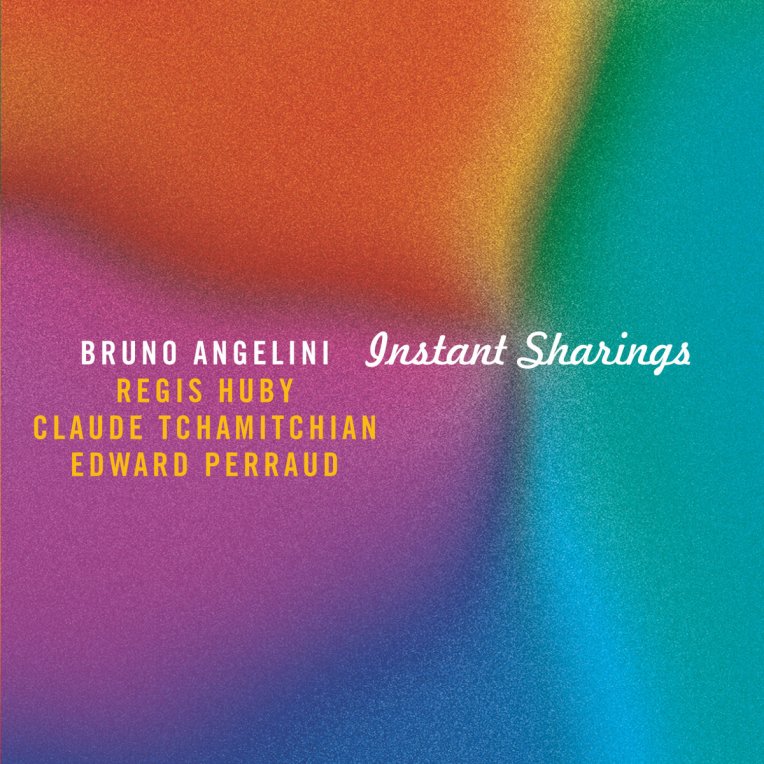
Bruno Angelini: Instant Sharings (RJAL 397022)

Cover

Bruno Angelini
Instant Sharings

Bruno Angelini piano
Régis Huby violin, tenor violin, electronics
Claude Tchamitchian double bass
Edward Perraud drums, percussion
Recorded June 16-18, 2014 and mixed November 10/11, 2014 at Studios La Buissonne by Gérard de Haro
Mastered by Nicolas Baillard at Studios La Buissonne
Release date: June 2, 2015

Pianist Bruno Angelini convenes his quartet with violinist Régis Huby, bassist Claude Tchamitchian, and drummer-percussionist Edward Perraud in this album of odes to what came before and songs for what has yet to be. Though the set list is largely made up of originals, it’s bookended by two versions of Paul Motian’s “Folk song for Rosie.” Each is a sun-kissed drizzle of cymbals in keeping with the composer’s preference for fluid color over solid form, and holds the other tunes in a loving embrace.

Wayne Shorter’s “Meridianne – A Wood Sylph” is another percussive wonder, giving away its secrets as if in slow motion and with an understated approach to beauty. The last outlier comes clothed in the melody of Steve Swallow’s “Some Echoes.” Its bowed strings align over pianistic arpeggios and other connective tissue: a musical illustration of synapses in a giant brain. It’s also a highlight for its melodic strength, robust yet airy arrangement, and harmonic finish.

As for Angelini’s tunes, they vitally hold their own against these cousins of creative spirit. Evocative not only for their cosmic scale, as in the quantum mechanics of “Solange” or the onomatopoetic “Be Vigilant” (the latter a stunner for its churning ocean of piano, drums, and echoing strings), but also for their titles (“Home by another way” and “Open land” personal favorites among them), these dreams within dreams pulls threads of cognizance from one subconscious beacon to another. “Romy” plucks said thread like a giant instrument, unleashing a theme song for the soul, before landing smoothly in the groove of “Immersion.” Walking a thin line between sleeping and waking, only to find that neither applies, it sheds its allegiances to chronology in favor of a more eternal language.

A standout in the La Buissonne catalog.

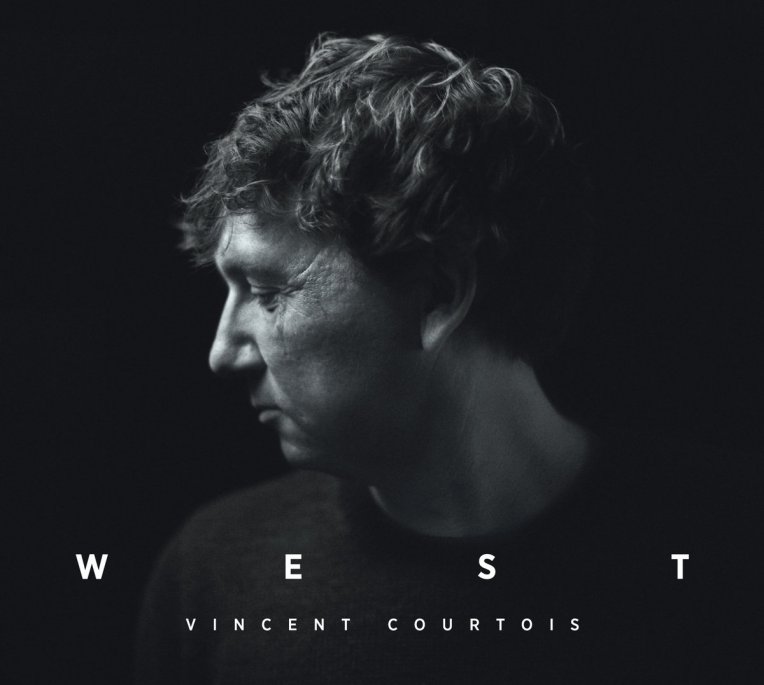
Vincent Courtois: West (RJAL 397021)

Cover

Vincent Courtois
West

Vincent Courtois cello, vocal guide
Daniel Erdmann tenor saxophone
Robin Fincker clarinet, tenor saxophone
Benjamin Moussay piano, harpsichord, celesta, toy piano
Recorded September 1-4 and mixed November 20/21, 2014 at Studios La Buissonne by Gérard de Haro, assisted by Nicolas Baillard
Mastered Nicolas Baillard at Studios La Buissonne
Piano, harpsichord, celesta, prepared and tuned by Alain Massonneau
Produced by Gérard de Haro and RJAL, la Compagnie de l’Imprévu
Release date: April 21, 2015

Cellist-composer Vincent Courtois continues his traversal of original landscapes, this time heading West in the most metaphorical possible sense. That is, he isn’t so much interested in dividing the world into arbitrary hemispheres as he is in questioning the very notion of borders as delineations of sociopolitical division and hierarchy while proceeding in a continuous direction. This philosophy is most forthrightly expressed in “So much water so close to home,” of which his pizzicato backbone and multitracked arco accents paint a living picture of the here and now as a means of putting the past into relief. His movements are palpable and consciously articulated, as Courtois himself notes in this album’s press release: “Conceiving, writing and orchestrating notes, almost like they were a travel plan, has become the main axis of my work, one that I cannot do without. A recording studio is a place like no other, these musical roads unwind and come alive.” Where on his last album, he explored such territories with saxophonists Daniel Erdmann and Robin Fincker, this time he welcomes also the structural backbone of Benjamin Moussay on piano, celesta, harpsichord, and toy piano.

Framed by two versions of “1852 mètres plus tard,” this sonic itinerary cushions every step in its picturing of time. Throughout “Modalités,” Fincker plays clarinet, later weaving with Erdmann’s tenor into a dramatic finish. From the brooding and distant (“Nowhere” and “L’Intuition”) to the whimsical and dramatic (“Freaks” and “Tim au Nohic”), every mood blossoms photorealistically. Moussay’s keyboards, especially the celesta and harpsichord of the title track, provide a Steve Reich-esque backdrop as multiple cellos dot the landscape with travelers. All of this funnels into the insistence of “Sémaphore,” throughout which the cello, divided into itself, draws an orthography of the soul for wayward ships to follow when lighthouses have used up their remaining oil. Moving ever forward yet glancing back to make sure that every footprint is a worthy record of what came before, each vessel docks safely to ensure our safe return.

Jean-Marie Machado/Dave Liebman: Media Luz (RJAL 397020)

Cover

Jean-Marie Machado
Dave Liebman
Media Luz

Jean-Marie Machado piano
Dave Liebman saxophone
Claus Stötter flugelhorn, trumpet
Quatuor Psophos
Eric Lacrouts violin
Bleuenn le Maitre violin
Cecile Grassi viola
Guillaume Martigne cello
Recorded live December 7, 2012 at NDR, Hamburg by Michael Plötz and Gérard de Haro
Sound Design by Andreas Paff
Production in Hamburg: Norddeutscher Rundfunk 2012
Executive Producers for NDR: Axel Dürr and Stefan Gerdes
Licensed by Studio Hamburg Distribution & Marketing GmbH
Recorded live January 25, 2014 at Centre des bords de Marne, Le Perreux by Gérard de Haro
Licensed by Cantabile
Mixed in June 2014 by Gérard de Haro at Studios La Buissonne
Mastered by Nicolas Baillard
Release date: November 18, 2014

Pianist Jean-Marie Machado and saxophonist Dave Liebman have been collaborating since 2003. For their third album, recorded live by Gérard de Haro for La Buissone on December 7, 2012, the duo welcomes trumpeter Claus Stötter and the Psophos Quartet for a program of uniquely melodic dreams.

Most of the set list was composed by Machado, and among his writing the title track is an atmospheric gem of sumptuous and cinematographic tendencies. The blending of string quartet with Liebman’s soprano and Stötter’s flugelhorn is magical, while piano comments selectively, engagingly. Machado’s “A noite (fado suite)” and “Snake sonata” are in three parts. Where the former is well-pruned, the latter walks a more overgrown path through emotional territories. A solo piano passage at its center, sweeping and spiraling inward, makes it a highlight. Liebman and Stötter crosstalk amiably in both, while the Psophos Quartet doesn’t just decorate but fleshes out real implications from within. Those same strings widen the camera of “La tarde silenciosa” and in the four-part “Same place different times” lift Liebman’s soprano like a brush on high.

The saxophonist’s own writing is as flexible as his playing. The mosaic of “Breath” is moody, that of “Snow day” more dance-like. “An old friend” closes the gap with a transparent stopper. Liebman’s is a voice to be heard with every fiber, and rewards what isn’t always easy listening with assurance of life.

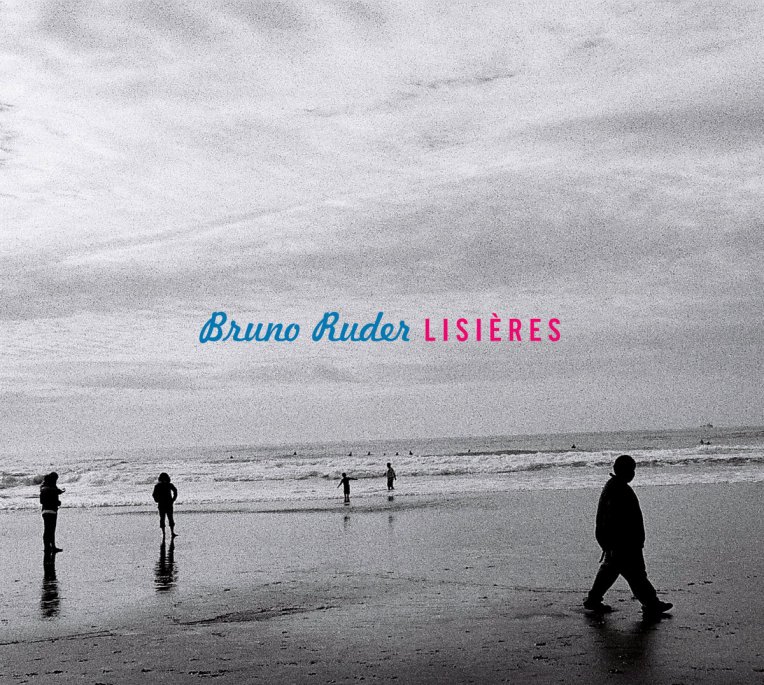
Bruno Ruder: Lisières (RJAL 397019)

Cover

Bruno Ruder
Lisières

Bruno Ruder piano
Recorded May 21, 2013 and mixed February 7, 2014 at Studios La Buissonne by Gérard de Haro
Mastered by Nicolas Baillard at Studios La Buissonne
Piano prepared and tuned by Alain Massonneau
Produced by Stephane Oskéritzian, Gérard de Haro and RJAL for La Buissonne
Release date: June 3, 2014

Lisières (Fringes) is a collection of self-styled short stories for solo piano composed and performed by Bruno Ruder. Ruder’s style lives in the deeper recesses of his instrument. He seems particularly interested in natural resonance, which engineer Gérard de Haro is more than willing to embrace with gentle persuasion. By way of “Ce qu’on appellee,” initial stirrings within are openly drawn. He lets these instincts pour themselves into themselves, like circular pitchers of musical water in another dimension. The more ideas flow into each other, the more convoluted they become. Yet Ruder makes lucid sense of them—enough to draw a comet’s tail to finish.

In “Yojimbo,” if named for the popular 1961 film by Akira Kurosawa, I can detect nothing by way of association except to say that it paints a world long gone. None of that samurai spirit is found here, except perhaps in the tangled dance of cause and effect that besets its final waves of energy. The title of “L’agglutination des pensées” (The agglutination of thoughts) is a far more accurate description of the Ruder mode. It’s a stormy sea of evocation that expands its territory with every block chord. “Des recoins” is in the same vein, albeit tenderer in its insistence on being heard. “Obligation~Évagation” is a conversation between a divided self. Plowing soil both damp and arid, it mixes both until a middle ground takes shape. At last, “Ce qu’on retient” takes all of these orthographies and compacts them into an even grander language. Phenomenal runs in the right hand almost taunt the left for its regularity and achieve a lyrical confluence as they ascend a ladder into self-awareness.

A deeply psychoanalytical listen that requires us to keep our heads on the couch for its duration, letting our ears do the talking.

ETE Trio: Sad And Beautiful (RJAL 397018)

Cover

ETE Trio
Sad and Beautiful

Andy Emler piano
Claude Tchamitchian double bass
Eric Echampard drums
Recorded July 1/2 and mixed August 14/15, 2013 at Studios La Buissonne by Gérard de Haro, assisted by Romain Castéra
Mastered by Nicolas Baillard at Studios La Buissonne
Piano prepared and tuned by Alain Massonneau
Produced by Gérard de Haro and RJAL for La Buissonne Label
Release date: January 28, 2014

The ETE Trio—whose acronym stands for pianist Andy Emler, bassist Claude Tchamitchian, and drummer Eric Echampard—spins of its most fragrant fields on record with Sad and Beautiful. “A journey through hope” takes its first steps by gliding rather than walking, speaking through arco bass as if it were an amplifier of the soul. Cycling between ambient stretches out of time and heavy grooves steeped within it, the 11-minute opener actualizes a philosophy built on the permanent spaces between things rather than the ephemeral accomplishments linked to said things themselves.

This balance between the material and immaterial is what distinguishes ETE’s musical acts from their traditional counterparts and is reflected in a tendency to change things up from track to track. Note, for example, the brief and pliant train ride through memories on the verge of fading completely that is “Last chance,” yet which despite those grand implications sits up against “Elegances,” in which a more cellular approach to thematic development lets in the light of spontaneous interaction shine through panes of glass to a trifold interior.

A chain of topographical associations ensues. “Second chance” dips the piano in a dark green lake of bass and rippling cymbals before setting up a campfire near it in “Tee time” and planting a spray of delicate underbrush in “By the way.” Last, we are led into the melodic ellipses of “Try home,” cast into the night like a fishing line from the heart.

While each musician is fantastically talented in his own right, in the present formation I feel like any attempts at separation would do them a disservice. And so, the instinct to shorten their names to a single palindrome makes perfect sense. Such is the nature of their collective spirit.

Bill Carrothers: Love and Longing (RJAL 397017)

Cover

Bill Carrothers
Love and Longing

Bill Carrothers piano, voice
Recorded and mixed by Gérard de Haro at Studios La Buissonne, Pernes-les-Fontaines from 2005 to 2013
Release date: June 18, 2013

Despite having recorded pianist Bill Carrothers many times at La Buissonne, producer Gérard de Haro had never known Carrothers as a singer until he heard him hum a tune during some post-session downtime. Unable to let the opportunity pass, he set up a microphone and recorded this album of piano solos and songs, each performed in a distinctly personal style. As de Haro recalls: “We were no longer in the studio, nor were we in a normal time frame either—we were all in a state of absolute grace, love and peace.”

Though not a vocalist by trade, Carrothers has a natural delivery that pairs well enough with the material at hand and makes for an endearing program. Truly striking, however, is his bold harmonization and pianistic unraveling. Across a terrain of carefully chosen standards, his neighborly diction brings ease and comfort to the fore. In “Mexicali Rose” (Helen Stone/Hack Tenney) and “Moonlight Becomes You” (Jimmy Van Heusen/Johnny Burke), we find the words in lush yet never overblown settings as he unfolds gorgeous midsections for improvisational outpouring. From “The L & N Don’t Stop Here Anymore” (Jean Ritchie), a bluegrass song from 1965 about coal miners (its steady pulse recalls the steam engines of old), to “Three Coins In The Fountain” (Jule Styne/Sammy Cahn), he sheds one expansive layer after another. A standout is “A Cottage For Sale” (Larry Conley/Willard Robinson), in which a clockwork intro and sweeping arrangement give legs.

Interspersed throughout these is a veritable pinwheel of originals. Though mostly for piano alone, they find him singing more than ever. With a restlessness not unlike that of a lover’s heart, Carrothers pulls us through balladry, a splash of dissonance, and brightly lit expanses all the same. As a film reel come to its close, it winds down to stillness—a slow-motion sequence fading to black. To give the ending credits a soundtrack, he offers his most optimistic setting: that of “Skylark” (Hoagy Carmichael/Johnny Mercer), which features his birdlike whistling.

Despite the piano’s drape of reverb, Carrothers plays as if giving a home concert for close friends and family. And to this we are privy for, as one Cole Porter lyric puts it, “a night mysterious.” About as organic as it gets.

Caravaggio: #2 (RJAL 397016)

Cover

Caravaggio
#2

Bruno Chevillon bass, double bass, electronics
Benjamin de la Fuente violin, Mandocaster, electric tenor guitar, electronics
Eric Echampard drums, percussion, electronics
Samuel Sighicelli Hammond organ, sampler, synthesizers (Korg and Minimoog)
Recorded at Studios La Buissonne by Nicolas Baillard and Gérard de Haro
Mixed by Nicolas Baillard, Gérard de Haro, Samuel Sighicelli and Benjamin de la Fuente
Mastered by Nicolas Baillard at Studios La Buissonne
Release date: November 20, 2012

This blending of jazz, rock, and electronic idioms wraps its eclectic arms around bassist Bruno Chevillon, guitarist Benjamin de la Fuente, drummer Eric Echampard, and keyboardist Samuel Sighicelli. As Caravaggio, they elicit a sound not like the paintings of their namesake: boldly portraitive, making use of deep contrast, and vibrantly expressive. Opener “Polaroid” builds to slow fruition over an eight-minute span, pulling from the electric guitar an entire film’s worth of scenography. The cleverly titled “Dennis Hopper Platz” digs further into the muck of postmodern angst but eschews the ennui in favor of a hip, bass-driven embrace of sound bites from Easy Rider before finishing in a hush of data. As if drawing from that same font of digital wisdom, “Aguirre” spins an open-ended projection of bygone fantasies across alluring electronic doctrine.

“When will you be angelic” pays tribute to the Hammond organ. Its old-school Jan Hammer vibe reads like a jazz performance attended only by androids. “Anybody here?” is an even more explosive catapult through gigabytes of information. Riding in a vessel of light, it zooms at speeds unimaginable to the physical body into the industrial ambience of “Beth’s variation.” Following this, “Medusa” drops its heavy dose of outro prog rock, replete with skittering violin for contrast. If the aforementioned were measured in gigabytes, “Profundo” is a veritable terabyte. As drums, guitar, and synth combine to show us the way to transformation, we leave ourselves behind, one cell at a time, until only impulse remains, shot in countless directions.

Like the soundtrack to a lost Philip K. Dick novel, #2 breathes in tune with synthetic animals, black boxes, and panoptical realities. A rage against the machine, by the machine.