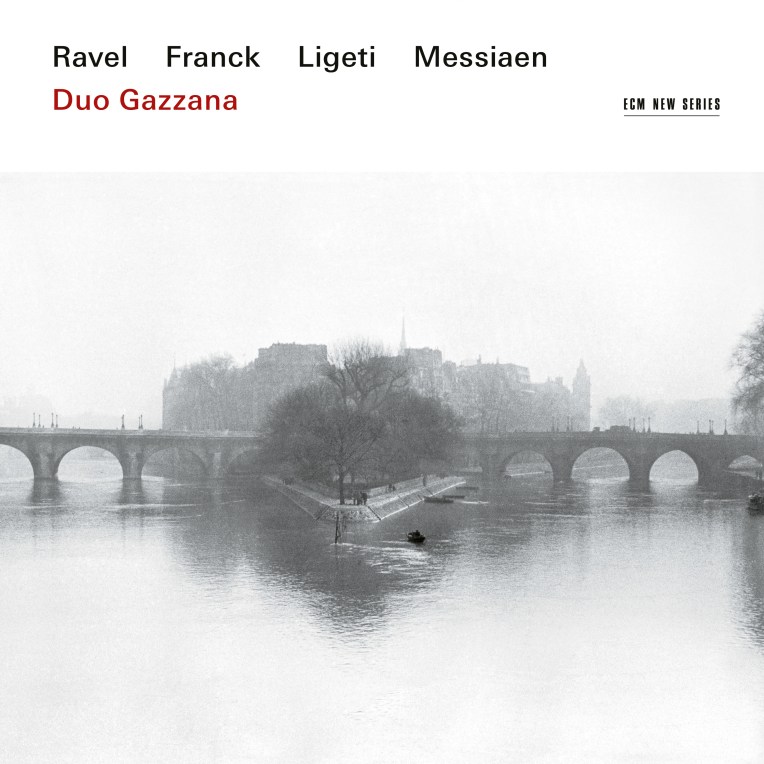
Duo Gazzana: Ravel/Franck/Ligeti/Messiaen (ECM New Series 2556)

2556 X

Duo Gazzana
Ravel/Franck/Ligeti/Messiaen

Natascia Gazzana violin
Raffaella Gazzana piano
Recorded March 2017, Auditorio Stelio Molo RSI, Lugano
Engineer: Markus Heiland
Produced by Manfred Eicher
Release date: April 20, 2018

For their third ECM New Series recital, violinist Natascia Gazzana and pianist Raffaella Gazzana deepen their conversation as soulful interpreters, if not also as interpreters of souls. Presenting four composers of spatial disparity yet creative overlap, they engage music that requires listening, respect, and emotional integrity. I recently asked them via email to talk about the new album, and how it differs from previous recitals.

“It takes us a long time to put together meaningful and organic programs, either for a recording or for public concerts. Usually in our recitals we span the gamut from established pieces of the classical repertoire to contemporary and less commonly performed pieces—or even totally unknown ones, such as György Ligeti’s Duo in this program. Our previous recordings were mostly focused on repertoire from the 20th up to the 21st century. On this album we went a bit further back in time, as we do in live performances.”

The Ligeti Duo is a brief yet narratively rich piece that receives its premiere recording here. Each character of this newly recovered folktale recalls the joys of childhood in exquisite detail, it searches for dialogue but instead discovers a soliloquy split into its component parts. And why, one wonders, did a piece by such an established modern composer get buried for so long?

“We have always loved Ligeti’s music and were wondering how it could be that he had not written any piece for violin and piano, a combination attempted by all composers. Only after looking through his catalogue attentively did we discover the Duo. Written in 1946, when he was only 23 years old, it was dedicated to György Kurtág and languished in a drawer. Most likely it was performed only for an inner circle of friends.”

The Gazzanas expended much effort to secure the rights to record the Duo, and the score, they note, has yet to be published. Heard alongside the 1932 Thème et variations of Olivier Messiaen that follows, it inhales shadow as Messiaen exhales sunshine. The Thème et variations is a wedding gift to the composer’s first wife, violinist Claire Delbos, and as such glows with adoration. The piano stretches a canvas for the violin, whose brushwork ranges from ponderous to effervescent.

While these two youthful compositions comprise the program’s second half, the first begins with Maurice Ravel’s Sonata posthume. Although composed in 1897, when Ravel was 22, his first chamber work wouldn’t see the light of day until 1975. Its combination of robustness and delicacy is masterfully recreated here. The initial violin line skitters through underbrush, its movements captured by the piano and rolled into a ball of spirited wonder. Fantastical elements omnipresent in Ravel’s later works are foreshadowed, but sway in and out of frame with the lilt of a windblown branch. Like water taking different forms, some moments drip through open fingers, while others evaporating as if from a distant lake, and still others polish to a reflective sheen. When playing such music, say the Gazzanas, “we concentrate on the sound quality and not getting distracted away from the structure of the work. We would think mainly in terms of sound story more than a visual narrative.” In that respect, sound structures are apparent even when silence is in order.

Because Ravel modeled his Sonata posthume on César Franck’s Sonate for piano and violin in A major, it makes for a natural inclusion. The Franck sonata was, in fact, the album’s seed:

“It is a real masterpiece and has a highly structured, cyclical form. Too often, when talking about French music, you may hear it spoken of in terms of delicate and refined sounds, nuances, and colors. Franck gave an impetus to the so-called French School and this sonata represents a cutting edge in composition that significantly influenced many subsequent composers.”

Originally written for Eugène Ysaÿe, it eschews showiness to spotlight the evocative abilities of its performers, who in this instance regard romanticism with a studied gaze. The second movement is a rolling tide of memory made flesh by the touch of these humane performers, while the third bridges a synapse of utter enchantment. As the profoundest example of communication between the Gazzana sisters, it is rich with unspoken language and metaphysical translations. The final movement walks a high tightrope in the violin, scaling down rocky terrain into an immaculately pruned path.

In combination, these selections offer a cumulative effect of consideration:

“Every piece included on the album represents our present vision. We enjoy immensely the fact that everything we have performed over many years has always sounded fresh to our ears. Every time we approach a work, we look for some new details or aspects to bring out. We are perfectly aware that we still have so much to learn and that every state of mind or stage in life can provide new impulse to our performances.”

Aiding in that process are producer Manfred Eicher and engineer Markus Heiland. Their contributions reveal hidden shades of meaning:

“Every stage of the recording process is important in bringing out the best sound quality possible. Manfred and Heiland were particularly attentive to microphone placement, and even before that to the placing of instruments in the studio. A lot of time was dedicated to finding out how to listen to each other, so as to balance the instruments’ levels. We went back and forth to the control room, listening to the results until we were satisfied with the purity of the sound. The final editing, the choice of the order of the compositions on the album, as well as the pauses between a piece and another also contributed to a lengthy creation process.”

By its end, forged together as a seamless story, the album beckons us like an open book, anticipating with great joy the experiences that await us.
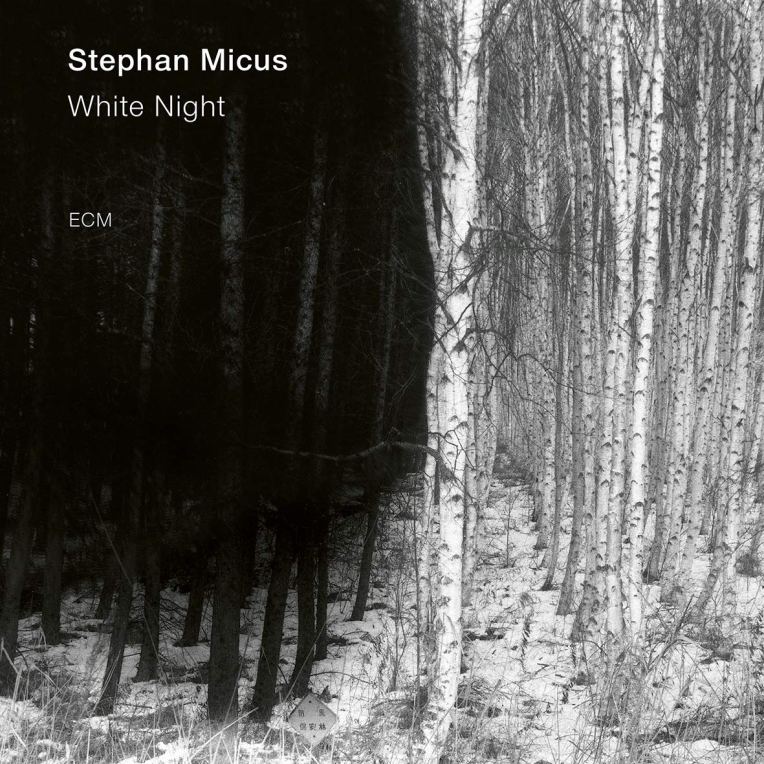
Stephan Micus: White Night (ECM 2639)

White Night

Stephan Micus
White Night

Stephan Micus guitars, duduk and bass duduk, cymbals, kalimba, sinding, dondon, voice, cane whistles, nay
Recorded 2016-2018 at MCM Studios
An ECM Production
Release date: April 26, 2019

Though the purity of the moonlight has silenced both nightingale and cricket,
the cuckoo alone sings all the white night.
–Anonymous, Japanese

White Night is Stephan Micus’s 23rd solo album for ECM and might just be his most inwardly focused. Figuring centrally in this sojourn is the kalimba, which through various incarnations hosts us at six of the ten waystations marking our path.

The bronze kalimba—a modern version of this ancient instrument—makes magical appearances in “The Forest” and “The Bridge.” Both tracks feature purely phonic vocalizations. The latter song multiplies the kalimba by four and adds the sinding, a West African harp with cotton strings that resonate through a gourd. As one of his most evocative pieces to date, it seeks meaning in selfless regard. Other vital stars in this constellation include “The Poet” (kalimba, sinding, voice), in which the voice primes soil for harvest; “The River” (2 kalimba, duduk), which elicits gamelan-like textures and suspends the duduk in gentle persuasions of moonlight; and “Fireflies” (kalimba, sinding, 13 Indian cane whistles, 7 voices), which renders the earth an altar for vocal offerings. And then there is the kalimba solo “All The Way,” touched by the souls of a faraway people. Each is a journey within a journey, a story within a story, a prayer within a prayer.

Framing the album are “The Eastern Gate” (5 fourteen-string guitars, bass duduk, Tibetan cymbals, steel-string guitar) and “The Western Gate” (5 fourteen-string guitars, bass duduk, sinding, Tibetan cymbals). Their fourteen-string guitars have a slack, liquid quality, which by virtue of their human construction (they are designed by Micus) reveal more-than-human energies. Harmonics speak of realms beyond the senses, while the bass duduk tenders its grace. From one gate to the other, we embrace the world in the span of 50 minutes, starting the cycle anew. Along the way, we stop to view “The Moon,” wherein a role that might normally have been filled by lone shakuhachi finds a multivalent replacement in the double-reed duduk. Like the nay that appears alongside the Ghanaian dondon (or talking drum) in “Black Hill,” it is a thought made incarnate by contact of skin and breath.

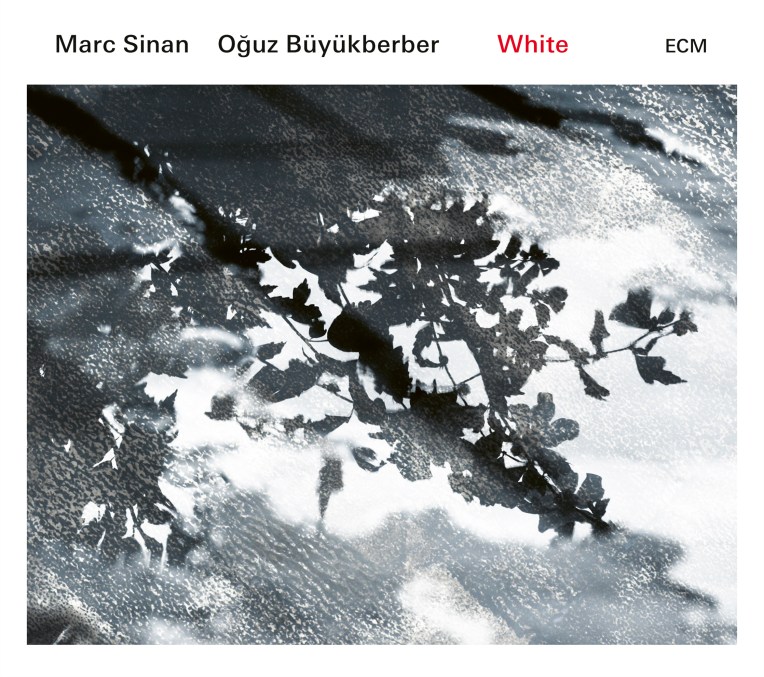
Marc Sinan/Oğuz Büyükberber: White (ECM 2558)

2558 X

Marc Sinan
Oğuz Büyükberber
White

Marc Sinan guitar, electronics
Oğuz Büyükberber clarinet, bass clarinet, electronics
Recorded October 2016, Rainbow Studio, Oslo
Engineer: Jan Erik Kongshaug
Produced by Manfred Eicher
Release date: May 18, 2018

No matter where I am yet I shall not forget our mournful songs,
Shall not forget our steel-lettered books which now have become prayers,
No matter how sharply they pierce my heart our wounds so soaked with blood,
Even then I love my orphaned and my bloodied, dear Armenia.
–Yeghishe Charents

On White, German-Turkish-Armenian guitarist Marc Sinan and Turkish clarinetist Oğuz Büyükberber join more than forces, blending history and all-but-forgotten biographies into a mosaic of reckoning. After working together in the much larger ensemble of Hasretim: Journey to Anatolia, they now present their first recording as a duo, and the result of their collaboration is one of the most ghostly albums to be released on ECM in recent years.

The program consists largely of a suite by Sinan entitled upon nothingness. Combining field recordings from 1916 of Armenian prisoners of war in German detention camps, it is divided into colored subsections of yellow, blue, green, white, and red. The field recordings add a sense of mystery, trickling from cracks in the wall around this unthinkable past while also seeming to scale said wall from a peaceable future. Caged folksongs—each a cry for freedom in places where such a concept feels as distant as the sky—act as catalysts for our two performers, who in their present clarity touch the looking glass of retrospection as if it were a talisman close to breaking. Electronics flood the air, foregrounding inner turmoil.

Sinan’s guitar is multivalent, at one moment tracing a barbed yet invisible border of hatred around the afflicted while the next igniting that ring as a halo of grace. Tents and squalid conditions peak from the images of a lost era like glaciers whose tips only hint at the immense traumas fanning out beneath the surface of a collective amnesia. As lost souls whose only hope is to be grasped like wisps of creative thought, their echoes give rise to electronic embraces wider than any arms of flesh could accommodate. In the album’s eponymous “white” section—a guitar piece written by Büyükberber and transformed by Sinan—we encounter shooting stars, forced to observe from a darkness without ornament.

Interspersed throughout is Büyükberber’s five-part there. Painting a more straightforward, though no less inspired narrative, it strikes a free jazz kaleidoscope, opening windows into windows into windows. Sheltered by their fragmentary architecture, symbiosis becomes the norm, and we as individual agents the exceptions taking in their stories as if they were our own.

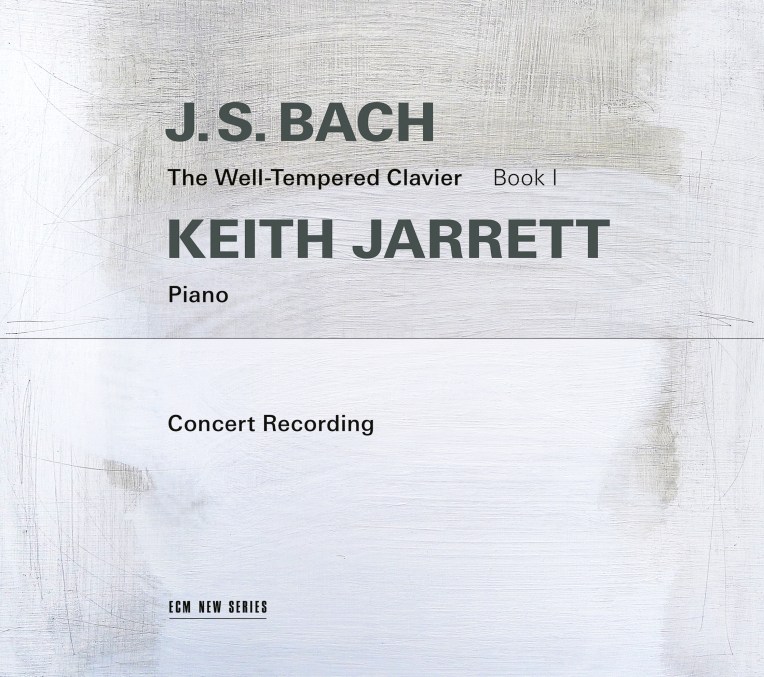
Keith Jarrett: The Well-Tempered Clavier Book I (ECM New Series 2627/28)

2627|28 X

Keith Jarrett
The Well-Tempered Clavier Book I

Keith Jarrett piano
Concert recording, March 7, 1987
at Troy Saving Bank Music Hall, Troy, New York
Engineer: Tom McKenney
Mastering: Christoph Stickel
Executive producer: Manfred Eicher
Release date: June 14, 2019

After recording Book I of Johann Sebastian Bach’s The Well-Tempered Clavier for ECM on piano in February of 1987, on the 7th of March that same year he performed it live at the Troy Savings Bank Music Hall in upstate New York. Throughout this archival recording, we see a side of Jarrett not so much hidden as broken wide open in his life as an improviser. His restraint is poetry in motion, figuring this masterful music with a touch that’s intimately bound to the score. Even in the more dramatic flourishes of the c minor and C-sharp major preludes, there’s a sense that he is submerging any impulse to flourish in a bath of deference.

KJI

In Jarrett’s hands, each pairing of prelude and fugue takes on the very character one presumes it was meant to have: which is to say, standing with resolute individuality as part of an interlocking embrace that cannot be broken apart. Issuing from these portals is a spiritual force that weaves between realms as Jarrett between notes. When he slips from the realm of C into that of D, where the latter’s major dyad feels blessed by a watery hand, he clarifies Bach’s inversions, rendering minor keys as stages for joy and their major counterparts as jumping points for faith.

KJII

Whereas D has its playful veneer, E casts aside all notion of folly and turns even the liveliest fugue into a fierce puzzle of longing. The e-flat prelude is an especially ponderous example of composer and interpreter working in harmony to communicate truth. That said, there’s no Platonic ideal lurking within, but rather a feeling tailored to every listener. If any exuberance is to be found in this phase of the journey, it’s in the e minor fugue, but even there it looks rather than speaks through a filter of tangled intentions. In light of this, the F major prelude’s wider net lets through more than it catches, interested as it is in preserving the terms of its passage. Landfall is suspended until the F-sharp major prelude, wherein Jarrett wears the tenderest of hearts on his muscled sleeve, and pulls out a treasure map in the key of f-sharp minor.

And treasure he does indeed find in G terrain, of which major and minor preludes yield their respective fugal gems. All the while, rewards of the A major prelude have awaited our triumphal return, hoisting up flags and drinks alike in the manner of tribute. Thus, we are primed for the B-flat major prelude, in which Jarrett’s quick-thinking fingers revel in the joy of safety. In closing, the b minor pairing embroiders a dream in waking filament. Its every stepwise turn introduces a new color in the tapestry and tempers the final fugue with intimations of obscurity, morality, and nothingness. The flesh may only whisper, but by now we know the calling of a higher power whose volume—though compressed into a single keyboard—matches that of millions more in aggregate.

Reto Bieri and Meta4: Quasi morendo (ECM New Series 2557)

Quasi morendo.jpg

Reto Bieri and Meta4
Quasi morendo

Reto Bieri clarinet
Meta4
Antti Tikkanen violin
Minna Pensola violin
Atte Kilpeläinen viola
Tomas Djupsjöbacka violoncello
Recorded November 2016, RSI Studio Zürich
Engineer: Peter Laenger
Produced by Manfred Eicher
Release date: May 10, 2019

When clarinetist Reto Bieri made his solo ECM debut with Contrechant, Salvatore Sciarrino’s Let Me Die Before I Wake (1982) was the most memorable piece of that program. Here, its unaccompanied wonders make a welcome reappearance, inciting an altogether different journey through works of Johannes Brahms and Gérard Pesson. Sciarrino’s sense of color is downright prismatic, separating the white light of breath into its constituent spectrum through deft use of multiphonic and overtone techniques. There is a tenderness to this music’s unfolding, the occasional outburst from which feels somehow delicate, as if the materiality of it all were but a blip on the listener’s dreaming radar. Bieri himself would be the first to agree on the enigma of it all: “How the sounds come about in this piece,” he says, “is a mystery even to me.” That air of separation between knowledge and production, catalyst and effect, is at once tangible and immaterial. For while Bieri has total control over the sounds emitted by his clarinet, there’s that same daunting sense of physics found in Heinz Holliger’s 1971 Studie über Mehrklänge for oboe (documented by the composer himself on ECM 1340).

Brahms’s Quintet in b minor, Op. 115, finds Bieri in the dynamic company of the Meta4 String Quartet, themselves making an ECM debut. Written in 1891, after Brahms had already decided to retire from composing yet opened that door again when clarinetist Richard Mühlfeld came knocking, this masterwork is what Roman Brotbeck in this album’s liner essay calls “a swan song.” It is, he goes on to write, “freer, more idyllic, less ‘controlled’ than Brahms’s earlier chamber music, but is in fact one of his most strictly constructed compositions.” The opening Allegro is an exercise in dark exuberance, clarinet playing the role of voice among the voiceless. There is lyricism, robust anatomy, and fortitude of reasoning at work in every thematic shift. The following Adagio sees itself reflected in the opening mirror, tracing memories of younger days with fingers dipped in sunlight, but always returning to a baseline of melancholy resignation. The Andantino seems to cradle the most happiness in these shadows, and somewhat recalls the third movement of Brahms’s First Symphony with its subdued pastoralism. The final movement takes all the self-regard that preceded it and turns it into moving images. Like a cinema that predates its own technology, it flows across the screen of the mind in glorious performance.

Pesson’s Nebenstück (1988), what Brotbeck calls “an estranged instrumentation, or rather arrangement, for clarinet and string quartet of the ballade for piano, Op. 10 No. 4, that Brahms composed in 1854,” takes a decidedly internal approach to homage. With a frailty that rivals even the Sciarrino, it speaks in a shaded and subliminal language while peeling back layers of awareness graspable only behind closed eyes, as if the very sight of things would interrupt its grammar with unnecessary punctuation. A brilliant gesture of continuity in summary of a wonderous recital.

Anja Lechner/Pablo Márquez: Franz Schubert – Die Nacht (ECM New Series 2555)

2555 X

Anja Lechner
Pablo Márquez
Franz Schubert: Die Nacht

Anja Lechner violoncello
Pablo Márquez guitar
Recorded November 2016, Spiegelsaal, Residenz Eichstätt
Engineer: Stephan Schellmann
Produced by Manfred Eicher
Release date: November 2, 2018

In his book Franz Schubert: Music and Belief, the late Leo Black wrote of the Austrian composer as figure of faith whose image morphed from “carefree minstrel” to “a man sorely tried, living under a horribly oppressive regime, afflicted through his own miscalculation with a horrible disease that was bound to bring an untimely end and make his final years a sojourn in Hell.” In either reduction there is surely a bit of mythology at play, for in the music itself we find a third Schubert: one whose breadth was all of those and so much more.

Although none of us knew Schubert, in the present recording we feel like we did at one time: a childhood friend dangling at the edge of memory and now pulled into the foreground by two musicians who understand his unique ability to, as Wolfgang Sandner phrases it in his liner essay, “poeticise all that is real, to turn reality into a dream and the dream of a better world into reality, all with the means of music.” In this spirit, cellist Anja Lechner has returned to her foundational love of Schubert and, alongside guitarist Pablo Márquez, carves an intimate sigil into the ever-growing tree of interpreters.

The selections herein speak mostly of latter days, during which Schubert was perhaps as much chiseled by creative visions as said visions were by his approach to a score. All lead to the precise yet free-flowing melodies of Nacht und Träume, of which humane touches in both the composing and this performance wind through forest on their way to new experiences. As a beacon among the program’s shorter pieces, it shines inlaid light upon such other standouts as Der Leiermann (The hurdy-gurdy man), in which Lechner evokes the titular instrument with sul ponticello double stops; Fischerweise, which unspools its theme with forthright harmonic drive; and, of course, the album’s title work, in which past and future dreams melt in the crucible of a lively here and now. Further delights abound in the rarer Romanze, an anatomical study written as incidental music for Rosamunde, and the duo’s rendition of the a-minor “Arpeggione” sonata, a relatively optimistic portal in which even the most eruptive moments cling like ink on pages bound by aged leather.

While this would be enough for a robust sequence, through it all are interspersed three nocturnes by Schubert contemporary Friedrich Burgmüller (1806-1874). Originally written for cello and guitar, they stir the proverbial soul while healing its wounds with grace. As the air in different seasons, each takes on its own constellation of fragrances, temperature, and quality of light, shifting from introspection to full gallop and back again.

Die Nacht is one of those special albums that could only have taken place under the guiding hand of ECM. Resting within its compact circle is music of translucent beauty, recorded with a balance of depth and immediacy, by musicians who surrender themselves to every note, and all in the name of a composer whose footprints have plotted their own glowing path along the label’s historical trajectory, as one hopes they will continue to do.

Of Sound Faith: An Interview with Violinist and Educator Ruth Tumpalan

Sing unto him a new song; play skilfully with a loud noise.
For the word of the LORD is right; and all his works are done in truth.
Psalm 33:3-4

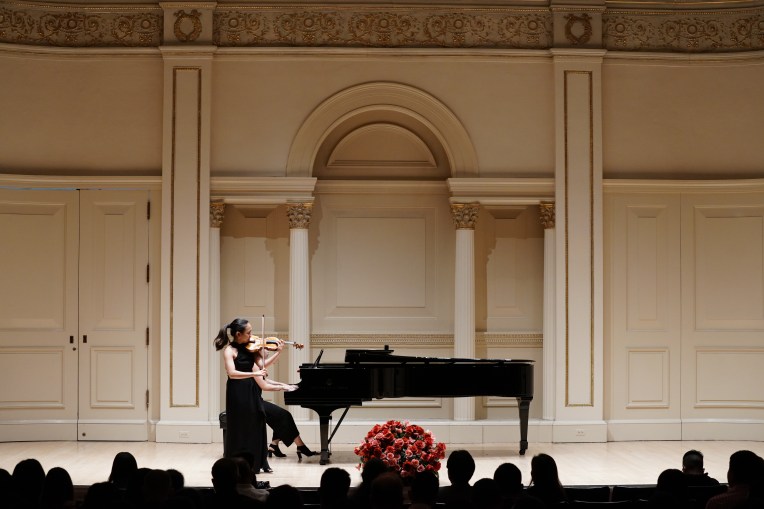
Born and raised in Manila, Philippines, violinist Ruth Tumpalan is a dedicated musician and educator. She is currently a faculty member at the Lindeblad School of Music, where her pedagogical zeal has earned her a place of distinction in the hearts of students. She has studied with such renowned classical artists as violinist Christoph Poppen and pianist Gilles Vonsattel, and has performed with a range of others across genres, from Jaime Laredo to Michael Bublé. Most recently, she won first place in the American Protégé International Piano and Strings Composition, and as a result of that honor was a featured soloist at Carnegie’s Weill Recital Hall in New York City. Her focus on cultural diversity is paramount and drives her to constantly improve her technique in all areas.

DSC_1615 2mb

Yet behind the glamour of performing on some of the world’s most hallowed stages, Tumpalan has found special fulfillment as part of the music ministry at Heritage Baptist Church in Manhattan. Her love of God and music have been intertwined since childhood, and manifest with especial depth in her work with the church’s choir as part of a vibrant ministry.

I recently sat down with Tumpalan via Skype to discuss the role of faith in her personal and professional life, asking first about her musical foundations.

“My father is a pastor, so we were all homeschooled, but when I was 10 he enrolled me and my siblings in an extension program at the University of the Philippines to study music. Two weeks later, I was playing in a Christian wedding officiated by my father. Since then, I’ve always played in church, both as a violinist and choir pianist.”

At the age of 12, Tumpalan got the chance to visit the United States with her father while he was touring churches. Upon returning home, she immersed herself in recordings and live performances, all the while cultivating a desire to pursue music as a profession. She went on to earn her Bachelor of Music degree at the University of the Philippines, with a focus on violin, graduating cum laude in 2009.

“After college, I played with the Philippine Philharmonic Orchestra, but after five years decided I wanted to develop myself even further through study. I had been praying since high school for an opportunity to study abroad, ideally in the U.S., in pursuit of new perspectives and higher standards. In 2014, God led me to a full scholarship to earn a Master’s degree at the University of Massachusetts.”

Tumpalan doesn’t take such blessings lightly and has always seen her gifts as God-given. While at UMass, however, she found herself at an impasse.

“There I was, halfway through my two-year program, contemplating what the Lord’s real will was for me. Did he want me to go back to the Philippines or did he have something bigger in store? It was a long journey, filled with prayer. But God provided, one step at a time, lining me up with a job before I even finished my degree. Although music had originally led me here to the U.S., I know in hindsight that it was actually God’s provision all along, working through all the little things to get me where I am now.”

Although Tumpalan’s husband was in Hong Kong at the time, he also earned a scholarship to study percussion at UMass, bringing them closer under an unseen but ever-felt guiding hand. They were further led to Heritage Baptist Church, where Tumpalan became immediately involved in the music ministry.

“Playing at Heritage is my priority. My job is important, but I like the need of going to church and being with brethren. It also enhances my career, leading me with strength through daily life and its many decisions. When I don’t go to church, even for just a week, I feel that my well-being is lowered.”

DSC_6088
(Tumpalan performs at Heritage Baptist Church)

And what, I asked, of her experience playing at Carnegie?

“I never thought I would get to play there as a soloist. I’d played there before with the Philippine Philharmonic, and thought that was going to be a once-in-a-lifetime experience. But then, last year, I was working with an excellent pianist named Jongsun Lee, who suggested we try out for the competition. With my full studio schedule, it wasn’t easy to manage practice time and teaching, but my teaching actually helped me to prepare. Certain things my own teachers had taught me before suddenly made sense. I never expected to get first place, but God made it possible.”

AmericanProtege-06-09-2019b-1652

For that performance, she chose Henryk Wieniawski’s formidable Scherzo Tarantelle Op. 16, a work brimming with the very excitement that stokes her appreciation for music as a means of communication.

AmericanProtege-06-09-2019b-1719

“The best feedback I’ve ever gotten as a musician is being told that I moved someone to tears. In that respect, in my playing I aim to be more of an inspiration, to connect with people at a level beyond words.”

This approach is integral to Tumpalan’s teaching, which builds upon the renowned methods of Shinichi Suzuki.

“I always make sure to explain to parents that the Suzuki method was designed to create better human beings through music, and that the most important things to learn from the experience are discipline, empathy, and cooperation. These are more than musical skills; they’re life skills. Without them, playing well and achieving success in music mean nothing. Whenever someone makes a mistake in my group classes, no one is allowed to point. They must respect themselves, first and foremost.”

As for the future, Tumpalan sees herself becoming even more involved in the church, and has been considering putting together a book of Christian music arranged for various instruments. Whatever may come, her faith will only continue to grow.

Praise ye the LORD. Praise God in his sanctuary:
praise him in the firmament of his power.

Praise him for his mighty acts:
praise him according to his excellent greatness.

Praise him with the sound of the trumpet:
praise him with the psaltery and harp.

Praise him with the timbrel and dance:
praise him with stringed instruments and organs.

Praise him upon the loud cymbals:
praise him upon the high sounding cymbals.

Let every thing that hath breath praise the LORD.
Praise ye the LORD.

Psalm 150

Kim Kashkashian: J. S. Bach – Six Suites for Viola Solo (ECM New Series 2553/54)

Six Suites for Viola Solo

Kim Kashkashian
J. S. Bach: Six Suites for Viola Solo

Kim Kashkashian viola
Recorded November 2016 and February 2017 at American Academy of Arts and Letters, New York
Engineer: Judy Sherman
Mastering: Christoph Stickel
Produced by Manfred Eicher
Release date: October 12, 2018

“Living with Bach: a true and faithful companion who patiently provides a merciless and transparent reflection of one’s failings in vision and simultaneously gives the deepest comfort in all circumstances.”
–Kim Kashkashian

If you were to unravel all the blood vessels contained in the average adult, they would stretch to a distance of 100,000 miles. And while the Six Suites of Johann Sebastian Bach (BWV 1007-1012) have always felt like such an unraveling, heard now from the viola of Kim Kashkashian, one becomes aware of that distance in an entirely new way. Whereas on the cello the extent of their totality feels surprising and overwhelming, here it takes an intimate, inevitable quality. In that respect, Kashkashian makes us believe that this music has passed through every molecule of her own body before a single note has tingled from the regard of a microphone.

Kashkashian heats expectation to the consistency of glass, cools it, and shines new light through its resulting prism by starting with Suite II in D minor. At first, one might miss the “depth” of the cello, but what the viola may lack in octave it makes up for with a resolutely vocal quality. With so much emotion at hand, the listener feels inadequate to contain it all. Yet both composer and interpreter assure us of having enough corridors within us to provide passage. In her rendering of the Sarabande especially, Kashkashian hasn’t so much revealed something once hidden by the screens of former performances, but taken the first pictures of this moon’s far side. Indeed, whereas other performers have focused on the face that’s always illuminated—whether by force of history or convention—Kashkashian shines her creative light onto a darker plane that was always there but for so long went unseen.

Only next do we find ourselves swaddled by Suite I in G major. At last, we get those familiar arpeggios, making their appearance all the more savory for their anticipatory marinade. What might normally be experienced as the seed, then, becomes the stalk born from that seed, at last graspable as an object of silent regard, not unlike the bow used to elicit its photosynthesis. Kashkashian shows her greenest spectrum in the Allemande, tracing every life-giving vein from edge to edge. Here, as also in the Courante that follows and the Menuet a skip beyond, she takes her time, allowing rhythms and ornaments to suggest their own variations and appearances.

Anyone missing the cello’s grit will find it dutifully preserved in C-minor Suite V. Between the angular Prélude and the laddering Gavotte, there’s plenty of sediment to be sifted through. The latter movement is a major turning point in that respect, and was for these ears the moment when the viola took on its spirit as a voice to be reckoned with in its own terms. What becomes clearer from this point forward is that everything Kashkashian plays is infused with as much of her being as Bach’s very own.

While “thinking out loud” is a descriptor often reserved for jazz improvisors, throughout Suite IV in E-flat major, Kashkashian shows us that classical musicians at the highest level are equally deserving of the accolade. Whether in every studied pause of the Allemande, masterful bowing of the Courante, or lively restraint of the duple Bourée, she shifts the light to reveal facets that, while forever singing, need a temporary amplifier to become audible.

Suite III, written in the fundamental C major, is a pantheon among temples, and therefore holds itself with a dignity that the other suites can only taste in shadow. Its own Allemande is another master class in syncopation and finds Kashkashian moving as would a linguist through a text so fully clothed in marginalia that, despite not being written in the native tongue, becomes second nature through years of anthropological internalization. So, too, the Courante, which leaps not from the strings but from the bow bidding them to resonate. Neither has the Bourée sounded so connected to its physical means, cracking in the ear like the softest of whips.

Just as the album began with the unexpected, so does it end as it should: with Suite VI in D major. Offering the most arresting Prélude of the collection, the microtonal rocking of which glows phosphorescently in its present handling, the suite is wisdom incarnate. The Sarabande is another manifesto of tenderness rarely so sustained, and delivers us like children into the dawn-drenched Gavotte. And where would we be but lost without its declamatory Gigue. Like its previous five counterparts, it gives us closure in order to hold us true to ourselves and our experiences. As Paul Griffiths in his liner essay notes of these farewells: “Gigues complete the landscape drawn in each key, not by the composer, not by the instrument, not by the performer, but by all three—complete it and leave.” We, however, stay behind, closing our eyes against the grain of what we’ve just heard in full knowledge that no such experience will ever honor us again. And so, we fold every artery, vein, and capillary we can call our own back into the suitcases of our skin, stepping back on the train of life and counting every track as we try to recall what it all felt like before these sounds compelled our detour into peace.

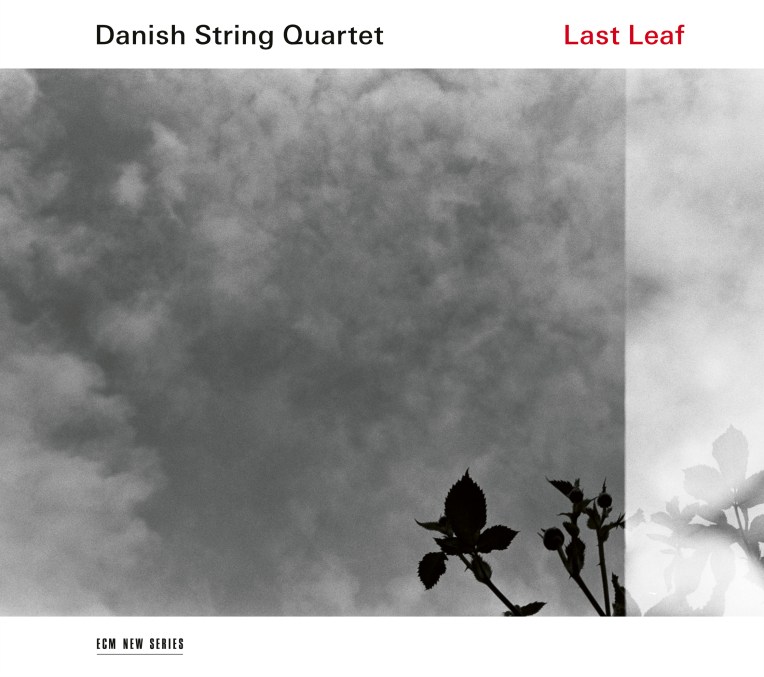
Danish String Quartet: Last Leaf (ECM New Series 2550)

2550 X

Danish String Quartet
Last Leaf

Rune Tonsgaard Sørensen violin, harmonium, piano, glockenspiel
Frederik Øland violin
Asbjørn Nørgaard viola
Fredrik Schøyen Sjölin violoncello
Recorded January 2017, The KirstenKjær Museum, Frøstrup
Engineer: Markus Heiland
Mixed June 2017 at Tritonus Studio, Stuttgart, by Rone Tonsgaard Sørensen, Manfred Eicher, and Markus Heiland (engineer)
Produced by the Danish String Quartet
Executive producer: Manfred Eicher
Release date: September 22, 2017

After an intimately electrifying 2016 ECM debut, the Danish String Quartet follow with this program of original arrangements so well suited to the source material that if their collective heart were a moon, it would be full and bright in the night sky of their creativity. The album’s seed is the Danish Christmas hymn “Now found is the fairest of roses.” First published by poet-theologist H. A. Brorson in 1732, it’s played as if in slow motion and captures the musicians in a film of artful restraint. That the tune concludes rather than begins the sequence is indicative of an underlying philosophy at play, in which stars regress back to their gaseous birth, mere wisps of galactic thought rendered sentient by the incubator of time.

At the other end of the spectrum is “Despair not, o heart.” This Lutheran funeral hymn, first notated in 1517, adds the elegiac cast of a harmonium, and with it the feeling of the open sea unraveled in “Shore.” Written by the quartet’s cellist, Fredrik Schøyen Sjölin, this self-described “folk fantasy” evokes sand and tide while also tracking the footprints left behind and washed away along its canvas. It finds later parallel in Sjölin’s “Naja’s Waltz,” a heartfelt piece of latticework that feels like a gift from father to daughter, and “Intermezzo,” a beautiful segue into “Shine you no more,” by lead violinist Rune Tonsgaard Sørensen. A reel partly inspired by John Dowland’s “Flow My Tears,” it moves kaleidoscopically and jigs its way across the grasslands.

Much of the liminal material at hand is Danish in origin, including the graceful “Minuet No. 60” from a 1760s collection of folk melodies transcribed by Rasmus Storm. Coordinated to the point of feeling untethered by convention, it moves as dancers in their prime. The song “Hur var du i aftes så sildig” (Where were you last night so late), from the same collection, treats pizzicato like a series of semantic puzzle pieces. Other highlights from this geographical focus are “The Dromer,” a so-called English dance collected by the Bast Brothers between 1763-1782, and “Æ Rømeser,” an example of the dance form known as the “sønderhoning,” unique to the southern Danish island village of Sønderho. Slow and sure, but transitioning into a more forthright sway, it grounds the listener as a prerequisite for leaving the earth behind.

Further travels take the quartet from the Swedish traditional “Polska from Dorotea,” attributed to fiddler Johan August Andersson (1866-1902) and filled with luscious interplay from the violin and the Faroese mythology of “Stædelil” to the astonishing sonorities of “Unst Boat Song,” an old Norse song from the Shetland Islands, and “Fastän,” a contemporary Swedish polska by Eva Sæther that ends with a trail of piano.

Regardless of origin, the quartet plays these all with such grace, attention to color, and scenic integrity, that where they’re going is never in question. In their handling, the last leaf becomes the first of another in a cycle of decay and burgeoning life, for which they are humble interpreters. We, in turn, are humbled to witness their unfurling.