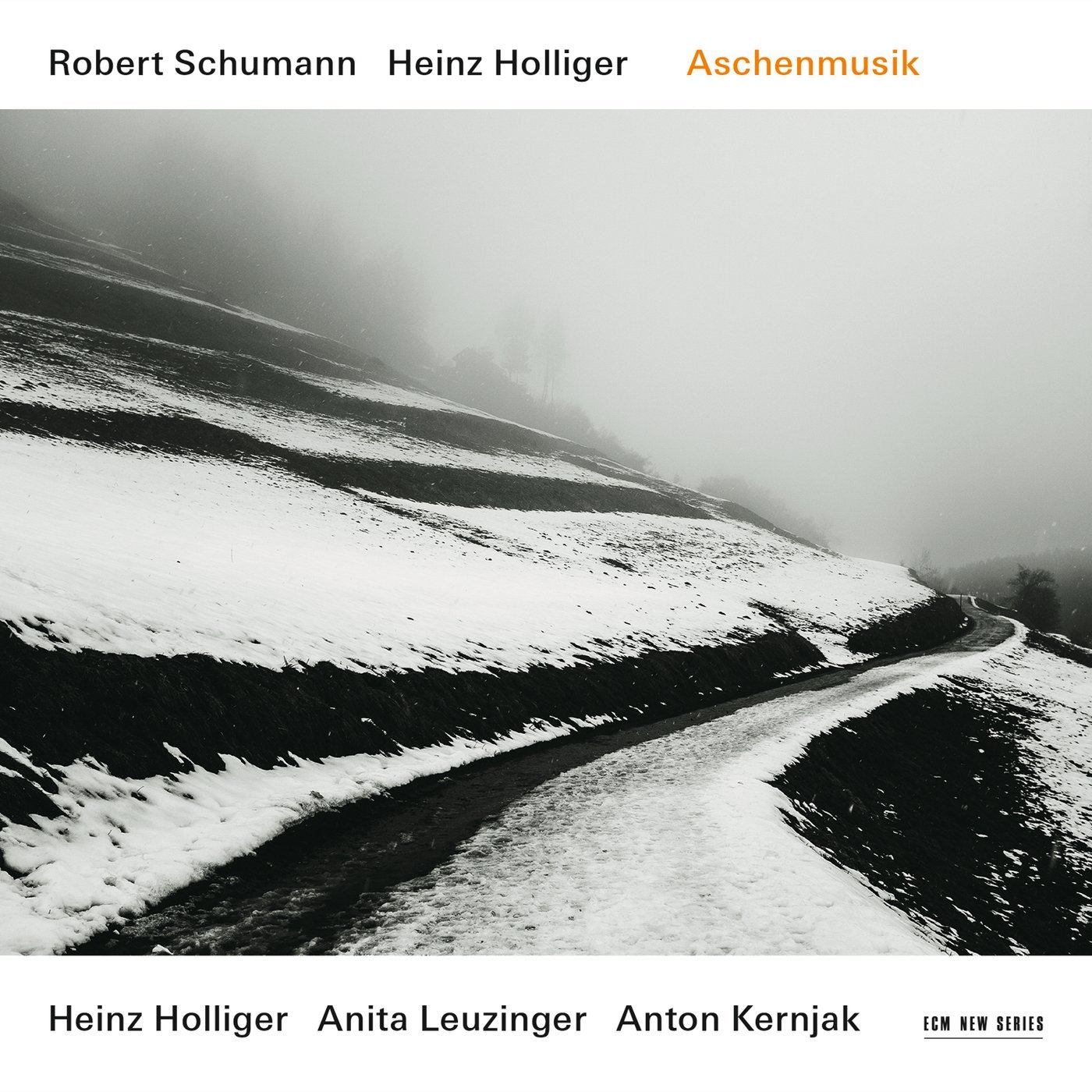
Robert Schumann/Heinz Holliger: Aschenmusik (ECM New Series 2395)

Aschenmusik

Robert Schumann
Heinz Holliger
Aschenmusik

Heinz Holliger oboe, oboe d’amore
Anita Leuzinger violoncello
Anton Kernjak piano
Recorded July 2012 and November 2013, Radio Studio Zürich
Engineer: Andreas Werner
Executive producer: Manfred Eicher
An ECM/SRF2 Kultur co-production
Executive producer (SRF): Roland Wächter

The solar system of Swiss oboist and composer Heinz Holliger has always thrived in a clockwork universe of innovation, but Aschenmusik may just be his most super nova yet. This second major ECM reckoning with the legacy of his much-admired Robert Schumann not only follows in the footsteps of Romancendres but also retreads them with finer shoes. By paying homage to Schumann’s Five Romances of 1853, forever lost to flames by wife Clara’s own consignment, Holliger works through personal frustrations over unrecoverable music by fleshing out the body of its ghostly narrative—the only indication that remains of its certain brilliance.

Romancendres is written for the same combination of cello and piano, and in this expanded version opens the ears to further allusions and cryptographies. Both instruments push their harmonic boundaries, thereby revealing—if not also reveling in—Holliger’s inner turmoil over the loss of Schumann’s score. Cellist Anita Leuzinger walks a tightrope, which like an electrical line through pruned trees carries energy powerful enough to kill. The cello’s vocal qualities and the piano’s percussive are magnified to the point of vulnerability, as emphasized in the fractures and tremors of the latter movements. Yet none of it approaches the masterstroke of the tensile second, in which pianist Anton Kernjak tinkers with a vessel that is constantly being broken by the Leuzinger’s need for sailing. The underlying now becomes the overlying and spins the globe not on an axis of poles but equator. In this decidedly rhythmic piece the piano is beaten, struck, and plucked while the cello ascends microscopic ladders and leaves only water-drop pizzicati to show for its swan dive.

Surrounding this modern morsel are some of Schumann’s latest and greatest, of which the Six Studies in Canonic Form, Op. 56, are a delight to hear in such fine company. Holliger, who here plays the violin part on the reedier oboe d’amore along with Leuzinger and Kernjak, makes a convincing case for these neglected masterworks. More than studies, they are fully matured bodies of exceptional beauty and proportion that effortlessly shine Baroque counterpoint through the foliage of Romanticism. Some are more playful and have an air of the salon, while others are gravid, tonic. Still others are more bucolic, but ever aware of the physical relationships between instruments. The marching fifth receives a particularly artful navigation of pianistic harmonies and rhythm changes, while the elegiac sixth ends on a sigh.

The Three Romances for oboe and piano, Op. 94, showcase Holliger’s peerless tone on the oboe. In these pieces he navigates an ocean swell of piano, its tidal differences yielding the wreckage of a crumbling mind. The insistent, even desperate, quality of the music speaks of an unrequited love that yearns to jump across vast stretches of barren landscape and straight into the heart of one who decomposes beneath it. The final movement unfolds like a map to a very different territory, leaving two shadows for every ray of light.

The second movement of the F-A-E Sonata, excised from a four-part exercise written in collaboration with Johannes Brahms and student Albert Dietrich, is an extant Romance. In this arrangement for oboe (originally violin) and piano, its lilting poetry serves as a bridge into Schumann’s First Violin Sonata, Op. 105, played here on cello. Yet even the glorious first and final movements can do little to conceal the darkness encroaching on Schumann’s cells. Such dynamic realism is not a fight against fantasy but an acknowledgment of its necessity. The central Allegretto follows an arc-like text, which the musicians read with such fluency and through which they relay objective punctuation and subjective expression.

True to the music, in which depth is to be found within the score, not around it, engineer Andreas Werner foregoes studio ornaments in favor of something less mitigated. Having deftly centered Holliger’s oboe on Ich hatte viel Bekümmernis and allowed the violin of Thomas Zehetmair and viola of Ruth Killius to reach out with so much of their spirits intact, Werner was an ideal choice for the present recording. Schumann’s art proves its centrality, activating as it does so much of what makes us live, even when we are no longer around to be aware of living.

(To hear samples of Aschenmusik, click here.)

Eleni Karaindrou: Medea (ECM 2376)

Medea

Eleni Karaindrou
Medea

Socratis Sinopoulos Constantinople lute & lyra
Haris Lambrakis ney
Nikos Guinos clarinet
Marie-Cécile Boulard clarinet
Alexandros Katsigiannis clarinet
Giorgos Kaloudis violoncello
Andreas Katsigiannis santouri
Andreas Papas bendir
Eleni Karaindrou voice
Choir directed by Antonis Kontogeorgiou
Recorded June 2011 at Studio Sierra, Athens
Recording engineer: Giorgos Karyotis
Edited and mixed June 2013 by Manfred Eicher and Giorgos Karyotis
Produced by Manfred Eicher

Backwards to their sources the sacred rivers return,
Justice and the whole world are born once again…

Medea is the powerful follow-up release to 2001’s Trojan Women, which similarly arose out of a collaboration between composer Eleni Karaindrou and stage director Antonis Antypas. Scored for an intimate ensemble of instruments and 15-voice choir of women’s voices, it also features the composer herself singing a maternal role. The text is an adaptation into modern Greek by Giorgos Cheimonas and begs reading along even for those already familiar with the Euripides play.

Perhaps more than any other Karaindrou album, Medea feels like one seamless piece, if only because the tragedy of its unfolding is present from the beginning. Such foreshadowing prepares us for the play’s infamous infanticide while also drawing a line of empathy toward its subject, so that we might better understand the motivations of her unthinkable sacrifice. Essences of that sacrifice flow through a recurring clarinet-flute arpeggio over a landscape of windblown grass and weeping horses. The beginning, “Voyage,” is the end, and we must go backward through time in order to find the seed from which has grown the hanging tree. And as we join the “Ceremonial Procession,” lead by bendir (frame drum) and santouri (hammered dulcimer), the Constantinople lute bends its strings along the pathway as if it were walking among us. Much of what we encounter thereafter is built on a bed woven of drone, bane, and gold. Over this landscape walk individual instruments, each with a story to tell. Whether in the cello of “On The Way To Exile” and “An Unbearable Song” or the forlorn ney of “Loss,” in the turmoil-laden santouri of “A Sinister Decision” or Karaindrou’s own voice in two iterations of “Medea’s Lament,” a wick of heartbreak burns the candle of Medea’s story from both ends.

Gluing chapters together are the five choruses. With titles such as “Do not Kill Your Children” and “Silence,” their transformation from admonishment to resignation clearly mirrors Medea’s own. The rhythmic undercurrents of these portions speak like a genetic revival, a calling of cells from within, an audible manifestation of the otherwise unknowable forces that drive souls into ruin and resurrection in kind. In these choruses, too, is the hub of Medea’s emotional circuitry, which through misted curtains guides the eyelids into closure with the strangely steady hands of grief.

Minimal in form yet epic in scope, as Karaindrou at her finest always is, Medea can only be a skeleton of itself, for bones are all we are left with by tale’s end. And while one may certainly listen to it for the music alone, even without knowledge of its storyline the feeling of remorse is overwhelming. This is music that asks us not to mourn, but to realize that the thirst of mourning is better slaked by drinking from the fountain of love, not power.

(To hear samples of Medea, click here.)

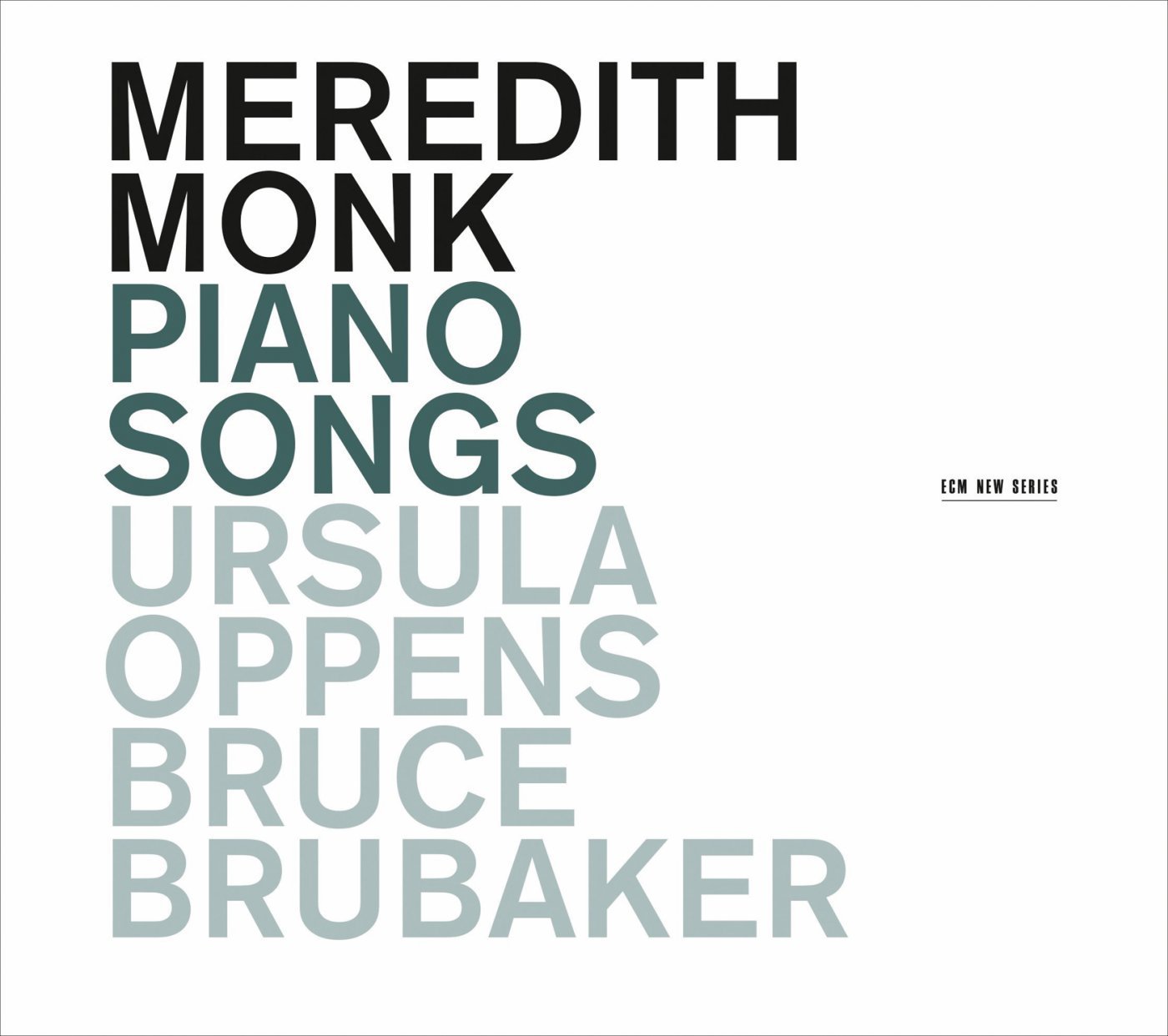
Meredith Monk: Piano Songs (ECM New Series 2374)

Piano Songs

Meredith Monk
Piano Songs

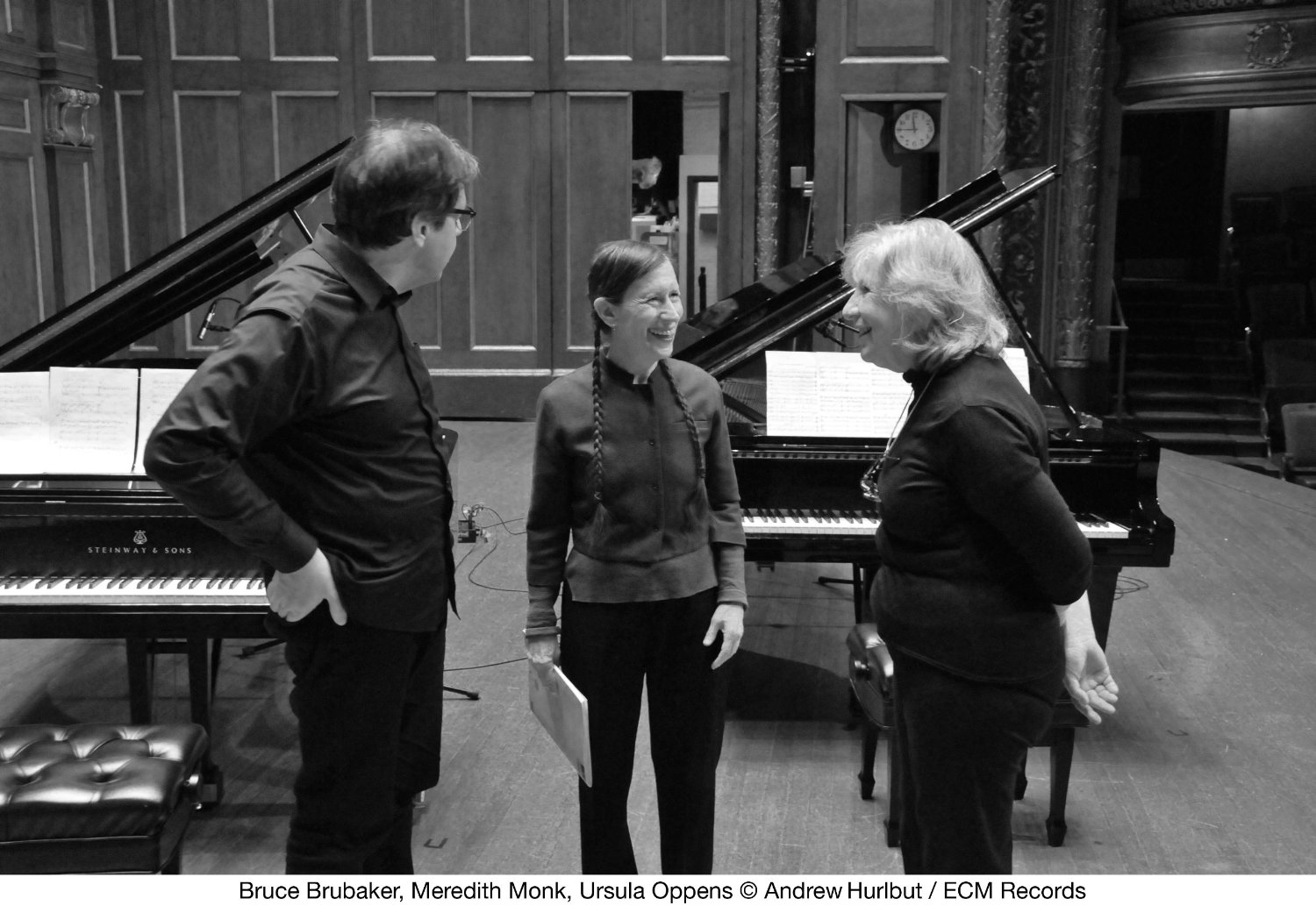
Ursula Oppens piano
Bruce Brubaker piano
Recorded April 2012 at Jordan Hall, New England Conservatory, Boston, Massachusetts
Recording and editing engineer: Jody Elff
Assistant engineer: Jeremy Sarna
Project coordination: Peter Sciscioli
Score preparation: Allison Sniffin
Mastering: Christoph Stickel
Produced by Meredith Monk and Allison Sniffin

This 2014 release marks the third instance of “songs” in a Meredith Monk ECM album title, following Songs of Ascension and Volcano Songs. And yet, aside from the occasional rhythmic chant, you will find no voices here. Even so, these pieces for one and two pianos sing with as much viscereal power as any of Monk’s more well-known ensemble projects.

Representing a 35-year period from 1971 to 2006, the program seems to ask: What does a song embody? The root of the word is incantation, and the magical, ritualistic functions that meaning implies. And certainly, few descriptors could describe Monk’s output (and input) so well. Hers is a continent of generative design, an environmentally aware space in which the tactility of melody fades in deference to its intangible worlding. The real question is, then: What does a song disembody?

According to Ursula Oppens and Bruce Brubaker: everything.

Monk session

Piano Songs is an album in the second person. It tells the story of your lives and mine, of anyone willing to join Monk’s sacred circle and hear the sonority of a biography unfold. In this respect, “Paris” (1972) is a highlight, for it represents the composer’s return to the piano after an intense period of concentration on the human voice. It begins innocently enough but throws canvases from windows and watches them crash to the streets below, thus breaking through an amnesic barrier toward the shedding of earthly possessions. It’s one of two solo pieces played by Oppens, who for contrast navigates the snowy streets of “St. Petersburg Waltz” (1993) as might a bird its most familiar patch of bramble. Brubaker plays two solos of his own. The 1981 “Railroad (Travel Song)” is among the more overtly programmatic selections. You can feel the metronome of the tracks beneath you. “Window in 7’s” (1986), on the other hand, is a nowhere-specific tessellation of heptatonic arpeggios.

Among the pieces written for two pianos, 1996’s “Obsolete Objects” makes for an evenly balanced introduction to this skeletal yet emotionally multifaceted soundscape. “Ellis Island” (1981) is another descriptive wonder, in which properties of water and hints of ocean brine shake the global web of personal histories as if it were an instrument. Here is the terrible yet beautiful mystery of it all, where the only life preserver you have left is the wreath of memories around your neck. “Folkdance” (1996) digs to the base of the self, clapping and chanting as if to confirm the illusion that is your body. And so, you stomp your feet on the ground, bridging traditions of an untouchable past and the immanence of an unknowable future.

And then there are three pieces arranged for two pianos by Brubaker: further transformations of impulse into form. From the triangle-turned-pyramid that is “urban march (shadow)” (2001) through the pagoda of “Tower” (1971) and on to the intimate “Parlour Games” (1988), each brings you face to face with open interpretations, each a picture connected to the next until together they mimic reality like a film.

Part of the appeal of Piano Songs is that its titles are virtually interchangeable. Not because they all sound the same, but because there is something of each in the other. For example, the synchronicities of “totentanz” (2006) might work just as well under the title of “Phantom Waltz” (1989), while the latter’s dissonance might likewise signal a dance of death. Whatever we may choose to call them, they are fragments of Monk’s soul, spun from essence to object, and from object to open breath.

If you are new to Monk, I would suggest that you start with Dolmen Music and Book of Days, if only because it is good to first love the soil, so that the diamonds will seem but one of its infinite treasures.

(To hear samples of Piano Songs, click here.)

Vijay Iyer: Mutations (ECM 2372)

Mutations

Vijay Iyer
Mutations

Vijay Iyer piano, electronics
Miranda Cuckson violin
Michi Wiancko violin
Kyle Armbrust viola
Kivie Cahn-Lipman violoncello
Recorded September 2013 at Avatar Studios, New York
Engineer: James A. Farber
Assistant: Tim Marchiafava
Produced by Manfred Eicher

In a brief liner note, MacArthur-winning pianist and composer Vijay Iyer defines the title of his ECM debut as “the noise in our genes.” The eponymous decalogue for piano, string quartet and electronics puts this theory into sonic practice with such organicity that fans and newcomers alike will find this laboratory to be a fascinating place in which to marvel at every biological compound. Having studied violin for 15 years, Iyer is anything but a stranger to the sounds of the string quartet, and so inclusion of that reduced orchestra is as timely as the gestures encoded into his score. Although one might read any number of influences into the piece (Terry Riley comes immediately to mind in the introductory movement, “Air,” and in the third, “Canon”), Iyer’s sound-world is very much its own ecosystem, where the randomness of sprouting leaves is just as vital as, and exists as an expression of, the roots that feed them. Subtitles thus reflect more the physical than emotional structure of individual movements. Some are more overt. “Rise,” for instance, consists of a rising tone that falls in on itself at the insistence of sirens and has its partner in the penultimate “Descent,” while small bursts of mechanical activity throughout “Automata” identify its clockwork soul behind the tasteful electronic appliqué. This is the key tone of the emerging landscape, drawn in the hue of dusk. Other portions are less obvious, such as “Chain,” which creates a feeling of linkage by the notes not played. Three distinct forces—the click track, piano, and strings—achieve remarkable unity here. From the concentrated (“Kernel”) to the frenetic (“Clade”), and even to the docked-boat knocking of “Time,” which closes out, the feeling is always one of fractals: the closer you get, the more detail is revealed. This might very well serve to describe Iyer’s entire output so far.

At the periphery of this program the listener will find three solo piano works that are anything but peripheral. Spellbound and Sacrosanct, Cowrie Shells and the Shimmering Sea, as the initiatory phase of both the album and a hopefully longstanding relationship with ECM, speaks with Iyer’s characteristic attention to detail. Contrasting pedaled sustains and shallower drops, he displays an unusual awareness of the piano’s timbral capabilities. In other words, he infuses the piano with a deeper knowledge of itself. He achieves this with no small effort of restraint, lest his territories become too ephemeral to grasp. The final two pieces factor electronics into the equation. Vuln, Part 2 emerges from an astutely urban palette. Augmented by a muffled bass beat, like that of trunk-mounted subwoofers as heard from a neighboring street, serves not as a rhythmic guide but as a reminder of the regularity and therefore fallibility of abstraction. Iyer illustrates that even the most fleeting movements of body and mind are driven by impulses that, when seen from far enough away, become regular and may even disappear. The piano’s beauties, then, exist only to be sworn to secrecy. When We’re Gone is the coda, and as such is trained to open two doors for each one closed. In its starker expansion of time, reflections of mortality tremble like icicles desirous of melting. So do we end as we began: at that indefinable edge between formation and destruction.

(To hear samples of Mutations, you may watch the EPK above or click here.)

Kremerata Baltica: Mieczysław Weinberg (ECM New Series 2368/69)

Mieczysław Weinberg

Mieczysław Weinberg

Gidon Kremer violin
Daniil Grishin viola
Giedrė Dirvanauskaitė violoncello
Daniil Trifonov piano
Kremerata Baltica
Recorded November 2012 and July 2013 in Neuhardenberg (opp. 42, 48, and 98) and Lockenhaus (opp. 46, 126)
Engineers: Peter Laenger and Stephan Schellmann
Album produced by Manfred Eicher

The name Mieczysław Weinberg (1919-1996) may not be as well known as that of his dear friend Dmitri Shostakovich, but the music he penned is at last receiving overdue attention. As Wolfgang Sandner suggests in his liner notes for this ECM conspectus, the Polish-born, Russia-based composer’s obscurity has perhaps less to do with his toeing of the party line (as the great Soviet composers were wont to do) and more to do with his optimism. Although this risks painting Shostakovich with a pessimistic brush, it makes a salient point on the marketing potential of the tormented soul. Whatever the reasons for Weinberg’s lesser reputation, we can marvel at this recording’s confirmation of his compositional acumen.

No piece could be more indicative of Weinberg’s gifts than the Sonata No. 3 for violin solo. Written in 1979, his Opus 126 is a masterpiece that, despite sounding more like Bartók or Hindemith, belongs right alongside Bach’s Sonatas and Partitas for the same instrument. Declamatory without being exclamatory and ideally suited to violinist Gidon Kremer’s style, it sings, full-throated, through a checkering of rustic and urban climates and achieves its cohesion by way of staggered exposition. Each section of the larger structure lends insight into the composer’s mind, corners of which may be quiet and melodic, while others may revel in an idyllic folk dance or two, and all of it leading to the ladder of harmonics, pizzicati, and whispers with which the piece closes.

The String Trio, Op. 48 of 1950, is an intriguing follow-up, not least for its relatively academic Andante, which is sandwiched by two far more mature reckonings. Yet musicians—Kremer, along with violist Daniil Grishin and cellist Giedrė Dirvanauskaitė—make spirited work of even the occasional pedantic bar, so that any playfulness beneath the seriousness of this early work is fully present by way of an intensely lyrical core. If anything, Weinberg’s youth in this instance is sometimes betrayed by a lack of subtlety, although its historical significance outweighs any such paltry concerns. On the other hand, Kremer and pianist Daniil Trifonov give vibrant account of the 1949 Sonatina, Op. 46. This far more distinctive triptych opens with a warped dance (the light steps of which are beautifully emphasized by the duo), moves on to an organic Lento (which, compared to the aforementioned Andante, allows the instruments to breathe), and finishes with an interpolated Allegro.

Two larger-scale works complete this two-disc program. The 1948 Concertino for Violin and String Orchestra, Op. 42 is another early example, but is eminently alluring for its romantic inclinations and modernist drive. The steeliness of the opening movement melts from Kremer’s bow, as his Kremerata Baltica provides the cyclical underpinnings of every line. The Lento that follows morphs from cadenza-like solo into shadowy dance, as if obscured by leaves and time. The concluding Allegro begins with muted strings before opening into a pizzicato-led flurry of activity and razor-thin interactions. Yet these delights bow to the program’s pièce de résistance, the Symphony No. 10, Op. 98. What makes this symphony so glorious is its scale: not in terms of vastness but intimacy. Over its five-movement course, we are led through a Neo-Baroque fantasy of exquisite construction. The clearest parallels are to Vivaldi, whose own string symphonies might very well have been on Weinberg’s mind, yet whose final Allegro of the Concerto No. 8 in A minor, RV 522 from L’estro armonico is a particularly vivid reference in the second half of the first movement. The central movements are achingly introspective and feature Kremer in a meta-narrative role throughout. The string writing is just as moving in the buoyant fourth movement, while the mounting consonance of the finale unleashes some percussive playing of instrument bodies and a threnody-like conclusion.

Integral to Weinberg’s music is its integrity, to which the Kremerata Baltica and charismatic leader attend with unflagging dedication. Not only do we feel the chasm of history yielding these forgotten treasures; we also understand the value of their latent exposure. This recording is a gift, and it deserves to be accordingly unwrapped.

Jean-Louis Matinier & Marco Ambrosini: Inventio (ECM 2348)

Inventio

Inventio

Jean-Louis Matinier accordion
Marco Ambrosini nyckelharpa
Recorded April 2013, Auditorio Radiotelevisione svizzera, Lugano
Engineer: Lara Persia
Produced by Manfred Eicher

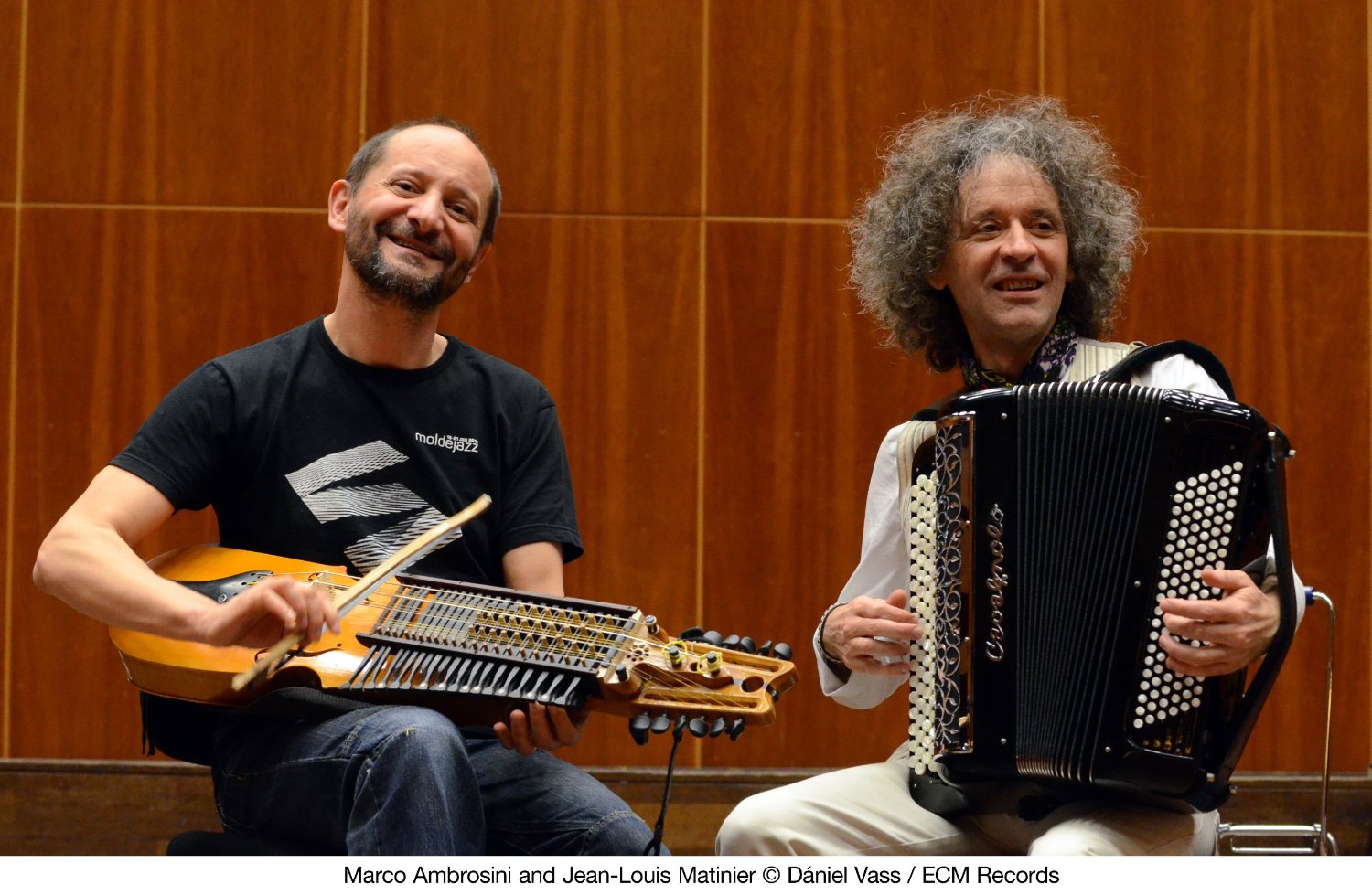
Although French accordionist Jean-Louis Matinier and Marco Ambrosini, Italian virtuoso of the nyckelharpa (a Swedish traditional instrument that is something of a cross between hurdy-gurdy and vielle), have existed as a duo since 2008, it took a period of refinement and an invitation to record for ECM Records in 2013 before their music at last saw the digital light of day. Anyone who has followed the career of Anouar Brahem in the 21st century will have encountered Matinier alongside the Tunisian oudist on 2002’s Le pas du chat noir and 2006’s Le Voyage de Sahar. Ambrosini is recognized as a leading proponent of the nyckelharpa and has carried that instrument in fresh directions across a varied terrain of recordings. Matinier has elsewhere characterized his musical relationship with Ambrosini as “a total dialogue,” and the description could hardly be more appropriate. They complete each other’s sentences.

Inventio Duo

The first strains of “Wiosna,” among the lion’s share of tracks penned by Matinier, immediately recall another duo: Argentine bandoneonista Dino Saluzzi and German cellist Anja Lechner. Both partnerships are savvy in terms of rhythm and atmosphere, morphing from tears into triumph at a moment’s notice. And yet, if Saluzzi and Lechner could be said to treat the listener like a canvas, Matinier and Ambrosini treat the listener like a movie screen on which to project moving images. This analogic difference comes about through both a distinct timbral palette and an unprecedented program. It is virtuosic and gorgeous all the same, but in its own way indivisible.

Matinier’s writing comprises a folk music all its own. Whether in the cartographic flybys of “Hommage” and “Kochanie Moje” or in the briefer passages of “Taïga” and “Balinese,” an underlying pulse finds consummation in the musicians’ synergy, which is so seamless that it’s sometimes difficult to tell where one instrument ends and the other begins. Even in Matinier’s two solo tracks, the nyckelharpa’s droning spirit lingers. Of those solos, “Szybko” is particularly moving and brings to mind the flute playing of Guo Yue. Like the “Siciliènne” (by accordionist-composer André Astier) that closes the album, his are fleeting portraits of places out of time. Also out of time are Ambrosini’s own compositions, through which the nyckelharpa’s sympathetic strings resonate like a life force. His “Basse Dance” best exploits the duo’s interlocking sound and might just as well have been lifted from a Renaissance manuscript. In this context the nyckelharpa sounds like a viola da gamba and signals the titular dance with a locomotive pulse. His “Tasteggiata” and “Tasteggiata 2” are likewise steam-driven, chugging through a full spectrum of color.

The album’s circle rounds out with segments plucked from a tangle of Baroque repertoire by Giovanni Pergolesi, Heinrich Ignaz Franz von Biber, and Johann Sebastian Bach. A “Presto” from the latter’s g-minor sonata for solo violin is reborn at Ambrosini’s fingertips, which imbue this familiar piece with an ancient air, while the “Inventio 4” from Bach’s Two- and Three-part Inventions yields not only the album’s title but also its most luminescent notecraft. Folk touches from Ambrosini again pull this music into a deeper origin myth. Such integrations make the Baroque selections something much more than obligatory nods to an established canon. Their placement stirs the waters with a certain depth of interpretation that links them to a chain across borders.

(See this review as it originally appeared in RootsWorld online magazine and listen to samples here.)

The Hilliard Ensemble: Il Cor Tristo (ECM New Series 2346)

2346 X

The Hilliard Ensemble
Il Cor Tristo

David James countertenor
Rogers Covey-Crump tenor
Steven Harrold tenor
Gordon Jones baritone
Recorded November 2012, Propstei St. Gerold
Engineer: Peter Laenger
Produced by Manfred Eicher

Throughout a four decades-long career, the Hilliard Ensemble has astonished with a vocal style so fluid yet so clearly textured that sometimes the inhales tell as much of the story as the exhales. There is, in no uncertain terms, something topographic about the Hilliards’ singing, which arcs and swivels like the mapmaker’s oldest instruments. Tenors Rogers Covey-Crump and Steven Harrold are particularly noteworthy as a core thread of the present recording, although it is baritone Gordon Jones who anchors Roger Marsh’s settings of Cantos 32 and 33 from Dante Alighieri’s Inferno with the added weight of guttural, chant-like singing. Written for the ensemble in 2008, Marsh’s title work (meaning “Misery of the heart”) is a masterful addition to the repertoire. Although it shares certain affinities with the rest of the program, one may ignore any marketing attempts to characterize its juxtaposition with the Renaissance works featured herein works as “seamless.” It is, rather fascinatingly, distinct for its organic irregularities. With a more stream-of-consciousness, recitational style, Marsh calls upon the voices to dig into Dante as if he were the very soil, until the Florentine poet’s underworld widens before us, where heads of betrayers lodged a frozen lake become tripping stones to his narrative other. Marsh’s remarkably astute writing and the Hilliards’ embodied diction make for a dramatic experience. In an explanatory liner note, the composer bids the listener to listen to these Cantos not merely for their harmony, but also for their poetry. Consequently, this release begs ownership of a physical copy. How else, then, might one appreciate Dante’s disturbing conversation of the disembodied, or the delicacy with which he and those tuneful tenors have “passed onward” into the next circle?

Francesco Petrarca, otherwise known as Petrarch, is the textual subject of interest for Bernardo Pisano (1490-1548) and Jacques Arcadelt (c. 1507-1568). The poems now focus on a rather different misery of the heart, calling on the powers that be more often to extinguish its yearnings than to chase them away by fire. Pisano’s settings are headlong excursions. Between the swift resolutions of Or vedi, Amor (Now you see, Love) and the ponderous circularities of Che debb’io far? (What must I do?), the Hilliards lead a deluge of probing sentiments. The freshness of their performance enhances Pisano’s sly arranging, which runs the gamut from lively and swinging to flowing and evenhanded. And the singers’ dynamic mastery is nowhere so beautifully tested than in Ne la stagion (At the moment), a trio of self-deprecating stanzas on the art of solitude.

Solitude further reigns over Arcadelt’s own settings, which yield some of the album’s fairest skies. The robustness of Solo e pensoso (Alone and thoughtful) sits self-interestedly on the shore of L’aere gravato (The heavy air). The latter is an ideal vehicle for David James, whose voice brings tidings of pulchritude wherever it may tread. Tutto ’l dí piango (All day I weep) likewise spotlights the countertenor and boasts some of the most pristine ensemble singing of the Hillards’ ECM tenure. And like Petrarch, who in that last verse is grieved by the failings of others more than his own, they seem to embrace the listener as an extension of their giving selves, trading fortune for a candle doused by the breath of a turning face.

(To hear samples of Il Cor Tristo, click here.)

Momo Kodama: La vallée des cloches (ECM New Series 2343)

La valée des cloches

Momo Kodama
La vallée des cloches

Momo Kodama piano
Recorded September 2012, Historischer Reitstadel, Neumarkt
Engineer: Stephan Schellmann
Produced by Manfred Eicher

As of late, ECM’s New Series imprint seems to be on a mission to prove that impressionism in classical music is, if anything, an exercise in clarity. This has been the message behind such releases as Tre Voci and Alexei Lubimov’s account of the Debussy Préludes. Joining these debunkers is distinguished pianist Momo Kodama, whose first solo recital for the label is sublime as crystal.

The title (which translates to “The valley of the bells”) of her characteristic program comes from Maurice Ravel’s Miroirs. This five-part gallery of expressionist vignettes wants for nothing in environmental fidelity. Each is an embodiment of its image, and then some. The first two pieces, “Noctuelles” (Night moths) and “Oiseaux tristes” (Sorrowful birds), are together a study in contrasts, juxtaposing the former’s dreamlike wing-beats, which by slightest touch of pond’s surface scatter minnows in sunbursts of activity, and the latter’s methodical gravidity, which transgresses memory like a cigarette through silk. Already obvious at this point is Kodama’s meticulous pressure, her balancing of strength and fragility. She adds leagues to “Une barque sur l’océan” (A boat on the ocean). Like a ballerina dissolving one cell at a time, it pirouettes into a dream of wind and sail, as if one were the inverse of the other. “Alborada del gracioso” (Mornign song of the jester), on the other hand, has a Spanish flavor, made all the more vibrant for its dissonances and reflective detours, while the final bells make for some strangely provocative reflections.

Momo Kodama

At the other end of the album’s spectrum is Olivier Messiaen, a composer close to Kodama’s heart and whose La fauvette des jardins is a wonder. Something of an extension of the Catalogue d’oiseaux, a recording of which Kodama released to great acclaim on the Triton label in 2011, it presents formidable challenges to the musician by way of its affective variety. An ashen foundation in the piano’s lower register contrasts and diffuses the upward motions that follow, lighting the way with the breath of a thousand torches. Its paroxysms are decidedly spiritual. Through them salvation sings with the notecraft of insects. A restlessness of servitude pervades. It speaks through contact of flesh and bone, not tongue and breath. The piece’s negotiation of the progressive and the regressive is ideally suited to Kodama, who transforms its turbulence into an opportunity for reflection, such that its consonances feel exhausting in their orthodoxy.

Considering that Tōru Takemitsu was such a great admirer of both Debussy and Messiaen, his Rain Tree Sketch makes for effortless company. Occupying as it does the center of the program, one might feel tempted to read it as filler or segue from one French master to the other. In Kodama’s practice, however, it holds its own as a robust work of art. Takemitsu was, of course, a prolific film composer in his native Japan, and his experiences in that capacity seems to have carried over into his later works, of which this is but one evocative example. The illustrative strengths explored in the work introduce another relationship of balance into Kodama’s toolkit—this between circular and linear forms—and does so with meditative attention paid to the underlying touch of things. Like the musician herself, Takemitsu’s idea of a sketch is full enough to be called consummate.

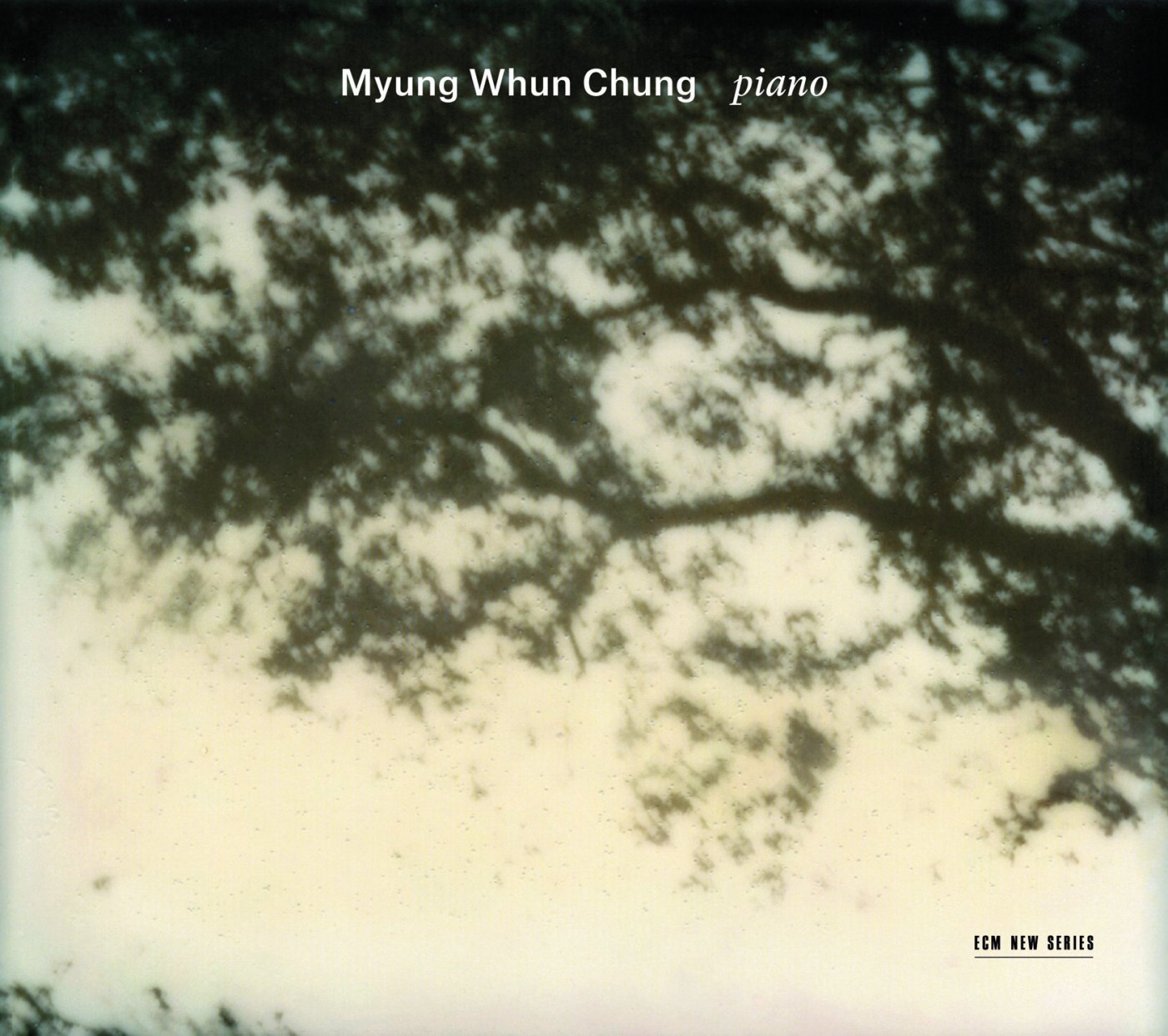
Myung Whun Chung: piano (ECM New Series 2342)

piano

Myung Whun Chung
piano

Myung Whun Chung piano
Recorded July 2013, Teatro La Fenice, Venice
Engineer: Rainer Maillard
Produced by Manfred Eicher

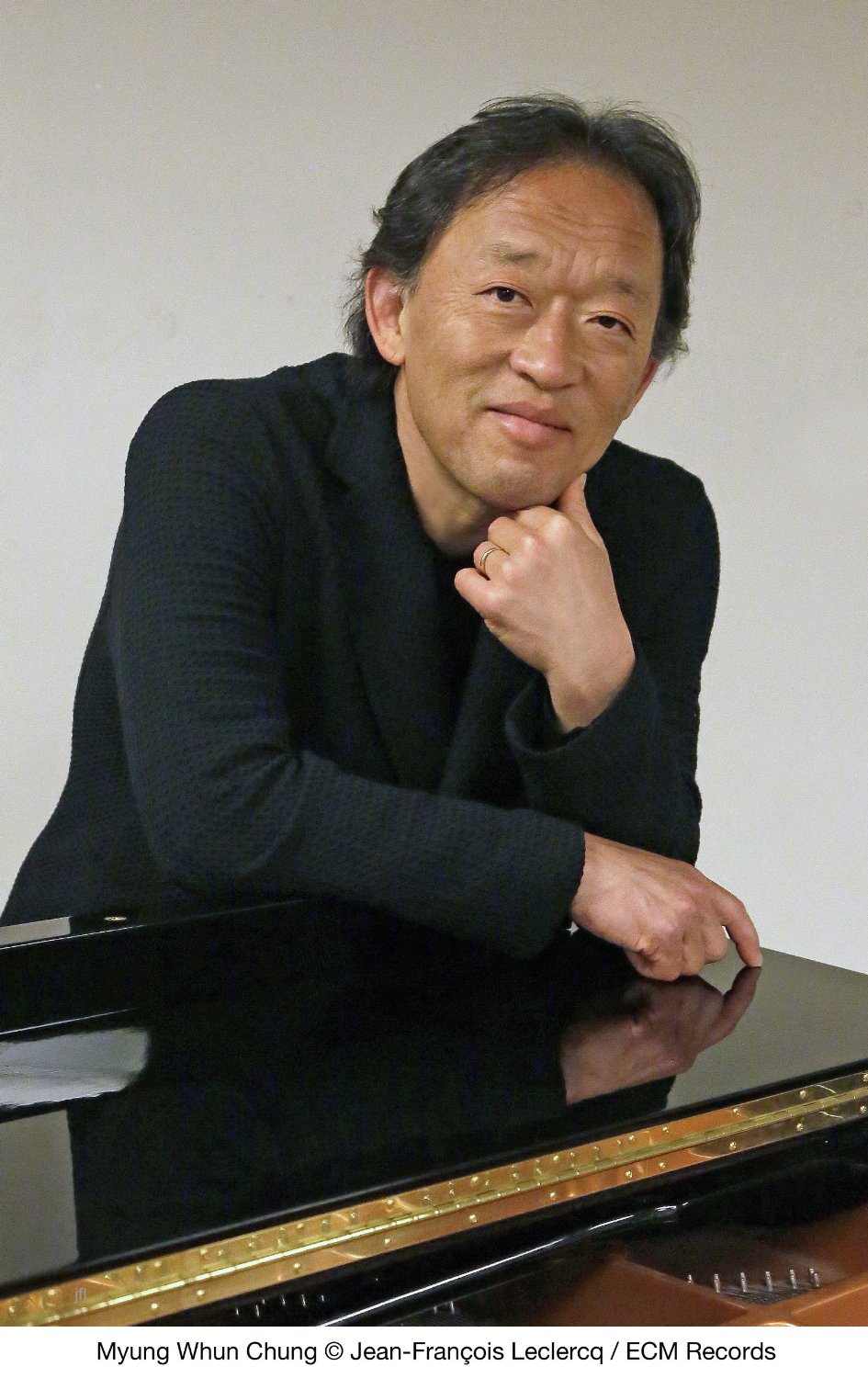
“I believe that musicians are only responsible for half of the real musical experience—the other half must be done by the listener. How one listens and receives the music is perhaps the most important gesture.” So writes Myung Whun Chung in a gracious liner note accompanying his ECM debut. One could receive no more fitting an invitation to a program for which the renowned conductor puts down his baton and takes to the piano, sharing his thoughtful inscriptions across some of the most immovable palimpsests of the classical canon.

In keeping with the spirit of listening, his barely titled piano is more a gift than a recital. It is also a brilliant instance of presentation, and of music’s personal necessity. The melodies we will know—some by name, others by association, each so ingrained in our subconscious that they would seem to exist of their own impulse.

Myung Whun Chung

Chung’s forte is his commitment to texture. True to reputation as a conductor, his interpretations are remarkable for their studied pacing and dynamic appropriateness. The giants of the set list are also its greatest ambassadors for intimacy. Among them, Debussy’s Clair de Lune is paramount. Yet where this much-copied painting, excised from the composer’s Suite bergamasque, so often drifts through our outstretched hands, in Chung’s it has palpable elasticity, made material by a heartfelt triangulation of playing, instrument, and engineering. His Für Elise is likewise weighed, Beethoven’s castaway gem taking on a driven quality through a balance of whimsy and despair.

Intimacy also reigns over Chopin’s Nocturnes in D-flat Major, op. 27/2 and in c-sharp minor, op. posth. Chung draws out the fidelity of their singing and underlying dance, walking that ephemeral path between slumber and waking. Even Mozart’s twelve Variations on “Ah! Vous dirais-je, maman” (better known to many as “Twinkle, Twinkle, Little Star”) don a patina of solitude. Despite their jovial development, they retain a cerebral edge that looks back to Bach even as it looks ahead to Beethoven, and conjures up imagery of self-enclosed genius.

Even with all the evening hymns, two Schubert Impromptus—these in E-flat Major, D899/2 and G-flat Major, D899/3—render the album’s darkest shades. Lovely in their own way, not least of all by their performer’s evocative makeover, they clutch within their sparkling ribcages hearts of unresolved tensions. So too do Schumann’s melancholy Träumerei and whimsical Arabeske, each an ode to closed eyes. Yet nowhere do Chung’s intentions take such unforced flight as in Tchaikovsky’s Autumn Song, in which he gives proper attention to the open spaces of the score, allowing them to breathe so that we may share in that breath.

I can assure you that none of the above is mere reviewer’s hyperbole. To dismiss it as such is to misrecognize the music’s inherency and the selflessness with which it is presented. You will, of course, hear these pieces again, just as you have heard them many times before, but it is unlikely that you will find them so lovingly unpacked. This is music that recognizes us before we recognize it.

(To hear samples of piano, you may watch the video above or click here.)