Dobrinka Tabakova: String Paths (ECM New Series 2239)

String Paths

Dobrinka Tabakova
String Paths

Kristina Blaumane violoncello
Maxim Rysanov viola, conductor
Janine Jansen violin
Roman Mints violin
Julia-Maria Kretz violin
Amihai Grosz viola
Torleif Thedéen violoncello
Boris Andrianov violoncello
Raimondas Sviackevičius accordion
Vaiva Eidukaitytė-Storastienė harpsichord
Stacey Watton double bass
Donatas Bagurskas double bass
Lithuanian Chamber Orchestra
Recorded March/April 2011 at National Philharmonic Hall, Vilnius by Laura Jurgelionyté and Valdemaras Kiršys, Studija Aurea in Vilnius
Such different paths recorded June 2011 at Jesus-Christus-Kirche Dahlem, Berlin by Markus Heiland
Mixed and mastered at Rainbow Studio in Oslo by Jan Erik Kongshaug, Manfred Eicher and Dobrinka Tabakova
Produced by Manfred Eicher

When art promises to be revelatory, it may become something to fear. Such is the case of String Paths, the first conspectus of music by Dobrinka Tabakova. Fear, in this sense, is close to awe, for before hearing a single note one knows its details will seep into places to which few others have traveled. Fear, because the trust and intimacy required of such an act is what the composer’s life is all about: she fills staves with glyphs so that anyone with an open heart might encounter their fleeting interpretations and become part of their accretion. Indeed, many factors go into the creation of a single instrumental line, incalculably magnified by its interaction with others. Fear, then, is closer still to love.

Born in 1980, Tabakova moved at age 11 from her Bulgarian hometown of Plovdiv to London, where she went on to study at the Guildhall School of Music and Drama. Her career began in earnest after winning an international competition at 14, since which time she has developed a voice that is refreshingly full and melodious. Such a biographical sketch, despite its prodigious overtones, does little to set Tabakova apart from her contemporaries. Recognition is one thing; experience is another. The coloring of imagination sustained in this timely album’s program, the whole of its corporeal sensibilities, can only come across when its water fills a listener’s cup.

Ukrainian violist-conductor Maxim Rysanov, notable proponent of Kancheli and other composers of our time, has become one of Tabakova’s strongest advocates. It was, in fact, his performance of the Suite in Old Style (written 2006 for solo viola, harpsichord and strings) at the prestigious Lockenhaus Festival that first caught ECM producer Manfred Eicher’s ear and led him to propose the present disc. As the album’s seed, it shelters refugees of the surrounding works. In amending a practice established by such visionaries as Górecki, Schnittke, Eller, and others who have mined elder idioms as a means of looking forward, Tabakova might be placed squarely in an ongoing tradition. She, however, prefers to trace the piece’s genealogy back to Rameau by way of Respighi. Given its descriptive edge, we might link it further to the great Baroque mimeticists—Farina, Biber, Muffat, Schmelzer, and Vivaldi—who were less interested in imitating each other (although some intertextuality was to be expected) than they were in describing nature and circumstance. In this respect, Tabakova’s triptych interfaces a variety of signatures, from which her own stands boldest.

The first movement is a triptych unto itself. Beginning with a Prelude marked “Fanfare from the balconies,” proceeding to “Back from hunting,” and on to “Through mirrored corridors,” already one can note Tabakova’s special affinity for space and place. A rich and delightful piece of prosody, its syncopations feel like ballet, a joyous dance of fit bodies. The viola leaps while the harpsichord adds tactile diacritics to Rysanov’s slippery alphabet. The transcendent centerpiece, entitled “The rose garden by moonlight,” is a shiver down the spine in slow motion, a season at once born and dying. The harpsichord elicits brief exaltations, pushing its wordless song into snowdrift, even as intimations of spring exchange glances with those of autumn. The quasi-Italian filigree of “Riddle of the barrel-organ player” and the Postlude (“Hunting and Finale”) fosters a nostalgic air of antique tracings, bearing yin and yang with plenty of drama to spare.

Insight (2002) for string trio opens the program with exactly that. Played by its dedicatees (Rysanov, Russian violinist Roman Mints, and Latvian-born Kristina Blaumane, principal cellist of the London Philharmonic), it unfolds in dense streams. For Tabakova the trio breathes as one, as might the moving parts of some singing, bellowed engine. The trio thus becomes something else entirely (a phenomenon achieved via the same configuration perhaps only by Górecki in his Genesis I). Moments of shining vibrato add pulse and skin. Glissandi also play an important role in establishing a smooth, coherent fable. The violin’s harmonics are glassine, somehow vulnerable. Indications of dances hold hands with jagged flames. Hints of a free spirit shine through the cracks. A decorated return to the theme looses a bird from an open palm, watching it fly until its song grows too faint to hear.

The 2008 Concerto for Cello and Strings, written for and featuring Blaumane as soloist, moves in three phases, the names of which recall the designations of John Adams. The music, too, may remind one of the American humanist, singing as it does with a likeminded breadth of inflection. The first movement (“Turbulent, tense”) unfolds in pulsing energy. Like a spirit coursing through the sky, it searches the heavens, lantern in hand, for earthly connection. The spirit casts a longing gaze across the oceans, leaping from continent to continent, harming not a single blade of grass by her step. The cello thus takes up the opening theme like a haul from the deep, letting all creatures slip through its fingers to hold the one treasure it seeks by their tips. In that box: a beating heart, one that seeks its own undoing by virtue of its discovery. It is a story revived in countless historical tragedies. The orchestra flowers around the soloist, carrying equilibrium as might a parent cradle a sickly child, laying her down on the altar where the opening motif may reach. The slow movement, marked “Longing,” thus revives that body, spinning from the treasure’s contents a trail she might follow back toward breath. With her resurrection come also the fears that killed her: the conflicts of a warring state, the ideals of a corrupt ruler, the confusion of a hopeless citizenry. The kingdom no longer smiles beneath the sun but weeps by moonlight. Chromatic lilts keep those tears in check, holding them true to form: as vast internal calligraphies whose tails find purchase only on composition paper. Echoes appear and remain. Blaumane’s rich, singing tone conveys all of this and more, never letting go of its full-bodied emotion. The softness of the final stretch turns charcoal into pastel, cloud into dusk, star into supernova. It is therefore tempting to read resolution into the final movement (“Radiant”). From its icy opening harmonics, it seems to beg for the cello’s appearance, which in spite of its jaggedness never bleeds into forceful suggestion. For whenever it verges on puncture, it reconnects to the surrounding orchestral flow, from which it was born and to which it always returns for recharge. Its blasting high sends a message: I am fallen that I might rise again.

Frozen River Flows (2005) is scored for violin, accordion and double bass. Intended to evoke water beneath ice, it expresses two states of the same substance yet so much more. It encompasses the snowy banks, the laden trees, the footprints left beneath them. It imparts glimpses of those who wandered through here not long ago, whose warmth still lingers like a puff of exhaled breath. The violin takes on a vocal lilt, the accordion a windy rasp, the double bass a gestural vocabulary—all of which ends as if beginning.

Such different paths (2008) for string septet ends the program. Dedicated to Dutch violinist Janine Jansen, it ushers in a full, chromatic sound. There is a feeling of constant movement here that is duly organic: in one sense as flow, in another as melodic variety. There is, again, a rocking quality, as if the music always rests on some sort of fulcrum. A quiet passage that deals with the barbs lifted to our eyes. It ends in transcendent wash, a bleed of dye in cloth.

The performances on this finely produced disc are as gorgeous as they come, even more so under the purview of such attentive engineering. This is not music we simply listen to, but music that also listens to us.

It is in precisely this spirit of mutual listening that I participated in an e-mail interview with Ms. Tabakova, who kindly answered the following questions from this enamored soul…

Dobrinka Tabakova

Tyran Grillo: In the String Paths CD booklet, your mention of a powerful first encounter with Keith Jarrett’s Köln Concert makes me recall my own. I felt as if that music had always existed beyond time, but that somehow Jarrett’s performance gave us the means to hear it at mortal speed. Because improvisation is, of course, vital to the compositional act, do you feel this way about your own music (i.e., that you funnel it from the ether), or do you see it emerging entirely from within, by your own design?

Dobrinka Tabakova: Longfellow said that “music is the universal language of mankind,” and I think this is what happens when you “meet” a work of music for the first time and it speaks in a way that you understand and/or it resonates with you. The time-old abstract dilemma of where music comes from, in this case, could be discussed under the larger topic of “how do we communicate.” Of course there is inspiration, and I hope the process of how that sparks the beginning of a new work will remain the wonderful mystery that it is. But that spark gets refracted through the artist’s own prism, made up of the experiences around, exposure to different musics, aesthetic preference… With composition we have the added layer of not working in real time and being able to work at the form and structure of a piece of music far longer than it will take to listen to it. Mendeleev imagined the periodic table in a dream, and the same is sometimes said of compositions, but that dream can only be the beginning, I think. It is a responsibility to capture it in the best possible way, and make it speak.

TG: As a listener who has been moved by your music, I see it as a gift. What has your music given you?

DT: The ability to express something through music has been the main focus of my life, and to have connected with someone is a privilege. That feeling is beyond words.

TG: I’ve always felt that music and literature are much alike: both are “written,” both “tell stories,” one has “movements” instead of “chapters,” etc. How do you envisage the relationship between the two?

DT: I am engrossed by literature, well-told stories, captivating multi-layered characters and, like you say, there are similarities with music in terms of form. But, at least for me, words and music occupy two very different worlds, and I am distracted to think too “literally” when composing. I don’t mean writing music to words—there is a relationship there, and this is when words become music.

TG: There is a seesawing quality to the opening and closing pieces of the program (Insight and Such different paths), as if they rest atop an unvoiced fulcrum and spin a melodic and chromatic equilibrium throughout. How do you visualize the structural nature of those two compositions?

DT: I am glad that you felt it this way and asked about this, because the structure of the album was an important part of the concept of the whole project. Although each of the pieces has its own structure, the feeling of an overarching symmetry to the structure of the album was important. The opening to Insight is almost deliberately aiming to make your ear search. The gradual development of the sounds from there, I feel, leads quite naturally and logically to the effect of the closing of Such different paths: having walked aurally through the album, reaching a kind of settled, calm sonic space.

TG: It’s easy to see your Suite in Old Style as continuing a trend among composers such as Górecki, Schnittke, Eller, and others who have leaned toward the past as a means of looking forward. Yet I wonder if what you have done in this marvelous piece is not more like the great Baroque mimetic composers—Farina, Biber, Muffat, Schmelzer, and Vivaldi—who seemed more interested in describing nature and action than in imitating each other.

DT: I think ultimately, I didn’t wish to try and sound like a composer from a certain time. The Suite is a bow to the music which inspired me and that I grew up hearing. Trying to capture that inspiration and present it through modern eyes/ears was at the heart of the concept of this work.

TG: Speaking of the same piece, your subsection titles have a very dramaturgical sheen to them.

DT: Yes, it helped me imagine being in this other time and also to emphasize the daily distance between then and now, but fundamentally hoping that the music would bridge the time gap.

TG: Insight is an appropriate way to open the program of String Paths. I particularly enjoy its horizontal energies, its balance of density and openness. Compared to the pieces that follow, it feels like a stream of consciousness that has undergone relatively little revision. Can you talk about its inception and unfolding throughout the process of composing it?

DT: I am glad you had that reaction—that it sounds like a stream of consciousness. I think at the start of most pieces, I have a general shape which I would like to achieve with a composition, so I am happy if it is perceived as a flowing unfolding. There are always edits and re-thinks, but I try to stick to the original shape. Also, having challenging parts for each voice makes the work dramatic which propels the motion of the piece.

TG: I am so fond of the little chromatic descending motifs in the second movement of your Concerto for Cello and Strings. They catch my attention every time like the teeth of a zipper locking together. How did this detail come to be in the piece?

DT:  The almost glissando motif came together with the melody—the two have always been inseparable. As I was imagining this to be the “human” section of the concerto (see my next answer), there is a desire to be particularly expressive and almost transform the cello to a singer.

TG: In relation to my earlier question regarding literature, I find the concerto to be especially vivid in its storytelling. What kinds of images does it bring to your mind?

DT: The overall shape of the concerto is an upward one—an ascent. As a student, my main thesis was about Music and Science, and while researching that I discovered the writing of Boethius, a 4th-century Roman philosopher who categorized music in three levels: musica instrumentalis, musica humana, and musica mundana. The first movement can be seen as an expression of musica instrumentalis—the “taming” of the instrument, challenging and stretching the performer and the instrument. Musica humana—believed to be the music of the soul, and everything that affects us as humans—is expressed in the second movement, while musica mundane—also known as music of the spheres—is our impression and hope for what may lie beyond our planet, which finds an expression in the final movement. I didn’t have a particular story in mind, more a shape, perhaps.

TG: Frozen River Flows, more than by virtue of its title, is a remarkably organic piece. The combination of instruments is intriguing. Did your decisions in this regard arise out of wanting to write for particular musicians or was there something about their admixture that spoke to you?

DT: Frozen River Flows was originally written for two conservatoire colleagues of mine, who formed an oboe-and-percussion duo called newnoise. Soon after I completed it, Roman Mints, who I also studied with at Guildhall, asked me if I could contribute a piece to a concert he was programming with violin, accordion, and double bass. This is how the unusual instrumentation came about.

TG: Such different paths is a piece of many layers. Where do you situate yourself among them?

DT: Perhaps, being the composer, I might situate myself at the foundation. But, in all seriousness, it is true, the septet is very layered and polyphonic/contrapuntal. This for me is the great pleasure in writing chamber music: one can have all these lines and give equal weight to each. The inter-relationships between parts can be very complex. Setting myself to this challenge—to have complexity within a clear structure and sound—was one of the first steps in the compositional process.

TG: Such different paths feels like an emblematic piece. What personal importance does it hold for you?

DT: I feel that way about all the pieces on the CD, to be honest. In each there are elements which build from previous ideas or thoughts, and since both the Cello Concerto and Such different paths are the latest compositions on the disk, I guess I’ve had more time to accumulate further thoughts when writing.

TG: Much of your music seems cyclical. Is this conscious?

DT: It really depends on the piece, I wouldn’t say that, for example, Such different paths is cyclical. But sometimes there is a satisfaction in hearing material in two contexts—without having a reference and after a certain development.

TG: Manfred Eicher has been a blessing to so many composers since beginning his New Series in the mid-80s. What does it mean for you to have worked with him and to see your music represented by an influential and prestigious venue?

DT: Manfred Eicher is inspirational, and it has been an unparalleled privilege to work with him and his team! It’s more than a dream to be part of such a catalogue of creativity. As a composer, it is a really great feeling to be able to feel that your music is understood and that those responsible for its delivery on record are concerned, above all, with the integrity and true nature of the music.

TG: On a related note, can you describe your involvement in the recording/mixing process and any insights Mr. Eicher imparted along the way?

DT: Well, my ability to navigate around a mixing desk would perhaps equal my ability to ice-skate, so I couldn’t have a detailed and technical conversation, as much as I may have liked. The process was very natural and dependent on what we were hearing, and at least my main point of reference was the feeling of being in the hall and experiencing the music as if it were played live.

TG: What currently excites you about being a composer? What currently excites you as a listener?

DT: I have a ton of research to get through for some upcoming projects, including one for the Shakespeare anniversary in 2016, and this is providing me with a well of inspiration and excitement. Being a Londoner excites me as a listener—with access to so many fantastic concerts and events as well as sounds.

TG: Generally speaking, how do you compose? Do you have a preferred space, environment, or atmosphere in which to do so?

DT: As long as I can have some quiet, a piano, and my notepad, I’m happy.

(See this article as it originally appeared in Sequenza 21. To hear samples of String Paths, please click here.)

Jan Garbarek/The Hilliard Ensemble: Officium Novum (ECM New Series 2125)

Officium Novum

Officium Novum

Jan Garbarek soprano and tenor saxophones
The Hilliard Ensemble
David James countertenor
Rogers Covey-Crump tenor
Steven Harrold tenor
Gordon Jones baritone
Recorded June 2009 at Propstei St. Gerold
Engineer: Peter Laenger
Produced by Manfred Eicher

A little farther
we will see the almond trees blossoming
the marble gleaming in the sun
the sea breaking into waves 

a little farther,
let us rise a little higher.
–Giorgos Seferis

Sometimes music bypasses all other faculties and journeys straight into our souls. It eschews intellectual games, removes the safety net from beneath critical acrobats, and seeks no justification for its effects. To say that Officium Novum is just such music would be as gross an understatement as is likely to drop from my brain. The achievements of the Hilliard Ensemble and saxophonist Jan Garbarek on this album’s predecessors, Officium and Mnemosyne, hardly need emphasis. They were nothing short of astonishing, blending presumably incongruous signatures in a sound of unparalleled parallels. Yet this third effort from the project stands out for its distinct separation of voices as it leads our ears and hearts more toward Eastern Europe, and farther to Armenia.

Hilliards Garbarek

In the latter vein, the multifaceted folk and liturgical arrangements of Komitas Vardapet (1869-1935)—whose music has elsewhere fallen within ECM’s purview on Kim Kashkashian’s Hayren—form the album’s central nervous system, although nowhere more so than in “Ov zarmanali,” a baptismal hymn that with Garbarek’s solo introduction marks the aforementioned separation as a running theme from first blush. In the rasp of his reed breathes a memory of nature, so that the Hilliards’ entrance spins a fantasy that can never gain traction in the here and now, confined as it is to wandering the past like a prisoner in his cell. Nevertheless, sanctity reigns, as prophesied by the third-century Byzantine chant, “Svjete tihij” (Gladsome light), which sacrifices its luminescence as it is sliced by the barred window. Its vocal blood later warms the body of Arvo Pärt’s “Most Holy Mother of God,” written for the Hilliards in 2003, thereby closing a divine circuit with its concluding dissonances.

Separations abound in other Komitas pieces as Garbarek carries the full chanting weight of “Surb, Surb” and skirts fields of dew in “Hays hark nviranats ukhti,” surpassed only once by countertenor David James in the “Sirt im sasani” (Hymn for Maundy Thursday). Like two wings joined to the same body, they are nominally separate but linked by thought, instinct, and action. Such notes of independence are implied also by the album’s cover photograph, which shows a lone outlier, back turned yet bridged to his fellows by light on the water. Even that reflection bears a horizontal rift of shadow: a cleft of nascent wave eating its way toward shore.

The lifeblood of Officium Novum courses through “Litany,” a three-chambered heart of Russian, Romanian, and anonymous sources. At its center is “Otche nash,” drawn from the Lipovan Old Believers tradition and sung alone by baritone Gordon Jones before Garbarek threads the backdrop of an anonymous “Dostoino est” in ways eerily similar to the first collaboration in 1993. Another anonymous relic, this of 16th century Spain, braces the architecture of “Tres morillas m’enamoran.” Heard on many a Renaissance record, the piece finds new life in the current rendering, seeming to reach for us from the future rather than out of the past. This is where the separations begin to soften, as Garbarek harmonizes more docilely at first before darting through and around the voices with bird-like grace. Breaths between verses lend a reflective, antiphonal quality, as they do also in Pérotin’s “Alleluia. Nativitas,” newly rendered since its appearance on Mnemosyne. It is joyous, almost incongruously so, among these monochromatic brethren, but gives a name to the light from which it fashions flesh for bone.

Two pieces by Jan Garbarek complete the musical share of the album. “Allting finns” (Everything there is) sets “Den döde” (The dead one), a poem by Swedish writer Pär Lagerkvist (1891-1974), into beautiful interpretive metalwork, filigreed by the composer’s alchemy of paramusical elements, while “We are the stars” (based on a Native American poem of the Passamaquoddy people) is here transformed from its last appearance on RITES into a fully embodied soul, whose words and bare coherences constitute a fabric unto itself. Garbarek’s playing is so respectful that it walks on water and leads us to Bruno Ganz’s reading of “Nur ein Weniges noch” by Giorgos Seferis (1900-1971), which ends the program. Both narrator and poet are recurring touch-points in the ECM corpus. By their virtue, we are left with a vastly intersectional view of the (im)material world and a single takeaway message that resounds, May you be blessed to be found.

(To hear samples of Officium Novum, click here.)

Keith Jarrett: Hymns/Spheres (ECM 1086/87)

Hymns Spheres

Keith Jarrett
Hymns/Spheres

Keith Jarrett organ
Recorded September 1976, Ottobeuren Abbey
Engineer: Martin Wieland
Produced by Manfred Eicher

There are musicians and there are magicians. Keith Jarrett is of the latter persuasion. Whenever his fingers touch the keyboard, they seem to have plunged into earth and anointed themselves with million-year-old magma before committing themselves to ivory. To be sure, he is one of the world’s most renowned improvisers, yet Hymns/Spheres—released unabridged at last in this double-CD set—documents an encounter with a grand Baroque organ that seems written in the stars. The organ in question was built by Karl Joseph Riepp in the eighteenth century and is a spectacular instrument in its own right. In communication with Jarrett, it produces sounds of extraordinary color and variety of register (many of the unique effects were produced by pulling stops only partway), sounds that comprise perhaps his most transcendent record to date.

Trying to describe it is like painting every leaf on a tree: far easier to take a photograph and offer it in place of an inferior rendering. Yet the parsing of its canvas over the years justifies a more surgical analysis. When first reissued on CD in 1985 as Spheres (ECM 1302)—i.e., with none of the “Hymns” included—it retained from those titular pieces only the 1st, 4th, 7th, and 9th Movements. Through them Jarrett was telling an eco-minded story, one that follows a single drop of water from the sky (prelude to a storm that never materializes) and freezes it in midair with winter’s coming to the sound of one bird flying south. Feelings of ice pervade the barren trees. The laughter that once ricocheted between them now hangs from the branches, an icicle for every child’s breath. Not all is gloom, however, for there is also a plenitude of warmth to be consumed and savored. Like a sleeping beauty who opens her eyes, only to stare into the depths of her own face, the 7th Movement stands before a mirror of inescapable meditation, while the 9th breaks thaw. Stirrings from below: beetles and earthworms unfurling with virginal respiration. A volcano erupts halfway around the world, yet you feel it in every follicle. Ships release their warning calls. You twist like a braided cord, thinner with each revolution, until your body is a wisp of molecules connecting lad, sea, and sky.

Fans were rightly saddened by the 1985 reissue for lacking five of the nine “Spheres” and the two “Hymns” etched into the original vinyl. The Hymns are especially important in tying this intimate session together; they begin and end its otherwise incomplete circle. Like much of the once-missing material, they are fuller, rib-shattering proclamations, much in contrast to the brooding abridgement. “Hymn Of Remembrance” opens ears and hearts like a church service in which communion is taken in wafers of sound, baptism in a river of glowing breath. “Hymn Of Release” processes along the walls, resting behind pews in postludinal exaltation.

As for the newly restored “Spheres,” they seem to open their mouths and eject columns of light into the very stars. Jarrett threads between the falling debris as many chords as he can before it combusts in the stratosphere (perhaps cluing us in on their collective title). If, in the 2nd Movement, we find ourselves confronted with a blinding vision of spirit, in the 3rd we are shown the opposite in tangled darkness. Jarrett resolves this tension with a pedaled drone, over which he unfurls a hefty banner of unrelenting majesty. The 5th and 6th Movements complicate this resolution with jagged memories, uncertain motives, and tattered masks. The final mystery is reclaimed in the 8th, where notes shimmer with underwater vibrato in a deepening commitment to contemplation.

It’s a shame that over half the album should have once been sacrificed, though I wouldn’t have programmed the Spheres reduction any differently, except perhaps to include the Hymns. Then again, a realization wraps its arms around me as I listen to the whole story anew: this music will never be complete. Its hints of infinity are overwhelming, and we are fortunate enough to know their touch in any form.

<< Keith Jarrett: The Survivors’ Suite (ECM 1085)
>> Edward Vesala: Satu (ECM 1088)

Beethoven: Complete Music for Piano and Violoncello (ECM New Series 1819/20)

Beethoven Complete Music for Piano and Violoncello

Ludwig van Beethoven
Complete Music for Piano and Violoncello

András Schiff piano
Miklós Perényi violoncello
Recorded December 2001 and August 2002 at Reitstadel Neumarkt
Engineer: Stephan Schellmann
Executive Producer: Manfred Eicher

Before leaving his indelible mark on the interpretive history of Beethoven through his account of the 32 sonatas for ECM, András Schiff posited an evolutionary affinity between that pantheon of piano literature and the sonatas for piano and cello. Smaller in scope yet bursting with ideas, these pieces pose just as many challenges to any who dare swim in their waters. As an artist of such high yet sensitive caliber, Schiff needed a most able ally with whom to run the gamut of this treasure store. There could be only one answer to that call: cellist (and fellow Budapestian) Miklós Perényi, who brightens the torch of his prodigy via these chamber masterworks with panache and smooth execution.

The program moves in generally chronological order, beginning with the Sonata No. 1, Beethoven’s Opus 5. The two Opus 5 sonatas were written in Berlin in 1796, the result of an association with Friedrich Wilhelm II, a fine cellist in his own right. Both sonatas mark a genetic shift not only in Beethoven’s evolution as a composer, but also in that of the chamber sonata, which in the past treated the featured instrument as a satellite. And yet, while Schiff concedes that the Opus 5 sonatas do indeed weigh in the piano’s favor, he and Perényi play with such balance—the cellist lending especial robustness to the supporting chords—that one would hardly know this without a score at hand.

The complaisant key of F Major imbues the opening measures with sanctity, opening the floor for a harmonious conversation. The foreshadowing is palpable: something is going to give. The pianism realizes these tensions in cascading arpeggios, each the garment of something restless, pure. The seamlessness is such that we needn’t even know the names of these musicians. They become something else entirely: not one with the music but musically one. Take, for instance, the central Allegro, which tents the sonata with effervescent keyboarding and hands the cellist a heavy shovel with which to dig. That an instrument of four strings can hold its own alongside one with 230 is a feat in and of itself. The pianism is exquisite here and indicates a playfulness in the early Beethoven that would translate into the cantilevering architecture of the later works. The concluding Rondo fully realizes the restlessness implied in the opening movement, weighing rocks against piles of feathers. Beethoven’s brilliance, even at this stage, is that he doesn’t give in to the temptation of treating the final movement as an endpoint or culmination of all that came before. It is, rather, its own entity with idiosyncratic hopes and dreams. These and more are borne out in the denouement, which shuffles Apollonian and Dionysian motives in a series of what in his liner notes Martin Meyer calls “surprising displacements of the entries.” These render the anticipatory nature of the sonata as something far beyond the purview of catch and release.

The inaugural Adagio of the Sonata No. 2 in G minor leaves greater room for interpretation than its counterpart in the No. 1. More floral than faunal, it nevertheless bounces its way through another gargantuan middle passage before emerging onto a Rondo of filigreed delight.

Also composed in 1796 are the Variations in G Major on “See the conqu’ring hero comes” from Handel’s oratorio Judas Maccabaeus. Beethoven would not have had chance to hear the oratorio live at the time, and so engaged with this theme by proxy of suggestion. The music is buoyant, typically classical in style yet also speckled with shadows by way of its intakes, leaving one scrambling to indulge in the decorative. As Meyer so eloquently puts it, “The constructive impetuosity minimizes any lingering over ‘beautiful’ passages or ideas; the virtuosic beginnings become displaced at the end by an unprecedentedly compact presentness, with the prospect of an uncertain art of the future.”

The Opus 17 “Horn Sonata” (1800) takes on a distinct arc of its own. That this sonata was originally composed for piano and Waldhorn (hunting horn) and later revised for the combination presented here is perhaps obvious only in the opening Allegro, the impulses of which function as building blocks for all that follows. Its themes burrow underground in a brief Adagio toward the fullness of the conclusion, which leaves us with a structure of integrity and, in its own way, poise.

From clarion to clean, we are treated to two further sets of variations—the 12 variations on “Ein Mädchen oder Weibchen” in F Major, op. 66 and the seven on “Bei Männern, welche Liebe fühlen” in E-flat Major, WoO 46—drawn from Mozart’s The Magic Flute. The former’s polite dance steps contrast artfully with the latter’s sluggish beginnings and sweeping uptake.

Although the Sonata in A Major, op. 69 selectively draws from its predecessors, the thinking put forth by its introduction is progressive and elicits the deepest anticipations in the program thus far. It is, in effect, a sonata unto itself. This is followed by the only Scherzo in the collection, a wonderful hiccup that stretches the sonata to four distinct sections. The golden Adagio is as pious as it is brief, while the final Allegro—tentatively and first but then with resplendence—runs in joyful, secular circles. This sonata is a highlight of the record: for its compression, for its focus, for its spirit.

The two Opus 102 sonatas date to 1815. The first, in C Major, is another compact affair. Not only is it the shortest (its total running time falls just shy of the Adagio of the Sonata No. 1), but it is also the most varied. A tender back and forth builds a core of mutual dependence. The second, in D Major, also crosses tightly engineered bridges. The jaggedness of the outer movements cradles, unscathed, a robust Adagio that practically cries for the gentle fugue that photosynthesizes into the final Allegro.

Although sure to become a benchmark, these renditions may not necessarily replace those of Richter and Rostropovich, but they do make suitable companions. Their forward motion is intriguing: there is little breathing room. In Beethoven’s hands the piano-cello combination slips into a “Zen” sort of oneness between medium and message. That the listener can feel that unity so nakedly is perhaps the greatest accomplishment of this album. Accordingly, it begs deep, undistracted listening.

In his own liner notes, Schiff admits that playing these works in sequence is like surveying Beethoven’s entire biography. Elsewhere, cellist Steven Isserlis has expressed similar feelings toward the cycle, saying, “[I]t is a journey through a life.” To this narrative Schiff and Perényi add a salient point: not only did Beethoven have an extraordinary life, but so too did his music, and forever will so long as ardent interpreters like these walk the earth in his shadow.

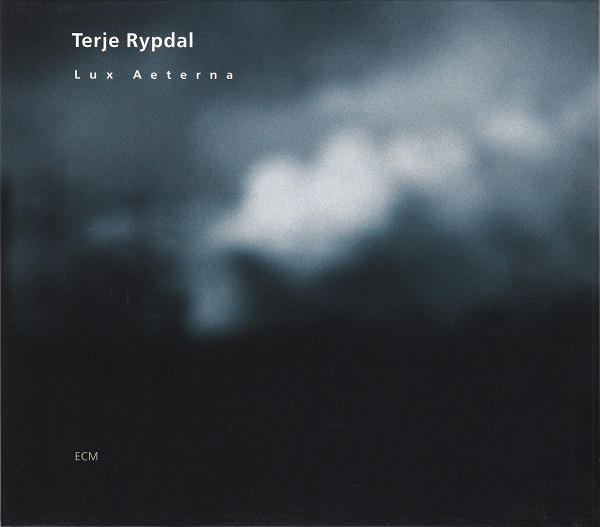
Terje Rypdal: Lux Aeterna (ECM 1818)

Lux Aeterna

Terje Rypdal
Lux Aeterna

Terje Rypdal guitar
Palle Mikkelborg trumpet
Iver Kleive church organ
Åshild Stubø Gundersen soprano
Bergen Chamber Ensemble
Kjell Seim conductor
Recorded live July 19, 2000 at Molde Domkirke
Recording engineer: Jan Erik Kongshaug
Album produced by Manfred Eicher

Regarding the modern Lux Aeterna (Eternal light), György Ligeti’s setting of the Latin text comes foremost to mind. Made famous by way of Stanley Kubrick’s 2001: A Space Odyssey (incidentally, my first exposure to Ligeti’s music), it did, of course, through that association take on cosmic aspects that may or may not have been originally intended. Although Ligeti was an earlier influence on Norwegian guitarist-composer Terje Rypdal’s take recorded here, the latter’s mapping processes are as distant as the faintest star. It is a setting in the truest sense, nesting one vocal movement among four others in a large-scale work that defies idiomatic description.

The first movement, subtitled “Luminous Galaxy,” is a serenade to the universe. Rypdal’s epic arranging skills and attention to color clear the sky of all pollution and distraction, leaving a naked belt, a cleft in the chin of darkness. The strings of the Bergen Chamber Ensemble (under the direction of Kjell Seim) reach heavenward even as their intentions burrow into the soil, spreading fingers and toes in pursuit of a shared, nameless goal. A celeste adds handfuls of stardust to the palette. Palle Mikkelborg then takes to the stage, almost startling in his surety. Warmed by the horse-haired fire around him, his echo-processed trumpet describes a vaulted architecture, of which windows and doors are galaxies unto themselves. The dialogic relationship established here at the outset encompasses so much space that the bulk of existence seems within reach. Swaying key changes mimic the flapping of a dress in the wind, the swirl of Jupiter’s eye, the quiet circumscription of Saturn’s rings. Through it all, the light of many suns coalesces in planetary alignment. And then, another entrance as a church organ (played by Iver Kleive) throws all satellite transmissions into paroxysms of static with its volcanic breath. It looses a subterranean call, rumbling more than singing, and bows in a gesture so luminous that only the pitch of night can contain it.

Rypdal explains the meaning behind “Fjelldåpen” (Baptized by the mountains): “For some reason now forgotten I wanted to teach my parents a lesson. I was 9 or 10 years old. I found a track used by sheep—very steep—and climbed the mountain fast. Once on top for a while I felt a very special connection to the mountain (and still do). At first I felt quite brave, but then a forceful wind started to scare me. And this feeling I’ve tried to capture in the second movement—you can hear when the wind is coming.” Rypdal goes on to say that he came down from the mountain to find that nobody had missed him: the world had gone on turning without him. The profundity of this realization at such a young age—the knowledge that one may be nothing more than an arbitrary arrangement of dark matter—is captured achingly in the composer’s lonely electric guitar as it leaves a trail of fuel to the mountain’s apex. Only when he surveys his achievement does he hold his axe to the sunset and light that trail with its fire. And as the world goes up in flames and licks the sky with its profound indifference, Rypdal shreds, balancing his trademark melodic lasers with the mercury of their fragmentation. His feet lift from the peak and float him beyond the clouds.

Hence the third movement, “Escalator.” Here the strings flow unlike earthly water, moving from land to mountain: a return to origins. Mikkelborg makes a subtle return. Spilling from a caesura in the very firmament, the trumpet liquefies and returns to a solid state in the musician’s hands, already itching with muscle memory to coat the landscape with elliptical grammar.

The fourth movement, “Toccata,” is an interlude for organ that twists the frame until all beings expire as they are, leaving only ruins behind. There, beneath tattered banners and dilapidated thrones, before the corpses of servants and skeleton-inhabited armor, a wordless sermon emerges with the force of a jumping spider. Distant flutes sing the praises of an idyllic age, when maidens and warriors needed no excuse to weep for love. This luxury of beauty plays out tearfully in the windowless corridor of this most titanic of instruments.

The titular movement ends the work with the voice of soprano Åshild Stubø Gundersen, introduced in points of contact and unison with electric guitar. Gundersen is captivating in her fallible tone, whereby she reveals the imperfections that make outer space such a ageless vessel for fascination. The difference between media blurs over time, so that Rypdal and the singer emote on almost exactly the same wavelength. The relationship between throat and pick feels entirely organic, less a shift between than a transfusion from one sonic entity to another. The organ sustains a drone and drops single notes like the signal tones in Close Encounters of the Third Kind—only here, the answer comes from within, from the trumpet (the messenger of peace), from the very rhythms of the heart by which all things cohere and expand. Descending chords—a recurring motif in Rypdal’s classically minded outings—leave their footprints clearly in mind. Thus spent, the densest matter spins into diffusion, leaving only the core theme intact, billiard-struck toward a black hole, silent and waiting.

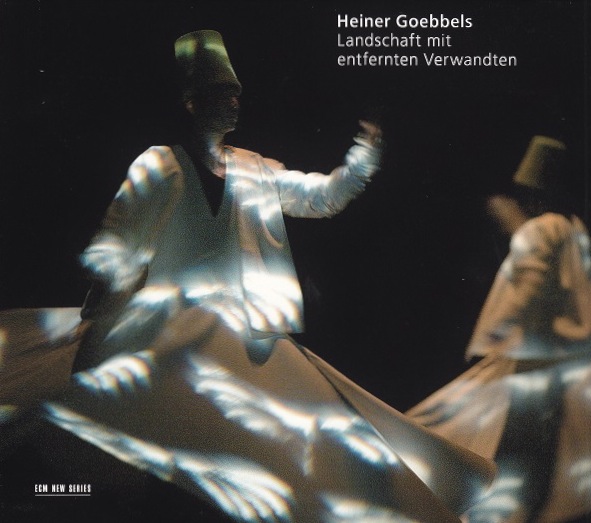
Heiner Goebbels: Landschaft mit entfernten Verwandten (ECM New Series 1811)

Landschaft mit entfernten Verwandten

Heiner Goebbels
Landschaft mit entfernten Verwandten

David Bennent voice
Georg Nigl baritone
Ensemble Modern
Deutscher Kammerchor
Franck Ollu conductor
Recorded live October 2004, Théâtre des Amandiers, Nanterre, Paris
Engineer: Max Federhofer, SWR
Mixed by Max Federhofer and Heiner Goebbels
Executive producer: Manfred Eicher

This recording chronicles the incidental music to Heiner Goebbels’s theatrical juggernaut, Landscape with Different Relatives, a much-lauded work that premiered in 2002. Billed as an opera for soloists, choir, and ensemble with texts by Gertrude Stein, Giordano Bruno, Arthur Chapman, Henri Michaux, T. S. Eliot, Leonardo da Vinci, and Nicolas Poussin, it includes mostly composed material with a mickey of improvisation slipped in. Both modes are taken up with gusto by the Ensemble Modern under the direction of Franck Ollu.

The composer’s polyglot approach to text reveals itself also in the music, which pins a wide-ranging geography of crumbling modernities. Like its librettic assemblage, the listener is eased into the work from the outside in. From above, one sees it divided into two parts. Seemingly disconnected in shape, the first contorts itself around all manner of war machinery while the second sees the body as machine and itemizes the internal workings of that most familiar technology. Closer inspection reveals a kinship between the two halves beyond the grasp of mere words. Both begin with the same introduction, for instance, adding only speech to the second iteration, as if the conscience of the opera’s former half were being revived.

Landschaft
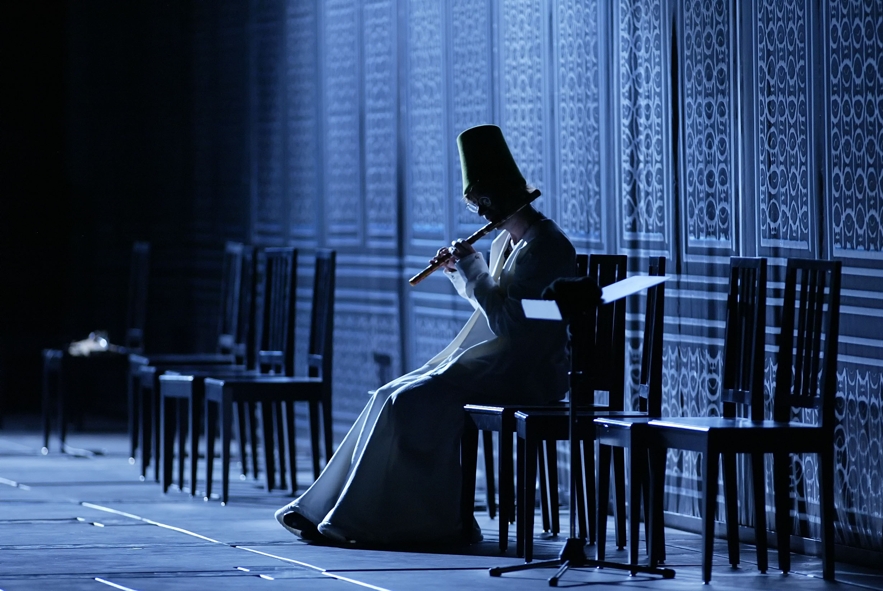
(Promo photo by Oper Frankfurt)

Part One thus inaugurates its concerns without voice. In a bed of organ, flute, and oboe, an electronic beep signals a message waiting to be heard before a wash of light shuttles the listener across narrow waterways into “The Sirens.” Here the vagaries of disgust are re-spun into catalysts, an interweaving of social stereotypes brought home by threats of destruction. Out of this swarm come multiple catharses. Dreamlike and fluid, they imagine procreation in lilting brass and, most notably, in the heavenward flute of “Tanz der Derwische,” one of three centerpieces. Drums and clarinet part the sky to reveal another, a parallel universe where the dead walk as if unscathed as gorgeous improvisations from the clarinetist interact with muted brass. “In the 19th Century” brings science under the lens of its own microscope and questions, as might Foucault, the dangers of expertise. “Triumphal March” is the second centerpiece. An obsessive mélange of lists and figures—and, by extension, of utility and servitude—it builds a monument to interrogation and crushes it to dust. “Schlachtenbeschreibung” is the final centerpiece. It’s title (Battle description) can be said to be the opera’s theme, layering as it does the grids of land and collateral damage that betray any ideological motivations lurking within terror. The playfulness of the instrumental arrangement here suggests a lost art and imbues baritone Georg Nigl with just the agitation he needs to carry off the words. Da Vinci’s pedantry, which guides artists in the depictions of battle scenes, lends a strangely categorical air, adding contrast to the fin de siècle politics that precede it. The ping-ponging of electronic and acoustic beats suggests confusion between the peace and antagonism of “Well Anyway,” which conflates revolution with sustenance, and celebrates the ability to shed tears. “Did It Really Happen?” further addresses the divide between historical revisionism and denial, and pulls the strings of the past clearly into the fray of the present, while “Kehna hi kya” haunts the center with its shrill plucked strings and local flourishes. The latter suggest a cultural archive, packaged and presented to the transient tourist. “Et c’est toujours” (And it is always…) addresses another gap, this between industry and flesh, between art and the earthen origins from which it is produced. It is the twist of a rind in the eye, a squinting of soul into eclipsed sun.

Part Two continues the opera’s marriage of modern and traditional instruments, consolidating many candles into a single flame. As emblematically in the feudalistic satire of “Just Like That,” it plays with minimalism (“Bild der Städte”), bricolage politics (“Krieg der Städte”), travel (“On the Road”), social awkwardness (“And We Said Good Bye”), communication (“On the Radio”), and even delves into a bit of Americana with “Out Where The West Begins,” replete with banjo and wagon procession. This blends into “Train Travelling,” about which the voiceover says, “The irregularity of its regularity is fascinating.” An overarching aesthetic of the opera if ever there was one.

Much of this second half delves deeper into notions of language and category, as in “Ich leugne nicht die Unterscheidung” (I do not deny the distinction), which understands the difference between destruction wrought by hand and by technological intervention, even as it washes both in the same descriptive waters. Such juxtapositions breed nostalgia through lenses of regret and distant complicities. Life takes its path abjectly. The deaths of animals loom as large as those of humans and round the jagged edges of the voices’ autobiographical disguises. Commanding and conquering can occur only where there are speech acts to back them up, and “Different Nations” gives a catalogue of call signs that lend vivid color to the connection between diplomacy and violence. Hence the ultimate arrival of the “Principes,” each a window into the soul that waters ambient soil. This final dronescape hosts only those voices that linger after all the others have expended their welcome. Welcome to their requiem.

Excerpt from the stage production, “Triumphal March”:

John Surman: Free and Equal (ECM 1802)

Free and Equal

John Surman
Free and Equal

John Surman soprano and baritone saxophone, bass clarinet
Jack DeJohnette drums, piano
London Brass
Recorded live June 2001 Queen Elizabeth Hall, London
Recording engineers: Steve Lowe and Ben Surman
Mixed January 2002 at Rainbow Studio, Oslo by Jan Erik Kongshaug, John Surman, and Manfred Eicher
Executive producer: Manfred Eicher

Free and Equal, John Surman’s furtherance of intermingling genres, is its own animal. Under its original title of That’s Right, it was the culmination of a 2000 festival commission and premiered in October that same year. The performance recorded for ECM comes from 2001, giving the work some time to incubate, as did subsequent mixing in Oslo’s Rainbow Studio under the direction of its composer, engineer, and producer.

Nods to classical and jazz modes are a clear and present danger throughout, for the purpose of their coexistence is not to mash them into some new hybrid but rather to flag their common goal: namely, to move listener and performer alike. Surman is joined by drummer Jack DeJohnette (also on piano) and classical stalwarts London Brass in an atmospheric tour de force that departs considerably from such previous experiments as Proverbs and Songs. The instrumentation alone would seem to imply a big band experiment à la Surman’s robust work with John Warren (see The Brass Project), but such is not the case. Neither should the DeJohnette connection, already well honed on Invisible Nature, foster misperceptions of what’s going on here. For as Surman paints the canvas with his soprano oils amid the swells of “Preamble,” it’s clear that freer considerations are at play. DeJohnette’s pianism, heard only occasionally on disc, proves descriptively apt in the follow-up “Groundwork,” which loops bass clarinet through trumpet in an evolving macramé of melody. Here, as elsewhere, Surman finds seemingly impossible paths for his improvisations through growing mazes of gold. Such balancing of the minimal and complex is no small task, and the establishment of that balance highlights their mutuality. It is in this spirit, perhaps, that DeJohnette doesn’t pick up his drumsticks until ten minutes into the album, working into “Sea Change” with the crash of surf in his cymbals, the heave of ocean waves in the brass choir at his back. His moments of abandon are thus kept within sight.

Soloists among the London players strengthen the marrow of this nine-part suite. The tuba soliloquy that opens “Back and Forth,” for one, gives an edible sense of textural contrast. Punctual and enlivening, it signals the first in a series of hardenings and dissolutions, from which trombone throws streams of light and draws Surman’s low reed into an invigorating trio with skins. Likewise, “Fire” traces the multifarious paths of its namesake through a modified trio of drums, trumpet, and bass clarinet. The latter continues its coppery speech in “Debased Line” with a nostalgia and restlessness of spirit that embodies Surman’s passion as a musician. “In the Shadow” evokes Paul McCandless in its sopranism, which floats over a relatively aggressive waltz in the background and sparks an ensemble-wide reaction in the title portion. Virtuosity is on full display as Surman looses his wilder side and fuels DeJohnette’s closing protraction. The drummer cracks many dams in the “Epilogue,” emptying into an open sea of well-earned applause.

Filled with exciting music that creates and maintains its own standard, Free and Equal represents an evolutionary leap in Surman’s compositional thinking. His uncanny ability to be at once joyful and mournful in a single arpeggio has elsewhere never been so explicit. It is music that begs for dancers or the flicker of a cinema screen—a vast, organic machine that runs on the promise of another listen.

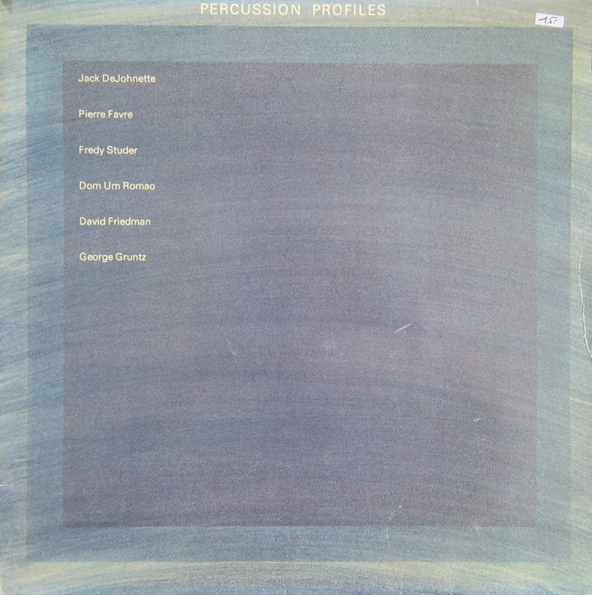
George Gruntz: Percussion Profiles (JAPO 60025)

Percussion Profiles Front

George Gruntz
Percussion Profiles

Jack DeJohnette drums, cymbals, gongs
Pierre Favre drums, cymbals, gongs
Fredy Studer drums, cymbals, gongs
Dom Um Romão percussion, gongs
David Friedman flat gongplay, vibes, marimba, crotales
George Gruntz gongs, keyboards, synthesizer, crotales
Recorded September 20, 1977 at Wally Heider Studios, Los Angeles
Engineer: Biff Dawes
Mixing: Georg Scheuermann and Manfred Eicher
Producer: Robert Paiste

Late Swiss composer, multi-instrumentalist, and artistic director George Gruntz (1932-2013) left behind a long and fruitful trail, one that intersected with ECM twice: once for the label proper as Theatre and before that for JAPO in the form of Percussion Profiles. The eminently influential Gruntz assembles here a veritable Who’s Who of the rhythmic circuit at the time of its recording (1977): namely, Jack DeJohnette, Pierre Favre, Fredy Studer, Dom Um Romão, David Friedman, and Gruntz in the architect’s chair on synths and keyboards. The project speaks less to Gruntz’s big band experiments than it does to his classical roots. Dedicated to Paiste brothers Robert (who also produces) and Toomas, the piece is a bona fide percussion concerto that approaches its performers as equal elements in a larger chemistry.

The piece is divided into six Movements, each illuminating a facet of the whole. Movement 1 introduces the pleasant blending of registers—from twinkles to full-throated calls—that defines the album’s broad trajectory. Like the sun on a cloudy day, its light shines variedly: sometimes in floods, sometimes in winks and flashes, but always with a clear conscience. There is a sensitivity of expression here that tells the stories of chamber music in the language of the Serengeti. Movements 2 through 4 bring out a veritable bouquet of fragrances: briny ocean (laced with intimations of birdsong and splashes of electronic marginalia), undercurrents of metal and oil, and resonant drones share a path toward the masterful “Movement 5.” This last opens in a vocal flower, which cups in its petals a sparkling array of notions and potions. The histrionic ways of this piece make it a beguiling standout, akin to Marion Brown’s Afternoon Of A Georgia Faun. Here is where the visuality of his medium is most apparent. If this record is a house, this movement enacts a thorough cleaning of its basement. Rusted tools and unused others share conversations of things past. Stuck between the water-damaged photographs and listless rodents are fortuitous becomings, blips and dots and dashes, sputtering pipes and creaking infrastructure. These are the feelings within, the memories of which “Movement 6” is a snare-inflected shadow, a spacy ride through keyboard textures and xylophoned exeunt.

Those who admire the work of Edgard Varèse will find much to sink their teeth into in Percussion Profiles, which begs repeated, unaccompanied listening, if only for its level of detail. A memorable rung on the JAPO ladder, and worth the climb to get there.

Percussion Profiles Back