Michael Galasso: High Lines (ECM 1713)

High Lines

Michael Galasso
High Lines

Michael Galasso violin
Terje Rypdal guitar
Frank Colón percussion
Marc Marder double-bass
Recorded November 2002 and April 2004 at Rainbow Studio, Oslo
Engineer: Jan Erik Konghaug
Produced by Manfred Eicher

The late violinist-composer Michael Galasso—whose solo album Scenes is a personal label favorite—returned to ECM more than two decades later with High Lines, a multifaceted set of music that draws on his love for theatre (as a longtime collaborator of dramatist Robert Wilson), film (having scored for Wong Kar-wai, Martin Provost, and many others), and dance. These activities brought him to many places around the world, among them Iran, where rhythms and melodies swirled their way into much of the writing realized here. From his soundtrack to Secret Ballot (dir. Babak Payami) to his extensive incidental work with Wilson, the program references many touchstones of Galasso’s varied career. Along with ECM stalwart Terje Rypdal on guitar (brought in at producer Manfred Eicher’s suggestion) and bassist Marc Marder with percussionist Frank Colón (brought in at Galasso’s), he opens himself to new interrelationships.

Because Scenes proved Galasso capable enough to row the waters in a boat of his own making, the presence of another distinctive voice in Rypdal bears mixed fruit. Whereas his atmospheric contributions in “Spheric” and “Fog and After” give sanctity and tactility to the surroundings, as an agent of melody his guitar feels like an afterthought in the context of tracks like “The Other” and “Swan Pond.” There’s not a single thing off about the playing itself: it’s pure Rypdal flame. It just doesn’t always have its eyes open. Then again, High Lines is more about the music than about the names behind it, and ultimately succeeds in this regard. Spread like ceremonial salt across a sumo stage, it prefaces a slow-motion ballet of powerful bodies in motion. Some of those gestures are cryptic, others hypnotic, and still others are intensely filmic. In the latter vein we have “Gothic Beach,” a brief passage pairing violin and ocean waves. Every footprint on those sands glows with life.

And really, the four strings conveying these things are the album’s heart and soul. A few pieces find Galasso multi-tracking on delicate fulcrums (“Iranian Dream” being a standout in this regard) and even experimenting with starry digital delays, as in “Boreal.” Lost travelers from Scenes (e.g., “Chaconne”) cross our paths, swaying and arpeggiating to the metronome of distant winds, while less familiar figures also sell their wares along the way. As one title would have it, this is an album of crossing colors, and in the final “Gorge Green” we have a churning stew of them. It is perhaps no coincidence, then, that Rypdal achieves strongest congruence of purpose here, tethering the journey at last to a foreseeable destination.

Yet lurking in the chemical composition of these sounds is an element that belongs to no instrument or music-maker. It is one that Galasso’s music activates of its own will, a wish made real in the asking.

<< Michelle Makarski: Elogio per un’ombra (ECM 1712 NS)
>> Thomas Zehetmair/Camerata Bern: Verklärte Nacht (
ECM 1714 NS)

Dino Saluzzi: El Encuentro (ECM 2155)

El Encuentro

Dino Saluzzi
El Encuentro

Dino Saluzzi bandoneon
Anja Lechner violoncello
Felix ‘Cuchara’ Saluzzi tenor saxophone
The Metropole Orchestra
Jules Buckley conductor
Live recording February 13, 2009 Muziekgebouw aan ’t IJ, Amsterdam
Music supervisor: Gert Jan van den Dolder
Recording engineer: Gert de Bruijn (Dutchview)
Assistant: Per van der Zande (Dutchview)
Mixing engineers: Gert de Bruijn and Ronald Trijber (Dutchview)
Concert production and executive producer for the NPS: Gustavo Pazos
A production of NPS Radio in collaboration with ECM Records

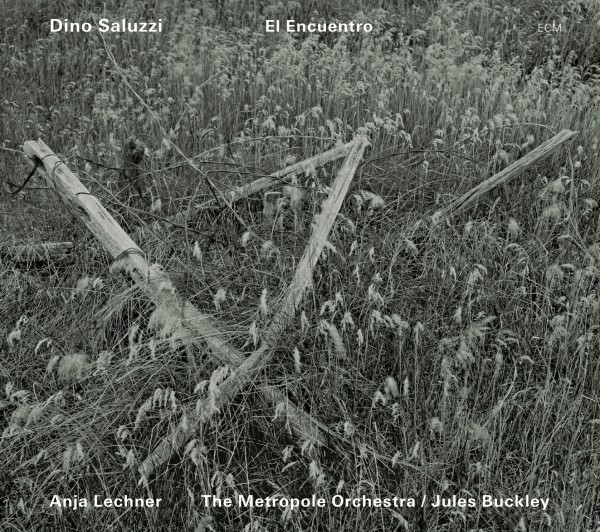
El Encuentro depicts Dino Saluzzi as a composer willing to go wherever the stream of consciousness takes him. In this, his first live album, the bandoneón maestro joins Anja Lechner (cello) and brother Felix (tenor saxophone) before the Metropole Orchestra, under the direction of Jules Buckley, for a varicolored quatralogy. Because the bandoneón is practically an orchestra unto itself, pairing it with strings feels like an implosive rather than explosive stroke of sonic fortuity. This introspective dynamic is heightened by the asymptotic relationship between the soloists, who are fully present in Plegaria Andina. This piece revisits thematic material from 1988’s Andina in a braid of wind, branches, and leaves: each strand a traveler from a different corner of the world. Even when silent, the soloists float like an oar-less vessel bobbing to the pulse of tide. The ruminations of this piece are thus deeply aquatic and equally representative of the clouds they reflect.

The relationship between bandoneón and cello is the album’s main anchor, and takes root in deepest reef in Vals de los días. Like the program as a whole, its moods and melodies are in constant flux, its themes as fleeting as the air in Saluzzi’s bellows, the touch of horsehair on Lechner’s strings. Assailed by dances and memories, their vessels keel and spread their melodic passengers far and wide. There is abundance to be felt here, plucked like ripe fruit from a branch, squished between the toes like wet sand, and dunked like the baptized body into holy river’s flow.

Despite its massive proportions, the title piece comports itself with the delicacy of a spider. It is the most brooding piece of the four—one which, despite its peaks and gorgeous finish, wallows in a pool of shadows. Its final jubilations pick at a lone thread of light, unravel the tapestry of the night, and weave a new one into the Miserere that follows. The strings, robust yet tentative in their dynamic recession, are servants to the bandoneón, the latter a messenger sent from above. Its lungs exhale only peace, leaving no doubt that Saluzzi’s is a spiritual art.

Despite the number of musicians gathered here, El Encuentro is one of Saluzzi’s most intimate realizations, compressing the sweep of an epic film into the eye of a spyglass. Because the title means “The Meeting,” it is tempting to read the album as one large cycle. Closer listening, however, reveals the self-awareness of the compositions therein. They are not cardinal points on a compass, but rather corners of a world that share a plane only in maps. Their yearning is more than physical; it is environmental. They meet only in dreams, drifting farther out to the sea with every heave. Were it not for the applause, we might blissfully remain so, never to feel the touch of shore beneath our soles.

(To hear samples of El Encuentro, click here.)

John Surman: Coruscating (ECM 1702)

Coruscating

John Surman
Coruscating

John Surman soprano and baritone saxophones, bass and contrabass clarinets
Chris Laurence double-bass
Rita Manning violin
Keith Pascoe violin
Bill Hawkes viola
Nick Cooper cello
Recorded January 1999 at CTS Studios, London
Engineer: Markus Heiland
Produced by Manfred Eicher

The title of John Surman’s Coruscating means sparkling. Yet with track names like “At Dusk,” “Moonless Midnight,” and “An Illusive Shadow,” we are squarely in a nocturnal realm. The multi-reedist, along with bassist Chris Laurence, puts his touch on this set of eight compositions, which over the album’s course blend into a seamless whole. At their center is an ad hoc string quartet, to which Surman and Laurence act as improvisatory satellites. The two aforementioned sections drop Surman’s oboe-like soprano into pre-written cuts of land, each a ripple in a lake that holds ebony sky in its cup.

Although it will not be surprising to any Surman fan, it is as baritonist—ever the rightful successor to Gerry Mulligan—that he comes closest to bringing the shine. Whether in the softly rolling sentiments of “Dark Corners” or the  muscular stirrings of “Stone Flower” (in memory of another baritone great, Harry Carney), his low reed dots the compass many times over through charcoal travels. “Winding Passages” is the most mature of these breeze-swept soliloquies and provides a solid platform for the composer’s bronzed hieroglyphs. Laurence shakes his most geometric ghosts out in “Crystal Walls,” while “For The Moment” mixes cello tracings into vibraphone, Surman’s restless gestures carrying us all the while into deeper pasture.

Those who weren’t quite feeling Proverbs and Songs might find Coruscating more accessible, if only because there is so much space for listeners to relax and, in spite of all the darkness, feel their way around. It is a dream of quotidian objects sleepwalking for want of a place to have purpose, only to discover that their wandering is that very thing.

<< Jan Garbarek/The Hilliard Ensemble: Mnemosyne (ECM 1700/01 NS)
>> Gianluigi Trovesi/Gianni Coscia: In cerca di cibo (
ECM 1703)

Anna Gourari: Canto Oscuro (ECM New Series 2255)

2255 X

Anna Gourari
Canto Oscuro

Anna Gourari piano
Recorded May 2011, Historischer Reitstadel, Neumarkt
Engineer: Stephan Schellmann
Produced by Manfred Eicher

Born 1972 to a family of musical pedagogues, Russian (and, since 1990, Munich-based) pianist Anna Gourari makes her ECM debut with a characteristically unconventional recital…or so it would seem. Two of J. S. Bach’s chorale preludes, as arranged by Ferruccio Busoni, parenthesize the program’s modern heart. “Ich ruf’ zu Dir, Herr Jesu Christ” and “Nun komm’ der Heiden Heiland” both come from the incomplete Orgelbüchlein, a pedagogical scrapbook compiled in the earthy 18th century. Busoni’s erudite touch burgeons further in Gourari’s, opening a doorway all the grander for being so austere. Yet here is a Bach that, while adorned, breathes with the minimalism of a single voice. The tenderness of these leaves betray nothing of the fragile limb to which they cling.

From light to brokenness, the program tilts its wings eastward to Sofia Gubaidulina’s Chaconne. Composed in 1962, this deconstruction of a b-minor triad represents an key period in the Russian composer’s development. One may be tempted to read grand philosophical statements of suffering into such music, when really it turns itself inside out for all to hear. This is not an evocation of suffering, per se, but an acknowledgment of its necessity. The effect is such that even the overt references to Bach come across as probing, strangely confident, and spiraled like a unicorn’s horn. Its elegiac impulse is foxed by ragged edges, given light in measured doses. Here is a lighthouse without a vessel to guide, a signal without a flare.

Paul Hindemith (1895-1963), a prolific composer yet one whose piano works have only in recent years begun to crop up on CD programs, is given plenty of space in Gourari’s ecstatic take on his Suite “1922.” Although its effect would surely have raised a few eyebrows that same year, as was Hindemith’s intention, today his experiment stands as a fascinating cross-section of early expressionism. Over the course of five parts, this jocular, if rigorous, piece takes us on a wild ride. Titles like “Shimmy,” “Boston,” and “Ragtime” transport the listener to a time when said dances still hit the floor, when financial doom was still some years away. Such historical perspective lends poignancy to the central movement, a “Nachtstück.” Like a fragment of title card found in the wreckage of a silent film warehouse, it tells only part of the story that its context makes abundantly clear. Hindemith’s references are seeds for more complexly developed ideas and beg comparison with contemporary George Antheil, whose own “Shimmy” graces Herbert Henck’s fascinating Piano Music. Gourari’s resolute command of, and passion for, the material makes this a benchmark recording.

Anna Gourari

Busoni resurrects Bach again in his supernal arrangement of the Chaconne from the solo violin Partita No. 2. The mighty Chaconne has always been a keystone in Bach’s solo literature. That it speaks with the same colors is testament both to arranger and performer. From the chord-enhanced arpeggios to the requisite drama throughout, Gourari allows the music to resound not by means of surface but interior. If Busoni has given it an elastic quality, then she has stretched it to the limit in an interpretation that promises to open new doorways with every listen.

Were this program a long day, Bach’s e-minor Prélude (transposed here to b minor) would be its longed-for slumber. In a stained glass arrangement courtesy of composer-conductor Alexander Siloti (1863-1945), this relatively small piece from the Clavier-Büchlein vor Wilhelm Friedemann Bach reminds us that duration has nothing to do with density. There is bounty in this music that one discovers through living it.

(To hear samples of Canto Oscuro, click here.)

Bach: Das Wohltemperierte Clavier – Schiff (ECM New Series 2270-73)

2270-73 X

Johann Sebastian Bach
Das Wohltemperierte Clavier

András Schiff piano
Recorded August 2011, Auditorio Radiotelevisione svizzera, Lugano
Engineer: Stephan Schellmann
Produced by Manfred Eicher

Johann Sebastian Bach’s The Well-tempered Clavier is more than a magnum opus. It’s an origin story. Practically speaking, it houses a prelude-fugue couplet for each of the 24 major and minor keys, twice over. Dated 1722 and 1742 respectively, Books I and II are the subjects of two earlier ECM New Series recordings by Keith Jarrett, while pianist Till Fellner has lent his shadows to Book I. Jarrett made the bold decision to record Book I on piano and Book II on harpsichord, thereby giving discernible substance to the two decades that separate them. Fellner’s poignant rendition is only half completed, and it remains to be seen whether the rest will reach market. Until then, label devotees have another.

In his marvelous liner notes, Paul Griffiths characterizes the WTC as “one of the central thoroughfares of western music.” He goes on to speak of prelude and fugue as gate and path or, another way, “Things in The Well-Tempered Clavier always come in pairs, but pairs that, unlike butterfly wings, display an essential asymmetry, if an asymmetry that will sound inevitable, even natural.” Doubtless, this asymmetry is inevitable, for it is the pollen that keeps Bach’s fields fragrant. As a renowned veteran of the composer, András Schiff dusts decades of return into these flora. For him the question is not whether to approach them as studio recording or as performance, because for him the two are inseparable. “To me, Bach’s music is not black and white; it’s full of colors,” he asserts. As in the cover art by Jan Jedlička, the music crosses lines in a deepening network of variation.

Schiff concludes his portion of the booklet with a note on pedal use—or, in his case, total lack thereof. The music is all the freer for it, the affectation a potent expressive tool. Like a digital photographer reverting to manual, Schiff’s process gives vision to its subject with meticulous care. Whether or not this creates a “purer” sound is entirely subjective, though one can hardly fault the sincerity of his choice, for indeed the pedal is often fantasy’s servant. In its place is a tasteful reverb, lacquered at Lugano’s Auditorio Radiotelevisione svizzera under the watch of engineer Stephan Schellmann.

Eschewment of pedal shortens the distance between attack and delay, making it more akin to human speech. Already, in the C major Prelude of Book I, we feel a linguistic touch speaking through those famous arpeggios as Schiff makes of the piano a syllabic organ, no mere percussive machine. His ability to distinguish palatal colors becomes further apparent in the A-flat major Prelude. Schiff’s hands-only approach lends pop and shine to the faster movements, and to the slower adds emotional weight. It also makes the rhythmic complexities glow. Whether the playful grinds of the C minor and C-sharp minor Fugues or the balance of taste and virtuosity of the D major Prelude, the relationship between medium and message becomes, again, inevitable the more one listens.

Perhaps most illuminating in this regard is the equal partnership of the left and right hands. Listen, for instance, to Schiff’s handling of the C-sharp minor Fugue ground, which folds words into sentences and sentences into stories, or the coalescence achieved in his E minor Prelude. From epic carriage to dulcet tickling, such nuances sweep the landscape free of its weeds. Other moments, like the F-sharp major Prelude, are the espresso in a latte universe. Also noteworthy are the extended trills, which Schiff varies to suit the mood at hand. Twirling like maple propellers at one moment (G minor Prelude) and methodically slow the next (F-sharp minor Fugue), they hold us captive at any speed.

Brilliant execution of the C major Prelude and C-sharp minor Fugue stand out in Book II, sounding at least like three hands. The sheer volume of intimacy in the D-sharp minor Prelude draws a comparable spiral of creative focus, and the famous F minor Prelude enchants, ghostly but tangible. The F-sharp major Prelude is yet another notable. This Schiff manages beautifully, shifting with perfect pacing between the dotted eighth-sixteenth couplets and moving into strings of sixteenths in this 3/4 piece. Likewise, his downward chromatic steps in the A minor Prelude are intuitively realized. The final Prelude and Fugue in B minor scintillate with new beginnings and good tidings. Thus, Schiff has locked us into Bach’s prism (especially in the E minor Prelude of Book II) with the precision of a Spirograph wheel and has held us there until the design can no longer repeat itself.

Happiness theorists believe that we become habituated to surpluses of pleasure or positive stimulation, to the point where even the most meaningful activities lose the value they once held. Bach’s WTC noshes on time with the same measured reflection that the iconic shepherd chews on his wheat stalk. In that idle motion is a world of temperament whose secrets will never be fully disclosed. Listening to this music today, it is easy to imagine how different our world is from the time in which it was written. The beauty of Schiff’s performance and Bach’s insightful writing is that, despite the potential infinitude of performances the score invites, at its heart is a survival instinct that will never falter so long as life walks this earth.

(To hear samples of this album, click here.)

András Schiff: Schubert C-major Fantasies (ECM New Series 1699)

Schubert Fantasien

András Schiff
Franz Schubert C-major Fantasies

András Schiff piano
Yuuko Shiokawa violin
Recorded December 1998, Schloss Mondsee
Engineer: Stephan Schellmann
Produced by Manfred Eicher

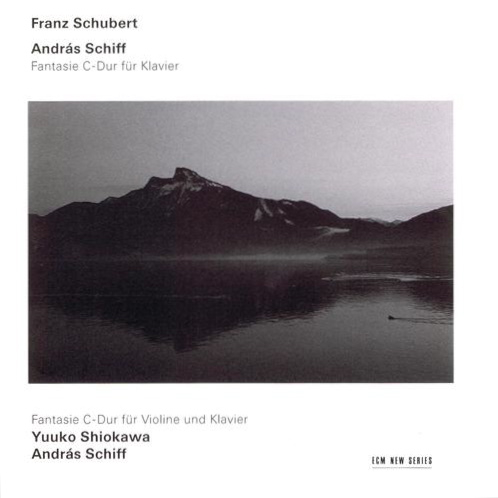
It is tempting to say that the music of Franz Schubert (1797-1828) was ahead of its time. In the words of pianist András Schiff, “Schubert has such modernity—perhaps his time has only arrived now.” When encountering the 1822 “Wanderer” Fantasy for the first time, the characterization would seem to fit like a tailored suit. And yet, if we track its subsequent influence on composers as diverse as Liszt and Ligeti, it becomes clear that he was a composer of his moment, and it is this moment to which so many listeners have returned in their own wanderings. It might, then, be more accurate to say, “Modernity has such Schubert.”

In the first half of this recital disc for ECM, Schiff flows through the piece’s technical challenges like a river through a forest. As remarkable as this is, more intriguing are the ways in which he navigates its emotional mazes, for as a Schubert interpreter Schiff prefers poetry to drama. He gives requisite oomph to the magisterial introduction and from it elicits rounded gestures implying acres of pasture at a single touch of key. Yet his most commanding moments are the gentlest. Almost as still as mirrors, they reflect the leaf-patterned light that seeks them. Pulling away the vines, Schiff smells the moss, fecund with mystery. Knowledge of Schubert’s all-too-brief life inflects these passages darkly. From the spectral to the colloquial, the “Wanderer” spans the gamut of responses to landscape, though the Beethovenian desperation in the final fugue is undermined by an intermittent restraint that may sit oddly with fans of benchmark recordings like Richter’s or Pollini’s. Still, a resplendent sign-off gives the piece a total shape that is Schiff’s own.

His wife, violinist Yuuko Shiokawa, joins her partner for Schubert’s Fantasy D934, also in C major. Published posthumously in 1850, its proper score rested dormant beneath the recital stage until the 1930s. Emerging in a ghostly whisper, Shiokawa draws a spider’s thread through the piano’s microscopic tides. This is the dream to the former fantasy’s waking, made manifest through the strains of an inviting dance. Shiokawa brings appropriate balance of airiness and strident romanticism to what is arguably some of Schubert’s most beautiful writing. She partners well with the piano as a parallel voice—neither competing nor unified. Shiokawa also handles the technicalities with grace, particularly during a delightful passage that floats pizzicato in cascading undulations from Schiff’s fingers. Another flowery conclusion, if more succinct than the last, again closes the circle with confidence.

The recording here is noticeably soft in texture, heavy in the lower register. The combination sucks a bit of wind from Schubert’s sails in portions, especially in the finale of the “Wanderer.” Both Fantasies remain purest in their introductions and in their quieter turns. Such issues aside, with these two pieces Schubert shows that perhaps all music is fantasy.

<< Dave Holland Quintet: Prime Directive (ECM 1698)
>> Jan Garbarek/The Hilliard Ensemble: Mnemosyne (ECM 1700/01 NS
)

Ketil Bjørnstad/David Darling: Epigraphs (ECM 1684)

Epigraphs

Epigraphs

Ketil Bjørnstad piano
David Darling cello
Recorded September 1998
Engineer: Jan Erik Kongshaug
Produced by Manfred Eicher

Driven into the
terrain
with the unmistakable track:
grass, written asunder.
–Paul Celan, “The Straitening”

Until Epigraphs, the output from Norwegian pianist Ketil Bjørnstad and American cellist David Darling had been explicitly aquatic, as on The River the duo furthered ideas and atmospheres explored on the quartet project The Sea. Here there is a more grounded sense of architecture. And while some of it remains activated by water, for the most part it observes as it feels: on high ground. It is not a boat but an observatory, which allows the eyes to look freely into the heavens where feet and oars may not progress.

The resonance of the recording takes lantern shape. The “Epigraph” theme is its flame. As such, it flickers without ever losing hold of wick, a moment of dance lost as quickly as it fades. Much of this light comes through in song titles alone. There is enough dawn in “Wakening,” for one, to deny the imminence of dusk, so that the draw of “Silent Dream” moves with almost painful self-awareness. “The Lake” looks back through overtly drenched eyes toward a moving rite of passage. “Gothic,” too, sounds like a seed for The Sea that never sprouted, content in being self-contained. One can almost hear those distant cries, swooning electric between the clouds. In the spirit of balance, Darling digs low in “Upland,” reassuring us that Earth is not forgotten. He slips into the topography of Bjørnstad’s playing like a shoe to a foot, which follows wherever the wind may lead. Only at the end does he leap skyward through the narrow eye of a shooting star.

A smattering of Renaissance material by William Byrd, Orlando Gibbons, Guillaume Dufay, and Gregor Aichinger rounds out the disc and reveals itself as the core of everything that Bjørnstad and Darling have molded together. Byrd’s “Pavane” is replete with such gentility in the artists’ touch that one can almost taste the mythological impulses that nourish them. Aichinger’s “Factus Est Repente” ends with stark hymnal energy. Like the fountain pen that flows as long as there is ink, it fades only when the blood has left its poetry.

Epigraphs further yields two important tracks for both musicians and label. First is “After Celan,” which combines the shape of words and the shape of music. Second is “Song for TKJD,” a profound dip into Darling’s whirlpool of multi-tracked pathos. Here the landscape stretches, pixilates into a mosaic of monochrome. Like a lost traveler from his Cello, it comes to us fully bearded with the eternal youth of its message. It is a wavering tapestry in which Bjørnstad somehow finds purchase in the bones, a ladder of pages in absence of binding.

The quiet power of this music is its emphasis of reality over thought. It rounds the edges of our quotidian activities with intermittent variations, leitmotifs, and signposts. Bjørnstad and Darling share an ability to take something melancholy, even morose, and flood it with light to expose a spectrum in darkest hours. From the past to the present and back again, their path ties a loophole in space and cinches it until the moon closes her monocle.

<< John Abercrombie: Open Land (ECM 1683)
>> Jan Garbarek: RITES (ECM 1685/86
)

Bent Sørensen: Birds and Bells (ECM New Series 1665)

Birds and Bells

Bent Sørensen
Birds and Bells

Christian Lindberg trombone
Oslo Sinfonietta and Cikada
Christian Eggen conductor
Recorded October 1997 at NRK Studio, Oslo
Engineer: Audun Strype
Produced by Manfred Eicher

Visual practitioners have experimented with processes of decay for centuries. Their art has even become subject to it over time in varying degrees. Those working with sound, however, face different challenges in evoking the same. Electronic musicians have perhaps been most successful in this regard. Mike Sandison and Marcus Eoin, better known as Boards of Canada, often subject their creations to a sort of virtual oxidation whereby the music loses its sheen and welcomes blemishes and distortions into its fold. William Basinski inadvertently took this one step further when he captured the process live while recording what came to be known as the Disintegration Loops. And now we have Bent Sørensen, whose quasi-spectralist sound-world dons the ECM New Series cloak in this program of instrumental works.

Bent Sørensen

Most of the program places soloists inside an ad hoc group under the moniker Cikada Ensemble. The Lady and the Lark (1997) centers on viola amid a spray of other colors. And yet this series of five miniatures (the longest at three minutes) turns soloist into periphery, dotting a mandala-like framework with textured bodhisattvas. Amid fluttering intentions and water-drip effects, woodblocks touch the night with their toad-throated vibrations. Like paintings subjected to X-ray, they reveal underlying sketches. Such attention to microscopic detail further shapes the Funeral Procession for violin, viola and 6 instruments (1989), which similarly pulls up the carpet from the forest floor and shines a flashlight on all that squirms beneath. Like an astronomer, it focuses on the negative space as much as the stars, each nothing without its limpid backdrop.

By contrast, while The Deserted Churchyards for violin, cello, flute, clarinet, percussion and piano (1990) designates no central instruments, piano and flute act as quasar to its gaseous system. Their transcendent relays render invisible fissions audible. A tubular bell bends to the will of a shifting wind and drowns in a wisp of distance. From the title alone, one might imagine a still and neglected scene. We instead encounter a microbiome of scuttling activity. Desertion does not mean death; it means the freedom of kinesis to run its course unimpeded, except by its own zeal.

The Bells of Vineta for solo trombone (1990) dips freely into the Uncanny Valley. Christian Lindberg is the soloist, and his presence throughout is almost disturbingly vocal. With every muted slur he walks the line between cartoonish mockery and cathartic mourning. He travels with an eerie persistence in the tripartite title composition. Composed in 1995, it drops him into the larger palette of the Oslo Sinfonietta under the baton of Christian Eggen, who elicits a viscous, bleeding mosaic with wounds that sparkle from the touch of a healing ear. Each grows a tiny hand of light, plucking thorns of shadow from its own luminescent skin. Lindberg again animates his playing vocally, closing and separating to the pulse of a larger body. The result is a Doppler effect of the soul, the tinnitus of collected verses that make up any life. The occasional rhythmic passage cuts through the fog, each a tadpole swimming in the piano’s darkened well, a place where reality and childhood intermingle like ink and water, respectively. References to George Crumb, Gideon Lewensohn abound inside these cellular whispers, dreams yet to be dreamt and whose realization flowers with the tide’s recession.

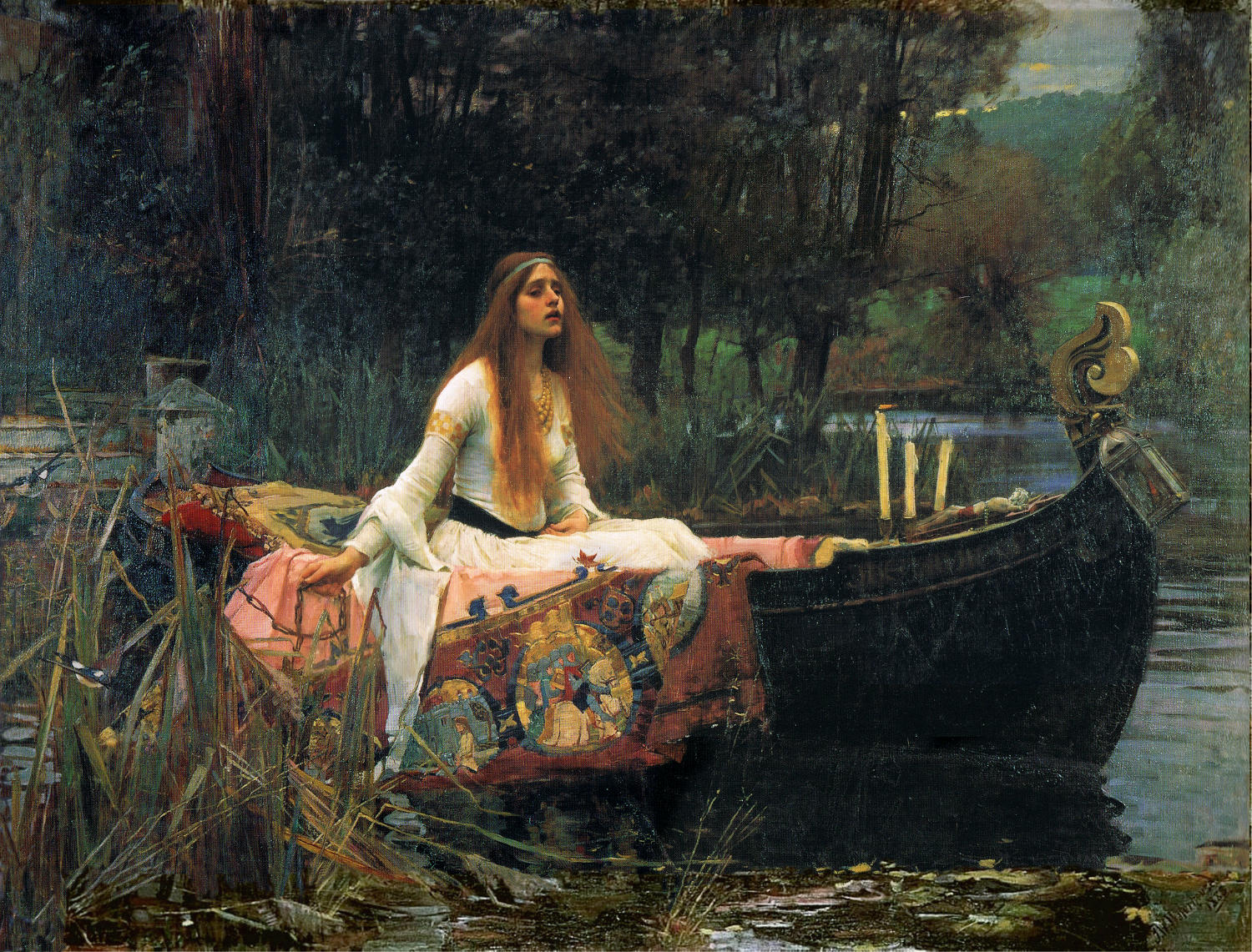
The Cikada Quartet draws a curtain with The Lady of Shalott (1993), which allows us to feel water and glass as if they were the same. Yet the cut of its passage is less like the boat in the famous John William Waterhouse painting…

Waterhouse Lady of Shalott

…and more like the threads in William Holman Hunt’s rendering, spilling from their loom with all the profusion of Christmas yet clipped by cerebral destruction. These are the paths we have taken, and they lead us all to where we began.

WHH Lady of Shalott

And on that note, these pieces, if only by virtue of their programming, exist as part of a phosphorescent whole. They arch their backs along the edge of a crescent moon, feeding off the oscillation of the night. By the humble touch of a fingertip to string and bone, their effect births as much as it dissolves. Though the foliage may change, the branches pulse in synapses of life. There is destiny in these leaves and it quivers with every verdant breath. In this music, sun and moon can touch each other without the slightest hint of destruction, for in that contact they acknowledge having been spun from the same breath.

<< Misha Alperin w/John Surman: First Impression (ECM 1664)
>> Keith Jarrett Trio: Tokyo ’96 (ECM 1666
)

Dominique Pifarély/François Couturier: Poros (ECM 1647)

Poros

Poros

Dominique Pifarély violin
François Couturier piano
Recorded April 1997, Festburgkirche, Frankfurt
Engineer: Markus Heiland
Produced by Manfred Eicher

Dominique Pifarély—violinist and former co-leader of clarinetist Louis Sclavis’s acclaimed Acoustic Quartet—and pianist François Couturier—who since Anouar Brahem’s Khomsa has recorded a string of varied albums for ECM—team up for this unique collaboration. The resulting admixture of folk and modern classical influences finds the duo charting waters that might have otherwise remained glassy and still without the cut of their oars. The image is no mere metaphor, for the album’s title comes from French philosopher Sarah Kofman, who characterizes the concept in precisely these oceanic terms: a path through aquatic expanse that is just as vulnerable to erasure as it is to discovery. Its trailblazing implications rest on a blade of uncertainty, and therein lies their beauty.

One might be hard-pressed, however, to read any of this into the music in the absence of such a setup. The listener is instead confronted with a tantalizing, if restless, chain of events. “Trois images” awakens in a fit of pique, only to realize that the object of its scorn has already fallen away like the house of cards that is any dream. The musicians seem to run frantically trying to rebuild it before it gives up the ghost of reality. In other pieces like “Retours,” “Vertigo,” and the title piece we encounter an even more gnarled grammar. It is a dialectical assemblage of action and thought, of secrecy and exposition. The album is a constellation of references whose stars belie hues of the French modernists, free improvisation, and Bartók, among others. We therefore never rest for too long on one idea. The occasional locks stand out for their beauty, only to drown in a sea of cat cries prancing into blackout. What with the bubbling streams of “Labyrintus” and the grinding gears of “La nuit ravie” there is far more going on below and within, locked away behind a shell of almost ritual design. Pifarély brings the occasional jazzy inflection to the arc of his swing, most notably in Mal Waldron’s “Warm Canto” (from his 1961 album, The Quest), in which he blends tiptoeing pizzicato into explosive resonant chords in a chromatic whirlwind. “Gala” offers a pileated ending.

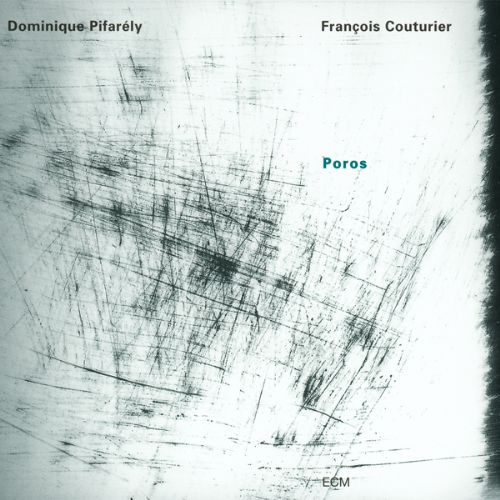
As on the album’s cover, the duo crosshatches incidentals in a knitted bruise. Pifarély trembles with the motion of a leaf obsessed with the fear of falling. His attention to detail and the precision of his agitations are thus remarkable. Couturier’s intricate astrology calls strangely from below, goading that leaf into decomposition. Only then do we see that the forest has been there all along, tilting, spinning, blurring into a looming mask of greens and browns. Traction is hard to come by, paths invisible. Our mind becomes the score, the stand on which its pages are turned, the sound dying to be released from within it. In thinking we believe, and in believing we know.

<< Giya Kancheli: Trauerfarbenes Land (ECM 1646 NS)
>> Michael Mantler: The School Of Understanding (ECM 1648/49
)