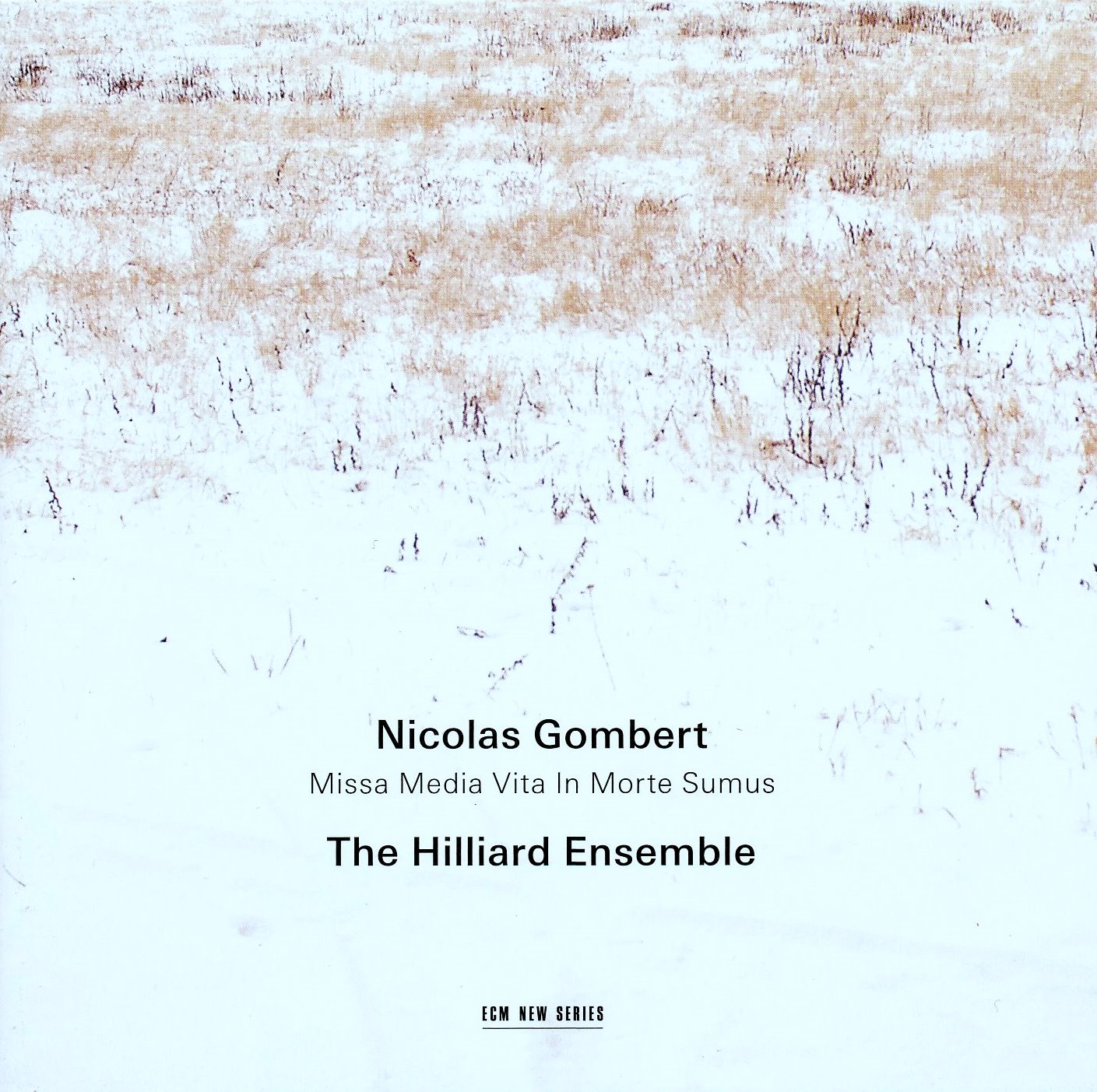
Nicolas Gombert: Missa Media Vita In Morte Sumus – The Hilliard Ensemble (ECM New Series 1884)


Nicolas Gombert
Missa Media Vita In Morte Sumus

The Hilliard Ensemble
David James countertenor
Rogers Covey-Crump tenor
Steven Harrold tenor
Andreas Hirtreiter tenor
Gordon Jones baritone
Robert Macdonald bass
Recorded May 2002 at Propstei St. Gerold
Engineer: Peter Laenger
Executive producer: Manfred Eicher

A rightful successor to Josquin Desprez, with whom he studied, Nicolas Gombert had been long neglected at the time of this recording. The mass represented here, split as it is among a choice selection of motets, is exemplary of his gift for rewriting. His vocal lines are characterized by their restlessness, both in terms of composition (the virtual lack of rests in the score) and mood (in its constant search for resolution).

How do Hilliards bring their own sensibility to music already so fine? By doing what they always do so well: allowing their entire beings to resonate with every note they sing. Augmenting their usual quartet, the Hilliards welcome bass Robert Macdonald and tenor Andreas Hirtreiter (making a trio of tenors for three of the motets herein) for this long-overdue recording. Macdonald’s presence is especially felt in the six-part motet, Media vita in morte sumus, that opens the program. Like much of what follows on this disc, the music is dark and bottom-heavy. This doesn’t mean, however, that moments of light are nowhere to be found, for in the escalations of tense polyphony that abound there is the illumination of obscurity. Like a stained glass window, one comes to know it through its variations in opacity and translucence, and then only through a glow whose source remains as intangible as the reverence that gave it life.

Gombert takes the Media vita in morte sumus as source for his five-part Missa Media Vita. Scattered among a selection of motets, the voices of the Missa tumble into one another in a music resigned to its own finitude. Harmonies tend toward the dissonant and tight, so that moments of consonance shine with an airy quality that seems to bypass the mind completely and head straight to the prayerful heart. There is gravity in this music, both in its sense of seriousness and in terms of force. One need listen no further than the Kyrie, which through its introductory tenor line shifts the angle of light to a gallery of rolling landscapes. Between the subtler interactions of the Sanctus and the continued magic of the tenor lines in the Agnus Dei, one cannot help but hear in their amen(d)s a visceral resolution.

Throughout the remaining motets, the brilliance of David James steals the heart, especially in O crux, splenidor cunctis. His duetted lines with tenors in the Salve Regina seem also to fly, scanning pasture for supplication. Unexpected changes await in Anima Mea, which moves with the timidity of a newly baptized child, while the closing Musae lovis, a tribute to Josquin, surrounds us in folds of ever-changing breath.

Gombert’s is music one can easily get lost in. In doing so, the listener learns to shut out the individual voice in favor of the grander tabernacle it embodies. His motives work in ropes more than threads. Like members of a shepherd’s flock, herded by divine command, they may not understand the constitution of the voice that guides them, but through the sound alone they know to press on with their brothers and sisters into the setting sun.
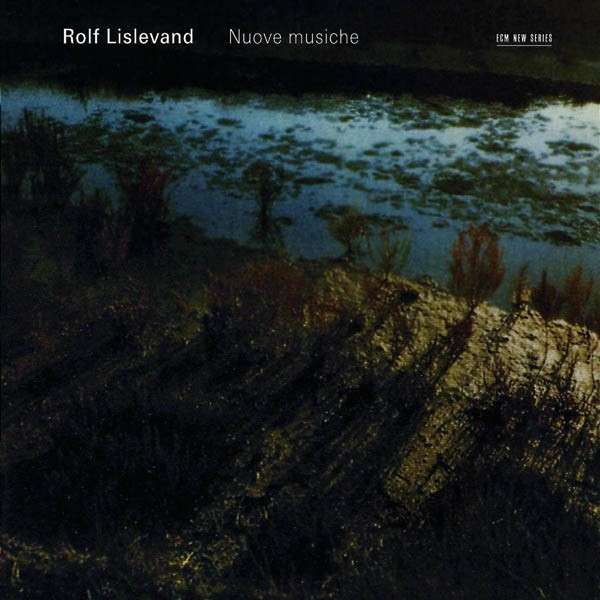
Rolf Lislevand: Nuove musiche (ECM New Series 1922)


Rolf Lislevand
Nuove musiche

Rolf Lislevand archlute, baroque guitar, theorboe
Arianna Savall triple harp, voice
Pedro Estevan percussion
Bjørn Kjellemyr colascione, double-bass
Guido Morini organ, clavichord
Marco Ambrosini nyckelharpa (viola d’amore a chiavi)
Thor-Harald Johnsen chitarra battente
Recorded October 2004 at Rainbow Studio, Oslo
Engineer: Jan Erik Kongshaug
Produced by Manfred Eicher

Anyone expecting a straight-off rendition of Baroque material from Rolf Lislevand’s ECM debut will, I hope, be pleasantly surprised by this eclectic and immaculately rendered program. Lislevand is that rare musician of early music who tries not to reconstruct that which cannot be reconstructed. Rather, he speaks to the spirit of things, is vitally interested in the intersection between the historical and the personal. Authenticity, we then find, is in this context not about accuracy but about a willingness to open oneself to the possibilities unwritten in a given score.

The titular “nuove musiche” terms a challenge among certain thinkers of the seventeenth century, whose dismissal of sixteenth-century polyphony led to a favoring of the pared-down rhetoric that forms the basis of this recording. Giovanni Girolamo Kapsberger, Domenico Pellegrini, Girolamo Frescobaldi, Alessandro Piccinini, Luys de Narváez, Bernardo Gianoncelli are composers who exemplified this nascent attitude, and their music comprises a luscious and life-affirming statement. Writes Lislevand in his liner notes, the nuove musiche “grew out of sound and musical silence in space. As in all music, the musician is forever inseparable from the sound of his instrument or voice. The space in which the sound arises is like the surface on which a picture is drawn: it is the canvas on which a painting emerges, or the time and space from the beginning to the end of a movement in a dance.” This seemingly reduced template did, in fact, enable in the musician greater freedom of improvisatory expression, and it is this spirit that moves every gesture of the present recording. Kapsberger’s Arpeggiata addio sets a tone dripping with atmosphere. From Pedro Estevan’s delicate percussion to Arianna Savall’s wordless voice, flowing over an oceanic ensemble, it haunts as it unfolds. So begins a journey that seems to flow more deeply with every breath taken, every string plucked, every bow drawn. Yet it is Pellegrini, whose masterful explorations of the passacaglia form make up the bulk of the album, who enlivens this program to its highest marks. A smattering of other passacaglias, including a beautiful nugget from Frescobaldi, and the fascinating Toccata cromatica close this crystalline album like a clasp on a locket.

An album this good, this unique, can only feel like a new life, so imbued is it with an innate force that energizes as much as it soothes the weary soul. Lislevand and his ensemble play to the needs of a music that so achingly wants to be heard. The recording sparkles, every trembling on the fingerboard and quiet breath coming through. Some of engineer Jan Erik Kongshaug’s finest work.

Stephen Stubbs: Teatro Lirico (ECM New Series 1893)


Stephen Stubbs
Teatro Lirico

Miloš Valent violin, viola
Erin Headley viola da gamba, lirone
Maxine Eilander Spanish and Italian harps
Stephen Stubbs chitarrone, baroque guitar
Recorded February 2004 at Propstei St. Gerold
Engineer: Markus Heiland
Produced by Manfred Eicher

After his successful collaborations with John Potter’s Dowland Project, American lutenist Stephen Stubbs at last leads his own ensemble with Teatro Lirico. The resulting efforts seek to express the completeness and spiritual heights of the human voice. His medium thereof on this particular album is “La Folia” (a dance and chord pattern popularized in the sixteenth century, connoting madness and empty-headedness through an improvisational and virtuosic aesthetic), the Italian Sonata, and a nod to more obscure Slovak sources.

Whereas an album like Rolf Lislevand’s Diminuito is the spirit of a trope, Teatro seems the spirit of an age. Like an age, its borders are as porous as the politics of those who delineate them, yet at the same time their very arbitrariness gives us insight into the larger meanings we may ascribe to them. Sonatas by Arcangelo Corelli on the Folia theme form the backbone of the adventurous program. As a trope, the Folia tends toward the cyclical in its musical progeny, so that the first of two group improvisations to follow taps into its intertextuality, finding within that delicate balance of intent and creative expression an ideal way to understand its architecture. The variations for harp and Baroque guitar speak to this same instinct, each variation an expression of infinitude.

The harmonic tensions of Giulio Caccini’s 1601 Amarilli, mia bella take on an even greater significance when played out against such wellsprings of free expression. One can almost hear the singing that inhabits the background of pieces like the Adagio from Maurizio Cazzati’s Balletto Quarto, in which the retraction of lead and bass lines reveals vast content. The meat of this fascinating journey comes in the form of Carlo Farina’s Sonata Seconda detta la desperata for violin and continuo, which bristles with Biber-like quality. That same sense of compressed drama (from an age in which the musical universe needed only a chamber to find purchase) reveals the visceral plenitude of every instrument. Thus heard, seen, and felt, their voices can live again. It all comes to a head in a Suite by Johann Caspar Horn from an anonymous Slovak manuscript before ending with Arpeggiata a mio modo (2004) in a loom of threads, sounding almost like a Gustavo Santaolalla dirge.

The performances on Teatro Lirico are impeccable, enhancing the lute’s newness at every turn—which is precisely why an album of Renaissance finds its way onto ECM: the here and now is what it’s all about.

Tigran Mansurian: String Quartets (ECM New Series 1905)


Tigran Mansurian
String Quartets

Rosamunde Quartett
Andreas Reiner violin
Simon Fordham violin
Helmut Nicolai viola
Anja Lechner violoncello
Recorded May 2004 at Propstei St. Gerold
Engineer: Markus Heiland
Produced by Manfred Eicher

It was not until his 40s that Tigran Mansurian at last wrenched out the two string quartets presented on this captivating disc. Already known for his labored approach, the Armenian composer has given us in these works something deeply profound and lasting for the genre. Yet in listening to this music, one gets the sense that genre is farthest from his mind. Both quartets are solemn statements for late friends David Chandschian and Eduard Chagagortzian. “The basic idea is to develop a musical style out of the principles of the Armenian language,” says first violinist Andreas Reiner, “and especially out of its stylized expression of grief.” With this in mind, we find that Mansurian’s capillary approach is like an expression of social power, whereby the bane of politics and displacement is dissolved in the tincture of an unfettered melody, in its careful arrangement of musical lines through the discovery of some emotional truth. Each strand of these quartets bows like a spider’s web cast in the wind, tethered to something behind the clouds.

Although both quartets take a three-movement structure, with two somber skins surrounding an active middle, any articulations of shape and size are rendered in moonlight alone, for these quartets are decidedly nocturnal, emphasized by their watery reflections. The Allegretto of the String Quartet N° 1 (1983-1984), for instance, reflects the glow of a moon obscured rather than its direct glittering light. It is unerring in its consistency, in its residual presence. The Agitato unfolds with an unsettling grace, anchored down by an active yet firmly earthbound cello line. This erratic dance is strangely consolatory. A descent carries us into quieter recapitulations, during which the viola sings with singularity. Any rhythmic urgency therein is picked apart by siren calls blending into the Maestoto. Moments of confluence in tutti add graceful flourishes to the inscription, ending in solace.

Mansurian’s quartets describe a world in which both the surface and the interior of the self, and of the material objects with which that self engages, are one and the same, participating as they do in a wider mediation between flesh and spirit. It is a reciprocal relationship, a symbiosis of sound and its notation. And so, the opening Andante of the String Quartet N° 2 (1984) is, while an inversion of the often declamatory instatement of a new piece, appreciative of the shadow that lies within, so that by its end we are not filled with anticipation but rather with the acceptance of the awakening pizzicati and dynamic phrasings in the Larghetto. The final Andante also works its way in spindles, threads spun by candlelight in an evening where silence becomes audible as the humming of the plains, the trees, and the beating of one’s own heart.

The Rosamundes end this already full program with a more recent work. Testament (2004) bears dedication to producer Manfred Eicher, whose tireless efforts in spreading the wonders of such composers as Mansurian is duly felt here. This single Lento moves like an organ with its solemn vocal qualities, bringing us into communion with the promise of a misted evening star.

Many composers can make the individual voices of a string quartet sing, but how many can make them breathe? This music is respiration incarnate. It has been speaking to us since time began. We need only open our lungs to take it in.

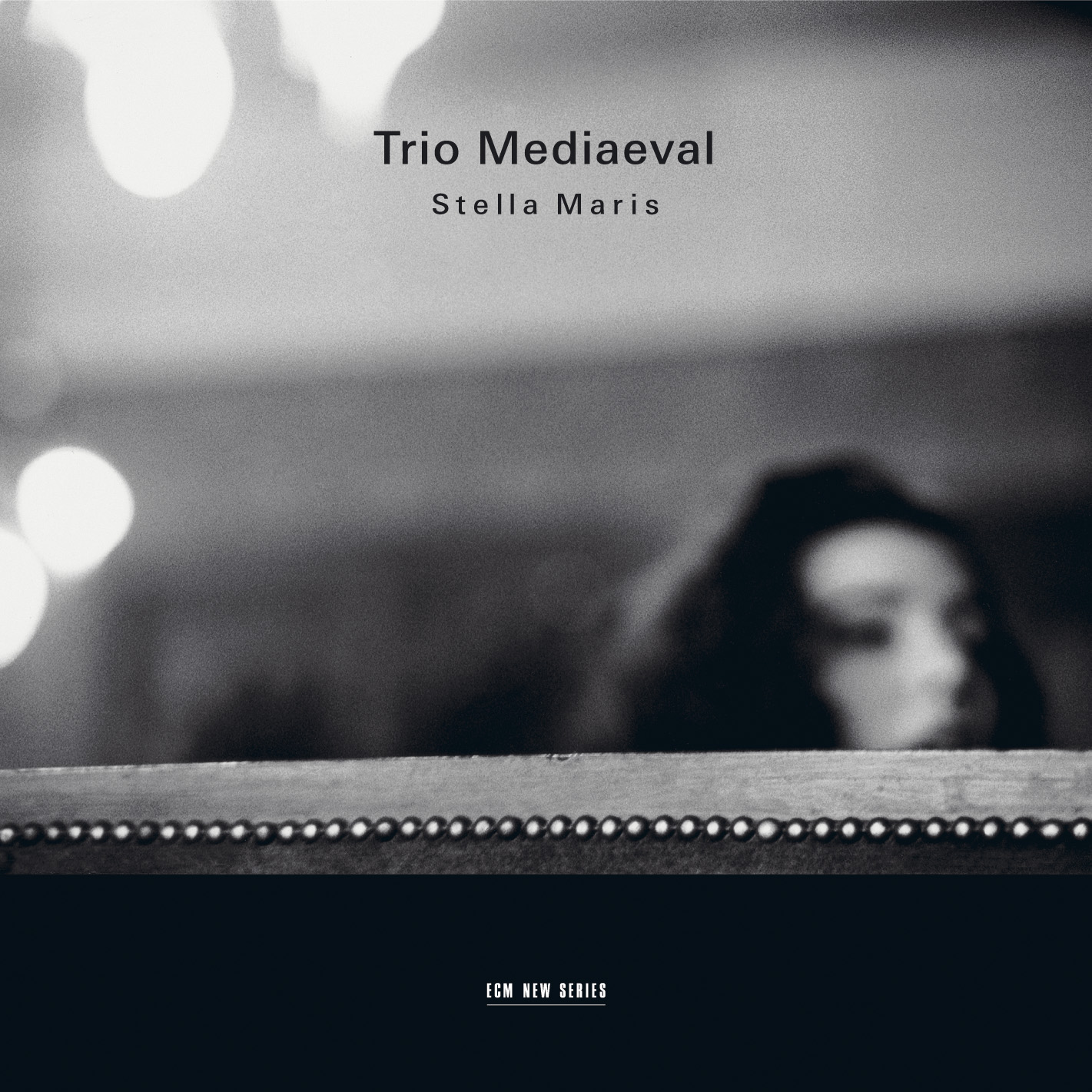
Trio Mediaeval: Stella Maris (ECM New Series 1929)


Trio Mediaeval
Stella Maris

Anna Maria Friman soprano
Linn Andrea Fuglseth soprano
Torunn Østrem Ossum soprano
Recorded February 2005 at Propstei St. Gerold
Engineer: Peter Laenger
Recording producer: John Potter
Executive Producer: Manfred Eicher

For their third ECM outing, the sopranos of Trio Medieaval set their vocal sights to 12fth- and 13th-century French and English (mostly conductus) chants, nestling within these a newly commissioned mass from Korean-born Sungji Hong. That the former (with one exception) performed here were never meant to be sung—or, for that matter, heard—by women at the time of their composition matters not when basking in the vitality of this recording: further proof that music is open to all who touch it, just as those who are touched by it become open to all.

In her liner notes, Nicky Losseff rightly speaks of sweetness, for one cannot help but savor in the fragrant wash of polyphony that is the opening Flos regalis virginalis. This, along with the protractions of Veni creator spiritus and the Beata viscera, comprise some of the program’s most affecting moments. Haunting also are the sustained drone of O Maria, stella maris and the transportive strains of Dou way Robyn.

Yet the most crystalline pillars in this house of mist and time resolve themselves in Hong’s beautiful Missa Lumen de lumine. Written in 2002 and dedicated to the Trio, it grows like vines in ruins grown truer with age. Like the light of its title, this mass is composed of prismatic strands, some of which unify in single threads of chant and others of which refract, visualizing the nature of their own splitting. Between the heavenly Gloria and Agnus Dei, one is left drifting in these precise rhythms and changes. Hong is highly respectful of the texts of the Mass Ordinary and forms of each line a secret braid, ending often with a subtle flourish in the spirit.

Anonymity in music is purity, filled with hope and the sparkle with wisdom. It allows us to strip music of its egotism and appreciate it as something out of place, if not out of time, and therefore of the world. In listening, we become the music’s inhabitants, not in a relationship of power, but of recognition. When paired with a highly composed work like Hong’s, the surrounding chants indeed take on a luminous quality, forever drawn to a heaven of undying voices. This is the magic that Trio Mediaeval brings to every note sung, and this just might be the most intimately appropriate album with which to begin that journey.

John Cage: Early Piano Music (ECM New Series 1844)


John Cage
Early Piano Music

Herbert Henck piano
Recorded December 2002, Festeburgkirche, Frankfurt am Main
Engineer: Markus Heiland
Executive producer: Manfred Eicher

Two years after his benchmark account of the Sonatas and Interludes, German pianist Herbert Henck returns to the music of John Cage for this refreshing program of early works. Henck’s prowess at the keyboard is matched note for note by tenderness, and in these pieces we find both in full order. His ability to render even the most serial works as lusciously as he does more readily accessible works like 1948’s In a landscape is nothing short of astonishing. Of the latter masterpiece he gives an endearing performance that thrums with drawn-out warmth under his touch—an intimate tapestry spread to reveal every tonal stitch blissfully intact.

Yet it is in the miniaturization of such works as The Seasons (1947), heard to great orchestral effect on the selfsame ECM disc, that one finds this artful program’s most enchanting moments. As with much of Cage’s instrumental music, it feels and flows like nature, is at one with certain understandings of universal design. And so, when we listen to a track like Winter, it does not feel like falling snow, or even the whipping winds of a blizzard, but speaks to a rather different sense of climatic change. Neither does Summer swelter. Rather, these pieces embody their elemental forces. From the scattered Preludes alone, we get a sense of the piece’s intense variation in styles, speeds, and modes of articulation, by turns rather mysterious and straightforward, uncompromised. This is music without form, but in being formless becomes ordered, unfolding at the speed of remembrance.

The five-part Metamorphosis (1938) presents us with some of the more playful moments in these selections, following linear melodies down halls of mirrors. Fleeting like the patter of children’s feet, it breathes over into an innocent finality. After the convoluted yet true-to-form little curiosity that is Ophelia (1946), the handful of piano pieces that concludes the album might come across as pedantic were it not for Henck’s distinctly “vocal” approach.

A worthwhile peek into Cage’s world that allows us to see a composer on the brink of finding his way, Early Piano Music is remarkable also for Markus Heiland’s engineering, which captures every nuance of Henck’s playing with a microscopically attuned ear.

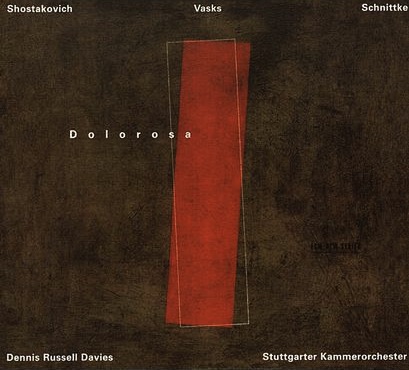
Shostakovich/Vasks/Schnittke: Dolorosa (ECM New Series 1620)

Dmitri Shostakovich
Alfred Schnittke
Peteris Vasks
Dolorosa

Dennis Russell Davies conductor
Stuttgarter Kammerorchester
Recorded June 1996, Mozart-Saal/Liederhalle, Stuttgart
Engineer: Peter Laenger
Produced by Manfred Eicher

Orchestral transcription can be a contentious enterprise, obscuring as it enhances. Yet in rare cases its contours manage to take a shape all their own, living a new life somehow beyond the shadow of the original. Of this transformation we get two fine examples in Dolorosa, a well-conceived program from three distinct compositional minds.

The works are presented in chronological order, with a 1967 orchestration of Dmitri Shostakovich’s String Quartet No. 8 as a “Chamber Symphony” coming first. The arrangement, by conductor and violist Rudolf Barshai (the only one ever approved by the composer), is brilliant in that it avoids masking itself and features a flowing chain of solos. The swell of grief that besets the first movement now feels like a cinematic shift rather than climatic one and leaves a lethargic trace on the second movement. Conductor Dennis Russell Davies takes a conservative tempo on this often-cathartic passage, figuring it as a page manifesting its own ink rather than one furiously scrawled upon. The macabre minuet that follows in the third reaches new dynamic heights in the current version, and allows us perhaps above all to feel what the composer himself read into the energies breathing through it (though, as Richard Taruskin reminds us, the motivations for doing so were questionable, the result of a personal revisionism). The quartet as a whole is an intertextual treasure trove, comprised primarily of snippets of Shostakovich’s own works and those of Wagner and Tchaikovsky, in addition to revolutionary songs such as “Tormented by Grievous Bondage.” Whatever the reason for writing this supposedly autobiographical summary, we can hear in the final two Largos an underlying nonconformity threatening to overtake us with each turn of phrase. But all of it is just so beautiful that one finds it hard to unlock it as a political document.

Those Largos seem to whisper throughout Musica dolorosa. Penned in 1983 by Latvian composer Pēteris Vasks in memory of his sister, it spins from indubitable threads a tapestry to be viewed, experienced, and understood. Though it manifests itself with Shostokovichian pathos, its structures feel relatively smooth to the touch. And when the quietude is at last overtaken by an outpouring of grief, pizzicato accents mark the tempo like an aural tic chipping away at a world that could dispense with life so readily. As the orchestra subsides, violas scrape the edges like tears. This piece does for grief what Erki Sven-Tüür’s Passion does for its eponym.

Alfred Schnittke’s String Trio brings the transcription instinct full circle. Arranged for orchestra in 1987 by Yuri Bashmet as Trio Sonata, it is both the longest piece on the album and the one in least need of commentary. Like Schnittke’s quartets, the trio opens itself up to moments of grandeur, but quickly undermines them with mournful denouements. Proof positive that, despite the expansion that an orchestral arrangement engenders, the music becomes no less introspective and no less intimate, and perhaps delves even deeper into the solitude of its creation.

Shostokovich noted that his eighth quartet, while openly bearing dedication to all victims of fascism, was in fact about himself, about the death of his ideological self after having undergone such intense social pressure to join the Communist party. Yet if we take a quiet walk between the lines of that history, we find a landscape populated with staves and notes like countless others before or since. Our assumptions about Shostakovich as the victim of a sensitive political milieu often color the ways in which we perceive his music, which is perhaps the point: to read is to experience. There is, however, a danger here. One the one hand, hardship in the lives of any of these composers, much less of any others, can hardly be denied. On the other, the music is its own space, which though its attempts to grapple with something in art that cannot be safely engaged in life breathes into our souls without mitigation. In the end, there only the beginning.

<< György Kurtág: Játékok (ECM 1619 NS)
>> Jean Barraqué: Sonate pour piano (ECM 1621 NS
)

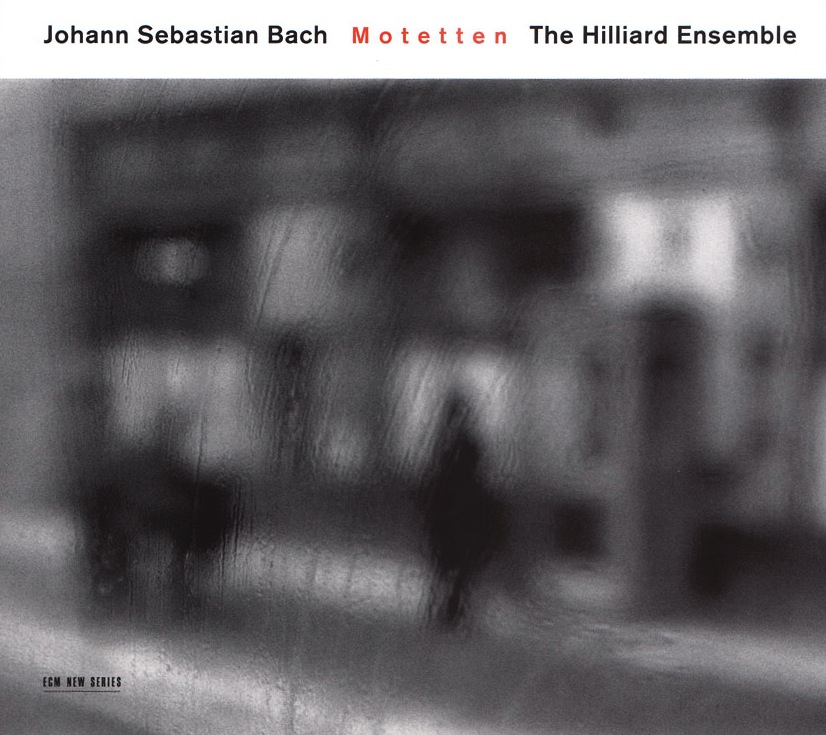
J. S. Bach: Motetten – The Hilliard Ensemble (ECM New Series 1875)

Johann Sebastian Bach
Motetten

The Hilliard Ensemble
Joanne Lunn soprano
Rebecca Outram soprano
David James countertenor
David Gould countertenor
Rogers Covey-Crump tenor, organ
Steven Harrold tenor
Gordon Jones baritone
Robert Macdonald bass
Recorded November 2003, Propstei St. Gerold
Engineer: Peter Laenger
Produced by Manfred Eicher

It was during a concert given by the Tallinn Chamber Orchestra and Estonian Philharmonic Chamber Choir in the fall of 1995 that a Bach motet’s masterful weaves of light and sound first nourished these ears. With infinitely branching listening paths before me, however, I never explored the motets further—that is, until the ECM connection came full circle with this wondrous recording from the Hilliard Ensemble. Or should I say, the Hilliard Ensemble in duplicate, for here the quartet is joined by sopranos Joanne Lunn and Rebecca Outram, countertenor David Gould, and bass Robert Macdonald for a special session in the familiar acoustics of Austria’s Propstei St. Gerold.

Very little is known about the circumstances surrounding the composition of these motets, but as Martin Geck’s liner notes remind us, their significance in Bach’s oeuvre is on par with The Well-Tempered Clavier, equally monumental as examples of counterpoint and absolute harmony. They are, one might say, extra-musical insofar as they express themselves far beyond the words at their core, beyond the note values ascribed to those words, and beyond the constraints that pigeonhole them into meters and divisions. Rather, they lose themselves blissfully in the finer details of their flowering.

From the first threads of Singet dem Herrn ein neues Lied one can feel the utter control these singers possess. Listening to them is like feeling the music being born from Bach’s mind, fresh and free from the pitfalls of excessive scrutiny. Lunn and Outram stand out especially, ringing out over the others like carillon overtones in a music overcome by a melismatic spirituality (listen also for their striking high that ends this opening motet). The shimmering space therein gives us some of the more intimate moments on the disc, nesting in mind and body with all the gentility of an autumn breeze. These motets all end on resolved chords, offering a sign of hope and tranquility in the wake of their roiling seas. On that note one can hardly praise this recording without highlighting the crisp diction throughout. This attention to linguistic color is perhaps what most separates it from those rendered in larger forces. Moments like the “Gute Nacht, O Wesen” portion of Jesu, Meine Freude are as tactile as our own bodies. Others of sheer transcendence abound, as in the final chorale of Fürchte dich nicht, ich bin bei dir and the Alleluia of Lobet den Herrn, alle Heiden. Yet it is in the last, Ich lasse Dich nicht, du sengnest mich denn (often elided from Bach motet recordings, due to its contested authorship), that we find ourselves bathed in deepest calm, for here is the breath turned sacred, that it might begin a life of its own.

Valentin Silvestrov: Symphony No. 6 (ECM New Series 1935)

Valentin Silvestrov
Symphony No. 6

SWR Stuttgart Radio Symphony Orchestra
Andrey Boreyko conductor
Recorded June 2005, Stadthalle Sindelfingen
Engineer: Dietmar Wolf
Executive Producer: Manfred Eicher

I would be surprised if Valentin Silvestrov’s Symphony No. 6 (1994/95, revised 2002) wasn’t someday recognized as being among the more significant of the twentieth century. Dedicated to Ukrainian-born composer Virko Baley, another powerful yet under-recognized voice, it speaks as might time itself. This world premiere recording is still the benchmark, given just the balance of violence and reverie it needs by the Stuttgart Radio Symphony Orchestra under the capable baton of Andrey Boreyko.

This piece, perhaps more than any other in the Silvestrov oeuvre, brings a distinctly programmatic energy to the fore of his craft. The first movement gasps like a hospital patient awakening from a horrible accident, pangs of realization shooting through a strung body arching against the onslaught of memory. The second is in the same vein, only now obscured by breath. Yet the heart of this symphony is its third movement, which over a 25-minute span encompasses all that frames it and more. Its sprawling, flower-like opening fears its own beauty, and so it breaks the mirror and swallows it, shard by shard. And as countless lives flow past, uncaught, unexplored, and unheard, Silvestrov’s omnipresent piano presses down from the sky, the detritus of a sifting pan turned ever so slowly by cosmic hands after being pulled from the Milky Way’s tepid waters. Winds and percussion contribute to the mounting sense of doom, forever dispelled by the occasional ray of sunlight. The aching fourth movement assures us of this chain of hopes. Clusters of starlight move like molten lava, leaving a quiet smolder to speak for their passing and lighting up the night like the flames on the album’s cover. The fifth and final movement continues from the unbroken thread of the fourth, a dangling chain that when pulled unleashes the liquid heart of a cloud, the frustration behind a prayer. It is the symphonic equivalent of a master engineer who with attentive fingers turns the dials of some vast mixing board, so that each element swells into a world in which “staccato” becomes a sin to be vanquished with the all-consuming statement of the almighty afterthought.

Although he does chart earlier harmonic territories in the Symphony No. 6, Silvestrov simultaneously deconstructs the privilege of doing so, expanding upon each harmonic cell with biological persistence. If the above abstractions leave you with little feeling as to what actually transpires over its nearly hour-long course, then this proves only the weakness of my words and not of the music that prompted them. Listen and be moved.