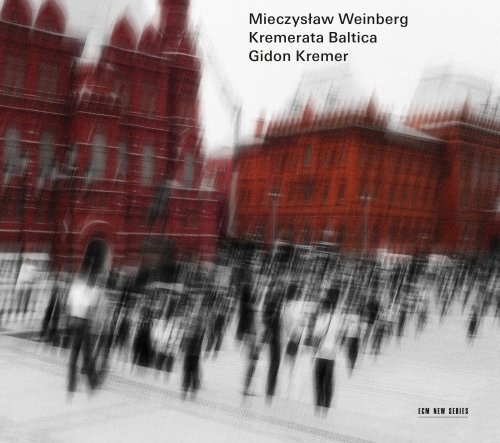
Kremerata Baltica: Mieczysław Weinberg (ECM New Series 2368/69)

Mieczysław Weinberg

Mieczysław Weinberg

Gidon Kremer violin
Daniil Grishin viola
Giedrė Dirvanauskaitė violoncello
Daniil Trifonov piano
Kremerata Baltica
Recorded November 2012 and July 2013 in Neuhardenberg (opp. 42, 48, and 98) and Lockenhaus (opp. 46, 126)
Engineers: Peter Laenger and Stephan Schellmann
Album produced by Manfred Eicher

The name Mieczysław Weinberg (1919-1996) may not be as well known as that of his dear friend Dmitri Shostakovich, but the music he penned is at last receiving overdue attention. As Wolfgang Sandner suggests in his liner notes for this ECM conspectus, the Polish-born, Russia-based composer’s obscurity has perhaps less to do with his toeing of the party line (as the great Soviet composers were wont to do) and more to do with his optimism. Although this risks painting Shostakovich with a pessimistic brush, it makes a salient point on the marketing potential of the tormented soul. Whatever the reasons for Weinberg’s lesser reputation, we can marvel at this recording’s confirmation of his compositional acumen.

No piece could be more indicative of Weinberg’s gifts than the Sonata No. 3 for violin solo. Written in 1979, his Opus 126 is a masterpiece that, despite sounding more like Bartók or Hindemith, belongs right alongside Bach’s Sonatas and Partitas for the same instrument. Declamatory without being exclamatory and ideally suited to violinist Gidon Kremer’s style, it sings, full-throated, through a checkering of rustic and urban climates and achieves its cohesion by way of staggered exposition. Each section of the larger structure lends insight into the composer’s mind, corners of which may be quiet and melodic, while others may revel in an idyllic folk dance or two, and all of it leading to the ladder of harmonics, pizzicati, and whispers with which the piece closes.

The String Trio, Op. 48 of 1950, is an intriguing follow-up, not least for its relatively academic Andante, which is sandwiched by two far more mature reckonings. Yet musicians—Kremer, along with violist Daniil Grishin and cellist Giedrė Dirvanauskaitė—make spirited work of even the occasional pedantic bar, so that any playfulness beneath the seriousness of this early work is fully present by way of an intensely lyrical core. If anything, Weinberg’s youth in this instance is sometimes betrayed by a lack of subtlety, although its historical significance outweighs any such paltry concerns. On the other hand, Kremer and pianist Daniil Trifonov give vibrant account of the 1949 Sonatina, Op. 46. This far more distinctive triptych opens with a warped dance (the light steps of which are beautifully emphasized by the duo), moves on to an organic Lento (which, compared to the aforementioned Andante, allows the instruments to breathe), and finishes with an interpolated Allegro.

Two larger-scale works complete this two-disc program. The 1948 Concertino for Violin and String Orchestra, Op. 42 is another early example, but is eminently alluring for its romantic inclinations and modernist drive. The steeliness of the opening movement melts from Kremer’s bow, as his Kremerata Baltica provides the cyclical underpinnings of every line. The Lento that follows morphs from cadenza-like solo into shadowy dance, as if obscured by leaves and time. The concluding Allegro begins with muted strings before opening into a pizzicato-led flurry of activity and razor-thin interactions. Yet these delights bow to the program’s pièce de résistance, the Symphony No. 10, Op. 98. What makes this symphony so glorious is its scale: not in terms of vastness but intimacy. Over its five-movement course, we are led through a Neo-Baroque fantasy of exquisite construction. The clearest parallels are to Vivaldi, whose own string symphonies might very well have been on Weinberg’s mind, yet whose final Allegro of the Concerto No. 8 in A minor, RV 522 from L’estro armonico is a particularly vivid reference in the second half of the first movement. The central movements are achingly introspective and feature Kremer in a meta-narrative role throughout. The string writing is just as moving in the buoyant fourth movement, while the mounting consonance of the finale unleashes some percussive playing of instrument bodies and a threnody-like conclusion.

Integral to Weinberg’s music is its integrity, to which the Kremerata Baltica and charismatic leader attend with unflagging dedication. Not only do we feel the chasm of history yielding these forgotten treasures; we also understand the value of their latent exposure. This recording is a gift, and it deserves to be accordingly unwrapped.
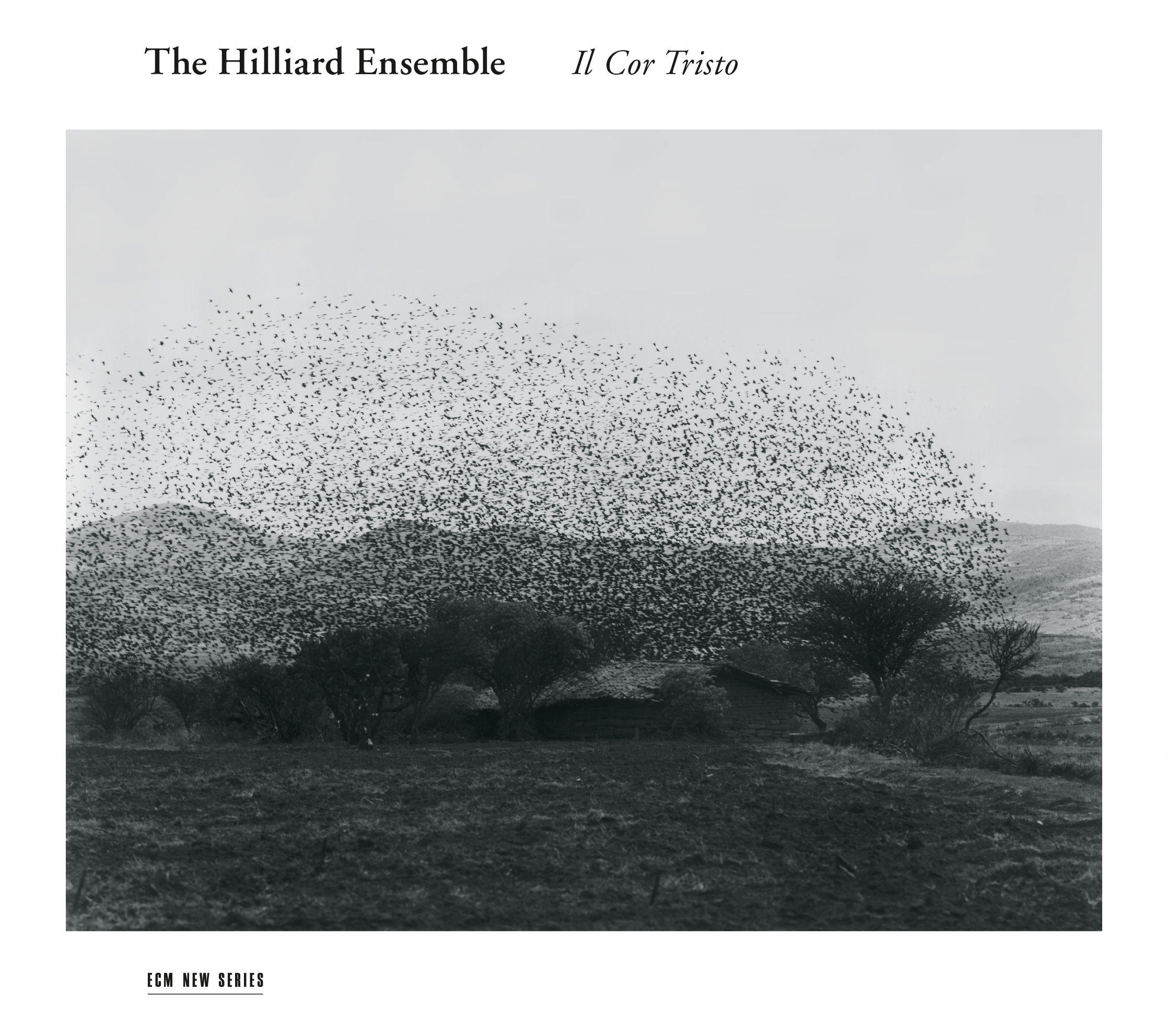
The Hilliard Ensemble: Il Cor Tristo (ECM New Series 2346)

2346 X

The Hilliard Ensemble
Il Cor Tristo

David James countertenor
Rogers Covey-Crump tenor
Steven Harrold tenor
Gordon Jones baritone
Recorded November 2012, Propstei St. Gerold
Engineer: Peter Laenger
Produced by Manfred Eicher

Throughout a four decades-long career, the Hilliard Ensemble has astonished with a vocal style so fluid yet so clearly textured that sometimes the inhales tell as much of the story as the exhales. There is, in no uncertain terms, something topographic about the Hilliards’ singing, which arcs and swivels like the mapmaker’s oldest instruments. Tenors Rogers Covey-Crump and Steven Harrold are particularly noteworthy as a core thread of the present recording, although it is baritone Gordon Jones who anchors Roger Marsh’s settings of Cantos 32 and 33 from Dante Alighieri’s Inferno with the added weight of guttural, chant-like singing. Written for the ensemble in 2008, Marsh’s title work (meaning “Misery of the heart”) is a masterful addition to the repertoire. Although it shares certain affinities with the rest of the program, one may ignore any marketing attempts to characterize its juxtaposition with the Renaissance works featured herein works as “seamless.” It is, rather fascinatingly, distinct for its organic irregularities. With a more stream-of-consciousness, recitational style, Marsh calls upon the voices to dig into Dante as if he were the very soil, until the Florentine poet’s underworld widens before us, where heads of betrayers lodged a frozen lake become tripping stones to his narrative other. Marsh’s remarkably astute writing and the Hilliards’ embodied diction make for a dramatic experience. In an explanatory liner note, the composer bids the listener to listen to these Cantos not merely for their harmony, but also for their poetry. Consequently, this release begs ownership of a physical copy. How else, then, might one appreciate Dante’s disturbing conversation of the disembodied, or the delicacy with which he and those tuneful tenors have “passed onward” into the next circle?

Francesco Petrarca, otherwise known as Petrarch, is the textual subject of interest for Bernardo Pisano (1490-1548) and Jacques Arcadelt (c. 1507-1568). The poems now focus on a rather different misery of the heart, calling on the powers that be more often to extinguish its yearnings than to chase them away by fire. Pisano’s settings are headlong excursions. Between the swift resolutions of Or vedi, Amor (Now you see, Love) and the ponderous circularities of Che debb’io far? (What must I do?), the Hilliards lead a deluge of probing sentiments. The freshness of their performance enhances Pisano’s sly arranging, which runs the gamut from lively and swinging to flowing and evenhanded. And the singers’ dynamic mastery is nowhere so beautifully tested than in Ne la stagion (At the moment), a trio of self-deprecating stanzas on the art of solitude.

Solitude further reigns over Arcadelt’s own settings, which yield some of the album’s fairest skies. The robustness of Solo e pensoso (Alone and thoughtful) sits self-interestedly on the shore of L’aere gravato (The heavy air). The latter is an ideal vehicle for David James, whose voice brings tidings of pulchritude wherever it may tread. Tutto ’l dí piango (All day I weep) likewise spotlights the countertenor and boasts some of the most pristine ensemble singing of the Hillards’ ECM tenure. And like Petrarch, who in that last verse is grieved by the failings of others more than his own, they seem to embrace the listener as an extension of their giving selves, trading fortune for a candle doused by the breath of a turning face.

(To hear samples of Il Cor Tristo, click here.)

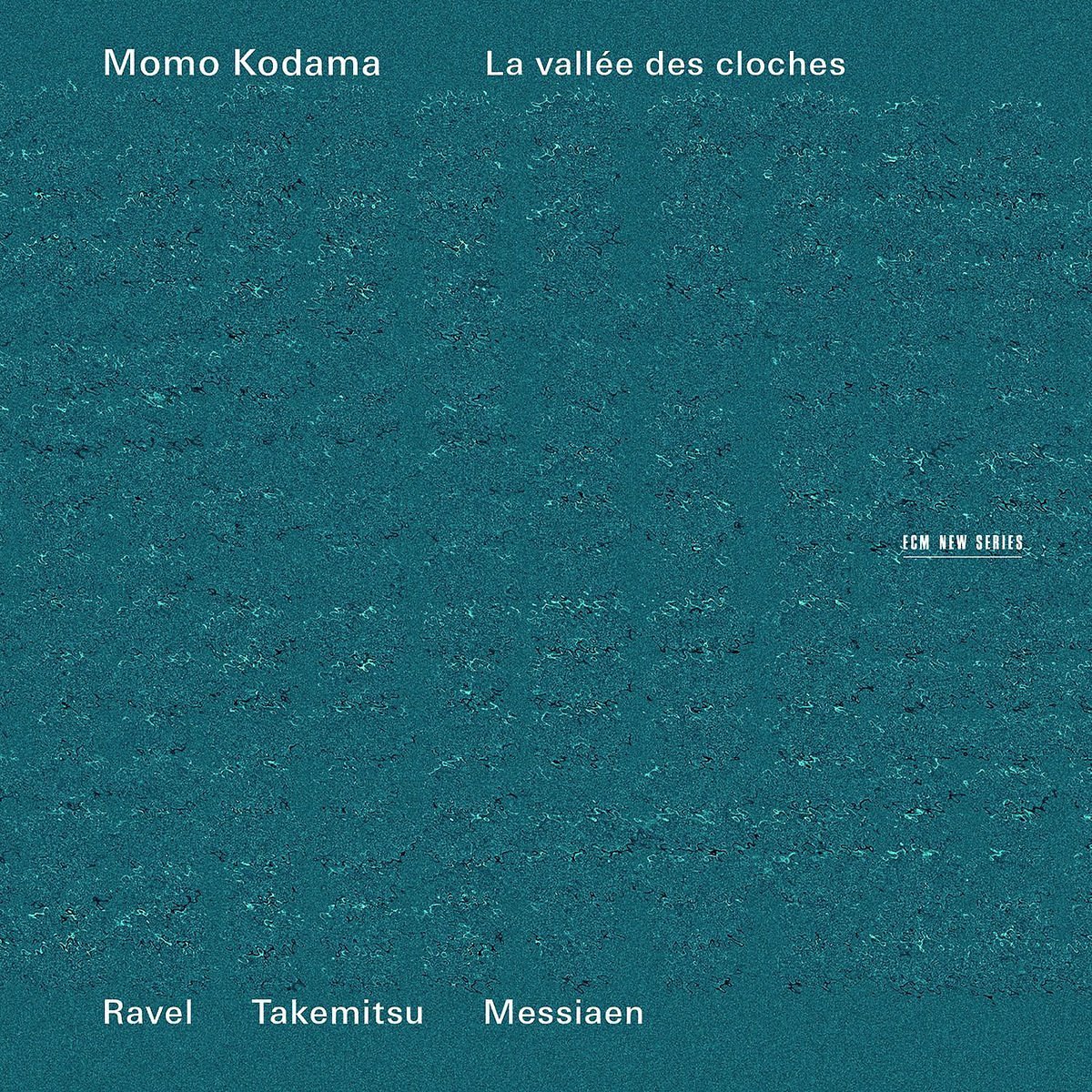
Momo Kodama: La vallée des cloches (ECM New Series 2343)

La valée des cloches

Momo Kodama
La vallée des cloches

Momo Kodama piano
Recorded September 2012, Historischer Reitstadel, Neumarkt
Engineer: Stephan Schellmann
Produced by Manfred Eicher

As of late, ECM’s New Series imprint seems to be on a mission to prove that impressionism in classical music is, if anything, an exercise in clarity. This has been the message behind such releases as Tre Voci and Alexei Lubimov’s account of the Debussy Préludes. Joining these debunkers is distinguished pianist Momo Kodama, whose first solo recital for the label is sublime as crystal.

The title (which translates to “The valley of the bells”) of her characteristic program comes from Maurice Ravel’s Miroirs. This five-part gallery of expressionist vignettes wants for nothing in environmental fidelity. Each is an embodiment of its image, and then some. The first two pieces, “Noctuelles” (Night moths) and “Oiseaux tristes” (Sorrowful birds), are together a study in contrasts, juxtaposing the former’s dreamlike wing-beats, which by slightest touch of pond’s surface scatter minnows in sunbursts of activity, and the latter’s methodical gravidity, which transgresses memory like a cigarette through silk. Already obvious at this point is Kodama’s meticulous pressure, her balancing of strength and fragility. She adds leagues to “Une barque sur l’océan” (A boat on the ocean). Like a ballerina dissolving one cell at a time, it pirouettes into a dream of wind and sail, as if one were the inverse of the other. “Alborada del gracioso” (Mornign song of the jester), on the other hand, has a Spanish flavor, made all the more vibrant for its dissonances and reflective detours, while the final bells make for some strangely provocative reflections.

Momo Kodama

At the other end of the album’s spectrum is Olivier Messiaen, a composer close to Kodama’s heart and whose La fauvette des jardins is a wonder. Something of an extension of the Catalogue d’oiseaux, a recording of which Kodama released to great acclaim on the Triton label in 2011, it presents formidable challenges to the musician by way of its affective variety. An ashen foundation in the piano’s lower register contrasts and diffuses the upward motions that follow, lighting the way with the breath of a thousand torches. Its paroxysms are decidedly spiritual. Through them salvation sings with the notecraft of insects. A restlessness of servitude pervades. It speaks through contact of flesh and bone, not tongue and breath. The piece’s negotiation of the progressive and the regressive is ideally suited to Kodama, who transforms its turbulence into an opportunity for reflection, such that its consonances feel exhausting in their orthodoxy.

Considering that Tōru Takemitsu was such a great admirer of both Debussy and Messiaen, his Rain Tree Sketch makes for effortless company. Occupying as it does the center of the program, one might feel tempted to read it as filler or segue from one French master to the other. In Kodama’s practice, however, it holds its own as a robust work of art. Takemitsu was, of course, a prolific film composer in his native Japan, and his experiences in that capacity seems to have carried over into his later works, of which this is but one evocative example. The illustrative strengths explored in the work introduce another relationship of balance into Kodama’s toolkit—this between circular and linear forms—and does so with meditative attention paid to the underlying touch of things. Like the musician herself, Takemitsu’s idea of a sketch is full enough to be called consummate.

Myung Whun Chung: piano (ECM New Series 2342)

piano

Myung Whun Chung
piano

Myung Whun Chung piano
Recorded July 2013, Teatro La Fenice, Venice
Engineer: Rainer Maillard
Produced by Manfred Eicher

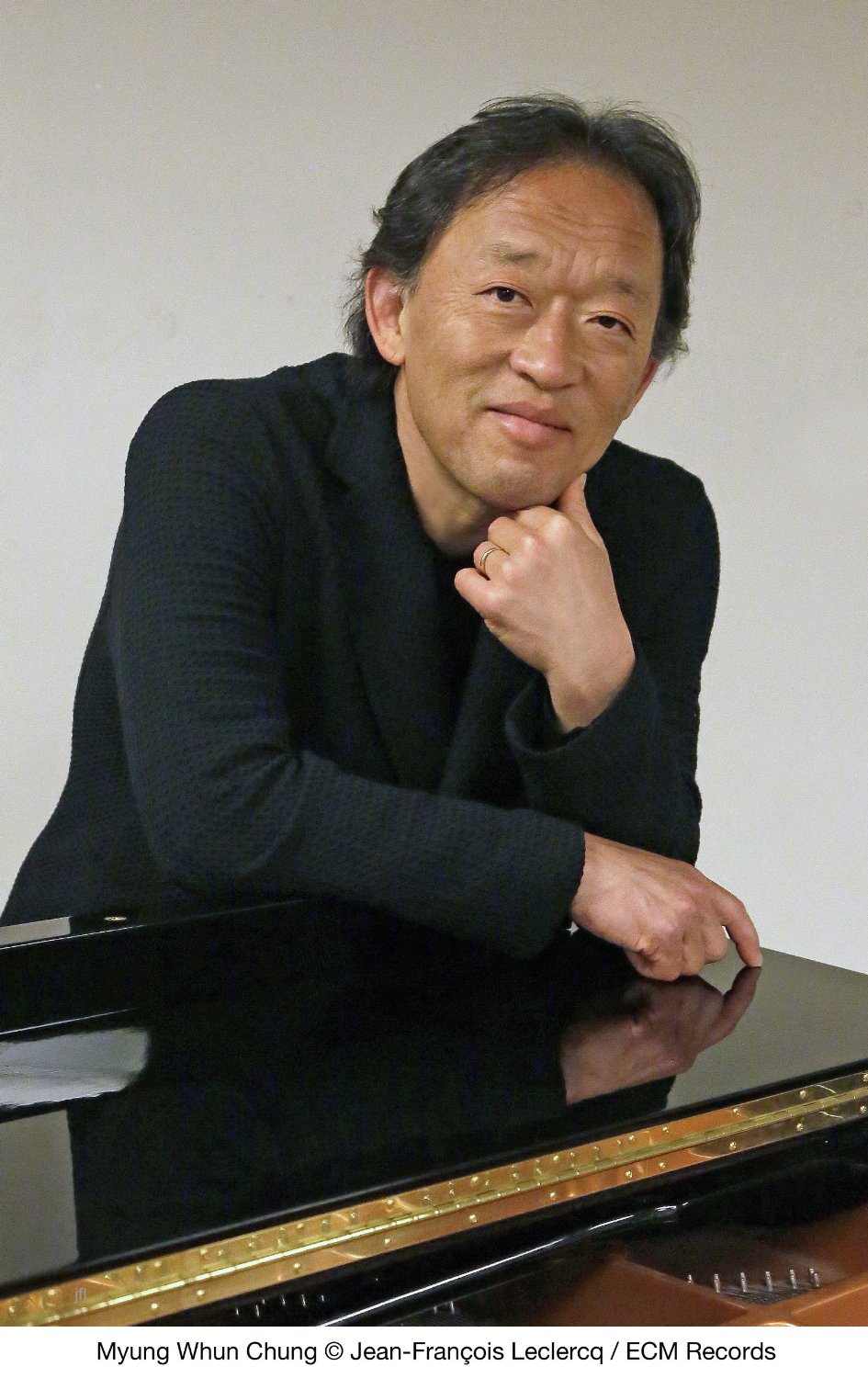
“I believe that musicians are only responsible for half of the real musical experience—the other half must be done by the listener. How one listens and receives the music is perhaps the most important gesture.” So writes Myung Whun Chung in a gracious liner note accompanying his ECM debut. One could receive no more fitting an invitation to a program for which the renowned conductor puts down his baton and takes to the piano, sharing his thoughtful inscriptions across some of the most immovable palimpsests of the classical canon.

In keeping with the spirit of listening, his barely titled piano is more a gift than a recital. It is also a brilliant instance of presentation, and of music’s personal necessity. The melodies we will know—some by name, others by association, each so ingrained in our subconscious that they would seem to exist of their own impulse.

Myung Whun Chung

Chung’s forte is his commitment to texture. True to reputation as a conductor, his interpretations are remarkable for their studied pacing and dynamic appropriateness. The giants of the set list are also its greatest ambassadors for intimacy. Among them, Debussy’s Clair de Lune is paramount. Yet where this much-copied painting, excised from the composer’s Suite bergamasque, so often drifts through our outstretched hands, in Chung’s it has palpable elasticity, made material by a heartfelt triangulation of playing, instrument, and engineering. His Für Elise is likewise weighed, Beethoven’s castaway gem taking on a driven quality through a balance of whimsy and despair.

Intimacy also reigns over Chopin’s Nocturnes in D-flat Major, op. 27/2 and in c-sharp minor, op. posth. Chung draws out the fidelity of their singing and underlying dance, walking that ephemeral path between slumber and waking. Even Mozart’s twelve Variations on “Ah! Vous dirais-je, maman” (better known to many as “Twinkle, Twinkle, Little Star”) don a patina of solitude. Despite their jovial development, they retain a cerebral edge that looks back to Bach even as it looks ahead to Beethoven, and conjures up imagery of self-enclosed genius.

Even with all the evening hymns, two Schubert Impromptus—these in E-flat Major, D899/2 and G-flat Major, D899/3—render the album’s darkest shades. Lovely in their own way, not least of all by their performer’s evocative makeover, they clutch within their sparkling ribcages hearts of unresolved tensions. So too do Schumann’s melancholy Träumerei and whimsical Arabeske, each an ode to closed eyes. Yet nowhere do Chung’s intentions take such unforced flight as in Tchaikovsky’s Autumn Song, in which he gives proper attention to the open spaces of the score, allowing them to breathe so that we may share in that breath.

I can assure you that none of the above is mere reviewer’s hyperbole. To dismiss it as such is to misrecognize the music’s inherency and the selflessness with which it is presented. You will, of course, hear these pieces again, just as you have heard them many times before, but it is unlikely that you will find them so lovingly unpacked. This is music that recognizes us before we recognize it.

(To hear samples of piano, you may watch the video above or click here.)

Erkki-Sven Tüür: Seventh Symphony/Piano Concerto (ECM New Series 2341)

Seventh Symphony

Erkki-Sven Tüür
Seventh Symphony/Piano Concerto

Laura Mikkola piano
Frankfurt Radio Symphony Orchestra
Paavo Järvi conductor
NDR Choir
Werner Has Hage choirmaster
Recorded June 2009 at Alte Oper, Frankfurt and June 2010 at hr-Sendesaal, Frankfurt
Recording producers: Eckhard Glauche (Piano Concerto) and Hans Bernhard Bätzing (Symphony No. 7)
Recording engineer: Thomas Eschler
Executive producer (hr): Andrea Zietzschmann
An ECM/Hessischer Rundfunk (hr) co-production

We are what we think.
All that we are arises with our thoughts.
With our thoughts, we make our world.
–Siddhartha Gautama

ECM’s sixth New Series album dedicated to Erkki-Sven Tüür spins the Estonian composer’s pen like the hand of a great karmic clock until it lands on some of his most ambitious writing to date. Tüür has come a long way since being introduced to ECM listeners on Crystallisatio, changing his compositional method not only nominally but also materially as he branches further into the cosmos by means of more orthodox assemblages. No longer do we get the standalone tone poems, the vocal juggernauts, or architectonic fragmentations—or, it might be more accurate to say, we get all of these together, now compounded into a fresher biological code, the dots and dashes of which find kindred souls on the pages of two massive scores in the proverbial formats of symphony and concerto.

The Piano Concerto of 2006 resounds with consciousness. Laura Mikkola is the soloist, nestled in the silvery tones of the Frankfurt Radio Symphony Orchestra, under Paavo Järvi’s erudite direction. Although the concerto assumes a tripartite structure, each movement dovetails into the next by means of an inexhaustible life force. The low piano hit and high bell that open the piece are pure Tüür: compactly dynamic and self-aware. Like the outer rim of an eclipse, it exposes arcs of fire normally obscured by the sun’s extroverted shine. This change of light allows us to see that everything is quilted. Due to its fragmentary grammar, the piano allows us to perceive only the asteroids it gifts to the atmosphere. Mikkola takes on no small task in finger-pedaling fault lines along the orchestra’s landscape. Fans will note the flutes from Crystallisatio making a distant cameo, but find them short-lived and intermittent in the grander scheme at hand. And while the piano, as a compositional tool, is this music’s genesis, in performance it feels rather like a membrane of intellectual freedom.

If the first movement is interactive, the second is retroactive. The beauties of the latter’s solo piano introduction cannot be emphasized enough. It’s wonderful to hear Tüür’s piano writing in unaccompanied snippets, for these reveal a composer who gathers his sweep with nothing wasted. The string writing in this instance is overtly narrative in style, cutting the scene with razor-thin sheets of rain and giving more pronounced voice to percussion and brass. A jazz piano trio signals the final movement, which morphs into a deep-space drone of starlight and comet-tail blues. Whether one sees such idiomatic choices as tried or true, they nevertheless tease out a playful heart beneath all overlap.

EST

The Symphony No. 7, subtitled “Pietas” (Devotion), is something of a spiritual hodgepodge. Dedicated to Tenzin Gyatso (the Dalai Lama) and his lifelong endeavors, it pairs the same orchestra with the NDR Choir, singing words attributed to the historical Buddha (from the collection known as the Dhammapada), as well as a lyrical potpourri from such diverse sources as Jimi Hendrix, Saint Augustine, Mother Teresa, and Deepak Chopra. Any opinions about its interfaith message are easily quelled by the symphony’s command of scope, which becomes more microscopic the larger it grows. Like the minnow to the frog, it speaks in origins.

So vast is Tüür’s vision that one can hardly be surprised at the entrance of the chorus, because the singers seem built of the same primordial stuff. The relationship between elements—strings, percussion, winds, and voices—is one of neither construction nor deconstruction, for they swim in parallel. The second movement hurtles its satellites farther into space, catching them in galactic nets with athletic precision. The third begins in helical spirals of brass and timpani but becomes more jagged with polyglot idioms. This leaves the 20-minute final movement, which is a symphony unto itself. There is a thick undercurrent to the singing, as if barely hanging on for all its gravidity, which is then atomized by the orchestra’s gradual materialization. Heavenly geometries unfold overhead, even as shadows crystallize below. Strings take on increasingly vocal qualities in the “thrown-ness” of their utterances, uniting with choir into a closing benediction of vibraphone.

Tüür seems always to have abided by his own string theory and awareness of the interconnectedness of things. In a marketplace where fellow Estonian Arvo Pärt has dominated contemporary classical music’s outreach even to those professing little interest in the genre, I can only hope that Tüür will continue to gain wider recognition for his comparable mastery and that others will realize there’s a little bit of all of us in the genetic evolution of his compositional voice.

Tigran Mansurian: Quasi parlando (ECM New Series 2323)

2323 X

Tigran Mansurian
Quasi parlando

Patricia Kopatchinskaja violin
Anja Lechner violoncello
Amsterdam Sinfonietta
Candida Thompson concertmaster
Recorded October 2012, Muziekgebouw aan ’t IJ, Amsterdam
Engineers: Peter Laenger and Stephan Schellmann
Produced by Manfred Eicher

ECM’s ongoing relationship with Tigran Mansurian yields what is perhaps the Armenian composer’s most integral archive yet. In a program of works spanning nearly three and a half decades, Quasi parlando brings together a roster of committed interpreters—musicians who live and breathe in order to allow the music of underrepresented composers that same privilege on an international stage. Yet if the image of a stage seems too formal for music that emerges as a butterfly from its chrysalis, it’s because Mansurian does not write music to be validated by the fleeting sanctity of the concert hall. Rather, he builds it as a craftsman would a piece of furniture, so that every joint fits without need for the glue of representation. In this respect, analogies fall short of his mastery even as they feel necessary to make sense of the darkness therein.

Patricia Kopatchinskaja and Anja Lechner are the respective soloists of the Double Concerto for violin, violoncello and string orchestra. Composed in 1978, it is the earliest work on the program and consists of two Largo movements. The first, marked “concentrando” (indicating an intensification of tone over time), is a concentric maze from opposite sides of which the lone cello and barely dancing violin seek an interactive center. Even when distanced by walls and dead ends, they share a certain elasticity of purpose that inhales even as it exhales. Only when the internal geometries of their capture begin to waver in the emerging chaos do open double stops cry through barriers toward their asymptotic meeting. Each instrument occupies its space at intervals of unaccompanied reset, inspiring the orchestra to unravel itself, one vine at a time. Yet where the effect here is exponential in the manner of a Fibonacci sequence, the second movement follows its designation of “sostenuto” (sustained) by means of a rhythmic core. From this extend tendrils of memory, guiding a single droplet of experience from mountaintop to river. A resolute tenderness ensues, creating suspension in a dream of lucid impulse.

The two pieces that follow are the disc’s most recent. Romance (2011) for violin and string orchestra once again features Kopatchinskaja, to whom it is also dedicated. In characteristic fashion, Mansurian constantly shifts the role of soloist and orchestra, as if between cause and effect, or among tiles in a sliding puzzle. Each aspect of its ungraspable emotions has the constitution of an after-effect. Kopatchinskaja emphasizes this and so much more, treating her bow as kindling to a growing fire that looses controlled tongues in every unaccompanied breath. The 2012 title composition for violoncello and string orchestra also bears dedication to its soloist. Lechner’s role, however, is more integrated, very much a part of the ecosystem in which it finds itself. Though possessed of a kindred robustness in its unaccompanied passages, the writing for cello abides by an even more self-directed faith in its own surroundings. There are quiet triumphs in this piece, intersections of light and cloud that stay locked in place through the simple act of acknowledging them, left to drift only by the final pizzicato strum.

Mansurian’s Second Violin Concerto carries the subtitle Four Serious Songs” (2006), a translucent bridge perhaps to Johannes Brahms’s scriptural settings of the same name. Compared to the music that came before, these movements come across with consistency. Denser and of more mournful quality, they morph from teeth to ribbons toward a final, subterranean resolve, following the magma to its womb.

If Mansurian’s corpus is a truth, then we are its clothing of mystery. It hides nothing of itself, but is hidden by our knowing of it. Let this be a lesson, then, unto the hit-and-run listener: you will leave a scar unless you tend to the wound of your interruption.

(To hear samples of Quasi parlance, click here.)

Victor Kissine: Between Two Waves (ECM New Series 2312)

Between Two Waves

Victor Kissine
Between Two Waves

Andrius Žlabys piano
Daniil Grishin viola
Giedrė Dirvanauskaitė violoncello
Andrei Pushkarev percussion
Gidon Kremer violin
Kremerata Baltica
Roman Kofman
conductor
Recorded July 2011 at Lockenhaus Festival
Engineer: Peter Laenger
Executive producer: Manfred Eicher
An ECM Production

Ears stretch sensitive sails,
dilated eyes lose fire,
over the silence swims
the night-birds’ soundless choir.
–Osip Mandelstam, “Stone”

After appearing in the shadows as arranger of Schubert’s G-major quartet in a reference recording by the Kremerata Baltica, and later in the company of Tchaikovsky, Russian-born and Belgium-based composer Victor Kissine at last gets the full ECM treatment in a program that spans his transition from chamber music to larger-scale pieces. In the latter vein we have the title composition for piano and string orchestra, composed in 2006 and revised in 2008. Built on the chorale Es ist genug of Bach’s Cantata BWV 60, it professes an interest in the spaces between notes on a score, if not also in their limpid pools of darkness, wherein swirl galaxies of further music. Here we find Kissine rekindling his association with the Kremerata Baltica, along with pianist Andrius Žlabys, whose initial dustings give materiality to the light of the piece’s opening breaths. The strings, too, carry their own torch, to which clings the truth-bringing qualities of emptiness. The relationship between the two is therefore neither that of dialogue nor of debate. It is, rather, an expression of two lesions on the same skin, separated by enough distance to be unseen from any single vantage point but close enough to be felt by wandering hands. The result is a troubling piece—which is not to say that it is difficult but merely a disturbance of waters, a node of silence in such a state of motion that it seems still. Kissine is thus that rare composer who, like Alexander Knaifel, is so attentive to negative space that it becomes positive. The profundity of this process cannot be overstated.

VK

The Duo (after Osip Mandelstam) of 1998/2011 pairs violist Daniil Grishin and cellist Giedrė Dirvanauskaitė in one of the most exquisite classical pieces ever recorded for ECM. What begins in the barest breath turns to a grammatical innovation: instruments speaking before they open their mouths. The effect is such that, even when the bows call from more orthodox hilltops, they are switching tongues with the self-awareness of seasoned translators. Glissandi act like an insect’s feelers searching the air for pheromones. Overlapping gestures speak to a shared core among the instruments—a life force of shapeless, autumnal color. Catharses are few and far between, falling instead under the spell of exhalation.

Kremer joins his orchestra, along with percussionist Andrei Pushkarev, for the 2007 Barcarola. A self-styled “concerto in watercolor,” it is all the more intimate for being so full and seeks no answer but its own questioning. Footprints along string paths dissipate like liquid mercury on an uneven surface. Violin trills describe the dances of those whose bone structures bend and break in tensile patterns. And yet, despite a wide dynamic range, the drama is neither theatrical nor cinematic, but literary. It jumps like the eye across a page in anticipation of what happens next but finds itself being pulled back until the ending draws a circle of self-realization. And there you stand.

Beethoven: Diabelli-Variationen – Schiff (ECM New Series 2294/95)

Diabelli

Beethoven
Diabelli-Variationen

András Schiff Bechstein piano, Franz Brodmann fortepiano
Recorded July and December 2012 at Kammermusiksaal H. J. Abs, Beethoven-Haus, Bonn (Brodmann fortepiano) and Auditorio Radiotelevisione svizzera, Lugano (Bechstein)
Tuning and technical assistance: Georg F. Senn (Brodmann) and Urs Bachmann (Bechstein)
Engineer: Stephan Schellmann
Produced by Manfred Eicher

As a performer, pianist András Schiff gifted his own magnum opus when he traversed Ludwig van Beethoven’s entire cycle of 32 piano sonatas for ECM’s New Series. Now he turns to the same composer’s own magnum opus (120, to be exact): the formidable Thirty-three Variations on a Waltz by Anton Diabelli. The Diabelli Variations, as they are more popularly known, have since taken on a status unsurpassed in post-Bach keyboard literature. At the time (1819) he was working on the variations, his Missa solemnis was also taking shape, though the Diabelli project would prove to be no less large in scope. Beethoven was one of 50 composers to be commissioned for a variation on Diabelli’s apparently paltry waltz (the legendary assertion of Beethoven’s dislike of it is questionable and, at any rate, irrelevant), and the only among them to expand the task to such fruitful proportions. His fearless imagination works wonders with the bait dangled before him, to the extent where he not only steals it unscathed but also hooks the dangler in the process.

Schiff

Humor, invention, and fragmentation: these are the hallmarks of Schiff’s Diabelli. Or should one say, Diabellis, for indeed the pianist offers two readings of the work on polar instruments. The first flows from a 1921 Bechstein grand, by which the music’s kaleidoscopic qualities come into sharp focus. Under Schiff’s control, it’s obvious that each variation carries something of the last one forward—from revelry to stubbornness to whimsy. Schiff handles these changes with consummate fluency, and with a spirit of continuity that massages every kink out of the material at hand(s). The occasional caduceus of trills is enlivening and along with the collection’s most brilliant moments reveals new details. Some are smoother, more legato, others more oriented toward punctuation, but the range of invention makes of the Diabelli a Beethoven primer and shows a craftsman enjoying himself so much that he must share it with the world.

Hearing these same vignettes on a Franz Brodmann fortepiano from Beethoven’s time is akin to witnessing history come to life. Like an old film reel, it has the quality of an era into which we have never stepped but from which we have proceeded to unravel, making of its relics whatever we can along the way. There is a more immediate charge to them, something urgent and vibrant, if not also vital.

There’s no dearth of fine Diabellis to satisfy the appetites of the curious. For total command, one will want to compare Alfred Brendel or Sviatoslav Richter; for something fresher, Paul Lewis or Rudolf Serkin; and for both, Artur Schnabel (who also plays on a Bechstein) or Stephen Kovacevich. Fewer versions exist on fortepiano, most notably by Andreas Staier. But the chance to hear one of each from the same artist on the same record is unprecedented. In addition to Schiff’s enthralling performances, his interpretation has the benefit of the composer’s previously unknown original scores at hand. These provide valuable cues absent from previous interpretations and set a new benchmark for future ones. “Schiff does not just perform the music,” observes Paul Griffiths in the album’s booklet, “he performs the music performing itself,” and in the listening we add another layer of performance that rewards us with gold.

And on the topic of rewards, this album has more in store. By way of the Bechstein we have Beethoven’s final sonata, the Opus 111, which Schiff revisits with remarkable elasticity. Even more so than his last account for ECM, it combines fluidity and rigidity as if they were one and the same—at once a reflection of Beethoven’s writing and of Schiff’s ability to evoke (invoke?) it. The piano is crisp under his fingertips in the first movement, pliant in the massive second (a statement for all time if there ever was one), and bends under a deluge of melodic tensions toward a sweeping finale, throwing parting handfuls of ash and fairy dust.

Not to be left out, the fortepiano yields a majestic Six Bagatelles. The storyboarding of Beethoven’s Opus 126 has rarely been so lucid. It is as if the music were bound into a book, its materiality as undeniable as its sonority. From rolling syncopations to quiet expanse, these pieces sit at an intersection of vertical architecture and horizontal travel. In them beats the heart of a musician who lives to paint, applying colors over and over until they become three-dimensional.

(To hear samples of Diabelli Variationen, click here.)

Morton Feldman: Violin and Orchestra (ECM New Series 2283)

Violin and Orchestra

Morton Feldman
Violin and Orchestra

Carolin Widmann violin
Frankfurt Radio Symphony Orchestra
Emilio Pomàrico conductor
Recorded October 2009 at Sendesaal des Hessischen Rundfunks, Frankfurt
Recording producer: Hans Berhnhard Bätzing
Recording engineer: Rüdiger Orth
Executive producer for Hessischer Rundfunk: Andrea Zietzschmann
An ECM/Hessischer Rundfunk Co-production

Alex Ross is one of many to characterize Morton Feldman’s music as being “glacially slow and snowily soft,” echoing the sentiments of Feldman specialists like Thomas DeLio and even Feldman himself, who employed “slow, soft” as a designation in his piano music, the so-called Last Pieces of 1959 being one example. All the while, such readings fail to out the culprit of human perception that defines their pathos to begin with. It’s not that Feldman’s “sound” (as if it were ever reducible to one) is inherently lethargic, but that we are simply ill-equipped to handle its cosmic speeds.

Feldman

We may project whatever we like onto the gossamer screen of Feldman’s hard-won life, but at the end of the day there is only the beginning of the music. That being said, there is great value in the analogic glacier to the new listener, one who comes to Feldman thinking he was a mere minimalist, only to discover that, like a glacier, he was symphony of stasis and movement in which no stratum was ever an exact replica of its neighbors. His Violin and Orchestra of 1979 is therefore not only a masterpiece in the biographical sense, but also in terms of its geological significance. Although Feldman modeled his writing off abstract impressionism, it traces fault lines so robustly scarred that no earthquake could impress them with abstraction.

Over its 1500+ bars, this multiple entity achieves sonority through rupture. Its beginnings beg not earthly but extraterrestrial comparisons, skimming black hole rims and flirting with a gravitational pull of such unfathomable power that its language can only be written by bow. Wielding said bow is violinist Carolin Widmann, while Emilio Pomàrico wields his own writing instrument in the form of a baton, suspended like a satellite antenna within the Frankfurt Radio Symphony Orchestra’s magnetic fields. Also among the forces gathered for this piece—massive in number but spectral in effect—is a piano’s droning paintbrush. Just as important as the violin, it is the below to the latter’s above and connects chakras in constellatory networks of nerve impulses. Neither is a soloist for the mere pleasure of orchestral accompaniment; they are indivisible as sunlight and water.

If any overarching thing can be said of Feldman, it is that he was a generous atmospherist. The beauty of Violin and Orchestra is that one will experience it as either a mystery or the most natural phenomenon imaginable—if not both. You might search for motifs, for concerto structure, but will come up only with handfuls of something far more organic. The variety of textures alone is proof of concept. Pulsing lower strings, light pizzicati, and tonal shifts comprise the circle, while the violin sews its holes into scars. There is an inner and outer skin to the music. Both belong to a beast that cowers below the earth’s surface, sucking its thumb and singing whatever lullabies it can dredge up from the pond of memory. It inhales, exhales. It takes continuous stock of its own emotional inventory and catalogs it finitely, like a machine. The violin’s higher-pitched notes are at some moments its veneer, at others the tone of an inner ear, at still others the sting of total recall. Even after the violin fades through a chain of percussion responses, it leaves behind a single open wound that can only be salved by our commitment to its passing.