Arianna Savall & Petter Udland Johansen: Hirundo Maris (ECM New Series 2227)

Hirundo Maris

Arianna Savall
Petter Udland Johansen
Hirundo Maris – Chants du Sud et du Nord

Arianna Savall voice, gothic harp, Italian triple harp
Petter Udland Johansen voice, hardingfele, mandolin
Sveinung Lilleheier guitar, dobro, voice
Miquel Àngel Cordero double-bass, voice
David Mayoral percussion, voice
Recorded January 2011 at Propstei St. Gerold
Engineer: Markus Heiland
Produced by Manfred Eicher

I fell in love by night, by moonlight beguiled.
If ever again I fall in love, let it be in the broad light of day.

Hirundo Maris is a landmark achievement on at least two counts. First, it literally marks land on either side of the North Seas, the currents of which linked Vikings, Catalans, Scots, and Sephardic Jews by lines of exploration and cultural exchange. Second, it spotlights the voice of Arianna Savall in ways that so recall her mother, Montserrat Figueras, with especial affection. Savall in fact dedicates this album to Figueras’s memory, to the “voice that sang to me and accompanied me from my very first heartbeat.” It’s a poignant undercurrent that might easily slip by the digital downloader without a CD booklet in hand, but one that imbues this sometimes-surprising bouquet of song with that much more generosity.

Fronting a seamless “jam band” aesthetic, the core duo of Savall (also a masterful harpist) and Petter Udland Johansen (singer, fiddler, mandolin player) elicits a seamless mash-up of early music and folk influences. In the latter vein, Johansen offers traditional songs from the tundra. With spotlight thrown on his lyrical voice, he helms their passage with troubadourian intuition. A handful of Norwegian examples boasts the consummate balladry of an unconsummated love in “Om kvelden” (In the Evening) and the dancing strains of “Ormen Lange” (The Long Serpent), which details the building of a great ship by the same name (a mood and image paralleled in Johansen’s bare rendition of the Scottish folk song “The Water Is Wide”). Other notables flower beneath overcast skies. There’s the sad tale of Bendik, who loves the king’s daughter, Årolilja, and is ordered to be killed when he is found out. In this song, Johansen’s ashen fiddling gives way to piercing, constellatory light as he trades verses with Savall in a complementary atmosphere. There’s also the “Trollmors vuggesang” (Mother Troll’s Lullaby), a Swedish children’s song by Margit Holmberg (1912-1989), in which the protagonist sings nonsense syllables to her eleven little trolls.

Throughout the program, these two gorgeous voices are joined by guitarist Sveinung Lilleheier, bassist Miquel Àngel Cordero, and percussionist David Mayoral, whose presence is felt in evocations from the mainland. Five traditional Catalan tunes highlight the syllogistic “El mestre” (The Schoolmaster), the liltingly harmonized “Josep i Maria” (Joseph and Mary), and artisanship of “El mariner” (The Sailor). The latter tells of a maid who sits embroidering by the sea. When she runs out of silk, a sailor lures her aboard with promises of more. He sings her to sleep. She awakes, only to discover he is the son of England’s king and means to marry her. With its synthetic ocean waves and tactile harping, it is the album’s most evocative song. Also evocative is the “Tarantela” by 17th-century Spanish harpist Lucas Ruiz de Ribayaz. The crispness of Savall’s rendition only emphasizes its lustrous antiquity.

Savall’s craftwork comes into greater focus in her original tune “Le Chant des étoiles,” which joins her harp in a sparkling instrumental of plucks and plumes. Johansen also contributes an original: the enchanting “Penselstrøk” (Brushstroke). “The dream is lost in a moment of joy,” he sings, “and for you it could be the last.” And with those words, he cloaks the sun in dusk. The collection rounds out with three Sephardic traditionals, including “Buenas noches” (Sweet Nights), which shines with steel-string inflections, and “Morena me llaman” (Dark One, They Call Me), another song of ship and sail. This genre favorite receives a downtrodden treatment here, replete with sparse instrumental reflections throughout.

Although this very special album bears the subtitle “Songs from the South and North,” by its end one feels the futility of mortal instruments to gauge directions across time. It is, instead, a chronicle not of geographies per se but of the transitions between them.

(To hear samples of Hirundo Maris, click here.)

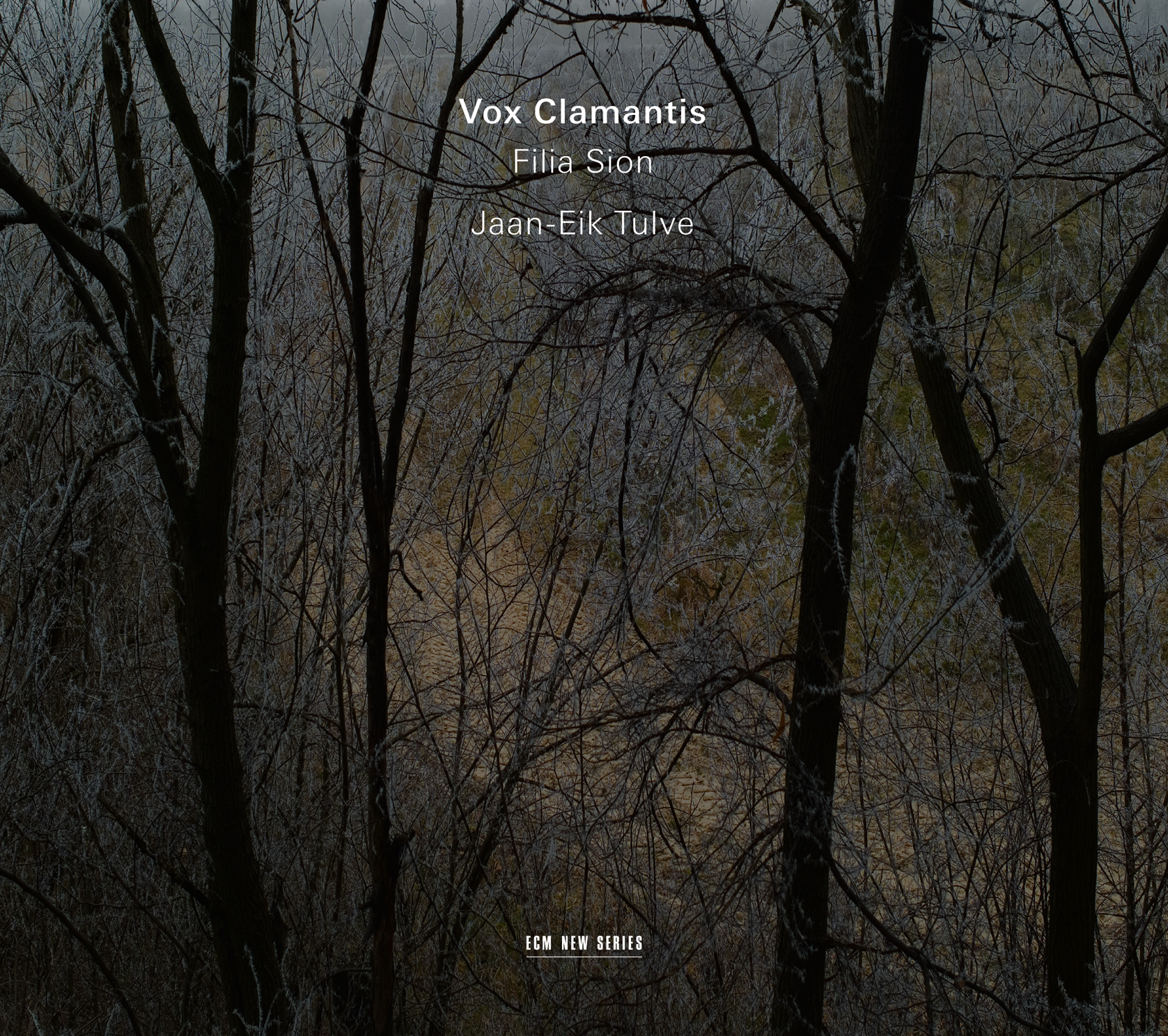
Vox Clamantis: Filia Sion (ECM New Series 2244)

Filia Sion

Vox Clamantis
Filia Sion

Vox Clamantis
Jaan-Eik Tulve conductor
Recorded September 2010, Dome Church of St. Nicholas, Haapsalu
Engineer: Igor Kirkwood
Editing: Margo Kõlar
Recording supervision: Helena Tulve
Executive producer: Manfred Eicher

O wisest Virgin,
where art thou going in this deepest red of dawn?

Estonian vocal ensemble Vox Clamantis shares its passion for Gregorian chant in an album dedicated to the Daughter of Zion. Directed by Jaan-Eik Tulve (husband of composer Helena), who sees precise blending as the foundation for purposeful singing, Vox Clamantis adds subtlest gold leafing to the program’s Marian repertoire. Remarkable in this regard is the use of overtone singing, an unlikely technique begotten through the spirit of improvisation during rehearsal. It is employed to glorious effect in two 12th-century pieces by Magister Perotinus and Hildegard von Bingen. As the twin hearts of the album, they shine with the depth of conception, mysterious and divine.

Polyphonous textures are only occasional throughout the program, appearing noticeably in the “Rex virginum,” which comes from the 13th-century Codex Las Huelgas of Spain. Cycling between two-part harmonies and plainchant, its timbral cast magnifies sanctity with sanctity. The motet “O Maria”—from another codex (from Montpellier) of the same period—gilds kindred geometry, while the tenors of “Prelustri elucentia” (by Petrus Wilhelmi de Grudencz, c1400-c1480) bind linearly, like the ligament of a spiritual body. The album’s final piece, a Jewish chant from Cochin entitled “Ma navu,” comes as a revelation that flows from chest to sky through c(h)ords of light.

Most of the album is rooted in plainsong, and few ensembles extol its unifying force with the grace of Vox Clamantis. The thickness of the monophonic pieces, and these performances of them, is such that polyphony would seem an overwhelming embellishment. Rather than muddy the waters, the singers clarify them, moving antiphonally between solo and tutti passages. Each chant feels torn from a book of shadows, so that it might be inscribed with light. This record comes long after a wave of chant albums that flooded the New Age market in the mid- to late 1990s. Unlike those transients, the present disc is set fully in its proper context. Its heartfelt prayer is for circularity: ashes to ashes, voice to voice.

The people of the nations that lay in darkness
rise up at the joy of so renowned a birth.

Eleni Karaindrou: Concert in Athens (ECM New Series 2220)

Concert in Athens

Eleni Karaindrou
Concert in Athens

Eleni Karaindrou piano
Kim Kashkashian viola
Jan Garbarek tenor saxophone
Vangelis Christopoulos oboe
Camerata Orchestra Alexandros Myrat conductor
Concert production: The Athens Concert Hall
Recorded live November 19, 2010 at Megaron Hall (Hall of the Friends of Music), Athens
Recording engineer: Nikos Espialidis
Editing/assistants: Bobby Blazoudakis, Peter DePian, Alex Aretaios, and George Mathioudakis
Mixed and edited March 2012 by Manfred Eicher and Nikos Espialidis
Produced by Manfred Eicher

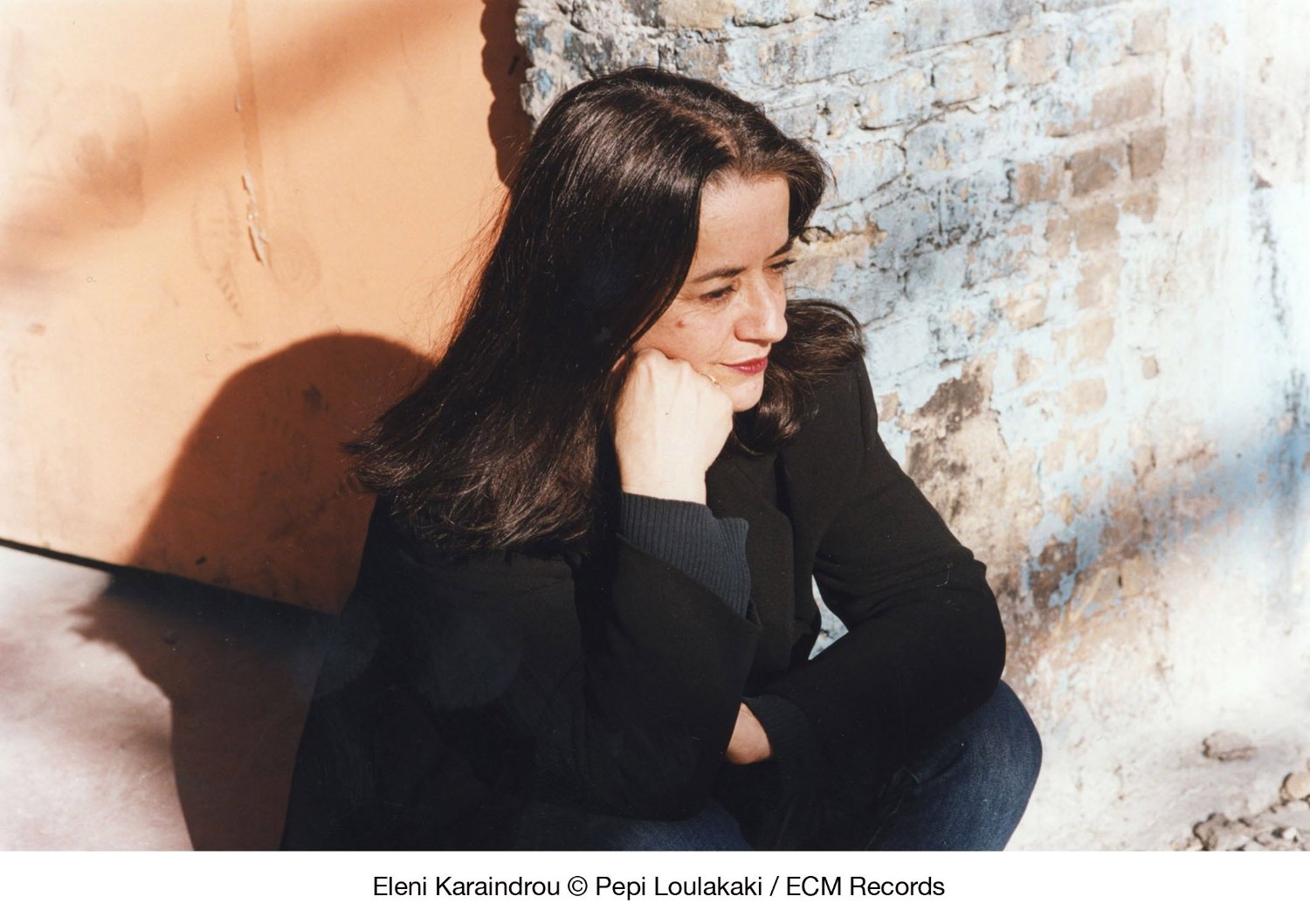
Eleni Karaindrou’s 10th album for ECM frames the self-taught Greek composer as the subject of worthy tribute in a second live conspectus for the label. Five years have passed since the recording of Elegy of the Uprooting, also captured at Megaron Hall in Athens, and the depth of her soundings has only intensified in that period. While that former performance made obvious her intimate working relationship with late filmmaker Theo Angelopoulos by way of a large projection screen at stage rear, here the music is its own actor. Differences between the two programs are striking, with emphasis now on Karaindrou’s incidental music for theatre. Directions also play out in the featured soloists: violist Kim Kashkashian and saxophonist Jan Garbarek. Kashkashian was instrumental—in the most literal sense—in exposing international listeners to Karaindrou’s sound on the highly successful Ulysses’ Gaze . Like that perennial soundtrack, Concert in Athens is a way station on her distinctive compositional path. Garbarek makes for an equally fine companion, his salted tone tessellating every motif it embraces.

Eleni

Garbarek oversees the most brooding portions of the concert, which opens and closes with his flute-like tenoring in “Requiem for Willy Loman” and its variation. This piece, from Death of a Salesman, suspends its mournful souls like laundry without bodies to wrap. It’s a tender circle, within which further theatrical connections abound. Whether unlocking dramatic awakenings in “Invocation” (Who’s Afraid of Virginia Woolf) or matching the sway of windblown branch in “Tom’s Theme” (The Glass Menagerie), Garbarek holds these melodies to be self-evident. The same is true for the consummate “Adagio for Saxophone,” the inward spiral of which traces the album’s endearing highlight.

Kashkashian, for her part, sails closer to the coast, skirting the rim of darkness beyond the lighthouse’s purview. The strings reveal her singing patina in “Closed Roads” as if it were a jewel clasped in silver. With just a sweep of her bow, she evokes a tug of war between flesh and horizon that finds resolution only in the “Dance” from Ulysses’ Gaze. As an agent of memory, she emotes without mitigation, standing out even among the trio settings of “Laura’s Waltz” (with orchestral accompaniment) and “After Memory” (without). The latter’s braiding with Garbarek and oboist Vangelis Christopoulos is another of the performance’s focal points.

Karaindrou herself sits at the piano, laying the groundwork for much of the activity surrounding these themes. Her solo from Eternity and a Day comes second in the program, a hinge for every door thereafter. Other cinematic intersections include Landscape in the Mist and Dust of Time. In these, tension becomes an organic material, a bed of soil as ocean. On that note, there is a textuality to both this music and its sources that finds confirmation in four pieces inspired by M. Karagatsis’s novel Number Ten. Of these, “Waltz of Rain” unfolds most nostalgically, affirming yet again why Karaindrou’s oeuvre is as enduring as the relics of her homeland.

(To hear samples of Concert in Athens, click here.)

Franz Schubert: Moments musicaux (ECM New Series 2215)

2215 X

Franz Schubert
Moments musicaux

Valery Afanassiev piano
Recorded September 2010, Auditorio Radiotelevisione svizzera, Lugano
Engineer: Peter Laenger
Produced by Manfred Eicher

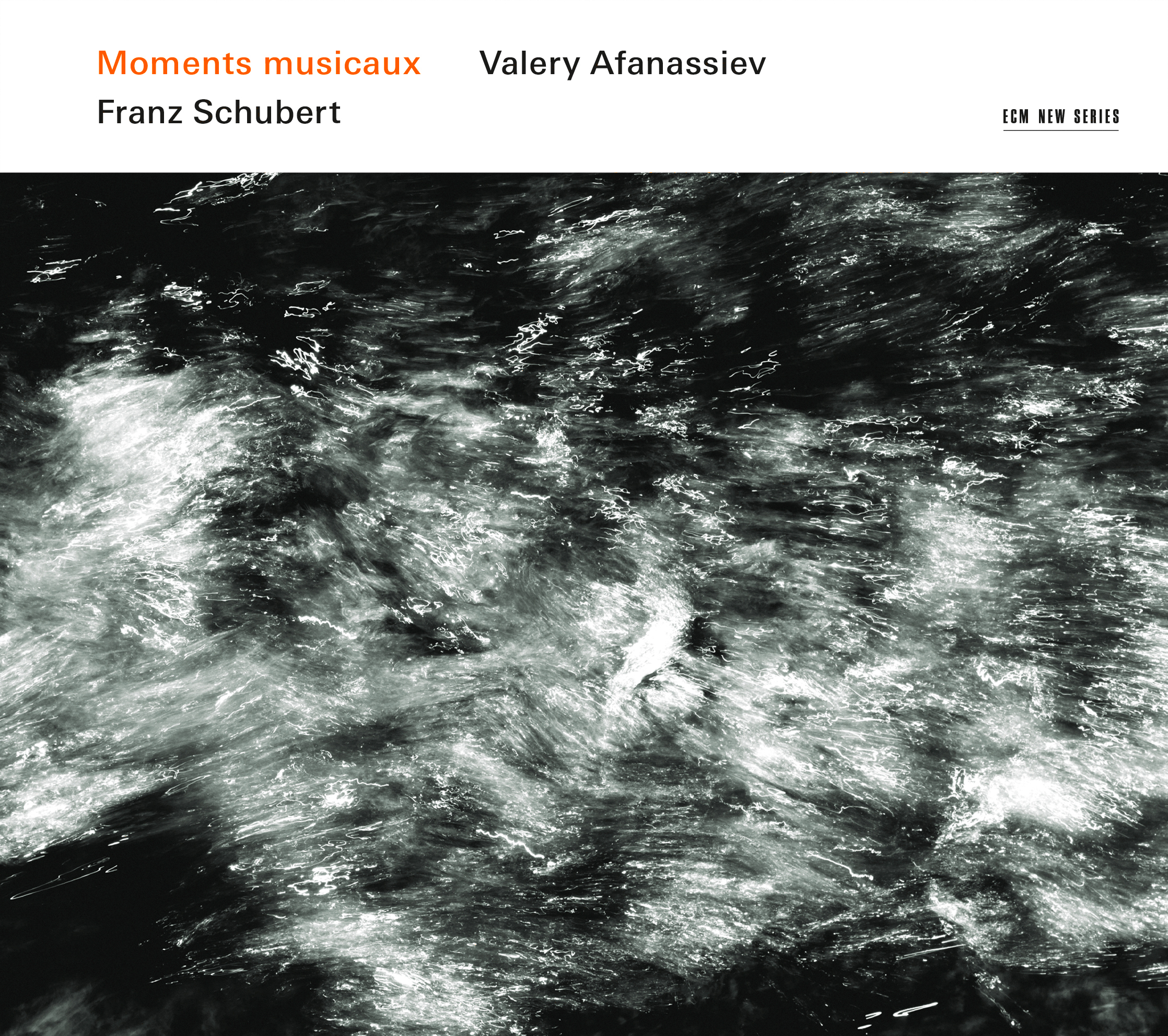
Valery Afanassiev returns to ECM with his second program dedicated to Franz Schubert (1797-1828). Whereas his much-lauded Lockenhaus disc reckoned with the massive final sonata, here focus is on the Moments musicaux (D. 780, Op. 94) and the Opus 53 D-Major Sonata, both late works of characteristically bipolar flavor. Also characteristic are Afanassiev’s interpretations of them, infused as they are with ebullience and melancholy in equal measure. In his liner notes, the Russian pianist muses on the notion of a “no-time’s land,” a momentary space that Schubert has filled with this music. It is a lingering moment, a moment to take pleasure in the details of one’s surroundings, a moment that is itself music. He notes also the tendency among (a certain number of) Japanese poets to unravel a moment, “driving it to the brink of eternity.”

Such aesthetics operate at turning points throughout the disc, first noticeable in the transition between the C-Major Moderato and A-flat Major Andantino of the Moments musicaux. Schubert composed its six miniatures sporadically between 1823 and 1828. That Mendelssohn called them “Songs without Words” should come as no surprise, for the block chords that pervade the first of the two sections in question lay down a solid foundation for all the melodies to follow. Emotionally vibrant yet somehow neutral (the notes shuffle one step back for each taken forward), these mercurial waters yield an Arthurian sword of innocent beauty. Neither parallel nor divergent, these streams meet in the solace of a universal unfolding. Following the charming, child-like storytelling of the f-minor Allegro moderato, the c-sharp minor Moderato owes its texture to Bach, whose keyboard style it expertly emulates but also colors with its own romantic flair before returning to f minor in a galloping Allegro vivace. Afanassiev excavates the latter with just the variety it needs to catch our archaeological regard. Last is an Allegretto in A-flat Major. Its statelier posture and chromatic inhalations make it the most mature moment of the set.

Characterized by Afanassiev as “an assortment of games,” the D-Major Sonata is something of a fountain of youth. “Unlike Schubert,” he goes on to say, “I shall never play hopscotch again except in some of his sonatas.” A relatively brisk sonata by Schubert standards, the Opus 53 can hold a candle to any of Beethoven’s and rests on the foundation of its massive first movement. A dense opening reveals flowery, delicate runs, alternating between drama and reflection within a naked stream of consciousness. The second movement, while longer, is more introspective. Afanassiev’s management of its densities depends on a feel for harmony as masterful as the composer’s. Like the Scherzo that follows, and even the concluding Rondo, it fuels its own ambition with transparency.

Afanassiev is an artist keyed into cinema, philosophy, and cultural difference. He brings this knowledge to his Schubert, which opens its eyes like sails and catches the wind of an interpretive spirit. Through this allegorical filter, he turns life into light and shines it on the keyboard without compromise. These pieces, then, become part of a brighter whole, wherein beats the heart of one who had many more songs to sing.

(To hear samples of Moments musicaux, click here.)

Reto Bieri: Contrechant (ECM New Series 2209)

Contrechant

Reto Bieri
Contrechant
Music for clarinet solo

Reto Bieri clarinet
Recorded September 2010, Propstei St. Gerold
Engineer: Peter Laenger
Produced by Manfred Eicher

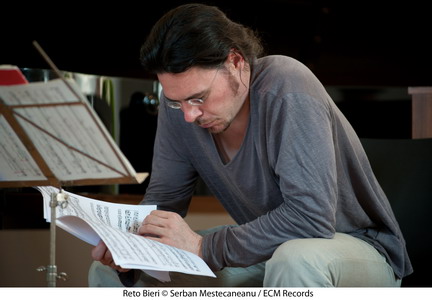
Within the ECM New Series sub-catalogue of solo recordings, the label debut of Reto Bieri stands out for impeccable selection and technical prowess. The Swiss clarinetist studied at Basel’s Academy of Music and at the Juilliard School before embarking on a solo career in collaboration with new and established composers alike, and the fruits of those efforts are bursting from their skins on Contrechant. Luciano Berio is the only featured composer with whom Bieri did not work in preparing for this album, and his 1983 Lied opens the program with its cantabile, legato phrasings. Aside from establishing something of a theme (in his liner text, Paul Griffiths notes among these pieces an affinity for song), the meticulousness of Bieri’s approach to the instrument sets a precedent for mood and timing. At his fingertips—each a hand unto itself—the deceptive simplicity of Berio’s spatial grammar feels omnipresent.

Likewise omnipresent are the grammars of Salvatore Sciarrino and Heinz Holliger. Both composers make illustrative use of multiphonics and formidable extended playing. The former’s 1982 Let me die before I wake reveals a matrix of overtones so rich that the addition of any other instrument would be an intrusion. Its artisan quality seems to plane away its own surface until underlying patterns are revealed. The album’s title piece comes from Holliger. Composed in 2007, it strikes a characteristic balance between darkness and whimsy. Each vignette therein is a window both into itself and into the whole. Across a range of transcendent voicings, it steps through a spectral door in the five-minute epilogue. Holliger’s Rechant (2008) bears dedication to the late Swiss clarinetist Thomas Friedli, with whom Bieri briefly studied. Despite its kindred telemetry of action and reaction, of interpretation and extrapolation, a lighter footprint makes it a song of more internal measures.

Bieri

The title of Elliott Carter’s Gra means “to play” in Polish and was written in 1993 to commemorate Witold Lutosławski’s 80th birthday. With its leaping figures and exacting breath control, it is a virtuosic feast, to be sure. Beyond that, its youthful pilot light flickers with verve. Péter Eötvös’s Derwischtanz (1993/2001), on the other hand, travels upward rather than inward, shuffling staircases before falling like an autumn leaf with no purpose but to decay. The latter piece pairs well with Lightshadow-trembling (1993) by Gergely Vajda, a student of Eötvös whose embodiment of title feels like a narrative too restless to contain.

This is, in the end, what connects all of the above: an uncontainable feeling to be experienced.

(To hear samples of Contrechant, click here.)

Signs Among Us: 30 Years of ECM New Series

ECM New Series

ECM’s New Series has been producing classical releases of highest caliber since 1984. As the German imprint quietly celebrates its 30th anniversary, these words attempt an affectionate survey of its output. Then again, how does one delineate a history of that which is so much a part of it? Jean-Luc Godard addresses this very question in his Histoire(s) du cinéma, of which the soundtrack saw a New Series release (ECM 1706-10) in 1999 and from which this essay borrows its title. The parenthetical “s” of Godard’s masterwork serves not merely to hinge the singular and the plural, but to unravel the multiple, simultaneous registers of the filmic medium—moving, as it were, from an “either-or” to a “neither-nor” approach. A film breaks down not only into individual frames, but also into molecular compounds within those frames, until signs of the original become nothing more than the breath expended to describe it. Similarly, the New Series vision, under the watchful ear of producer Manfred Eicher, has for three decades programmed music as if it were a field of signs that live among and within us, each an ephemeral capture that begets infinite others.

The New Series bears no discernibly overarching aesthetic. Just as ECM proper has diversified the pasture of jazz with flowers of stark variation, so has the New Series loosened the borders of the classical landscape through democratic enhancements of technique, instrumentation, and concept. Indeed, the success of the New Series vision has grown in direct proportion to its inclusivity, even as it has refined an idiosyncratic corpus of composers. If one can say that Eicher has brought a classical sense of detailing toward the jazz-oriented records that earned him first renown, one might also say that he brought to classical recording a feeling of jazz, insofar as whatever spirit animates the improviser with unquantifiable purpose also thrums like a shell around every classical recording worthy of the ECM moniker.

Inception of the New Series traces back to 1980, when Eicher first heard Arvo Pärt on the radio. Not knowing what it was, he searched for quite some time before connecting those angelic sounds to a name that would define the label to come. In its role as the first New Series release, Pärt’s Tabula rasa (ECM 1275) is said to have introduced an ancient world to a new sound. And yet, it would be just as accurate to say that the album introduced an ancient sound to a new world. In other words, it wasn’t the newness of Pärt’s music that turned the album into such a watershed moment. It was, rather, its resonant heart, to which listeners across genres and affiliations found immutable connections, points of relatability, and glimmers of familiarity in its starry sky. Such an interpretation existed already in the name: New Series. As for the “new,” one finds it in the recordings and performances. The word “series,” on the other hand, connotes linkages between past and future tenses in an unbroken chain of influence. Like the single line that underscores the label’s logo, it’s a horizon, either side of which brings innovative possibilities to the old, and old possibilities to the innovative.

Within the parameters of Eicher’s discerning archaeology, much credit must go to ECM’s committed engineers, of whom Peter Laenger and Stephan Schellmann stand out for their clear, adaptive methods. Schellmann’s tenure with the label has been remarkably varied, ranging from violinist John Holloway’s benchmark accounts of transitional Baroque repertoires to the chamber music of 20th-century Korean composer Isang Yun. Moreover, Schellmann has shadowed András Schiff’s 10-disc traversal of the complete Beethoven sonatas and, within the last year, an extraordinary account by Anna Gourari of Sergey Prokofiev’s Visions fugitives. Laenger’s most commercially successful intersections with ECM have generated collaborations with the Hilliard Ensemble, including the much-beloved Officium project with Norwegian saxophonist Jan Garbarek. He has also been involved in Pärt productions, Tabula rasa not least of all, and made audible the slightest whispers of Russian contemporary Alexander Knaifel. The contributions of these and others at the mixing board are integral by presence so tangible that their all-too-often-ignored efforts would be impossible not to notice.

Binding these artistic confluences is Eicher’s willingness to not so much think outside the proverbial box as redefine and expand what that box may contain to begin with. An especially fascinating orbit of the ECM solar system has been traced by a relatively small but no less life-sustaining planet of spoken word projects. These have taken various forms, as in the above-mentioned Godard soundtrack and in the unaccompanied recitations of actor Bruno Ganz, who has lent his voice to the poetry of Friedrich Hölderlin, T.S. Eliot, and Giorgos Seferis. There is, too, the gorgeous pairing of cellist Frances-Marie Uitti and author Paul Griffiths, there is still time (ECM 1882), which dovetails poetry by Griffiths, limited to the 482-word vocabulary as spoken by Ophelia in Shakespeare’s Hamlet, into the cellist’s fully immediate improvising.

I recently caught up with Griffiths, who kindly offered his insight into working with Manfred Eicher in the studio.

“Manfred said almost nothing, but what he did say was crucial. No less crucial was his just being there. We hadn’t prepared very much—hardly at all. We tried some things out that didn’t work. Others did, sometimes at a first take. It was hard work, and extremely easy. No pressure. Just let it happen. Room for spontaneity. We kind of relaxed into intensity. Frances’s playing was—you can hear this, and though I don’t like the word I have to use it—an inspiration.”

Griffiths’s summary of the recording process happens to be an effective description of the listening that attends it. One may come to each New Series recording afresh, suspending expectations toward even standard repertory in favor of the novel expositions sure to take place. Sometimes the listening clicks, achieving unity of absorption at first meeting. Other times, understanding grows as experiences bond with the music, little by little. There is room for spontaneity in how one may hear the sounds and, yes, an inspired communication behind it all.

I began, though, by asking Griffiths about his first experience as New Series listener. “That would have to have been the Arvo Pärt album Tabula rasa, when it came out, in pre-CD days, in a foot-square sleeve of unglossy white, which would be so difficult to keep clean, but one would try,” he said. The historicity of his reply would seem to treat the album in question as an artifact and reminds me that my first copy of the same was on the even more outmoded medium of cassette. And his initial impressions?

“I was bowled over, like everyone else, especially by the title piece. Before that ‘Arvo Pärt’ was just a name floating around—one of the younger Soviet composers who’d taken modernism on board—without that name being grounded in any experience of the music. We’re talking of a time, of course, when knowledge of music from the Soviet Union was very limited. To anticipate your third question, I can’t remember what came next—maybe the second Pärt album, Arbos, or a Lockenhaus compilation. But I’m not sure I was aware that the Lockenhaus disc came from the same stable; it took a little while, for me at least, before I began to have a notion of an ECM identity.”

And what did that identity signify once he became aware of it as such?

“There was the matter of design, which impressed in a very different way when sleeves were 12” by 12”—I vividly recall the beautiful starkness of, especially, the Arbos cover, with the title in blue-green against dark grey. Then the notes were always good. But of course it was the sound, the combination of intimacy and distance, and the awareness that a recorded performance is not simply a recording of a performance but something distinct—the Glenn Gould lesson, absorbed with total simplicity and straightforwardness. It may have taken me a little longer to notice that ECM was also creating its own repertory.”

On the topic of notes, any fan will have become acquainted with the contributions of Griffiths, who along with music critic Hans-Klaus Jungheinrich has brought his erudition to the lion’s share of New Series booklets. In addition to an encyclopedic knowledge of contemporary classical music and its lineages, Griffiths has given beautiful, narrative readings to handfuls of compositions in ways thitherto unexplored. I inquired about his first assignment, which to his recollection was Kim Kashkashian’s disc of three Hungarian viola concertos—by Bartók, Kurtág, Eötvös—with the Netherlands Radio Chamber Orchestra (ECM 1711).

“That would have been in the late nineties. I knew it had to be good. I would guess that everyone working for Manfred, in whatever capacity, strains to deliver only the best. That’s part of his skill and his success, that he doesn’t impose but somehow opens, lets you achieve as much as you’re able. The terms are perhaps too grand in which to talk about liner notes, but I felt—and still feel, maybe twenty or thirty albums later—an ECM assignment to be a special opportunity.”

Special, too, for those on the receiving end of their intellectual labor.

No such musical body would stand without the nourishment of its composers. In this respect, ECM has widened the listenership of previously insularly known figures. Pärt, to be sure, heads the list for his inaugural significance, but more lastingly for the unpretentious depth of his notecraft. Here is a human being of flesh and less tangible things who tends the latter with such integrity that even those who wouldn’t normally consider themselves classical listeners have made his motives a staple of their listening diet. I hesitate to describe Pärt as a “universal” composer, implying as the term does a reach fanning out from this blue orb and its galaxy into countless more beyond, when in reality his power has the opposite effect, burrowing so far inward that it caresses the spark which makes each of us unique.

Pärt’s ruminations comprise but one landmass in a changing map that has lowered its waters to reveal archipelagos, canyons, and glaciers—each possessed of its own topographical influence. In this respect, one value of the New Series is its vested interest in the marginalized, the exiled, and the misunderstood. Estonia has blessed us further with the folkloric choral interpretations of Veljo Tormis and the glowing architectures of Erkki-Sven Tüür, while the former Soviet state of Georgia has given the thematic persistence of Giya Kancheli, Ukraine the postludinal elegies of Valentin Silvestrov, and Armenia the open loom of Tigran Mansurian’s threadbare prayers. On the European continent, we find the meticulous microscopy of György Kurtág, while Gavin Bryars emotes from across the English Channel with his sonorous fusions. Through all of this, the works of Bach—and, more recently, Schubert and Schumann—have become touchstones. Hence, my final question for Griffiths on the nature of ECM’s classical interests, to which he replied:

“Yes, there certainly is an ECM repertory—a world where Schubert and Schumann are more prominent than Beethoven, and certainly than Mozart—but I’m not sure its rationale can easily be defined. Factors include Manfred’s taste, of course, but also his loyalty to artists and his curiosity, or perhaps his eagerness to go against his own grain. Perhaps there’s a sort of intimate yet intense expressiveness that links all these things. And an absence of show. Is it possible to think of a composer unimagineable on ECM? Wagner? But then I could imagine the Siegfried Idyll, with the right performers and the right context. Oh, perhaps the key is in some sense of the music—and the performance—creating an arc of an uncompleted circle, a sense of something beyond.”

Mention of performance speaks to the talented musicians that have lent their hands, bows, and voices to the above repertoires. Notable among them are violinist Thomas Zehetmair and his famously score-less quartet; cellist Thomas Demenga for his pairing of Bach’s cello suites with contemporary chamber works, to say nothing of his phenomenal homage to Paul Sacher (ECM 1520/21); Gidon Kremer and the Kremerata Baltica for their sense of adventure; Kashkashian for her impeccable tone and tireless championing of modern music; the now-disbanded Hilliard Ensemble and their thriving protégés Trio Mediaeval for likewise expanding vocal repertoires with utmost professionalism and respect; pianists Alexei Lubimov and Herbert Henck for their artful assemblies and contrasting touch at the keyboard; and tenor John Potter’s Dowland Project for unusually organic permutations of the troubadour’s heart. These are but a few.

There are those—namely Meredith Monk, Heinz Holliger, and Thomas Larcher—who fulfill both categories with comparable proficiency, and still others who are in categories all their own: violinist Paul Giger, composer Heiner Goebbels, and keyboardist extraordinaire Keith Jarrett. That Jarrett has been able to cross the line so fluidly between jazz and classical realms speaks to the blurriness of that line. Whether playing Bach’s French Suites on harpsichord (ECM 1513/14), the 24 Preludes and Fugues of Shostakovich on piano (ECM 1469/70), or fronting an orchestra in sweeping accounts of Mozart piano concertos, his contributions to the label circle back to where it all began: with him at the keyboard and Kremer at the violin ushering in an age of discovery as Pärt’s Fratres prepared to speak its mantra for all time.

In line with an arbitrary and subjective tradition, I conclude with the following “Top 10” list of New Series recommendations. More than anything, it reflects a hierarchy of personal engagement and as such may or may not overlap with your own experience of the label. Either way, I hope it will be cause for (re)discovery. The astute fan will note that a good portion of my picks was recorded in the first half of the 1990s. This is no coincidence. Many of my favorites immediately proceeded from my introduction to the Series by way of Pärt’s Te Deum (ECM 1505) and represent something of a golden age for the label, during which production, aesthetic, and selection were for me at their peak of harmony.

  1. Giya Kancheli: Exil (ECM 1535). Kancheli’s Exil will forever be the crowning achievement of all for which the New Series stands. Recorded in the defining acoustics of Austria’s Sankt Gerold monastery and featuring the incomparable soprano Maacha Deubner, its sounds are of an order beyond the craft of any wordsmith. Hear it, and you may just find that your heart has been holding a space for it since before you were born.
  2. Paul Giger: Chartres (ECM 1386). The Swiss violinist combines improvisation and through-composed scripture in a peerless—all the more so for being solo—exploration of the Chartres cathedral. Through extended techniques such as overtones, percussive tapping, and choral textures, Giger forges an effect so unearthly that it pulls ghosts from every stone.
  3. Heinz Holliger: Scardanelli-Zyklus (ECM 1472/73). Holliger’s seasonally inflected obsession is a masterpiece. From the album’s mysterious cover, in which the autograph of Hölderlin’s alter ego floats in a sea of stars, to the shuffling of a cappella settings into small orchestral longings, and all of it sheltering an epic flute solo by Aurèle Nicolet, there’s enough here to satisfy a lifetime of returns.
  4. Erkki-Sven Tüür: Crystallisatio (ECM 1590). With a background in progressive rock and abiding interest in jazz-like sonorities, Tüür pulls out all the stops in his ECM debut. Shorter works for various orchestral combinations build to the title composition for 3 flutes, glockenspiel, strings, and live electronics, and beyond it to the 1994 Requiem, which stands as one of the most compelling examples to ever bear the title.
  5. Gavin Bryars: Vita Nova (ECM 1533). Though Bryars seems to have faded from the label’s auspices, there was a time when he flourished, and never to such beauteous effect as on Vita Nova. The album documents some of countertenor David James’s most articulate singing on record, both among the Hilliards and with a haunting trio of strings, and amends the composer’s atmospheric precision with textual resonances, even in the absence of words.
  6. Arvo Pärt: Miserere (ECM 1430). Of the many recordings I might have selected from the Estonian composer’s archive, Miserere stands apart. Pärt’s handling of the title work balances the apocalyptic and the introspective with such care, it’s a wonder the musicians don’t weep as they play. The singers’ interactions with organ and winds prepare the skin until the ritual drumming of Sarah Was Ninety Years Old anoints with holy genealogy.
  7. Christopher Bowers-Broadbent/Sarah Leonard: Górecki/Satie/Milhaud/Bryars (ECM 1495). There’s nothing quite like this rarely mentioned record, which combines the smooth limb-work of organist Christopher Bowers-Broadbent and the atmospheric reach of soprano Sarah Leonard (both featured to astonishing effect on Miserere) across a bridge of music by Górecki, Satie, Milhaud, and Bryars. While the middle two are writing for organ alone, the album’s massive bookends feature the unusual duo, and the results shatter. Between the declamatory punctuations of Górecki’s O Domina Nostra and the stream-of-conscious narrative of The Black River, for which Bryars sets words of Jules Verne, listeners might very well find themselves transformed.
  8. Hans Otte: Das Buch der Klänge (ECM 1659). Even more rarely mentioned is this enchanting album of solo piano music by Hans Otte, which in Henck’s capable hands comes alive in a most assured interpretation. Otte’s infusion of fundament and fragment belongs to a world unto itself.
  9. J.S. Bach: Ich hatte viel Bekümmernis (ECM 2229). Despite the fact that Bach lurks in so many places, some more overtly than others, it wasn’t difficult to settle on this recording by master oboist Heinz Holliger, violinist-director Erich Höbarth, and the Camerata Bern, though Keith Jarrett and Kim Kashkashian’s rendering of the viola da gamba sonatas (ECM 1501) comes a close second. The sheer fullness of Holliger’s phrasing and feel for rhythm alone make this one worth owning. That, and one of the finest Bach programs ever assembled.
  10. Arianna Savall/Petter Udland Johansen: Hirundo Maris (ECM 2227). So many albums might have occupied this place in my list, but this one is a more recent discovery and therefore freshest in mind. Singer-harpist Arianna Savall, daughter of Jordi Savall and the late Monstserrat Figueras (in whose memory the album is dedicated), and Oslo-born singer and multi-instrumentalist Petter Udland Johansen form the core of the titular project, which explores folk roots in early music of Norway and Catalonia. Bound by an uncompromising instinct for melody and augmented by spirited arrangements, their artistry seems boundless in one of the more surprising bouquets to sprout from ECM soil.

Honorable mentions might just as well include every other release from the label, but I would highlight, in catalog order: Meredith Monk’s Dolmen Music (ECM 1197), Steve Reich’s Tehillim (ECM 1215), Paul Hindemith’s Viola Sonatas as played by Kashkashian (ECM 1330-32), Thomas Demenga’s pairing of Bach’s 4th Cello Suite with works of Heinz Holliger (ECM 1340), Gesualdo’s Tenebrae as sung by the Hilliard Ensemble (ECM 1422/23), the same ensemble’s landmark recording of selections from the Codex Speciálnik (ECM 1504), an impressionistic rendering of Federico Mompou’s Música Callada by Henck (ECM 1523), an all-Sándor Veress program which includes his Passacaglia Concertante under baton and oboe of Holliger (ECM 1555), Eleni Karaindrou’s soundtrack to the film Ulysses’ Gaze (ECM 1570), Arvo Pärt’s a cappella magnum opus Kanon pokajanen (ECM 1654/55), the Trio Sonatas of J. D. Zelenka (ECM 1671/72), Heiner Goebbels’s spectral Surrogate Cities (ECM 1688/89), Jan Garbarek and the Hilliard Ensemble’s sophomore album Mnemosyne (ECM 1700/01), H.I.F. Biber’s Unam Ceylum as played to perfection by Holloway and friends (ECM 1791), Ensemble Belcanto’s unorthodox (or is it?) account of the Ordo Virtutum by Hildegard von Bingen (ECM 2219), the Italian Duo Gazzana’s dynamic Five Pieces (ECM 2238), Dobrinka Tabakova’s label debut String Paths (ECM 2239), Helena Tulve’s mystical Arboles loran por lluvia (ECM 2243), and Victor Kissine’s profound Between Two Waves (ECM 2312).

Finally, no New Series conspectus would be complete without at least passing mention of Valentin Silvestrov’s Silent Songs (ECM 1898/99). Though not originally an ECM production, Eicher saw fit to reissue these invaluable recordings of poem settings for baritone and piano. Like the label that revived them, they speak for the forgotten so that we might remember.

(See this article as it originally appeared for Sequenza 21.)

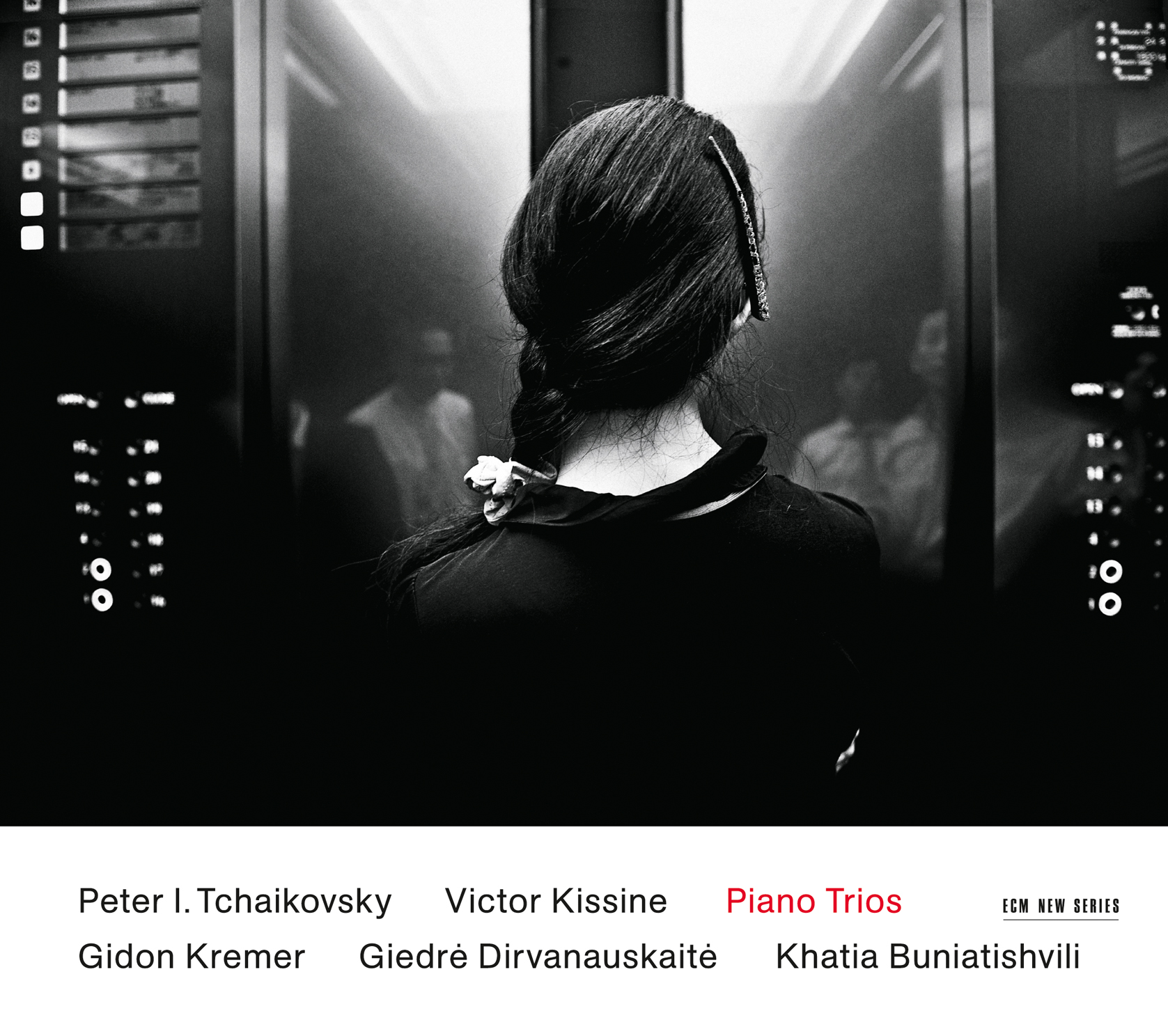
Kremer/Dirvanauskaitė/Buniatishvili: Tchaikovsky/Kissine – Piano Trios (ECM New Series 2202)

Piano Trios

Gidon Kremer
Giedré Dirvanauskaité
Khatia Buniatishvili
Peter I. Tchaikovsky / Victor Kissine – Piano Trios

Gidon Kremer violin
Giedré Dirvanauskaité violoncello
Khatia Buniatishvili piano
Recorded August 2010, Himmelfahrtskirche, Munich
Engineer: Peter Laenger
Produced by Manfred Eicher

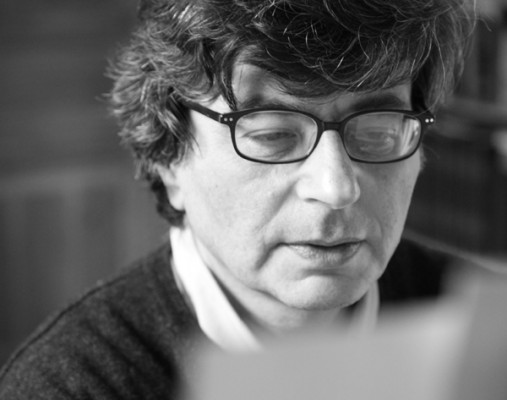
Russian-born composer Victor Kissine first eased into ECM when violinist Gidon Kremer and the Kremerata Baltica recorded Kissine’s orchestration of the Schubert G-major quartet for the label in 2003. The present disc of piano trios gives Kissine’s own music a welcome spotlight, placing his 2009 Zerkalo (The Mirror) in conversation with a masterwork of the medium: Tchaikovsky’s opus 50 a-minor Trio.

Kissine

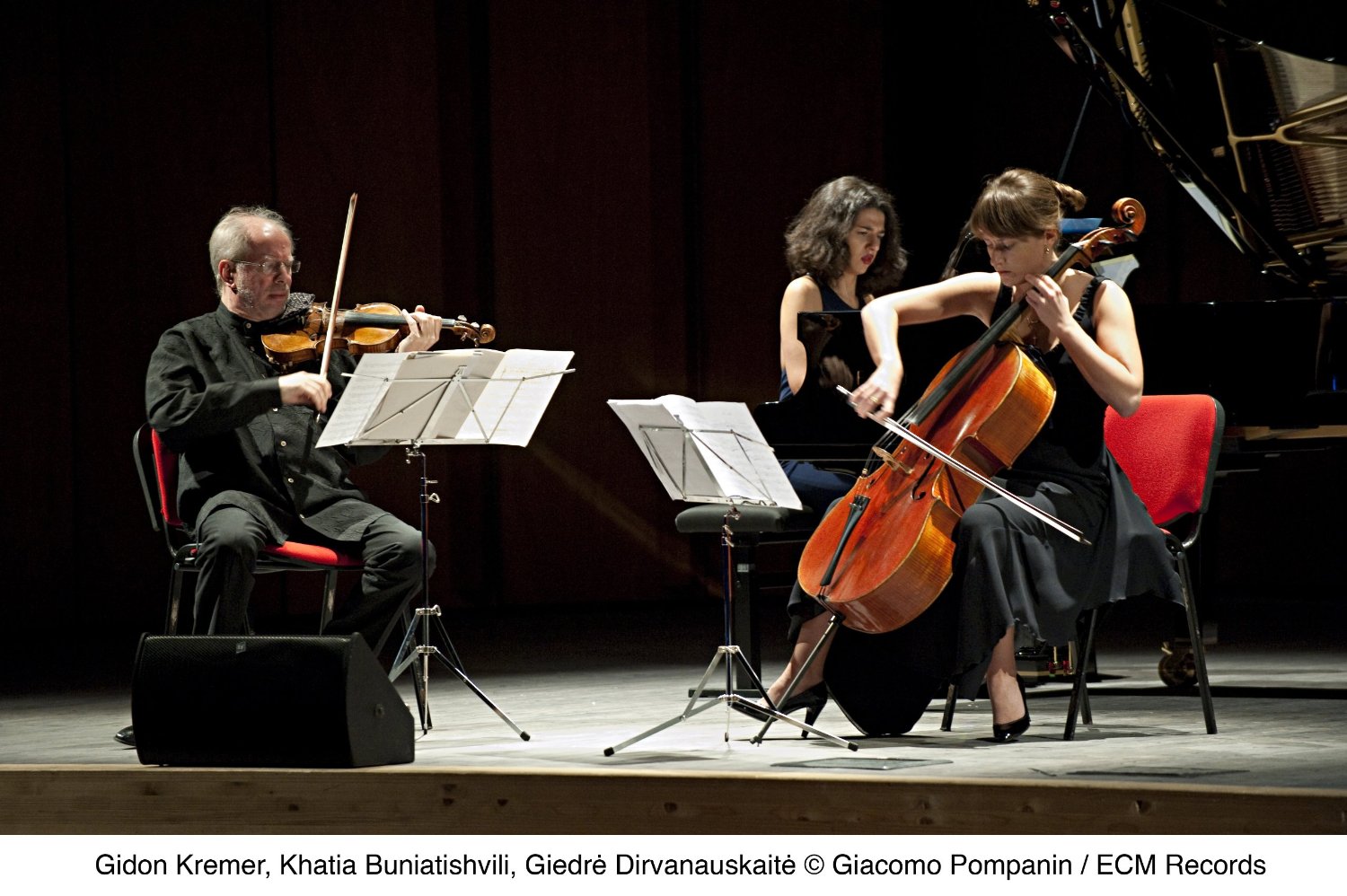
For this reference performance of Zerkalo, Kremer joins cellist Giedré Dirvanauskaité and pianist Khatia Buniatishvili, the very trio to whom the work is dedicated. From the beginning it’s clear that Kissine’s music doesn’t believe in beginnings. Rather, it raises one hand to the sky and another to the earth, leaving grooves of barest traction along the way and notating the resulting paths, yet always with the unwritten periphery in mind. Throughout the piece, Kissine riffs meticulously on the piano’s essence as a percussion instrument. Its echoing relationship to pizzicati provides as much rhythmic as melodic emphasis. It might seem a bold move to begin the album with this nominally modern piece were it not also so delicate in its infusions of place and time, creating of those philosophical staples an intimate and dialogic repose. Speaking to the latter is an astonishing variety of timbres, from the flute-like breath of Dirvanauskaité’s bow to Buniatishvili’s field of twigs and branches, and all of it kissed by Kremer’s wiring. Zerkalo speaks mostly at the level of a whisper and turns the magnification of its microscope higher with every pianistic reset. The music ends—again, not really an ending—in the manner of a palindrome, touched by an evening breeze that has licked brine and carried with it the dreams of freshwater afterlife.

Kremer Trio

Tchaikovsky’s Trio is headed with the words “To the memory of a great artist,” referring to pianist Nikolai Rubinstein, on whose first death anniversary the piece was premiered. In light of this, it’s no wonder that Tchaikovsky himself claimed it an elegiac piece. And yet, such a range of moods courses through its two gargantuan movements that choosing any single quality from among them would seem a sacrilege. We may read plenty of mourning into the cello writing especially, which like Peter Pan seems at times embroiled in a struggle to attach shadows to the pianism’s running feet. But then one notices Tchaikovsky’s feel for space, no better served then by engineer Peter Laenger, and which like the composer’s Souvenir de Florence turns harmonies and compulsions into imagistic storehouses.

The drama therein exists not only in the heft of its 20-minute first movement, but also in the sensitivity of its outpouring. Its most robust sections are also its tenderest, as in a beautiful passage just over halfway through in which violin and cello circle slowly around the piano’s lumbering chords. The Trio concludes with a theme and 11 variations. Enchanting passages abound, as in the fifth variation, for which the piano floats into higher registers against folkish backing from the strings. The churning reverie of the ninth variation and anchoring pizzicato cello of the eleventh are further highlights. All roads lead to the bracing Finale and a Coda that sends us off with a lullaby, that we might dream of the music’s continuance.

(To hear samples of Piano Trios, click here.)

Keller Quartett: Ligeti String Quartets / Barber Adagio (ECM New Series 2197)

Ligeti Barber

Keller Quartett
Ligeti String Quartets / Barber Adagio

András Keller violin
János Pilz violin
Zsófia Környei violin (on String Quartet No. 2)
Zoltán Gál viola
Judit Szabó violoncello
Recorded June 2007 and October 2011 (String Quartet No. 2), Radio Studio DRS, Zürich
Engineer: Peter Laenger
Produced by Manfred Eicher

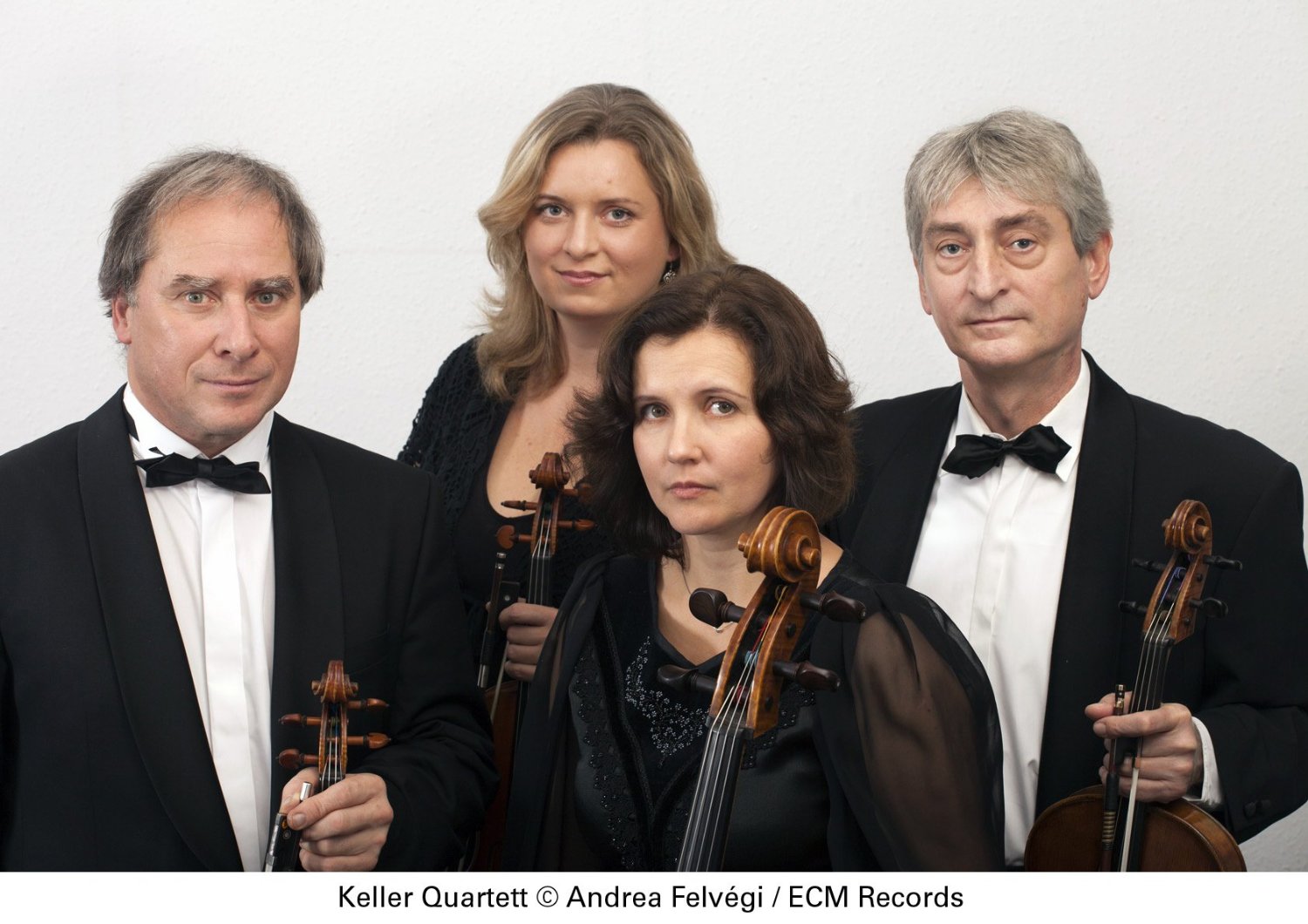
“How times have changed,” notes Paul Griffiths in his liner text to this album of string quartets by György Ligeti (1923-2006) and Samuel Barber (1910-1981). “How a recording can change them.” Indeed, at the bows of the Keller Quartett, the capabilities of two violins, one viola, and a cello are intensely magnified by performance and composition in equal measure.

Keller Quartett

Ligeti’s single-movement String Quartet No. 1 (1953/54) takes the title Métamorphoses nocturnes. It opens the program with a DNA helix, from which a single aberrant rung breaks free as a model for the others. The Kellers handle such structural changes with graceful science as warped dances and dizzying draws stoke the embers of continuity from beginning to end. Pizzicati become tactile pressure points, signs that the titular metamorphoses take place in those interims where dreams expand into days’ worth of experience yet take up only a sweep of the second hand. Darker textures at the center of this quartet prefigure Henryk Górecki’s own by decades, while the unforgettable slap pizzicato from cello marks the path with fortitude. The sheer variety of textures is beguiling enough. That Ligeti is able to combine them so organically takes a depth of attention of which few are possessed. A flock of harmonic glissandi toward the end elicit some of the most atmospheric writing for the medium, lasting only as long as the thought to include them before the cello snakes into affirmation and quiet recoil.

The undefeated Adagio from Barber’s opus 11 String Quartet (1935/36) is a chromatic dream come true. Needing no introduction, it nonetheless feels introduced here by the Keller touch. Tasteful, selective applications of vibrato allow for smooth textures to arise, especially in the second violin and viola. Furthermore, the musicians back off at the piece’s climax, thus rendering it less insistent, more of a blossoming than a cutting through, and setting up rawness in the cello-heavy afterglow. It’s somewhat regrettable that the rest of the quartet should be so often ignored, and the missed opportunity to correct this tendency here is only somewhat perplexing, for full inclusion might also have undermined the intimate compactness of the disc, which if pushed to a double could lose its hold on the listener (I would argue for the opposite). Either way, Barber’s contrapuntal beauties are vibrant and secure in this unique Ligeti sandwich.

Second violinist Zsófia Környei replaces János Pilz for Ligeti’s String Quartet No. 2, which over the course of five movements proves itself to be microscopically bonded beneath a seemingly fragmented surface. Where the mood is slow and sustained, the feeling is of viscous substance from which arise globules that never quite attain autonomy. The mostly pizzicato center forges dawn from dusk, welcoming ephemeral bow contacts in latent purchase. The final Allegro, by contrast, orients itself by a language most akin to cinema. As if in a credit roll, arpeggios and peripheral utterances sweep themselves into recession, leaving only a trail of shadows for us to follow.

Then again, the invitation to follow might itself be an illusion born of the listening process, which can never repeat itself exactly as before. And so, not only can a recording change the times; it can record change itself.

Zehetmair Quartett: Beethoven/Bruckner/Hartmann/Holliger (ECM New Series 2195/96)

ZQ

Zehetmair Quartett
Beethoven/Bruckner/Hartmann/Holliger

Thomas Zehetmair violin
Kuba Jakowicz violin
Matthias Metzger violin (Hartmann)
Ruth Killius viola
Ursula Smith violoncello
Françoise Groben violoncello (Hartmann)
Beethoven, Bruckner, and Holliger recorded April/May 2010 by Andreas Werner Hartmann recorded April 2002 by Markus Heiland at Radio Studio DRS, Zürich
Produced by Manfred Eicher

Violinist Thomas Zehetmair has become a household name at ECM, and nowhere more passionately than in his world-renowned quartet. While the group has always been adventurous, this album takes that spirit to new heights, and lengths, as it presents a monumental two-disc program of quartets by Ludwig van Beethoven, Anton Bruckner, Karl Amadeus Hartmann, and Heinz Holliger.

ZQ Portrait
(Photo credit: Keith Pattison)

In his brilliant liner notes, Wolfgang Sandner discusses the senescent Beethoven, whose final work, the formidable Opus 135, is the subject of the Zehetmairs’ bar- and hair-raising performance: “Beethoven’s late string quartets share the fate of many works created by great artists in their declining years, works which, as Adorno put it, point to the borderlines of art and almost acquire documentary stature. That is why, he continues, discussions of late Beethoven rarely lack references to his life and destiny.” In other words, the stature of an artist tends to be proportional to one’s biographical investment in that artist, as if the two were bonded matter. But if we were to see this quartet as a rope, we would find that, throughout each movement and between them, the unraveling yields thinner and thinner fibers, each more potent than the last. What distinguishes it as the final work of a master composer is therefore not so much the foreboding admixture of death and reflection that may or may not be intentioned in the music as an underlying spiritedness, held in check until choicest moments of reveal. All of this gives delicate passage into the second movement, which begins in that carefully controlled fragility by which Beethoven was so enamored but sows its field of tension with mounting density. The third movement, marked Assai lento, is cosmic and emotionally naked, a filamented chain into the final movement. Where rhythmic interplay was delightful before, here it surges.

From the end of one’s compositional life to the beginning of it, Bruckner’s String Quartet in c minor, WAB 111, was written in 1862 as a study piece while under the tutelage of German cellist-conductor Otto Kitzler. A smooth mélange of styles, it harbors echoes of Beethoven, and perhaps more explicitly of Dvorák, especially in the opening and closing movements. It is a sumptuous offering, its relief more extroverted in comparison to Beethoven’s inlaid approach, but in the flowing Andante we hear the latter’s game of hide and seek with exuberance before climbing ashore fully intact in the Scherzo, which serves as an amiable and spirited portal into the darker conclusion.

Hartmann’s String Quartet No. 2 is duly special for appearing on this record. First, it was recorded in 2002, eight years before the rest of the program, with a different second violinist (Matthias Metzger) and cellist Françoise Groben (1965-2011), a founding member of the quartet and in whose memory this recording, her last, bears dedication. Second, the music itself represents one of the pinnacles of the 20th-century string quartet. Begun at the tail end of World War II and finished in its immediate wake, it takes a three-movement structure, building on lachrymose foundations a tower of dance. Far from linear, however, it continues the theme of animated expositions out of quiet introductions. By these the music adopts an illusion of self-recognition. Despite its many shadows, the passion and joy with which the quartet plays this piece is fully evident. Groben’s playing is a wonder, bringing out as it does a turgid core. That said, the players do, and must, work together as one unit, for each move pulls the others in empathic response. A pervading heaviness in the central Andantino makes it an especially demanding play, as the performers must engage in deep listening and strictest attention to dynamics. The last movement, a Presto, enables reckoning of those darker predecessors with the light of geometric (if not also geographic) thinking and lends sanctity to the final major chord. Phenomenal.

Last is Holliger’s own String Quartet No. 2. Written by commission from the musicians, this stream-of-consciousness, single-movement work includes aleatory elements and is played scordatura. Like a scientist who pours water from one glass to another yet still finds wonder in the changes, Holliger engages the strings in flowing conversations of elements and transparencies, marking every drop spilled with precision. In this way, he cleverly reverses inner and outer. Like the Hartmann, this piece requires religious attention to dynamic contrast. This is not to say that Holliger is a cryptic composer, but that he composes with solutions rather than questions. One needs not overextend any theoretical impulse to understand the motives of writing that so comfortably favors absorption. This means that the piece’s quieter midsection may seem the very definition of mystery, when in fact it uses the mode of whisper to focus attention on its thread count. Consequently, the more forthright politics of its surroundings glisten with a personal sheen, which finds itself honed by erosion and the shape of human voices, as the musicians are bid to sing in the final scene. With the joining of their throats, these classical constructions of gut and wood become bodies in and of themselves, and render the preceding quartets a limb apiece.