Herbert Henck: Piano Music (ECM New Series 1726)

Herbert Henck
Piano Music

Herbert Henck piano
Recorded August 1999, Festeburgkirche, Frankfurt am Main
Engineer: Markus Heiland
Produced by Manfred Eicher

George Antheil (1900-1959) caused a stir in October of 1923 not unlike the one provoked by Stravinsky’s Sacre du Printemps after performing a selection of his sonatas. Only when Erik Satie, in attendance for the performance, voiced his unflinching support did Paris accept him as the self-anointed “Bad Boy of Music.” What incited the audience was the sheer ferocity with which Antheil played, so unsettling was it in its precision. In doing so, he flirted with the Uncanny Valley, taking the human dangerously close to the mechanical. And while his American debut was met with less fruitful derision, Antheil remained convinced that he was as important as ever. Whatever we may think of the man, his tireless spirit (he was known to practice for 20 hours at a stretch) lives on in the keen performances of pianist Herbert Henck, who makes a welcome return to ECM, pairing the French maverick’s sonic factories with the more intimate production lines of American composer and political outcast Conlon Nancarrow (1912-1997). The double meaning of the album’s title, Piano Music, gives us clearest insight into its program. Almost instinctively, both composers took to the player piano, treating it as though it were an organism in and of itself. Henck uses the phrase “piano music” as one might speak of “bird song.”

Of Nancorrow there is little to say, as he spent much of his life in hermetic obscurity (in Mexico, no less, after having been denied reentry into America from Spain, where he took up arms against the Franco regime and professed his allegiance to the communist party), quietly amassing a sizable oeuvre of laboriously perforated pianola rolls, which later astonished the musical world with their depth. Although the selections given here were written before Nancorrow began tinkering with the player piano in earnest, their virtuosity is clear in the autonomy of Henck’s elicitations. Such is the electricity that runs the Three 2-part Studies (1940/41), which “roll” off Henck’s fingers with absolute precision, and do the short Prelude and the Blues of 1935.

The Sonatina für Radio (1929), an infectiously jaunty piece with ragtime flair, is a capricious introduction to the music of Antheil, who makes up the rest of this modest 39-minute album. Among a fine selection of miniatures, some as short as thirteen seconds, are his adroit Second Sonata “The Airplane” (1922) and Mechanisms (1922/23). Where the former employs a host of rotary techniques and melodic turbines, all given upward lift by the aerodynamic contours of its fuselage-like core, the latter is a more enigmatic mosaic of unreachable clusters gilded in consonant frames. This is a piece that asks not which mechanisms are being described, but which are being deployed. One possible answer to that question can be found in A Machine (1932/33), a veritable build-up of static shocks that finds its demise in Sonatina (Death of the Machines) (1922). The (Little) Shimmy (1923) that ends the disc is precisely that, scooting the listener ever closer to an indefinable threshold.

This music was meant to be played by only the most skilled of human performers. Henck handles their notorious challenges with a practical ease nowhere to be found when originally composed, showing us in the process that the animate body is still the most creative machine of them all.

<< Keith Jarrett Trio: Whisper Not (ECM 1724/25)
>> Zehetmair Quartett: Karl Amadeus Hartmann/Béla Bartók (
ECM 1727 NS)

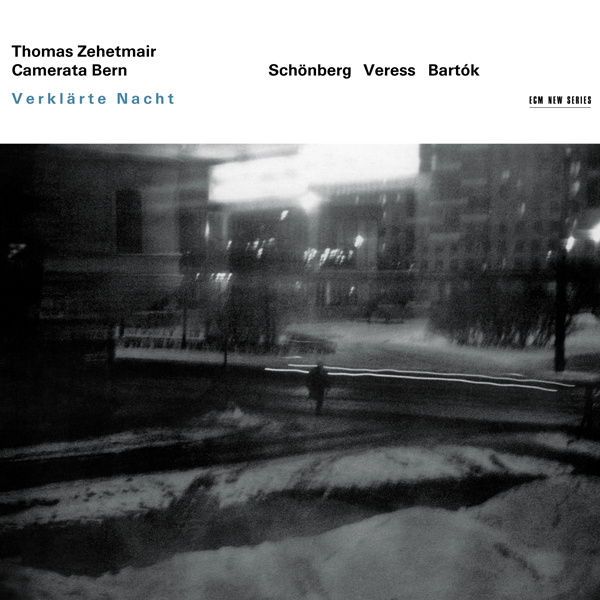
Camerata Bern/Zehetmair: Verklärte Nacht (ECM New Series 1714)

Thomas Zehetmair
Camerata Bern
Verklärte Nacht

Thomas Zehetmair violin and director
Camerata Bern
Recorded 1999 at Radio DRS, Zurich; 1995 at Salle de Musique, LaChaux-de-Fonds
Engineer: Bernd Runge and Eberhard Hinz
Produced by Manfred Eicher

Splendour falls on everything around,
you are voyaging with me on a cold sea,
but there is the glow of an inner warmth
from you in me, from me in you.
–Richard Dehmel, “Transfigured Night” (trans. Mary Whittall)

It’s difficult to believe that the first performance of Arnold Schönberg’s Verklärte Nacht (Transfigured Night) in 1901 incited a riot, prompting one critic to report, “It sounds as if someone had smudged the score of Tristan while it was still wet.” Structured as it is around the eponymous poem by Richard Dehmel, in which two lovers test their resolve while wandering in moonlight, the gossamer threads of night are its makeup. Along with The Book of the Hanging Gardens, it is one of the composer’s most visceral works. Not easy listening, to be sure, but nothing worth coming to blows over, either. Its lyrical chromaticism is lush yet opaque and descriptive to the core. Its contours slowly come into focus like a whale from a dark sea, Zehetmair’s violin waiting along with the seagulls for any morsels to escape from its yawning food trap. The Camerata Bern pays strictest attention to rhythm, caressing every beat with its strings. Though branded as a nocturnal affair, the piece also resounds with light. Certain sections sound like a magnified string quartet, while others breathe with the lung capacity of a full orchestra, but always with characteristic insulation. Like Wagner at his most self-effacing, Schönberg emotes with high narrative volume, as though a ballet and an opera had been stripped of words and collapsed into this one glorious whole.

After a glassy stillness that leaves us transfigured ourselves, the Four Transylvanian Dances of Sándor Veress pull us to our marionetted feet with spirited urgency. The second of these, with its finely wrought pizzicato beads, is notably heartwarming, while the fourth contrasts processional ceremony with outright exuberance. I can hardly imagine a better segue into Béla Bartók’s famed Divertimento (1939), of which the opening is perhaps the Hungarian’s most recognizable motif. Lower strings emerge as a major consonant force against the more adventurous uppers, which dance their way into the Adagio with infectious verve. The musicians’ dynamic control is on full alert here, as quiet restraint carries over into a cyclical swell of emotive power. The third and final movement is played to perfection. Its accentuating fingerboard slaps, solo cello, and open-stringed double stops stand out with scintillating clarity, all wrung through an imitative filter before ending with a pizzicato-friendly “micro-ballet.” The Divertimento, a more precise rendering of which I cannot recall, was the result of a commission by patron Paul Sacher, whose importance one can gauge further in ECM’s kaleidoscopic tribute album.

Verklärte Nacht scores another hit for Zehetmair, whose quartet album pairing Hartmann and Bartók made a concurrent appearance to equal acclaim. There’s no reason why you shouldn’t have both on your shelf.

<< Michael Galasso: High Lines (ECM 1713)
>> Heinz Holliger: Schneewittchen (
ECM 1715/16 NS)

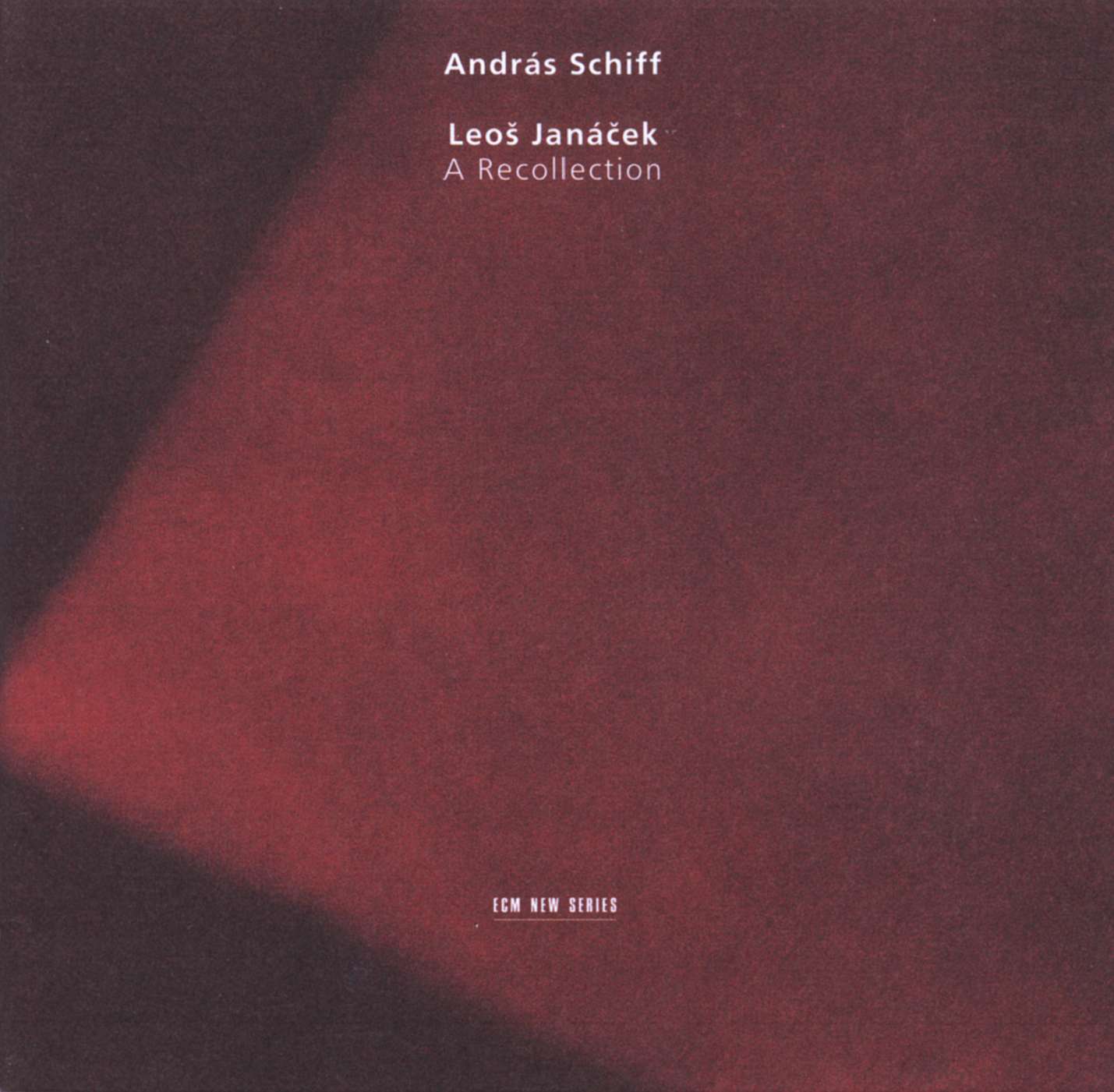
Leos Janáček: A Recollection (ECM New Series 1736)

Leoš Janáček
A Recollection

András Schiff piano
Recorded January 2000, Schloss Mondsee, Austria
Engineer: Stephan Schellmann
Produced by Manfred Eicher

“And it floated along on the water that day, like white swans.”
–Leoš Janáček, on tossing his score for the 1905 Sonata into the Vltava River

Intimacy and the piano make for an inseparable pair. At its best, the instrument paints an image of a composer in solitude, forging from its complex array of mallets, strings, and keys a music of one’s own. This is especially apparent in András Schiff’s peerless recital of Leoš Janáček (1854-1928), at last given the ECM makeover it deserves. Drawing from Moravian folk melodies and less discernible influences, Janáček’s pianism, by way of Schiff, is all about heart.

The Andante of In the Mists (V mlhách), composed in 1912, plays like a guitar, strings pressed rather than plucked, given renewed life in surroundings of waning visibility. One immediately notices the delicacy of the Schiff touch, and beneath it the supremely robust evocation of the melodic line that balances its way throughout the program’s remainder. He continues pulling at hidden energies in the Adagio that follows, working magic in small bursts. Each emotion falls with the insistence of late summer rain toward the transfixing Presto. One finds here the incredulity of the melodic gesture played out against itself in a roiling sea, where darkness lives only in our dreams.

The Sonata 1.X.1905 (From the street) is an incomplete work written, we are told, in memory of Frantisek Pavlik, a young Czech carpenter bayoneted during a Brno demonstration on 1 October 1905 in the name of higher learning. Dissatisfied with the result, Janáček burned the third movement, a funeral march, and cast the first two into the Vltava. It might have been lost forever had not Ludmila Tučková, who gave its premier in January of 1906, announced that she still had a copy in her possession. Each of its survivors is a mirror of the other, a long and soulful stream that leaves us lost and without company at their conclusion.

The miniatures of On an overgrown path (Po zarostlém chodníčku) form a pinnacle of the composer’s chamber output. Book I of 1908 is the more programmatic of the two. With such titles as “Our evenings” (Naše večery) and “A blown-away leaf” (Lístek odvanutý) at the outset, we are never in doubt as to what is being described. Yet even without these, we can feel our toes spreading in wild grasses, hear the music of autumn drifting across the dawn. The lovely reverberations of “The Madonna of Frydek” (Frýdecká panna Maria) and “Good night!” (Dobrou noc!) linger throughout later vignettes, such as “In tears” (V pláči) and in the call and response of “The barn owl has not flown away!” (Sýček neodletěl!). These last paint an emotional portrait of a composer bereaving the premature death of his daughter, Olga. Such diaristic approaches to musical experience are furthered in Book II (1911), where an Orphic, undulating Andante sits beside a bipolar Allegretto. The concluding three sections fall under the subtitle “Paralipomena” (or supplements), of which the Allegro leaves the most indelible mark.

A recollection (1928) plays us out with the grace of a sunflower bending to the wind.

Although the music of Schiff’s third ECM album evokes so much in the way of sight and sound, it rests firmly on silence insofar as it worships the internal impression, which is ultimately inarticulable. Try as they might, these lips produce nothing worth hearing in light of the music at hand, and so I type instead, hoping that my arbitrary dance of fingers on a keyboard of a rather different sort have done even a modicum of justice to what can more easily be known from buying this superb album and experiencing it for yourself.

<< Luciano Berio: Voci (ECM 1735 NS)
>> Vassilis Tsabropoulos: Akroasis (
ECM 1737)

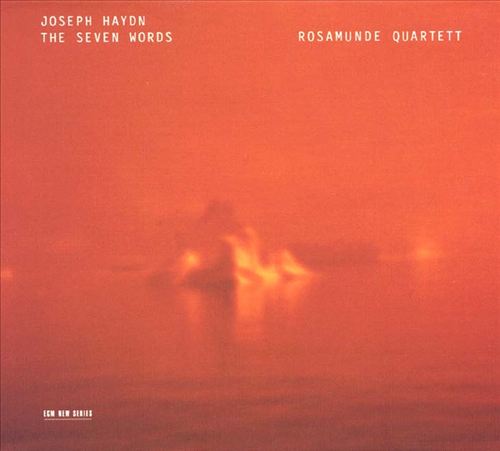
Haydn: The Seven Words (ECM New Series 1756)

Joseph Haydn
The Seven Words

Rosamunde Quartett
Andreas Reiner violin
Simon Fordham violin
Helmut Nicolai viola
Anja Lechner cello
Recorded May 2000, Festeburgkirche, Frankfurt am Main
Engineer: Markus Heiland
Produced by Manfred Eicher

What a paradox it is that the trappings of language should bring us so much spiritual power whereby our actions speak not only louder than words, but in place of them. Speech can only be a stepping-stone, replacing our imagination with temporary idols. Rather, the breath of life inside language is itself the awe we seek. Franz Joseph Haydn (1732-1809) offers another possibility: that the divine word is pure sound. The Seven Last Words of Our Savior on the Cross is his crowning achievement in this regard, and transcends all possible semantic constraints. Prefaced by an introduction and ending with an earthquake, at its center beat seven hearts in sonata form:

Sonata I
“Pater, dimitte illis, quia nesciunt, quid faciunt”
(“Father, forgive them, they know not what they do”), B flat, Largo

Sonata II
“Hodie mecum eris in Paradiso”
(“This day thou shalt be with me in Paradise”), C minor, Grave e cantabile, ending in C major

Sonata III
“Mulier, ecce filius tuus”
(“Woman, behold thy son”), E major, Grave

Sonata IV
“Deus meus, Deus meus, utquid dereliquisti me”
(“My God, My God, why hast thou forsaken me?”), F minor, Largo

Sonata V
“Sitio”
(“I thirst”), A major, Adagio

Sonata VI
“Consummatum est”
(“It is finished”), G minor, Lento, ending in G major

Sonata VII
“In manus tuas, Domine, commendo spiritum meum”
(“Into thine hands, O Lord, I commend my spirit”), E flat, Largo

Though originally written for orchestra, and in a state of religious fervor, the string quartet redaction performed here (it also exists as an oratorio and in a version for solo clavier), though questionably sanctioned by the composer, brings forth the music’s intention all the more vividly. Most scores will have the Latin texts directly beneath the first violin line, lest their efficacy fade in the absence of human voices, which makes the Rosamunde Quartett’s performance all the more astonishing for its enunciative clarity, an inward sense of tempo and nuance that seems to breathe through every instrument.

The opening proclamation is a wakeup call. While not especially dense, it nevertheless pulls us like a hooked fish. Its tight harmonies reveal a more porous foundation by which the benefits of language are weighed against its sins. We are swept past our conjectures with intense forward motion into a world of sound where Classical charm and Baroque pensiveness walk hand in hand. The violin strings the others like beads on a rosary. Through an almost serpentine motif and multivalent gentility, it exposes the folly of human ways by the light of retribution. We pause on the occasional neutral resolution before soaring into more rhythmically staggered interiors. In the Third Word, we encounter imbalanced key changes, thereby establishing the corpus of the piece as though a cocoon were unwinding itself into a path to the more urgent Fifth. By the time we take our final footsteps, treading carefully over muted strings, we lose ourselves in the trembling earth.

<< Keller Quartett: Lento (ECM 1755 NS)
>> Stephan Micus: Desert Poems (
ECM 1757)

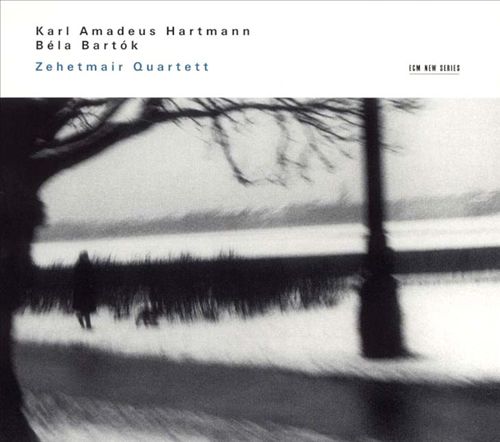
Zehetmair Quartett: Hartmann/Bartók (ECM New Series 1727)

Zehetmair Quartett
Karl Amadeus Hartmann/Béla Bartók

Zehetmair Quartett
Thomas Zehetmair violin
Ulf Schneider violin
Ruth Killius viola
Françoise Groben cello
Recorded November 1999, Radio DRS, Zürich
Engineer: Markus Heiland
Produced by Manfred Eicher

Violinist Thomas Zehetmair made headlines when he debuted his quartet in what stands to be a reference recording for years to come. The two pieces featured on this disc, one from Karl Amadeus Hartmann (1905-1963) and the other from Béla Bartók (1881-1945), date from the interwar years, during which time ravages of a bloody past and intimations of an even more tragic future sat side by side. In this respect, the string quartet represents what Hermann Conon in his liner essay describes as a “microsocial sphere in which human beings can learn to coexist harmoniously.” Hartmann was inspired by Bartók’s Fourth String Quartet (1928) when writing his first (1933). The two are linked here in temporal spirit to form a tightly knit program from one of the genre’s most talented configurations.

Hartmann draws into his neglected masterpiece with a mournful viola, which is then lifted ever so slightly by cello. These pass through a cluster of harmonics, as if traversing a portal, into a world of structural contrasts that foreshadow those of Górecki’s works for the medium some six decades later. The Zehetmair Quartet carefully measures every tension and release, as in the avian calls of the second movement, marked con sordino (that is, played with mutes). The nervous energy of the final is funneled into robust violins as they scale beyond Bartók into their own airspace. This is a quartet that demands not only to be heard, but also to be seen.

The Bartók itself plays out like a game of leapfrog, such that each instrument is always engaged with another. Through a spidery forest of glissandi, pizzicati, dynamic contrasts, and tinny bowings, we find ourselves in a likeminded atmospheric haven at its center. The famous Allegretto pizzicato introduces us to a Bartókian staple, given all the room it needs to soar. The frenetic dance at the close works off a tight rhythm section in the lower strings into dense fortissimo thickets of dissonant bliss.

This recording warrants nothing but highest praise on all counts and furthers ECM’s commitment to the very best in string quartet performance and composition. What a journey it continues to be.

<< Herbert Henck: Piano Music (ECM 1726 NS)
>> Tsabropoulos/Andersen/Marshall: Achirana (
ECM 1728)

Michelle Makarski: Elogio per un’ombra (ECM New Series 1712)

Michelle Makarski
Elogio per un’ombra

Michelle Makarski violin
Thomas Larcher piano
Recorded May 1999, Radio DRS, Zürich
Engineer: Stephan Schellmann
Produced by Manfred Eicher

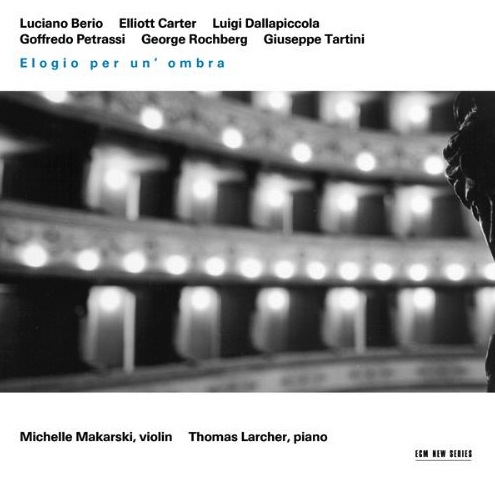
For her second ECM recital, Michigan native Michelle Makarski has assembled an equally disparate yet harmonious program. The endlessly fascinating Caprice Variations (1971) of George Rochberg (1918-2005) continue where they left off on the violinist’s label debut, Caoine, twirling into a sonic thread between the two. Makarski is a particularly sublime interpreter of Giuseppe Tartini (1692-1770), whose music is the window into all that borders it. His Sonata VII in A minor is spread throughout in large bites, each gnawing on the succulent Sarabanda at their core. Its lilting cadences and finely executed trills capture our melodic eye from note one to none. The Due Studi (1947) of Luigi Dallapiccola (1904-1975), an early Italian devotee of the Second Viennese School, share Tartini’s affinity for deconstruction. Here, Makarski is joined by Thomas Larcher on piano for added color. The album’s title piece, written in 1971 by Goffredo Petrassi (1904-2003), carries us through a gentle introduction and softly piercing high notes into a conduit of agitations and protracted statements. Though delicate in its tension, it nonetheless requires lucid virtuosity. Elliott Carter balances this out with a Riconoscenza (1984) for the same composer. Larcher returns for the Due Pezzi (1951) of Luciano Berio (1925-2003). These are more playful, if naïve, pieces with enough neo-classical flint from which to strike an adequate fire. Makarski then graces us with the anonymous Lamento di Tristano of 14th-century Italy, played sul ponticello for a rather metallic slide into finality.

<< Kim Kashkashian: Bartók/Eötvös/Kurtág (ECM 1711 NS)
>> Michael Galasso: High Lines (
ECM 1713)

Sofia Gubaidulina (ECM New Series 1775)

Sofia Gubaidulina

Elsbeth Moser bayan
Boris Pergamentschikow cello
Münchener Kammerorchester
Christoph Poppen conductor
Recorded January 2001, Himmelfahrtskirche Sendling, München
Engineer: Stephan Schellmann
Produced by Manfred Eicher

“There is no more important reason for composing music than spiritual renewal.”
–Sofia Gubaidulina

Shostakovich once famously said of his student, Sofia Gubaidulina, “I want you to continue along your mistaken path.” Mistaken, that was, in the former Soviet Union, where the deliverance preached through her devout composing sat uncomfortably with censors. So much so that when she composed her Seven Words in 1982, she was obliged to leave out “…of Our Savior on the Cross” from its title. Nevertheless, this riveting work is one of the twentieth century’s reigning masterpieces. One will want to compare Gubaidulina’s instinctive metaphorical approach to Haydn’s more direct setting of the same. The two could hardly be more different, either in sound or in circumstance, but they clearly embrace the same fragile heart. Providing the blood herein is the bayan, a button accordion typically heard in Russian folk contexts. Through Gubaidulina’s notecraft, and in the hands of longtime associate Elsbeth Moser, it becomes a speech act in its own right. In constant dialogue with a cello soloist and tentative orchestral commentary, the bayan comports itself not unlike the turbulent waves on the album’s sleeve. And while there are far too many moments to single out for praise, the epiphany of Part VI (“It is finished”) is a wondrous experience indeed, and leads us to an ending that is beyond earthly.

The following Ten Preludes (1974, rev. 1999) for cello were originally conceived as instructional etudes, with the final piece leaving room for improvisation, and therefore the creative edge of the performer. Inevitably, these have taken on lives of their own, and flow here in a line of fractured counterpoint that “resets” us for the heavenly strains of De profundis (1978) for bayan alone. The instrument’s multilayered sound lends itself beautifully to the Trinitarian gaze in which it finds itself illuminated, lapsing into trundled passages where lateral divisions turn our souls to the indecipherable limits of their own awareness.

There is no ground on which to stand in this music. One must remain elevated, if not airborne, in relation to one’s expectations, always approaching them from above. It is a revelation to finally have Gubaidulina’s music represented on ECM, where spacious production values give it all the berth it needs. Let us hope this is not a one-off affair.

<< Bach/Webern: Ricercar (ECM 1774 NS)
>> Valentin Silvestrov: leggiero, pesante (
ECM 1776 NS)

Kim Kashkashian: Bartók/Eötvös/Kurtág (ECM New Series 1711)

Kim Kashkashian
Bartók/Eötvös/Kurtág

Kim Kashkashian viola
Netherlands Radio Chamber Orchestra
Peter Eötvös conductor
Recorded January and July 1999, Musiekcentrum Vredenburg, Utrecht
Engineers: Stephan Schellmann and Markus Heiland
Produced by Manfred Eicher

The viola has long been one of my most beloved instruments. I see it less as a “neglected” presence in the string world and more as a quiet supporter whose ubiquitous presence has simply been taken for granted. In all this time, it has never been compromised, and for that I adore it. Nearly all of my adoration can be attributed to one musician: Kim Kashkashian. For this all-Hungarian program, the instrument’s most committed proponent raises the bar on a standard work in the literature and sets another for two others.

Of the first, Béla Bartók’s Concerto for Viola and Orchestra, I can say that in Kashkashian’s firm grasp it falls with the sweetness of rain onto drought-ridden land. The concerto was written between July and August of 1945 and never finished, due to the composer’s death just one month later. Here, the musicians use Tibor Serly’s standard completed score along with some adjustments of their own. After a robust introduction from the viola, the 14-minute Moderato comes to life like an afterthought that was always meant to be. The viola is such a profound presence in this piece that at points one almost forgets the orchestra is even there. Rather than see this dynamic as a distraction, I chalk it to the orchestra’s ability (both in the playing and the writing) to infuse the soloist’s every move. Pizzicati crumble off like debris as discernible themes come and go through a fractured lens that opens our eyes to the pastoral, openhearted exchange of the second movement. Though hardly a third in length of the first movement, it plies our scales of judgment with as much moral weight. The third movement, marked Allegro Vivace, bursts almost immediately into the final dance. Like the rest of the concerto, it is so melodically confident that it could easily hold its own as a solo piece. What the orchestra provides is a tonal palette upon which the viola’s many colors may rest.

Replica for Viola and Orchestra was written in 1998 for Kashkashian by this recording’s conductor, Peter Eötvös. Regardless of what its intended replication is, the viola and orchestra are always sketching one another: the former linearly like smudged charcoal and the latter in bold yet multifarious brushstrokes dripping with excess paint. The puddle that collects on the floor beneath the easel is its own replica, more than a mere remnant of the creative process. Throughout this single-movement piece, we are never sure of where we are, only that we are comfortable being there. It is music to which we may open our ears without fear of harm.

György Kurtág’s Movement for Viola and Orchestra (1953/54) is the lone survivor of an abandoned early concerto and a welcome change of pace from, if no less fragmentary than, the miniatures that dot much of his other label representations. Distant timpani and swells of brass throw wide the curtains of its keen melodic stage. Also in one movement, its terse balance is the result of astute composing adorned with virtuosic viola writing and not a few demanding moments. Through every spiral we hear the revelry of composer and performer alike, plucked like so much fruit in the orchestra’s final pizzicato.

While a handful of fine recordings of the Bartók certainly exist (of which Hong-Mei Xiao’s superb twofer on Naxos is a personal favorite for comparison), Kashkashian’s brings something untouchable to bear upon this masterwork. To the others she imparts a fresh and mounting vitality. She plays with fortitude yet also with such grace that we find ourselves stunned in the middle. The crisp recording and all-around pellucid musicianship only strengthen her case. Hers is neither the delicate chiseling of the fine woodworker nor the casual scraping of the whittler. Rather, it is the rough-hewn grace of the ice sculptor. And like our breaths that cloud in the air as we watch her at work, the music fades all too soon.

<< Jean-Luc Godard: Histoire(s) du cinéma (ECM 1706-10 NS)
>> Michelle Makarski: Elogio per un’ombra (
ECM 1712 NS)

Patrick and Thomas Demenga: Lux Aeterna (ECM New Series 1695)

Patrick Demenga
Thomas Demenga
Lux Aeterna

Patrick Demenga cello
Thomas Demenga cello
Recorded November 1998, Propstei St. Gerold
Engineer: Teije van Geest
Produced by Manfred Eicher

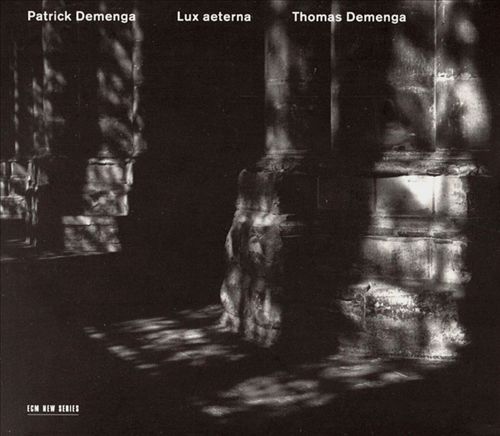
This album is a special one for having introduced me to the awe-inspiring pathos of Alexander Knaifel. Here, the phenomenally talented Demenga brothers give their most heartfelt performance in the composer’s Lux Aeterna. It is, by no simple means, a glorious meditation on the notion of divine light. Its structure is simple: high harmonics on the cellos give way to words intoned by the musicians themselves (cast in the score as “psalm singers”) before combining with strings, so that song is produced from all aspects of the body, through gesture and through sacred vibrations. A profound and moving piece, played with utter sensitivity and a dedicated sense of direction, this title work is more than the album’s theme, but also its genesis. One cannot help but be comforted in its ethereal embrace.

We might hope this mood could be sustained throughout the entire program, but the remaining offerings are no less engaging in their own right, comprising an intriguing potpourri drawn from the duo’s longstanding repertoire. Thomas offers up his own piece, Duo? o, Du…, an insightful look into the mind of this singular (albeit twinned) musician that delights with its deep-throated croaks and delicate relay of harmonics.

French composer Jean Barrière (1707-1747) was the finest cellist of his day, but his music is hardly ever recorded. Despite its upbeat tempi and virtuosic scoring, there is solemnity to be found in his G-major Sonata No. 10. Its buoyancy presages the Mozartean paradigm by half a century and rests on laurels of comforting fluidity. At certain moments the cellos ring out in lush, sweeping harmonies, leaving the bass line to float like a ghostly implication in the corner of our mental eye. The raw Adagio plays like a viola da gamba divided into its complementary personalities and captivates with its Baroque sensibilities. The resonant space in which the album is recorded ensures the cellos are given the widest berth possible, stretching the sonata’s third movement into a majestic fabric. After this tour de force, the Demengas change gears with a piece from Swiss compatriot Roland Moser. A student of Sándor Veress and Wolfgang Fortner, Moser writes in feverish yet contained bursts, as evidenced in the dizzying pizzicati and sharp bowings of his Wendungen. A sprinkling of silence ensures that the immediacy of its drama stays true to its quieter affirmations. Barry Guy’s Redshift brings us full circle to Kniafel’s invocation of light. The title references a process by which, not unlike a Doppler effect in sound, changes the visible spectrum as distance increases. With bows a-bouncing the cellists reap a varied crop of meditations and improvisations through which a cunning rhythmic acuity is brought to fruition. We end on a lullaby, left to writhe like Odysseus strapped to the ship that threatens to sail him into a song that will mean his demise.

<< Peter Ruzicka: String Quartets (ECM 1694 NS)
>> John Cage: The Seasons (ECM 1696 NS
)