Jack DeJohnette’s Directions: Untitled (ECM 1074)

ECM 1074

Jack DeJohnette’s Directions
Untitled

Jack DeJohnette drums, tenor saxophone
John Abercrombie electric and acoustic guitars
Alex Foster tenor and soprano saxophones
Mike Richmond bass, electric bass
Warren Bernhardt piano, electric piano, clavinet, cowbell
Recorded February, 1976 at Talent Studios, Oslo
Engineer: Jan Erik Kongshaug
Produced by Manfred Eicher

With Untitled, Jack DeJohnette’s Directions popped a jazz milestone into ECM’s prolifically expanding oven, and it still smells as fresh as the day it was baked. Building off DeJohnette’s robust intro to the 14-minute “Flying Spirits,” a compelling quintet completed by guitar (John Abercrombie), bass (Mike Richmond), sax (Alex Foster), and keyboard (Warren Bernhardt) makes for an aerial interweaving of complementary signatures. The band kicks up a whirlwind of activity, leaving DeJohnette’s delicate applications to rustle like the last stray leaves blowing down the road, out of sight but ever in mind. “Pansori Visions” is an eccentric duet of hand drums and detuned guitar, slack strings sounding like the amplified offspring of a koto and a human voice. Not coincidentally, the title refers to a traditional Korean art form of often-satirical storytelling, also to the accompaniment of a single drummer. “Fantastic” is just that, its colorful percussive accents giving way to some infectious saxophonic action. In spite of the killer title, “The Vikings Are Coming” unfolds like something straight out of Pat Metheny’s Watercolors session, again striated by fluent reeds. “Struttin” evolves into a rather punchy face-off between saxophone and guitar, refereed superbly by DeJohnette. The only victory to be had is in the brief but bitter groove as it closes in resolute harmony. Bernhardt’s “Morning Star” begins with a duet of piano and acoustic guitar, the latter always one step behind. From these dream-like beginnings come a pronounced rhythm section and more melodic fortitude from alto. Capping off this invigorating set is “Malibu Reggae,” which slinks like a drunken dancer in slow motion, its delightfully kitsch keyboard gnawing at the edges of our curiosity with a familiar burn. A tune that would have sat easily among John Zorn’s Naked City abstractions in their heyday, it’s a whimsical ending to a powerfully direct album, ever blushing with hints of its own enigma.

These compositions—all but “Morning Star” are by DeJohnette with or without his collaborators—are bright, resilient, and vociferous. Having stood the test of three-plus decades, they will easily hold up to three more, and then some. And while our leader captivates with his usual kinesis, Foster’s vocal modulations and the unobtrusive support network of Abercrombie/Bernhardt/Richmond make this one for the ages. When you’ve had enough blues for one day, Untitled is as good a pick-me-up as you could ask for. A prime candidate for reissue.

<< Pat Metheny: Bright Size Life (ECM 1073)
>> Jan Garbarek: Dansere (ECM 1075)

Collin Walcott: Cloud Dance (ECM 1062)

ECM 1062

Collin Walcott
Cloud Dance

Collin Walcott sitar, tabla
John Abercrombie guitar
Dave Holland bass
Jack DeJohnette drums
Recorded March 1975 at Tonstudio Bauer, Ludwigsburg
Engineer: Martin Wieland
Produced by Manfred Eicher

The late, great Collin Walcott made his proper ECM debut on Cloud Dance (after an appearance three years earlier on Trios/Solos), where he was joined by the Gateway trinity—John Abercrombie, Dave Holland, and Jack DeJohnette—for one of his most powerful albums ever to grace ECM’s vinyl (and later, digital, thanks to a vital Touchstone series reissue) grooves. The marrow-warming twang of Walcott’s sitar sets up the opening “Margueritte” to be a long raga, when suddenly Abercrombie’s electric appears in kind, beckoning a chill entourage of bass and drums and touching off a pair of graceful solos from Abercrombie and Holland. The album’s remainder is fleshed out by a variety of intimate configurations. “Night Glider” and “Vadana” both feature guitar, bass, and sitar, the latter two instruments feeding beautifully off one another, the guitar weaving in and out where it may. The two duets between Walcott and Holland, however, are really where this album gilds its worth. Our frontman lays out plush carpets of tabla and sitar on “Prancing” and “Eastern Song,” respectively, over which Holland takes stock of every variation of pattern and thread count. The second of these pieces, while the briefest of the album, is also one of its most mesmerizing. Contrary to what the titles might have us believe, these are all genuinely realized pieces where the word “exotic” is but another puff of smoke in the breeze. And so, the heavy tabla and shawm-like guitar of “Scimitar” describes not the weapon wielded in the hands of countless white actors in uninformed filmic productions, but rather an exploration of the object on its own terms, tracing forms and histories, battles and silences alike, with due abandon. So, too, with the final and title cut that brings DeJohnette back into the mix for an animated closer.

The telephone wires on the cover are like the strings of some large instrument, with the sky as its sound box. Its clouds don’t so much dance as perform, caressing endless waves of voices careening through the ether. The joy of Cloud Dance is that it makes those voices intelligible. Fans of Oregon, of which Walcott was of course an integral part, need look no further for likeminded contemplation.

<< Abercrombie/Holland/DeJohnnette: Gateway (ECM 1061)
>> Enrico Rava: The Pilgrim And The Stars (ECM 1063)

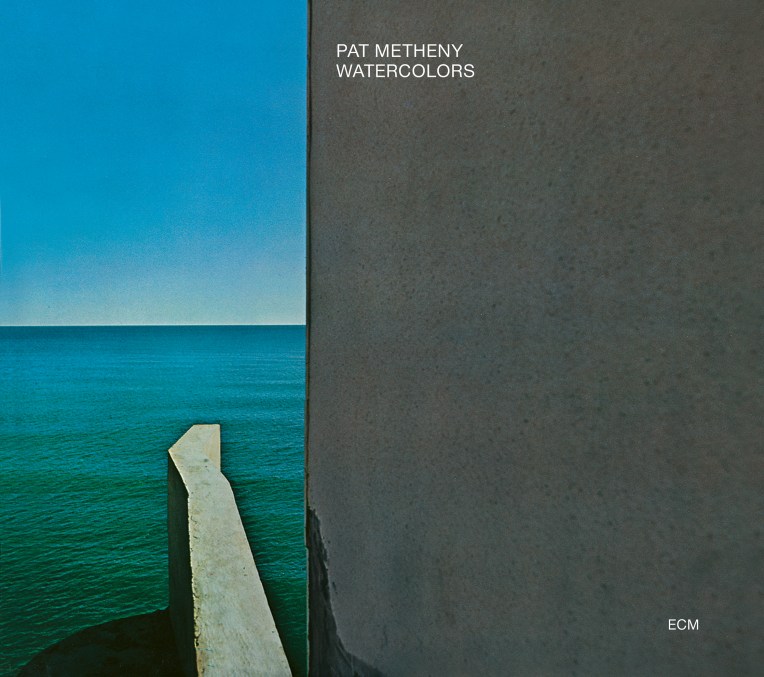
Pat Metheny: Watercolors (ECM 1097)

1097 X

Pat Metheny
Watercolors

Pat Metheny guitars
Lyle Mays piano
Eberhard Weber bass
Dan Gottlieb drums
Recorded February 1977 at Talent Studio, Oslo
Engineer: Jan Erik Kongshaug
Produced by Manfred Eicher

From the opening strains of Pat Metheny’s second album, we immediately know that we have a calming yet powerful journey ahead of us. The present company—among which keyboardist Lyle Mays, a Pet Metheny Group fixture, makes his first appearance—renders his characteristic combination of form and style into an instinctive wash of comfort. Mays’s pianism proves the perfect complement to the guitarist’s untainted sound. Just listen to the way he buoys the music in the opening title track, and his fluent solo in “River Quay,” and you will hardly be able to imagine the music without him. We get a lingering look at Metheny’s own abilities in “Icefire,” in which he solos on a cleverly tuned 12-string that lobs between solid chords and higher callings. Midway through, the music melts into its second titular half, flowering in a cluster of Ralph Towner-esque harmonics. “Oasis” introduces the harp guitar, a sympathetically strung instrument that shines in Metheny’s hands like the charango in Gustavo Santaolalla’s. A mournful electric sings at its center, ever shielded by an unrequited embrace of acoustics. Varied rhythms and bold chord changes animate its otherwise stagnant beauty. After these quiet submersions, we come up into air, and into light, with the beautiful “Lakes,” which positively glows with quiet ecstasies. Again, Mays broadens the edges to new waterlines, cresting like a wave that never crashes upon its thematic shores. A two-part suite proves a complex call and response with the self before the 10-minute “Sea Song” reprises the harp guitar for its swan song. The music here is beyond aquatic, and could easily have seeded a Ketil Bjørnstad project. Eberhard Weber’s smooth bass introduces the morning’s regular activities with the first rays of sunrise in countless awakening eyes, before rolling out once again, drawn back into the depths like the tide that gives them life.

Metheny’s precision dives and soars, a most selfless bird, his fingers running together like the colors of the album’s title. His supporting crew is in tune at every moment (and one mustn’t fail to praise Dan Gottlieb’s drumming in this regard), protecting every melody with passionate detail. This is perfect music for travel, for the music travels itself. It’s a plane ride above a shimmering landscape, a hang-glide over open valleys, a dive into crystal waters—and yet, our feet never leave the ground. One might call it otherworldly, were it not so firmly rooted in the earth in all its glory. Pure magic from start to finish.

<< Collin Walcott: Grazing Dreams (ECM 1096)
>> Julian Priester and Marine Intrusion: Polarization (ECM 1098)

Chick Corea: Solo Piano (ECM 2140-42)

Corea Solo Piano

Chick Corea
Solo Piano

Chick Corea piano
Ida Kavafian violin
(Children’s Songs, Track 20)
Fred Sherry cello
(Children’s Songs, Track 20)
Release date: March 26, 2010

Much of the jazz that has come to characterize the “ECM sound” is known for its pellucid solemnity. Conversations between sound and space abound, in which vestiges of their own histories mark the passage of time. To younger listeners like myself, it is sometimes easy to forget that the label remains rooted in the youthful immediacy one finds in these formative efforts from Chick Corea. While his refreshing approach to pianism inhabits the same continent as other formidable players, Corea is very much his own culture. Much of the later material that would come to define the “Corea sound,” however, is in clear evidence throughout these discs, and especially in the improvised efforts.

1014 X

Piano Improvisations Vol. 1 (ECM 1014)

Recorded April 21 & 22, 1971, Bendiksen Studio, Oslo
Engineer: Jan Erik Kongshaug
Produced by Manfred Eicher
Release date: 1971

From note one, these improvisations abound with the freedom of an artist who is ever at his peak. Their many tender touches and nostalgic leanings are shielded by a powerful optimism. Such exuberance makes them all the more embraceable in their poignancy. Tunes such as “Noon Song” twirl like a skirt in the breeze. Others (“Sometime Ago” and “Song For Sally”) are flirtatious and skip from one thought to another: a love in overdrive. The pièce de résistance, however, is the eight-part suite “Where Are You Now?” In this series of “pictures,” Corea renders for us a film whose soundtrack precedes its images. There are no mysterious titles to ponder; each tells us exactly what we are going to hear. The playing is at once pliant and mechanical, carrying across its feelings with such genuine appreciation for the listener that one cannot help but smile.

<< Dave Holland/Derek Bailey: Improvisations for Cello and Guitar (ECM 1013)
>> Jan Garbarek Quintet: Sart (ECM 1015)

1020

Piano Improvisations Vol. 2 (ECM 1020)
Recorded April 21 & 22, 1971, Bendiksen Studio, Oslo
Engineer: Jan Erik Kongshaug
Produced by Manfred Eicher
Release date: March 1, 1972

This companion volume of Corea’s improvisations doesn’t merely continue where the first left off, but fleshes out finer details unexplored in its neglected depths. This volume is more nocturnal than the last, a siesta in songs without words. “After Noon Song” starts us off alluringly before the crisper interjections of Thelonius Monk’s “Trinkle Tinkle” and Wayne Shorter’s “Masqualero.” The second act is where the album begins to fray at the edges, and becomes all the more mystical for it. At first, experiments like “Departure From Planet Earth” seem to stray into unnecessarily weighty territory. Yet with each listen, they tell us more about their travels. And while Corea’s often-discussed religious predilections (I dare not invoke the “S” word here) may give us even greater insight into the music’s enigmatic borders, in this instance such forays into biographical details provide little advantage. Either way, Corea reacclimates into “A New Place.” This is polyglot music, of which each melody its own tongue. Though some are more readily interpretable than others, we always know what is trying to be said.

<< Circle: Paris Concert (ECM 1018/19)
>> Keith Jarrett/Jack DeJohnette: Ruta And Daitya (ECM 1021)

1267

Children’s Songs (ECM 1267)
Recorded July 1983 at Tonstudio Bauer, Ludwigsburg
Engineer: Martin Wieland
Produced by Manfred Eicher
Release date: April 1, 1984

By a similar twist of fate that kept me from The Köln Concert for so many years, I only discovered this album recently, and I must say that it deserves a throne alongside Keith Jarrett’s magnum opus for its unfathomable hidden power. Beneath the album’s contemplative veneer beats a furnace of a heart stoked by creative flames, the heights of which are rarely surpassed in today’s genre-hungry climate. Begun in 1971, and recorded here twelve years later, Children’s Songs gives us Chick Corea at his compositional best. At first, the title is an enigma: Are these songs to be played by children or for children? But as we soon discover, the child has already outgrown itself. Like clouds, these pieces take on whatever shapes we project onto them. On the one hand, their steady obbligatos and carefully chosen points of contact resemble the latent energies of Philip Glass (No. 1) and Steve Reich (No. 9). On the other, they pantomime a range of influences, from ragtime to Satie (No. 19 is like something lifted straight out of Gymnopédies) to Bartók (the Mikrokosmos parallels being almost too obvious to mention). One can also clearly see how influential this music must have been to others. The filmic beauty of No. 4 cannot have been lost, for example, on Michael Nyman. These are also pieces about contrast. Take, for example, the left hand in No. 6, which lays out a triadic darkness, while the right hand insists on spinning light before our very eyes. Corea’s characteristic ornaments, as in the descending trill at end of No. 3, grow richer every time, and the sweeping elegies of No. 10, 12, and 13 allow the Corea we know and love to shine through. Violin and cello add delightful pliancy to the “Addendum,” a classically minded closer that puts a stylish bow on an already crisply wrapped package.

Corea and his legacy blossom at every moment throughout these three seminal albums, with which he singlehandedly revitalized the solo piano program as an art form to be taken seriously in the post-Art Tatum era. He is the reliable narrator, the quiet provocateur, and the entertainer. He is also none of these. He bids us to listen without pretense, knowing that a carefully defined surface is nothing without the depth to support it. At the same time, he wastes no time in trying to intellectualize what lies beneath, secure in the knowledge that his music will carry on the conversation. This is an essential collection that belongs on any ECM fan’s shelf, not to mention a prime candidate for reissue of the century.

<< Rainer Brüninghaus: Continuum (ECM 1266)
>> Ulrich P. Lask: Sucht+Ordnung (ECM 1268)


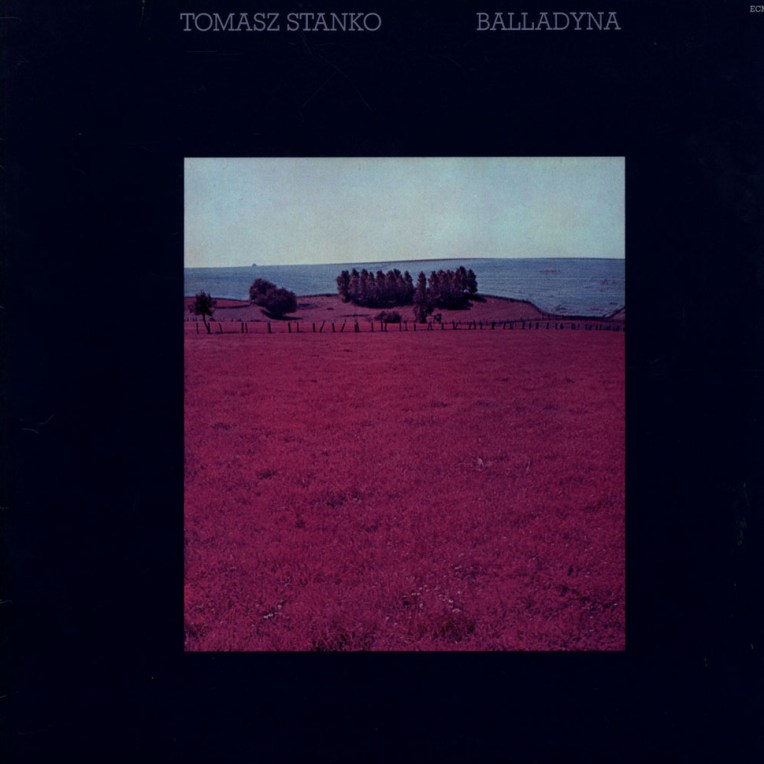
Tomasz Stanko: Balladyna (ECM 1071)

Balladyna

Tomasz Stanko
Balladyna

Tomasz Stanko trumpet
Tomasz Szukalski tenor and soprano saxophones
Dave Holland bass
Edward Vesala drums
Recorded December 1975, Tonstudio Bauer, Ludwigsburg
Engineer: Martin Wieland
Produced by Manfred Eicher

I can only imagine the reactions Tomasz Stanko garnered with Balladyna, his first recording for ECM. The no-holds-barred “First Song” jumps into action with that hard swing that can only come from Dave Holland. Add to this brew the wide-ranging percussion of Edward Vesala and the spicy solos of our frontman and Tomsaz Szukalski, and you have a jambalaya to savor and remember. After such a climactic opener, Stanko could play “Happy Birthday” for all I care. Thankfully (though who knows what this quartet might have done with such ubiquity?) we a get the Ornette Coleman-infused “Tale” that faithfully charts a key transition from raw to cooked jazz. One can feel the rapt attention with which each musician listens to the other.

Original Balladyna
Original cover

This live, interactive energy continues in “Num,” sustained by knitted cymbal work as the two Tomaszes go head to ecstatic head. A killer bass solo makes the cut complete. A lumbering Holland/Stanko interlude opens the door on the title number, anteing up in tutti before spreading its hand into a straight improvisatory flush. Stanko screeches above a pointillist rhythm section, Szukalski stepping into the footprints he leaves behind. A doleful, mocking tone returns in the tongue-in-cheekly titled “Last Song,” nodding like a head succumbing to sleep. The fine horn playing makes this one a standout. The actual last song, “Nenaliina,” is an effusive spring of percussion with a brassy tail.

After all these years, the teeth of Balladyna still make for quite a bite. Anyone wanting to hear the label’s heartbeat in its prime need place an ear to no other chest.

<< Keith Jarrett: Arbour Zena (ECM 1070)
>> Gary Burton Quintet: Dreams So Real (ECM 1072)

Terje Rypdal: After The Rain (ECM 1083)

ECM 1083

Terje Rypdal
After The Rain

Terje Rypdal electric and acoustic guitars, string ensemble, piano, electric piano, soprano saxophone, flute, tubular bells, bells
Inger Lise Rypdal voice
Recorded August, 1976 at Talent Studio, Oslo
Engineer: Jan Erik Konghaug
Produced by Manfred Eicher

With an incendiary initiation on Jan Garbarek’s Afric Pepperbird, and after successfully leading far-reaching experiments like his first self-titled project and the plush Whenever I Seem To Be Far Away, Terje Rypdal opened a new door for ECM when he stepped into the studio to record perhaps his most intimate statement to date. In spite of their brevity, the ten tracks on After The Rain flow in a single 38-minute ode to the almost painful depths of life’s greatest joys. Rypdal overdubs every instrument himself, with his then-wife, vocalist Inger Lise, providing the occasional organic touch. Shielded by a holy trinity of intimacy, sincerity, and fearlessness, Rypdal plunges with open eyes into the darkest eddies of his emotional waters. An electric keyboard provides much of the album’s supportive breadth, as in the heavily flanged gem that is “Air.” Rypdal gives us a rare acoustic taste in “Now And Then,” and in “Wind” an even rarer flute solo. The title track breathes in a cloudless sky, Rypdal’s electric cello-like in its weighted grace. Wind chimes complete the illusion of the cover art’s open plain. A string of vignettes, among them the utterly poignant “Little Bell,” leads us to “Like A Child, Like A Song,” bringing its hands together in humble elegy.

Hanging words such as “atmospheric,” “evocative,” or “lyrical” on this Christmas tree would only topple it in a shower of withered needles. One might say the title refers not to the music itself, which if anything feels drenched, but rather to its lingering effects. I sometimes imagine the synthesizer here as a substitute for an unavailable orchestra, the presence of which would have created an entirely different, Eberhard Weber-like, experience. As it is, its sedation lends a potent archival ascendency and distills the soaring solos within. Rypdal’s keening guitar percolates through the album’s semi-porous cloth like sunlight through the veil over a face of one who has seen the world only through the wavering screen of tears, and never in the clarity of day. It is a style of playing that falls even as it rises. At his profoundest moments, Rypdal inspires a humbling lack of vocabulary with which to describe what one hears. In which case, After the Rain is filled with silence.

<< Arild Andersen: Shimri (ECM 1082)
>> Eberhard Weber: The Following Morning (ECM 1084)

Kenny Wheeler: Gnu High (ECM 1069)

ECM 1069

Kenny Wheeler
Gnu High

Kenny Wheeler fluegelhorn
Keith Jarrett piano
Dave Holland bass
Jack DeJohnette drums
Recorded June 1975, Generation Sound Studios, New York
Engineer: Tony May
Produced by Manfred Eicher

Kenny Wheeler’s ECM debut cut against the grain of his previously avant-garde stylistics. Dispensing here with his trusty trumpet for fluegelhorn, Wheeler carved out a niche that still leaves room for no other. The heartening tone of “Heyoke” animates our very bodies with 22 minutes of bliss. After Wheeler’s prophetic intro, Jarrett is given free reign at the keyboard, uttering ecstatic cries as he threads through Holland’s solo while also buoying Wheeler’s instinctive pickups. “Smatter” injects this trio of compositions with a hefty dose of kinetic energy that is sustained by Wheeler’s fluid brass and the tireless volleys of Jarrett. Even as the latter takes his lone passage, one feels the energy lingering like a potential leap into flight. “Gnu Suite” begins smoothly before locking into a downtempo trajectory. An unrepeatable magic occurs as Holland’s magnetic solo opens into the wider ethereal territory of his bandmates’ consecutive reappearances. And as the voices realign themselves, we feel the release of arrival, of knowing that we’ve come home.

One could hardly smelt a more fortuitous combination of musical alloys, which in spite of (or perhaps because of) their intense respective powers, manage to cohere into a consistently visionary sound. Jarrett only seems to get better in the presence of others (this was to be his last album as sideman), feeding as he does off their energy and vice versa. Wheeler is another musician who easily stands his own ground, yet imbibes only the most saturated elixirs of mindful interaction. And I need hardly extol the wonders of having Holland and DeJohnette covering one’s back. Gnu High stands out also for the fact that many of its solos occur alone, so that we are able to place an ear to the heartbeat of every musician in turn. Their internal compasses share a magnetic north, pointing to a direction in sound that continues to drive the label some three-and-a-half decades later.

<< Terje Rypdal: Odyssey (ECM 1067/68)
>> Keith Jarrett: Arbour Zena (ECM 1070)

Richard Beirach: Eon (ECM 1054)

ECM 1054

Richard Beirach
Eon

Richard Beirach piano
Frank Tusa bass
Jeff Williams drums
Recorded November 1974 at Generation Sound Studios, New York
Engineer: Tony May
Produced by Manfred Eicher

Eon was the first album under the New York-born Richard Beirach’s name, and arguably still his best. Its balance of rhythm, melody, and reflection epitomizes the piano trio format, and nowhere more so than “Nardis” (Davis/Evans), the 14-minute epic that opens this set of six progressively far-reaching tunes. ECM listeners may recognize its lovely vamp as performed by Ralph Towner on his unparalleled Solo Concert of 1979. Here, it glows under a full and vibrant touch. Beirach keeps his fingers busily engaged, while allowing his rhythm section some glorious airtime, winding down like a rock band extending power chords, only here in a more intimate space in which that prolonging becomes not a dramatic farewell but the acceptance of a new beginning. “Places” (Dave Liebman) is an effervescent piano solo with all the romanticism one might expect from such a consummate musician. It also gives us a preview of his solo album Hubris, which would be soon to come. “Seeing You” (Tusa/Beirach) continues in much the same vein, but reintroduces the smooth glide of brushed drums and bass. A subtle rhythmic acuity and free and easy interplay suspend the listener in a swaying hammock of nostalgia. Block chords burrow through the title track with a hint of dissonance before flowering in calmer pastures. Fair, extended performances make this the culmination of the album’s surrounding gestures. Sentiments build into ecstasy before a final sprinkling from piano and cymbals is flicked into darkness like water from glittering fingertips. “Bones” at last puts more sticks to skin as Beirach recedes for tearful bass solo, hitting the occasional accent to keep us chordally ground. “Mitsuku” closes us out in style with a gratifying promise.

An easy album to get lost in, for at its gates one sees no need for maps.

<< Michael Naura: Vanessa (ECM 1053)
>> Gary Burton/Steve Swallow: Hotel Hello (ECM 1055)

Michael Naura: Vanessa (ECM 1053)

ECM 1053

Michael Naura
Vanessa

Michael Naura piano
Wolfgang Schlüter vibraphone, marimba, percussion
Eberhard Weber bass
Joe Nay drums
Klaus Thunemann bassoon
Recorded September 1974 at Windrose Studios, Hamburg
Engineer: Martin Wieland
Produced by Michael Naura

Lithuanian-born Michael Naura is a German pianist, editor, and journalist. Capitalizing on a range of influences, from George Shearing to Horace Silver, his successful self-titled quintet LP of 1963 made him a household name in hard bop. If the benefit concerts arranged after his being diagnosed with polyserositis the following year are any indication, his brief absence caught many in its ripples. Central to Naura’s cadre in his formative years as recording artist was vibraphonist Wolfgang Schlüter, whose presence is keenly felt throughout Vanessa, his first and only album for ECM proper (he did release another, Country Children, as part of the label’s short-lived SP series). Even though last year saw Naura’s efforts recognized with a WDR Jazz Prize lifetime achievement award, this album remains etched in vinyl.

Naura’s set of six opens its eyes in the electric piano and marimba strains of “Salvatore.” The unmistakable electrobass of Eberhard Weber provides just enough ground for Klaus Thunemann’s stellar bassoon improvisations. This gorgeous opener sounds more like John Zorn’s Electric Masada on sleeping pills than anything else. The energy peters out over time and seems to trip on its own intentions, opening up a subtle improvisatory space in the process. From these murky depths arises the track’s thematic beginnings, passionately recapitulated with some superbly realized drumming from Joe Nay, amid a flanged wash of familiarity. “Hills” bustles like lunch hour in Burtonville, though it’s Weber’s nimble fingers that make it the album’s highlight. The next tune lumbers playfully like its titular “Baboon,” all the while emoting an intrinsic self-assurance. Thunemann adopts a vocal quality that is anything but primitive in a three-minute aside that’s sure to bring a smile to your prehensile lips. The title cut reaffirms Schlüter’s reign, billowing through the night like a curtain at an open window, where once wavered the silhouette of a love no longer here, and at which now stands the one left behind. Moments of synchronicity hint at a fleeting union shared under cover of neon and subterranean steam. The serrated contours of “Listen To Me” contrast alluringly with its straight-edged neighbors. Vibes thread the whole, culminating in a sustain-pedaled echo. Ultimately, the bassoon abstractions and soloing of the elegant “Black Pigeon” prove Thunemann to be the star performer of an altogether commendable group of musicians.

A rare video of the group from 1974:

The only downside to the album is its sometimes weak recording mix. One can almost feel the marimba solo in “Salvatore,” for example, being tweaked into the foreground (compare this with the more equitably balanced “Listen To Me”). Should a reissue ever be in the works, as I hope it will be, a remastering will also be in order. Nonetheless, a keeper if you can track down one of these hot pink, fishnet sleeves.

<< Steve Kuhn: Trance (ECM 1052)
>> Richard Beirach: Eon (ECM 1054)