Steve Kuhn: Trance (ECM 1052)

ECM 1052

Steve Kuhn
Trance

Steve Kuhn piano, electric piano
Steve Swallow electric bass
Jack DeJohnette drums
Sue Evans percussion
Recorded November 11/12, 1974 at Generation Sound Studios, New York
Engineer: Tony May
Produced by Manfred Eicher

Perhaps no one on the ECM roster, other than Keith Jarrett and Chick Corea, has as enlightened an understanding of the keyboard as Steve Kuhn. His debut album for the label only grows profounder with age. The elegant title track says it all: a trance of epic proportions etched into a set of almost impossibly modest length. Its prominent bass line lays down an airy ostinato, through which Kuhn digs straight into the album’s molten interior. The tender Fender in “A Change Of Face” lulls us into thinking we’re in for another methodical number, opening instead into some blazing percussive interplay between Steve Swallow and Jack DeJohnette. “Squirt” begins and ends with the same staccato declarations, strung together by a continual stream of sustain-pedaled galaxies and brightened by Sue Evans’s always-colorful accents. “The Sandhouse” rolls along the keyboard, collecting debris as it gathers speed toward the hip electric style of “Something Everywhere.” Kuhn lets Swallow do most of the talking here, taking charge only briefly through a series of quick key changes, all while DeJohnette keeps up his end of the bargain and then some. “Silver” is the only piano solo and shows Kuhn at his lyrical best, which hones the raunchy “The Young Blade” into an even darker edge. Kuhn plays us out with “Life’s Backward Glance,” a curious metaphysical experiment in which he intones: “It was a dark and stormy night at sea. The captain called his men on deck and said, ‘Men, I have a story to tell.’ And this is the story he told. It was a dark and stormy night at sea. The captain called his men on deck and said, ‘Men, I have a story to tell.’ And this is the story he told.” The mise-en-abyme of this tale only serves to analogize the haunting enigma of his craft.

An historic example of Kuhn’s lush, romantic style, Trance speaks of something beyond the realm of even the most intense study; beyond the possibilities of unchecked ability, technical prowess, and sheer finesse. It is a journey that has been faithfully recorded for all its hardships and triumphs alike. Kuhn fills every space with something fresh and palpable, allowing us total freedom in the listening.

<< The Gary Burton Quintet with Eberhard Weber: Ring (ECM 1051)
>> Michael Naura: Vanessa (ECM 1053)

Dave Liebman: Drum Ode (ECM 1046)

ECM 1046 CD

Dave Liebman
Drum Ode

Dave Liebman soprano and tenor saxophones, alto flute
Richard Beirach electric piano
Gene Perla basses
John Abercrombie guitars
Jeff Williams drums
Bob Moses drums
Patato Valdez congas
Steven Satten percussion
Barry Altschul percussion
Badal Roy tablas
Collin Walcott tablas
Ray Armando bongos
Eleana Steinberg vocal
Recorded May 1974, Record Plant, New York
Engineer: Jay Messina
Produced by Manfred Eicher

“Drums and drummers. For me, they’ve been the moving force and inspiration, a reason to live, and celebrate life through playing music. Thanks to the men who play the drums. This music is dedicated to you.”
–Dave Liebman

It was the summer of 1997. I was fresh out of high school and settling into my new life at Goddard College (of Phish fame) in Plainfield, Vermont. The transition was sudden, but I was fortunate enough to have been placed in the music dorm, where dwelled lovers of all things audible. Late one night, during an emotionally exhausting orientation week, I was awoken by a sound coming from downstairs. Rubbing the sleep from my eyes, I descended to the common room to find my dorm mates deep in the throes of an impromptu drum circle. Congas, djembes, pots, tabletops, human bodies: everything was fair game. With nothing but a tin cup and a spoon at my disposal, I joined in with cathartic joy. I don’t think any of us remember how long the session went on after that (I’m not sure we even slept). Sadly, the school itself wasn’t what I had expected. After a long conversation with the group, I decided to return home and incubate for a year. Although this taxing decision eventually put me on a straighter academic path, I do think fondly of the profoundly attuned synergy we of the musical persuasion had forged in those dense seven days surrounded by the region’s denser foliage. Since coming across Dave Liebman’s seminal Drum Ode in reissued form, I have rediscovered something of that physical feeling of surrender one so rarely gets from a laser scanning a concealed silver disc.

Piggybacking on this success of Lookout Farm, Liebman surrounds himself with likeminded company. The rhythmic core of the 1973 joint remains intact, with a minus here and some additions there. The dedicatory introduction of “Goli Dance,” quoted above, leaves no mystery as to the album’s philosophical goals. “Loft Dance” comes closest to reenacting my anecdotal experience, and counts among its actors an animated Richard Beirach on electric piano, a lively John Abercrombie on guitar, and Liebman himself laying down some infectious rhythms of his own. The playing is baked to a crisp, and scathingly uplifting. Gene Perla deploys a heavy anchor, offset by the whimsy of whistles, all of which tethers the soloing to its immediate territory. “Oasis” is the odd one out for its vocal cameo, courtesy of Eleana Steinberg. A beautifully soulful sax solo is rendered all the more so for the songstress’s curious presence, her uneven edges and off-key honesty a sobering foil to the otherwise instrumental sound. Liebman lights a veritable box of matches in “The Call,” a revelatory pyramid with Bob Moses and Jeff Williams at its bottom corners. Its martial snares and echoing sax are the heart and soul of the album, hands down. “Your Lady” (an oft-neglected page from the Coltrane songbook) darkens the mood with a rain-drenched bass and nocturnal soprano sax. “The Iguana’s Ritual” continues in the same vein, save for the noticeable additions of electric guitar and the soothing grace of Collin Walcott’s tabla. Here, atmosphere becomes the primary melody. A trebly bass then ushers in a raunchier solo from Abercrombie and a kinetic finish from Liebman. A fluttering of guitar harmonics begins the end in “Satya Dhwani (True Sound).” Flute and tabla expand the sound further, carrying us out on an enigmatic path to stillness.
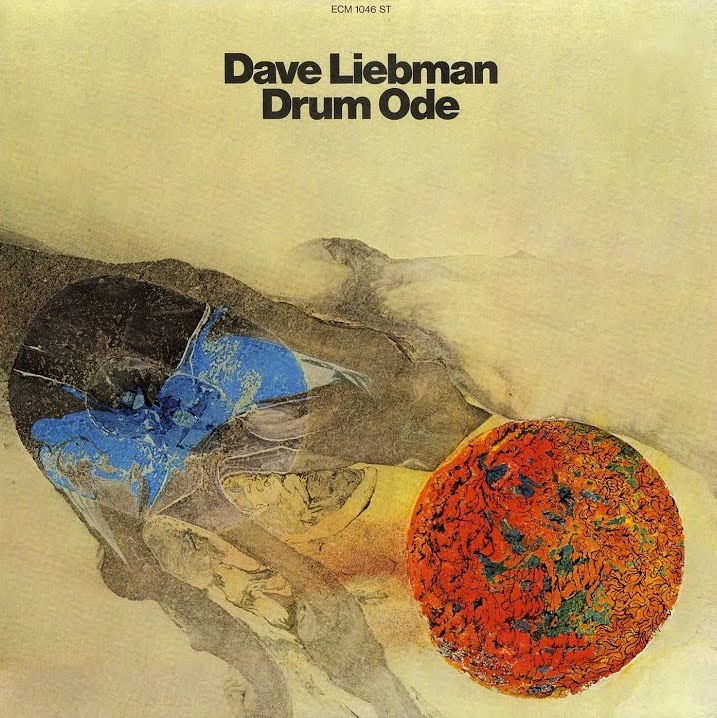
ECM 1046 LP
Original cover

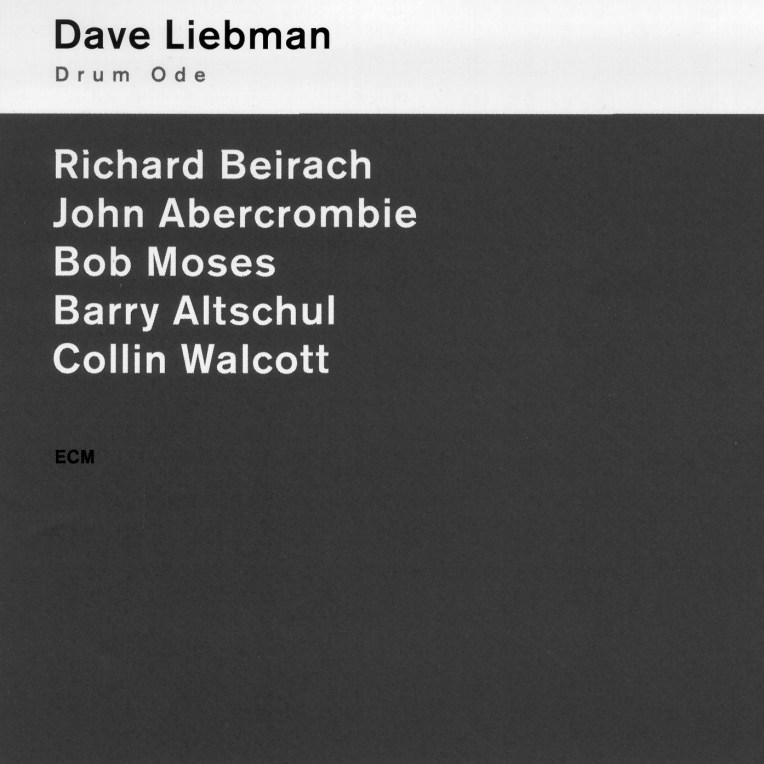
The contrast in covers between the original vinyl and the CD could hardly be greater. The latter’s block list of names, while typographically pleasing, obscures the vibrant colors that said roster produces. One look at the former, however, reveals all in a single perusal: a brilliant sun, cradled in the arid landscape of its own desires, has found a voice where shadows intersect, and waits to share it with any in search of oasis.

<< Terje Rypdal: Whenever I Seem To Be Far Away (ECM 1045)
>> John Abercrombie: Timeless (ECM 1047)

Terje Rypdal: Whenever I Seem To Be Far Away (ECM 1045)

Terje Rypdal
Whenever I Seem To Be Far Away

Terje Rypdal electric guitar, guitar
Sveinung Hovensjø 6- & 4-string basses
Pete Knutsen mellotron, electric piano
Odd Ulleberg French horn
Jon Christensen percussion
Südfunk Symphony Orchestra
Mladen Gutesha conductor
Recorded 1974 in Oslo and Ludwigsburg
Engineers: Jan Erik Kongshaug and Martin Wieland
Produced by Manfred Eicher

This laconic yet lasting statement from Terje Rypdal marked the Norwegian guitarist’s third ECM appearance as composer and leader. Its crucible continues to yield an enticing tincture of prog-rock and classical stylings for the weary musical mind. The reverberant French horn that animates “Silver Bird Is Heading For The Sun” betrays nothing of its cooption by a punchy g/d/b constituent. Floating on a well-aged mellotron, it bows out gracefully as Rypdal rolls in like a fuzzed haze. Sveinung Hovensjø’s robustly amplified bass carries its surrounding weight beautifully, and continues to do so for the album’s duration. Languid relays between guitar and horn coalesce at the piece’s muscular conclusion. In “The Hunt,” we get a heftier dose of percussion, courtesy of the one and only Jon Christensen. Thus begins a brightly syncopated journey filled with plenty of dynamic movement. All of which makes the title piece that much more affecting. A lone cello becomes our only introduction into its slow 18-minute wave of orchestral bliss. Oboe and clarinet usher in the encroaching stillness with subdued attention. Only during a climactic peak does Rypdal make his presence known, as if born from the nexus of violins trailing off into the darkness (a section that perhaps foreshadows Gavin Bryars’s After the Requiem). This switch from external to internal register seems to caress some distant shore, much like the waters of the album’s cover. We wait for dusk, only to realize that the night has never left us.

Whenever I Seem To Be Far Away is an album in infrared, a silent face whose expressions make infinite use of a limited palette. Rypdal is one of the few hybridizers whose creations become something outside of themselves. His soloing wrenches from its present surroundings as many handfuls of melody as it can before fading into the solace implied at the album’s genesis. And I cannot stress enough how fantastic the bass sounds throughout, its steady tone stabilizing like an iron cable. In it, we hear our own gravidity made audible, touching its lips to a temple of sound with a following of one.

<< Julian Priester: Love, Love (ECM 1044)
>> Dave Liebman: Drum Ode (ECM 1046)

Julian Priester: Love, Love (ECM 1044)

Julian Priester
Love, Love

Julian Priester trombones, horns, whistle flute, percussion, synthesizers
Pat Gleeson synthesizers
Hadley Caliman flute, saxophones, clarinet
Bayete Umbra Zindiko pianos, clavinet
Nyimbo Henry Franklin basses
Ndugu Leon Chancler drums
Mguanda David Johnson flute, saxophone
Kamau Eric Gravatt drums, congas
Ron McClure bass
Bill Connors electric guitar
Recorded June 28 & September 12, 1973 at Different Fur Music, San Francisco
Engineers: John Viera and Dane Butcher
Produced by Julian Priester and Pat Gleeson

With a title like Love, Love, Julian Priester’s ECM debut could be nothing but a warm embrace, an abstract melodrama lifted from the pages of an epic story. Hot on the heels of Bennie Maupin’s The Jewel in the Lotus, this album gives us more than we might expect and electrifies like a Mwandishi joint sans Herbie Hancock. Between the groovy “Prologue” and brass-laden “Epilogue” lie three interconnected pieces in two 20-minute suites, each a head-nodding peregrination couched in the vibrant expanse that only an ensemble of this size can maintain. Congregations of horns abound in a funky milieu of drums and bass. The spell is immediate and unrelenting, heightened by an elegant application of synths. The late Hadley Caliman captivates with binding contributions to Priester’s own arsenal of raw materials. Guitarist Bill Connors, who would soon explore his acoustic leanings, shines on the electric, at times grazing the upper atmosphere with almost Steve Mackey-like ebullience. The first set ends as it began, fading into an originary space, leaving wisps of energy in the darkening skies. The second set arises from a tangle of sine waves. Drums stand tall like a stone circle, circumscribing the ritual within with rapt skyward attention. An electric piano courses through every gesture of this activity, petering out into a light flute-driven melody that rests confidently at the lower lip of dissonance. A fiery trombone solo from Priester forges an ecstatic peace. Bayete Umbra Zindiko works wonders at the keys, drawing lines from music to listener with every note struck, even as Connors lays a grungy scream of white noise in the face of possible self-destruction. The kinesis builds like a train until each instrument falls to the wayside, if not crushed under wheel by its passage. From this is pulled a thin urban stream of staccato harmonies that derail into a heap of conclusive breaths.

The music on this much-needed reissue at once sails through the clouds of its infatuations and plunges into the oceanic expanse of its fears. It knows exactly where it’s going, and hopes that you will be waiting on the other side.

<< Bennie Maupin: The Jewel In The Lotus (ECM 1043)
>> Terje Rypdal: Whenever I Seem To Be Far Away (ECM 1045)

Bennie Maupin: The Jewel In The Lotus (ECM 1043)

ECM 1043

Bennie Maupin
The Jewel In The Lotus

Bennie Maupin reeds, voice, glockenspiel
Herbie Hancock piano, electric piano
Buster Williams bass
Frederick Waits drums, marimba
Billy Hart drums
Bill Summers percussion, water-filled garbage can
Charles Sullivan trumpet
Recorded March 1974, Record Plant, New York
Engineer: Dennis Ferrante
Produced by Manfred Eicher
Remastered by Manfred Eicher with Jan Erik Kongshaug in Oslo in February 2007

After 33 long years, this ECM classic finally saw the light of day on CD in 2007. Thankfully, I came upon it since then, thereby saving me from the difficulties of tracking down its highly sought-after vinyl counterpart. On The Jewel In The Lotus, eclectic reedman Bennie Maupin is joined by his Mwandishi crewmates Herbie Hancock, Buster Williams, and Billy Hart, along with Headhunter percussionist Bill Summers and drummer Frederick Waits. Bassist Buster Williams further expands the Mwandishi nexus, while underrated trumpeter Charles Sullivan—who just two months later would step into the studio with Carlos Garnett to record the latter’s Black Love—rounds out the stellar cast. Maupin’s first album in leader’s shoes (his bass clarinet had already made an indelible mark on Miles’s Bitches Brew) is a space of many moods and consistent colors. The tentative bass of “Ensenada” flickers like a candle in a developing photograph. Subtle brass and hints of percussive breakouts adorn a rolling, poetic sound that is as vast as it is immediate. I cannot help but be reminded of the ensemble pieces of Gavin Bryars, such is the cinematic reach of Maupin’s extensive arrangements. Maupin turns to flute in “Mappo,” making way for Hancock’s floating reveries (both of which lift the stunning but ephemeral “Past + Present = Future”). Maupin’s haunting incantations open our ears into “Excursion.” Percussion tinkles like coins tossed into a prayer box. Instruments accustomed to leading instead become fragments in an impartial wash of sound, building to tightly controlled chaos. The title cut is bookended by Hancock’s spacey electric ornaments, complete with a “Fly Like an Eagle” moment or two (sans kitsch), and between which the grainy touch of snare and swaying bass provide a rhythmic hammock in which Maupin’s sax can lounge comfortably. “Winds Of Change” is another brief interlude, not surprisingly for winds only, and cleanses the palate for the final two tunes. The sparse bass solo and unimposing development of “Song For Tracie Dixon Summers” finds much common ground with ECM’s many Nordic projects, whereas “Past Is Past” stumbles into heavily romantic territory, with Hancock providing a fullness of sound that’s hard to resist. The album ends on a somber note, riding a wave back into the darkness from which it sprang.

1043 X
Original cover

Having never heard the original vinyl, I cannot speak for the remastering. All I know is that the reissue sounds terrific. While noticeably top-heavy, ever so slightly undercutting the bass in the process, the trebly focus works well enough in its present form. Rhythm comports itself erratically, as if hesitant to assert its presence out of mere expectation, and in so defying that expectation comes up with far more interesting things to say. The entire album moves in slow motion, as if a more concise musical statement unraveled, allowing musician and listener alike to bask in its finer nuances. Every moment is like an introduction and a finale in one, each speaking to the infinity implied therein.

<< Eberhard Weber: The Colours Of Chloë (ECM 1042)
>> Julian Priester: Love, Love (ECM 1044)

Gary Burton: Seven Songs For Quartet And Chamber Orchestra (ECM 1040)

1040 X

Gary Burton
Seven Songs For Quartet And Chamber Orchestra

Gary Burton vibraharp
Michael Goodrick guitar
Steve Swallow bass
Ted Seibs drums
NDR-Symphony Orchestra
Michael Gibbs conductor
Recorded December 1973 in Hamburg
Engineer: H. Ruete
Produced by Manfred Eicher

If one were to draw a line between the ensemble aesthetics of Eberhard Weber and Keith Jarrett, then one might plot the compositions of orchestral jazz legend Mike Gibbs somewhere along the way. Born in 1937 in what was then Southern Rhodesia, and a graduate of Boston’s Berklee College of Music, Gibbs has laid down a musical path as diverse as his travels. On Seven Songs for Chamber Orchestra, one gains vision of a mind looking not so much to cross over into uncharted waters as to expand the inclusivity of jazz’s already broad topography. At the heart of this project is Gibbs’s most famous student, the inimitable Gary Burton, who presents a lovingly realized program of his mentor’s own design. “Nocturne Vulgaire” sets the album’s plaintive tone with a groundswell of strings, into which Burton drops his mercurial sound. This delicate blend of mallets and bows continues unabated in “Arise, Her Eyes” (Steve Swallow), the only non-Gibbs number on the album. Mick Goodrick’s steady strums and Ted Seibs’s cymbal-heavy drumming make the most of the tender “Throb,” as Burton’s vibes glow like phosphorescent blood in the piece’s ambulatory body. “By Way Of A Preface” spins the album’s densest song. Its abstract beginnings carry over into a gorgeously perpetual solo from Goodrick, while Swallow makes his memorable mark in the pensive confines of “Phases.” The vast open fields that underlie “The Rain Before It Falls” give way to the chromatic wonders of “Three,” in which Burton and Goodrick’s relays emerge with all the inevitability of a final word.

This is a dream album for admirers of both Burton and Weber, combining as it does the former’s dulcet precision and the latter’s lush arrangements, and is therefore well worth tracking down (a CD-reissue is long overdue). Burton’s ability to carry a tune to fruition is only enhanced by Gibbs’s affected settings, which hardly make a dent in their emotional reserves. If jazz is about discovering the integrity of every lifted voice, then certainly Seven Songs rises from its murky waters with just a few of many unheard treasures.

<< Dave Liebman: Lookout Farm (ECM 1039)
>> Jan Garbarek: Witchi-Tai-To (ECM 1041)

Dave Liebman: Lookout Farm (ECM 1039)

ECM 1039

Dave Liebman
Lookout Farm

Dave Liebman soprano, tenor saxes, alto c flute
Richard Beirach electric, acoustic piano
Frank Tusa electric, acoustic bass
Jeff Williams drums
John Abercrombie acoustic, electric guitar
Armen Halburian percussion
Don Alias congas, bongos
Badal Roy tablas
Steve Sattan tamburine, cowbell
Eleana Sternberg voice
Recorded October 10/11, 1973 at Generation Sound Studios
Engineer: Tony May
Produced by Manfred Eicher

Saxophonist, flutist, and all-around wunderkind Dave Liebman—who only last year received an NEA Jazz Masters lifetime achievement award for his tireless efforts in music and instruction—made his ECM debut with Lookout Farm, his first of only two albums for producer Manfred Eicher as leader (the other being the enthralling Drum Ode; he would also guest on Steve Swallow’s Home some six years later) and a trendsetter for fledgling improvisers seeking their voices in the seventies and beyond. Here, he is joined by a telepathic ensemble that includes regulars Richie Beirach and John Abercrombie, in addition to a pointed percussion section. Abercrombie’s quasi-flamenco arpeggios open the evocative “Pablo’s Story.” Liebman leads in on flute, establishing an intimate flywheel from which is spun a most democratic mosaic of intersections, solos, and rhythmic ecstasy. Liebman (switching to soprano sax) and Beirach provide the skeleton of the track’s flexible physiology. An intuitive pattern of tension and release ensues, thus maintaining a solid unity throughout. Frank Tusa’s understated yet richly emotive bass lines bring out a vital inner depth, and one can hardly remain static during the hand-drummed interlude. “Sam’s Float” introduces a more hardened sound, cut to the core by Leibman’s alto squeals and Abercrombie’s biting electricity. The 24-minute “M.D./Lookout Farm” closes this humble set of three. The first half turns down the lights with its elegiac piano and tender reeds, while the title half transports us with Jeff Williams’s downright flammable drumming.

A spectacular sense of curiosity would seem to be de rigueur in Liebman territory, its infectiousness inescapable. This is a milestone album, not only for the liberating musicianship and timeless sounds, but also for its production value. With Lookout Farm, Eicher channeled the reverberant specter that has haunted the label’s sound ever since, and with it an entirely new way of listening emerged.

A pilgrimage for the ECM enthusiast.

<< Art Lande/Jan Garbarek: Red Lanta (ECM 1038)
>> Gary Burton: Seven Songs For Quartet And Chamber Orchestra (ECM 1040)

Terje Rypdal: What Comes After (ECM 1031)

ECM 1031

Terje Rypdal
What Comes After

Terje Rypdal guitars, flute
Barre Phillips basses
Jon Christensen percussion, organ
Erik Niord Larsen oboe, English horn
Sveinung Hovensjø electric bass
Recorded August 7/8, 1973 at Arne Bendiksen Studio, Oslo
Engineer: Jan Erik Kongshaug
Produced by Manfred Eicher

Terje Rypdal’s What Comes After, his second for ECM as frontman, is more about what came before. An exquisite diversion from the dustier billows of his later work, it charts much of the same territory as its self-titled predecessor, only this time with a tighter supporting roster. Sveinung Hovensjø lays down the dominant bass line that is “Bend It,” an atmospheric 10-minute opener that lulls us into its nocturnal crawl. The bowed bass of Barre Phillips and Jon Christensen’s subtle drum work adorn long-form improvisations from Rypdal as he wrenches out an ever-changing dialogue from the repetitive core. “Yearning” reprises the sinewy oboe (played here by Erik Niord Larsen) of Rypdal’s self-titled effort and features him in a rare acoustic turn. The jangly percussion makes for a mystical, if all too brief, experience. The see-sawing melodies and tender bass solo of “Icing” extend this feeling of isolation and memory before the delicate rimshot of the title track slinks metronomically through Rypdal’s mounting ruminations. “Séjours” marks the oboe’s standout return in one of the album’s most thoroughly realized tracks, while “Back Of J.” leaves us with a sparse final word, Rypdal unplugged and unhurried.

Albums like this allow us to appreciate the ways in which artists grow. ECM’s consummate electric guitarist has worn many hats, and perhaps none so many as in his formative years. Here, he feeds off his surroundings, even as he strays in equally fruitful directions, always harboring an innate awareness of where he is grounded. A wonderful place to start for initiates and strangers alike.

<< Gary Burton: The New Quartet (ECM 1030)
>> Ralph Towner: Diary (ECM 1032)

Jan Garbarek: Triptykon (ECM 1029)

ECM 1029

Jan Garbrek
Triptykon

Jan Garbarek soprano, tenor and bass saxophones, flute
Arild Andersen bass
Edward Vesala percussion
Recorded November 8, 1972 at Arne Bendiksen Studio, Oslo
Engineer: Jan Erik Kongshaug
Produced by Manfred Eicher

Jan Garbarek’s third album for ECM is a free, though by no means easy, trek through indeterminate territories. “Rim” breaks into light with the mournful saxophonic cries that thread the entire set. Arild Andersen dots Garbarek’s auditory cloth with almost vocal ink stains. We find Garbarek in a uniquely agitated mode, showing both great restraint and willful shifting in his performance. This is an arresting track, as sublimely depressing as it is soulful. The title denotes “frost” in Norwegian, and describes Edward Vesala’s icy percussion to a T. In “Selje,” Garbarek opts for a wooden flute against a thawed backdrop of bass and wind chime-like glockenspiel: a mystical aside to an otherwise forward projection.

“J.E.V.” breaks from the album’s expansive palette with a more flatly recorded sax intro. The appearance of bass and drums merely underlines the music’s hesitancy, at once assured and unaware of its future paths. “Sang” (Chant) is another subdued interlude, featuring a bass sax caught in a silken web of percussion and bass. The title track unravels like a herding song picked apart piece by piece, its remnants scattered along the base of a low mountain to the tune of an intriguing bass solo. “Etu Hei!” screeches and pounds its way into being before the Norwegian folk song “Bruremarsj” is rendered in a tense bondage of sax and bowed bass, closing with a flutter of wing beats in the final drum break.

In spite of its many abstractions, Triptykon is rife with melody and movement. It’s almost as if a distant relative were singing traditional tunes that everyone else in the family has forgotten. Though drunk with nostalgia and slurred speech, his voice is so genuine that one can hardly fault him for straying a bit off the beaten path. With repeated listenings, one begins to distinguish such thematic material from its improvised surroundings, thereby rendering any challenges this album sets before us much deeper in their returns.

<< Paul Motian: Conception Vessel (ECM 1028)
>> Gary Burton: The New Quartet (ECM 1030)