The Gurdjieff Ensemble: Komitas (ECM 2451)

Komitas

The Gurdjieff Ensemble
Komitas

The Gurdjieff Ensemble
Emmanuel Hovhannisyan duduk, pku, zurna
Armen Ayvazyan kamancha
Avag Margaryan pogh, zurna
Aram Nikoghosyan oud
Davit Avagyan tar
Mesrop Khalatyan dap, dhol
Vladimir Papikyan santur, voice
Meri Vardanyan kanon
Norayr Gapoyan duduk, bass duduk
Eduard Harutyunyan tmbuk, cymbal, kshots, burvar, bell
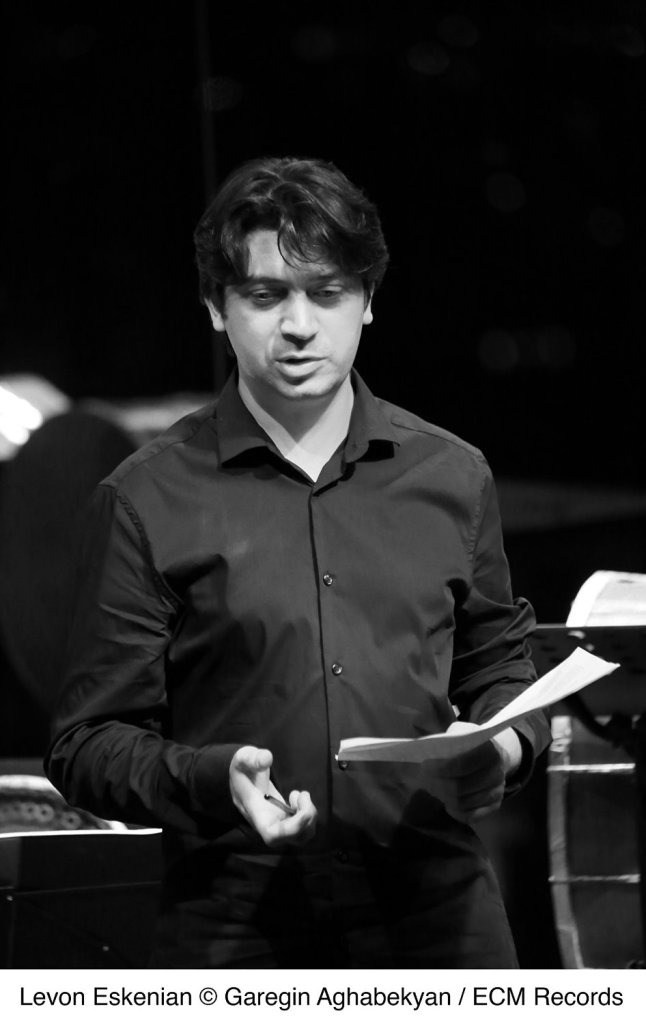
Levon Eskenian director
Recorded February 2015, Auditorio Stelio Molo RSI, Lugano
Engineer: Markus Heiland
Produced by Manfred Eicher
U.S. release date: October 2, 2015

Since forming the Gurdjieff Folk Instruments Ensemble in 2008, musician and director Levon Eskenian has moved beyond delineations of the group’s namesake, even while staying truer than ever to the roots such an association implies. His ECM debut, Music of Georges I. Gurdjieff, drew from a well that had already been dug into the label’s landscape by Keith Jarrett and Vassilis Tsabropoulos/Anja Lechner, and deepened by Lechner’s subsequent duo with François Couturier. It was only natural, then, that Eskenian should turn his attention to that spiritual progenitor of Armenian classical music: Soghomon Soghomonian (1869-1935), a.k.a. Komitas.

Having appeared on Kim Kashkashian’s Hayren and Savina Yannatou’s Songs of Thessaloniki, among others, the music of Komitas has been something of a leitmotif in the ECM catalog, where its expressions of folk sentiment feel right at home, and nowhere so fully as on this first disc dedicated to him alone. As with Gurdjieff, Eskenian and his ensemble have gone as far back to into this music’s past as is conceivable, arranging it for the very instruments whose sounds first inspired Komitas to put pen to paper. Eskenian has, in essence, “re-composed” them as physical environments around on which listeners can walk to absorb every detail.

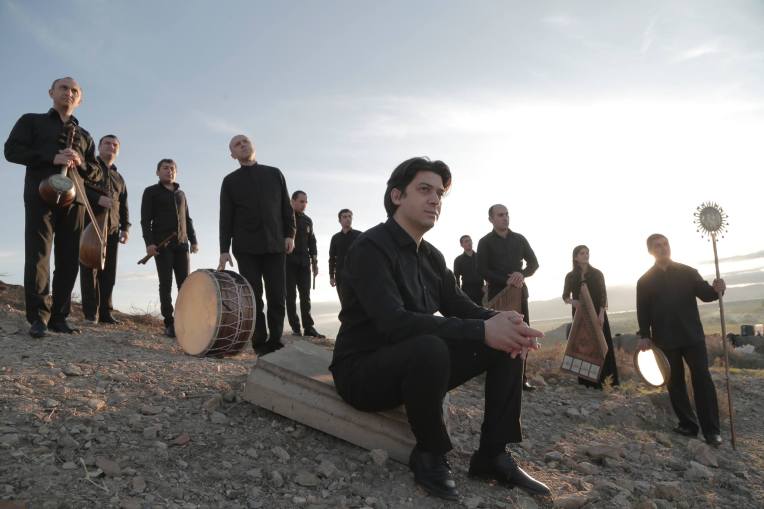
Gurdjieff Ensemble
(Photo credit: Andranik Sahakyan)

Eskenian, for his part, provides—in both the music and liner notes—a loving account of Komitas, whose approach to diverse interests imbued his writing with metaphysical levels of beauty. Even when composing for western instruments, he would often notate with traditional instruments in mind, and so Eskenian’s instinct is in keeping with the origin story at hand. Komitas and Gurdjieff share one degree of separation by way of the latter’s student, Thomas de Hartmann, but even more in terms of philosophy, lifestyle, and artistic engagement. I asked Eskenian whether these connections had anything to do with how he put this album together.

“Gurdjieff sent de Hartmann to Yerevan, where he immersed himself in, held concerts of, and gave lectures on the music of Komitas. Later on, de Hartmann would found the Komitas Society with the goal of collecting and printing the composer’s music. There are some pieces in which Gurdjieff and Komitas used the same folk tunes. Both of them were truth-seekers. Like Gurdjieff, Komitas would also talk about vibrations. He consulted ancient manuscripts and believed in the healing powers of music, the effects of modes and how each string of the knar [a traditional harp], for example, had on a different part of the body. He taught movements rooted in ancient ritual dances of pre-Christian temples, and often referred to himself as a teacher of dancing. In all cases, I consider the music of Komitas to be an essential key for a better understanding of the music of Gurdjieff and of the many other classical composers who have based their compositions on folk motifs.”

Eskenian’s gentle and respectful assertions of the significance of this music further explain why the album seemed to take form of its own volition. Eskenian elaborates on the genesis of the project, which began with a suggestion on the part of producer Manfred Eicher to center a follow-up to his Gurdjieff debut around Armenian folk and sacred music:

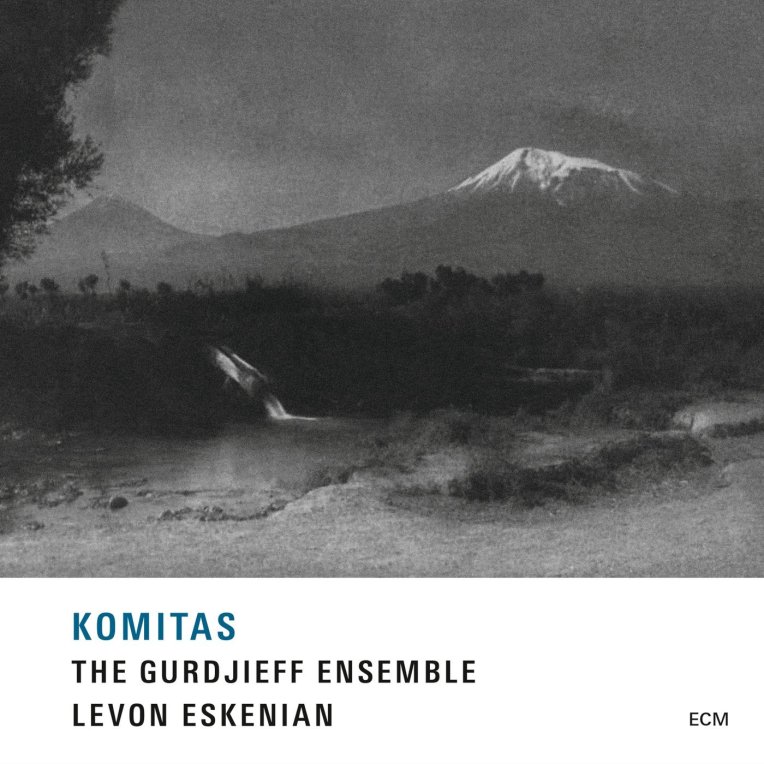
“For many years I’d thought about the Komitas dances, to have them performed on traditional Armenian and ancient instruments. I knew the pieces long before my encounter with the music of Gurdjieff and they had always served as a reference for me, but arranging the piano scores for authentic traditional Armenian instruments was in fact a bold labor which required additional research along anthropological, historical, and ethnomusicological lines in order to have a certain level of objectivity that wouldn’t ruin his work. Manfred left me free to decide the program. During the recording session he was actively involved in creating a comfortable atmosphere in which the musicians might better hear their inner sound, and with the assistance of engineer Markus Heiland recorded these instruments in their full timbrous colors. During the mixing session, Manfred paid strict attention to the sequence of pieces, and to the ‘silent’ pauses between them. The album cover was also of his choosing, a beautiful photo and one of the first of biblical Ararat Mountain ever taken at the beginning of the 20th century.”

In his own briefer liner note for the album, Armenian composer Tigran Mansurian—onetime director of the Komitas State Conservatory of Yerevan—expands on the cultural iconicity of Komitas, whose piano pieces he goes so far as to describe as “documentary works,” preserving as they do the spirit of his Armenian heritage. The “Yot Par” (Seven dances) represent one such set of piano pieces, recalibrated here to suit the spectral qualities of Eskenian’s peerless ensemble. These dances are centered around the capital of Yerevan, the contentious city of Shushi, the village of Karin, and the Turkish provincial capital of Mush. Whether the binary star of bowed kamancha and hammered santur in “Manushaki,” the duduk and tar in “Yerangui,” or the pogh flute and tmbuk drum duet that is “Het u Araj,” each dance flows in measured contrast to surrounding tunes and highlights a different instrumental color. That same pogh flute, in tandem with oud, embodies perhaps the deepest entanglement of ancient impulse and contemporary realization in “Karno Shoror,” which is about as close to experiencing history as this music gets. Even “Masho Shoror,” another piano work newly fashioned, is rife with textures that feel much older than we can articulate by any other means. The present rendition cross-hatches the double-reed zurna with the santur’s metallic lines. At just under 12 minutes, it is an album in and of itself, gathering as it does many influences in a single hearth of understanding.

“I often think about this piece,” says Eskenian, “which was a series of mystical pagan dances accompanying pilgrimage to St. Karapet Monastery in Mush. The monastery was one of the main pilgrimage sites for Armenians and served as their temple even before Christianity. After the Armenian genocide inflicted by the Ottoman empire, when most Armenians were killed, this marvelous monastery was destroyed much like ancient monuments in the Middle East have been in recent years. It was a great loss, to be sure, but I reflect on the fact that we have these sounds and traditions encoded into the piano music, now brought back to their inspirational sources. Through this process, we are reconstructing something of what has been lost. I am grateful to be able to share this with the world: a piece of the past reaching out to us from unrecoverable times.”

Eskenian

Many of the program’s standalone songs are likewise rooted in nature, by which traces of what came before our current generation continue to thrive, changed but also essential. In the plough songs of the northern Lori region, such as “Lorva Gutanerg,” we almost don’t need to know that Komitas gathered such melodies himself and separated them like chaff from the wheat so that posterity might be nourished by their bread. The medieval influences are clearest in these examples, as in the fortune-telling motivations of “Mani Asem, Tsaghik Asem” (Praises to the flower) and, more so, the strains of “Hov Arek” (Dear mountains, send me a breeze), a high point in the album’s topography that accentuates the talents of santur player Vladimir Papikyan, whose virtuosity unites sentiment and form. Moving through lullabies and other pieces for children, as well as love songs, the ensemble touches on Komitas’s religious affinities in songs like “Havun” (The fowl of the air), in which two duduks express Christ’s Resurrection in metaphor. On the subject of ascendant beings, the pogh solo “Havik” (A radiant bird) evokes its eponym with purposeful flight. Breathy and full of charcoal in its palette, it recalls the sensory world of a Japanese brush painting, trees barely visible as splashes of ink in the background.

Despite any mystical characterizations one might draw around Komitas, it’s clear from this recording that the heart of his music runs on a fundamental energy. It’s the same energy that allows us to listen and to love, to seek out those things which connect us beyond concerns of the flesh. So much so, that no matter what form it takes, the music of Komitas occupies an immediately relatable realm of understanding. In this vein, listeners can look forward to an album of his complete piano music as performed by Lusine Grigoryan, who has worked diligently to reproduce every effect as indicated in the original scores. Where Eskenian has taken those cues to heart by transferring them the very instruments that inspired them, Grigoryan has accepted the challenge of expanding the piano’s vocabulary to suit the ambitious needs of these timeless melodies. The reconstruction has just begun.

(Click here to read the rest of my interview with Levon Eskenian for RootsWorld online magazine, alongside another review of the album by Erik Keilholtz.)

Anat Fort Trio w/Gianluigi Trovesi: Birdwatching (ECM 2382)

Birdwatching

Anat Fort Trio
Gianluigi Trovesi
Birdwatching

Anat Fort piano
Gary Wang bass
Roland Schneider drums
Gianluigi Trovesi alto clarinet
Recorded November 2013, Auditorio Stelio Molo RSI, Lugano
Engineer: Stefano Amerio
Produced by Manfred Eicher
U.S. release date: April 8, 2016

On Birdwatching, Anat Fort’s third album for ECM, the Israeli pianist and composer proves once again that music is a journey without repetition. I trace this axiom back to her label debut, 2007’s A Long Story, from which “Something ’Bout Camels” carried over into the 2010 follow-up, And If. This time around, another tune from that same record—“Not The Perfect Storm”—makes a reappearance, now re-cloaked by the melodic overlay of Italian reedman Gianluigi Trovesi, who joins her trio with bassist Gary Wang and drummer Roland Schneider for her farthest-reaching record to date. The rumbling pianism of that latter track speaks at once to Fort’s illustrative prowess and willingness to sidestep its clichés. Indeed, beyond the thunder implied in the lower register of her keyboard, the broad wingspan of Trovesi’s alto clarinet speaks of clearer skies. The forces at work are greater than the sum of their parts, which over the course of six and a half minutes emit more light than they absorb.

Moved by this collaboration, I opened a recent interview with Fort by asking about Trovesi’s involvement—a partnership perhaps as inevitable as it was unexpected.

“Unlike with Paul Motian, I was never intimidated by working with Gianluigi. I really loved his work, which I’d known through ECM, and fate brought us together on stage for a jazz festival in Novara, Italy in 2013. A few months later, he joined my trio in Israel. He’s such a gentle and beautiful human being, so there was never any conflict. The only thing that gets in the way is the language barrier, but at any rate we communicate through the music.”

Case in point: “Earth Talks,” which finds them conversing as a duo. Like Fort herself, Trovesi seems to attract entire planetary systems into orbit than be gravitationally pulled into others. His chromatic inflections are the blood flow of her ebony and ivory veins, which pulse with solitude even as they drink in joyful praises. Trovesi walks over, never through, Fort’s articulate themes, so as not to disturb their archaeological integrity. Even when he joins the full trio, as in “Jumpin’ In” or “Murmuration,” his sinewy topography feels like grass in love with the soil. In other words: an affirmation of roots.

Neither does the trio engage with blatant exhibitionism, but finds unity—and utility—in the negative spaces that frame each intimate spectacle. Such alignment to the inner workings of faith gives the quartet all the oil it needs to burn through the collectively improvised “Inner Voices.” Though delicate and exploratory, it never breaks its stare. Such disparate elements reach deepest convergence in two variations of “Song Of The Phoenix,” in which the trio clears a path for Trovesi’s transformation from roaming to mourning. His rougher bending of pitch enhances the emotional gravity at hand. Wang and Schneider reveal themselves to be so much more than a rhythm section, but a listening organ attuned to every gradation. Which is not to say their individual talents are not forthcoming. In the trio-only “It’s Your Song,” Schneider’s drumming is remarkably fluent, moving with the insouciance of an Olympic ice-skater, while Wang’s kinetic solo lends the scene some much-needed heat.

It’s impossible for me to experience such gestures without reading biographical impulses behind each tune. The beauty of this record, as with all of them, is that Fort allows more than enough space for individual interpretation:

“I think that’s how I usually treat my music, or how my music treats me, I should say. It’s a very personal thing. I could even call it a private universe, which of course I’m trying to share by playing and putting out there. This recording is different for having so many short pieces, which wasn’t something we planned to do. But as [producer] Manfred [Eicher] and I started mixing it together, we did more editing than I’ve ever done. It clearly needed to be a story of vignettes. That was a surprise for me, and something that the music initiated, and which we answered collaboratively. As I say in the promo video, the music will convey its own story if you let it.”

Listening to what the music was saying led to Fort to add two improvised piano solos: “First Rays” and “Sun.” Added at the last minute, these became the first and last tracks of the final mix. Within this frame, the album is better able to balance color and monochrome.

On that note of production, Birdwatching marks the first time Fort has worked with Stefano Amerio at the Auditorio Stelio Molo RSI studio in Lugano, Switzerland, thus completing her unintended tour of ECM’s heavyweight engineers, rounded out by Jan Erik Kongshaug in Oslo (And If) and James Farber in New York (A Long Story).

“Each of these experiences has been great,” Fort admits, “and Stefano has a great ear. It was very special to record at the RSI studio, because you record live, setting up on a stage in a very small auditorium without headphones or dividers. It’s really unique to do it that way, and he knows how to record so that it feels live but also clean enough to be crafted.”

One can hear this especially in “Meditation For A New Year,” which boasts some of Fort’s most soulful playing on record, but keeps its expansiveness within reason in search of a major chord. Like “Milarepa,” of which only the first of three parts appears on this album, it indicates a new phase of self-expression, a turning of the ear toward the self to know what may become of love.

Tigran Hamasyan: Luys i Luso (ECM 2447)

Luys i Luso

Tigran Hamasyan
Luys i Luso

Tigran Hamasyan piano, prepared piano
Yerevan State Chamber Choir
Harutyun Topikyan conductor
Recorded October 2014 at Argo Recording Studio, Yerevan
Engineer: Markus Heiland
Assistant engineer: Armen Paremuzyan
Mixed March 2015 at RSI Studio Lugano by Markus Heiland, Manfred Eicher, and Tigran Hamasyan
Produced by Manfred Eicher
U.S. release date: October 2, 2015

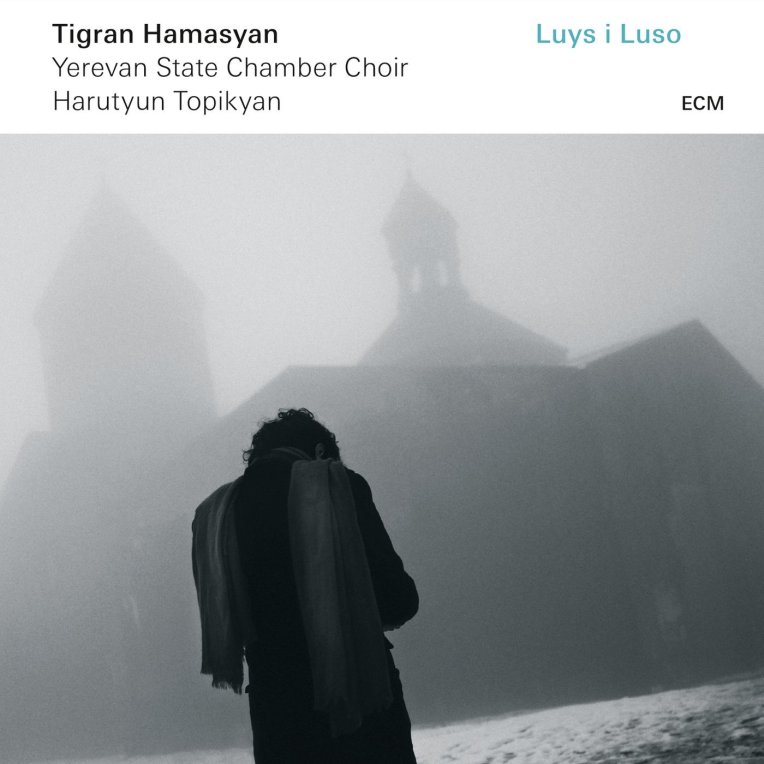
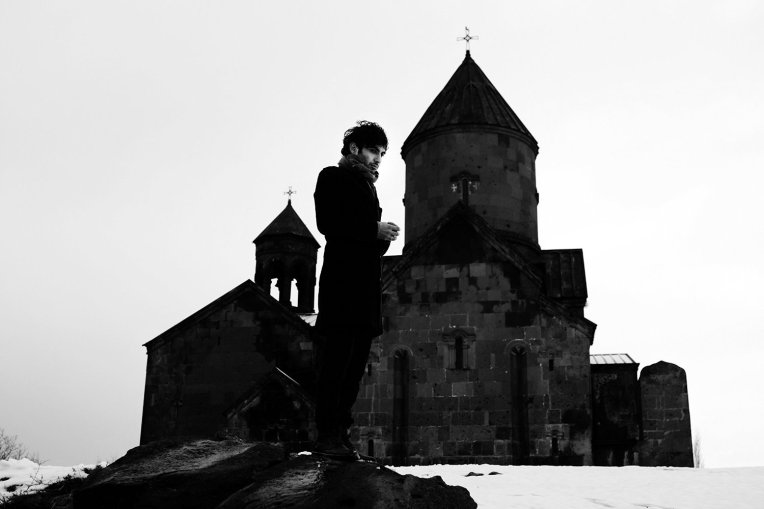
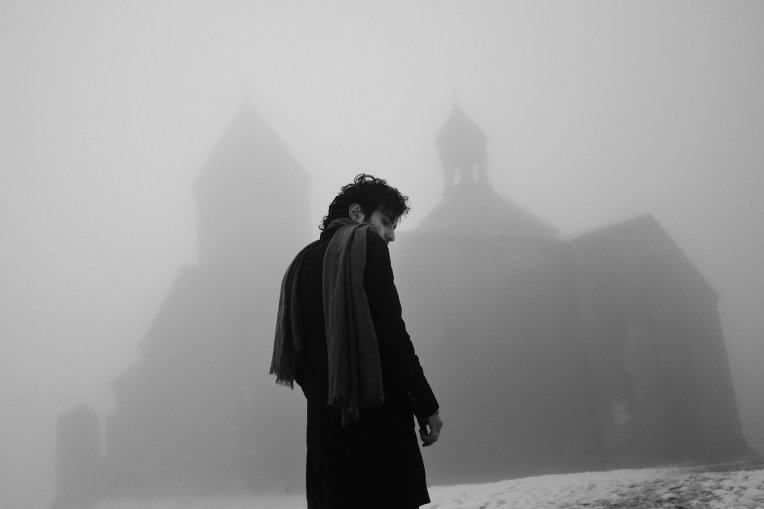
Luys i Luso realizes the dream of Tigran Hamasyan to build an entire album around the sacred music of Armenia. Now based in Los Angeles, the prodigious jazz pianist has held on to the melodies of his homeland with solemnity and patience for this project. The antiquity of much of the repertoire—hymns, sharakans (chants), and cantos, some of which date back to the fifth century—leaves room for improvisation, which evidence suggests has been a part of its living tradition for centuries. Hamasyan takes to this freedom like a wing to wind, using his polyphonic arrangements of monophonic melodies as runways for spontaneous flights. He has intentionally left the piano parts unwritten, so that by following only skeletal structures he is free to move about the score.

Hamasyan 1
(Photo credit: Vahan Stepanyan)

The album’s title (Light from Light) is primarily descriptive, revealing the process of pulling out an interpretive glow from contemporary compositions, and from the older ones embers of bygone devotions. It also signals themes of variation in a program built around multiple incarnations of the core melodies. The preludinal “Ov Zarmanali” (Oh this Amazing and Great Mystery) by 12th-century catholicos and composer Grigor G. Pahlavuni, for example, illuminates the listener’s ears first through a solo piano treatment, like snow falling from the branches of a godly tree, and later in the album in a veritable river of voices. The Yerevan State Chamber Choir’s balance of raw technique and rhythmic precision indicates a vulnerability diminished by numbers. Hamasyan’s pianism takes on a regular role here, sounding its arpeggios with veracity. The modal changes speak to something deeper than beauty, to the heart within it darkened by neglect. Midway through the singers fade and leave the piano to move jazzily through their afterimages, only to return like objects of worship polished smooth over centuries of devotion. “Sirt im Sasani” (My Heart is Trembling!), a canticle by 13th-century canonical writer Mkhitar Ayrivanetsi (c. 1230-1297) also reveals its mercies through two iterations, the second of which is a piano variation of Trinitarian dimension, while the first professes faith through the distant mechanisms of exile. Bass soloist Seiran Avagyan renders a flower of textual identity shedding petals in favor of bodiless light.

Hamasyan 2
(Photo credit: Vahan Stepanyan)

No such project would be complete without Komitas (1869-1935), because of whose efforts much of Armenia’s sacred music has been preserved. His “Hayrapetakan Maghterg” (Patriarchal Ode), a hymnal request to be heard and absolved, takes three forms. In two Hamasyan-only versions, the pianist attends to the words between notes. He is keenly aware of these spaces and gathers strength through their collective presence. Like the pages of a thumb-worn Bible, its gilding has faded through absorption, finding in its choral life a treasure of grace and, in soprano soloist Jenni Nazaryan, a dove clutching sprigs of gratitude. From Komitas’s Armenian Holy Mass we encounter two sections, “Surb Astvats” (Holy God) and “Orhnyal e Astvats” (Blessed is God), each based on melodies from the seventh century. Where the former is driven by forward-thinking improvisation, the latter looks backward by sampling tenor Armenak Shahmuradyan. This 1912 archival recording, made in Paris in the presence of Komitas, defines the palette from which the choir draws its colors over a century later.

Medieval theologian and hymnologist Mesrop Mashtots (c. 362-440) is represented in two chants and a canticle for Fasting Days. The first of these, “Ankanim araji Qo” (I Kneel Before You), is where the choir makes its album entrance—or should I say “in-trance,” for such is its state of being. Therein, singers descend to the bottoms of their linguistic wells, making dervish circles until the shadows are cleansed. Each is a powerful statement of redemption, of the will to drown in transgression so that one might be reborn into sobriety.

For the singly rendered, Hamasyan offers two cantos of the Resurrection, both chanted during Divine Liturgy. “Nor Tsaghik” (New Flower) by Nerses Shnorhali (c. 1102-1173) strikes difference through its use of prepared piano, at which Hamasyan uncovers hidden voices behind the voices, while “Havoun Havoun” (The Bird, the Bird was Awake) by Grigor Narekatsi (c. 951-1003) pairs soprano and piano in the name of faith. Nazaryan’s lone singing barely grazes the belly of the nearest cloud until the nourishment of Heaven comes raining forth, leaving us to drink in what we can.

Those who would write off this recording on the sole basis of its description—Do we really, they might say, need another jazz musician improvising over a vocal ensemble?—may be pleasantly surprised at the level of integration achieved on Luys i Luso. Like Misha Alperin, Hamasyan recognizes the dedication of knowledge required to mesh with equally disciplined singers. Whether broken or healed, each of his selections embodies the fragmentary nature of things as a path to wholeness. The sheer love pouring from that wholeness is proof of concept.

An unexpected masterpiece, and one of ECM’s most astonishing in years.

(To hear samples of Luys i Luso, please click here. Further information about the project is available here.)

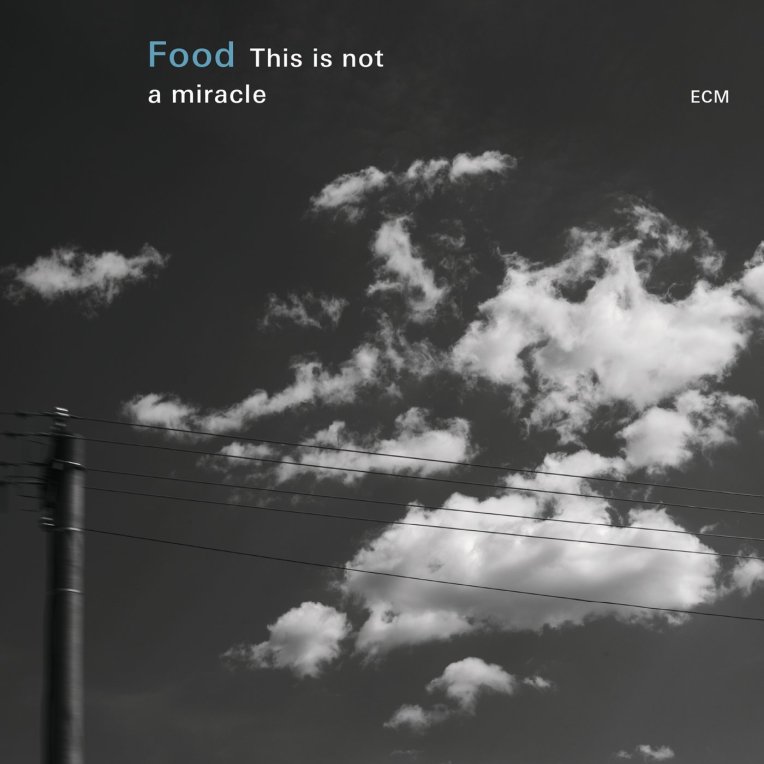
Food: This is not a miracle (ECM 2417)

This is not a miracle

Food
This is not a miracle

Thomas Strønen drums, electronics, percussion, moog, fender rhodes
Iain Ballamy saxophones, electronics
with
Christian Fennesz guitar, electronics
Recorded June 2013 at Holand Sound, Oslo
Recording producer: Thomas Striven
Engineer: Ulf Holland
Mixed February 2015 at Holand Sound, Oslo by Ulf Holand, Manfred Eicher, and Thomas Striven
Mastered at MSM Studio, Munich by Christoph Stickel and Manfred Eicher
An ECM Production
U.S. release date: November 20, 2015

For its third ECM course, the duo of Thomas Strønen (drums, electronics, percussion, Moog, Fender Rhodes) and Iaian Ballamy (saxophones, electronics), known together as Food, serves up its most introspective chunk of nourishment yet. With assistance from Christian Fennesz (guitar, electronics), who last guested on Mercurial Balm, the project burrows even deeper into its lyrical universe with atmospheric phasers set to stun.

Under the creative disclosure of This is not a miracle, Strønen has taken to crafting every piece using elements culled from hours of studio improvisation with the musicians and producer Ulf Holand, whose hand was so gorgeously evident in Nils Petter Molvær’s Khmer. Strønen admits to starting more often with a structural rather than melodic idea before cutting the music, in his words, “to the bone.” Cutting is precisely the word, as linear utterances became spliced, looped, and restructured into fully fledged, standalone grooves.

It would be tempting, once the distorted guitar and muffled bass beats of “First Sorrow” pulse their way into the mind’s ear, to place the origins of this music at a far remove from Earth, when really it is torn from the book of an internal cosmos. Brushed with fire and written in ashes, its pages glow with the allure of a sere orthography in “Where Dry Desert Ends,” making even this unforgiving territory feel like cashmere on winter skin. Drums add their skipping traction to the dunes, while synthesizer and saxophone cut the sky with their cloudless scissors. A marked shift in viewpoint flushes heat as if through an emotional exhaust system of continental proportions, turning the emptiness of sunset inside out as a gift for the coming dawn.

Much of what awakens thereafter draws its nutrients from somewhere between this planet’s surface and its core, a comfort zone of difference and sculpted time. Whether whirling in the title track’s dervish circles or overlapping reeds in “Death Of Niger,” crunching through the detritus of “Sinking Gardens Of Babylon” or drifting over “The Concept Of Density,” just high enough to traverse the highest mountains yet low enough to ingest the detail of every village below, genetics bleed through every joining of head and tail with the power of unifying color.

Whatever the means at hand, lineage remains at the forefront of Strønen’s sound-world. Khmer kinship is strongest in “Exposed To Frost,” of which Fennesz’s biwa-like twangs imply another world within, while the drumming of “Earthly Carriage” and “Without The Laws” has the tuneful attention of label mate Manu Katché. His simple guidance is as shifting as the sand of an hourglass, pulling notes by gravity into mountainous ends. Similarly, “The Grain Mill” seeks the chicken in the egg. This glitch-laden lullaby enables a searing emergence from Fennesz, who tears through the veil of dreams into waking reality, where coronas whip themselves in place of lovers drowning in self-regard.

Whatever poetry This is not a miracle might inspire, it is, as the title implies, a practically molded object. The band has since taken these constructions as cohesive compositions, performing them as such in live concerts. But their democratic foundation remains audibly intact, and is perhaps the greatest force keeping them from being sucked into the black hole of countless other albums vying for your attention. This one tugs as the moon does the ocean, leaving shores refreshed and glistening beneath its light.

(To hear samples of This is not a miracle, please click here.)

Dino Saluzzi & Anja Lechner: El Encuentro (ECM 5051)

El Encuentro (1)

Dino Saluzzi
Anja Lechner
El Encuentro: A film for bandoneon and violoncello
Directors: Norbert Wiedmer and Enrique Ros
Camera: Norbert Wiedmer and Peter Guyer
Editing: Katharina Bhend
Sound, sound editing, and sound mix: Balthasar Jucker
Production: PS Film, Biograph Film
Co-produced by SRF
Post-production: Recycled TV

In Sounds and Silence, Norbert Wiedmer produced a rather fleeting portrait of ECM Records and its head Manfred Eicher, leaving viewers with, at best, vague sketches by trying to do too much in one go. But with El Encuentro, glimpses of which one might remember seeing in the former documentary, he has given us the film that should have been. Along with co-director Enrique Ros, Wiedmer touches more of the label’s ethos by following only two of its major artists than Sounds and Silence does in profiling many more besides. Despite being from opposite sides of the Atlantic, gentle giant of the bandoneón Dino Saluzzi and cellist Anja Lechner have bridged waters of their own making since 1998, when they first collaborated in the Kultrum project that featured the Rosamunde Quartett, of which the cellist was founder.

What makes El Enceuntro such an insightful window is the relative clarity of its narrative glass. At its core is a trip taken by Dino and Anja—so one feels compelled to call them after getting to know them so well by the end credits—to Salta, Argentina, where the bandoneonista absorbed the tango that would become central to his life. It’s an art form that would become increasingly important for Anja, who cites her own deep knowledge of, and respect, for the tango as a motivation for forging this intergenerational partnership with Dino. She recalls learning these rhythms for the first time in Argentina, where signatures rendered cut and dry through classical training now blossomed at her fingertips, reinvigorated.

El Encuentro 1

Dino meanwhile looks back on memories of his father, who after working a long day at the factory would sing for their village. Dino took to his father’s love of song like a sunset to ocean and, as the film makes clear, has passed that spirit on to Anja in kind. Indeed, the cellist says that even though Dino is always more comfortable playing with his family, she feels she has become a part of it. Whether dancing with the locals or navigating a recording session with Dino and his brother Felix, she adapts with chameleonic precision—which is to say: unthinkingly.

El Encuentro 2

But Dino’s story is as much about leaving home as finding it. He regales us with stories of putting his home country behind him to support his family, and of finding an unexpected brother in the late George Gruntz, who in 1982, as president of the Berlin Jazz Festival, traveled to Latin America in search of musicians and recruited Dino on the spot. No one in Gruntz’s band had ever seen or heard a bandoneón before, and this opportunity would prove career-defining.

El Encuentro 5

The past, however, is never too far behind. As Dino admits, “I compose with memories and hopes,” and in so doing kneads the passage of time into desired shapes. In this respect, the film is as much a meeting of lives as of minds. Anja lets us in on her own past: playing with rock bands at age 12, among whom she learned to improvise in the heat of the moment; hearing Dino’s music for the first time in Munich, where she’d so dutifully immersed herself in classical music of the European masters, even while surrounding herself with the melodies and forms of other places. And for her that’s the key. You have to go to these places to experience the emotional core of their music. Location is vocation. It’s something that cannot be substituted or recreated.

El Encuentro 4

None of this is meant to suggest that Lechner has abandoned her classical foundations. Far from it, as evidenced in her interactions with composer Tigran Mansurian in Armenia, the country dearest to her after Argentina.

El Encuentro 3

The cameras are there again for conversations with Levon Eskenian, who explains to her the sacred music of Armenia, and how when playing folksongs on the duduk one must always convey a sense of improvisation. Anja thus characterizes life in Armenia as more immediate, whereas in Argentina people truly engage and look into you. Such is the balance of her traveling life.

El Encuentro 6

On Dino’s own travels, no companion has been more constant than his trusted bandoneón. “I can’t conceive of life without the bandoneón,” he says. “The instrument has spoken with modesty since its conception. It doesn’t raise its voice, it only speaks with calmness, simplicity, and directness. All of the words are written here. All of the thoughts are here. All of the difficult equations are here. You only have to serve to bandoneón and understand that you’re letting the human experience pass through other channels.” But he also believes that bandoneonists should explore beyond the tango and create new forms of music. As if his recordings weren’t already ample proof of this advice in action, excerpts from concerts with drummer U.T. Gandhi and singer Alessandra Franco, and with the Metropole Orchestra in Amsterdam’s Musiekgebouw under the baton of Jules Buckley, show just how catalytic the instrument can be.

El Encuentro 7

But it is in combination with the cello where channels of communication open their hearts to the vastest possibilities. Just as Anja says, “Music is a world in which all emotions exist,” so are emotions a world in which all music exists. And at their center, we can feel these two souls creating a third for the listener to inhabit at will.

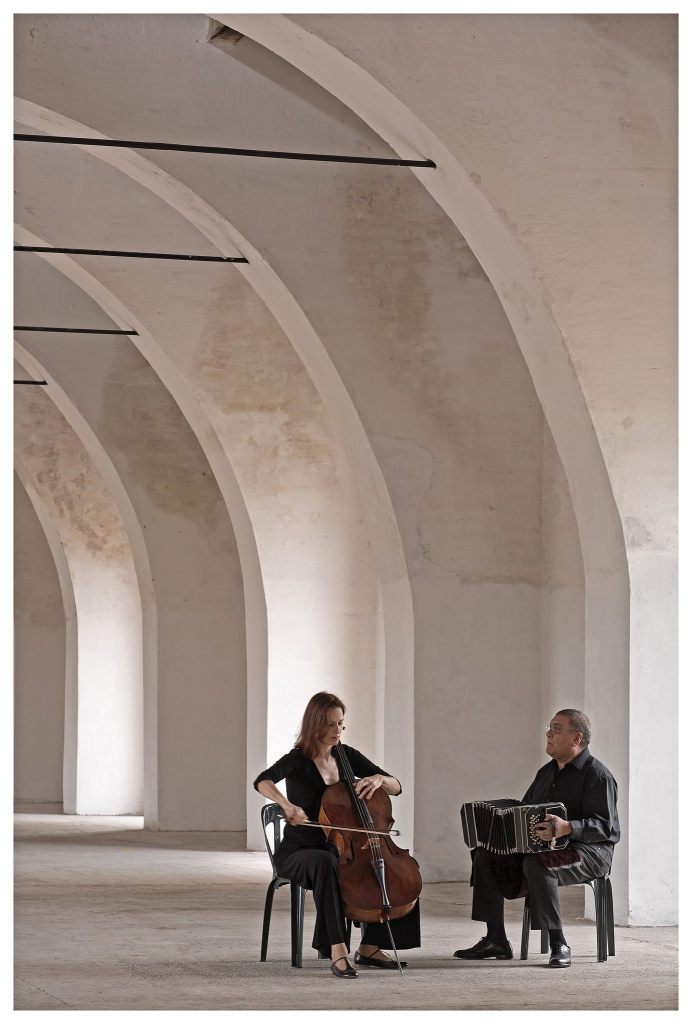
Saluzzi and Lechner
(Photo credit: Juan Hitters)

Early on in the film, Dino wonders how people can connect at all to his melancholic music, even as he recognizes something that meets the listener halfway. “For me,” he goes on, “doubt is driving force. It’s like gasoline. You use gasoline to run a car. And for us to work, we need doubt. Because if doubt is a driving force, then it can’t become a paralyzing problem. On the contrary, it’s a generator of ideas and desires, of searches and answers to the great questions we have.” And if we must be the electricity that powers this generator, how fortunate we are to be swept up in its current.

Keith Jarrett Trio: Live In Japan 93/96 (ECM 5504/05)

Live In Japan

Keith Jarrett Trio
Live In Japan 93/96

Keith Jarrett piano
Gary Peacock bass
Jack DeJohnette drums
DVD 1
Recorded live in Tokyo, July 25, 1993 at Open Theater East
Director: Kaname Kawachi
Recorded by Toshio Yamanaka
Produced by Yasuhiko Sato
Executive producers: Hisao Ebine and Toshinari Koinuma
DVD 2
Recorded live in Tokyo, March 30, 1996 at Hitomi Memorial Hall
Director: Kaname Kawachi
Recorded by Toshio Yamanaka
Produced by Yasuhiko Sato
Executive producers: Hisao Ebine and Toshinari Koinuma
Concerts produced by Koinuma Music

It’s one thing to hear, but quite another to see, the Keith Jarrett Trio in action. For those unable to do so in a live setting, this two-DVD release is the next best thing. Like the Standards I/II set that precedes it, this one was recorded in Tokyo, but puts about a decade between those first Japan performances.

Japan 1

A 1993 gig at Open Theater East takes place in the heart of a sweltering summer. The air shines both with the music and with the rain that forces a large and dedicated audience to listen from beneath ponchos, and the musicians to play from beneath a clear canopy. The video quality is much finer this time around, and despite a rocky start born of technical issues and the weather, captures one of the trio’s finest sets available on any medium.

Japan 2

What separates this concert from the others available on DVD is the openness of the band’s aura. Jarrett more than ever plays for his appreciative listeners because he understands the bond into which nature has pushed them. Perhaps it’s no coincidence that Jarrett’s The Köln Concert also famously began in the least ideal of conditions. Clearly, the pressure set him on an unprecedented creative path. And so, even as the trio struggles to feel out the climate in Dave Brubeck’s “In Your Own Sweet Way” (throughout which Jarrett must often wipe down the keyboard with a towel), all while latecomers snake to their seats, we can feel the groove emerging one muscle at a time. After the worldly touches of “Butch And Butch” and “Basin Street Blues,” we know that things have been set right.

Japan 3

Whereas in the previous Japan documents Peacock proved himself the man of the hour (although, to be sure, the breadth of his architectures in “If I Were A Bell” and “I Fall In Love Too Easily” are as masterful as they come), it’s DeJohnette who produces the deepest hues of this rainbow. His sticks make evergreens like Sonny Rollins’s “Oleo” that much greener, and turn a 26-minute rendition of Miles Davis’s “Solar,” combined with Jarrett’s “Extension,” into a downright sacred space.

Japan 4

As with the 1986 concert on Standards I/II, the trio ends on three encores: “Bye Bye Blackbird,” Jarrett’s “The Cure,” and “I Thought About You.” In all of this one can sense a quiet storm of commitment to the music that flows from within. Melodies breathe, reborn, requiring open hearts to know their graces.

Japan 5

The year 1996 brings us to Hitomi Memorial Hall, where Jarrett and friends jump fully refreshed into “It Could Happen To You.” As always, Jarrett’s lyrical intro reveals little about the mosaics soon to follow. He takes the theme and its surrounding chords as a starting point down densely textured corridors. Which is, of course, what improvisation is all about: dungeon crawling without a map yet knowing that a destination will wrap its arms around you eventually. Jarrett seems to unravel every possible path into its fullest and on through the ballad “Never Let Me Go,” in which the pianist transcends the status of storyteller to that of myth keeper.

Japan 6

“Billie’s Bounce” is a staple not only for its composer, Charlie Parker, but also for Jarrett. As one of his prime expressive spaces, it layers all the bread and butter that make his art so nourishing. But we mustn’t forget that each member of this unit is equally important. In “Summer Night,” Peacock’s gentility is Jarrett’s flame, shining like the moon with a song to sing, and DeJohnette’s opening to “I’ll Remember April” shows a drummer with just as much to say from the bedrock, even as Jarrett evolves in real time through every change in the rapids above.

Japan 7

Other standbys such as “Mona Lisa” and crowd favorite “Autumn Leaves” open as many new avenues as they retread. With a crispness of feeling, Jarrett grabs the spotlight, while lively soloing from Peacock and fancy brushwork from DeJohnette make the picture whole. Even the familiar strains of “Last Night When We Were Young” become something new when they melt into Jarrett’s groovier “Carribean Sky.” It’s what one can always count on with this trio: playing as if for the first time.

Japan 8

The Bud Powell tune “John’s Abbey” commands from the sidelines as Peacock and DeJohnette go from canter to gallop and sets off a rapid-fire succession of closing tunes. A touching rendition of “My Funny Valentine” falls like a tear of quiet joy into Jarrett’s “Song,” in which the musicians open a book you always meant, and at last have the chance, to read again. “All The Things You Are” and Ray Bryant’s lesser-heard “Tonk” end the set with a satiating balance of delights. Nothing added, nothing taken away.

Japan 9

Keith Jarrett Trio: Standards I/II – Tokyo (ECM 5502/03)

Standards Tokyo

Keith Jarrett Trio
Standards I/II – Tokyo

Keith Jarrett piano
Gary Peacock bass
Jack DeJohnette drums
DVD 1
Recorded live in Tokyo, February 15, 1985 at Koseinenkin Hall
Director: Kaname Kawachi
Recorded and mixed by Toshio Yamanaka
Production coordinator: Toshinari Koinuma
Produced by Masafumi Yamamoto
Executive producer: Hisao Ebine
DVD 2
Recorded live in Tokyo, October 26, 1986 at Hitomi Memorial Hall
Director: Kaname Kawachi
Recorded and mixed by Seigen Ono
Production coordinator: Toshinari Koinuma
Produced by Masafumi Yamamoto
Executive producer: Hisao Ebine
Concerts produced by Koinuma Music

Standards I/II is an invaluable two-DVD archive of the Keith Jarrett Trio’s inaugural tours of Japan. The first, recorded at Tokyo’s Koseinenkin Hall on 15 February 1985, offers the pianist at his heartfelt best in an intro as tender as a drizzling rain. So begins a smooth version of “I Wish I Knew,” through the lens of which bassist Gary Peacock and drummer Jack DeJohnette illuminate the spectrum of this format like few others can. What distinguishes them, as made clear in this concert opener, is their consistent ability to surprise. Sure, the technical prowess required to carry off such florid versions of “If I Should Lose You” and “It’s Easy To Remember” is formidable to say the least, but how much more virtuosity there is to be savored in the ballads. The night-laden memories of “Late Lament” add softness to the set list’s emerging palette, even as they whisper in a language as crystalline as all the rest. This is a diamond in which every occlusion represents an opportunity for clarity. “Stella By Starlight” starts with Peacock and Jarrett emoting in space and time without allegiance to either, working into a 14-minute groove so sublime that it melts.

Standards 1

To be sure, the more upbeat tunes have a crispness all their own. “If I Should Lose You” finds Jarrett listening intently to his bandmates, who exchange tactile glances in anticipation of DeJohnette’s rolling play. But whether the drummer is riding the rails in “It’s Easy To Remember” or adding choice accents to a diagonal “God Bless The Child,” he leaves plenty of room for his audience to grow in kind.

Standards 2

Jarrett originals such as “Rider” and “Prism” showcase his penchant for gospel and Byzantine grooves. In these tunes the band reaches a high point of synchronicity, working a detail-oriented art into a genre all its own. Even the lighter “So Tender” retains full emotional accuracy, going all in via Peacock’s supernal melodizing. All of which leads to sixteen and a half minutes of soulful unpacking in “Delaunay’s Dilemma.” Peacock fascinates again in his soloing toward the finish line, while DeJohnette sings even as he punches his way toward bluesy victory.

Standards 4

The second Japan concert was recorded at Hitomi Memorial Hall, also in Tokyo, on 26 October 1986. This standards extravaganza is the regression to the previous concert’s progression, but loses no sense of integrity for its introversion. “You Don’t Know What Love Is” eases into things with sweeping finesse such as only Jarrett can pull off. It is followed by “With A Song In My Heart,” the meditation of which morphs into some solid invigorations. Peacock and DeJohnette share a flawless rapport, the drummer popping off that snare like a machine gun.

Standards 5

So begins an alternating pattern of valleys and peaks, which by the end leave behind an even more cohesive program than the first. We next dip down into a tune the trio plays like no one else: “When You Wish Upon A Star.” Jarrett’s rendering makes even the most familiar blossom anew with emotional honesty. The mastery on display in this quintessential example is as pliant as Peacock’s strings, and carries over into the interlocking tempi of “All Of You.” For this, the bassist leaps forward with the first of two solos, moving from robust to filigreed without loss of syncopation.

Standards 6

The bassist turns out to be the sun of this solar system, lathering a mysterious yet lucid “Georgia On My Mind” and a duly nostalgic “When I Fall In Love” with enough light to spare in conversation with his bandmates. DeJohnette, for his part, airbrushes the night sky in “Blame It On My Youth” and lets the groove be known behind “Love Letters.” And in tandem with Jarrett, he feeds magic into the masterstroke of “You And The Night And The Music.” Unforgettable.

Standards 7

Each of the three encores—“On Green Dolphin Street,” “Woody ’n You,” and “Young And Foolish”—is a virtuosic gem set to twinkling and reminds us that Jarrett and his associates came this far only by selecting their divergences lovingly.

Enrico Rava Quartet w/Gianluca Petrella: Wild Dance (ECM 2456)

2456 X

Enrico Rava Quartet
w/Gianluca Petrella
Wild Dance

Enrico Rava trumpet
Francesco Diodati guitar
Gabriele Evangelista double bass
Enrico Morello drums
with
Gianluca Petrella trombone
Recorded January 2015, Artesuono Recording Studios, Udine
Engineer: Stefano Amerio
Produced by Manfred Eicher
U.S. release date: August 28, 2015

Wild Dance documents yet another chapter in the career of Italian master trumpeter Enrico Rava, who for this outing has assembled one of his most exciting bands to date. Along with guitarist Francesco Diodati, bassist Gabriele Evangelista, and drummer Enrico Morello, he welcomes back into the fold trombonist Gianluca Petrella, whose darker brass has added memorable contrast to Rava’s quintet albums over the past 13 years. Just as many Rava originals, both new and old, populate the set list of this latest ECM collaboration, with a collective improvisation added in for good measure. The latter format, which falls penultimate in the set list, is a good litmus test for any jazz outfit, and in this respect the band succeeds beautifully. Overlapping just enough to yield thematic intimations while allowing each instrument to speak personal truth, it journeys with optimism on its sun-faded sleeve.

All of which makes “Diva” all the more alluring for noir-ish saunter. In keeping with that atmosphere, the band caresses every flutter of Rava’s hardboiled romanticism with austerity. Diodati and Evangelista are this opener’s heart and soul, stretching and tensing by turns as Rava walks the alleyways in search of connections. “Space Girl” continues the thread with similarly half-lit cinematography, by means of which Morello discloses the underlying bonfire of physiological activity required to pull this music off with such smoothness of intuition.

Rava and Eicher
Enrico Rava with producer Manfred Eicher (photo by Luca D’Agostino)

“Don’t” radically changes the album’s exposure, moving with that same swagger but opening up the aperture through Petrella’s delayed entrance. In his hands, the trombone becomes a fully vocal entity that is equal parts storyteller and troubadour. His notecraft bespeaks an itinerancy that never fears the unknown. Whether winding around Rava’s core melody at the end of this tune or jumping headfirst into the animations of the next (“Infant”), he plays with fire as a house cat might a mouse—batting it around just enough to stun without the need for a kill. Such restraint is required of all the musicians under the bandleader’s employ, for even at their most unleashed (as in the up-tempo gems “Cornette” and “Happy Shades”) they make sure to keep a sizable portion of their unity within frame. Further contributions from Petrella are studies in contrast, adding humor to “Not Funny,” liquidity to the title track, and bite to the otherwise smooth “Monkitos.”

Enigma is the name of the game in “F. Express,” which by electronic whispers opens a dialogue of swinging proportions. This also happens to be one of its composer’s finest throwbacks to hit the digital shelves in some time, and is an album highlight—not only for its atmospheric acuity, but also for the archaeological care with which it is unearthed. A lone bass introduces “Sola” at length before the core-tet fleshes its skeleton with dreamlike locomotion. As if talking in his sleep, Rava spills inner secrets with the offhandedness of a sigh. “Overboard,” for its part, recalls the album’s moodier beginnings and finds the band gliding over shifting waters. In tandem with the unmistakable trumpeting, Diodati surprises with a gritty solo that stands out in an album of many standouts.

All of this and more abounds in “Frogs,” which showcases the band’s vibrancy to its fullest. Every instrument sings in this roving gallery of impulses and rhythm changes, making for a fitting closer to one of Rava’s finest.

(To hear samples of Wild Dance, please click here.)

Stephan Micus: Nomad Songs (ECM 2409)

2409 X

Stephan Micus
Nomad Songs

Stephan Micus ndingo, genbri, steel-string guitar, suling, voice, nay, rewab, rabab, twelve-string guitar, fourteen-string guitar, tin whistle, shakuhachi
Recorded 2012-2014 at MCM Studios
An ECM Production
U.S. release date: August 7, 2015

Pundits often speak of “going green” as if all it involved were more considerate allocation of resources and regulation of harmful industry. Yet with this comes the responsibility of creating more resources in turn and balancing injury with abundance. Greenness entails awareness of Earth in all its forms, physical and metaphysical alike. The music of Stephan Micus engages both persuasions, enriching the inner lives of those fortunate enough to hear it while encouraging a harmonious and, above all, creative relationship with the environment. A consummate traveler and student of traditional instruments from nearly every continent, Micus has drawn inspiration from a staggering variety of locations, but that makes him no mere collector checking off items on some cultural itinerary. Instead, he modifies these instruments to suit his needs and manifests his connections to them through truly original compositions, all while replenishing what the world has gifted him, and then some.

Micus has had a long association with ECM Records, known for its rigorous production standards (typically recording, mixing, and finalizing an album in three days) but which has come to give the German multi-instrumentalist free reign to record in his home studio and send in the master(ful) tapes for postproduction. Despite being his 21st album for the label, Nomad Songs is no less thoughtful than the 20 previous. If anything, it’s a return to the most essential forces of his physics: push and pull. This is not to imply conflict but balance in the music, whereby seemingly contradictory actions flow into one another in the manner of the tide, expanding and recessing to the beat of an invisible drum. Which is perhaps why Micus plays, for the first time on record, the genbri, a bass lute used by Gnawa of Morocco as an instrument of healing and, in his hands, a percussive force throughout these sequences. Also new is the ndingo, a kalimba-like instrument favored by the San, an indigenous people of Botswana stripped of their nomadism by African nation states. The album’s title thus has dual meaning, tracing Micus’s own itineracy and honoring those deprived of it.

“Everywhere, Nowhere” opens the 11-part odyssey with a duet between the two newcomers. The resonant buzz of the ndingo, enhanced by means of a wooden sounding box, is as organic as a human-made instrument can be. Like the throat of one who has sung for eons, it reveals lifetimes of knowledge with every utterance. The genbri, in the enlarged form heard here, could almost be mistaken for an upright bass and as such takes Micus in lucid directions, unveiling a little of the mystery of his expressions. Only one other piece, “The Spring,” features this same combination of roots and leaves. Like a row of people walking hand in hand through the night, it sneaks away into the hope of a future without hierarchy.

Such respect has always been at the core of the Micus soundscape: his music may be openly visual but is temporal at heart, compressing and decompressing long stretches of time as if they were matter to be molded. A kindred message prevails in the album’s two solitary pieces. “The Blessing” is a vocal solo that meshes Micus’s spontaneous language with wayfaring melody, yet it is the 12-string guitar of “The Stars” that acts the part of storyteller. Brief, delicate, and ending in sparkling harmonics, it is a meteor shower reduced, as the sky would have it, to a play of light against the yawn of night.

Whether pairing steel-string guitar and the Balinese recorder known as a suling (“Leila”), or two Irish tin whistles, played simultaneously (“Sea Of Grass”), the duo pieces are less conversational than they are integrational. These, too, glance back to Micus’s earliest work. In characteristic fashion, the more instruments he adds, the more uniform his sound becomes. The gamelan qualities of the three ndingo in “Under The Chinar Trees” mesh exceptionally well with shakuhachi and voice, making for one of the most beautiful experiences he has ever committed to record, while appearances by the Egyptian nay (“The Feast” and “The Promise”) and a 14-string guitar of Micus’s own design add fire and water in equal measure. The rewab (long-necked lute of the Uyghur people of Western China) and rabab (Afghan lute) expand the plectrum-heavy palette, culminating with guitars in “The Dance,” in which the rabab’s shamisen qualities pave an alluring detour.

Not only is this some of Micus’s finest work; it is also the most enchantingly recorded and mastered. Listening to it, one can hardly be surprised that his last name is an anagram of “music,” because everything he touches turns into nothing less. His gestures open arteries by linking them to a universal blood flow, in which the aneurisms of supernovas and the embryos of planets weave a path that he treads, for all a sage, crushing nothing beneath his feet except denial of eternity.

(See this article as it originally appeared in RootsWorld online magazine, from which you may also link to a sample track.)