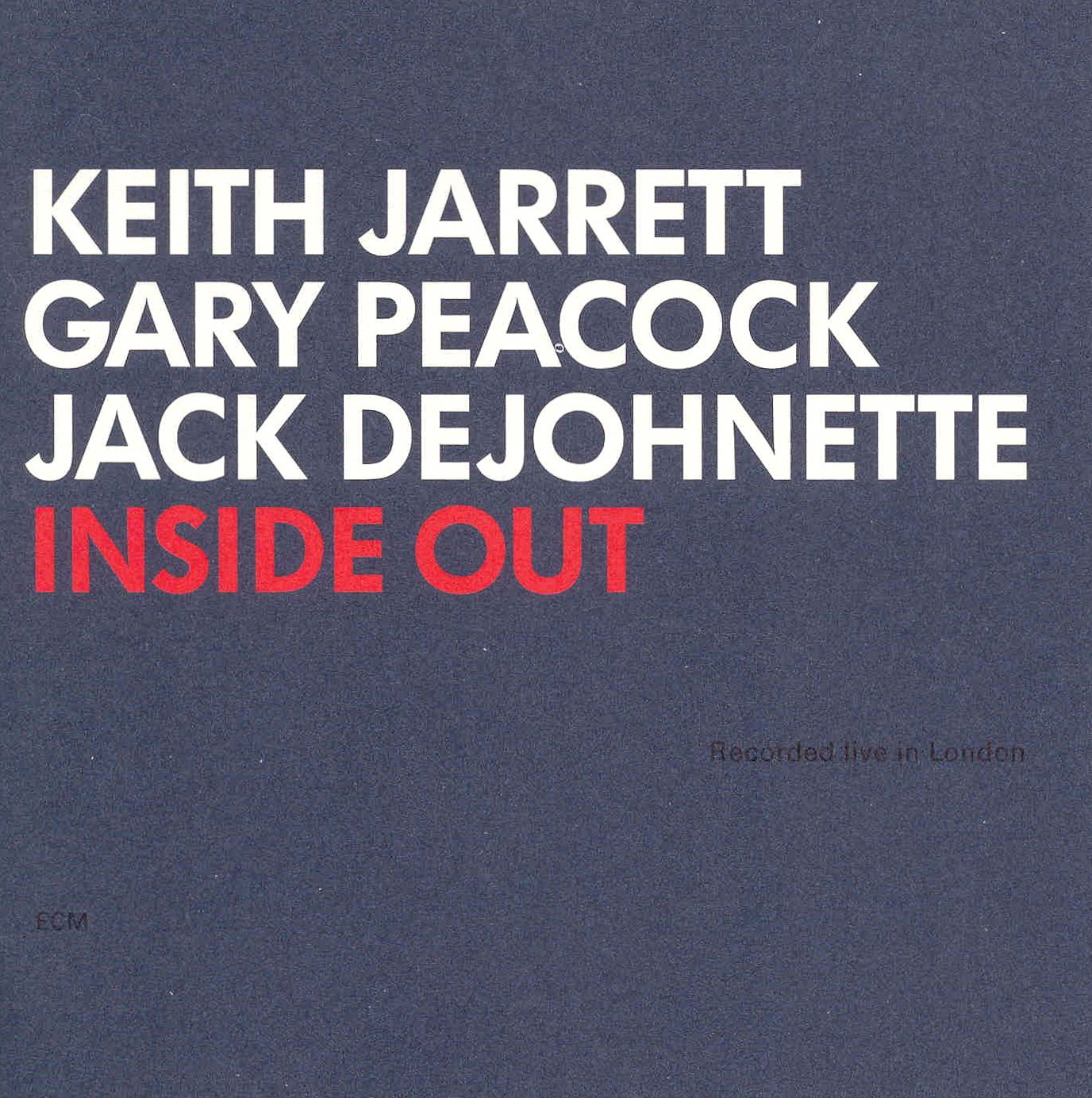
Keith Jarrett Trio: Inside Out (ECM 1780)

Inisde Out

Keith Jarrett Trio
Inside Out

Keith Jarrett piano
Gary Peacock double-bass
Jack DeJohnette drums
Recorded July 26 and 28, 2000 at Royal Festival Hall, London
Engineer: Martin Pearson
Produced by Manfred Eicher

Of his approach to this 2001 album, recorded live the year before in London, pianist Keith Jarrett says, “Don’t ask. Don’t think. Don’t anticipate. Just participate.” Where for so long he and his partners Gary Peacock and Jack DeJohnette had served up piping hot new takes on old recipes, here they decided to do away with all that and, with the exception of their version of the evergreen “When I Fall In Love” that concludes, let the music create itself. What in others’ hands would have been a risky venture turns into a balanced, intuitive record from these most capable sound-smiths.

Jarrett, Peacock, and DeJohnette are undoubtedly masters of their craft, but each album has tended to highlight the skills of one over the others. In this case, DeJohnette is the trio’s North Star. He breaks in the stage like a good pair of shoes, making oil from grit and smoothing the way for Jarrett’s spontaneous fountains at every turn. With a freshness that recalls his Special Edition days, he emboldens the tessellated “From The Body” in such a way that Jarrett’s freestyle analyses can shed fullest sunlight on the unfolding story. Of that story, we get floods of exposition in a sandwich of registers. Peacock muscles his way through with a twangy abandon that characterizes so much of his playing from the period, leaving at the bottom of this crucible a pianism so angelic that it pulls itself skyward until it reaches the beginning of itself.

DeJohnette unpacks further brilliance in the equally jagged title track, which along with the first starts big and works down to the finer core before rebuilding from that core something new and glorious. His powerful brushwork and meditative swing treats every strand as if it were a means to an end and leaves Jarrett to explore their finer implications in a bluesy afterglow. The latter’s right hand has a mind of its own as it skips its way across the keyboard. “341 Free Fade” opens with tantalizing string games from Peacock, bringing back the trio’s tried and true formula of building molecules from atoms. DeJohnette delights yet again, his hi-hat carrying a heavy load into outer space as he tinkers gorgeously around the halo of its kit. And after leading the way through the foot-stomping ritual that is “Riot,” he opens the pathway to genius with his cymbals in “When I Fall In Love.” By means of barest whisper, he stargazes, trusting life’s stresses to Jarrett’s hands and setting them to fly like pieces of paper above a campfire—glowing as they rise, turning into patches of night, indistinguishable from the rest.

Inside Out is unafraid to live up to its title. Although on the surface it seems more abstract than might a typical standards outing, you may just find yourself lulled by its inherent, not to mention accessible, profundity. Were the album a genetic experiment, each track would be a kink in the DNA helix that makes its bearer unique.

<< Heiner Goebbels: Eislermaterial (ECM 1779 NS)
>> Gideon Lewensohn: Odradek (
ECM 1781 NS)

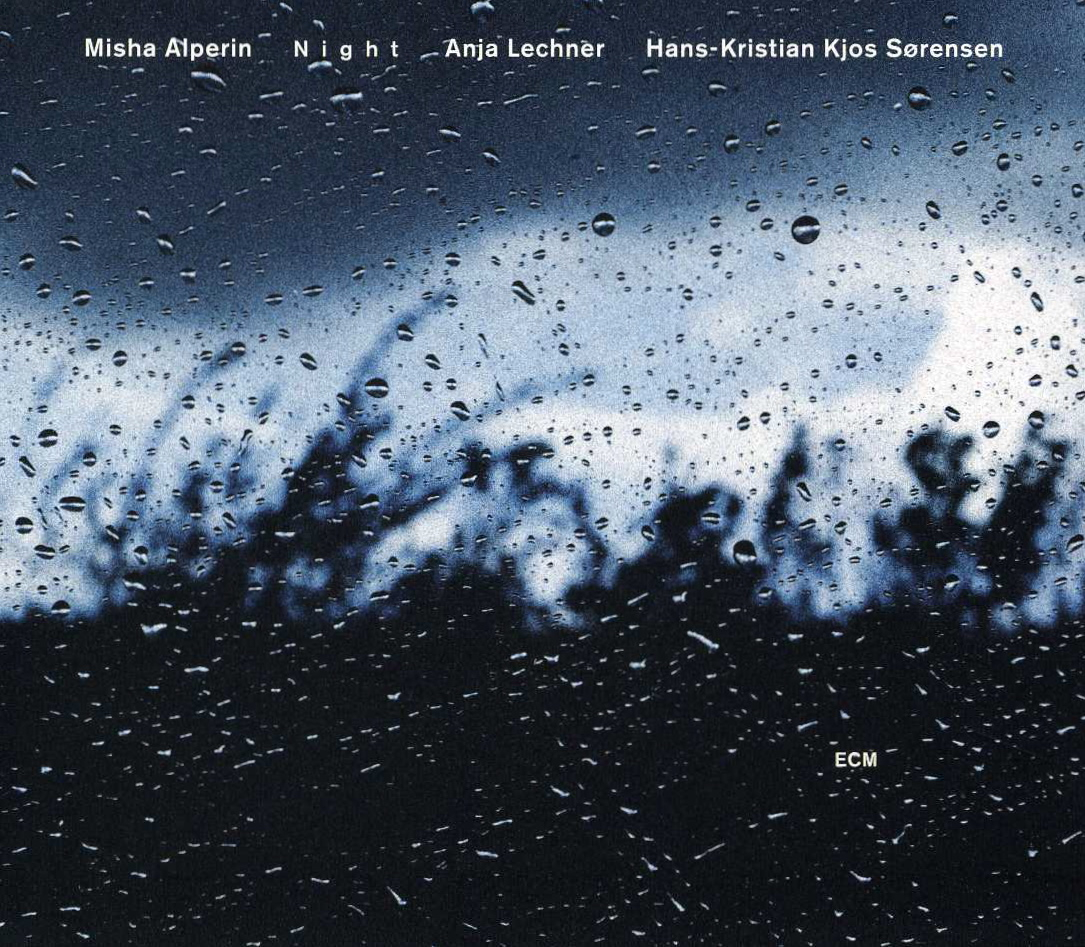
Misha Alperin: Night (ECM 1769)

Night

Misha Alperin
Night

Anja Lechner cello
Hans-Kristian Kjos Sørensen percussion, marimba, voice
Misha Alperin piano, claviola
Recorded April 4, 1998 at Vossa Jazz Festival, Norway
Engineer: Jan Erik Kongshaug
Produced by Manfred Eicher

Atmospherically speaking, Misha Alperin has created some of ECM’s most haunting discs. In the wake of one such disc, At Home, the Ukrainian pianist-composer surprises with yet another unexpected turn of events. The event in question is the commissioned performance at the 1998 VossaJazz Festival in Norway documented here. The end result is a new beginning, a flowering of innovation and sensory breadth.

With German cellist Anja Lechner and Norwegian percussionist Hans-Kristian Kjos Sørensen in tow, Alperin’s keys open the curtain with “Tuesday,” and in that Everest shape reveal the touch of two bows: one at Lechner’s strings, the other humming along the edge of Sørensen’s cymbals. As the trio settles into a spiral of sleep, regularities begin to emerge. Thus welcomed into the performance, one can note the figural language that is Alperin’s forte. His body arches, conforms to what is being played. His physicality comes out especially in “Tango,” which fronts his sweet descriptions before delicate snare rolls and legato support from Lechner, the latter switching to pizzicato to buoy every footnote. After a duet between Lechner and Alperin (the tender “Adagio,” which absorbs breath in lieu of exhale), the dotted marimba of “Second Game” counters with some delightful surprises. From the persuasive beauty of its Steve Reichean introduction to jocular turns and thematic quick-changes that recall The Carnival of the Animals of Saint-Saëns, it encompasses a thousand positive memories. These render the quiet spirit of “Dark Drops” all the subtler. The title track is evocation par excellence, weaving cricketing percussion through a loom of moonlight. Timpani and strained vocals make for some unusual effects in “Heavy Hour,” a ritual thesis of howling abandon. The suite concludes with “Far, Far…,” which carries us beyond the implied “away” to a place where lullabies alter the sky as would a luthier achieve a perfect curve of tiger maple.

Night is a topographical palate. From hills to caves, cliffs and open fields, it is a regression to the womb, a reverie of cloud-shift and prenatal lightning. Like etcher’s acid, it renders its images in reverse, righted when printed on the mind.

<< Misha Alperin: At Home (ECM 1768)
>> John Abercrombie: Cat ‘n’ Mouse (
ECM 1770)

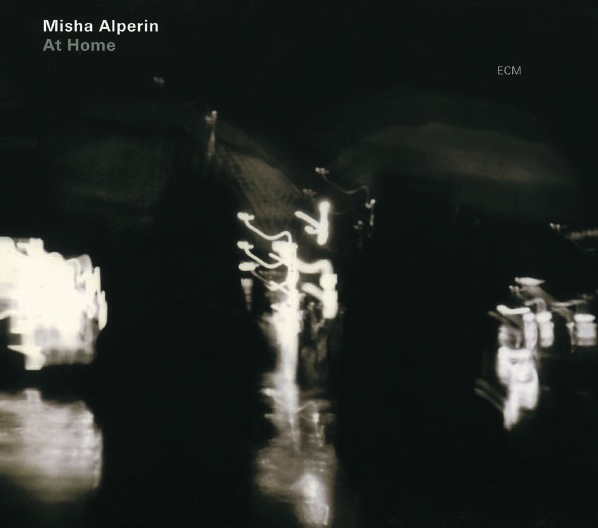
Misha Alperin: At Home (ECM 1768)

At Home

Misha Alperin
At Home

Misha Alperin piano
Recorded at home by Misha Alperin, February 1998
Edited and mastered at Rainbow Studio, Oslo
Album produced by Manfred Eicher

Misha Alperin has been something of a shadowy presence in the annals of ECM. His previous albums—namely, Wave Of Sorrow, North Story, and First Impression—marked him as an enigmatic musician of sparse yet effective language, at times of humor and gaiety. But if you want to know how the Ukrainian-born pianist’s heart beats, the forms his dreams take, let At Home be your looking glass. The aching lyricism of the title track, which opens this collection of improvised pieces, is all you need to know what’s going on: a private, reflective session surrounded by Alperin’s most familiar things. Recorded at his home in Norway, where he has lived for the past two decades, the program unfolds in a mosaic portrait of the artist in various stages of emotional awareness.

Remarkable about this album (and true also of Keith Jarrett’s Facing You) are the levels of evocation sustained throughout. It’s as if Alperin were letting himself fall and trusting in the piano strings to catch him in their net. It is inspiring to experience such breaking down of hesitations—to feel, for example, the subterranean forces of “Nightfall” digging so deep it almost hurts to imagine their visceral impact. In “Shadows” Alperin makes use of space as a brush artist would of ink, expressing much with little. Intermittent clusters and arpeggiated phrases share the piano’s natural resonance, stretching phonemes into the speech of “10th of February.” It is the album’s most figural piece, contrasting a circular left hand with a circling right: a night flight of unfathomable scope in under five minutes. Behind the winged structures of “The Wind” thrive unlived pasts, histories beyond the ken of the hermetic performer at the keyboard, lives whose implications are decades yet in knowing.

The album is not without its whimsy. A Norwegian folk dance provides the inspiration for “Halling,” which might have felt out of place in the program were it not for the integrity of its spirit. “Light” and “Game” bring further playfulness to the fore, in the former offsetting potentially ominous chords and in the latter rummaging through a toy chest of childhood relics. With these Alperin creates sparkling vignettes, one after another, until the outtake of “Njet” chambers the parent calling to the child, the husband to the partner, flowing down the hallways into light.

<< Giya Kancheli: In l’istesso tempo (ECM 1767 NS)
>> Misha Alperin: Night (
ECM 1769)

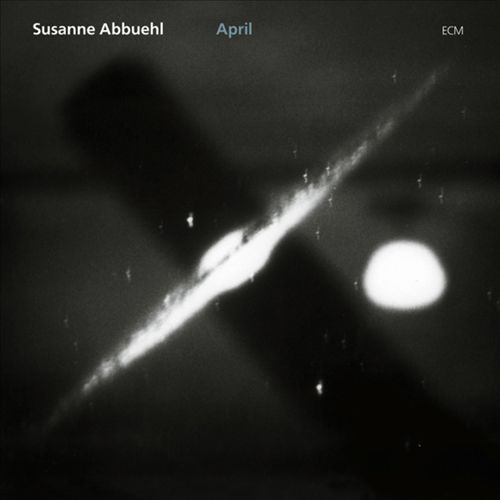
Susanne Abbuehl: April (ECM 1766)

April

Susanne Abbuehl
April

Susanne Abbuehl voice
Wolfert Brederode piano, harmonium, melodica
Christof May clarinet, bass clarinet
Samuel Rohrer drums, percussion
Recorded November 2000 at Rainbow Studio, Oslo
Engineer: Jan Erik Kongshaug
Produced by Manfred Eicher

All night the sound had
come back again,
and again falls
This quiet, persistent rain.
–Robert Creeley (1926-2005)

The ECM debut of Susanne Abbuehl is a verdant introductory résumé for which the Swiss singer-composer presents settings of poems by e. e. cummings and sets her own to the music of Carla Bley. Abbuehl comes from a long line of idiosyncratic chanteuses to have passed through ECM’s hallowed halls—including Sidsel Endresen, Norma Winstone, and Annette Peacock—and has left behind a veritable wing of artwork to admire at length. April carves out perhaps the most distinct of these exhibitions, and with “yes is a pleasant country” introduces us not only to her nesting textu(r)al approach, but also to the poetry of her synergistic band. Pianist Wolfert Brederode (who has since gone on to record leader dates for ECM), drummer Samuel Rohrer (also of Brederode’s quartet), and clarinetist Christof May together grow, needle by needle, the Christmas tree from which Abbuehl hangs her vocal ornaments. The simpatico between singer and sung is further palpable in her braiding with melodica and clarinet in “all i need,” for which its love guides her indigo words far into the heavens. “skies may be blue” and “yes” form a bonded pair. One is a meditation on spring, the other a field of rolling hills painted in wordcraft. Brederode’s composing and playing are exquisite in “maggie and milly and molly and may,” a litany of fleeting memories in which his pianism overshadows with a vocal quality all its own. The final cummings tribute comes in “since feeling is first.” This Abbuehl sings solo, a tribute to the poet’s later disavowals of punctuation.

Bley’s classic “Ida Lupino” gets a lyrical makeover, bringing out just one of countless stories hidden in its pathways: astute, a touch dark, and emotionally forthcoming. Brederode is something of a sage here, navigating the whimsical images therein: a tiger in the snow, a waning eye, a folding of the self into another’s embrace. “Closer” and “A.I.R. (All India Radio)” pitch more cargo onto the S.S. Bley, set adrift on moonlit waters. Beyond Abbuehl’s “together-colored moment,” precious jewels shine in anticipation. The air is as wistful as one’s naming of it, yet promises eternity in the bass clarinet’s deep pocket. The latter tune processes by virtue of Rohrer’s understated timekeeping. Among the more seamless weddings of voice and music the album has to offer, one can easily get lost in its wordless circumscriptions. (It also foreshadows the album’s closer.) Bley gets one last nod in “Seven,” for which Abbuehl places spoken verse—in her words: petal by petal, yet deeper than all roses—upon the heart’s altar.

Yet there is perhaps nothing so beguiling here than her re-imagining of “’Round Midnight.” Accompanied only by Brederode on harmonium, the tune creeps out from the darkness and shivers the very marrow. “Mane na” concludes the session by paying homage to Abbuehl’s Hindustani vocal training with a raga compressed to the scope of a teardrop.

Although barely acknowledged above, Rohrer’s delicate infusions haunt the landscape throughout, reaching, as Abbuehl recites, “somewhere I have never travelled, gladly beyond…” In those rhythms is a heart made of pages, thirsty for the next scratch of pen.

An auspicious label debut.

<< Christoph Poppen/The Hilliard Ensemble: Morimur (ECM 1765 NS)
>> Giya Kancheli: In l’istesso tempo (
ECM 1767 NS)

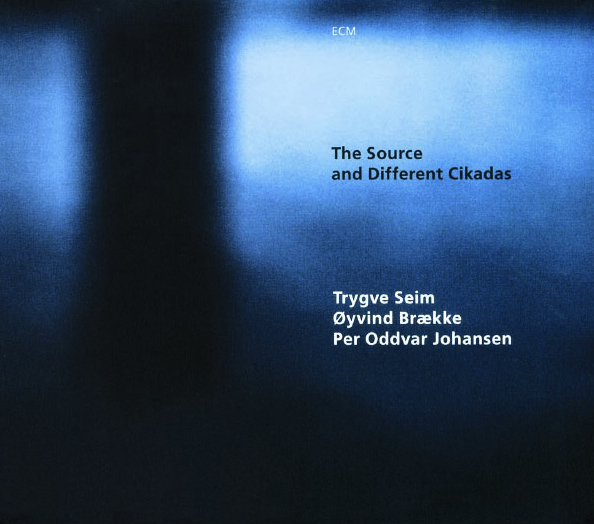
Seim/Brække/Johansen: The Source and Different Cikadas (ECM 1764)

The Source and DIfferent Cikadas

Trygve Seim
Øyvind Brække
Per Oddvar Johansen
The Source and Different Cikadas

Øyvind Brække trombone
Trygve Seim tenor and soprano saxophones, clarophone
Per Oddvar Johansen drums
Henrik Hannisdal violin
Odd Hannisdal violin
Marek Konstantynowicz viola
Morten Hannisdal cello
Frode Haltli accordion
Arve Henriksen trumpet
Christian Wallumrød piano
Finn Guttormsen bass
Recorded November 2000 at Rainbow Studio, Oslo
Engineer: Jan Erik Kongshaug
Produced by Manfred Eicher

Norwegian saxophonist Trygve Seim presents another facet of his musical diamond with the Source, a band he leads with trombonist Oyvind Brække and drummer Per Oddvar Johansen. Notable for bringing together the Cikada Quartet, of which cellist Morten Hannisdal had already played with Seim on Different Rivers and Sangam, and pianist Christian Wallumrød, along with mainstays Arve Henriksen on trumpet and Frode Haltli on accordion, the present session draws out music of a spongier texture, something more prone to dances than to rituals.

The compositional credits are fairly well distributed, with four coming from Seim’s pen. Generally, his are viscous, pathos-rich becomings. “Organismus Vitalis” puts the world under a microscope and revels in all that wriggles in its enlightening circle. In this regard, and by virtue of its floating sensibilities, one might easily connect the dots to Terje Rypdal’s chamber pieces or even to the diffuse scenography of David Darling’s solo ventures—such are its darkly inflected beauties. The Cikadas ebb and keep on ebbing, inching ever closer to shoreline structures as Johansen’s nuanced descriptions ever so barely edge the frame. An auspicious, postludinal beginning to an album of rich variety.

Seim’s thematic voice achieves deeper traction in such tunes as “Bhavana” and “Obecni Dum.” In both, the strings play a vital role in shaping the contexts in which, respectively, saxophone and accordion find purchase. Whether the slide of Seim’s earthy song or the moth-like pursuit of Haltli’s accordioning, there is in all of it something sacred. Even the restless “Fort-Jazz” brings with it a consistency of atmosphere, a fox hibernating in want of rampant spring.

Johansen brings that thaw with three pieces of starkly agitated character. In both “Mmball” and “Deluxe,” his drums are front and center. The latter especially recalls Hal Russell’s exuberant storytelling, all the while heightening the strings’ integration. Bisecting them is “Funebre,” an excerpt from Witold Lutosławski’s 1964 String Quartet that breathes with much the same looseness of structural integrity. This leaves “Uten Forbindelse,” a jazz spring ever on the verge of uncoiling toward infinity. Brække is the clear winner here, spawning as he does an outpouring of spirited exchanges and merging with Seim until the final trill sets them free.

The trombonist, in fact, edges past his co-leaders with five pieces to his name. Brække’s work lies somewhere between that of Seim and Johnansen, balancing the former’s weathered sound with the latter’s spontaneity to varying degrees. Notables include the whimsical “Flipper,” which takes full advantage of the group’s sound colors, and “Plukk,” which charts a subtle interplay of light drumming, pianism, and pizzicato filigree. “Sen Kjellertango” is another eye-opener, a slinky groove anchored by cello and punctuated by soprano saxophone, trumpet, accordion, and drums to dazzling effect.

Two free improvisations round out the set list. Wallumrød and Johansen touch off “Number Eleven” with their patience, overturning stone after stone, until the promise of subterranean force pushes through like a bud. The surrender is tender and blends into surrounding forest like a hunter. “Tutti Free” brings us back to a winter wilderness, dotted by fresh footprints of escape.

Those who enjoyed Bent Sørensen’s Birds and Bells may want to give this one a test spin. The scenography Seim has constructed here is of the highest integrity and practically assures the bending of a curious ear.

<< Alexander Knaifel: Svete Tikhiy (ECM 1763 NS)
>> Christoph Poppen/The Hilliard Ensemble: Morimur (
ECM 1765 NS)

Anders Jormin: Xieyi (ECM 1762)

Xieyi

Anders Jormin
Xieyi

Anders Jormin double-bass
Robin Rydqvist trumpet, flugelhorn
Krister Petersson french horn
Lars-Göran Carlsson trombone
Niclas Rydh bass trombone
Recorded December 17, 1999 at Artisten, Göteborg
Engineer: Johannes Lundberg
Produced by Manfred Eicher

The Chinese title of Anders Jormin’s Xieyi (寫意) means, literally, “to write one’s intentions.” It also names a style of ink painting. Both conceptions—the linguistic and the visual—adequately describe the Swedish bassist’s attempts to sing with his instrument. The result is a session of quiet drama that purges expectations in favor of in-the-moment expressivity. Emerging here on his own after successful ECM tenures with Charles Lloyd, Bobo Stenson, Tomasz Stanko, and Don Cherry, Jormin dips us into a unique world of robust tension, for what began as a solo bass project soon grew, at producer Manfred Eicher’s suggestion, to incorporate morsels for brass quartet. The latter begin, end, and dot the program with cellular interludes, each mobilizing a general reflective theme. These passionate, moveable cores constitute the printing press of all the verbal excursions that occur between them.

The accompanying CD booklet informs us that Xieyi was recorded in one swoop on a rainy December evening. Yet the music is anything but compressed or dank. Rather, it soothes with a warm respect for the many sources recalled at Jormin’s fingertips. From Sibelius to Ornette Coleman and Violetta Parra, Swedish tone poems to children’s songs and improvisations, the sequencing carries us through a globetrotting journey, crystallizing in that single instrument.

Jormin’s unpretentious ability to pluck out the melody behind the melody (listen, for instance, to his harmonic-infused take on Parra’s “Gracias a la vida”) establishes and upholds a strong corporeal presence. Rounded and emotionally descriptive, his musculature acts out every story at hand with interlocking grace. Like teeth biting the edge of a coin, it tests every note for its integrity. At times he folds private shapes from the mind’s origami paper (as in “Idas sommarvisa”), while at others he flings open notions of love like church doors to the world at large. The spontaneous notecraft of tracks such as “Decimas” and “Tenk” further connect ideas by dividing them, thus appreciating their individuality by means of an emerging collective effect. Animated gestures intertwine with winged reciprocation, marking time with glissandi and gaping sluices, through which the trickle of things melodiously passes…

Jormin presents two pieces by composer Stefan Forssén. “Och kanske är det natt” is the album’s most lyrical, a gnarled thing of beauty steeped in nature. “Sonett till Cornelis” is another gem, a recitation of invisible texts. Jormin then pairs his own “Scents” with the ornamental language of “Fragancia” by composer Evert Taube. Its slow trills and deep returns lend plenty of wonder to the scenery. And in that scenery the clearest figure takes shape in the jazz touchstone that is “War Orphans,” realized here with arco brilliance as a dirge of infinite wisdom under the close watch of finitude.

One look at the album’s cover should tell you what this is like: a swath of ever-changing monochrome across which hymns and songs leave their intermittent trail.

<< Harald Bergmann: Scardanelli (ECM 1761 NS)
>> Alexander Knaifel: Svete Tikhiy (
ECM 1763 NS)

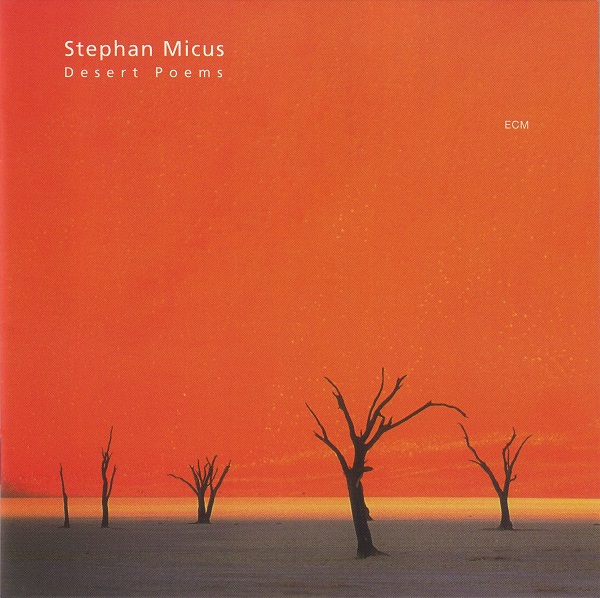
Stephan Micus: Desert Poems (ECM 1757)

Desert Poems

Stephan Micus
Desert Poems

Stephan Micus sarangi, dondon, dilruba, doussn’gouni, kalimba, sinding, steel drums, shakuhachi, ney, sattar, flowerpots, voice
Recorded 1997-2000 MCM Studios

On Desert Poems, Stephan Micus’s 15th solo excursion, the intrepid musical sojourner introduces a few new actors to his already extensive roster of instruments: the doussn’gouni (West African harp), kalimba (Tanzanian thumb piano), and dondon (Ghanaian talking drum). These he nestles among more familiar veterans: his modified 10-string sarangi, dilruba (another bowed instrument from India), ney, and sattar (an upright Uighur fiddle). As always, Micus is attentive to the Janus nature of the instruments he touches. On the one hand each has a history, while on the other it enables new paths of expression. He embraces both as equals.

Characteristic histrionics speak of a thousand other worlds in “The Horses of Nizami” (for sarangi, 5 dondon, and 23 voices) and in “Mikhail’s Dream” (2 kalimba, voice, sinding, 2 steel drums, percussion). In these multi-tracked biospheres, a self divided becomes a self magnified and therefore needs its own language to breathe properly. Indeed, at Micus’s touch the sarangi body becomes a wooden lung through which a chanting chorus activates its array of sympathetic strings. Buzzing kalimba then glow with firefly steps, a ladder of light into the rising dune heat. Amid this flowering conference of souls, a single voice rises into, even as it drops down from, the ether and places its song on a fulcrum of memory and future paths.

The blood of this album’s earthly incarnation is purified by “Adela” (for 22 dilruba), for it speaks of a mirroring heaven in which all that has come to pass awakens to the possibility of a self-aware now. These sounds take human shape: a warrior walking upside down, feet treading sky, his horse long dead behind him, turned to cloud and dropping rain somewhere on more fertile land. With a grating pulse, he marks his footfalls by way of a dotted moon. By nightfall, only his afterimages remain, thrumming in the counterpart of “Shen Khar Venakhi” (6 dilruba, 6 sattar), a 13th-century choral piece from Georgia which Micus arranges in wordless tonsure.

“Thirteen Eagles” (doussn’gouni, 20 ney) and “For Yuko” (2 flowerpots, 8 voices, shakuhachi) share another soul. One is a blissful trek over land and under emotion that focuses purely on movement and shape, ney pleated many times over like feathers and free as heroines of the open sky. The other bears dedication to the performer’s daughter in a galaxy of nascent voices, hurtling through space along a trajectory of sentience and love.

If these are the internal organs, three solo tracks comprise the external features. The eyes flicker into being by way of “First Snow.” Although not a title one might expect amid all this warmth, the continuity is not lost. Its lone shakuhachi is an arid instrument. Cored and lacquered, it rasps like wind through wheat and digs through the soil with deeply grained fingertips. Its song dreams of water, and like the snow remains dry until the warmth of sun or living touch renders it fleeting. Lips speak in “Contessa Entelina,” a voice solo in English that is named for, and inspired by, a village Micus encountered while riding through the Sicilian countryside, and tells the story of a countess who provided solace to Albanian immigrants some centuries ago. This intimate portrait folds perfect divinity into the imperfect cage of human language and means. Ears listen in “Night,” a far-reaching doussn’gouni reflection that bears gifts from the heavens to the caverns.

Seemingly enamored with the same consuming silence of the desert that captured the heart of writer Paul Bowles, Micus translates the hidden energies of landscape into a form that escapes all measure of mortal grasp. World music? Perhaps. But not entirely of this one.

A selfless masterpiece.

<< Joseph Haydn: The Seven Words (ECM 1756 NS)
>> Dave Holland Quintet: Not For Nothin’ (
ECM 1758)

Claudio Puntin/Gerður Gunnarsdóttir: Ýlir (ECM 1749)

Ýlir

Ýlir

Claudio Puntin clarinet, bass clarinet
Gerður Gunnarsdóttir violin, vocal
Recorded 1997-99 at Radio Bremen, Sensesaal
Engineers: Dietram Köster and Christine Potschkat
Recording producer: Peter Schulze
Co-production ECM Records/Radio Bremen

Claudio Puntin and Gerður Gunnarsdóttir make their ECM debut with Ýlir, a musical portrait of Iceland utilizing a mixture of techniques, realities, and understandings of that fabled volcanic jewel. Gunnarsdóttir, a violinist and vocalist of eclectic professional associations, calls Iceland home, while clarinetist Puntin hails from Switzerland. The latter also possesses a wide-ranging talent across idioms, and has continued his association with ECM as a regular member of the Wolfert Brederode Quartet. As a duo, these partners operate under the moniker Essence of North, folding seamless improvisations into a batter of original and traditional material, but always with an ancestral taste on the tongue. The culmination of all this is a unique chamber recital of magical dimensions.

Puntin and Gunnarsdóttir seem most in their element when there are stories to be told. In particular, “Huldufólk”—literally “hidden people” but translated more colloquially as “fairies”—speaks to a world within a world, a world from which the duo draws its breath and feeds an interpretive grace back into the hollows. The piece takes shape in three divided parts. “Draumur” (Temptation) and “Tæling” (Seduction) each open a blank diary and inscribe it with mythological phonemes, a siren’s song in points and lines. Here, as elsewhere throughout, the clarinet embodies an unsuspecting Alice. The violin, meanwhile, slithers Cheshire-like across an outstretched branch, leaving a trail of streaking teeth and fur. “Hringekja” (Whirligig) finishes with a dance on a miniature scale, leaping up fungus steps and swinging from dripping leaves.

Evocative highlights include “Hvert örstutt spor” (Each Little Step), for which Gunnarsdóttir sings words by Icelandic writer Halldór Laxness, winner of the 1955 Nobel Prize for literature, as adapted by Darmstadt disciple Jón Nordal. This forlorn song for voice and bass clarinet closes our eyes in anticipation of “Sofðu unga ástin min” (Lullaby For An Abandoned Baby), a thrumming folk tune. “Kvæðið um fuglana” (Fantasy About Birds) is another visceral episode. This piece by Atli Heimir Sveinsson, a composer whose interest in folk music bears ripe fruit, positively glows in Puntin’s arrangement.

Whether the ebony drones of “Einbúinn” (The Ermite) and “Enginn láì öðrum frekt” (Contemplation), the Lena Willemark-esque excitations of “Peysireið” (Gallop), or the blend of near and far that is “L’ultimo abbraccio” (Last Embrace), there is much to explore in these vignettes. In the title track a pliant violin draws footpaths in snow (“Ýlir” means “winter”), joined by a clarinet that sings with memories of autumn. Like a bird caught in a blizzard, it ululates in the throes of indecision, thus giving melodious name to isolation. The yang to this yin comes with “Leysing” (Melting, Thaw), which sounds as if someone had placed a microphone inside a spring landscape and recorded its renewal. Through scrapings and lilting phrases, the musicians find a treasure trove of messages lurking below, just waiting to see the sky above and reach for it while they still can. In “Vorþankar” (Reflections On Spring), too, the harshness of winter is softened, glistening off icicles as if they were instruments, each a note with its own song to sing. Resonant and glassine, they waver at the edge of waking, like the lonesome goodnight of the “Epilogue,” a kiss forever locked on the lips of the moon.

All in all, this storybook journey peeks through the trees even as it uproots them, one microscopic tendril at a time, and with them strings a loom of thick emotions. Worth seeking out, if it hasn’t already sought you.

<< Eberhard Weber: Endless Days (ECM 1748)
>> Suite For Sampler – Selected Signs II (
ECM 1750)