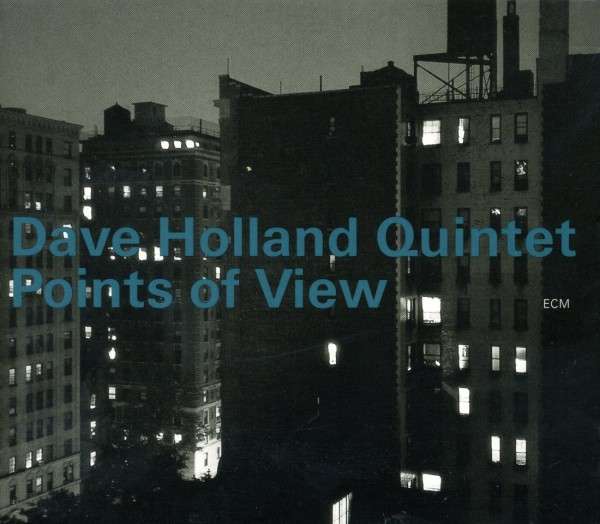
Dave Holland Quintet: Points of View (ECM 1663)

Alternate Points of View

Dave Holland Quintet
Points of View

Dave Holland double-bass
Steve Wilson soprano and alto saxophones
Robin Eubanks trombone
Steve Nelson vibraphone, marimba
Billy Kilson drums
Recorded September 25/26, 1997 at Avatar Studios, New York
Engineer: James Farber
Produced by Manfred Eicher

In 1997, ECM veteran Dave Holland unveiled his new quintet with saxophonist Steve Wilson, trombonist Robin Eubanks, vibist Steve Nelson, and drummer Billy Kilson. Wilson and Kilson were then the latest additions to the bassist’s milieu, the former making his only ECM appearance here and both making their debut with the label. Kilson has since grown to notoriety through his associations with Holland, and it’s impossible to wonder why after hearing him emote throughout this smooth, copacetic set, especially in tracks like “Metamorphos” (the sole Eubanks-penned tune therein) and Holland’s opener, “The Balance.” As representative a doorway as one could hope for, its unmistakable bass line underscores a developing signature of drums, bass, and vibes that sticks to the ribs like a good meal. It’s a deep and shimmering sound, whetting our appetite through a solid solo from Eubanks, Holland all the while bringing that buoyant flavor we crave. Wilson’s sopranism whips a thin caramel in Holland’s dark chocolate goodness, while Kilson’s riffle force adds texture and crunch. The result is the astrological sign under which the remainder lives.

As per usual, Holland takes the lion’s share of compositional duties. “Mr. B.” brings the joyful, swinging sort of beauty one would expect from bassist Ray Brown, to whom it bears dedication. An early vibes solo gets us off on the right foot in this sure jaunt through city streets. Wilson gives an exemplary lesson in alto improvisation, building from simple elements and unwinding in flowing chromatic lines that cajole the band to peak intensity. “Bedouin Trail” is a leftover from Holland’s Thimar session with Anouar Brahem and John Surman and proves to be a perfect atmospheric vehicle. Nelson draws from an especially appropriate color palette, pairing nicely with the sandy textures from Eubanks. “Ario” means à Rio and came out of a trip Holland took to Brazil just before putting this record together. Though inspired by rainforest and natural splendor, it boasts an urban edge, not to mention also the cleanest solos of the entire set. Holland’s then-recent work with Herbie Hancock adds due piquancy to “Herbaceous,” an upbeat cruise along fast-moving waters. Holland is swift as a jackrabbit here, setting off some gorgeous soprano work in the process.

Wilson and Nelson round out the writing with “The Benevolent One” and “Serenade,” respectively. The saxophonist gives us the tender heart of the session and provides plenty of page space for soulful monologues all around. Nelson likewise in “Serenade,” a tropical infusion of marimba that is easy, breezy, beautiful.

Throughout every track, Holland brings the listener courtside, as it were, with his lyrical, elliptical playing. Yet off all the soloists, it is Eubanks who shows the most fire and innovation. In the end, we have laid-back, non-confrontational, music that comes to us democratically and without pretension. A well-rounded record, slick as rain.

<< Philipp Wachsmann/Paul Lytton: Some Other Season (ECM 1662)
>> Misha Alperin w/John Surman: First Impression (ECM 1664
)

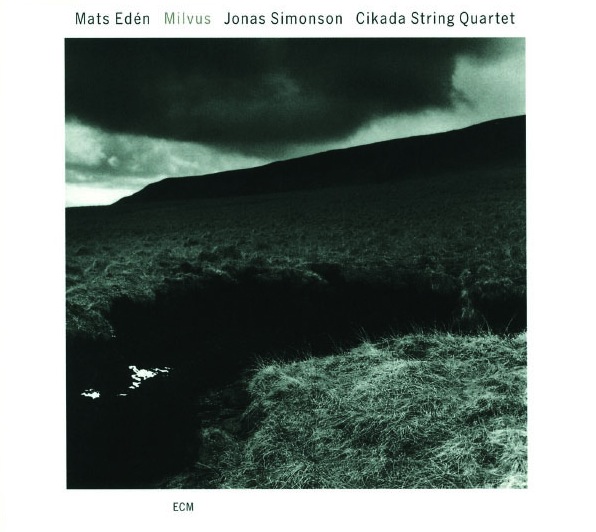
Mats Edén: Milvus (ECM 1660)

Milvus

Mats Edén
Milvus

Mats Edén drone-fiddle, violin, viola
Jonas Simonson flute, alto flute
Cikada String Quartet
Recorded September 1997 at Rainbow Studio, Oslo
Engineer: Jan Erik Kongshaug
Produced by Manfred Eicher

After making vital contributions to the ECM collaborations of Lena Willemark and Ale Möller, Swedish multi-instrumentalist and composer Mats Edén brings his folk revival sensibilities to this leader date from 1999. He joins longtime musical partner Jonas Simonson in paying homage to many great fiddlers, including Ärtbergs Kalle Karlström and Lejsme Per Larsson, and old-time masters Torleiv Björgum and Anders Rosén. The latter revived the use resonating strings, which Edén took on himself in developing a custom instrument called the bordunfiol, or drone-fiddle, featured prominently in Milvus.

Of that drone we get plenty in “Haväng,” an original tune dedicated to Indian violinist K. Shivakumar. Simonson’s flute is the photographic image that develops in Edén’s solution. This frothy combination of sublime harmonies and cohesive adaptation permeates especially the vibrant polskas that speckle the program. The contrast between airy riffs and tethered harmonics, between flowing lines and jagged accompaniment, between fragrant soil and dry winds makes for an altogether inviting atmosphere.

Having grown up in Värmland, which borders Norway, Edén takes inspiration from the region in “Norafjälls,” which he plays to earthen perfection. Likewise the dirge-like lows of “Vardag.” He also offers two improvised solo “Variations,” which bring with them a darker cast. Their strained quality and wrenching, emotional grit reveals a highly ingrained mind at work.

Simonson brings spiritual centeredness against distant fiddle accompaniment in “Den lyckliga (Beate Virgine),” a devout, reverberant jewel in the album’s rusted crown, and brings reflection and depth to his solo “Spillet,” a brief but profound segue.

As if this weren’t enough, the Cikada String Quartet concludes with Edén’s three-part String Quartet No. 1, of which the first movement feels like an unpacking of all the traditions that came before. As such, it is a distillation, a crystal fragmented and made whole again (the “jigginess” here is far more subtle, internal). The second movement is a quiet agitation of rubber-banded ideas, a spiral into the final Lento, engaged by folk themes amid careful attention to surroundings.

The album’s title refers to the kite bird. Not surprisingly, the music created in its name embodies the cut of those wings, angular and sure against the sky. Such contrasts would seem to be of vital importance to Edén, a musician who understands that the spaces in between the strings are just as important as the strings themselves.

<< Hans Otte: Das Buch der Klänge (ECM 1659 NS)
>> Joe Maneri/Mat Maneri: Blessed (ECM 1661
)

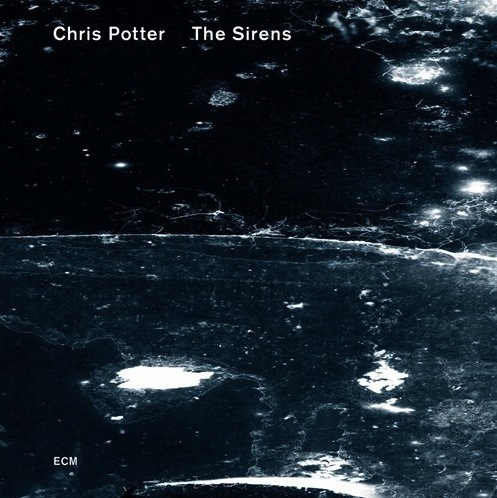
Chris Potter: The Sirens (ECM 2258)

The Sirens

Chris Potter
The Sirens

Chris Potter tenor and soprano saxophones, bass clarinet
Craig Taborn piano
David Virelles prepared piano, celeste, harmonium
Larry Grenadier double bass
Eric Harland drums
Recorded September 13-15, 2011 at Avatar Studios, New York
Engineer: James A. Farber
Assistant: Charlie Kramsky
Produced by Manfred Eicher

Saxophonist Chris Potter does Homer’s The Odyssey jazzily in his first leader date for ECM. Joined by pianists Craig Taborn and David Virelles, bassist Larry Grenadier, and drummer Eric Harland, he dips into a sea of changes and emerges with a row of gold coins in his mouth. It is one thing to read into his allusions and programmatic suggestions for what follows, quite another to take the music on its own terms in the heat of moment after delectable moment. Not only has he taken a concept and made it his own, but he has further let the concept have a life of its own. He’s unafraid to round the corners, darken the edges, and age the surface, so that each tune is fully weathered before it reaches us, despite its nominally spontaneous creation and oxidization. In such a context, his extroversion speaks a thousand tongues.

Sirens

From the start, “Wine Dark Sea” proves an apt descriptor of Potter’s tannined blowing and sets a tone for this smooth, eminently drinkable leader date (his first for ECM). The cinematic writing (all but the final track were penned by Potter) and rolling pianism get us into the textuality of things with a single reed as interpreter. Potter also opens the door for a far-reaching solo from Taborn, whose recognizable tickling brings a hip, modern edge to an otherwise classic sound. Matching this fine work is Virelles, whose prepared piano adds patina to “Wayfinder.” This ebullient track dashes more than a hint of its flavor from Pat Metheny and contrasts with the opener as a way of expressing Potter’s depth of execution.

On to “Dawn (With Her Rosy Fingers),” perhaps the only Homeric ballad in modern jazz. If we are tempted to read the urban sprawl into its matrix it’s only because Potter is so adept at rendering the ancient as if it were cotemporal with our awareness of it. Grenadier’s solo captures all of this and more, flipping rocks and mushroom caps like children in search of miniscule dreams. The progressive solo from Potter is a music lover’s dream come true: fresh, welcoming, sincere. He expands his versatility in the title track, for which he cracks open a vintage bottle of bass clarinet and lets its notes air. The attention to detail is sublime, even if the music is more than that. One might expect the call of the eponymous sirens to be ethereal, floating, and divine. Yet while the bass clarinet certainly possesses these qualities in its forested way, it is perhaps not the first instrument we might choose to evoke such iconic allure. What we experience, then, is not the call per se but the wrenching thrill of that call at the cellular level, of the biological fists that clench in response to it. We feel this especially in the arco bass solo, which threads its own curse, as if on the verge of blackout. And even when the calls themselves are realized by way of tenor, the steadiness of Potter’s breath enacts a decidedly secular enchantment. That same tenor flows through the veins of the penultimate “Stranger At The Gate” (a more complexly singing track that fits Taborn’s pointillism into a lovely trio progression) and gives the disjointed “Kalypso” an epic cast. The latter’s boppish ending throws us like a stone into moonlit water.

Potter dons the sopranist’s hat in “Penelope” and “Nausikaa,” both of which give us aerial views of the album’s topography and narrative arc. Potter’s squint-worthy changes and chromatic playing flower intently, towering but never domineering. Virelles evokes the princess’s footsteps via celeste, running with piano down the slopes—only in this valley of the wind there is only music. He and Taborn settle the tab with “The Shades,” a shimmering sunset of celeste and piano only.

The Sirens showcases Potter’s most mature writing yet. His tone is robust yet crisp, weighted yet dancing. He bears his improvisatory toolkit most admirably, going from legato chains to piercing wails at the flip of a tunic. His panache is never hackneyed. This the seasoned Potter fan will already know. What separates his saxophonism on this album apart is its commitment to story arc. How appropriate he should pick a tale that survived for so long through oral preservation alone. In meshing these two “texts”—the spoken and the written, the improvised and the composed—he continues that tradition, cutting into it a rift of personal experience into which we are welcome to pour our own. And indeed, Potter structures these pieces as any good storyteller would: with introductions that hook us in and with characters that come and go as they would in real life. This is the magic of The Sirens: in mining a classic of world literature, Poptter frees its personages and places from the bondage we might expect of them. Led by motives as gnarled as the oldest roots, they wander, never lost as long as they are heard.

Writing as I am in Ithaca (New York, that is), I cannot help but feel self-indulgent in loving this scintillatingly recorded disc. Its spacious, verdant music-making has as many tales to tell as there are people to hear them. Wherever ECM might take you, be sure to spend the night here at least once in your odyssey. Destined to be a classic.

(To hear samples of The Sirens, click here.)

Roscoe Mitchell: Nine To Get Ready (ECM 1651)

Nine To Get Ready

Roscoe Mitchell
Nine To Get Ready

Roscoe Mitchell saxophones, flute, vocal
Hugh Ragin trumpet
George Lewis trombone
Matthew Shipp piano
Craig Taborn pianos
Jaribu Shahid basses, vocal
William Parker double-bass
Tanni Tabbal drums, percussion, vocal
Gerald Cleaver drums
Recorded May 1997 at Avatar Studios, New York
Engineer: James Farber
Produced by Manfred Eicher

Nine To Get Ready realizes a leap of intuition for saxophonist Roscoe Mitchell and his Note Factory ensemble. The influential Art Ensemble of Chicago veteran observes structure in even the freest settings and activates that structure with convulsive possibility. Taking his previous collaborations with Evan Parker as litmus, we find in Mitchell’s approach to composition a like-spirited feeling of bridled spontaneity. Yet if those two unforgettable sessions represented the breaking of new ground, this one enacts a finer sifting of its upturn.

The mysterious “Leola” opens in goopy meditation and perhaps shifts expectations to another plane entirely. From a slow draw it liquefies the pips on playing cards and scrambles them until a royal flush of reflective art takes form. From this Mitchell deals as potent a hand as one could imagine, introducing us to the post-AEC developments he has so meticulously sustained. Here is a scene where sunlight peaks out from overcast Byzantine sky with all the weight of a dictionary compressed into a single utterance. Like the mouth rounded in preparation, its textures work in a symphony of muscle and air. As the atmosphere builds up the depth of its green, trills add fresh movement to an implied and fragrant biosphere. Here is the power of imagination, kneaded until the grammar of brass is personified even as it is depoliticized.

If the Parker comparison feels arbitrary, then through “Dream And Response” it finds purchase in Mitchell’s remarkable sopranism, which lends mysticism also to the silver chain of “Hop Hip Bip Bir Rip.” At once sibilant and razor-edged, it carves as it sings. The beauty of the former piece—and by extension of Mitchell’s sound-world on the whole—is that dream and response are one and the same. Like a nighttime vision it implies a vast and impenetrable backdrop, a sphere of myriad voices. The late Lester Bowie gets prime dedication in “For Lester B.” This gorgeous, slow swing through galactic travels is all the more poignant for trumpeter Hugh Ragin’s soulful approach. Couched in a loving cluster, he casts a bronze of stark quality. A shaded bass solo reaches a hand heavenward and pulls down a projection screen, across which flits a gallery of memories.

To offset the bitter sweetness of it all, Mitchell reveals a clear and golden tone in “Jamaican Farewell.” In the presence of his buttery textures and delectable intonation, the entrance of piano resounds with oceanic current and stuffs plenty of beauty into the naysayer’s pipe. The title track is another soprano feat, circular and intense. Here is also where the doubled backing trio reveals its many-chambered heart. Drummers Tanni Tabbal and Gerald Cleaver, bassists Jaribu Shahid, and pianists Matthew Shipp and Craig Taborn match the speed and tone of every phoneme in a Jacob’s Ladder of overzealous diphthongs. They are both the underlying soil and the fresh pavement atop it. Highlights abound further in “Bessie Harris.” This more straightforward morsel whirls until it spends itself in pure goodness. Phenomenal playing from Mitchell moves the spirit in Ragin’s thin-lipped solo, and bids both drummers to speak. After the insightful experiment in reanimation that is “Fallen Heroes” (featuring Mitchell on flute), the ensemble ends with two shorter tracks, “Move Toward The Light” and “Big Red Peaches,” the latter spinning a Tom Waits-like coda.

We can speak of this music all we like, but by the end it has spoken of us.

<< Selected Signs, I: An ECM Anthology (ECM 1650)
>> Bach: Die Kunst der Fuge – Keller Quartett (ECM 1652 NS
)

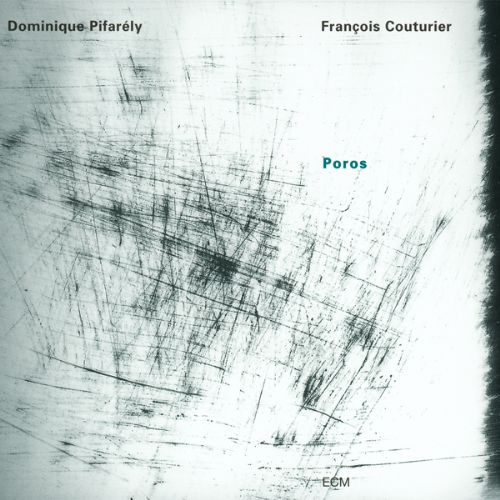
Dominique Pifarély/François Couturier: Poros (ECM 1647)

Poros

Poros

Dominique Pifarély violin
François Couturier piano
Recorded April 1997, Festburgkirche, Frankfurt
Engineer: Markus Heiland
Produced by Manfred Eicher

Dominique Pifarély—violinist and former co-leader of clarinetist Louis Sclavis’s acclaimed Acoustic Quartet—and pianist François Couturier—who since Anouar Brahem’s Khomsa has recorded a string of varied albums for ECM—team up for this unique collaboration. The resulting admixture of folk and modern classical influences finds the duo charting waters that might have otherwise remained glassy and still without the cut of their oars. The image is no mere metaphor, for the album’s title comes from French philosopher Sarah Kofman, who characterizes the concept in precisely these oceanic terms: a path through aquatic expanse that is just as vulnerable to erasure as it is to discovery. Its trailblazing implications rest on a blade of uncertainty, and therein lies their beauty.

One might be hard-pressed, however, to read any of this into the music in the absence of such a setup. The listener is instead confronted with a tantalizing, if restless, chain of events. “Trois images” awakens in a fit of pique, only to realize that the object of its scorn has already fallen away like the house of cards that is any dream. The musicians seem to run frantically trying to rebuild it before it gives up the ghost of reality. In other pieces like “Retours,” “Vertigo,” and the title piece we encounter an even more gnarled grammar. It is a dialectical assemblage of action and thought, of secrecy and exposition. The album is a constellation of references whose stars belie hues of the French modernists, free improvisation, and Bartók, among others. We therefore never rest for too long on one idea. The occasional locks stand out for their beauty, only to drown in a sea of cat cries prancing into blackout. What with the bubbling streams of “Labyrintus” and the grinding gears of “La nuit ravie” there is far more going on below and within, locked away behind a shell of almost ritual design. Pifarély brings the occasional jazzy inflection to the arc of his swing, most notably in Mal Waldron’s “Warm Canto” (from his 1961 album, The Quest), in which he blends tiptoeing pizzicato into explosive resonant chords in a chromatic whirlwind. “Gala” offers a pileated ending.

As on the album’s cover, the duo crosshatches incidentals in a knitted bruise. Pifarély trembles with the motion of a leaf obsessed with the fear of falling. His attention to detail and the precision of his agitations are thus remarkable. Couturier’s intricate astrology calls strangely from below, goading that leaf into decomposition. Only then do we see that the forest has been there all along, tilting, spinning, blurring into a looming mask of greens and browns. Traction is hard to come by, paths invisible. Our mind becomes the score, the stand on which its pages are turned, the sound dying to be released from within it. In thinking we believe, and in believing we know.

<< Giya Kancheli: Trauerfarbenes Land (ECM 1646 NS)
>> Michael Mantler: The School Of Understanding (ECM 1648/49
)

Tomasz Stanko New York Quartet: Wisława (ECM 2304/05)

Wislawa

Tomasz Stanko New York Quartet
Wisława

Tomasz Stanko trumpet
David Virelles piano
Thomas Morgan bass
Gerald Cleaver drums
Recorded June 2012 at Avatar Studios, New York
Engineer: James A. Farber
Assistant: Charlie Kramsky
Produced by Manfred Eicher

They call it: space.
It’s easy to define with that one word,
much harder with many.

The verse comes from the poem “Before a Journey” by Nobel Laureate Wisława Szymborska, whose legacy gives color to a starry tribute from trumpeter Tomasz Stanko. Given the snapshot ethics of Szymborska’s visual language, one could find no better musical interpreter to put this epigraph to the test. For though words may indeed fall short of expressing these swaths of infinitude we call “albums,” the language of instruments in the right hands can accomplish the impossible.

Wisława Szymborska
Wisława Szymborska (1923-2012)

One need hardly expound the virtues of Stanko’s new allies, each handpicked from the profuse garden of the New York City jazz scene. Pianist David Virelles brings a robust gentility to the table that meshes effortlessly with Stanko’s own. Bassist Thomas Morgan and drummer Gerald Cleaver—rhythm section to Craig Taborn’s trio—offer their dark synergy in kind. The proof, as they say, is in the pudding, and over the thickly whipped concoction of this 2-disc set it reaches our ears at the peak of flavor and consistency.

True to inspiration, Stanko and company derive wry upsweep from sentiments that, while unspoken, nevertheless dance in the spaces between. Of those spaces we encounter many, though of a markedly different cast from Stanko’s past ECM joints with the Polish quartet. Those expecting the aching, cool moroseness of that past may marvel at the prevalence of fire. The band swings with the best of them in “Tutaj – Here,” a track that takes its name, like a handful of others, from Szymborska’s final collection. Stanko leaps, as he does also in “Assassins,” at the fortuitousness of this meeting of word, feeling, and expression. He makes us aware of the here and now, as if we were there in the studio with him. Yet while the band is busy running all sorts of virtuosic errands in these dizzying soundscapes, we know that the finery is as thick as the souls it clothes.

The restless grooves of “Metafizyka” and “Mikrokosmos” find the band in a more down-tempo mood, though no less beguiling for melodic accuracy and Stanko’s unchained asides. Further allusions refract in “Faces” and “A Shaggy Vandal,” both highlights, taking their cue from Symborska’s poem “Thoughts That Visit Me on Busy Streets.” Stanko is at the top of his lyrical game in the former, trading off artfully with the others in cells of interpretation, to which Cleaver adds a vivid soliloquy of his own, while the latter is a well-oiled machine that blends influences into a postmodern mélange of rhythmic beastliness.

Despite these dips into upbeat waters, creature comforts reveal a heart whose petals have only grown fuller with the blush of time. Still, lurking in the album’s tenderest moments is an emotional heaviness. This is apparent in the fine patchworks of surplus and deficit that are “Dernier Cri,” in which the ghost of Miles is felt tenfold, and the wistful, floating “Song For H.” For another, “Oni” summons with smooth ritual, showing restraint while inviting us all the same with its beguiling atmosphere: the hallmarks of any good Stanko tune. Though its charm may be as deceptive as its title (if indeed the Japanese meaning of “demon” is intended), we are better equipped for it to wander into “April Story,” which opens nostalgia like a love letter forgotten in the back of a sock drawer. It is a raindrop forever hanging at a leaf’s trembling tip, a tear that never falls but which is sucked back into the eye, whereupon it tells the others: Not today.

Stanko NY Quartet

The title track and its 13-minute variation hug the set with dreams made real. Here the microscopy of the band is at full magnification. Stanko is the stain beneath Cleaver’s brushed cover slide, while Morgan and Virelles provide light and adjust the focus. Morgan’s especially contemplative soloing leaves us suspended before the blade of Stanko’s brass snips that thread and lets us drop into the quiet waters below. Notes linger, bringing us back to wistful ambiences of long ago.

Stanko wields his pen as surely as ever. His younger partners bring all the maturity needed to relay his torch with a grasp that lets everything slip through but the finest crystal. Tuneful to the core, each solo is a holistic admixture of heritages on the one hand and on the other elicits the satisfying crack of new eggs onto the frying pan. Do not go into this album expecting the lofty spaces of Lontano or Suspended Night. These songs are cruder oil to those past efforts’ refined, and all the more enchanting for it. Here the levels are grounded, not airborne. Denser and tenser is the name of the game. But let us not fall deeper into the trap of comparison, for Wisława possesses its own stage and protagonists. In this play there are no villains, only messengers of progress whose abilities precede them and whose reputations burgeon in golden light. Verily, verily so.

Promo video:

(To hear more samples of Wisława, click here.)

OM: A Retrospective (ECM 1642)

OM

OM
A Retrospective

Urs Leimgruber soprano and tenor saxophones, flutes, percussion
Christy Doran guitars, guitar synthesizer
Bobby Burri double-bass
Fredy Studer drums, gongs, percussion
Dom Um Romão percussion, berimbau
Erdman Birke accordion
Recorded 1975-80
Compiled by OM

The iconoclastic group known as OM (after John Coltrane’s album of the same name) took root in the musical wilds of Lucerne, Switzerland in 1972, and for the next decade filled its cup with an idiosyncratic blend of rock and free improvisation. Thus branded, its members launched into the electric jazz universe with comets blazing. Their brilliance had lain dormant in the Land of Out of Print for far too long until this program caught the ECM bug at last and made its way into the open. The current program, chosen by the band from its four JAPO releases, reflects an evolution that is both chronological and elliptical.

OM

From Kirikuki (JAPO 60012) we get two representative tracks, with “Holly” firmly establishing OM’s spaces of conviction. The skittering drums of Freddy Studer, restless bass of Bobby Burri, punctuation of guitarist Christy Doran, and prophetic run-ons of reedist Urs Leimgruber bind a unique sonic book of ever-widening proportion. Leimgruber also plays flute, adding a flavor of incantation to “Lips.” Nourished by Doran’s metallic cries, he plants nostalgic flowers in trodden fields, whipping up a rustic and genuinely direct aesthetic.

From Rautionaha (JAPO 60016) comes the title track, of which the interaction between soprano and guitar is of special note. OM’s penchant for highly controlled insanity, its funneling of whistles and stomps, is elsewhere hardly more apparent. The power of making music together comes alive here. “Rautionaha” also boasts a memorable turning point when Doran unleashes a fluid dentist’s drill that sends the rest spiraling into a quiet, more introverted cause. From angular to curved, the contours turn in on themselves in an epic of sheer improvisatory credence.

Om with Dom Um Romao (JAPO 60022) also yields a single track: the enigmatic “Dumini.” Again, soprano and guitar lay out the welcome mat. Cymbals give them a trajectory to follow, a destination forever invisible because it calls from deep within. The flanged guitar cuts through the din like butter, melting the pain away.

Despite the forthrightness of the playing, many of the album’s moments remind us that even the most aggressive heat shelters a coolly beating heart, which is perhaps why Cerberus (JAPO 60032) makes it into the retrospective fully intact. “Dreaming for the People” begins its formula in much the same way as the previous two examples, only here Doran takes a decidedly fragmented approach, flinging packets of salt into the stew. Mystical turns abound thereafter in “Cerberus’ Dance” and “Asumusa,” each showing the breadth of OM’s sensitivity. “At my Ease” elicits watery textures from Doran as the rhythm section inspires some headstrong lyricism from Leimgruber on tenor. The guitarist’s moment in the sun, however, comes in the company of “Earworms,” a masterful hatching of dots and dashes in swirling pools of Morse code. Yet there is nothing so insightful as the final “Eigentlich wollte Johann auf dem Mond den andern Jazz kennenlernen.” This viscous fever dream, filled with galactic whale songs and lost answers, welcomes accordionist Erdman Birke into the fray for a haunting excursion into the soul. With the persistence of a flare drowning in an electronic swamp, it awakens hidden feelings. A radio blurs in and out of vision, intimations of faraway lands and rituals, painstakingly whitewashed until they bow in deference to the ether. In this music we can trace a satellite’s path.

Cerberus

To listen to OM is to witness an evolutionary process in biological time. This superbly assembled collection of music we can taste, smell, and touch, then, holds the key to its own reveal. It has a tinge of ash, a starchy texture, and licks like fire in a burning house, abandoned except for the music that has inhabited it for so long. Its magic has nothing to do with mystery, for it speaks with voices we already have in mind. Whether or not we recognize them is of no consequence. They know us inside and out.

<< Brahem/Surman/Holland: Thimar (ECM 1641)
>> Maya Homburger/Barry Guy: Ceremony (ECM 1643 NS
)

Eberhard Weber: Résumé (ECM 2051)

Résumé

Eberhard Weber
Résumé

Eberhard Weber electric double bass, keyboards
Jan Garbarek tenor and soprano saxophones, selje flute
Michael DiPasqua drums, percussion
Recorded in concert 1990-2007
Recording engineers: Walter Speckmann and Gert Rickmann-Wunderlich
Produced by Manfred Eicher

There’s a reason why songs on a CD are called “tracks.” Each takes us on a journey somewhere, and no jazz bassist sports the conductor’s hat in quite Eberhard Weber’s way. Over the course of 1000+ concerts with the Jan Garbarek Group, the German bassist/composer has for decades enthralled listeners with unimaginable pathways, all the while defining and redefining a sound for the ages. Each of those concerts featured a solo entr’acte, wherein fomented some of his most extraordinary ideas. Résumé consolidates a cohesive selection of these in a fresh program of eternal ideas. More than mere interludes, each is a marker of the respective location that titles it.

Weber 1

Weber devotees will recall his 1988 Orchestra (link), half of which placed him in a solo spotlight. If that memorable record gave early and lasting insight into his uncompromising ear for melody, then Résumé furthers the crucible’s purpose in boiling down to the essence of who he is. This is Weber in the flesh, in no way obscured by the spontaneous loops, forged in real time, that issue from his electronic paraphernalia. Aside from these ghostly selves, his is not truly solitary endeavor throughout, for he also has a sprinkling of help from drummer Michael DiPasqua and saxophonist Jan Garbarek, the latter also on the selje flute. The overtones of this Norwegian folk instrument add blush to the canvases of “Karlsruhe” and “Bath.” The first paints arco flight paths like the steps of cranes lingering in the scent of freshly harvested rice paddies. The second is angular and playful, and finds Weber tying his bow into an assortment of harmonic knots before darkening into a heavy drone.

Such contrasts can be found as much within tracks as between them, though nowhere more acutely than in “Liezen.” The program’s opener is a window into the heart of a man whose artistry is heart incarnate. Lush chords usher us down a gallery of warm emotions, its walls decorated by the vibrant palettes of wife Maja that grace so many of his past album covers. Swinging from delicate pizzicato branches, Weber strings more robust vines through a germinating landscape. Keyboards scatter like windblown blossoms as Weber dances into the crowning night. The profundity of his intuition comes to fruition in “Heidenheim,” which weaves DiPasqua’s sparkle through looped matrices, each a world in a pocket fed to us in a trail of crumbs. Percussion and strings crosshatch again in “Amsterdam” and “Bochum.” Both of these, with their Steve Reichean marimba pulse, provide rich textural detail and irresistible propulsion. “Lazise” brings us out of the tunnel and into a wintry countryside, where a carnival of the mind awaits our arrival.

Garbarek’s reeds haunt the murkiest coves, fully a porpoise coaxed toward the setting sun while schools of fish swim spirals in the briny deep. With a presence like light through leafy shadow, he drops some of his most mystical sopranism on record into “Tübingen.” Here the feeling is of song, of evocativeness.

Weber’s fingers are feet, their paths still radiant all these years later. His traveler’s mind brings photographic clarity to every locale. Of Santiago we see the snowcapped mountains and spired churches, feel the swoon of star-crossed lovers whose bodies meet only under cover of dreams. In “Wolfsburg” we skim across water and technology, ending on a high signal cast into the world at large. Like its namesake, “Marburg” is a towering architectural node, leaving “Grenoble” nestled in its Alpine settlement, where cinematic strings blend us into terra firma.

Weber 2
(Photo by Jörg Becker)

This is more than a résumé in the sense of being a mere list of past accomplishments, for it engenders new ones through our experiencing of them. Like the crowd whose voices occasionally appear, we can only show our appreciation from far below, reading familiar shapes into every passing cloud.

(To hear samples of Résumé, click here.)

Charles Lloyd: Voice In The Night (ECM 1674)

Voice In The Night

Charles Lloyd
Voice In The Night

Charles Lloyd tenor saxophone
John Abercrombie guitar
Dave Holland double-bass
Billy Higgins drums
Recorded May 1998 at Avatar Studio, New York
Engineer: James Farber
Produced by Manfred Eicher

First loves never die. When it comes to jazz, Voice In The Night was mine. Not only was it the first proper jazz album I ever purchased, but it also introduced me to a tenor sound that had me at note one and has yet to let go. Memphis-born but California-spirited, Charles Lloyd has expanded the sweep of his instrument in incalculable ways by means of an unerring willingness to surmount every obstacle that stands in his way. After jumping the pond for a handful of (re)defining sessions, including the unmissable All My Relations and Canto, this fish out of water kept stateside, recording in New York’s Avatar Studios with a crew of new and old alike. By the time of this record, he and drummer Billy Higgins had had a history stretching back to the mid-1950s. Bassist Dave Holland and guitarist John Abercrombie were mixed recruits—Holland having shared a festival stage or two with Lloyd, Abercrombie fresh on the boat. Abercrombie had been especially astonished by Lloyd’s depth and phrasing, and the introduction of the former to the latter’s milieu was a masterstroke.

This album bears prime witness both to Lloyd’s songcraft and to the wonders it inspires in his band mates. His restless arpeggios are more than just that. Like emotional tics he can’t (and need never) shake, they constitute a grammar all their own, each a subtle unpacking. They flow throughout the title opener with such soul-to-soul intrepidity as to turn each gesture into a different shade of charcoal. With said charcoal this intensely laid-back quartet draws a bold landscape of shadows and dreams. Some ring more fancifully, such as a topflight rendition of the Elvis Costello/Burt Bacharach tune “God Give Me Strength,” given here a full and chromatic treatment that pushes Higgins into the foreground with the inevitability of April wind. Lines of the eponymous tune reverberate in the playing:

And I don’t have anything to share
That I won’t throw away into the air

If Lloyd is the voice in the night, Abercrombie brings out the stars, calling forth a fluid artistry in what just might be his best date since Timeless. His soft, midrange-heavy tone flows like rain down a window. Standout moments abound in “Requiem” and in “Homage,” the second a hip display of acrobatic proportions. With fingers flying and solos enchanting (the homage can only be to Coltrane), in addition to a bubbling drum solo at the fulcrum, there’s much to savor in repeated listening.

Other dreams, such as “Dorotea’s Studio,” read more impressionistically. Abercrombie’s extended solo here inspires the rhythm section to build the melodic frame into which Lloyd eases his way and dances amid a collection of artifacts. Carved wood, painted canvas, developing film: these vestiges of impulse come to life in the absence of their creators. This is an emblematic track for its unforgettable vamp and organic shifts in key, all working toward a flick of an ending, abrupt and sincere.

Lloyd is so known for his personal reflections, and in this regard “Island Blues Suite” represents a return to roots. This multifaceted track blends backyard jam aesthetics and weaves through them, by way of Abercrombie’s strings, a chain of uninhibited dances. Subtle soloing from Holland and a keening guitar are icing on the cake. Lloyd takes the deepest dip into his canon with a newly re-imagined “Forest Flower” (this one goes back to the 1967 live album of the same name). The bossa nova undercurrent sets Abercrombie on a fruitful improvisatory path, while Holland’s whispers reveal the set’s dynamic charge. These interactions smooth into a long play-out before Billy Strayhorn’s melodic strength blossoms in “A Flower Is A Lovesome Thing,” in which Lloyd lays heavy tenderness over a Saharan pulse until earth and sky change places.

As a whole, the band maintains a steady river without the need for waterfalls. The fact that Voice is also a melodic tour de force for Lloyd in particular only sweetens the pot. His is a clarifying presence that brings lucidity to the current with so much vision, it’s almost blinding. James Farber’s rounded engineering gives us the clearest sense possible of the importance of space in the tenorist’s songcraft. The result is lyrical music-making at its best. Classic to the bone.

<< Erkki-Sven Tüür: Flux (ECM 1673 NS)
>> Keith Jarrett: The Melody At Night, With You (ECM 1675
)