Louis Sclavis Quintet: Rouge (ECM 1458)


Louis Sclavis Quintet
Rouge

Louis Sclavis clarinets, soprano saxophone
Dominique Pifarély violin
Bruno Chevillon bass
François Raulin piano, synthesizer
Christian Ville drums
Recorded September 1991 at Rainbow Studio, Oslo
Engineer: Jan Erik Kongshaug
Produced by Manfred Eicher

Rouge is the magical label debut from clarinetist and soprano saxophonist Louis Sclavis, fronting here a group whose unity betrays an innocence honed to a galactic edge.

The album is an organically connected unit, a suit of sights and sounds working in concert toward a vastness that outstrips them all. I cannot help, from the vantage point of retrospection, draw certain musical connections throughout this hour-long journey. First are the Edward Vasala-like touches of “Kali la nuit,” which like the enigmatic drummer paints a veritable field whose constellations are marked by the hoof-prints of wild horses. Tales of war and tradition intermingle until they become one unbreakable braid, contrasting visceral screams with old-school togetherness. One then encounters the specter of minimalism in “Reeves,” which seems fed through a kaleidoscope filled with shards of Philip Glass. These are merely an exploratory introduction to the intense electric violin of Dominique Pifarély, who stirs the drink until there’s only ice left in the glass. A heady piano trio fills out the backdrop all the while with a glittering appliqué of finely wrought support. “Les bouteilles” is perhaps the most eclectic. With head nods ranging from John Surman (in its exquisite attention to melodic and technical detail), Steve Reich (in the string playing), and Pat Metheney (in the exuberant close), it’s a fantastic ride.

These comparisons do nothing to rob Sclavis of his originality, for he casts a shadow from a distinct angle of mind and experience. As in the dawn-drenched threads of “One,” he draws his craft through varicolored needles. His flair for the programmatic is also notable, as in “Nacht,” in which bassist Bruno Chevillon folds his alchemy into the batter of the evening sky, baked to a crisp by distant stars and glazed with a sugary free jazz concoction courtesy of drummer Christian Ville. “Reflet” is an even starrier affair, one of many celestial moments in the album’s remainder, all of which find rest in “Face Nord.” Like a rewound VHS tape, this highly cinematic track spools back through climax, tragedy, romance, and into an innocent beginning. This we find fleshed forward in “Yes love,” the album’s last, stringing us across pianist François Raulin’s web of emotional power, innocence, and honesty—the tenets by which this groups lives, breathes, and plays.

<< Anouar Brahem: Conte de L’incroyable Amour (ECM 1457)
>> Veljo Tormis: Forgotten Peoples (ECM 1459/60 NS)

Anouar Brahem: Conte de l’incroyable amour (ECM 1457)


Anouar Brahem
Conte de l’incroyable amour

Anouar Brahem oud
Barbaros Erköse clarinet
Kudsi Erguner ney
Lassad Hosni bendir, darbouka
Recorded October 1991 at Rainbow Studio, Oslo
Engineer: Jan Erik Kongshaug
Produced by Manfred Eicher

After a memorable ECM debut with Barzakh, Anouar Brahem recorded this even more memorable sophomore effort one year later. Carrying over percussionist Lassad Hosni, Brahem welcomes Turkish musicians Kudsi Erguner on ney and Barbaros Erköse on clarinet. Erköse, a gypsy music specialist, adds rich colors to an already dense palette, weaving tethers that pull us into tender worlds. His duets with Erguner (“Etincelles” and “Peshrev Hidjaz Homayoun”) stand out as some of the album’s most flowing. The title track brings the patter of clay drums, weaving a gorgeous ney into our vision. (The melodies and rhythms here put this listener immediately in mind of the song “I Love You” from Omar Faruk Tekbilek’s album One Truth.) Captivating. Erguner shines again in “Diversion.” Slaloming through every drummed pillar with the conviction of a bird in search of prey and yet with the delicacy of an angel avoiding such violence, he brings a sense of history to every lilting gesture. “Nayzak” revives the clarinet amid oud and drums for a stunning taste of mountains and the plains. The album’s meat, though, comes in Brahem’s unaccompanied storytelling. From the dawn chorus of “L’oiseau de bois” and invigorating virtuosity of “Battements,” through the tender air “Le chien sur les genoux de la devineresse,” and on to “Epilogue,” there is unimaginable depth of yearning in every twang and strum.

This album is all about the composition, stripped to the barest essentials of melodic craft and burrowing straight into the marrow of our past lives.

<< Eleni Karaindrou: The Suspended Step Of The Stork (ECM 1456)
>> Louis Sclavis Quintet: Rouge (ECM 1458)

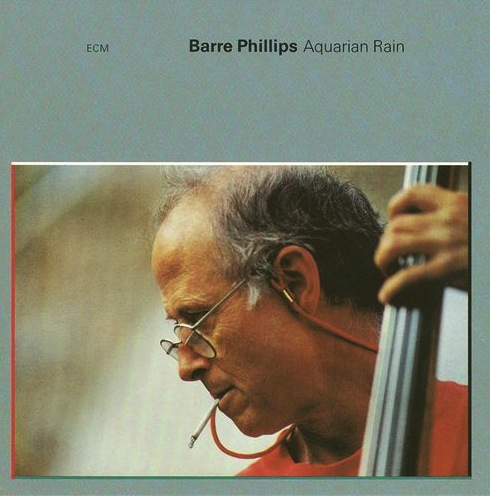
Barre Phillips: Aquarian Rain (ECM 1451)

Barre Phillips
Aquarian Rain: Music for bass, percussion and tape

Barre Phillips double-bass
Alain Joule percussion
Recorded May 1991 at Rainbow Studio, Oslo
Engineer: Jan Erik Kongshaug
Produced by Manfred Eicher

Constant readers will by now be well aware of my Barre Phillips worship. It seems the man can do no wrong when left to his own devices under the auspices of my favorite label, and Aquarian Rain is no different. As a first, this time around the individual tracks go less by titles than by explanatory cues, for in the first, “Bridging,” we find connections already being made between disparate continents. Its guitar-like exuberance and melodic percussion (courtesy of Alain Joule) skirt arco territories toward stillness. “The Flow” brings about a sense of fluidity through electronic whispers, Joule’s vivid comments accentuating the bass’s inner core and painting its outer skin with observations. Phillips elicits a range of avian effects, from twittering concealed in foliage to lanky elegance of cranes and waterfowl, both hunting and in the rapture of a mating dance. “Ripples Edge” does indeed trace the water’s rim with its opening harmonics and navigates surface tensions like a water skater. Grammatical flair abounds in “Inbetween I and e.” Like a skilled poet who learns the rules only to break them with creative beauty, Phillips seems to mike a degrading clock from the inside. “Ebb” recesses into “Promenade de Memoire,” which like memory is a deeply rooted thrum torn by cries of the present. This intrusion of technology upon the emotional makes a fascinating blend of startling breakers and ponderous undertows. “Eddies,” along with “Early Tide,” puts me in mind of Andy Goldsworthy’s spinning wood in the documentary Working with Time, while “Water Shed” takes shelter from the oncoming storm by ruminating among tackle and life preservers until we get finally to the title track, which empties like a pipe into a pile of panned materials, finding its closure in the chatter of icicles.

Such astounding sound colors are difficult to describe and bear comprehension only through listening. Needless to say, they coalesce into yet another cerebral and perfectly realized episode in the Phillips drama. His is a highly melodic strain of the avant-garde. Not that you’ll be humming these tunes anytime soon, but they’ll certainly hum you.

<< Keith Jarrett: Bridge Of Light (ECM 1450 NS)
>> Heiner Goebbels: Hörstücke (ECM 1452-54)

Trevor Watts/Moiré Music Drum Orchestra: A Wider Embrace (ECM 1449)

Trevor Watts
Moiré Music Drum Orchestra
A Wider Embrace

Trevor Watts alto and soprano saxophones
Nana Tsiboe african drums, congas, gonje, djembe, lead twanga, wea flute, vocals
Nee-Daku Patato congas, african drums, berimbau, bells, cabasa, vocals
Jojo Yates mbira, twanga, cowbells, african drums, bells, cabasa, wea flute, vocals
Nana Appiah african drums, lead wea flute, shakers, cabasa, cowbells, vocals
Paapa J. Mensah kit drums, shakers, wea flute, vocals
Colin McKenzie bass guitar
Recorded April 1993 at Angel Studios, London
Engineer: Gary Thomas
Produced by Steve Lake

Blending Ghanaian folk music with groove and jazz elements, saxophonist Trevor Watts and bassist Colin McKenzie join a group of multitalented drummers for one of ECM’s smoothest crossovers. My ignorance of all the musicians involved allowed me to take its sounds as they came during my first listen. The energy that surges from the first drum hit of “Egugu” frees a chorus of voices calling to the sky as every drum leaves a footprint upon the plains. Watts treats these visions not as mere backdrop but as an environment into which he must totally integrate himself. The medley that follows is an album in and of itself, starting with the spirited “Ahoom Mbram” and ending with the drums-only “Tetegramatan.” Watts adds a nice rasp to his soprano in “Opening Gambit” (and don’t miss the shawm-like circular strains of “Brekete Takai”), while “Otublohu” brings on the fun(k) and then some with some heady alto work over a firm grounding of bass and get-out-of-your-seat-and-dance rhythms. After the pleasant excursions of “Bomsu” and the a cappella “Hunters’ Song: Ibrumankuman,” the tinkling percussion of “The Rocky Road To Dublin” dives into a swanky trio with an ecstatic finish. The jazziest moods await in “Southern Memories.” Throwing his smoky alto into the night, Watts engages a funky bass line and powerful vocals, only to recede for the congregation of flutes and spirits in “We Are,” which carries us out on invisible wings.

A fantastic coming together, superbly recorded. This is the art of song personified.

<< Cherry/Åberg/Stenson: Dona Nostra (ECM 1448)
>> Keith Jarrett: Bridge Of Light (ECM 1450 NS)

Don Cherry: Dona Nostra (ECM 1448)

Don Cherry
Dona Nostra

Don Cherry trumpet
Lennart Åberg saxophones, flute
Bobo Stenson piano
Anders Jormin bass
Anders Kjellberg drums
Okay Temiz percussion
Recorded March 1993 at Rainbow Studio, Oslo
Engineer: Jan Erik Kongshaug
Produced by Manfred Eicher

Trumpeter Don Cherry gets cozy with some of ECM’s brightest European talents for a onetime sextet of notable introspection: reedman Lennart Åberg, pianist Bobo Stenson, bassist Anders Jormin, drummer Anders Kjellberg, and percussionist Okay Temiz. It’s hard not to love the very concept, and the music lives up.

“In Memoriam” opens the session’s eyes in a waking dream of deferential pianism and scurrying percussive accents. Jormin’s laddered circles sweep through Stenson’s, while lovely tenor work returns to the soil, even as it holds on to memories of the sun. “Fort Cherry” at last puts its namesake’s lips to brass, melding shades of Ornette Coleman into warm piano strains. For the direct Coleman digs, we need look no further than “Race Face” (which gives us the satisfaction of traction with some fresh and lively playing) and “What Reason Could I Give” (a noteworthy duet between Stenson and Cherry that is also the highpoint of this date). “Arrows” winds a stem of bass, pollinated by a flurry of spores. Well-rounded soprano and bass solos twist into a quietly spasmodic ending. “M’Bizo” begins as a viscous, Nordic-sounding dirge before emptying its waters into a Charles Lloyd-shaped vessel, cycling back and forth between these two modes toward “Prayer,” which features lovely playing from Jormin, searing lines from Cherry, and some beatnik style percussion thrown in for good measure. The suitably abstract color show of “Vienna” then sets us down in the ecstatic “Ahayu-Da,” all laced together by Stenson’s consonant presence for a breathless finish.

While everyone contributes to this deceptively open session, it would be a crime to neglect Temiz’s vital contributions. These and more make this an album of incredible subtlety to be savored.

<< Dino Saluzzi Group: Mojotoro (ECM 1447)
>> Trevor Watts/Moiré Music Drum Orchestra: A Wider Embrace (ECM 1449)

Dino Saluzzi Group: Mojotoro (ECM 1447)

Dino Saluzzi Group
Mojotoro

Dino Saluzzi bandoneón, percussion, voice
Celso Saluzzi bandoneón, percussion, voice
Felix “Cuchara” Saluzzi tenor and soprano saxophones, clarinet
Armando Alonso guitars, voice
Guillermo Vadalá electric bass, voice
José Maria Saluzzi drums, voice
Arto Tuncboyaci percusson, voice
Recorded May 1991 at Estudios Ion, Buenos Aires
Engineer: Jan Erik Kongshaug
Produced by Manfred Eicher

On this wonderful date from the early 90s, Dino Saluzzi joins brothers Celso (doubling Dino on bandoneón), Felix (on saxophones and clarinet), and drummer José for a true family effort. Fleshed out by guitar, bass, and percussion, the so-called Dino Saluzzi Band strikes out with a solid session from start to finish. Even in such a populated setting, Saluzzi’s characteristic backward glance is as intimate as ever, threading every needle on the horizon with voices from a valued past. His bandoneón bubbles from a fissure of memory as Felix’s gravelly tenor waxes mythic across the plains, but finds its purest sentiment in “Tango a mi padre.” One of my all-time favorite Saluzzi songs, this time it is augmented by a buttery soft soprano. This segues into “Mundos,” which finds Felix back to tenor over rolling hills of percussion and reedy drones. “Lustrin” is circumscribed by singing children, drawing us into a wall of nostalgia, at the center of which stands the personable guitar of Armando Alonso. Dino pairs with Felix yet again (this time on clarinet) in the mournful “Viernes Santo” for a track that wouldn’t feel at all out of place on an Eleni Karaindrou soundtrack. One of Dino’s best, to be sure. “Milonga (La Puñalada)” is a more dance-like number, which with a shake of the hips and the wag of a finger leads us into “El Camino,” a straight path into the beyond, where the past reigns anew.

Dino Saluzzi’s salt-of-the-earth sound enchants, the power of his inspiration all the greater when activating an already fine band of musicians. There can be no room for gimmicks; only song.

<< Tamia/Pierre Favre: Solitudes (ECM 1446)
>> Cherry/Åberg/Stenson: Dona Nostra (ECM 1448)

Tamia/Pierre Favre: Solitudes (ECM 1446)

Tamia
Pierre Favre
Solitudes

Tamia voice
Pierre Favre percussion
Recorded April 1991 at Rainbow Studio, Oslo
Engineer: Jan Erik Kongshaug
Produced by Manfred Eicher

Tamia and partner Pierre Favre continue the love letter begun in de la nuit … le jour with Solitudes. Tamia opens this even deeper dive in “Chant d’Exil” by wrapping her astonishing voice around a thread-like drone. Favre’s malleted energy unspools into a glassine bone walk of private ritual. And there it ends, leaving us in the silent answer from which “Drame” unmasks its rasps and gongs. Tamia upends the water’s waking dreams, singing of sulfur and magma, in places where lullabies can be sung only to the dead. The thin drone of circumstance returns in “Clair -­ obscur.” It is a circle under a microscope slide filled with cytoplasmic ululations, a flute hollowed out from a tree branch and smeared along a copper sky. That voice rises from its chorused depths like a flock of recorders. “Pluies” is a percussion-only piece, dancing between a drum’s low beat and the metallic swirl of cymbals. Amphibian croaks and avian cackles draw themselves into a fading tail-wisp of bowed gongs. Shades of Meredith Monk abound in “Allegria,” an interlude to the electrifying sprawl of “Erba Luce.” Over the slow arpeggios of “Sables” Tamia connects her dots all the way to the title track, which sings through a solemn organ pulled down from the sky and made earthly through breath alone. Tamia extends the threads of her craft through its intangible pillars for a mythology that echoes far into the icy silence of our future.

<< Jon Balke w/Oslo 13: Nonsentration (ECM 1445)
>> Dino Saluzzi Group: Mojotoro (ECM 1447)

Jon Balke w/Oslo 13: Nonsentration (ECM 1445)


Jon Balke
Oslo 13
Nonsentration

Per Jørgensen trumpet
Nils Petter Molvær trumpet
Torbjørn Sunde trombone
Morten Halle alto saxophone
Tore Brunborg tenor saxophone
Arne Frang tenor saxophone
Audun Kleive drums
Jon Christensen drums, percussion
Finn Sletten percussion
Miki N´Doye percussion
Jon Balke keyboards
Recorded September 1990 at Rainbow Studio, Oslo
Engineer: Jan Erik Kongshaug
Produced by Jon Balke

With the number of musicians assembled on Arild Andersen band veteran Jon Balke’s first ECM album as leader, one might expect a big sound. What we get is a subtle and artfully arranged set of 10 originals. Take “Circling The Square,” for example, an easy album highpoint, which with quiet percussion and horns lays down a runway for trumpeter Per Jørgensen’s electronically enhanced flight. Other joyful landing strips can be found in “Stop” (which features some splashes of engagement from Balke at last and superb tenor work from Tore Brunborg) and “Nord.” The album begins in a solemn mood, however, and seems to never to let go of those darker threads no matter how energetic the playing gets. These tender underpinnings are given more overt exposure in tunes like the montuno-flavored “Blic” and the smooth outro that is “Construction Stop.”

One can hardly pass a comb through this session without singling out “The Laws Of Freedom.” With a minimal and open sense of play from Balke over the subtlest of drones one can imagine, this breathtaking journey into a piano’s beating heart turns reverberation into cloud and spirit, and presses between them footsteps of air. One of the most beautiful tracks in the entire ECM catalogue and reason enough to own this album.

Although not an entirely consistent effort, behind the clever title of Nonsentration lies an honest set, one to put on in the background and listen to closely by turns.

<< Garbarek/Vitous/Erskine: StAR (ECM 1444)
>> Tamia/Pierre Favre: Solitudes (ECM 1446)

Garbarek/Vitous/Erskine: StAR (ECM 1444)


StAR

Jan Garbarek soprano and tenor saxophones
Miroslav Vitous double-bass
Peter Erskine drums
Recorded January 1991 at Rainbow Studio, Oslo
Engineer: Jan Erik Kongshaug
Produced by Manfred Eicher

StAR is yet another classic from a fertile period for Jan Garbarek. Clothed in some of Barbara Wojirsch’s most striking typography, it holds an intimate portrait of one of ECM’s profoundest artists. Characteristic trails fade in the title track like infant spiders’ webs as bassist Miroslav Vitous dances a solemn dance. Garbarek unlocks a doorway in the sky, where the only keyhole is a star, before teleporting back to earth to find his roots in “Jumper.” The scatting syncopation here draws us into a vocal world. “Lamenting” begins with a keen from Garbarek and Vitous filled with such beauty that every tear in its vision changes into hopeful light, sketched into life by Erskine’s pastel accents and Garbarek’s distinctly burnished tenor. From scintinllating beginnings, “Anthem” purrs with snare rolls from Erskine, backgrounding a celestial wash. “Roses For You” takes its first timid steps widely and innocently in the bass, Garbarek again showing unique sensitivity, born of attention and experience. He flips slowly through an album of love and loss in equal measure, cradling it in a hand smooth with youth and turning pages with fingers wrinkled with age. “Clouds In The Mountain” brings us to the album’s most spirited territory, fluttering like eyelashes into the sun’s glare. “Snowman,” on the other hand, is a dose of wintry whimsy, cracked like an egg by some mystical overdubbing. “The Music Of My People” ends with a lovely homage to the inspirations of a saxophonist who has done so much to expand the art from the sea into the fjords, and beyond.

<< Jan Garbarek: Ragas and Sagas (ECM 1442)
>> Jon Balke w/Oslo 13: Nonsentration (ECM 1445)