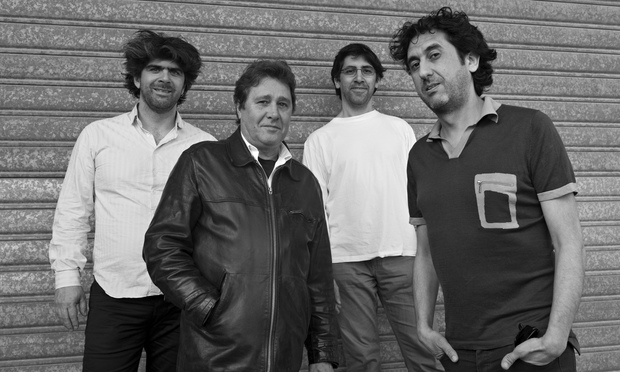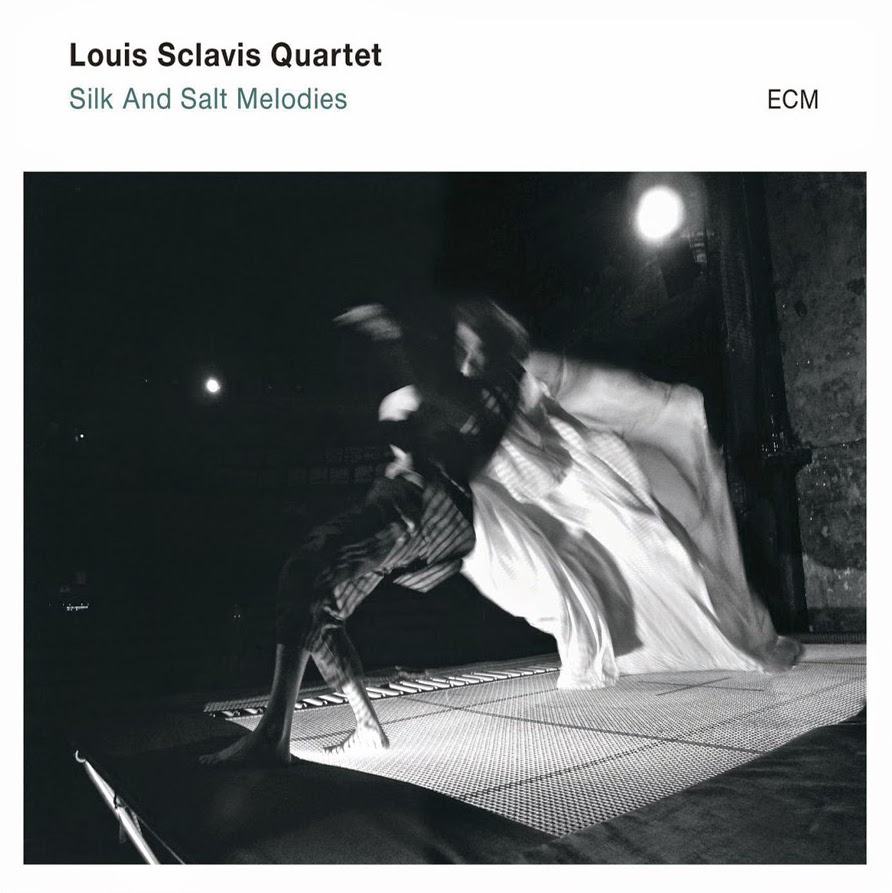
Michael Mantler: The Jazz Composer’s Orchestra Update (ECM 2391)

Mantler Update

Michael Mantler
The Jazz Composer’s Orchestra Update

Nouvelle Cuisine Big Band
Christoph Cech conductor
Michael Mantler trumpet
Harry Sokal tenor saxophone
Bjarne Roupé guitar
Wolfgang Puschnig alto saxophone
David Helbock piano
radio.string.quartet.vienna
Bernie Mallinger violin
Igmar Jenner violin
Cynthia Liao viola
Asja Valcic cello
Recorded live August 30/31 and September 1, 2013 at Porgy & Bess, Vienna, Austria
Engineer: Martin Vetters
Mixed and mastered October and December 2013 at Studios La Buissonne, Pernes_les_Fontaines, France
Engineers: Gérard de Haro and Nicolas Baillard
Produced by Michael Mantler
An ECM Production in collaboration with Porgy & Bess, Vienna

Trumpeter and composer Michael Mantler began the Jazz Composer’s Orchestra in the mid-1960s with Carla Bley as a larger outlet for radical jazz interventions. Having just arrived in New York City as a young man from Vienna, Mantler was raring to float his ideas among musicians—Pharoah Sanders, Cecil Taylor, and Don Cherry among them—who cared. In an interview with Steve Lake printed in this album’s booklet, he stresses the tightly knit community of free jazz at the time. The scene was small, he recalls, “and most everybody knew and worked with each other, having formed a kind of bond through necessity, since we were involved in a music that was commercially totally unviable and often even quite disliked by the mainstream audience and critics alike.” While digitizing old JCO scores in 2012, he saw a chance at renewal and The Jazz Composer’s Orchestra Update was born. The new pieces—penned 1963-69 and revised in 2013—are sheep in wolves’ clothing, each precisely notated but with room to spin wool of improvisation.

MM

Mantler has always been one for forthright atmospherics, and these pieces are no exception to that tendency. If anything, they embody it to the fullest. Aiding in the reshuffling are guitarist Bjarne Roupé (last heard on Mantler’s For Two), altoist Wolfgang Puschnig, tenorist Harry Sokal, pianist David Helbock, the radio.string.quartet.vienna, the Nouvelle Cuisine Big Band under the direction of Christoph Cech, and the composer himself on trumpet. Mantler is, in fact, the featured soloist of Update One, which introduces a slightly dissonant and reactive world of sound. Because the big band cuts such a complex figure in the studio, muscling its way through a chain of through-composed cells, each “Update” may be distinguished by its soloist(s). While all the musicians here are well suited for the job, Roupé is a natural-born Mantler interpreter. His gestures cut like a razor across Updates Eleven and Part 1 of Twelve, both of them bursting with roots in a gnarled sort of grandeur.

The main reedmen are likewise exceptional. Sokal’s tenor flips a coin of thunder and soul in Update Eight, landing once on each side in the name of night. Puschnig’s alto, rides a wave somewhere beyond even those extremes in Update Ten, crashing on a vacant shore and leaving only a tender solo from bassist Manuel Mayr to show for having been there. Update Five lodges both saxophones in a briar patch of architectural impulses as the brass section blasts its messages with faith. The radio.string.quartet.vienna adds a dab of brooding to the palette in Update Nine. Violent expectorations, flowering pizzicati, tinkling cymbals, bright piano, clarion trumpet, and dim sonorities from the horns all enhance the strings’ flexibility as spider-web anchors bowing in the wind. Update Six, meanwhile, boasts crepuscular descriptions from Helbock at the keys, while Mantler returns in his barnacled shell.

The last two tracks form an unspoken diptych, with “Update Twelve Pt. 2 (Preview)” going all in with its round of spotlights, and “Update Twelve Pt. 3” taking the opposite route in a skeletal motif, ending where it might also have began: with a thesis statement. It’s an enjoyable reminder that Mantler’s pieces, while consummate in execution, are forever malleable in form, markers along a trail like no other on ECM grounds.

(To hear samples of The Jazz Composer’s Orchestra Update, click here.)

The Jazz Composer's Orchestra Update

Kenny Wheeler: Songs for Quintet (ECM 2388)

Songs for Quintet

Kenny Wheeler
Songs for Quintet

Kenny Wheeler flugelhorn
Stan Sulzmann tenor saxophone
John Parricelli guitar
Chris Laurence double bass
Martin France drums
Recorded December 2013 and mixed September 2014 at Abbey Road Studios, London
Engineer: Andrew Dudman
Assistant: Toby Hulbert
Mastering: Frank Arkwright
Produced by Manfred Eicher and Steve Lake

The late trumpet/flugelhorn virtuoso and composer Kenny Wheeler was one of jazz’s most beloved musicians and every album he recorded for ECM was an event to be savored—and now more than ever with Songs for Quintet. Wheeler’s last recording nestles some classics in mostly newer material and is a departure for the label in being recorded at London’s legendary Abbey Road Studios, where he is joined by longtime friends tenor saxophonist Stan Sulzmann, guitarist John Parricelli, bassist Chris Laurence, and drummer Martin France.

KW

Given the way that “Seventy-Six” eases its way into the heart, you can be sure this is a Wheeler record. Like “The Long Waiting” later in the set, it rests on a foundation of bass and guitar, on which the band builds its togetherness. Within this mesh, Parricelli slings his guitar solo like a comfortable leather bag that conforms to the body from years of regular use. In both tracks, Sulzmann’s tenor is another remarkable voice, shadowing Wheeler’s own lyrical fronting without stepping on their toes. In fact, he and the rest are in obvious deference to their leader’s coolness.

Two blasts from the past, buffed to a reflective shine, enrich the album with their inclusion. “Old Time,” last heard as “How It Was Then” on the 1995 Azimuth album of the same name, is among the groovier numbers. Sulzmann and Wheeler share soaring harmonies over some prime rhythm sectionining: France an ambassador of finesse and Laurence of nimble eccentricities. And one of ECM’s finest jazz albums of all time, Angel Song, gets a nod in “Nonetheless,” a deserving self-tribute now shed of its shadows in the presence of brighter cymbals and guitar. Sulzmann’s wings catch thermal after thermal in a space that Wheeler might once have claimed on Gnu High. The saxophonist’s true standout track, though, is “Sly Eyes,” a luscious tango that is all the wiser for its bassing. “Pretty Liddle Waltz” is another robust dance.

The cryptically titled “1076” is champagne in a bottle, by which is christened a scuttling vessel. Like “Jigsaw,” its elements interlock seamlessly. The latter tune is slick in that distinctly Wheelerian way and spotlights a musician with a lot on his mind. By his gentle yet forthright tone, Wheeler serves no pretense but the down-home profundity of his vision. Even as his younger sidemen paint sunbursts overhead, he is content to strip his cottage and repaint its walls in variations of that same comfortable shade. In keeping with the rural theme, “Canter No. 1” begins with a relaxed bass solo, from which Wheeler spins an enchanting story. Each chord change becomes a rope swing in his hands as he suspends his peerless language over childhood rivers toward fuller throttle.

Not only is this as fine a swan song as one could hope for; it’s also fantastic album in and of itself. Were one to approach it not knowing the personnel involved, it would sound just as poignant, for its strength lies first and foremost in the writing: a mark of greatness, if ever there was one.

(To hear samples of Songs for Quintet, click here.)

Chris Potter & Underground Orchestra: Imaginary Cities (ECM 2387)

Imaginary Cities

Chris Potter
Underground Orchestra
Imaginary Cities

Chris Potter tenor and soprano saxophones, bass clarinet
Adam Rogers guitars
Craig Taborn piano
Steve Nelson vibraphone, marimba
Fima Ephron bass guitar
Scott Colley double bass
Nate Smith drums
Mark Feldman violin
Joyce Hammann violin
Lois Martin viola
Dave Eggar cello
Recorded December 2013 at Avatar Studios, New York
Engineer: James A. Farber
Assistant: Tim Marchiafava
Mixed October 2014 by Manfred Eicher, Chris Potter and James A. Farber
Produced by Manfred Eicher

Chris Potter has been deservedly recognized as a superlative musician and soloist, but he will just as likely go down in history as one of the great jazz composers of his time. Having already proven himself in that capacity with The Sirens, Potter continues his relationship with the only label with vision deep enough to realize his own. The title of Imaginary Cities evokes Italo Calvino’s invisible ones, and like the Italian magical realist’s vignettes depicts the same space from different angles of time and perspective. Bringing life to this masterpiece are the musicians of his Underground Orchestra. Essentially an expansion of his Underground quartet with guitarist Adam Rogers, pianist Craig Taborn, and drummer Nate Smith, the current project adds to that nexus bassists Fima Ephron (on electric) and Scott Colley (on upright), vibraphonist and Dave Holland Quintet colleague Steve Nelson, and a string quartet headed by violinist Mark Feldman.

The album’s torso is the title suite in four parts. Beginning with the sparkle of “Compassion,” moving through the propulsive “Dualities” and “Disintegration,” and ending with “Rebuilding,” Potter applies pigment to a formidable cityscape indeed, beyond which the bandleader’s sidemen and -women unroll ocean until an entire globe’s worth of water is given a chance to reflect it. Strokes of brilliance to listen for are Rogers’s constellatory riffs (especially in the far-reaching Part 4) and the string quartet writing of Part 2 (in which Nelson’s marimba also makes a multifaceted splash within a pizzicato frame). Through it all, Potter’s saxophones carve lines in the water like the fins of benevolent sharks. He unpacks his solos with the intuition of an experienced traveler and, especially by the sopranism of Part 3, emotes in an honest, straightforward tone.

The peripheral yet no-less-integral outliers of the program beget some of Potter’s most advanced playing on record. Of these, “Lament” is a most worthy introduction. Colley’s contributions on bass to the same are duly expressive and feed off arco strings without draining their atmosphere, from which emerges Potter’s tenor only after a lush prologue. His patient reveal is genius and thwarts our over-allegiance to the man at stage center. Between the angular “Firefly” (remarkable for Ephron’s bass guitar solo) and the Bartók-inspired “Shadow Self” (marked by Feldman’s unmistakable violin and Potter’s bass clarinet), exist lips locked in a smile, and which in the concluding “Sky” leave their kiss marks on the clouds.

Potter practices a trifecta approach, meaning that he eases into his themes and that, no matter how far his fingers travel in improvising around them, he always keeps home base in plain sight. His is a music of the here and now. It needs only you to guide it into the future.

(To hear samples of Imaginary Cities, you may watch the EPK above or click here.)

Stefano Bollani: Joy In Spite Of Everything (ECM 2360)

Joy In Spite Of Everything

Stefano Bollani
Joy In Spite Of Everything

Mark Turner tenor saxophone
Bill Frisell guitar
Stefano Bollani piano
Jesper Bodilsen double bass
Morten Lund drums
Recorded June 2013 at Avatar Studios, New York
Engineer: James A. Farber
Mixed March 2014 in Lugano by Manfred Eicher, Stefano Bollani and Stefano Amerio (engineer)
Produced by Manfred Eicher

“You just go and you see what happens.” This is how pianist Stefano Bollani describes jazz in its purest form. And because so much happens on Joy In Spite Of Everything, his latest for ECM, you’ll want to return to it time and again to puzzle through its many twists and turns. The band is accordingly something of an ad hoc congregation. The album documents the first time that saxophonist Mark Turner, guitarist Bill Frisell, bassist Jesper Bodilsen, drummer Morten Lund, have ever been in the same room, and with their charismatic leader armed at the helm with nine original tunes, the results are spectacular.

Bollani band

Bollani never ceases to impress with the underlying consistency of execution he brings to even the most disparate music. His ballads glow by virtue of an inner fire, while his up-tempo numbers breeze coolly on by. But the new sound of “Easy Healing” may be something of a surprise. One half-aware listen, and you might swear it was an outtake from Charles Lloyd’s Voice In The Night. The instrumental combination—and within it Frisell’s John Abercrombie-esque picking, Bollani’s kaleidoscopic solo, and Bodilsen’s brief unpacking—in tandem with the closely miked engineering puts you in the center of it all.

Slow dances are hard to come by this round, but find a worthy ambassador in Turner, who graces two of the album’s most reflective sides: “Les Hortensias” and “Vale.” His soulful unpacking of the first, a gorgeous rubato picture brushed as finely as the drums, is by far the album’s highlight, while the second weaves its solos through a gnarled forest. Turner is, of course, just as comfortable on the hot plate, leaving his wheels on the runway of “No Pope No Party” with no intention of ever coming down. And as Lund balances power and sensitivity, Frisell walks a tightrope of his own between melodic defiance and evolution. The guitarist further shares moonlight with Bollani throughout “Ismene,” which would seem to evoke a fairy frolicking along the cusp of a leaf-cupped pool but which might just as well be a love song.

A sprinkling of other tunes rounds out the set. Bollani’s nimble fingers clutch the spotlight of “Alobar E Kudra.” Its angular groove is most representative of the album’s name. “Teddy” is a happy-go-lucky duet for guitar and piano that might seem out of place were it not so brilliantly executed. And the title track is the fleetest of them all, throwing the circle back on Lund, who shuffles the deck at every turn of this trio excursion.

I was delighted to encounter “Tales From The Time Loop,” which names a 2003 book by David Icke. Having read and listened to almost everything ever written by the world’s most controversial author, I couldn’t help but smile to see him referenced on an ECM record. Of the many theories put forth by Icke, his vision of a holographic universe is one of the more intriguing, and finds a musical equivalent in these smooth travels (this album’s title further echoes his message of infinite love). Every cell of the rhythm section’s bustling interactions suggests infinitely more within, setting up a chain of arresting illusions. Bollani’s very presence reminds us of why we arrived in the first place: to go and see what happens.

(To hear samples of Joy In Spite Of Everything, you may watch the EPK above or click here.)

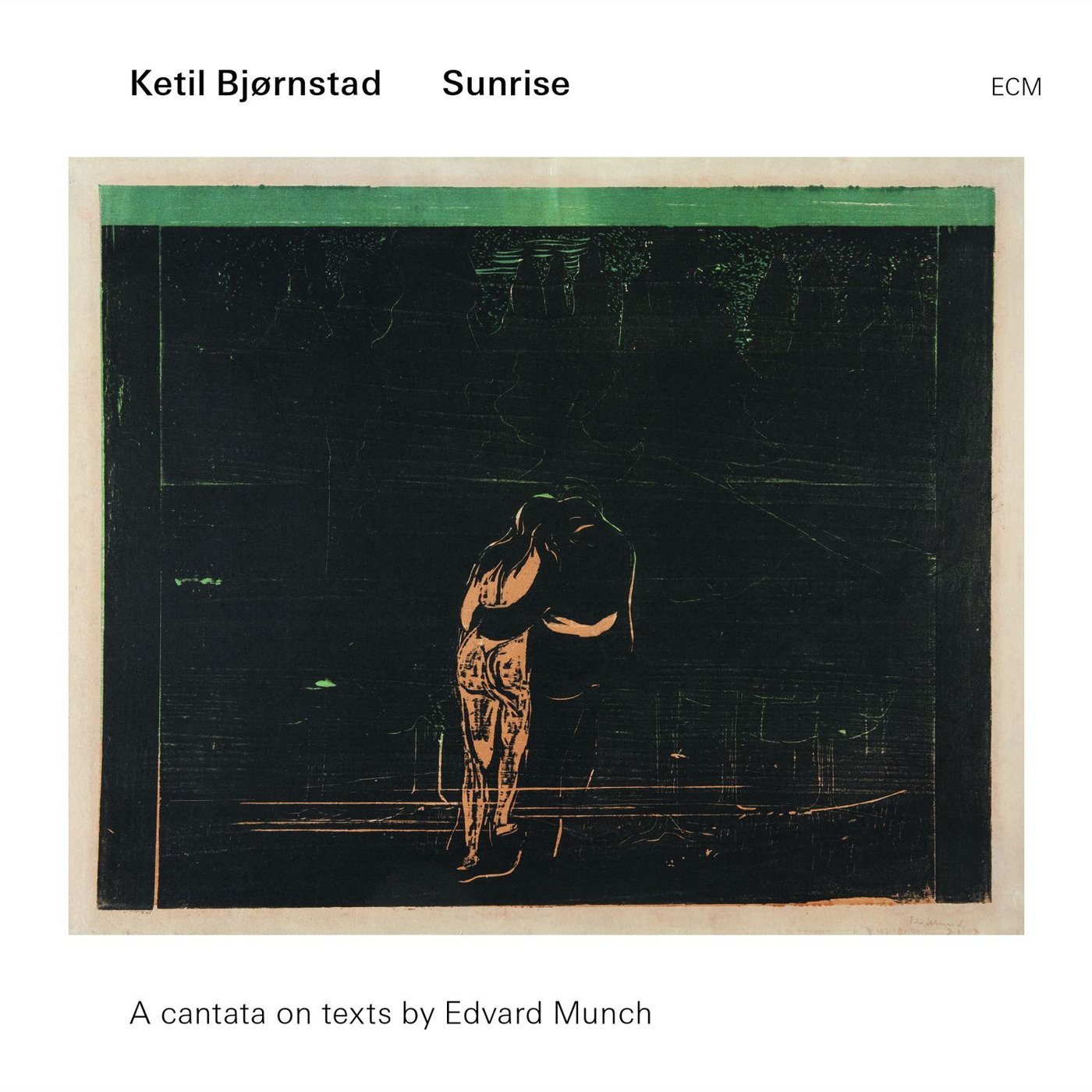
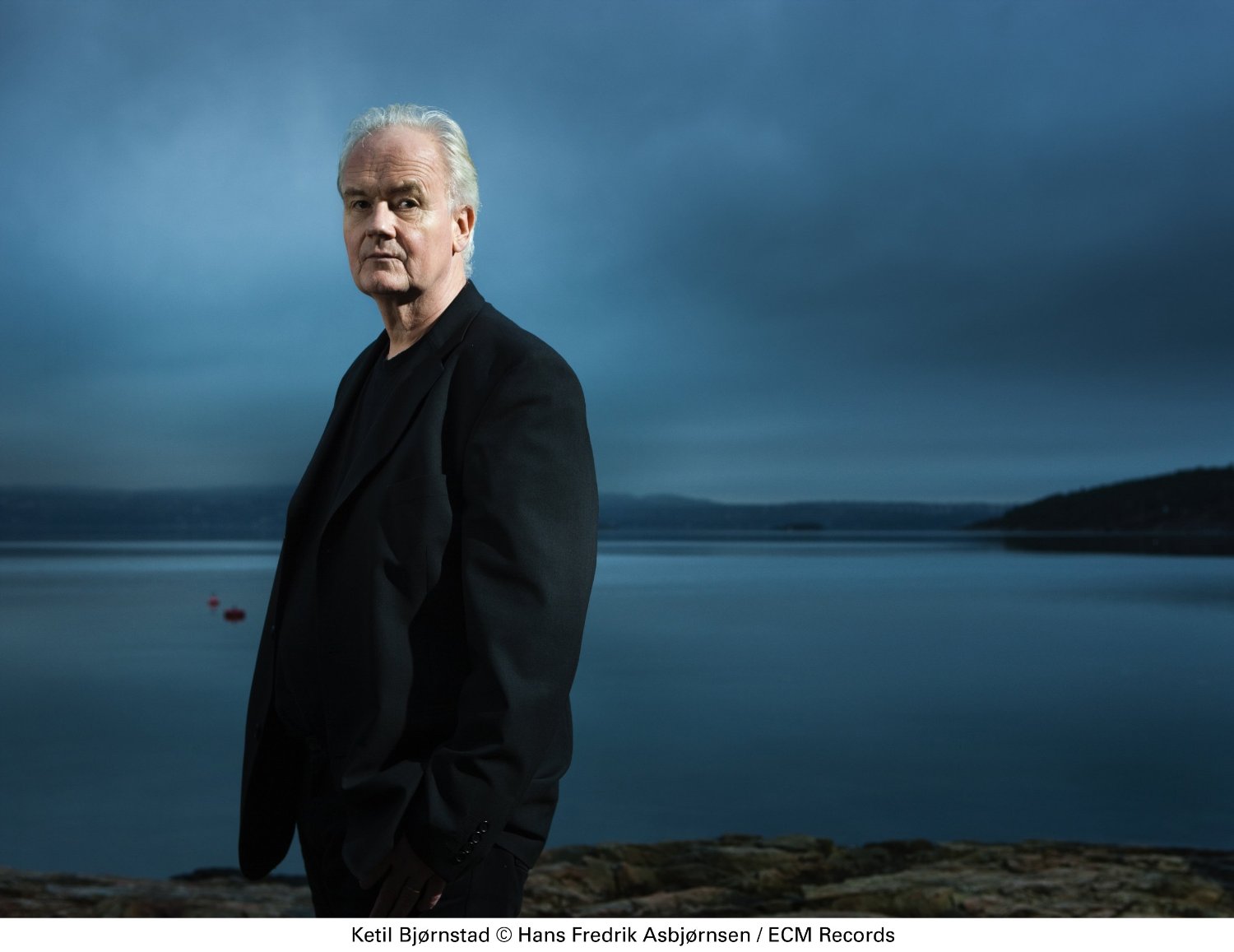
Ketil Bjørnstad: Sunrise (ECM 2336)

Sunrise

Ketil Bjørnstad
Sunrise

Kari Bremnes vocal
Aage Kvalbein cello
Matias Bjørnstad alto saxophone
Bjørn Kjellemyr double bass
Hans-Kristian Kjos Sørensen percussion
Ketil Bjørnstad piano
Oslo Chamber Choir
Egil Fossum conductor
Recorded April 2012 at Rainbow Studio, Oslo
Engineer: Jan Erik Kongshaug
An ECM Production

A bird of prey is trapped
deep inside me. Its talons
have ripped into my
heart, its beak has
driven itself into my chest,
and the beating of its wings
has darkened my sanity.

Norwegian pianist-composer Ketil Bjørnstad seems to be in one of the most creative phases of his career. Increasingly, he has turned to the human voice as an expressive outlet for his ever-songlike writing, and it was only a matter of time that those forces should reach the level of a choir, a medium for which he was asked to write music in commemoration of the Nordstrand Musikkselskap Choir’s 70th anniversary in 2011. Having already engaged with the life of Edvard Munch in his 1993 literary biography Historien om Edvard Munch and set the painter’s neglected words to music on the album Løsrivelse, he naturally returned to those same texts for Sunrise. Yet Bjørnstad’s self-styled cantata is more than the portrait of an artist. It is an affirmation of light.

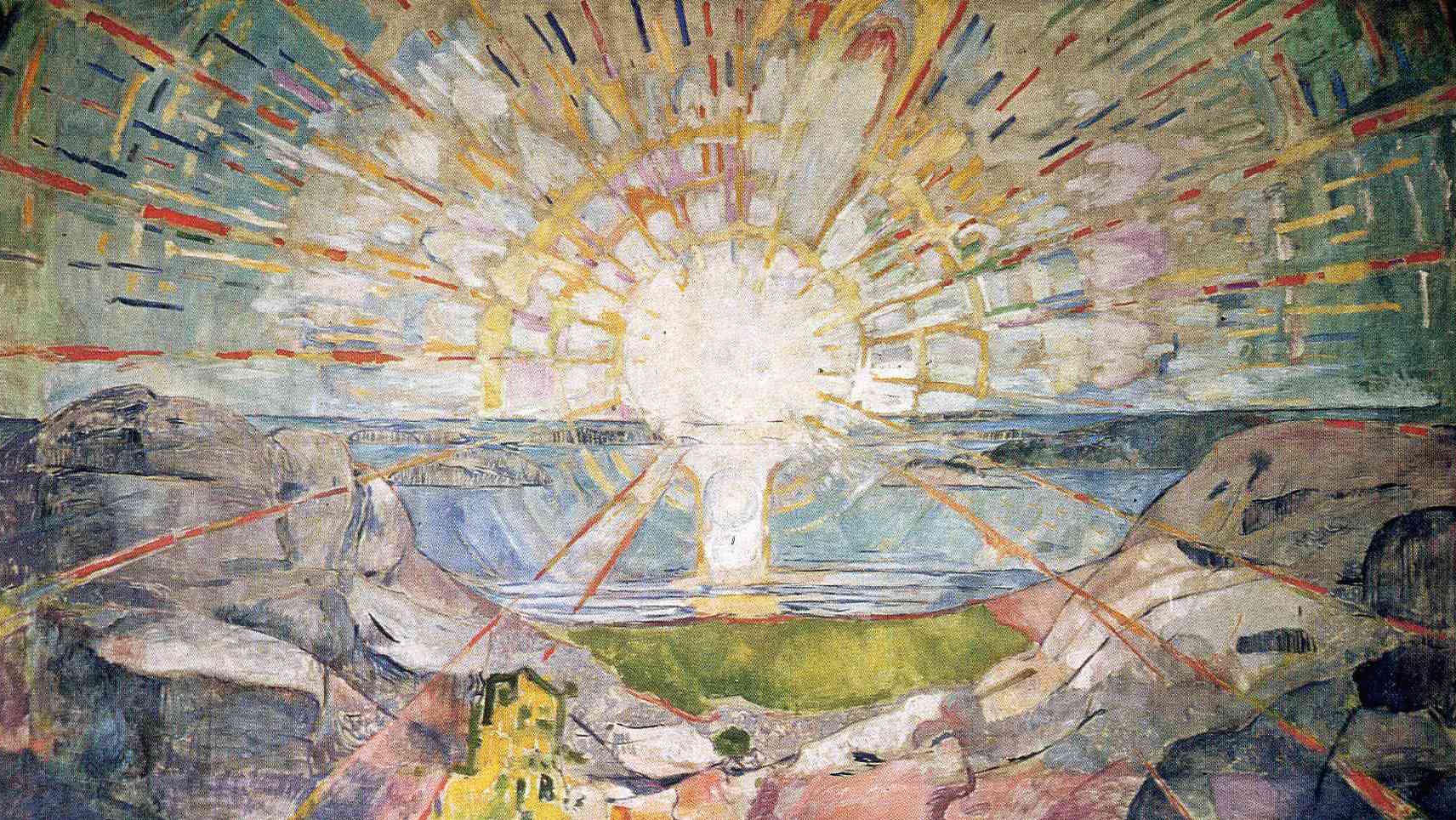
Munch wrote flashes of prose in preparation for many of his paintings. Bjørnstad characterizes the texts chosen for this monumental work as dealing unanimously with existentialist dilemmas. In addition to Munch’s paratextual writings, Bjørnstad was intimately acquainted with his 1909 mural The Sun, under which the young pianist saw many greats play at Oslo’s University auditorium, the Aula, where it hung. In that painting, notes the composer, “one can clearly discern the degree to which Munch struggled with and against the forces of life, and how deeply and endlessly he yearned for enlightenment and reconciliation.” The same holds true for the music he has written into its aura.

The Sun

Most attractive about Sunrise is its breadth of idiomatic conviction, which is most vividly clarified in the four songs written for singer Kari Bremnes, with whom Bjørnstad worked on the aforementioned Munch cycle. She is joined by Bjørnstad at the keyboard, alto saxophonist Matias Bjørnstad (no relation, it seems), and bassist Bjørn Kjellemyr on “Moren” (The Mother), which depicts the haunting scene of a young boy who holds his mother’s hand in anticipation of going outside but is blinded by the light of spring once they open the door. Bremnes’s oaken alto lends heart to every word it envelops. In the montuno-flavored “Stupet” (The Cliff), for instance, she evokes a jagged cliff and the dangerous ocean churning below like a death wish. The naturalness of her shading lends intuitive dimensionality to the near-pop groove of “De fineste nerver er rammet” (The Most Delicate Nerves are Affected) and a lover’s wicked thoughts in “Åpent vindu” (Open Window), for which cellist Aage Kvalbein provides the lamplight and Bjørnstad a certain temptation beneath the floorboards.

Turning to the sections for choir gets us into some potentially divisive territory. Bjørnstad is clearly not a choral writer, as attested by the fact that the vocal arrangements were done by Egil Fossum, who also conducts the present recording. Certain sections are more memorable than others, such as “En rovfugl har satt seg fast i mitt indre” (A Bird of Prey is Clinging to My Inner Being), which opens the entire cantata with the unlikely ante of a steel drum, courtesy of percussionist Hans-Kristian Kjos Sørensen. Like a warped church carillon as heard through the screen of memory, it breeds a prayerful cello to greet the dawn. The choir opens its lips to greet the titular bird, which traps itself in the chest but which by the grace of song is placated by God’s azure stare. Subsequent moods and images range from the apocalyptic [“Alfa og Omega” (Alpha and Omega)] to the frivolous [“Livets dans” (The Dance of Life)]. Other elements feel more derivative, such as the hints of Samuel Barber’s famous Adagio in “Adskillelsen” (The Separation).

More interesting to consider are Munch’s sentiments, revealing as they do a conflicted mind desirous of peace, splashing color across the human psyche as if it were the truest canvas. In “Intet er lite” (Nothing is Small) is nestled his meta-statement: Nothing is small, nothing is large. / We carry worlds inside us. Words to live by for both the painter and his thoughtful composer. Wordless singing beneath the cello’s commentary accentuates an underlying yearning. Even the jazzier inflections of “Joden elskede luften” (The Earth Loved the Air) enhance the starkness of Munch’s inner world, a place where trees uproot themselves and turn into human beings: Everything is alive and in motion. / Even at the center of the Earth / there are sparks of life. This leaves us to bask in the promised “Soloppgang” (Sunrise), which unites musicians and singers in an optimistic flourish that is hard to come by in Bjørnstad’s work.

Overall, there is a rustic, hymnal quality to the choruses, which suits the material well enough. More exciting, however, are the three “Recitatives” and “Intermezzos” signposting the program. The former elicit some of Bjørnstad’s most unchained playing on record in bursts of cathartic free improvisation, while the latter weave the piano into melodic shadows of cello or saxophone, each a thread gathered from an open wound and spun into new flesh. Like the protagonists of “Som i en kirke” (As if They Were in a Church), they reveal a gravid awareness of mortality, seeing creation as a church unto itself, and nature as God’s tabernacle.

(To hear samples of Sunrise, click here.)

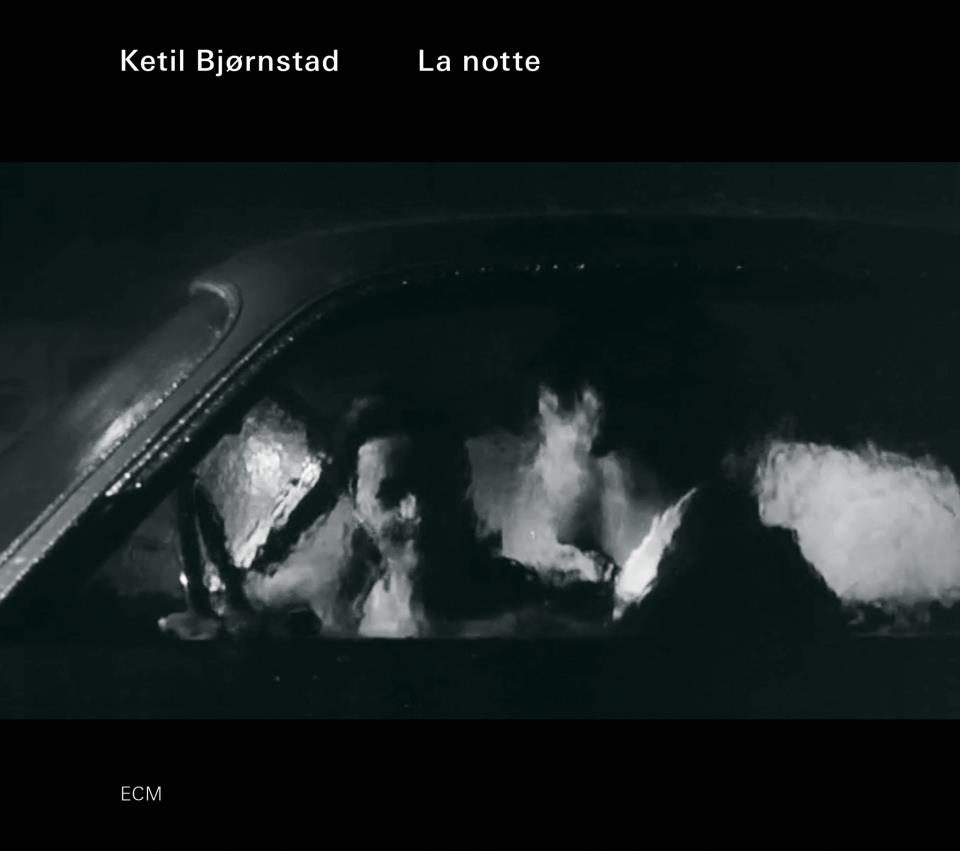
Ketil Bjørnstad: La notte (ECM 2300)

La notte

Ketil Bjørnstad
La notte

Ketil Bjørnstad piano
Andy Sheppard tenor and soprano saxophones
Eivind Aarset guitars, electronics
Anja Lechner violoncello
Arild Andersen double bass
Marilyn Mazur percussion
Recorded live July 21, 2010 at Molde International Jazz Festival
Engineer: Jan Erik Kongshaug
Mixed March 2012 at Rainbow Studio, Oslo by Jan Erik Kongshaug, Ketil Bjørnstad, and Manfred Eicher
Produced by Manfred Eicher

Ketil Bjørnstad has been a formative presence on a wide variety of ECM releases. Since 1993’s Water Stories, his recognizable pianism and compositional voice have left indelible marks on the label’s catalogue. Age has fortified the intimacy of his melodic formations, whether in his darkly alluring collaborations with cellist David Darling or in projects with singers. La notte, however, represents a return to form, while also taking his craft in unexpected new directions. The result of a Molde International Jazz Festival commission and recorded live in 2010, Bjørnstad’s eight-part suite is a self-styled “soundtrack to an inner film.” It’s also his most sublime creation to date.

KB

Bjørnstad has always been literary in his music, just as he has always been musical in his literature, but cinema has also been an integral influence. Here he pays natural homage to Michelangelo Antonioni, citing the Italian director’s “slow, rhythmic authority” as an early source of musical inspiration. To bring that moving vision to life, he has assembled a powerhouse band of saxophonist Andy Sheppard, guitarist Eivind Aarset, cellist Anja Lechner, bassist Arild Andersen, and percussionist Marilyn Mazur. Together, they create a musique verité of raw forces.

Harnessing such forces requires no small amount of finesse and patience, as demonstrated in the slow progression from Parts I to II. Between the low, arco bass and electronic hum, there is little to grab hold of in the beginning. Even as Lechner’s cello and Bjørnstad’s piano engage in proper dance, Mazur’s tracery is still far away. Only when Sheppard lights up the sky with his tenor does the band’s full gravity take effect. Into that shift from liquid to solid, we might read the robustness of Antonioni’s characters and the fleetingness of their environments, if not the other way around.

Mazur and Sheppard are, in fact, the stars of this performance, although, duly invigorated as they are by Bjørnstad’s finely grained writing and flexible architecture. The saxophonist opts for soprano in Parts III, V, and VII, taking off with un-caged melodies. Having learned from Icarus’s example, his wings are impervious to the sun, which he proves to be a reflection anyway when he leaps into the sky as if it were an upside down pond, sending ripples toward every horizon. Mazur, for her part, accentuates the jazzier shades of this spectrum, acting as a buffer zone for Andersen’s bold cartography. With Bjørnstad, the latter two become a most formidable trio, the central nervous system to Aarset’s coronal guitar and Sheppard’s ecstatic flailing.

Mazur and Sheppard are, in fact, the stars of this performance, although, duly invigorated as they are by Bjørnstad’s finely grained writing and flexible architecture. The saxophonist opts for soprano in Parts III, V, and VII, taking off with un-caged melodies. Having learned from Icarus’s example, his wings are impervious to the sun, which he proves to be a reflection anyway when he leaps into the sky as if it were an upside down pond, sending ripples toward every horizon. Mazur, for her part, accentuates the jazzier shades of this spectrum, acting as a buffer zone for Andersen’s bold cartography. With Bjørnstad, the latter two become a most formidable trio, the central nervous system to Aarset’s coronal guitar and Sheppard’s ecstatic flailing. The presence of these bandmates rubs off on Bjørnstad, whose solo in Part IV magnifies the suite’s red thread with a fullness of expression such as he has rarely elicited before. When Lechner joins him, it feels more than logical. Their relationship is this music’s very foundation, prefiguring Parts VI and VIII as well and making broken images whole again by the glue of remembrance.

This is a must-have for fans of any of anyone involved, but especially of Bjørnstad, who on this stage reaches new heights, and depths, spreading his energies across the toast of inspiration into a brighter tomorrow.

(To hear samples of La notte, click here.)

Jon Balke: Magnetic Works 1993-2001 (ECM 2182/83)

Magnetic Works

Jon Balke
Magnetic Works 1993-2001

Jens Petter Antonsen trumpet
Per Jørgensen trumpet, vocals
Arve Henriksen trumpet, vocals
Morten Halle alto saxophone, flute
Tore Brunborg tenor and soprano saxophones
Gertrud Økland violin
Trond Villa viola
Jonas Franke-Blom violoncello
Svante Henryson violoncello
Cikada String Quartet
Henrik Hannisdal violin
Odd Hannisdal violin
Marek Konstantynowicz viola
Morten Hannisdal violoncello
Jon Balke piano, keyboards, percussion, electronics
Anders Jormin double-bass
Marilyn Mazur percussion
Audun Kleive drums
Recorded 1993 (Further) and 2001 (Kyanos) at Rainbow Studio, Oslo
Engineer: Jan Erik Kongshaug
Solarized recorded 1998 at Audiopol, Skien
Engineer: Audun Kleive
and Rainbow Studio, Oslo
Engineer: Jan Erik Kongshaug
Compilation by Jon Balke
An ECM Production

Magnetic Works confirms keyboardist and composer Jon Balke as one of the most important and eclectic voices of Norwegian jazz. Collecting tracks from two ECM albums and nine of ten tracks from the long out-of-print Solarized (originally released in 1999 on the EmArcy label), this 2-CD set is an instant archival gem. In his liner note for the compilation, Balke describes the music he played with his influential Magnetic North Orchestra as having been “written to allow the individual musicians to enter an optimal playground for their expressivity.” Achieving this was no small feat, but listening to these musicians negotiate their personalities by way of the group’s collective distribution promises fascination for the Balke fan and newcomer alike. Although anyone who owns Further and Kyanos will find nothing new among the selections from those albums, hearing them shuffled in the present context is sure to bring about new relationships and nuances.

Further

Released in 1994, Further was the MNO’s label debut. “Departure” opens both album and compilation with an incantation of reed and brass. It’s a full-throated welcoming into a space abundant in elemental colors. The swinging undercurrent of “Changing Song” is picked up by strings and Per Jørgensen’s distinctive vocals, while drummer Audun Kleive and percussionist Marilyn Mazur flesh out the ecosystem of its unfolding. Balke, meanwhile, emotes at the piano through this lush climate with all the freedom of a bird. In this vein, “Flying Thing” expands on the percussive delicacies at hand, bassist Anders Jormin laddering down into the gears of a most intimate machine. Balke then leads a Brazilian-inspired groove, gliding just under the radar of the horns. “Horizontal Song” is a nostalgic piece of heaven. The string section relays pizzicato accents and arco trails while the horns and percussion flock to bass like wings of shadow to a flame. “Moving Carpet” is another rhythmic standout. So open yet so fully plumed, it boasts a soaring turn from saxophonist Tore Brunborg. “Taraf,” with its lovely altoism from Morten Halle, could very well be a Michael Mantler elegy. The ascending bass line of “Shaded Place” most clearly evokes its title. Like a napping stranger whose dreams are visible in a hovering cloud, it turns but does not wake. Balke and Jormin dig deep for emotional treasure and come up with handfuls.

Kyanos

Kyanos, from 2002, is a far more biologically minded album—not only because of the track names, but also because of the intensely miniscule palette on which Balke and his musicians draw throughout. A seemingly omnipresent breath of electronics sets it apart from other MNO records, as does its prioritized roster, only minimally adorned by strings. The title track is quintessential in its pairing of trumpet and droning wave. Like the tracks “Katabolic” and “Mutatio” that precede it, it has caught something mournful in its net and can only contemplate whether to throw it back or consume it. In this sense, Balke’s role is far more physiological than melodic, as demonstrated by the pianistic surgery of “Plica.” The fertility-laden “In Vitro” and “Zygotos” enrich the microscopy of every snake and ladder, breaking skin at last in the exploratory “Karyon.”

Solarized

Solarized sits between these two abridged albums, finishing Disc 1 and beginning Disc 2, as if it were somehow too expansive to contain in full. The rolling snare of “Present Position” ushers us into a substantial sound. Jormin’s bassing is weighty and, in this outing at least, indeed the most magnetic force within the group. Balke follows a linear, faceless figure through catacombs of spontaneity, mapped by the string players as Jørgensen’s trumpet lights every torch in the castle. The title track switches above ground. Through-composed beginnings lead to some beautiful leaps from Halle, who reaches catharsis with a hard-hitting altissimo. A phenomenal exercise in rewarded patience. Jormin glows again in “Dark And Slow,” in which trumpeter Arve Henriksen exhales his way through those oaken walls with ease. Like a heartbeat made manifest, “In Degrees” emotes in the name of survival and ends with a satisfying growl.

Because Balke is never one for being longwinded, at nearly eight minutes “Curve” might seem gargantuan were it not for the smoothness of its contours. This is such a visual track, with streets and pedestrians clearly discernible through the fog. The looping “Circular” is a steady but varied groove, Kleive leading all the way. Trumpet and violin double one another in “Vertical,” a short track that feels like a scene in a novel you once read and forgot about. “Encoded” sports an upbeat piano trio vibe. And just as there is nothing cryptic about it, neither is “Elusive Song” difficult to grasp. You can hear the wiping of strings along the piano’s edges, and the trumpet’s swan song touching a hand to the window.

It’s just as well that the seventh track of Solarized, “Linear,” should be left out, for there is nothing linear about the goings on documented here. Balke and his cohorts are champions of neglected songs, and this set ensures those songs will never be neglected again.

Marcin Wasilewski Trio w/Joakim Milder: Spark Of Life (ECM 2400)

2400 X

Marcin Wasilewski Trio w/Joakim Milder
Spark Of Life

Marcin Wasilewski piano
Slawomir Kurkiewicz double bass
Michal Miskiewicz drums
Joakim Milder tenor saxophone
Recorded March 2014, Auditorio Radiotelevisione svizzera, Lugano
Engineer: Stefano Amerio
Produced by Manfred Eicher

Still warm from a session with Jacob Young, Polish pianist Marcin Wasilewski’s landmark trio turns from guest to host, welcoming to its fourth ECM outing Swedish tenorist Joakim Milder for an otherwise characteristically eclectic mix of originals, outliers, and nonstandard standards. While the addition of a reed may at first seem unnecessary, emphasizing as much composed material as it does improvised, and leaving its mark on only about half of the set list, its role is crucial to not only the album’s development, but also to the trio’s own as it lengthens its reach.

MW

Even before Milder’s entrance by way of the Wasilewski original “Sudovian Dance,” the trio’s evolutionary prowess is in full evidence on “Austin.” Being the album’s opener and also by Wasilewski, it makes a definitive statement about the musicians’ enduring patience and fortitude in kind. As drummer Michal Miskiewicz airbrushes his way into frame and bassist Slawomir Kurkiewicz drops plumb lines into the bodies of water that emerge from every melodic cell, the band’s smoothness arises not from its playing alone but more so from the mutual understanding that drives that playing to fruition. In this track especially, Wasilewski emotes at the keyboard in a way not heard since Tord Gustavsen on Being There. His minor inflections are especially savory and add to the expansion of vision. That being said, and despite the big-sky country feel, the title is meant to evoke not Texas but Austin Peralta, the prodigious multi-instrumentalist who died in 2012 at the tragic age of 22. “Three Reflections” is another trio example, and along with the arcing title track and its concluding variation caps the bandleader’s pen for this round. In all of these, Kurkiewicz tends to the flame, while Wasilewski and Miskiewicz push their interactive skills to new depths.

Milder’s contributions are most acutely felt in his own composition “Still,” which frames an urban setting with robust punctuations, and in his repeat of Krzysztof Komeda’s “Sleep Safe And Warm” (originally written for the film Rosemary’s Baby and last heard at Milder’s lips on Tomasz Stańko’s Litania). The saxophonist’s improvisations are as integral as they are caressing, ever focused more on the atmospheric potential of melody than the melodic potential of atmosphere for its own sake. Miskiewicz meanwhile proves phenomenally articulate on cymbals, while Wasilewski carries us over one horizon toward the next.

MWT
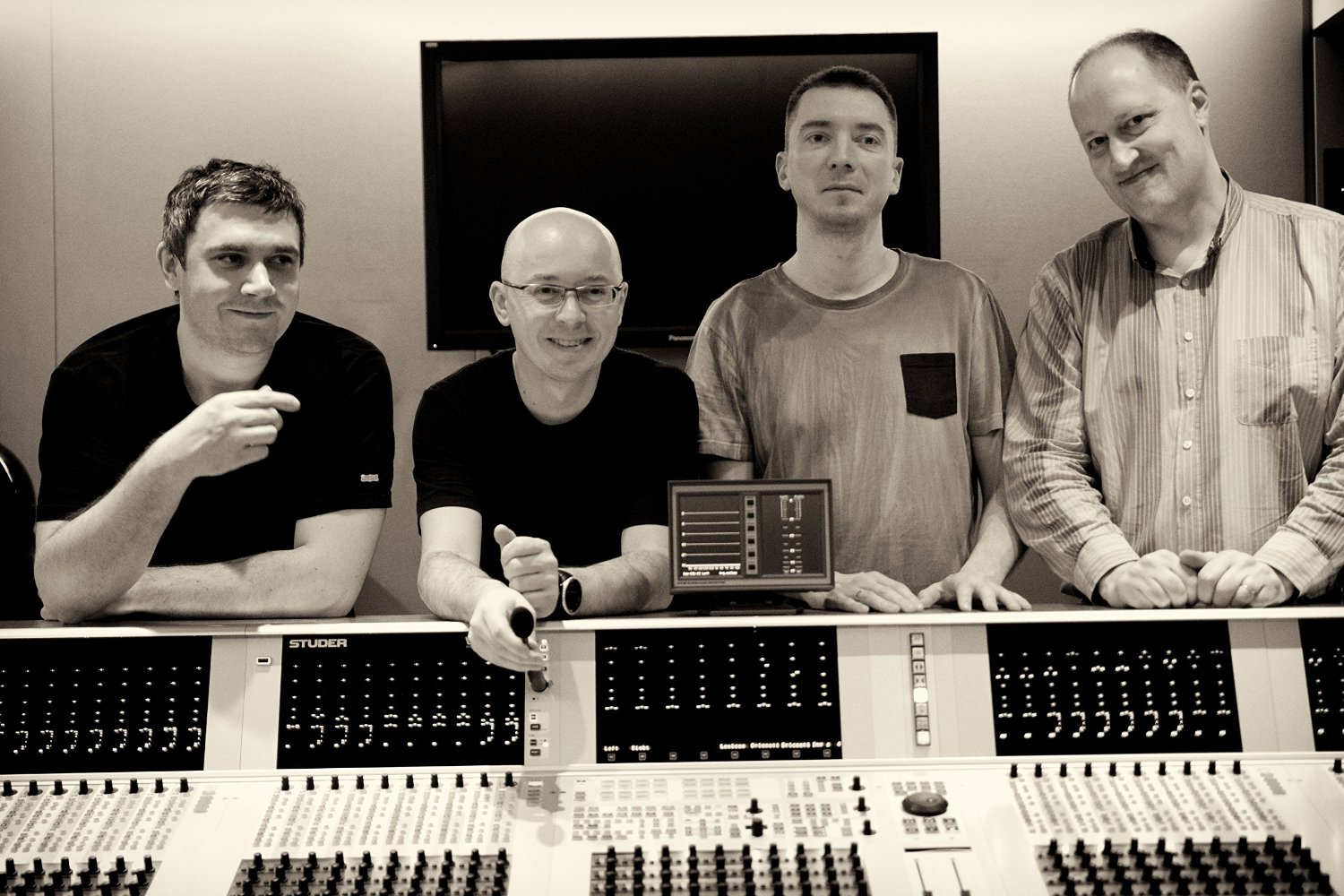
(Studio photos by Gildas Boclé)

Other covers include “Do Rycerzy, Do Szlachty, Do Mieszczan” (For the Knights, the Nobility, and the Burghers), a sunlit arrangement of an already luminescent song by Polish rock favorites Hey, and “Message In A Bottle,” a throwback to Sting’s days with The Police. The latter indeed scrawls its concept of time across a curl of paper. Tossed into the ocean along with it, we feel the motion of the waves, their storms and slumbers. These and more we can read into a solo from Kurkiewicz, who digs even deeper for the interlocking groove of Herbie Hancock’s “Actual Proof,” in which distantly recorded drums blend in a psychedelic hue. Completing this album’s puzzle is the “Largo” from Grazyna Bacewicz’s 1963 Sonata No. 2 for piano. In the bassist’s arrangement, it shadows a river’s flow like the night follows noon.

The Japanese use a word, komorebi (木漏れ日), to describe the play of sunlight through trees. The term describes Spark Of Life to a T. Milder is the light, the trio its leaves and branches, and together they are a glade whose forest, one can hope, will continue to grow.

(To hear samples of Spark Of Life, you may watch the album trailer above or click here.)

Paul Bley: Play Blue – Oslo Concert (ECM 2373)

Play Blue

Paul Bley
Play Blue – Oslo Concert

Paul Bley piano
Recorded live August 2008 at Kulturkirken Jakob, Oslo Jazz Festival
Engineer: Jan Erik Kongshaug
Mixed October 2013 at Rainbow Studio by Jan Erik Kongshaug and Manfred Eicher
Produced by Manfred Eicher

Since appearing as bandleader on ECM’s third release in 1970, Canadian pianist Paul Bley has been a formative presence for the label. Yet despite the classic combos with Evan Parker, Barre Phillips, Gary Peacock, Paul Motian, and other legends, Bley has been at his own most legendary when alone at the keyboard. Open, to love was just the beginning of a highly intermittent journey that continued with Solo in Mondsee, both now achieving trilogy status with the addition of Play Blue.

It’s practically impossible, of course, to discuss ECM’s catalogue of solo piano improvisations without touching on Keith Jarrett and Chick Corea, to say little of younger additions Craig Taborn and Aaron Parks. And while it’s easy to lose oneself in the enchantments of these continents, perhaps none is so abundant as Bley’s. As the album’s anagrammatic title suggests, the illocutionary need to perform is in this very DNA. He has such command of his freedom at the keyboard, where he expresses such freedom in his command.

Bley

(Photo credit: Carol Goss)

Traversing five tracks averaging 11 minutes each, Bley’s program, recorded live at 2008’s Oslo Jazz Festival, is as hefty as his toolkit, from which he seems to draw on the entire history of jazz to make every invention shine. At just over 17 minutes, “Far North” might make for a top-heavy introduction were it not so intricately pocked by tunnels of play, exploration, and living for its own sake. There is, for lack of a more effective word, an unthreatened quality to this music, as if it were some final refuge of wilderness where fauna thrive by the safety of mutual trust. As with nearly everything Bley touches, the climate is constantly changing: now lush with foliage, now crisp like the tundra. There is sweeping grandeur and gnarled microscopy in equal measure. Like morning and evening, each is a reflection of the other.

From the far north, Bley shifts to the “Way Down South Suite.” Although ultimately more playful and chromatic, it sprouts a much knottier pine before expanding its reach to distant planets. With an open stance Bley navigates these changes as if he has known them before, despite their utter lack of repetition. Earth awaits us with open arms in “Flame.” With classically balladic contours, this intimate journey bears that characteristic Bley edge, which keeps us at full attention by never privileging a single mood over others. Even denser, but also bittersweet, is “Longer,” which leaves “Pent-Up House” to finish things off. This tune by Sonny Rollins, in whose band Bley played in the early 1960s, emerges from the rubble of its original structure. Bley rebuilds it cell by cell, until its compact circle becomes a period at the end of an epic tale.

With this masterful addition to his discography, Bley has proven that not only is he open to love, but also a style of beauty that comes only with age. Let this not be the end.

(To hear samples of Play Blue, please click here.)