Manu Katché: Playground (ECM 2016)

Playground

Manu Katché
Playground

Mathias Eick trumpet
Trygve Seim tenor and soprano saxophones
Marcin Wasilewski piano
Slawomir Kurkiewicz double-bass
Manu Katché drums
David Torn guitar on “Lo” and “Song For Her (var.)”
Recorded January 2007 at Avatar Studios, New York
Engineer: James A. Farber
Produced by Manfred Eicher

Playground is the spiritual successor to drummer Manu Katché’s auspicious ECM leader debut: Neighbourhood. Auspicious, because said debut practiced just the communal sort of sharing it preached. The lineup here replaces saxophonist Jan Garbarek with the multi-talented Trygve Seim and adds to its ranks trumpeter Mathias Eick—neither strangers to one another since their appearance on Iro Haarla’s Northbound. Rounding out the cast are two thirds of the Marcin Wasilewski Trio (bassist Slawomir Kurkiewicz and Wasilewski himself at the keys), as well as guitarist David Torn. Aside from the latter’s ambient contributions to its bookends, the album luxuriates in the all-acoustic interplay of Katché’s simple yet potent tunes.

Of those tunes, we get 11 artfully crafted gems, gradated from sunrise to sunset. From the first, there is a sort of lush Americana that pervades each smooth turn of phrase, swaying like poplars in anonymous urban landscapes—a result, perhaps, of these European jazzmen soaking in the spell of New York City, where Playground was recorded. Either way, one can hear the pulse of the city’s history in the underlying beat textures. In this regard, Wasilewski’s pianism is striking for both its sink and swim. In the album’s opener it acts as an intermediate force between Katché’s supporting brushes and Eick’s leading stare, while in “Song For Her” (and its variation, which ends the set) it enables reflective bassing, pinging like pachinko balls in slow motion. Here, as elsewhere, the horns build to the non-invasive sort of head at which Katché’s writing excels.

Tracks are designated by names that are as descriptive as they are simple. Most are relatively obvious. “Motion,” for example, moves flexibly. Noteworthy is Wasilewski, given free reign in one of the session’s strongest improvisational showings, of which there are a strategic few (others being Seim’s chromatic solo in “Inside Game” and Eick’s skyward lob in “Project 58”). Despite the groundedness of Katche’s drumming, there is always something airborne about the melodic front line, so that tracks like “So Groovy” showcase Katché’s multidirectional awareness. What distinguishes his grooves, then, is less their sense of push than of pull. Here, as in “Snapshot,” the music draws ocean waters like the moon. Whether piecing together the cymbal-happy backbone of “Clubbing” or paving the smooth runway of “Morning Joy,” Katché finds strength in his attractions to kindred spirits. They clearly take inspiration from him in kind, for by the end one feels the cycle ready to repeat for a third round.

The title of the second track, “Pieces Of Emotion,” describes it best: each fragment builds a larger mental whole, a place built on togetherness, listening, and, above all, synchronicity.

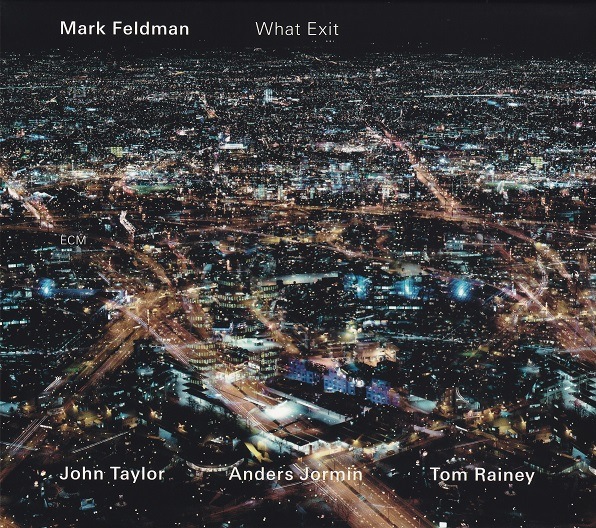
Mark Feldman: What Exit (ECM 1928)

What Exit

Mark Feldman
What Exit

Mark Feldman violin
John Taylor piano
Anders Jormin double-bass
Tom Rainey drums
Recorded June 2005 at Avatar Studios, New York
Engineer: James A. Farber
Produced by Manfred Eicher

Mark Feldman belongs to that selective cadre of jazz violinists ruled by such greats as Noel Pointer and Stéphane Grappelli, all while honing a storyteller’s edge so much his own that he might one day be seen as the pioneer of a new tradition. Should that ever be the case, then the 23-minute “Arcade” which begins What Exit—Feldman’s first leader date for ECM—will certainly comprise a central chapter of his scripture. It is a quintessential statement for both album and artists in kind. One first notices the delicate tracings of drummer Tom Rainey, who throughout the album shows the spectrum of his touch. Into that soil bassist Anders Jormin presses his feet like an archaeologist about to embark on a vast improvisational survey. Only when pianist John Taylor fills those footprints with plaster does Feldman whisper into being. The band almost comes together, part by part, like some parthenogenetic steam train, coalescing from metal and gristle and steam, alighting upon a track fully formed and ready to chug. But just as the ride is about to begin, Feldman and Taylor pause to take stock of things. The latter fades for Jormin’s arco dovetailing, haunting the sub-terrain as Feldman beguiles with Bach-like arpeggios before, ever the feline, slinking into a trio with Jormin and Taylor, interjected with popping duet statements with Rainey. Such eruptive flip-flopping becomes more complex and fragmentary as the train moves forward, engaging the quartet in various combinations of resolve and dissolve. “Arcade” is therefore appropriately titled, filled as it is with spontaneous sounds, which after a while take on a cadence of their own in the interest of play.

The cerebral challenges of this behemoth introduction are rewarded by “Father Demo Square,” second of the album’s eight Feldman originals. This one more smoothly and expectedly tallies the invigoration of the violinist’s characteristic grammar. Jormin takes an early solo, swinging in the loose netting woven by Taylor and Rainey, but it is Feldman’s restless beauties that overtake the foreground, courting implosion at every turn. From foreground to underground, the memorial tune “Everafter” balances cinematic foreboding with understated grandeur. The branches of Taylor’s encroaching pianism hang ripe with fruit, their scent lingering like the double stop that ends with its swan breath. As in the later “Elegy,” Feldman cuts a bitter shadow, slaloming through his backing trio’s loosely upholstered interplay along the way.

There is, however, a brighter side to this moon. Brightest in “Ink Pin,” a rousing throwback that trades licks freely toward swift-footed unity. This brilliant track boasts the special combinatory force of Jormin and Feldman, gilding the frame from start to finish. The Brazilian flavor of “Maria Nuñes” adds spice to the night, trading strings for strands in jagged, sparkly development. The tenderness of “Cadence” tips the scales yet again toward shadow, giving way at last to the light of the title track. Between its fragile liveliness and the album’s confident serenity as a whole, there is much to absorb and re-absorb. And all from a quartet of which only ECM could dream and make reality—proof of the label’s unflagging creative spirit in pursuit of jazz perfection.

Sylvie Courvoisier: Abaton (ECM 1838/39)

Abaton

Sylvie Courvoisier
Abaton

Sylvie Courvoisier piano
Mark Feldman violin
Erik Friedlander cello
Recorded September 2002 at Rainbow Studio, Oslo
Engineer: Jan Erik Kongshaug
Produced by Manfred Eicher

The ancient Greek title of Abaton denotes, abstractly, an “inaccessible place” and, practically, a space believed to have curative properties when used for ritual sleep by those deemed worthy of its seclusion. It also names the trio performing here under its auspices. Born in Switzerland, pianist Courvoisier has lived and worked in New York City since 1998. This is her only ECM appearance thus far, but with it she makes a far-reaching splash. Violinist Mark Feldman, who after a string of successful releases with the John Abercrombie Quartet explores his classical foundations through the pianist’s evocative writing, and cellist Erik Friedlander, another New Yorker whose penchant for edges finds him in comfortably eclectic tenure, accompany her. Together they have forged something so realistic that it can only be enchanting. Indeed, what began as a recording exclusively of Courvoisier’s compositions, four of which comprise the first disc, turned into a double album at the behest of producer Manfred Eicher, who encouraged the musicians to improvise another disc’s worth of material once the initial recording was complete.

SC

“Ianicum,” with which the album begins, is also its postmodern statement par excellence. Courvoisier daubs the canvas with barest ash, producing an audible equivalent of the album’s cover art, while Feldman and Friedlander draw a winter moon’s halo around her. From these introductions coalesces a mirror structure: strings on one side, keyboard on the other. Direct plucking of piano strings signals tectonic movements, a breaking of surface that flirts with indecipherability even as it speaks clear as day to our mental sanctums. Courvoisier’s internalism is echoed by pizzicati, prompting Friedlander to own the shadows of interpretive duty for a spell. Into this dynamic context wanders Feldman, who leaves a trail of breadcrumbs both familiar and newly inspired. The pianism of “Orodruin,” by contrast lights the cello’s fuses in an asymptotic dance between the macabre and material reality. Unisons somehow make it through, angelic and suspended in the glow of afterlife. The title composition is also for the trio. In it, linguistic affinities abound, dialecting over time as voices become protracted and distinct.

Courvoisier is absent for “Poco a poco,” making for a slicker, more chameleonic experience. The effect is celebratory at heart and delineates a realm where nostalgia for 20th-century chamber music blends motifs with assurance. Feldman and Friedlander are an intuitive pair in a tertiary drama.

Each of the 19 improvisations that follow is a vignette of eclectic power. Confronted with titles such as “Icaria” (of which there are three versions) and “Clio” (Greek muse of history), one can’t help but read mythological impulses behind these ad hoc constructions. Words and images fall short of their affective spectrum, dancing among the shadows across the wall of Plato’s allegorical cave. These figures haunt themselves, stepping into their own dreams as if through water.

As fascinating as the trio’s full-on interactivity can be (cf. “Archaos”), it is in the program’s solo portions where brilliance truly crystallizes. Feldman draws the most mournful bow through “Imke’s,” a candle flame in sound that holds on to wick like life itself and draws melody from oxygen. Friedlander is not far behind in “Turoine” and “Ava’s,” walking a tightrope between regret and resolve. Yet it is Courvoisier, tracing an arc from “The Scar of Lotte” through the organic preparations of “Brobdingnag” and lastly to “Narnia,” who houses the album’s spirit with most of its wing fibers intact. Her notes become indistinguishable from the snowflakes beyond the wardrobe, reminding us that quietude sits on the throne of this castle.

The relationship between these two halves—the predetermined and indeterminate—is hardly conversational. It instead forms a palindrome of intention, meeting in the silent middle between disc changes: the album’s very own abaton, waiting to make divided listeners whole again.

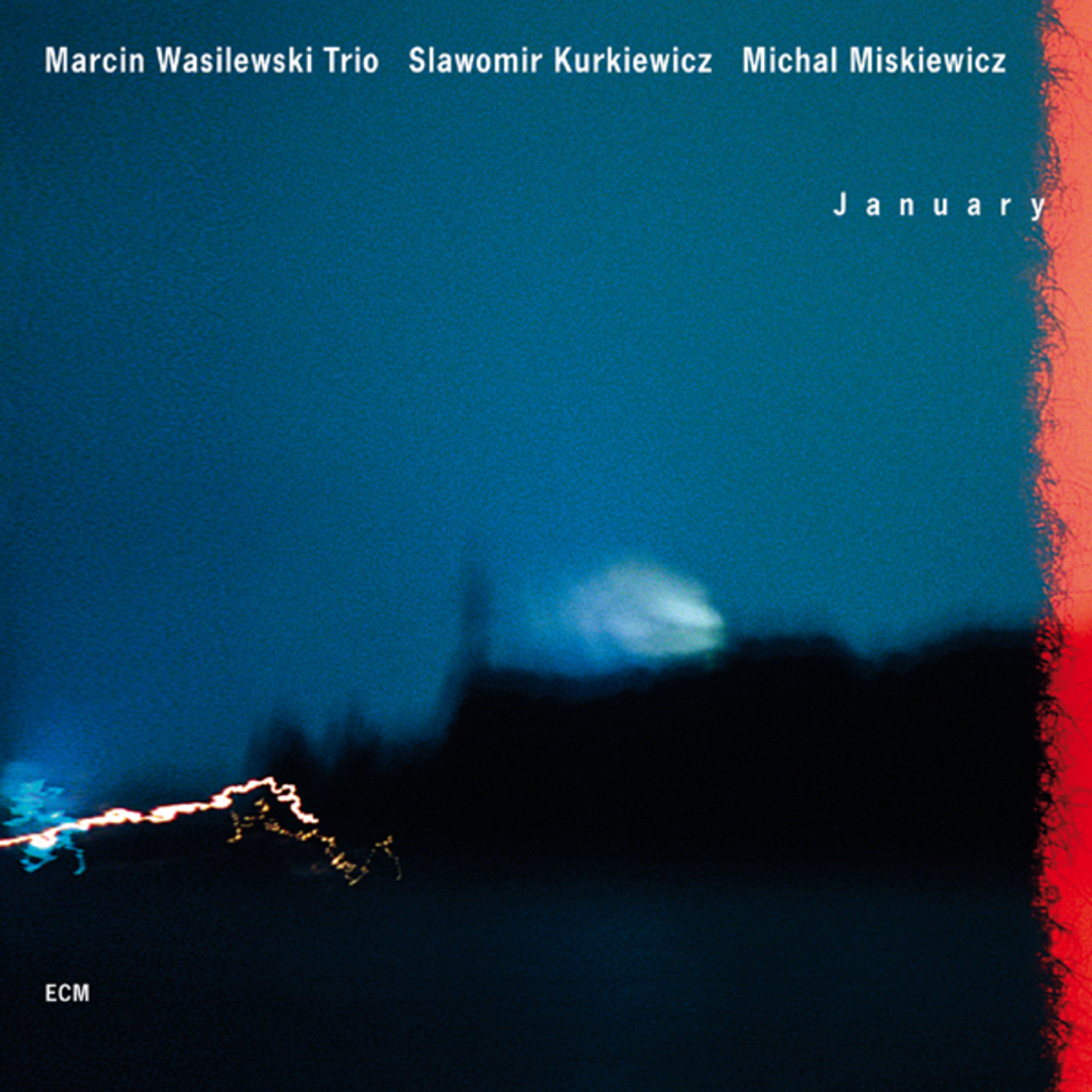
Marcin Wasilewski Trio: January (ECM 2019)

January

Marcin Wasilewski Trio
January

Marcin Wasilewski piano
Slawomir Kurkiewicz double-bass
Michal Miskiewicz drums
Recorded February 2007, Avatar Studios, New York
Engineer: James A. Farber
Produced by Manfred Eicher

Pianist Marcin Wasilewski is a seeker of themes. As nominal leader of one of the most assured trios in recent jazz history, he throws together a variety of sources, moods, and songs into one pot, stirring until every ingredient takes on something of the rest. Bassist Slawomir Kurkiewicz and drummer Michal Miskiewicz are therefore no mere sidemen. Their flavors permeate every morsel of this sonic stew, the group’s sophomore disc for ECM. With well over a decade of steady experience going into this record, it would be harder not to enjoy the synergy at play.

As per usual, the set list is grab bag of delights. Wasilewski leads off “The First Touch,” one of four original tunes, on a tender foot. The rhythm section here marks time by beats irregular and less discernible: kisses of raindrops before the album’s quiet storm. The title track, another penned by the pianist, is as somber as its season and finds Miskiewicz in a decorative mode. Balancing these are “The Cat” and “The Young and Cinema,” both decidedly hipper affairs replete with flourish and sparkle. Drums and bass crosstalk beautifully in both, the latter miked in such a way as to capture every inflection with immediate clarity.

Brightening the music’s silver screen pulse is Ennio Morricone’s “Cinema Paradiso,” of which the pianism is so delicate that it nearly floats away of its own volition. Gentle, yes, but patterned by the razor edge of nostalgia. Such blurring between image and sound is paramount at ECM, and fans of the label will encounter much to admire between two cuts suggested by producer Manfred Eicher. The trio’s loving attention to detail is especially poignant in “Vignette,” which casts a backward glance to Gary Peacock’s seminal yet often-neglected Tales Of Another. The bassing here is magnetic, independent yet resolving by a gradual return to fold. By contrast, jocularity abounds in Carla Bley’s “King Korn,” which gets a treatment to be reckoned with. There is, further, a poignant nod to Tomasz Stanko—with whom the trio first gained international notoriety—by way of “Balladyna,” an enduring swirl of leaves fallen from the tree of Stanko’s label debut.

The group’s tradition of pop do-overs continues with Prince’s “Diamonds and Pearls,” bringing to light the album’s most soaring passage and providing an aerial view of the trio’s melodic landscape. All of this ties together in “New York 2007.” This improvised blip completes the radar sweep by which this album navigates. January belongs on any jazz lover’s shelf right next to Changing Places as yet another groundbreaking statement of trio-ism from ECM. Its sounds are hollow-boned and ready to fly.

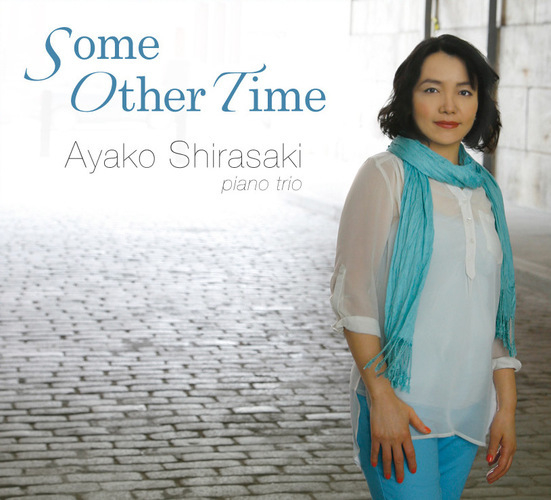
Ayako Shirasaki: Some Other Time

Some Other Time

Ayako Shirasaki brings world-class jazz down to earth on Some Other Time. For this, her fifth album, the Japan-born and New York-based pianist is joined by bassist Noriko Ueda and drummer Quincy Davis. That Shirasaki cut her teeth on the bebop greats—Charlie Parker, Sonny Rollins, and Bud Powell, to name but a few—should come as no surprise. Neither should the fact that, in her defining twenties, the beauties of Bill Evans, Art Tatum, and Kenny Barron (her mentor at the Manhattan School of Music) would be just as influential in defining her current sound, a perfect admixture of both.

This being her first trio album in eight years, Shirasaki brings a wealth of maturation into the studio. “In that time my life has greatly changed by having two kids,” she tells me during a recent interview. “I’m not only a musician anymore but also a mother, wife, and teacher.” Shirasaki further acknowledges her children as having an effect on her playing: “I think that in dealing with small children everything has to be clear, natural, and easy for them to understand. These elements have changed my music a little bit. I have also become more openhearted since becoming a mother.”It’s an unenviable identity to inhabit in a male-dominated profession, but hearing her phenomenal rendition of “Oleo,” such labels cease to matter. This Sonny Rollins gem floats effortlessly from her fingertips with the punch of Chick Corea and the underlying elegance of Marc Copland.

Shirasaki is a cat with nine lives who imbues her playing with nods to various stages of jazz history. That said, she makes no pretensions about theme:“It’s funny, I never had any intension to make this album into a particular direction. I just followed my heart, and still the album developed a certain character.” And while some of that character comes from nods to the American Songbook, notably in the nostalgic hipness of “Long Ago and Far Away” (Jerome Kern) and her solo take on Duke Ellington’s “Sophisticated Lady” (a mission statement if there ever was one), Shirasaki brings more than a rainbow’s worth of colors to this gallery of moods by way of her interpretive prowess. Whether in the vivid, classic sound of “April in Paris” (Vernon Duke) or the bluesy urbanity of “My Man’s Gone” (George Gershwin), a certain optimism persists, although perhaps nowhere more so than in “Hope.” This Lars Jansson tune proves just how positive jazz can become in the pianist’s hands. Shirasaki: “Music has an aspect to heal people’s heart when they’re down or stressed for any reason. Jazz has such power in energetic and beautiful ways to impart positive messages.”If we hear anything in this revelry, it is the confidence in Shirasaki’s step; a confidence born of love.

These are, of course, songs without words, and as such get to the heart of every melody without distraction. Such conviction comes from Shirasaki’s rigorous classical training, which through the prism of the piano trio format lends special focus. “I love playing solo,” Shirasaki notes, “as I can control all the sound, harmony, bass, and rhythms from beginning to end, but it can be lonely. The trio brings out individual colors and tasks. Interaction between the three brings the music to another level. I think the piano trio is a very strong unit for being ‘minimal.’”

Ayako

Such are the hallmarks, too, of her own tunes. “Sunrise” connotes the luminosity of her craft to exponential degree. Its invigorations emote with a welcoming spirit, fitting like well-worn shoes. The improvising here may not be fierce, and is even a bit saccharine, but nevertheless balances touch and go with assurance. Corea again lurks in the staggered harmonies and independent hands of “3 Steps Forward,” throughout which the superb rhythm section is plush and omnipresent, of which the phrasing speaks to tasteful attunement all around. “Peace of Mind” is another optimistic slice of forward-thinking jazz. Sparkling highs in the right hand contrast beautifully with thumping bass, the latter of which has a remarkable solo, delicate yet forthright.

As an avid enka (Japanese popular folk) and traditional Japanese music listener, I was delighted to encounter on this album such spirited takes on Saburō Kitajima’s “Yosaku” and the children’s song “Antagata dokosa.” When asked about her inclusion of these particular tunes, Shirasaki discusses her experiences performing in Japan as one motivation. “Another reason is that simply I like to play these songs. ‘Antagata dokosa’ came up since I used this song for my music class for kids and found that its odd metering carried over into jazz in a unique way.For ‘Yosaku,’ I just like the bluesy feeling of its chord progression (re-harmonized from the original version). It was quite a joy to find that ‘Yosaku’ could transform into jazz!” Both tracks show the trio at its swinging best and bring to life the freshness of Shirasaki’s thinking.

Like the title track by Leonard Bernstein, the album as a whole has a sense of breathing about it, as if it were being sung through the body rather than through an instrument. The affective commitment required to achieve this dynamic amounts to no small task, but Shirasaki and her trio make it sound natural as can be. In her own words: “I always want to play better than yesterday.” Let us hope, then, that there will be many other times to come.

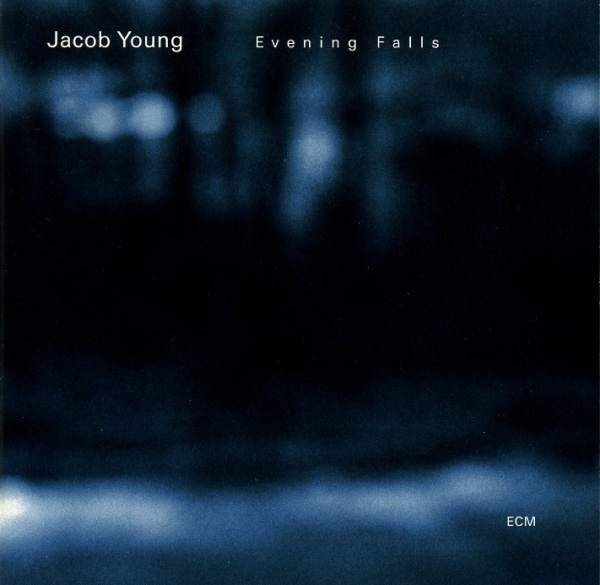
Jacob Young: Evening Falls (ECM 1876)

Evening Falls

Jacob Young
Evening Falls

Jacob Young guitar
Mathias Eick trumpet
Vidar Johansen bass clarinet, tenor saxophone (track 6)
Mats Eilertsen double-bass
Jon Christensen drums
Recorded December 2002 at Rainbow Studio, Oslo
Engineer: Jan Erik Kongshaug
Produced by Manfred Eicher

Considering the legion of Norwegian talents with whom Jacob Young has played, and of which he is one star in a constellation of them, it was perhaps inevitable that his sound should migrate over to ECM. Enter Evening Falls, the guitarist’s sensuous international debut for the German powerhouse following four albums on local labels. The Jacob Young Group, as it has come to be styled, finds him in the enviable company of trumpeter Mathias Eick, reedman Vidar Johansen (primarily on bass clarinet), bassist Mats Eilertsen, and drummer Jon Christensen. This who’s who of northern talent brings a wealth of history to the table, so that the lyrical results are not merely intuitive, but comfortable like worn-in denim.

That Young studied under Jim Hall and John Abercrombie is apparent in “Blue,” although one may also hear a bit of Bill Connors glinting off his rural edge. Young’s composing also spans territories, sounding one moment like a Tomasz Stanko ballad (check the brilliant, trumpet-driven “Minor Peace”) and for all at others like a dulcet etude (cf. “Falling”). The fluidity of his teachers shines through music that, although weighing little, is emotionally robust. There is warmth here, a love for life in all its colors seeping like rain through soil into all that follows. Eick connects the dots to another satellite reference—Kenny Wheeler, whose insightful laddering can be heard in the trumpeter’s nonetheless distinct soloing.

No one on this record, however, is as distinct as Young, who navigates ever-changing currents with the skill of an ancient mariner. Despite his acoustic penchant, he does plug in for a few tunes, notably “Looking for Jon” and “Sky.” The former skips by virtue of Christensen’s brilliant drumming and Eick’s clarion fluency, while the latter tune flies not like a bird but lilts as would a paper airplane thrown from a tall building. The effect is nothing short of profound. Even in the acoustic tracks, such as “Formerly,” Young’s playing shines with its own electricity. Either way, the dynamic checks and balances continue in “Evening Air,” in which Young draws bass clarinet and trumpet from hiding in a beauteous thematic braid. Guitar and bass play especially well off one another. Eick’s trumpet likewise flowers, while Christensen’s cymbals trickle in with the last rays of sunset.

In trio with Eilertsen and Christensen, Young carries the full weight of his compositions with the effortlessness of respiration. This nexus works in elastic, tactile fashion throughout, seesawing between Mediterranean reveries (“The Promise”) and slick turns of phrase. So synergistic is this core unit that it bears an album’s worth of weight in the web of its interplay. In light of this, Johansen’s contributions are more enigmatic but no less integral, although with one exception. His bass clarinet does wonders whenever it appears, charting the tailwinds of that which has preceded it, but on tenor saxophone he proves superfluous on “Presence of Descant,” of which Eick’s trumpeting leaves little room for embellishment. What this track lacks in a melodic frontline Christensen makes up for with masterful color, laying down a mood as few drummers can.

In the end, we are gifted a superbly listenable album with all the qualities of an old friend.

Miroslav Vitous: Universal Syncopations (ECM 1863)

Universal Syncopations

Miroslav Vitous
Universal Syncopations

Jan Garbarek soprano and tenor saxophones
Chick Corea piano
John McLaughlin guitar
Miroslav Vitous double-bass
Jack DeJohnette drums
Isaac Smith trombone (tracks 2 to 4)
Wayne Bergeron trumpet (tracks 2 to 4)
Valery Ponomarev trumpet, flugelhorn (tracks 2 to 4)
Recorded at Universal Syncopation and Rainbow Studios, Oslo
Edited and mixed March 2003 by Miroslav Vitous, Manfred Eicher, and Jan Erik Kongshaug
Produced by Manfred Eicher and Miroslav Vitous

Miroslav Vitous’s Universal Syncopations is an ode to many things. To the late 60s, when he laid down the seminal album Infinite Search with guitarist John McLaughlin and drummer Jack DeJohnette, both featured on the present disc. To the purity of improvisation as a game of thrones over which melodic integrity forever reigns. To the joys of making music in fine company. Indeed, the Czech bassist could hardly ask for better session mates with whom to share the infinite search that is jazz. To that end, he is further joined by pianist Chick Corea and saxophonist Jan Garbarek, the latter of whom produces some of his liveliest playing yet. For ECM fans, it should be especially poignant to hear Garbarek and DeJohnette reunited in the studio, a planetary alignment not heard on the label since 1982’s Voice from the Past – PARADIGM.

Although Vitous has never been one for predictability, he is a poster child for reliability. One catch of “Bamboo Forest,” and it’s obvious: he is a musician’s musician, whose muscling ranges from powerful to miniscule (note, for example, his acrobatics in the penultimate track, “Medium”). Spurred along by a Brazilian vibe, the joyous sweep of this album opener finds Garbarek ticking off a smooth list of errands, adding depth to the gloss with every lick of his reed. And really, it’s the Vitous-Garbarek-DeJohnette nexus that holds the molecule together throughout, flexing with especial limberness in “Univoyage.” Here DeJohnette holds down the fort while the rest flit about with all the freedom of the world at their wingtips. McLaughlin and Corea provide spectral flashes in the brightness of their playing, painting the stardust to Garbarek’s eagle-eyed navigation. The swanky “Tramp Blues” finds the same trio walking a tightrope of expression toward more playful destinations.

Other configurations, however, do arise organically from the mix. There is the bass-drums-guitar grouping of “Faith Run,” which deposits DeJohnette’s propulsion at the center of it all, now gilded by McLaughlin’s sparkling ringlets (it’s also the last of three tracks featuring light brass accompaniment). Yet another coloration introduces itself in “Sun Flower,” which brings Corea back into the mix alongside the dynamic rhythm section. Pianist, drummer, and bassist dance and divine by turns, Garbarek hanging low to bring earthier hues to canvas. Corea hangs around for “Miro Bop.” This swinging piece of prosody lights its fair share of fireworks from DeJohnette, while Garbarek again proves his chops and strategic deployment as a jazzman. The saxophonist joins Vitous in “Beethoven,” a slick lesson in translation with DeJohnette acting as interpreter. What goes around comes around as “Brazil Waves” ends the album in the same vein with which it began: an atmospheric ride through surging beats and melodic treats.

Universal Syncopations is a tapestry of sound woven by steady, practiced hands. Each musician knows when to make way for another’s pass of thread and to contribute his own color when appropriate. The overall effect is unanimous and gifts us with a chunk of unforgettable, life-affirming jazz, its heart in all the right places.

David Torn: Prezens (ECM 1877)

Prezens

David Torn
Prezens

David Torn guitars, live-sampling and manipulation
Tim Berne alto saxophone
Craig Taborn Fender Rhodes, Hammond B3, mellotron, bent circuits
Tom Rainey drums
Matt Chamberlain drums
Recorded March 2005 at Clubhouse Studios, Rhinebeck, New York
Engineer: Hector Castillo
Produced by David Torn

Prezens marks David Torn’s return to ECM after a long hiatus since cloud about mercury. Here the guitarist joins altoist Tim Berne, keyboardist Craig Taborn, and drummer Tom Rainey for a combustible tangle of music making. The band, goes the backstory, recorded a dozen hours of free improvisation, from which were culled and refashioned an album’s worth of material, surgeried by Torn post factum. Finding one’s way through the end product may be no small task, but reaps its rewards in proportion to the openness of the ears receiving them.

At sound center is Torn himself, who, if not picking his glyphs across six amplified strings, is deepening them at the mixing board. Indeed, his presence (the album’s title under another name?) echoes far beyond the chord that stretches its yawn across “ak” in a swirling electronic haze. If the appearance of drums, organ, and saxophone seems out of place in this opening track, it is because they belong there so needfully. Ambient constructions flit in and out of aural purview, foiling the physicality of the acoustic here and now. Trailing the footfalls of Berne’s ghostly doppelganger, they trip over grungy riffs from Torn, who invites satirically blissful finish. Ganglion to ganglion, each instrumental element touches the third eye of something cerebral yet instantly accessible. Accessible, yes, because of the music’s inability to clothe itself. This isn’t meant to make your head nod, but to implode.

Spoken words hide like poison in “rest & unrest,” an exploration of the illusory nature of reality, a musical testimony led astray by its own shadow. It reveals the album’s variety of diction and leads into the evolved patterning of “structural functions of prezens.” As Torn’s electric keens distantly yet with the bleed-through of a Venn diagram, cells of machine-gun drumming turn this forlorn jam session into an exercise in self-destruction. Berne’s alto weaves its legato path across a landscape that is equal parts Jon Hassell and Steve Tibbetts, as if smuggling genomes across the border between consciousness and unconsciousness. So begins a chain of possible references one might connect. The electrical charge of Elliott Sharp activates the filaments of “bulbs,” while Bill Frisell’s weeds tumble through the ghost town of “them buried standing,” the latter further notable for its angelic resolution.

The album’s latter half mines decidedly urban sites of sonic production. The mélange of beat and grunge that is “sink” pulses with the muffled wisdom of an underworld nightclub. Berne’s hard-hitting altoism here gives the sheen of dislocation that comes with dreams. Yet grooves are rare on Prezens, because this project is less about the hook than about the catch dangling and writhing on its barb. Despite the metallurgy of “ever more other” and “ring for endless travel,” two further rhythmic outliers, warped atmospheres prevail. By those atmospheres the music is always connected, whether in the jangly slide acoustic of “miss place, the mist…” or in the mock shredding of “transmit regardless,” so that by album’s end we find ourselves wrapped in a swan song to impetuous youth by way of looking into the maturity of an artist who with his cohorts has unearthed a timeworn stone to contemplate for decades more.

Prezens is an album of inbound escapism—that is, one which enjoys getting lost in itself. Its codes come to us broken, for they speak only of that which was never whole.