Crispell/Peacock/Motian: Amaryllis (ECM 1742)

Amaryllis

Amaryllis

Marilyn Crispell piano
Gary Peacock bass
Paul Motian drums
Recorded February 2000 at Avatar Studios, New York
Engineer: James Farber
Produced by Manfred Eicher

With Nothing ever way, anyway, the trio of pianist Marilyn Crispell, bassist Gary Peacock, and drummer Paul Motian degaussed the sonic landscape. With this, its follow-up, the trio redefines itself. If in that debut Crispell proved the sonority of her craft as an improviser, here she proves the craft of her sonority. Whether evoking river’s flow or faucet’s drip, there is such palpable structure to her playing that one can almost live in it.

“Voice from the Past” gazes back to Gary Peacock’s 1982 album of the same name while also trudging forward in anticipation of what sigils it might inscribe by virtue of its fresh passage. Even the composer seems compelled to drown in his own creation, allowing Crispell’s porpoises to shake their bottlenoses in slow motion to the rhythm of Motian’s tide. Conversely, Peacock stands out in the pianist’s title track, which for all its prettiness cages a lonesome heart. There is a feeling of nature as entity, as if it were somehow able to brush away the veneer of our sadness and flow resolutely into its cause. “Requiem” is another dip into classic Peacock, this off his 1987 effort Guamba, again played here as if for the first time. Peacock takes the foreground as an artist grabs a paintbrush: which is to say, swiftly but respectfully. Yet even when composer and process sync with expectation, as they do also in “December Greenwings” (referencing 1979’s December Poems), Crispell is not to be overshadowed, for she brings a tree’s worth of blossoms into full view. As a melodic first responder, she unpacks Peacock’s compact phrases with obvious delight, and in her own “Rounds”—which connects the dots back to her 1983 album for Cadence, Spirit Music—she blankets our vision with flurries of brilliance. Strong as his drumming is in this track, Motian’s own compositional voice grabs even more attention in the trio’s slippery rendition of “Conception Vessel” (which titles his 1973 album) in conjunction with “Circle Dance.” The latter in particular elicits some of Crispell’s profoundest atmospheres, channeling Keith Jarrett at his most sacred. Motian’s “Morpion” solidifies the triangle by muscling its wide mane down connecting avenues of shine.

During sessions, producer Manfred Eicher further bid the musicians to improvise in the spirit of seeing what might take shape. Striking is how distinct the results are from their surroundings. “Voices” lays out a bed of bass and drums, one resonating and the other in a state of decay, and gives the piano an amorphous tree up which to climb. “Silence” is an album highlight, a real stunner that leaves us hanging from a branch of Zen-like irresolution. “M.E.” naturally pays tribute to Eicher, without whom it would not have taken shape and whose miraculous influence echoes through every touch of finger and brush, here and beyond. Another flask of inspiration drained and refilled to the last drop. “Avatar” is similarly gauze, fecund, and free. Pure magic, but with the bonus of “Prayer” (by clarinetist Mitchell Weiss) providing the final kiss to ensure the spell’s completion.

The most significant revelation of Amaryllis for ECM devotees is Crispell, who underscores the fortuitousness of having “crisp” in her surname with a string of performances that are exactly that. She is an expert at deep listening, and can provoke only the same in we who listen in turn.

<< Bobo Stenson Trio: Serenity (ECM 1740/41)
>> Ralph Towner: Anthem (
ECM 1743)

Michael Mantler: Hide and Seek (ECM 1738)

Hide and Seek

Michael Mantler
Hide and Seek

Robert Wyatt voice
Susi Hyldgaard voice, accordion
Roger Jannotta flute, oboe, clarinets
Michael Mantler trumpets
Martin Cholewa French horn
Vincent Nilsson trombone
Bjarne Roupé guitars
Tineke Noordhoek vibraphone, marimba
Per Salo piano
Marianne Sørensen violins
Mette Winther violas
Helle Sørensen cellos
Recorded and mixed February-Septemer 2000 at Danish Radio Studios, Copenhagen
Engineer: Lars Palsig
Vocals recorded April 2000 at Gallery Studios, London
Engineer: Jamie Johnson
Electronic percussion programmed by Michael Mantler, sounds realized at Subzonique
Produced by Michael Mantler

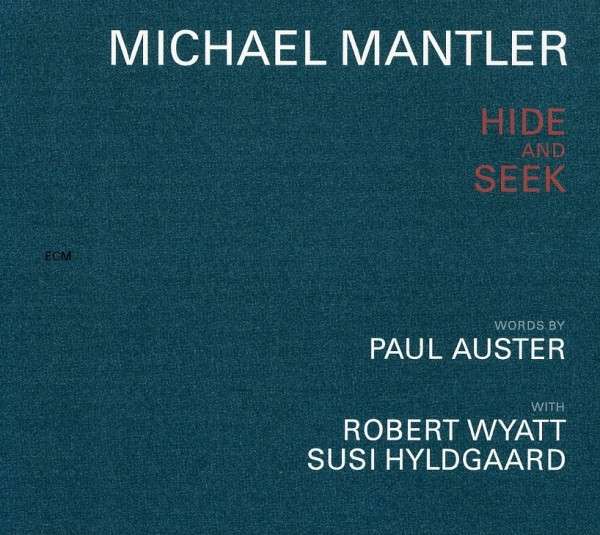
Michael Mantler is a force: not to be reckoned with, per se, but of reckoning itself. He is an artist of voices, one who, as the title of this operatic jewel attests, seeks them out from hiding. One of those, Robert Wyatt (long since found), is a singer with whom this album furthers a 25-year collaboration. Another is Susi Hyldgaard (also an accomplished accordionist), who first rose from within the Mantler fold in his masterwork The School of Understanding. Accompanying them is an expanded version of the composer’s loosely termed Chamber Music and Songs Ensemble, which opens its wings to include, on winds, Roger Jannotta (of Tom van der Geld’s elusive Children At Play) and Danish pianist Per Salo. Also (omni)present is Bjarne Roupé, a guitarist who has become an integral player in Mantler’s soundings. The most vital instrument of all, however, is the text by Paul Auster, an author on Mantler’s mind for years and whose eponymous short play lends itself starkly to the composer’s unmistakable brand of telepathy. The result is no mere setting, as Mantler takes his scissors (with the author’s approval) to its language with surgical care.

Holograms are constructed in such a way that if you cut them into pieces, each retains the entire image on a smaller scale. Such is the dynamic of Hide and Seek’s seventeen miniatures. Not one is fragmentary but rather contains elements of the whole. The purely instrumental “Unsaid” dots the program in six parts, the first of which opens. In them one encounters swarms of commentary, some more modest than others, around the guitar’s queen bee. In them are the agitations into which the play’s two characters are so reluctant to give. The balance is meticulous. It allows Wyatt and Hyldgaard to dance in their circles of comfort, breaking even in their seesawing between resignation and martyrdom even as the strings paint cracks in the glass above. Unsaid, yes, but not un-voiced.

“What did you say?”

These words introduce us to a drama of elliptical conversational elements. They cradle in their hands steaming plates of indecision, miscommunication, and vulnerability, which take the piece’s full duration to consume. Voices get caught up in their own vices, and in that process also take advantage of a few loopholes. Statements become facing mirrors lost in a mise-en-abyme of their own making. In their net the accordion occupies stage center, emotes without semantic limitations, while Mantler’s trumpet drips with guidance.

“What do you see?”
“Absolutely nothing”

Question and answer. Cloud and rain. Strings and footsteps. These comprise the core of Hide and Seek, their refrain a powerful marker of identity, or lack thereof, in which all traction is gilded, amplified. The tangled web of “What can we do?” features Mantler’s electronically programmed drums in a whirl of self-realization. It also poses the album’s most pertinent question, for which it has no answer but the melody of its asking.

“It all has to end sometime”

Closure by conjuring. An impending doom, so dark it is beautiful. In its shadows Wyatt and Hyldgaard make an emotionally foiled pair, especially in the final leg. They braid acceptance, parrying and thrusting their way toward the simple resolution of “I’m glad you’re glad.”

All of which culminates in two of Mantler’s most perfect shapes. The circling electric guitar of “Do you think we’ll ever find it?” marks a standout denouement, while “It makes no difference to me” sets speech atop a fulcrum of rocking strings. A return to the game, the accordion’s song passes through the door and on to the next chapter, as yet unwritten.

<< Vassilis Tsabropoulos: Akroasis (ECM 1737)
>> Ensemble Belcanto: Come un’ombra di luna (
ECM 1739 NS)

Vassilis Tsabropoulos: Akroasis (ECM 1737)

Akroasis

Vassilis Tsabropoulos
Akroasis

Vassilis Tsabropoulos piano
Recorded March 28, 2002 at Megaron, Dmitri Mitropoulos Hall, Athens
Engineer: Nikos Espialidis
Executive Producer: Manfred Eicher

Akroasis confirms Vassilis Tsabropoulos as a pianist whose talent is as deep as the ocean but who is content exploring single drops of it. Of those drops we get eight in Akroasis, which follows his intriguing ECM debut as jazz artist with a collection of improvisations built around, and in response to, five Byzantine hymns. The latter are Orthodox staples, and in their re-imaginings here chart new plains with a feeling of eternity. The first three, and in particular “Axion Esti,” gently showcase Tsabropoulos’s knack for evocation. Shifting from emerald to topaz, they bring a lofty yet intimate architecture into being. Cascading as they do from such great heights, the melodies quaver behind veils of their own mist, folding and refolding into increasingly visual arrangements. Certain others (namely: “Anastasis”) brim with optimism under cover of low-grade fever, dances of molecules and light that yield songs of ethereal cast. Their gifts flow like Sunday morning into a vestry which, though empty, nevertheless sings with the pregnancy of its shelter. Like the music reverberating between its walls, it cares not for fleeting objects or soundings but for the prism of heavenly care into which they feed.

Axion Esti
Axion Esti Icon

Tsabropoulos’s own compositions flush the ears of toxins via rolling currents, gazing upon the shapes of their divine interest as if they were impressed with icons in relief. “The Secret Garden” best shows his rigorous classical roots, evoking Ravel, Mompou, and de Falla in a blush of twilight. Don’t let the title mislead, however. Although the temptation to link these billowing streams to some invisible mystery is strong, they are firmly rooted in the realities of their creation: a coming together of body, instrument, and element. “Interlude” further illuminates the detail of Tsabropoulos’s artistry and shows a player starkly attuned to the value of spacious play. Its waves of pause and reflection are overwhelming in their subtlety, rendered all the more honest against an occasional sprinkle of dew in the higher register. The beauty of this album can hardly be overstated, if only because it is so understated, and nowhere more so than in the concluding “Prayer,” which like all that comes before it glistens with the innocence of its birth. We can feel Tsabropoulos thinking out loud, as if with an arm around us in brotherhood and peace.

Although comparisons to, for one, his duo project with Anja Lechner would seem inevitable, and despite the album’s decidedly sacred slant, to my ears it is more closely analogous to The River. That latter effort between pianist Ketil Bjørnstad (perhaps as close an analogue as one can find at the keyboard) and cellist David Darling brims with the same aquatic grace and expresses that grace through likeminded depth of production, clearly mapped even in the most heavily pedaled regions. Tsabropoulos’s relationship to this music is that of cloud and lake: one creates the other and, in being created, reflects the creator in kind. Thus, the album cover, in both incarnations, becomes an icon unto itself. Neither is positive and neither is negative. Both are nothing without the breath of life to be seen and, above all, heard.

<< András Schiff: Leoš Janáček – A Recollection (ECM 1736 NS)
>> Michael Mantler: Hide and Seek (
ECM 1738)

Annette Peacock: an acrobat’s heart (ECM 1733)

an acrobat's heart

Annette Peacock
an acrobat’s heart

Annette Peacock vocal, piano
The Cikada String Quartet
Henrik Hannisdal violin
Odd Hannisdal violin
Marek Konstantynowicz viola
Morten Hannisdal cello
Recorded January and April, 2000 at Rainbow Studio, Oslo
Engineer: Jan Erik Kongshaug
Produced by Manfred Eicher

we play our own music
we sing our own song
I make my own music
for right or for wrong

With these words, Annette Peacock reveals the shape of an acrobat’s heart, a portrait of a consummate artist. In her voice of voices is a world of wisdom, poised like a golf ball atop a tee—only instead of soaring down the fairway it sinks deep into the earth and marks its passage with remainders of relationships, dreams, travels. Previously represented on ECM as a ghostly compositional force to be reckoned with (viz: Paul Bley’s Ballads and Marilyn Crispell’s tribute record Nothing ever was, anyway), after years of preparation in response to a label commission Peacock at last spread her fan, nestling her voice and pianism in a bed softened by the presence of the Cikada String Quartet.

Annette
(Photo by Alastair Thain)

The bed metaphor proves apt, for in her plush, if sometimes distant, textures Peacock invites the listener into a space canopied by sheets. With an imploring yet never desperate tone, she turns experience into diary and diary into melody. More than personal, these songs are personified, each a character on a stage whose name is love. In this respect, piano and string quartet work like a giant heart, translating blood into life as might the poet turn breath into light. The instruments churn soil for every vocal flower, piano loosing handfuls of descriptive raindrops to water them. Some of those flowers are supple (“Over.”), while others are fallible (“u slide”); some liberated (“b 4 u said”), others wedded to time (“ways it isn’t”). More often, however, Peacocok is content mining the interstices of indecision for valuable emotional ore, unraveling a genuinely honest songcraft along the way. Heaviness of subject matter aside, there is an ethereal quality to her framework that turns questions into reality by shrouding them in fulfillment.

The lyrics say only what they need to say. Be they the open communications of “weightless” or the fresh wounds of “Free the memory,” one can expect a minimum of dress, for indeed the more one listens, and in spite of an intense physicality, the more the body becomes immaterial and passion reigns as emptiness. Peacock’s distinctly lilting cadences draw upon a stark cinema, thrown onto the screen by a projector of innocence. With a single utterance she can gut your expectations and fill them with conversations, at once profuse and fragmentary with age. Against these, “Camille” is a relatively mysterious turning of the mirror, catching just enough luminescence to clarify what is under the microscope.

The comet tails of Peacock’s surroundings are laden with affect. They turn like a mobile above a crib, connecting one galaxy to another with a rug weaver’s eye. The Cikadas brush lithely across her paper, erasing as much as they inscribe. For the most part, their gestures are bowed, although the rare pizzicato bloom (“The heart keeps”) lets its fragrance be known. Such moments take the album’s stream back to its course like an unsure lover back to the skin, to the warmth and closeness in which this music so wholeheartedly believes. The quartet also provides reprieve (in relation to the density of its surroundings) in “Unspoken,” floats us into “Safe” (the pianism of which becomes a speech act), and haunts again in “Lost at Last,” colored in lapsed time.

ECM has done quiet and significant work in extolling the virtues of jazz’s most intriguing songstresses, among them Sidsel Endresen, Norma Winstone, and most recently Judith Berkson. Yet with this release the label has unwrapped a significant gift indeed, one that keeps on giving the more you let it in.

<< Robin Williamson: The Seed-at-zero (ECM 1732)
>> Charles Lloyd: The Water Is Wide (
ECM 1734)

Arild Andersen w/Vassilis Tsabropoulos and John Marshall: The Triangle (ECM 1752)

The Triangle

The Triangle

Vassilis Tsabropoulos piano
Arild Andersen double-bass
John Marshall drums
Recorded January 2003 at Rainbow Studio, Oslo
Engineer: Jan Erik Kongshaug
Produced by Manfred Eicher

Classical pianist and late jazz bloomer Vassilis Tsabropoulos turned heads with his ECM debut, Achirana, for which he redefined the piano trio under the leadership of bassist Arild Andersen and guidance of drummer John Marshall, both improvisers of proven stamina and invention. Whereas Tsabropoulos’s playing felt at times muddied and inattentive to negative space on that nevertheless enchanting record, this sophomore effort ushers us into a new and vibrant chapter with “Straight.” Immediately one can tell in this Tsabropoulos original that its composer has already tapped into the qualities of a fine improviser, treating his hands more like feet engaged in dance, leaping and bounding their way through turns of phrase. The transformation is obvious in the way he listens, in Andersen’s duly spirited soloing, in Marshall’s vintage sound. That feeling of metamorphosis is even more palpable in “Choral” and in “Simple Thoughts,” both rustling, leafy scenes, picturesque yet open to darkness. And in “Cinderella Song,” Tsabropoulos elicits gobs of soul from the rhythm section, carrying the night with all the resignation of one who is sure in life and in love. His development as a jazz artist manifests itself further in the album’s intertextual variety, evoking Bill Evans, Vince Guaraldi, and French impressionism in short chains of keystrokes. In the latter regard, his arrangement of Ravel’s “Pavane” proves that his architectural awareness has indeed bloomed in the four-year gap between trio albums. Here he balances guidance and recession, thinking out loud in real time before our ears and brushing away the leaves to reveal the ground in all its promises of life.

Although on paper Tsabropoulos headlined Achirana, which was irrefutably an Andersen showcase, this time the opposite holds true. Still, Andersen muscles his way through some soft territories without so much as a blemish in his wake. He contributes three tunes, rendering a puff of cloud for every patch of sky. “Saturday” invokes a proper and delicate swing and finds Tsabropoulos going for a more linear approach, which bodes well for everyone involved. There is a nostalgic, quasi-urban energy in this one that sits on the cusp of swimming and drowning, opting to jump before finding out which will prevail. “Prism” offers a velvety ballad—the album’s only in the truest sense—and sets us up for the groovier “Lines,” in which the trio hits its stride.

By far the most interesting portion of this album, however, comes in the form of “European Triangle,” an unusual group improvisation that hints at broader undercurrents begging for exploration.

This is simpatico done right.

<< John Taylor Trio: Rosslyn (ECM 1751)
>> Trio Mediaeval: Words of the Angel (
ECM 1753 NS)

Tsabropoulos/Andersen/Marshall: Achirana (ECM 1728)

Achirana

Achirana

Vassilis Tsabropoulos piano
Arild Andersen double-bass
John Marshall drums
Recorded October 1999 at Rainbow Studio, Oslo
Engineer: Jan Erik Kongshaug
Produced by Manfred Eicher

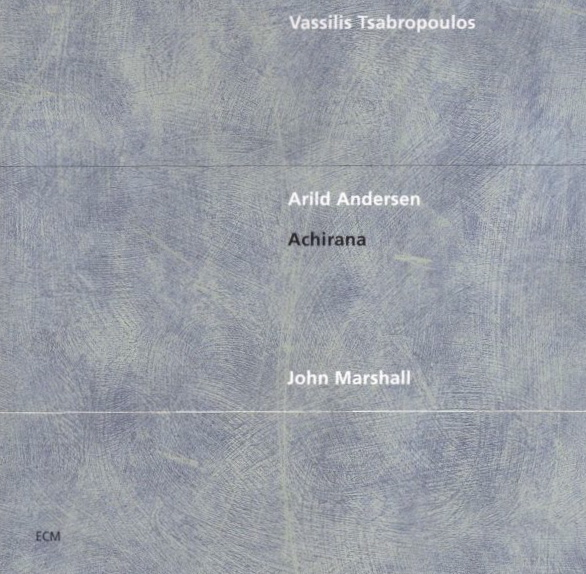
Achirana introduces a special trio formed by bassist Arild Andersen with pianist Vassilis Tsabropoulos and drummer John Marshall. Although the prodigious Tsabropoulos anchors equal footing in classical performance and composition, his improvising, notes Andersen, has full independence. Its rounded panache and ability to graft on to its surroundings while also maintaining an inherent melodic drive make this, his ECM debut, a thoughtful entry. That said, by the end he leaves us with a little too much to process. More on this below.

Tsabropoulos’s melodic gifts are immediately apparent in the whispered clusters with which he begins the title opener. A wistful thought, a tangle of hair about the nape, a ribbon loosed and windblown: such are the tiny pictures created by these gestures. Andersen’s playing is poignant and builds to density with such tact, magisterial yet as compressed as a teardrop, that the facets of “Diamond Cut Diamond” glitter with that much greater beauty. In this dance of thread and needle, Andersen resonates with mercurial depth-soundings. His heavy quavers are like giant arrows in the darkness, each shafted by a fallen tree and feathered by itinerant dreams, leaving their spores behind to sprout, fly, and strike their targets truly. Yet these are not weapons but instruments of writing, flowing down into “Valley” with their watery dreams fully intact. Such tracks as this clarify the album’s key element: namely, its ability to make the ineffable audible. Andersen’s poised soloing says it all, as does his pliant re-imagining of the Norwegian folk song “She’s Gone.”

The album’s remainder consists of Tsabropoulos originals, of which the breadth of “The Spell” and the upswing of “Fable” stand out for their pathos. He allows the music to breathe with such deference to the act of bringing it to life that he feels more like a ghost as the set progresses. By the final two tracks (“Song for Phyllis” and “Monologue”) he feels like an untraceable border in a Rothko canvas: nothing seems to separate his playing from his surroundings. It’s not that a jazz musician needs to stand on his head. Nevertheless, one wants to feel something embraceable, and sometimes Tsabropoulos plays a little too smokily. Compared to, say, John Taylor’s work with Peter Erskine and Palle Danielsson (as documented on Time Being, As It Is, and JUNI), the surface of Achirana is rather uniform. This is not necessarily a drawback, but it may help you decide whether or not Achirana is for you. Either way, it’s a unique swath of pianism and the formative mark of a musician who has since grown into his skin as an improviser. In this respect, the trio’s follow-up, The Triangle, is where it’s at, to say nothing of Tsabropoulos’s marvelous solo effort, Akroasis.

Barring the fact that Tsabropoulos’s name heads the roster, this is an Andersen record through and through. In addition to his creative playing, the bassist’s creative listening is patently obvious throughout, whereas Tsabropoulos tends to fill space wherever he can find it. The difference in approach is staggering and proves that jazz is more about what you don’t play. And let us not forget Marshall’s luminescent contributions, which open the listener further to that unnamable, tuneful inkwell into which masters of the art all dip their quills. In this respect, Edward Bulwer-Lytton only got it half right when he said that the pen is mightier than the sword, for what the pen leaves behind is mightier than both, as is the page, without which those markings might never reach us.

<< Zehetmair Quartett: Karl Amadeus Hartmann/Béla Bartók (ECM 1727 NS)
>> András Keller/János Pilz: Béla Bartók – 44 Duos for Two Violins (
ECM 1729 NS)

Keith Jarrett Trio: Whisper Not (ECM 1724/25)

Whisper Not

Keith Jarrett Trio
Whisper Not

Keith Jarrett piano
Gary Peacock double-bass
Jack DeJohnette drums
Recorded July 5, 1999 at Palais des Congrès, Paris
Engineer: Martin Pearson
Produced by Manfred Eicher

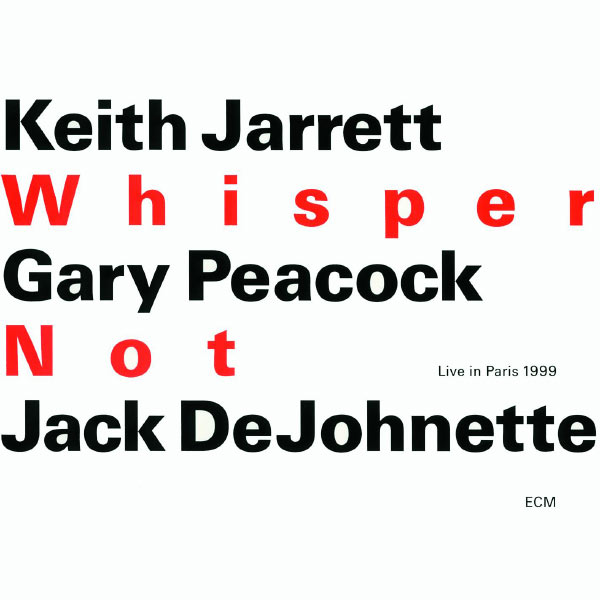
Following his intimate comeback from an illness that might have barred him from the keyboard forever, pianist Keith Jarrett closed another gap with Whisper Not, the first live album with his standards trio in three years. Once the needle of “Bouncin’ with Bud” drops, however, it’s as if there’d never been a skip in the record. Jarrett seems unable to contain the joy of being once again in his element, so that his chording behind Peacock’s first solo feels like a bird circling, waiting to dive: not in for the kill, but for the sheer thrill of his clip. And dive he does, navigating DeJohnette’s thermals with expert care, thus marking a triumphant return to the fold. That said, when later Jarrett comes into his vocal own on “Hallucinations,” he proves that this concert is more than that: it’s a reframing of what always was, and ever will be, a profound talent.

That the trio’s sound is brighter and more focused will be obvious to any longtime listener. There’s a special, scintillating quality to this album notable already in the title track, which opens with a characteristically wood-knotted intro before locking into a welcoming gait. Yet Jarrett positively fluoresces in the more downtempo turns. “Chelsea Bridge,” for one, moves with the magical fortitude of a classic fairytale—only this music is undeniably real. Some tender unpacking from Peacock sets the pianist to the delicate task of sorting those artifacts to heartwarming effect. His vivid approach to melody stands out further in “All My Tomorrows” and “Round Midnight,” both deep gazes inward that light candles in a post-storm blackout: not with fire but with an inextinguishable love for the musical process.

From “Wrap Your Troubles In Dreams” to George Shearing’s “Conception,” the set’s more upbeat turns have a tenderness all their own. On the same note, “Groovin’ High” might as well be the name of a school, for the trio’s performance of this Dizzy Gillespie tune is a master class in exposition. Peacock revels in the sound to which he is able to contribute so intelligently, while DeJohnette elicits visceral exchanges, ligaments to this as-yet-infallible body. “Sandu” further proves why Peacock and DeJohnette comprise one of the most intuitive rhythm sections in the business. They flow so organically, and with such unforced conviction, that it seems impossible to listen outside their spell. Each has his master moment: the bassist’s in “Prelude To A Kiss” and the drummer’s “Poinciana.” The latter is one of the most brilliant in the trio’s recorded output, of which only this concert’s encore, “When I Fall In Love,” has made it to disc before. Even more beautiful than one could hope for, it’s the perfect way to end a new beginning.

Welcome home.

<< Bruno Ganz: Wenn Wasser Wäre (ECM 1723 NS)
>> Herbert Henck: Piano Music (
ECM 1726 NS)

Children At Play: s/t (JAPO 60009)

Children At Play

Children At Play

Tom van der Geld vibes, percussion
Roger Janotta reeds, percussion
Larry Porter piano, electric piano, percussion
Richard Appleman bass
Jamey Haddad drums
Bob Gulotti drums
Recorded 1973 at Rennaissance Studios, Maynard, Massachusetts
Engineer: C. Ange
Produced by Tom van der Geld

Vibraphonist Tom van der Geld’s distinct musical wanderings have left behind some of the choicest among ECM’s out-of-print relics. Whether the trio settings of Path or the broader palette of Patience, his sound is at once soft and unbreakable, forthright yet ecumenical. His footsteps also found purchase in the rarer soil of the JAPO sub-label, of which this self-titled date from his legendary group Children At Play was the first. Here van der Geld is joined by Roger Janotta on reeds, Larry Porter on keyboards, Richard Appleman on bass, and Jamey Haddad on drums. Basking in opener “Tamarind,” it’s clear why the ensemble has attained such high status among collectors. This power statement awakens to a wealth of morning light every bit as descriptive as Grieg’s. The brittle bass line that ensues nets a flavorsome admixture of piano, vibes, and soprano sax that positively exudes personality. Between Porter’s grounding keys and a drum circle-like interlude, there is much to take in throughout this 18-minute journey as it pulls down the sun to where it began.

“Wandering I” lumbers further into the album’s storybook scenography, bringing illustrations to life with a hint of whimsy. In addition to the group unity forged in such tracks, Janotta’s reeds work a most vivid magic throughout, but especially in “Sweet My Sweet,” in which he sets up a tropical narrative from van der Geld, trembling and sunbathed, swaying like the album cover’s long grasses. Drummer Bob Gulotti replaces Haddad on “Reason,” a rubato outing of multifaceted inner dimensions. A gnarled, lethargic bass solo paints the picture of sleep before van der Geld’s dreams touch off lens flare accents.

If pushed to find a point of critique regarding this album, I might comment only on the sequencing, for the tracks might have better served themselves in reverse. As the order stands, it’s like starting with an enormous dessert and working one’s way back through smaller main courses. Either way, the album is another beautiful entry in the van der Geld travelogue and finds rich closure in “Patch Of Blue.” The only track not written by the bandleader (this one comes from Porter’s pen), it molds a pastiche of all that came before, combining the time of “Tamarind,” the fantasy of “Wandering I,” the warmth of “Sweet My Sweet,” and the introspection of “Reason” in smooth detail. The feeling is one of sand—not of desert, but of beach—between the toes, honest down to the last grain.

Nils Petter Molvær: Solid Ether (ECM 1722)

Solid Ether

Nils Petter Molvær
Solid Ether

Nils Petter Molvær trumpet, piccolo trumpet, synthesizer, electronics, bass, percussion, sound treatments
Eivind Aarset guitar, electronics
Audun Erlien bass
DJ Strangefruit voices, beats, samples, ambience
Per Lindvall drums
Rune Arnesen drums
Sidsel Endresen vocals
Reidar Skår vocoder
Recording producer: Nils Petter Molvær
Recorded, edited and mixed 1999 at various floors in Oslo, Norway
Mastering: Shawn Joseph, Masterpiece London
Album produced by Manfred Eicher

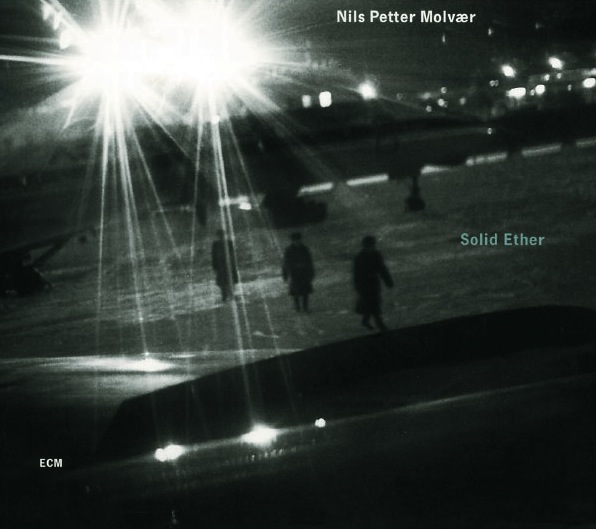
ECM left an indelible mark in 1998 with the release of Khmer. Trumpeter Nils Petter Molvær’s leader debut spread a royal flush across the table when the music industry least suspected it. Solid Ether marks a return to that trending sonic universe, only now it turns away from the idiomatic sources of its predecessor and looks deeper into the mirror for inspiration. This time around, the layers are more archaeologically striated, servile to a beat-driven cartography. Melodically, the album is rawer, rudimentary, and finds its voice through the detailed care of the arrangements. “Dead Indeed” is but one rhythmically arresting example with an altogether sharper edge: a bolder, well-oiled machine. Molvær’s far-reaching introduction surveys a landscape with hand over eyes before diving into a serpentine Nile of its own making. The grinding drum ‘n’ bass vibe raises the dead with its veracity while singing calls harmonize like ancestors with the living: a mummy reanimated and bid to break-dance like it has never loosed a ribbon before. With a wry smile, it cocks its head and throws a handful of sand into those same eyes, that it might have a moment to fade and leave you wondering if it was all just a dream, a vision gone mad the moment you pressed PLAY. This opening track is also significant for being almost entirely played and programmed by Molvær himself, grafting only guitarist Eivind Aarset’s overdubs for effect.

“Vilderness 1” takes its name from Molvær’s daughter Vilde and boasts a cut-and-paste aesthetic of many masks. It is a porous, geometric picture, of which the throbbing bass is an alizarin crimson-loaded palette knife. “Vilderness 2” doesn’t continue where the first left off but dances through its forest once more, hopping from branch to branch like the lithe warriors of Ninja Scroll. After experiencing this slide of Rubik’s plane as if from the inside, the caress of “Kakonita” feels like a wholly different love. Floating primary-colored blocks of notecraft on a bed of infant foghorns, it reworks cinematic DNA into a golem’s playlist. Sidsel Endresen, with whom Molvær plays on the singer’s two ECM recordings, So I Write and Exile, lends her voice to two iterations of “Merciful.” Joined by Molvær on piano, she cuts moving pictures of intense observation, each a morsel of gesture in a world of stills. Her poetry peels alienation away like a sticker, filling in the remaining ghost as if it were a piece of candy in danger of melting.

“Ligotage” first appeared on a Khmer tie-in single and takes a more congealed form here. Its breathtaking scope and depth of language glistens with sun-kissed brilliance. Audun Erlien’s growling bass flushes the sewers of the mind with its grit, heightening the feeling of alarm until it leaps with the unbridled spirit of a dolphin against Ra’s unblinking eye. Drummers Per Lindvall and Rune Arnesen add similar comfort to the concoction of “Trip,” proving definitively that the feeling created by this hip collective sells the music by virtue of its structural integrity alone. From tripping to skipping, we come to “Tragamar.” Striding a fuzzy border between ballad and lament, it drowns in the title track and its biochemical integers. More live drumming adds punch and bites us in the ear with its head-nodding finality.

There is an indigeneity to Molvær’s art that is as far away from pretension as we are from knowing the truth about ourselves. The music is a stranger in its own land, a king without subjects, a dog without a leash. It has only us to turn to.

<< Michael Mantler: Songs and One Symphony (ECM 1721)
>> Bruno Ganz: Wenn Wasser Wäre (
ECM 1723 NS)