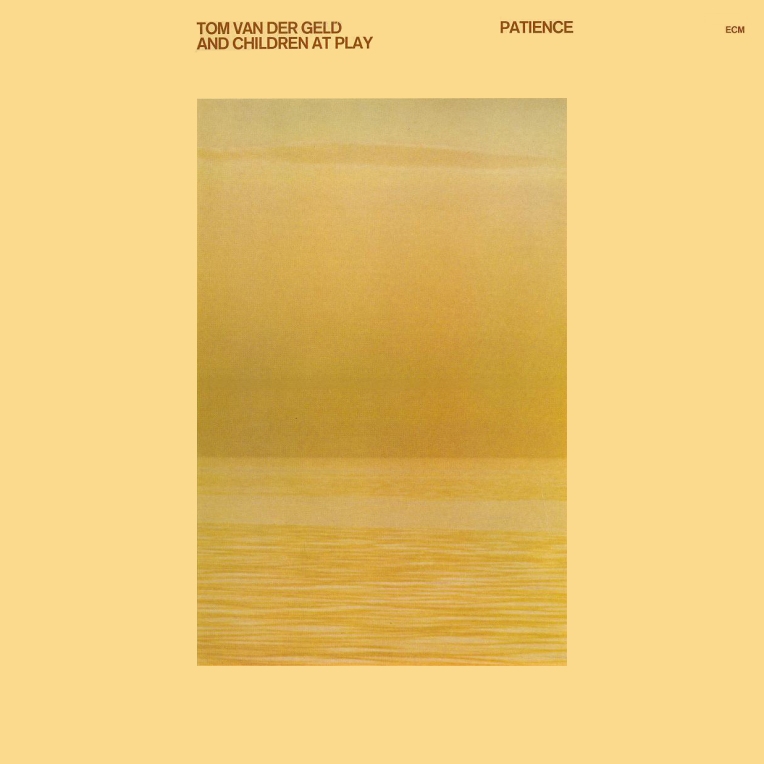
Tom van der Geld and Children At Play: Patience (ECM 1113)

ECM 1113

Tom van der Geld and Children At Play
Patience

Tom van der Geld vibraharp, percussion
Roger Jannotta soprano and baritone saxophones, flutes, oboe, bass clarinet
Kent Carter bass
Bill Elgart drums, percussion
Recorded May 1977 at Tonstudio Bauer, Ludwigsburg
Engineer: Martin Wieland
Produced by Manfred Eicher

As yet to provide choice “vibes” for Kenny Wheeler’s around 6, in addition to his elusive but well-worth-owning Path, mallet man Tom van der Geld made his ECM debut with this, his second of three “Children At Play” recordings. Less specific than his later work with the group, which was perhaps never meant to be a stable collective/concept in the first place, Patience may require just that. That being said, the abstractions of the opening title track have a charm all their own, seeming to inhabit that blurry space between fading night and the coming dawn. This diurnal circle unrolls into a relatively straight line in the flute of multi-instrumentalist Roger Jannotta through the vibes’ infrared lobs. With “Golden Stabs” we feel that dawn acutely, warming our faces with a gorgeous soprano that always remains tonally centered despite its erratic rays. Those smooth reeds carry over into the even smoother melancholia of “Alison.” “Celia” is an ever-changing mosaic of continental winds and underwater railways. Like a broken vial of liquid mercury, it recedes, unrecoverable, into the cracks of a melodious tessellation. “And Then…” ends the album on a pointillist reverie with the oboe as storyteller. We get the barest intimations of traction in the bass (Ken Carter) and drums (Bill Elgart) before taking shelter in more densely woven brush. It is here where the album at last begins to gel and its trajectory becomes known to us.

Viscous and profoundly solitary, van der Geld’s is an intimate world to be sure. Like the flute that haunts its darkest corners, it is a half-remembered death given a new body through the resurrection of the musical act. One feels Patience in degrees of heat, each track an incremental setting on a toaster that sets the coils aglow with varying intensity, leaving us with a distinct char every time.

<< Keith Jarrett: Ritual (ECM 1112)
>> Pat Metheny Group: s/t (ECM 1114)
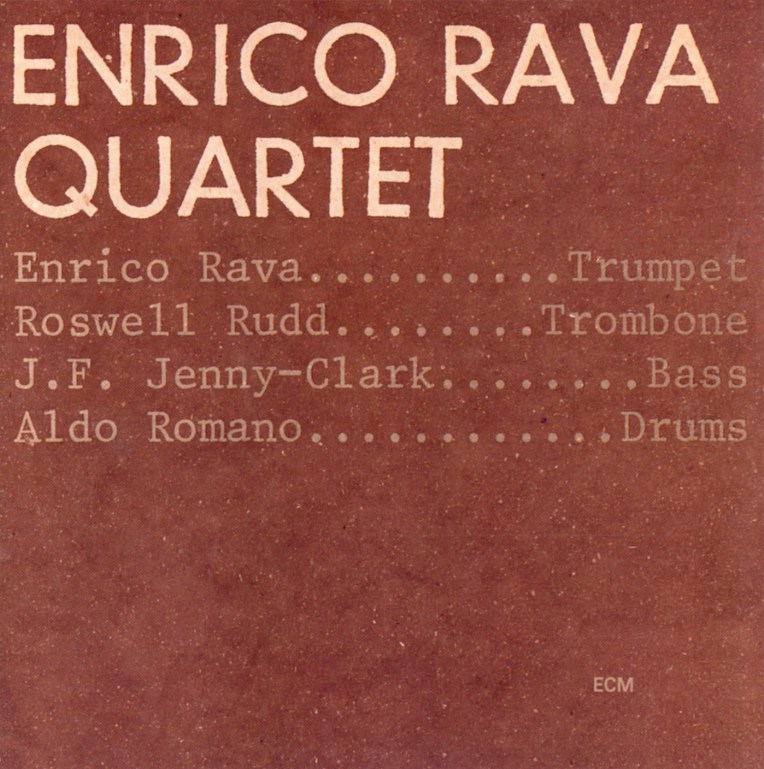
Enrico Rava Quartet: s/t (ECM 1122)

ECM 1122

Enrico Rava Quartet

Enrico Rava trumpet
Roswell Rudd trombone
Jean-François Jenny-Clark bass
Aldo Romano drums
Recorded March 1978 at Tonstudio Bauer, Ludwigsburg
Engineer: Martin Wieland
Produced by Manfred Eicher

Enrico Rava, one of the trumpet’s unsung heroes, unearthed a gem in this self-titled quartet offering from 1978. Although one can always expect an expertly realized variety in any Rava project, what makes this date so special is the assembly of its players. The Italian virtuoso’s hit-you-in-the-chest lyricism—matched perhaps only by label mate Kenny Wheeler—is foiled beautifully by trombonist Roswell Rudd, a free jazz specialist and Archie Shepp go-to whom ECM enthusiasts will recall from Michael Mantler’s CONCERTOS and a smattering of Carla Bley releases on Watt. Rudd’s fluid undertow brings our leader’s more incisive melodic lines to vivid light, gently laying down long thematic carpets upon which every improvisatory step leaves behind an indelible print.

The opening chunk of “Lavori Casalinghi” doesn’t so much kick things off as pull the curtains to reveal a slow sunrise. The drumming of Aldo Romano sets off a spate of powerful statements from the two brassmen, each linked by a chain of highly charged relays. The rhythm section never lags, and even spawns a nimble-fingered turn from bassist Jean-François Jenny-Clark before sliding back into the mournful twists with which it began. This is one of two substantial cuts, the other being “Tramps,” a fifteen-and-a-half-minute swell of sometimes frenzied proportions. Rava and Rudd draw each other into ecstatic exchanges, their playing at its most soaring. Wilder moments are short-lived, but always tasteful. Romano shows off one of the most fluid snare rolls in the business here, flanked by rousing phrasings from Rava and Rudd both. “The Fearless Five” is the first of three shorter numbers that flesh out this balanced effort. A bit of Monk creeps in, foreshadowing the well-worn “Round About Midnight,” which the crew buffs to like-new shine. Finally, the upbeat intro of “Blackmail” leads into some prime playtime for Rava. And as he skips his way across the sky, we take comfort in the somber closure into which he lays his final rest.

All in all, a fine session bubbling with personality and heft, and one well worth owning for the Rava newbie and veteran alike.

<< Ralph Towner: Batik (ECM 1121)
>> Barre Phillips: Three Day Moon (ECM 1123)

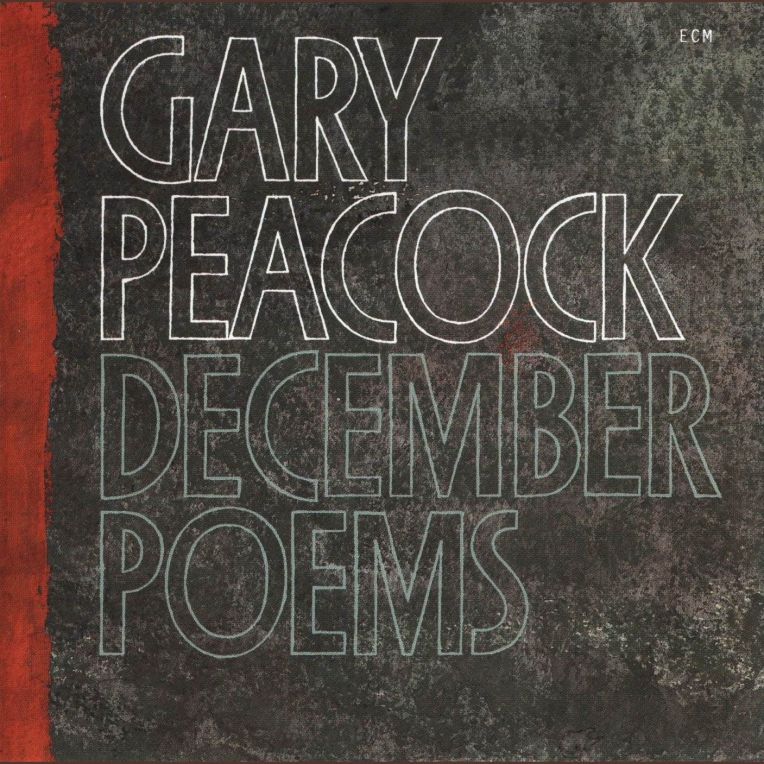
Gary Peacock: December Poems (ECM 1119)

ECM 1119

Gary Peacock
December Poems

Gary Peacock double-bass
Jan Garbarek tenor and soprano saxophones
Recorded December 1977 at Talent Studio, Oslo
Engineer: Jan Erik Kongshaug
Produced by Manfred Eicher

From the start of Gary Peacock’s December Poems, one revels in the sound of his instrument, the buzzing, raw quality of which comes to listeners at last relatively unmitigated. After a languid intro, “Snow Dance” lays down an unsinkable bass line, over which overdubbed improvisations abound. Jan Garbarek’s reports paint “Winterlude” like the sky outside my streaked window: that is, with only the barest of contrasts separating heaven and earth. “A Northern Tale” is a strangely airy segue into the wistful intro of “December Greenwings” and Garbarek’s subsequent reappearance. His winding paths intersect beautifully with Peacock’s straight and narrow in a track that is about as upbeat as the album gets. “Flower Crystals” changes the tone considerably with some internal pianism before settling into “Celebrations.” Like the opener, this also features two basses, only this time caught in a more erratic chain of events.

As I write this, it is indeed December—New Year’s Eve to be precise—and I am on a bus bound for New York City. Behind thoughts of friends and fun (the Metropolitan Opera’s performance of Pelléas et Mélisande awaits me), I feel in the starkness of this music the deeper roots of my travel. As the sun rises somewhere behind the cloud cover, I know that its light shines within. Recorded with unsurprising clarity, the album captures every creak, tap, and involuntary hum. Like a bare tree standing in a snowy field, its branches cut a bold hand-stretch of lines across a canvas of white and gray. As with Jack DeJohnette’s Pictures, this effort offers insight into an otherwise fiery group player whose free-spiritedness is akin to that of the label on which he has found his ideal home.

<< Jan Garbarek: Places (ECM 1118)
>> Bill Connors: Of Mist And Melting (ECM 1120)

Egberto Gismonti: Sol Do Meio Dia (ECM 1116)

ECM 1116

Egberto Gismonti
Sol Do Meio Dia

Egberto Gismonti guitars, piano, kalimba, percussion, flute, voice
Nana Vasconcelos berimbau, percussion
Ralph Towner guitar
Collin Walcott tabla
Jan Garbarek soprano saxophone
Recorded November 1977 at Talent Studio, Oslo
Engineer: Jan Erik Kongshaug
Produced by Manfred Eicher

Inspired by his time spent with the Xingu Indians of the Amazon, to whom the album is also dedicated, Sol Do Meio Dia (Midday Sun) is a consistently intriguing transitional album from multi-instrumentalist Egberto Gismonti. With him are percussionists Nana Vasconcelos and Collin Walcott and guitarist Ralph Towner, as well as Jan Garbarek on soprano saxophone for a brief spell. At this point in his career, Gismonti was beginning to fill in the porous sound of his 8-string guitar. To this end, Vasconcelos and Walcott flesh out much of the dizzying rhythmic space that defines his sound, while Towner’s 12-string laces the background with more explicit chording. Walcott traces magical circles in “Raga,” for which Gismonti engages us with nimble fingerwork on the guitar’s highest harmonics. Thus begins a chain of sporadic bursts acting in dialogue. With modest virtuosity, the musicians run hand-in-hand down this ecstatic path of music-making to an even more specific sound, this time marked by kalimba and thumb piano. Gismonti’s shrill flute and wordless chanting here recall the work of CODONA. “Coração” is a rich solo and, along with the album’s closer, is a perfect exposition of Gismonti’s notecraft. The disc finishes with a 25-minute suite. Garbarek makes his only appearance in the opening section, which glows with his mournful ululations. An inviting solo from Towner opens the ears to another fluted passage anchored by percussion and handclaps. One can feel the forest at such moments as if it were living and breathing all around us.

The combination of musicians is pure ECM and reflects the brilliant casting of producer Manfred Eicher. As airy as Sol Do Meio Dia sounds, it is also weighted with a certain nostalgia that is difficult to quantify. Like a memory, its actors are always out of focus even when their intentions ring clear. And in the end the intentions are what it’s all about.

<< Keith Jarrett: My Song (ECM 1115)
>> John Abercrombie: Characters (ECM 1117)

Keith Jarrett: Ritual (ECM 1112)

1112 X

Keith Jarrett
Ritual

Dennis Russell Davies piano
Recorded June 1977 at Tonstudio Bauer, Ludwigsburg
Engineer: Martin Wieland
Produced by Manfred Eicher

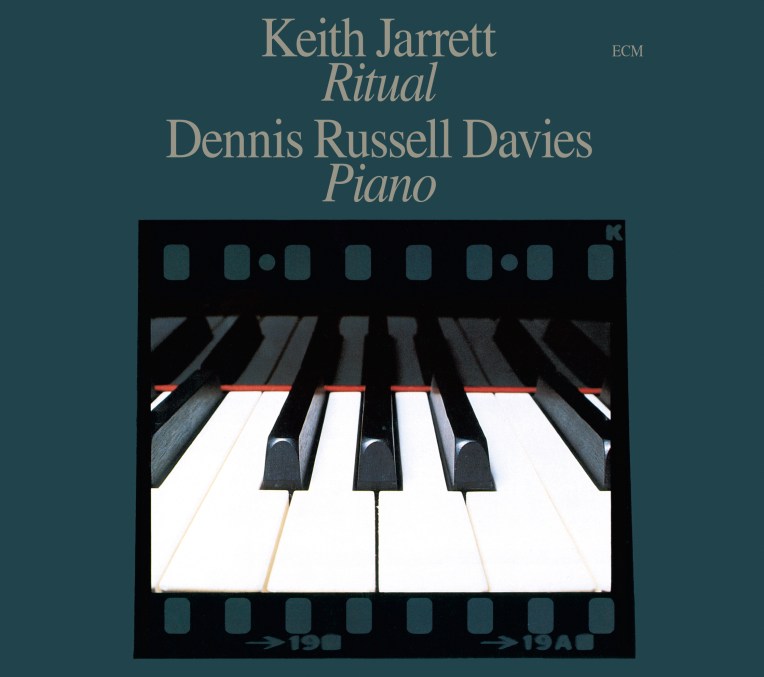
Ritual is something of an anomaly in the Keith Jarrett archive. It’s a solo album, as many of his best are, only this time it is pianist, conductor, and frequent collaborator Dennis Russell Davies at the keys playing a work penned entirely by Jarrett. The hallmarks of a Jarrett piano recital are all there—the rolling ostinatos, dense arpeggios, and profound doublings—yet are valenced differently under the rubric of “composition.” In this context, we get a sense of “once removed-ness” that might not present itself under improvisational circumstances. The piece’s modest 32 minutes are divided into two immodest parts. From the opening groundswell we get not only dense pockets of energy, but also nodes of emptiness. Put another way: the music’s glorious peaks share the same space as the shadowy valleys at their feet, thereby encompassing a harmonious middle ground. Like a geyser, its eruptions are predictable yet manage to enthrall every time. Despite its claustrophobic beginnings, Part 1 ends in bright solitude, like a room in which the curtain has been slowly opened to welcome the morning sun. Heavier chording marks Part 2, which resolves in a hopeful melancholy, but not before gelling the emotional plasticity of its precursor. This brings us full circle, ending on a solemn intonation of a single note.

Ritual is far more “regulated” than typical Jarrett fare, spun as it is from the surrogacy of another performer rather than through the alchemy of spontaneous creation (though there is, of course, some of each in the other). The results are captivating in their own way, stoked by every depressed key and lifted pedal. Its shapes are drawn not by what is, but what has been and will be. The present is invisible and lives on only as formless possibility, caught like a blown kiss in the cup of one’s hand.

<< Gary Burton: Times Square (ECM 1111)
>> Tom van der Geld and Children At Play: Patience (ECM 1113)

Art Lande and Rubisa Patrol: Desert Marauders (ECM 1106)

ECM 1106

Art Lande and Rubisa Patrol
Desert Marauders

Art Lande piano
Mark Isham trumpet, horns
Bill Douglass bass, flute
Kurt Wortman drums
Recorded June 1977 at Tonstudio Bauer, Ludwigsburg
Engineer: Martin Wieland
Produced by Manfred Eicher

Desert Marauders represents the final iteration of pianist Art Lande’s Rubisa Patrol quartet, which over its flash-in-the-pan tenure produced a solid, if modest, body of imaginative work. For this recording Kurt Wortman replaces Glenn Cronkhite on drums and provides plenty of adhesive for otherwise free-floating themes and ideas. His stop-and-start playing engages Lande in exciting conversation throughout the groovy opener. At 16 minutes, it is more main course than appetizer, but whets our expectations all the same with its vivid prime directive while offering food for thought via Mark Isham’s serpentine melodies. Bassist Bill Douglass works us back into the swing of things with consummate fortitude. After this epic journey, “Livre (Near The Sky)” feels like a piece of heaven. Driven by the fluid trumpet of its composer in the only non-Lande composition on tap, it’s a piece of and about imagination. Each piano chord is a branch to which Isham glues his own improvised leaves. We feel the entire tree swaying in the winds of an oncoming storm, the first drops of which hit our forehead in the piano of “El Pueblo De Las Vacas Tristes.” As it comes down in placid sheets, it flows at the feet of camels and worn sandals. Lande lays out the loveliness over his rhythm section in a blend of oil and chalk pastels. Douglass doubles Isham on flute in “Perelandra” for some airier moments. “Sansara” is a throwback of sorts. Its solid, infectious pianism, lively trumpeting, and tender bass solo combine for a smooth and rousing finish to a fine effort all around.

<< Abercrombie/Holland/DeJohnnette: Gateway 2 (ECM 1105)
>> Eberhard Weber Colours: Silent Feet (ECM 1107)

Richard Beirach: Hubris (ECM 1104)

ECM 1104

Richard Beirach
Hubris

Richard Beirach piano
Recorded June 1977 at Tonstudio Bauer, Ludwigsburg
Engineer: Martin Wieland
Produced by Manfred Eicher

Classically trained pianist Richie Beirach has created some of ECM’s most melodically engaging music. His first solo album is a keepsake to be treasured for its melodic detail and structure. “Sunday Song” embraces the album at either end with heartache and never lets go, even in silence. Within its fibrous interior, Beirach spins thematic funnels from vivid ostinatos. Floating in its liquid center is the title piece, which if anything is circumscribed and modest. No single mood dominates, thereby allowing the listener the benefit of continual reassessment. One feels the music developing in multiple and simultaneous directions, such that a destination cannot always be inferred. Between the speculative considerations of “Osiris” and “Future Memory” and the narrow syncopations of “Leaving,” one finds a range of brushstrokes at the musician’s employ. The aerial dissonances of the latter piece leave particularly indelible impressions upon the mind’s palimpsest. “Koan” is a colorful and erratic interlude and stands equidistant from the likeminded “Rectilinear.” Beirach scales his greatest heights in “The Pearl,” which he buffs to a blinding shine with arresting key changes, only to be refracted in a haunting traipse through the “Invisible Corridor.”

With no one to answer to here, Beirach’s notecraft is pared down to the core and given free reign. These vignettes are atmosphere itself, bound to their titular prompts while also shedding them in favor of absolute expression.

<< Jack DeJohnette’s Directions: New Rags (ECM 1103)
>> Abercrombie/Holland/DeJohnnette: Gateway 2 (ECM 1105)

Jack DeJohnette: New Rags (ECM 1103)

ECM 1103

Jack DeJohnette
New Rags

Jack DeJohnette drums, piano
John Abercrombie electric guitar, electric mandolin
Alex Foster tenor and soprano saxophones
Mike Richmond bass, electric bass
Recorded May 1977 at Tonstudio Bauer, Ludwigsburg
Engineer: Martin Wieland
Produced by Manfred Eicher

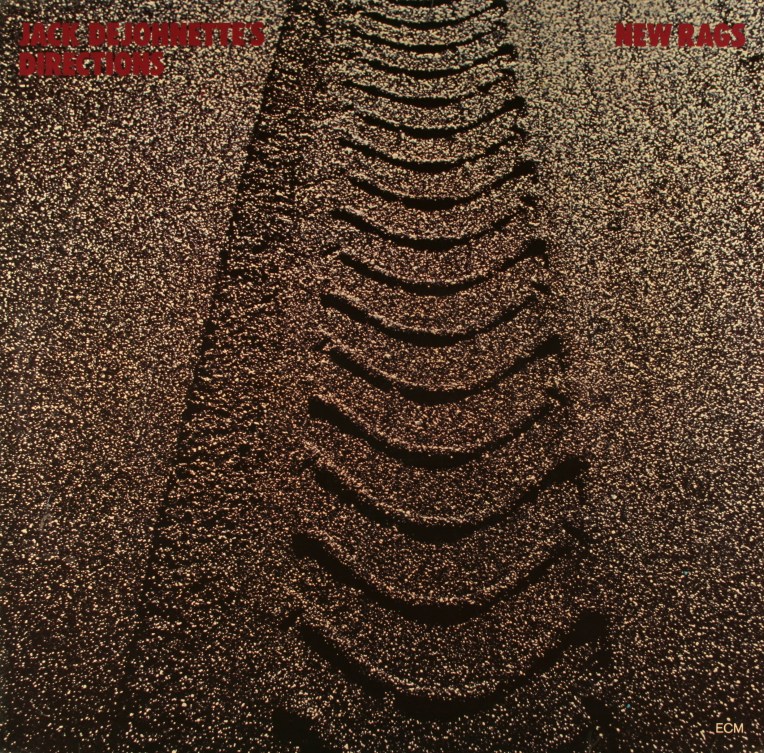
Directions was a short-lived unit from the evolving mind of drummer Jack DeJohnette, who on this ECM joint proved once again that his deftness at the keyboard is almost on par with his mainstay. New Rags features the same line-up (John Abercrombie on electric guitar and mandolin, Alex Foster on reeds, and Mike Richmond on basses) as 1976’s Untitled, sans Bernhardt. Our frontman meanders into the thick of things with three originals, of which the title track bristles with luscious work from Richmond in a steady interplay with all. The consistent improv comes to a head at the halfway point, where Foster pulls his fingers as if in a vast string game by way of transition. We lapse into a brief, somnambulant carnivalesque before merging back on track as Abercrombie leads the charge, loosing a thematic call to arms that concludes in delight. An energetic groove awaits us in “Minya’s The Mooch,” in which sax and guitar are more than happy to hop onto the rhythmic bandwagon. Energies subside as quickly as they flare, leaving Abercrombie to hang in space like the brightest star on a cloudy night. Meanwhile, the elegant sax trio of “Lydia” is a short but sweet diamond in the rough that is sure to win your heart.

Foster counters with two sucker punches of his own. “Flys” is an upbeat number with attentive chording from Abercrombie. The final “Steppin’ Thru,” however, outshines the others combined in a 10.5-minute exposition with the raw intensity of an Everyman Band. Abercrombie wrenches out the album’s best solo here, more than willing to take us along for the ride. The energy accumulates with a funky electric bass before fading out, having no other recourse to finish.

While perhaps not as melodically solid as its previous effort, New Rags lives up to the group’s name. With purposive commitment and forward-looking arrangements, DeJohnette serves up another piping hot dish of auditory comfort food.

<< Kenny Wheeler: Deer Wan (ECM 1102)
>> Richard Beirach: Hubris (ECM 1104)

Gary Peacock: Tales Of Another (ECM 1101)

ECM 1101

Gary Peacock
Tales Of Another

Gary Peacock bass
Keith Jarrett piano
Jack DeJohnette drums
Recorded February 1977, Generation Sound Studios, New York
Engineer: Tony May
Produced by Manfred Eicher

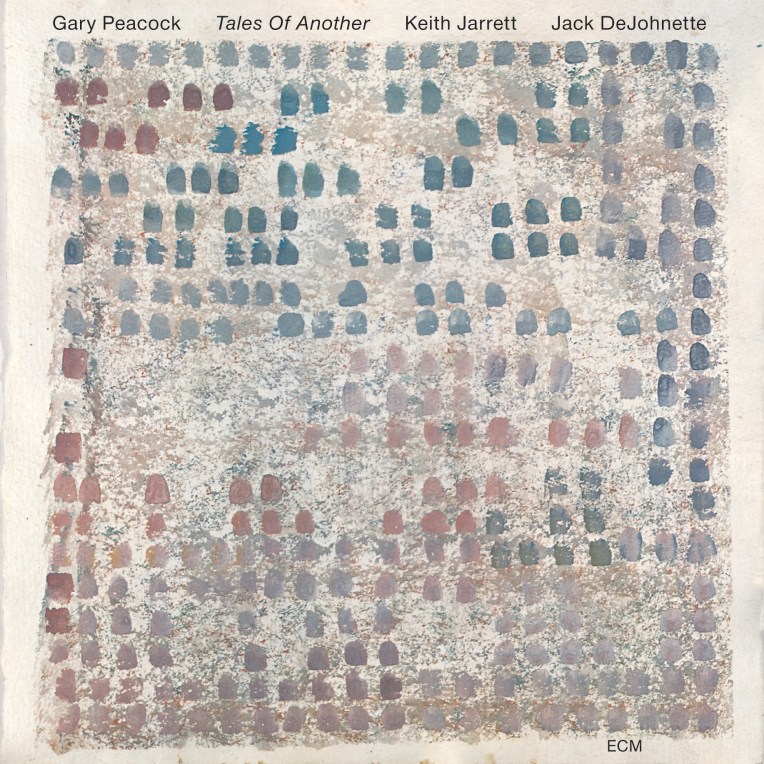
The grouping on this album represents a milestone in ECM outfits, persevering to the present day as it has in the form of Keith Jarrett’s mighty standards trio. Though a far cry from the ecstatic overloads honed over years of synergy and touring, there is an almost naïve charm to this effort and the evenhanded musicianship that sustains it. Each of these six “tales” begins in loveliness. Piano and bass bring the most urgency to bear, as in the gorgeous “Vignette,” in which Peacock gets his first lilting solo, and its follow-up, “Tone Field.” Both start off slow and sure, with DeJohnette giving the barest hint of traction and Jarrett biting deeply into fractured themes. “Major Major” gives us the steady beat we crave beneath majestic chording from the piano man, who offers up a prime slab of linear sirloin. Yet the album’s juiciest sediments can be found in the massive “Trilogy” that makes up its second half. DeJohnette skirts the rims with requisite flair while Peacock slathers on a bright veneer. Jarrett grunts ecstatically with every new development, shooting fire from his fingers. Such is the energy one has come to expect from this nonpareil threesome. Jarrett cuts off our air supply before the final stretch, the hair-trigger precision and on-your-toes syncopations of which make this pensive journey more than worth taking.

Peacock’s moody compositions make for a strikingly different experience. His fingers pull with accomplished ease at the strings of his bass. DeJohnette sticks to the margins, but fills them like no one else can. Jarrett, it might be noted, is more vocal here than I’ve ever heard him. For many, this seems to be the album’s only downfall. As far as this listener is concerned, his woops, grunts, and squeals merely underscore a musician who is unafraid to let his heart sing.

<< Keith Jarrett: Sun Bear Concerts (ECM 1100)
>> Kenny Wheeler: Deer Wan (ECM 1102)