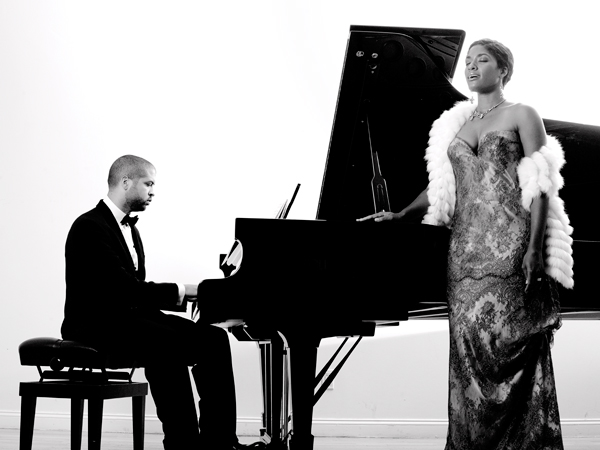
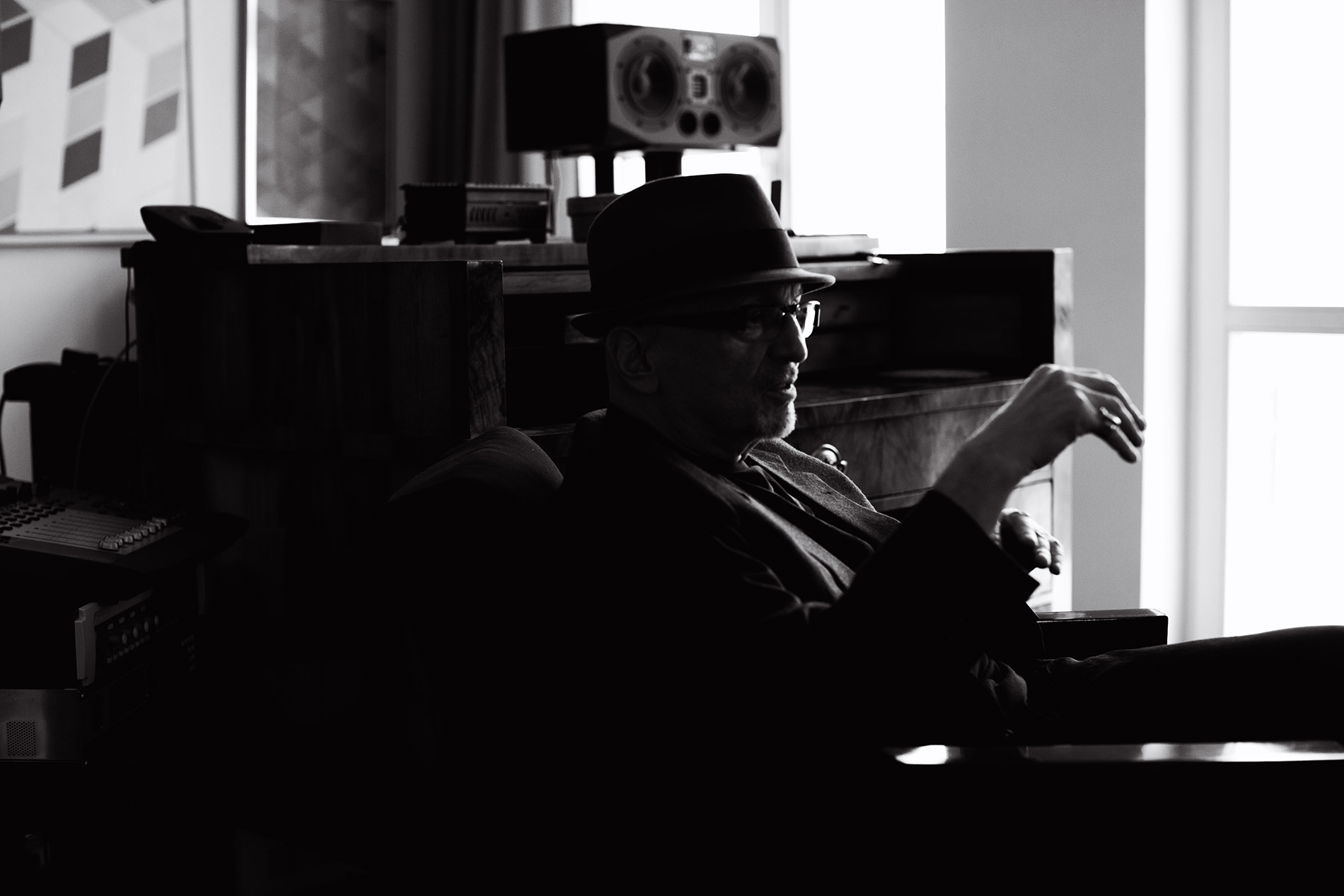
A Little Bit Wiser: Jason and Alicia Hall Moran

Jason Moran piano
Alicia Hall Moran voice
Barnes Hall, Cornell University
April 11, 2013
8:00 pm

JAHM

In January of 2012, pianist Jason Moran and his wife, mezzo-soprano Alicia Hall Moran, were slated to perform on Cornell University’s intimate Barnes Hall stage. A Broadway gig prevented Alicia from being able to appear and bassist Dave Holland was kind enough to substitute. The result was an unforgettable evening of music. Yet I always wondered what spells the original billing might have cast. At last, some 15 months later, that magic was realized. There was something about the way that Jason opened with his solo rendition of Fats Waller’s “Honeysuckle Rose” that assured us we were in for something special. His flourishes were straight from the heart, not the least bit rhetorical. He took those classic threads and re-spun them: same colors, different weave. It was the first of a handful of solo pieces, which also included John Scofield’s “Fat Lip” (a jauntier affair, coated in silver and wine) and some original music written for Alonzo King. The latter revealed the gentler side of an artist whose panache lays it all on the table: diamonds, clubs, hearts, and spades. Or maybe it was the way in which Lucille Clifton’s “blessing the boats” tumbled from Alicia’s lips. A poetess in her own right, she took to the platform fully prepared for the power of love in a world riddled with hindrances. Her resonance filled the room, sharing the rafters with spiders’ webs and history. Like Clifton’s timeless words, she manifested a fully embodied style, her pulse audible during sustained notes.

may the tide that is entering even now the lip of our understanding carry you out beyond the face of fear

Alicia used these interludes as doorways to personal reflection. Not only because she wrote the melodies, but also because in her was a storyteller whose loom was strung with moonbeams. By the end of the night we knew how she and Jason had met and fallen into oneness, how music had called to them as equals and set their phasers to shine. Their autobiographical transparency cut the fourth wall like butter.

may you kiss the wind then turn from it certain that it will love your back

A soulful rendition of a Stevie Wonder classic, endearingly altered as “I Was Made to Love Him,” set off a string of standards. Of these, “My Funny Valentine” stood out for its rasp, traversing a bridge of good fortune into a swinging “Summertime.” Leonard Bernstein’s “Big Stuff” was the icing on an already optimistic cake, boxed and tied with a bow.

may you open your eyes to water water waving forever

Two pieces by Jason from a commissioned suite based on hymns of the quilters at Gee’s Bend, Alabama were the reigning portion of the set. “Here Am I” was downright transcendent, melding supplications into sustained, train-like chords from the keys. “People are more important than things,” Alicia sang, and we could feel that theory made real in practice. This was followed by “You Ain’t Got but One Life to Live, You Better take Your Time,” the notes of which rubbed up against one another as Alicia looked us all in the eye and straight into our hearts. She walked offstage, her voice still carrying before boomeranging back to encore with Duke Ellington’s “I Like the Sunrise.” A glint of light at the end of this long winter, it glowed until we were warmed.

and may you in your innocence sail through this to that

By this point, we had experienced something more than a show. It was a life lesson. Thus spoken and sung for, we carried snatches of post-concert conversation in our pockets out into a maze of streetlights, strung to the gills with joy. Carry on, butterflies, carry on.

Lena Willemark album review

Click on over to RootsWorld magazine to read my review of a new album by Lena Willemark on the Swedish label, Country & Eastern. Readers will be familiar with her handful of ECM projects, including the popular Agram. Here she is joined by saxophonist Jonas Knutsson (also featured on Agram) and keyboardist Mats Öberg in a gorgeous folk-inspired program. I further encourage ECM fans to check out Country & Eastern. It is the brainchild of Bengt Berger, whose Bitter Funeral Beer album is among the best of ECM’s outliers.

ADS

All 4 One: The Anonymous 4 Sparkle at Sage Chapel

Anonymous 4
Sage Chapel, Cornell University
April 5, 2013
8:00 pm

Anonymous 4

Although the Anonymous 4 have been singing for over 25 years, to hear them is to experience what feels like centuries more. The current lineup of this all-female vocal quartet (two of its original members have moved on to other projects) consists of Ruth Cunningham, Marsha Genensky, Susan Hellauer, and Jacqueline Horner-Kwiatek, who together presented “Marie-Marion: Motets & Songs from 13th-century France” to a packed Sage Chapel audience last Friday night. Motets formed the bulk of the program, each built around Old French and occasionally Latin texts. The latter were mostly dedicated to Marie (the Virgin Mary), who along with an earthly counterpart, Marion, was the main protagonist of the evening’s dedications. The presence of both Marie and Marion made for a creative pastiche of the divine and amorous. The singers augmented this with a selection of plainchant standards and solo renditions of the trouvère (troubadour) love songs to which the grander settings often alluded.

Fans of the Anonymous 4 will be familiar with their classic Love’s Illusion. While in that program the focus was on courtly love, here a deft mash-up of sacred and secular themes formed the backbone of a dramatic and sometimes-prurient corpus. The motets were complex in their own right, with two or three voices singing from entirely separate texts over a wordless “tenor” line. The selections came from the Montpellier Codex, compiled in the south of France circa 1300. Paring its 315 motets down to an hour-long “best of” was certainly no easy task, but the end result was nonetheless intuitive and sure.

The flowing nature of the program was such that parsing of individual pieces seemed as unnecessary then as it does now. Moods ranged from forlorn to joyful, but were always flavorsome. If any distinction can be made, it is that the most secular passages were often also the most restless. Staggered rhythms and the occasional unexpected change in pitch attested to the singers’ sparkle of execution amid a landscape of maidens, shepherds, and holy visions.

The concert culminated in a final juxtaposition of the two “Marys,” who came to represent the fullness of consciousness, the depth and shallowness of human concern in the forest of life. For indeed, the Anonymous 4 achieved a verdant sound. Their blends, at moments uncanny, allowed single voices to rise and fall with the tide, so that the ringing qualities of each could shine through. Of those qualities we heard plenty in the solo chansons: Cunningham’s roundedness; Hellauer’s sweeter, raspier blush; Genensky’s sharper, earthy tone; and Horner-Kwiatek’s fair, supple lilt. In each was the flutter of a genuine medieval heart.

We might compare these ancient settings to contemporary popular songs, for in them were brief, simple introductions, engaging riffs and satisfying conclusions. That being said, we must remember that the motets especially were considered avant-garde for the time(s) in which they were composed. Either way, it is refreshing to know that one can still be privy to such splendor in concert, navigating its mazes as if they were our own, held only to the standard of our adoration, unadorned. Keeping true to their name, the talented songstresses of Anonymous 4 presented melodies without discernible authors, a dynamic that might seem as distant from us in this age of intellectual property as the Old French in which much of this music was sung. Whatever the language, we could not help but be fascinated.

(See this article as it originally appeared in The Cornell Daily Sun.)

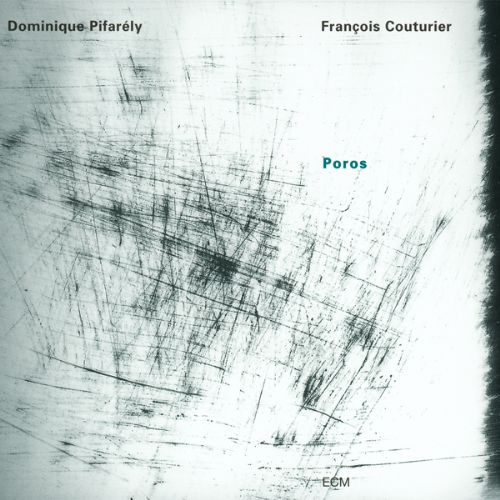
Dominique Pifarély/François Couturier: Poros (ECM 1647)

Poros

Poros

Dominique Pifarély violin
François Couturier piano
Recorded April 1997, Festburgkirche, Frankfurt
Engineer: Markus Heiland
Produced by Manfred Eicher

Dominique Pifarély—violinist and former co-leader of clarinetist Louis Sclavis’s acclaimed Acoustic Quartet—and pianist François Couturier—who since Anouar Brahem’s Khomsa has recorded a string of varied albums for ECM—team up for this unique collaboration. The resulting admixture of folk and modern classical influences finds the duo charting waters that might have otherwise remained glassy and still without the cut of their oars. The image is no mere metaphor, for the album’s title comes from French philosopher Sarah Kofman, who characterizes the concept in precisely these oceanic terms: a path through aquatic expanse that is just as vulnerable to erasure as it is to discovery. Its trailblazing implications rest on a blade of uncertainty, and therein lies their beauty.

One might be hard-pressed, however, to read any of this into the music in the absence of such a setup. The listener is instead confronted with a tantalizing, if restless, chain of events. “Trois images” awakens in a fit of pique, only to realize that the object of its scorn has already fallen away like the house of cards that is any dream. The musicians seem to run frantically trying to rebuild it before it gives up the ghost of reality. In other pieces like “Retours,” “Vertigo,” and the title piece we encounter an even more gnarled grammar. It is a dialectical assemblage of action and thought, of secrecy and exposition. The album is a constellation of references whose stars belie hues of the French modernists, free improvisation, and Bartók, among others. We therefore never rest for too long on one idea. The occasional locks stand out for their beauty, only to drown in a sea of cat cries prancing into blackout. What with the bubbling streams of “Labyrintus” and the grinding gears of “La nuit ravie” there is far more going on below and within, locked away behind a shell of almost ritual design. Pifarély brings the occasional jazzy inflection to the arc of his swing, most notably in Mal Waldron’s “Warm Canto” (from his 1961 album, The Quest), in which he blends tiptoeing pizzicato into explosive resonant chords in a chromatic whirlwind. “Gala” offers a pileated ending.

As on the album’s cover, the duo crosshatches incidentals in a knitted bruise. Pifarély trembles with the motion of a leaf obsessed with the fear of falling. His attention to detail and the precision of his agitations are thus remarkable. Couturier’s intricate astrology calls strangely from below, goading that leaf into decomposition. Only then do we see that the forest has been there all along, tilting, spinning, blurring into a looming mask of greens and browns. Traction is hard to come by, paths invisible. Our mind becomes the score, the stand on which its pages are turned, the sound dying to be released from within it. In thinking we believe, and in believing we know.

<< Giya Kancheli: Trauerfarbenes Land (ECM 1646 NS)
>> Michael Mantler: The School Of Understanding (ECM 1648/49
)

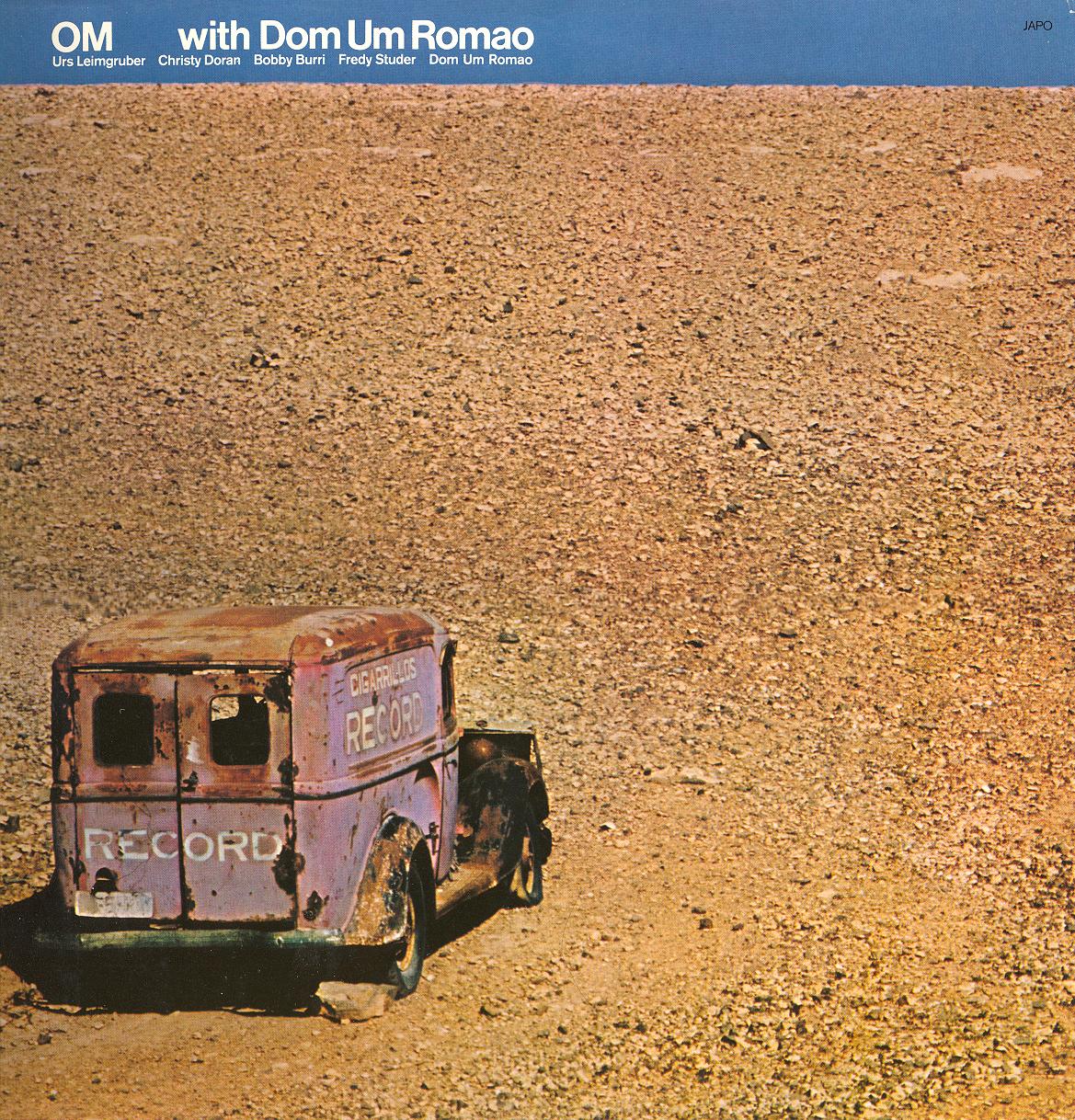
OM with Dom Um Romao (JAPO 60022)

OM with Dom Um Romao

OM with Dom Um Romao

Urs Leimgruber soprano and tenor saxophones, bass clarinet
Christy Doran 6- and 12-string electric guitars
Bobby Burri bass
Fredy Studer drums
Dom Um Romão percussion, berimbau
Recorded August 1977 at Tonstudio Bauer, Ludwigsburg
Engineer: Martin Wieland
Produced by Thomas Stöwsand

Is there a high road? This is the question asked by OM’s third of four albums for JAPO. For its junior effort, the renegade quartet of Urs Leimgruber (reeds), Christy Doran (guitar), Bobby Burri (bass), and Fredy Studer (drums) would seem to hold to a relatively accessible doctrine. But while it is the most groove-oriented in their potent discography—not surprising, given the driving center found in guest artist Dom Um Romão (1925-2005)—the core provided by the legendary Brazilian jazz drummer and percussionist, known for his work with Weather Report, allows a melodic brand of expressive freedom to take shape. The showdown is just as dreamy and feverish as anything OM had ever produced. This atmosphere comes about through the hypnotic effect of a steady pulse, the essence of all ritual. Burri’s “Chipero” opens the doors to a realm of bird and goddess, a forest where waters run shallow but sure. Romão provides the welcoming call, the rest evoking fauna and wounds of expectation. These energies sustain themselves throughout, especially in the two Doran-penned tunes. “Back To Front” swings us farther out into the cosmic stretch by way of some especially colorful picking from the composer, unwrapping a package of candy and strewing its contents over Saturn’s rings. The flow is not without its detours, as evidenced by the stark change of scenery as bass and guitar mellow for a concluding night flight. Doran’s other half is “De Funk,” which churns the butter to even smoother consistency. Romão’s Nana Vasconcelos vibe adds just the right touch of salt to Studer’s metronome. Doran, ebullient as over, can only defer to Burri, who works overtime to keep us in the here and now. Leimgruber’s bass clarinet turns like a jigsaw piece crying for fit and sets up a round of witty exchanges. Nestled among these propulsive journeys, the artful dodge of Leimgruber’s “Dumini” awakens the behemoth of memory in a lanky, sweltering pitch. Because it is the only track to have made the cut for OM’s retrospective album, this collaborative joint is worth checking out for the surrounding paths it lays. OM remains attentive to ebb and flow, an oarless boat reaching shore. What does oxygen breathe?

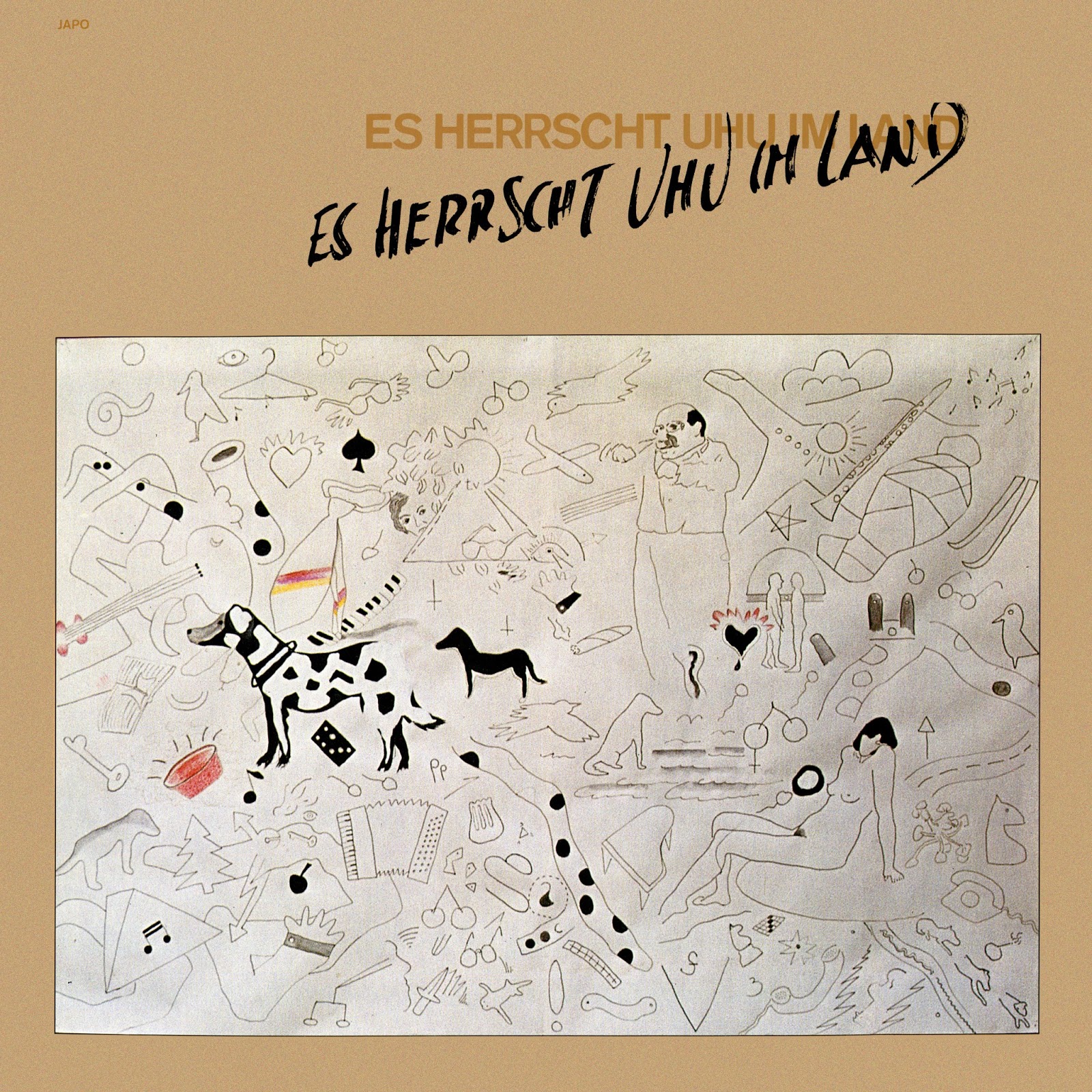
Es herrscht Uhu im Land: s/t (JAPO 60037)

Es herrscht Uhu im Land

Es herrscht Uhu im Land

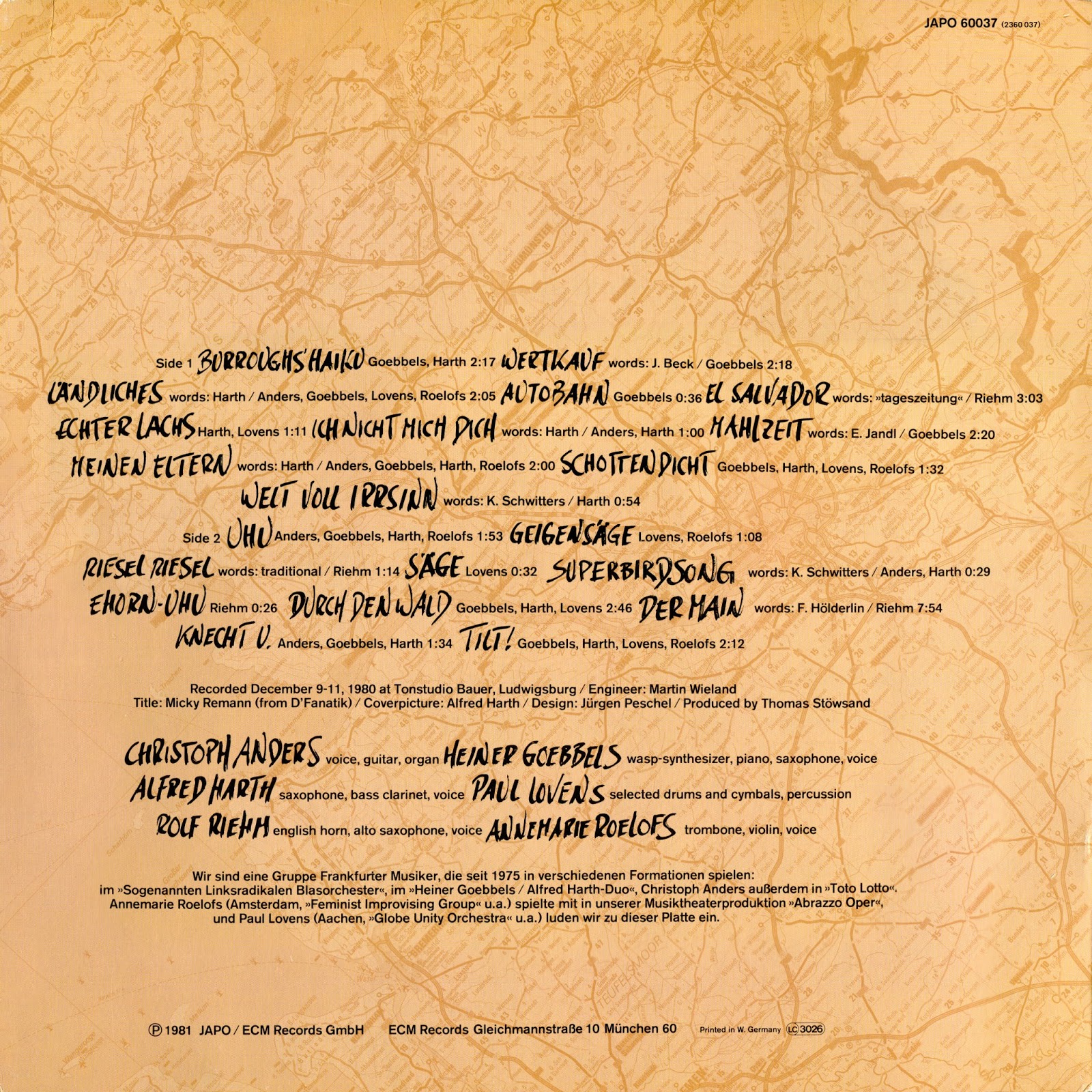
Christoph Anders voice, guitar, organ
Heiner Goebbels synthesizer, piano, saxophone, voice
Alfred Harth saxophones, bass clarinet, voice
Paul Lovens drums, percussion
Rolf Riehm english horn, alto saxophone, voice
Annemarie Roelofs trombone, violin, voice
Recorded December 9-11, 1980 at Tonstudio Bauer, Ludwigsburg
Engineer: Martin Wieland
Produced by Thomas Stöwsand

This early collaboration from saxophonist Alfred Harth and composer Heiner Goebbels is a telling lens of intersection through which to mine two fascinating careers. Harth will be familiar to ECM devotees as the progenitor of the label’s second album, Just Music, and would go on to release two further albums in other venues before meeting Goebbels in 1975. The two came together musically in a jazz-rock outfit called Rauhreif which, being to neither’s liking, dissolved, leaving these powerhouses itching for freer means of expression. It was in the context of this collaboration that Harth introduced the young Goebbels to the music of Hanns Eisler, which would of course lead to Eislermaterial, his most successful project to date. After connecting the dots for five years as a duo in various German settings, Harth called on the services of an old friend, Thomas Stöwsand, who’d played cello and flute on Just Music and was now headlong into the ECM storm. Stöwsand agreed to produce and welcomed into the studio Chris Anders, Rolf Riehm, and Annemarie Roelofs, each accomplished multi-instrumentalists, and drummer Paul Lovens. Such is the tangled web of Es herrscht Uhu in Land.

In it ideas were already taking shape that would become touchstones for Goebbels’s work, such as “Autobahn,” which meshes rallying songs with a field recording of its eponymous motorway, while “Wertkauf” betrays a less delicate side, sounding like something out of an Otomo Yoshihide free-for-all. The reversed vinyl and crunchy guitar make for a powerful contrast, each groove a cavity waiting for a tooth. “Mahlzeit” is a trembling gift, enacting a sacred touch of tongue to circuit. And one can’t help but uphold the frozen wasteland and creaking wonders of “Durch Den Wald” as a precursor to Stifters Dinge.

Riehm also makes a significant contribution with “Der Main.” Composed around poetry of Friedrich Hölderlin, it thus lays another important keystone in the ECM ethos. This skip through space is like a sonic parlor trick, a knock on the door of memory, a wishful thought. Through a deft admixture of songs, the relay of word to voice moves in an extended meditation. At nearly eight minutes, it towers over the outlying tracks, which average around two minutes each, and underscores the otherwise restless musings therein with a bold cohesion.

The musicians turn air to solid with their touch. Intimate musings, talking brass, laughter, and wires share a bed, rolling in the sheets until something musical takes shape. Each body part becomes a note that in combination with other, activates instrumental ideas. Harth, for one, writhes in soprano-gilded spirals over the song of a hungry whale in “Echter Lachs” and pops the electronic bubble in “Knecht U.” Yet for the most part, the group works as a whole, spitting watermelon seeds out of cartoon mouths in “Ich Nicht Mich Dich” alongside the jackhammer of self-questioning. It pulls us into an underworld of radio signals, waltzing to the beat of a perverse drum (“El Salvador”) and changing channels with the twist of a rein (“Uhu”), all the while feeding voices through a sluice pipe of craft. A spate of translation (“Superbirdsong”), dust for wings and air, and we are in the forlorn wakeup call of “Tilt!” smoking monosyllables until they stain the lungs with honesty.

In this bedtime story for the escaped mind, the main characters are an adroit political insight, a leak in the colonial pen that ruins a fluid takeover with exposition of intent, and a crucible of retrospection. Neither derisive nor derivative, this project takes a good long look at the sandy areas of our consciousness and pours water on them for sandcastles. The water jug drains itself. The water jug waits for no one.

Es herrscht Uhu im Land (Back)
Back cover

Serving the Music: Going Astral with Charles Lloyd

Charles Lloyd New Quartet and Friends
with Special Guest Maria Farantouri
March 15, 2013
7:00 pm
Met Museum, NYC

Charles Lloyd tenor saxophone, flute, tárogató
Maria Farantouri voice
Alicia Hall Moran voice
Jason Moran piano
Reuben Rogers bass
Eric Harland drums
Socratis Sinopoulos lyra
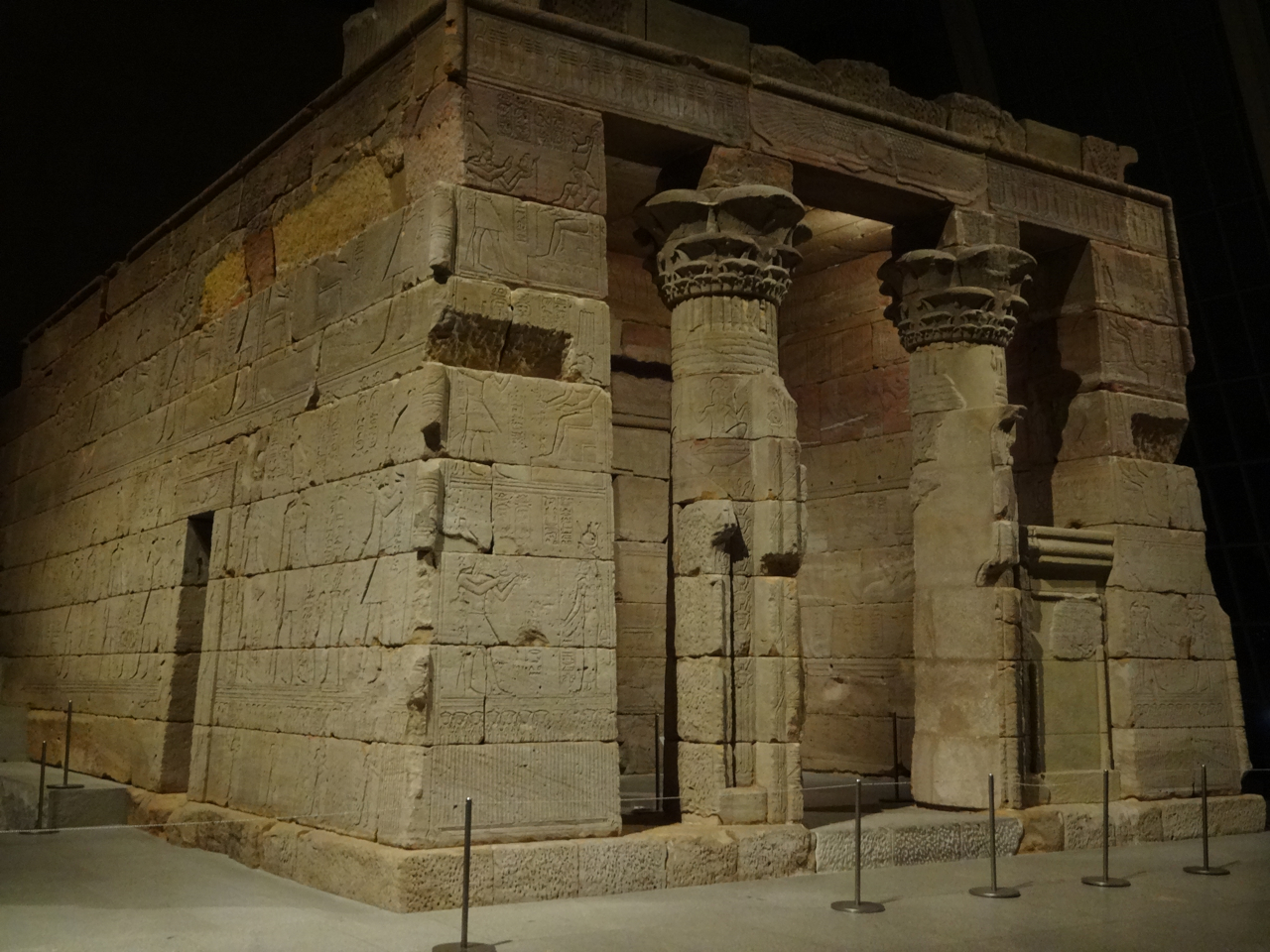
Temple of Dendur

Blessed. That was how Charles Lloyd expressed what it felt like to stand before the Temple of Dendur at New York’s Metropolitan Museum, nodding to the fortune of making a life in music, that torch of never-ending flame. The celebration was nominally in honor of Lloyd’s 75th birthday. Spiritually, however, it was in celebration of all creation, offering as it did the greatest gift of all: beauty. Like the Egyptian temple itself, each tune was transported and rebuilt, stone by stone, until its architecture stood by whim of its own gravity, channeling an energy that flows through rivers wide and narrow. Lloyd’s fingers thirsted for that water, gathering its holistic power in the vessel of his horn until the particles sang.

Strayhorn and Ellington loomed intimate in his opening gambit with Jason Moran at the keys. That unmistakable tenor filled a reverberant space with soul, soul, and more soul. Every run was a flutter of the heart, every split high note a distant supernova. Moran’s quiet flow brought the sound homeward, chiming the ashen bells of recollection until their surfaces glistened afresh. He brought with him a jagged array, sewing ragtime shadows to his Peter Pan feet and running through patchwork fields.

The duo’s brief exhale of “Abide With Me” welcomed the rhythm section to the stage. With a drum roll and a splash the band jumped into raging waters. So began the New Quartet portion of the evening, wherein fire and ice embraced their differences and found peace in aquatic compromise. A solo from bassist Reuben Rogers drew a sidewinder’s path in the dunes, turning heat into nourishment. Lloyd and his band not only rode the train, but also laid the tracks, stoked the fire, and wound through glowing thematic tunnels. Drummer Eric Harland left an ephemeral trail of steam, soloing with the strength of a thousand signal flares. Rogers further pinholed the darkness with constellations to the tune of Moran’s twenty-fingered chording.

From behind his sleek shades, Lloyd turned day into night with every lick, keeping the sandman at bay and digging low only occasionally for effect. It was in this context that his gentle dream-weaving over a Saharan beat provided as yielding a surface as was needed to welcome Alicia Hall Moran into the mix for a spirited “Go Down Moses.” With its serpentine refrain of “Let my people go,” her operatic contralto painted the sheltering sky with prophecy. A gentle cascade from Moran trickled into Lloyd’s “New Anthem,” moving through rhapsodic changes reminiscent of Barber’s Knoxville: Summer of 1915. Fly, songbird, fly.

Yet it was Greek singer Maria Farantouri who spread the richest wings of the concert. Joined by lyra master Socratis Sinopoulos, she assumed a vast presence in her rendition of the Greek Suite from the Athens Concert album. A lone improvisation from Sinopoulos served to emphasize the holiness of the space. Farantouri was the twilight itself, an Adriatic dream realized before the ears. Lloyd and Farantouri always seem to bring out the best in each other, and on this stage the vibe was no different. Traveling down the River Styx and back again, Moran appending thoughtful diacritics along the way, the group inscribed its journey with nary a backward glance. Harland wound a fantastical roll to whisper strength, the lyra tracing a perfect horizon line.

After this two-hour tour de force, Farantouri lightened the mood by singing “Happy Birthday” to Lloyd before encoring with the joyous “Yanni Mou,” thus signing off on a living résumé of the saxophonist’s legacy and influence.
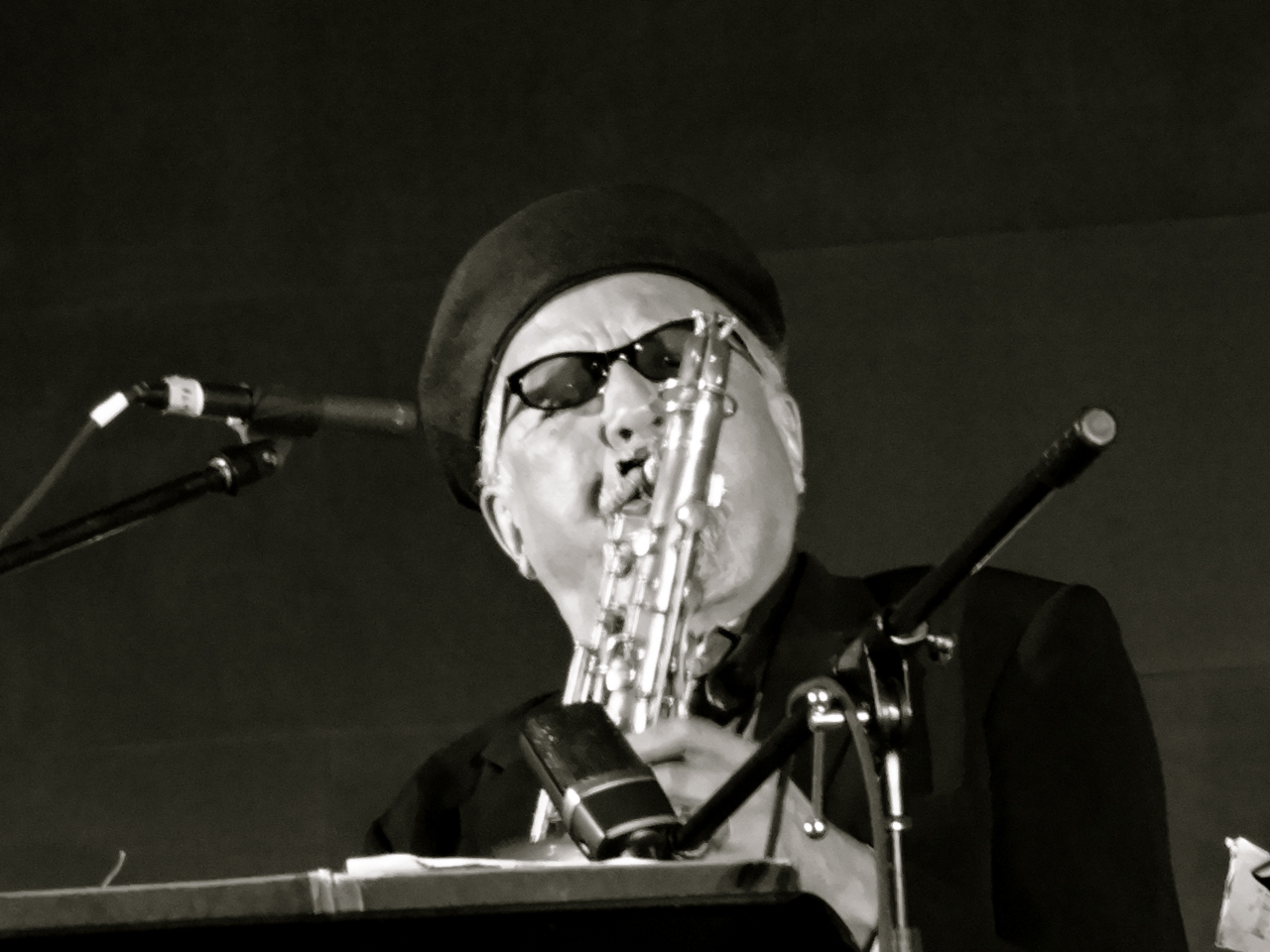
Lloyd live

The morning following the concert found me well rested and in Lloyd’s hotel room, where the star of the hour was anything but. “After I play,” he explained, “I’m exhausted but exhilarated, so I can’t go to sleep. Two, three, four, five in the morning I go to sleep, and now I’ve got to recuperate.” Being the inquisitive soul that he is, he first took more interest in me, my wife, and our new son, asking about our family histories, how we met, the values that drew us together. By the time I got around to my brief questions, I forewent those I’d written down and went with the flow. I asked first about Hagar’s Song, for I’d noticed after listening to the album a few times, and having just heard him and Jason start the concert with some of its material, that a feeling of history far beyond music was coming through. “I can’t get over someone taking this 10-year-old child and wrenching her from her parents and then impregnating the daughter at 14,” Lloyd responded, referring to the great-great-grandmother to whom the album is dedicated, and whose history of enslavement only recently became clear to him. “It’s sick. But here’s the thing about that recording. It’s all part of that fabric. I don’t know why people are trying to separate them. ‘Why did you insert this into these beautiful ballads?’ Some people have asked me that.”

Well, the real question is: How do you take it out?

Right. That came to me, that information, and it was like a wall for me.

What impressed me—and I think this bears testament to the power of music, and the human spirit more broadly—is that an undeniable core of joy comes out in the music. And I’m wondering if that’s something you saw in her spirit as having been passed down through the story. She survived, she gave that feeling…

She’s obviously a beautiful soul. All I can do is reinvent the world. My thing is about beauty. There’s all that ugliness out there. I’m trying to wipe it out with beauty. I’ve always been trying to do that. I can’t change my stripes now. I’m an idealist and dreamer. My dreams are still bigger than my memories. Maybe that’s why I don’t succumb to age or polarities, lines of demarcation…. I’m not the one for that stuff. Obviously, to me she’s very beautiful and I wanted to enfold that. I started out with Strayhorn’s “Pretty Girl” because there was this flower and I don’t know how to not do what I do. Things just happen along the way. These things, they’re all my world.

Did you feel anything different this time around recording a duo album with Jason as opposed to the quartet, or is it all part of the same fabric?

Yeah, you’re naked. We made that sound. It’s a homemade pancake.

Can you talk more about that sound and how your relationship with ECM has built it?

I like the idea of being in one place for a long time and developing something. When I recorded Fish Out Of Water, I just went in and played. Some of the big companies have come to me, but I have a home here. I always knew that ECM made great sound, hermetically sealed, but I need what I need, because I’m a sound seeker.

Maybe sound seeks you as well.

What you’re looking for is looking for you.

On that premature note, it was time for us to go. Before leaving the hotel room, subject to whatever might be looking for us, my wife and I said our goodbyes, but not before Lloyd laid a hand on my son and said a prayer for him. The silent wonder in the boy’s eyes as life began to take shape in them was as inspirational as anything we’d heard the night before. Blessed indeed.

(To watch the concert in full, click here.)

Breaking down the set

Tomasz Stanko New York Quartet: Wisława (ECM 2304/05)

Wislawa

Tomasz Stanko New York Quartet
Wisława

Tomasz Stanko trumpet
David Virelles piano
Thomas Morgan bass
Gerald Cleaver drums
Recorded June 2012 at Avatar Studios, New York
Engineer: James A. Farber
Assistant: Charlie Kramsky
Produced by Manfred Eicher

They call it: space.
It’s easy to define with that one word,
much harder with many.

The verse comes from the poem “Before a Journey” by Nobel Laureate Wisława Szymborska, whose legacy gives color to a starry tribute from trumpeter Tomasz Stanko. Given the snapshot ethics of Szymborska’s visual language, one could find no better musical interpreter to put this epigraph to the test. For though words may indeed fall short of expressing these swaths of infinitude we call “albums,” the language of instruments in the right hands can accomplish the impossible.

Wisława Szymborska
Wisława Szymborska (1923-2012)

One need hardly expound the virtues of Stanko’s new allies, each handpicked from the profuse garden of the New York City jazz scene. Pianist David Virelles brings a robust gentility to the table that meshes effortlessly with Stanko’s own. Bassist Thomas Morgan and drummer Gerald Cleaver—rhythm section to Craig Taborn’s trio—offer their dark synergy in kind. The proof, as they say, is in the pudding, and over the thickly whipped concoction of this 2-disc set it reaches our ears at the peak of flavor and consistency.

True to inspiration, Stanko and company derive wry upsweep from sentiments that, while unspoken, nevertheless dance in the spaces between. Of those spaces we encounter many, though of a markedly different cast from Stanko’s past ECM joints with the Polish quartet. Those expecting the aching, cool moroseness of that past may marvel at the prevalence of fire. The band swings with the best of them in “Tutaj – Here,” a track that takes its name, like a handful of others, from Szymborska’s final collection. Stanko leaps, as he does also in “Assassins,” at the fortuitousness of this meeting of word, feeling, and expression. He makes us aware of the here and now, as if we were there in the studio with him. Yet while the band is busy running all sorts of virtuosic errands in these dizzying soundscapes, we know that the finery is as thick as the souls it clothes.

The restless grooves of “Metafizyka” and “Mikrokosmos” find the band in a more down-tempo mood, though no less beguiling for melodic accuracy and Stanko’s unchained asides. Further allusions refract in “Faces” and “A Shaggy Vandal,” both highlights, taking their cue from Symborska’s poem “Thoughts That Visit Me on Busy Streets.” Stanko is at the top of his lyrical game in the former, trading off artfully with the others in cells of interpretation, to which Cleaver adds a vivid soliloquy of his own, while the latter is a well-oiled machine that blends influences into a postmodern mélange of rhythmic beastliness.

Despite these dips into upbeat waters, creature comforts reveal a heart whose petals have only grown fuller with the blush of time. Still, lurking in the album’s tenderest moments is an emotional heaviness. This is apparent in the fine patchworks of surplus and deficit that are “Dernier Cri,” in which the ghost of Miles is felt tenfold, and the wistful, floating “Song For H.” For another, “Oni” summons with smooth ritual, showing restraint while inviting us all the same with its beguiling atmosphere: the hallmarks of any good Stanko tune. Though its charm may be as deceptive as its title (if indeed the Japanese meaning of “demon” is intended), we are better equipped for it to wander into “April Story,” which opens nostalgia like a love letter forgotten in the back of a sock drawer. It is a raindrop forever hanging at a leaf’s trembling tip, a tear that never falls but which is sucked back into the eye, whereupon it tells the others: Not today.

Stanko NY Quartet

The title track and its 13-minute variation hug the set with dreams made real. Here the microscopy of the band is at full magnification. Stanko is the stain beneath Cleaver’s brushed cover slide, while Morgan and Virelles provide light and adjust the focus. Morgan’s especially contemplative soloing leaves us suspended before the blade of Stanko’s brass snips that thread and lets us drop into the quiet waters below. Notes linger, bringing us back to wistful ambiences of long ago.

Stanko wields his pen as surely as ever. His younger partners bring all the maturity needed to relay his torch with a grasp that lets everything slip through but the finest crystal. Tuneful to the core, each solo is a holistic admixture of heritages on the one hand and on the other elicits the satisfying crack of new eggs onto the frying pan. Do not go into this album expecting the lofty spaces of Lontano or Suspended Night. These songs are cruder oil to those past efforts’ refined, and all the more enchanting for it. Here the levels are grounded, not airborne. Denser and tenser is the name of the game. But let us not fall deeper into the trap of comparison, for Wisława possesses its own stage and protagonists. In this play there are no villains, only messengers of progress whose abilities precede them and whose reputations burgeon in golden light. Verily, verily so.

Promo video:

(To hear more samples of Wisława, click here.)