Heiner Goebbels: Hörstücke (ECM 1452-54)

Heiner Goebbels
Hörstücke
based on texts by Heiner Müller and featuring the talents of:
David Bennent
Peter Brötzmann
Peter Hollinger
Kammerchor Horbach
Alexander Kluge
René Lussier
Megalomaniax
Heiner Müller
Walter Raffeiner
Otto Sander
Ernst Stötzner
We Wear The Crown
Die Befreiung des Prometheus recorded and edited by Walter Brüssow, Heiner Goebbels, Peter Jochum, Gisbert Lackner, Gerlind Raue, Rainer Schulz, and Martha Seeberger
Produced 1985 by Hessischer Rundfunk and Südwestfunk
Verkommenes Ufer edited by Peter Jochum, Martha Seeberger, and Heiner Goebbels
MAeLSTROMSÜDPOL recorded 1987/88 at F.T.F. and Unicorn Studios, Frankfurt/Main
Engineers: Peter Fey and Jürgen Hiller
Mixed at Rainbow Studio, Oslo
Engineer: Jan Erik Kongshaug
Produced 1984 by Hessischer Rundfunk
Wolokolamsker Chaussee recorded at Unicorn Studio, Frankfurt/Main and Südwestfunk Baden-Baden
Engineers: Thomas Krause and Alfred Habelitz
Mixing engineer: Alfred Habelitz
Produced 1989/90 by Südwestfunk, Hessischer Rundfunk and Bayerischer Rundfunk
Album produced by ECM

My respect for Heiner Goebbels only increases with each work I encounter. Yet while his art, not least through frequent collaborations with linguistic wizard Heiner Müller, has always had its heart in drama, from this collection of radio plays that drama emerges—in the wake of German reunification, no less—with a fresh, genuine voice.

The first of this massive collection’s four plays, Die Befreiung des Prometheus (The Liberation of Prometheus), will sound familiar to those who’ve followed Goebbels in chronological order, for its themes had already made an appearance on Herakles 2 two years before. Both are based on a chunk of text from Müller’s Cement, only here we actually come to know that text amid a filmic montage of others. This process of splicing places, spaces, and times for new mythology will be familiar to any Goebbels listener, but it rings more intensely than ever. From the opening nod to Laurie Andersen we feel right at home. Like her Superman, Müller’s Prometheus is deconstructed from the inside out. Rather than carrying the flame of knowledge, he roasts over that flame his own sustenance at the gods’ table, where he is doomed to eat himself in an eternal circle of hunger and release. Though freed by Heracles, he is plagued by a waning remembrance of godliness, chewed and spat by the rock of the earth. Where Goebbels excels is that, in setting all of this, he manages to evoke a wealth of environmental details that his mosaic of voices can only hint at. Through the bubbling crude of his electronic interventions, he unpacks intimations of the zeitgeist with enviable intelligibility. Incidental sounds turn and tumble, grasping at the enamel-hidden scraps of mastication in hopes of picking off a morsel, ending up instead with a fist full of weeds, and it is these we must weave into a basket if we are ever to catch a sense of things. Metallic edges, heavily serrated and rusted over with time, melt in our gaze. Goebbels marks these rhythms with clips and starts. Snatches of the everyday butt up against unpredictable and sometimes-confrontational turns, but always with a uniquely organic energy.

Verkommenes Ufer (Despoiled Shore) takes its seed from an early (1955) play by Müller. For this project, Thorsten Becker asked fifty strangers in Berlin to read the text in question, thus yielding the raw material for Goebbels’s subsequent mash-up. Because none of the readers were familiar with the text, their renderings bring out inner truths. What begins as a writhing and inarticulate being in the final product resolves itself into a landscape of hesitations, loops, and, above all, porous communication. The Argonaut’s promise kisses the face of chance too many times, leaving only the corpses of a onetime progeny swinging in the wind of manipulation. Poison seeps through the ground in reverse, seeking out those vials from which it was poured, but finding only the fullness of adolescent laughter wafting across the urban sprawl. A masterstroke in the Goebbels/Müller canon.

The album’s cover photo is taken from its third play, MAeLSTROMSÜDPOL (MAeLSTROMSOUTHPOLE). If its blood-red wash of solitude is any indication, we might easily know its fascination with reality and disconnect before a single word grabs us. The continuity of the text, inspired by Edgar Allan Poe’s The Narrative of A. Gordon Pym, is its own contradiction, carving out of those syllables a subterranean world. Speech stores hidden desires in its vowels, misted by white noise and the song of an open cataract: drones and queens, reeds and marshes, all blended into a smoothie only a ghost might drink. It is a photograph that grows blurrier the more it develops. The only way to discern it is to drink the vat of chemicals that brought it to visible life. Echoes turn into birds, the shimmering backdrop of an open mike emceed by the mistress of our deepest nightmares. “OH KEEP THE DOG,” she croons, as if to cut the running line that binds us to everything. She overwhelms us with the responsibilities of liberation.

Last is Wolokolamsker Chaussee (Volokolamsk Highway). Based largely on motives from writers Alexander Bek and Anna Seghers, this self-reflective look at social change in the DDR’s last gasps is vitriolic through and through. Part I, “Russian gambit,” introduces the voice of stage actor Ernst Stötzner and music by heavy metal band Megolomaniax. The combination is a fortuitous one, for the sheer theatricality of the language almost screams for these experienced thespians of two not-so-different stages (though, as Verkommenes shows, this needn’t be so across the board). Bloodshed and total recall dance with one another, spinning their way to “Forest near Moscow.” Stötzner continues his tirade, only now with gentler guitar accompaniment. Death still looms in every pregnant pause, given just enough room to spread a pair of wings which, though flightless, can at least move enough to remember flight. Some preparatory shuffling in Part III, “The Duel,” opens a 20-minute call and response between Stötzner and men’s choir, all of whom join lungs to blow the dust off the mood of German Arbeiterlieder. Behind the scenes, the musc underscores an important truth: namely, that no matter how robust we spin our sentiments regarding human existence on paper, they would all burst into ashen death at the touch of a match. Part IV, “Centaurs” (the title of which, a booklet note reminds us, comes from the Old Greek for “red tape”), recasts Kafka’s Gregor Samsa in a world ordered by totalitarianism, a theme finds blatant traction in a recycling of Shostakovich’s (in)famous Symphony No. 7. The narrative is even more localized in the mouth, which bites a desk in order to prevent its screams from tearing out the still-beating heart of resistance. The fifth and final part, “The Foundling” (after Kleist), is perhaps the most unusual, if only for being backed by hip-hop group We Wear The Crown. Stötzner’s “rapping” is a mélange of generic signatures that transcends its surroundings even as it relies wholly on them. In this prison of madmen speaking in “MARXANDENGELSTONGUES” there is only room for forgetting.

German speakers and/or those up on their German history (I can count myself among neither) will surely get the most out of this recording whose booklet forgoes translating every word (especially in Prometheus)—a real shame considering the parodic depths awaiting our swan dive of relish. The language is visceral in the deepest sense, at times vulgar but always self-aware. Completists wanting the most unfettered glimpse into the architecture of Goebbels’s craft would do well to track down this invaluable set. Though the sentiments throughout are as complex as their politics, certain common themes exploit the connections between songs and conflicts. Through songs we can hide in the foxholes of life and cover our heads against any aerial assault, but in the end all of their lyrics flow through us, be they of the enemy, of our mothers, or of ourselves.

<< Barre Phillips: Aquarian Rain (ECM 1451)
>> Eleni Karaindrou: The Suspended Step Of The Stork (ECM 1456)
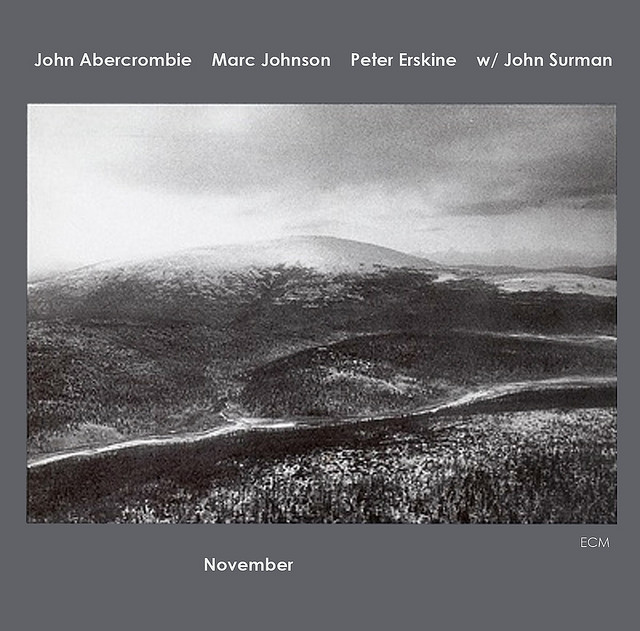
John Abercrombie: November (ECM 1502)

John Abercrombie
November

John Abercrombie guitar
Marc Johnson bass
Peter Erskine drums
John Surman baritone and soprano saxophones, bass clarinet
Recorded November 1992 at Rainbow Studio, Oslo
Engineer: Jan Erik Kongshaug
Produced by Manfred Eicher

Named for both the month its was recorded in and for the mood it maintains, November is a cogent record from guitarist John Abercrombie’s trio with bassist Marc Johnson and drummer Peter Erskine, along with special guest John Surman. The English reedman lends his fluid considerations to the album’s deepest moments, and nowhere so engagingly as in “The Cat’s Back,” thus opening a cloudy and sometimes pensive set of mostly group originals. Abercrombie’s quiet sparkle ushers in the gravid quartet sound of this improvised prelude, Surman tipping the scales with bass clarinet against the weight of Erskine and Johnson’s joyous communication. Those timeworn ululations scramble themselves in “Rise And Fall,” a veritable Rubik’s Cube of baritone utterances. The legato soprano of “Ogeda” also inspires particularly soulful picking from Abercrombie, who pulls from the gumdrop strums of “Come Rain Or Come Shine” and “Prelude” a scroll of ideas. These come to life inside rings of celestial fire, each a meteorite in freefall. Meditation throbs at the heart of “J.S.,” a lavish piece boasting starry turns all around. After this look inward, we get something more extroverted in the foot-tapping beats of “Right Brain Patrol.” Despite small beginnings, it ends up spitting pale fire as if it were breath itself into “John’s Waltz.” Over Erskine’s calm ripples, Abercrombie grabs the tail of Johnson’s solo for one of his own, deploying a parachute held by chromatic tethers. “To Be” reprises Surman’s bass clarinet, played here as if it were the last of its kind. Its voice paints the night with that gentle resignation only loneliness can bring, a heartening and mournful sound that recedes from “Big Music,” which finishes the album with ice-skating melodies and tight syncopations.

While everyone on November listens to the others with equal acuity, I find this outing all the more enjoyable for what Johnson does to its sound. After having only encountered him in denser projects like Bass Desires, it was a real pleasure to hear—in the title track, for example—the intimacy of his craft. His duet with Erskine on “Tuesday Afternoon” is a real gem in this regard and provides a guiding lens for this exquisite studio date.

<< Bach: 3 Sonaten für Viola da Gamba und Cembalo (ECM 1501 NS)
>> Ketil Bjørnstad: Water Stories (ECM 1503)

Hal Russell: Hal’s Bells (ECM 1484)

Hal Russell
Hal’s Bells

Hal Russell tenor and soprano saxophones, trumpet, musette, drums, vibraphone, bass marimba, congas, gongs, bells, percussion, voice
Recorded May 1992 at Rainbow Studio, Oslo
Engineer: Jan Erik Kongshaug
Produced by Steve Lake

Hal’s Bells is a rare thing: an artist’s first solo recording made in his last year. This astonishing statement is a panorama of Hal Russell’s succinctly indefinable career (for the best attempt at such, look no further than The Hal Russell Story), which the hapless listener finds realized in the breadth of his one-man band abilities. From drums (his starter instrument) to bass and horns, his kit has room for no other. A congregation of marimba and bells in “Buddhi” speaks with childlike innocence before cracking open an egg of reeds and Chinese gongs. Such contrasts prove quotidian in a space where the fuel-engaged tenor of “Millard Mottker” and “Strangest Kiss” can hug the muted trumpet goodness of “Portrait Of Benny” without a blink of hesitation. Soprano skills are on full tap in “Susanna.” Even as he twists himself into all manner of contortions, Hal maintains an astounding level of precision in the highs and sets off a lovely spate of vibes against some thread-through-needle drumming. “Carolina Moon” has much to say in 390 seconds, howling like a pack of wolves in desperate need of attention but which instead converges on “Kenny G.” While the latter’s endearing abandon is as far from its patron saint as can be, it nevertheless rings with a relatively free and breezy timbre. The enticing solo of “I Need You Now” furthers the album’s mission from restlessness to meditation and unmasks a deceptive repose in “For Free” (which might as well be Russell’s motto). The great vibes—in all respects—of this track work toward a blubbering finish sure to leave you breathless and in want of the elixir that is “Moon Of Manakoora.” This vocally blessed excursion into outer space is a straight shot to that marsh in the sky where, no doubt, Russell’s squealing energies continue to mount, ever amphibious and slithering their way through territories unclean yet oh so stunning.

The rewards of Hal’s Bells might never have been known to us were it not for Steve Lake, who has seen fit to produce a selective body of work for ECM in the interest of preserving sometimes-underappreciated artists, and we have him and Manfred Eicher to thank for believing in Hal, now immortal in the digital afterlife.

<< Heiner Goebbels: La Jalousie (ECM 1483 NS)
>> Michael Mantler: Folly Seeing All This (ECM 1485)

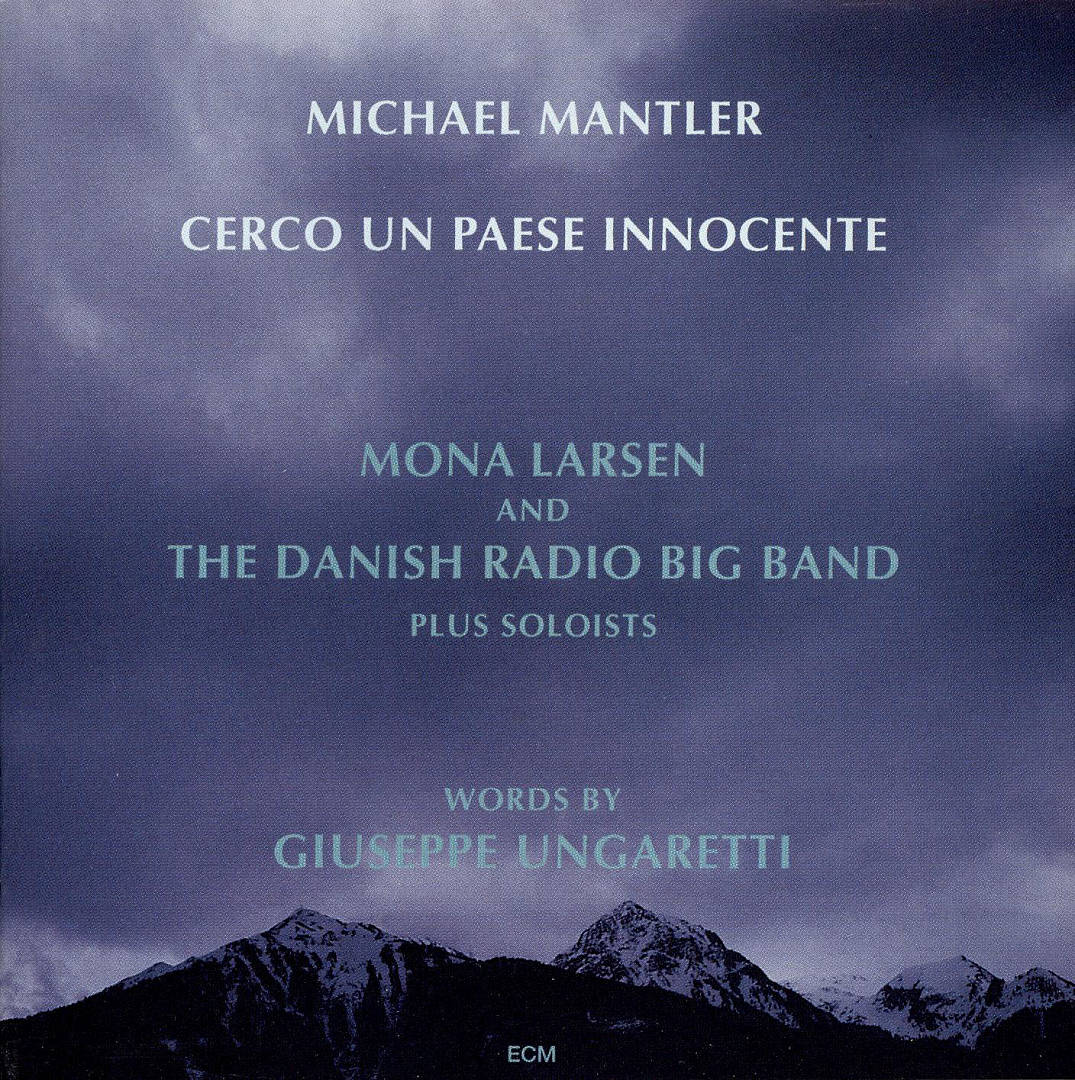
Michael Mantler: Cerco Un Paese Innocente (ECM 1556)

Michael Mantler
Cerco Un Paese Innocente

Mona Larsen voice
Michael Mantler trumpet
Bjarne Roupé guitar
Marianne Sørensen violin
Mette Winther viola
Gunnar Lychou viola
Helle Sørensen cello
Kim Kristensen piano
The Danish Radio Big Band
Ole Kock Hansen conductor
Recorded January 1994 at the Danish Radio, Studio 3, Copenhagen
Recording and mixing engineer: Lars Palsig
Produced by Michael Mantler

Beginning has us singing
and we sing to make an ending

Michael Mantler’s Cerco Un Paese Innocente (I search for an innocent land) pays tribute to the father of modern Italian poetry, Giuseppe Ungaretti. Subtitled “A Suite of Songs and Interludes for Voice, Untypical Big Band and Soloists,” this seamless construction feels anything but untypical in the comforting plush of its instrumentation and attention to soundscape. The present recording is also significant for bringing Copenhagen-born vocalist Mona Larsen back together with the Danish Radio Big Band, who debuted her as soloist in the seventies to wide renown. Larsen’s diction, in combination with her already broad palette, imparts life to dead limbs and electrical impulses to still hearts. Through it we know the touch of many landscapes, their peoples, their flora and fauna, reaching through our bodies toward the setting sun at our backs. This same sun warms the field’s worth of fragrance that wafts through the swell of orchestral goodness in the piece’s introduction. Yet the voice of “Girovago” (Vagrant) does not feel that touch, is forced to wander, forever a stranger, from land to land. A clarinet plays, stringing a trail of possible futures, all of which disappear into the first of five intermezzi, each an anointing of melodic oil that smacks of the perpetual. Curtains part to reveal the starlight of “Stasera” (This evening) and Larsen’s Francesca Gagnon-esque acrobatics. “Perché?” (Why?) ties an operatic ribbon around the index finger of Part 2. It is the tale of a dark heart lost in its desire to erase the scars of travel. “Sempre Notte” (Everlasting night) turns the dial further inward and walks through cascading gardens, from which hang sad and sorry tales of yesteryear like so much totora reed left to dry. The depths of “Lontano” (Distantly) evoke the poet’s blindness in a landscape of fiery hands. The music here seems to explore those sparkling pockets of air in which our dreams still breathe. Breathing, however, comes at a cost in Part 3, where the soaring orchestration of “Se Una Tua Mano” (With one hand) euphemizes the harm of curiosity trembling beneath its veneer. “Is surviving death living?” Larsen sings, prompting mental implosion through Ungaretti’s unwavering mortal concerns. The halting rhythms of “Vanità” (Vanity) further paint a world of startlement and shadows, its rubble soldered back together by the warmth of Mantler’s trumpet into “Quando Un Giorno” (When a day) and the invigorating “Le Ansie” (Fear). In these we encounter life as smoke, at once agonizing and brimming with potential. Gloom lives in these soils and nourishes the churning dramaturgy of Part 4, of which “È Senza Fiato” (Motionless) darkens like an arc of twilight, led by a shooting star of electric guitar into “Non Gridate Più” (Outcry no more). This sweeping transition rakes its fingers through silent grasses and hushes the mouths of the dead, in whom only the resolutions of “Tutto Ho Perduto” (I have lost all) continue to resound, their childhoods laid to rest by a final word.

One of your hands resists your fate,
but the other, you see, at once assures you
that you can only grasp
tatters of memory

<< Sándor Veress: Passacaglia Concertante, etc. (ECM 1555 NS)
>> Charles Lloyd: All My Relations (ECM 1557)

Jan Garbarek Group: Twelve Moons (ECM 1500)

Jan Garbarek Group
Twelve Moons

Jan Garbarek soprano and tenor saxophones, keyboards
Rainer Brüninghaus keyboards
Eberhard Weber bass
Manu Katché drums
Marilyn Mazur percussion
Agnes Buen Garnås vocal
Mari Boine vocal
Recorded September 1992 at Rainbow Studio, Oslo
Engineer: Jan Erik Kongshaug
Produced by Manfred Eicher

Twelve Moons may be the fifth Jan Garbarek Group album by name, but its smoothness and level of musicianship mark it as a great leap into the group’s signature sound. Between the sparkling ocean of the two-part title track and a gloriously realized “Witchi-Tai-To” (making its first reappearance since the selfsame album of 1974), Garbarek and his mind-melded band mates have created a record of great scope and mood. Earthen motives mesh with synth textures, breath with lively percussion, folk tunes with modern lilts. By means of his cinematic sweep Garbarek turns aside the bane of an indifferent world in favor of visceral emotional connections. Just when we think those connections have receded, they come back at fuller force, pulling away the darkness like a curtain to reveal the light which has offset it all along. Agnes Buen Garnås (who had previously collaborated with Garbarek on Rosensfole) and Mari Boine lend their mineral-rich voices to “Psalm” and “Darvánan,” respectively, moving from vast droning landscape to haunting duet as might a rainbow split into two. Garbarek’s tenor makes only a few appearances (most effectively in the arcing storyline of “Brother Wind March”). Its voice in “The Tall Tear Trees,” for one, implores the firmament with the conviction of a returning wayfarer who has just spotted home on the horizon. Yet this session is mostly about a soprano whose sky-bound warbling in “There Were Swallows…” (notable also for Eberhard Weber’s whale-like bass) and lullaby strains in “Arietta” seem to take great comfort in the cushiony surroundings. “Gautes-Margjit” is an especially attractive groove that rests itself easily in the cradle of our wonder, bristling with an aliveness of pianism such as only Rainer Brüninghaus can elicit. Garbarek’s soaring tone bleeds pink like tropical clouds afflicted with heat lightning. And let us not forget Manu Katché’s gripping provocations in “Huhai.”

A flawless classic, Twelve Moons offers a rich bouquet for the ears with melodies and rhythms that go straight to the heart of anyone who loves to listen.

<< Red Sun/SamulNori: Then Comes The White Tiger (ECM 1499)
>> Bach: 3 Sonaten für Viola da Gamba und Cembalo (ECM 1501 NS)

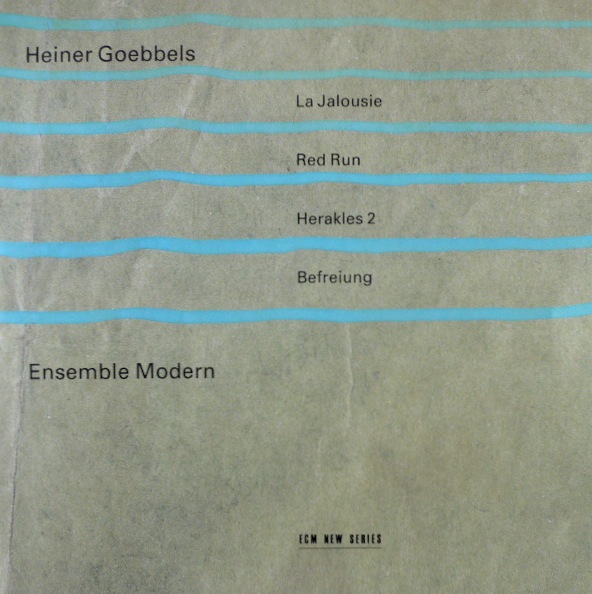
Heiner Goebbels: La Jalousie / Red Run / Herakles 2 / Befreiung (ECM New Series 1483)

Heiner Goebbels
La Jalousie / Red Run / Herakles 2 / Befreiung

Heiner Goebbels
Ensemble Modern

Christoph Anders narrator
Recorded May 1992 at Performance Studios, Frankfurt am Main
Recording engineers: Leslie Stuck and Andreas Neubronner
Mixed and edited at Rainbow Studio, Oslo
Engineer: Jan Erik Kongshaug
Produced by Manfred Eicher

Sometimes music is so theatrical that it needs no stage or actors to enlighten its listeners. If such music comprised a genre in and of itself, composer Heiner Goebbels would be one of its most idiosyncratic masters. Along with Michael Mantler, Goebbels represents a theatrical strand in the ECM universe that challenges the reviewer attempting to describe it, yet which is perfectly clear once it reaches the ears. My first encounter came through Surrogate Cities, a dazzling piece of music theatre that remains the yardstick by which I’ve measured all Goebbels experiences since. That being said, the more I hear, the more I recognize the futility of such comparison, for in his decidedly textual sound there is equal room for any and all sentiments to frolic, dance, and weep.

La Jalousie places four pieces of ranging character at the capable hands of Ensemble Modern, whose interpretations thrum with the utter embodiment that so distinguishes it from likeminded groups. The title composition for sixteen musicians, subtitled “noises from a novel,” already betrays Goebbels’s fascination with language as toolkit. His source is a work by Alain Robbe-Grillet (who famously wrote the script for Alain Resnais’s 1961 Last Year at Marienbad), in which the protagonist’s suppressed jealousy comes to vivid life on the page. Goebbels nurtures a description portion thereof and attempts to reconstruct it in acoustic terms. The genesis of this piece bursts forth from a rustling of conductor’s pages and unfolds from its compressed chaos a menagerie of guitar, piano, and winds. These are but clothing lines, however, for piles of freshly laundered samples: birds, frogs, and other secrets of the marshlands move in and out of the fray. A car door slams in retrospect, a voice seeming to relive this difficult dream in ominous reflection. The animals’ voices are an indigestion of the soul, stirring ever so disconsolately beneath this veneer of solitude. The clack-clock of footsteps pokes through the piano’s dampened commentary. An overblown oboe bears the imprint of Heinz Holliger’s Studie über Mehrklänge and leads us into a narrative passage underlined by crashing piano and synth shamisen (the synthesizer continues to bear witness to much of the goings on in varying gradations of convention). This brings us to an ending tinged by hope and submersion and a reprise of those restless pages.

In the wake of this palindrome, the nine songs for eleven instruments of Red Run come across rather comfortingly. This concert reduction of a ballet opens with a trio of drums, keyboard, and electric guitar in a deceptively simple pocket of jazz club anxiety. Improvisation abounds in this acute deconstruction of the popular. Tracing horns resolve themselves into a focal point of rumbling breath; a lilting violin arches its back from a bed of nails, drawing a sustained line from its dreams into the measured steps of its waking life: these handfuls and more share an edge, scattered like ashes in the wake of a trumpet’s derisive calls.

Herakles 2 (for five brass players, drums and sampler) takes a section of Heiner Müller’s play Zement as another structural prompt for music without words. The pedantic beginnings are just a front to a flipbook of superbly detailed constructions, each a building block in a crumbling tower of sound. The music trips over some quiet harrumphs from the tuba on the way toward Befreiung (Liberation). Goebbels composed this concertante scene for narrator and ensemblein celebration of the 200th anniversary of the French Revolution. Excerpting anti-liberal diatribes from Rainald Goetz’s anti-liberal play Krieg, he paints an insistent call to arms, where hugs turn into defense mechanisms against the blight of direct and noted perception. This is an unrelenting piece, ringing with the glass and bangles and spent energies of a zeitgeist now mute with self-realization. As Goebbels himself admits, with this piece he does not intend “to resolve for the audience the political tension contained in these texts but unleash it for individual confrontation.” And perhaps, in the end, individual confrontation is what the Goebbels experience is all about. Like a language stripped of its consonants, leaving only a sea of diacritical marks, his is a book without page numbers. Through it we face the emptiness of our texts, of our very bodies, and know that within emptiness beats a heart dying to create.

<< Meredith Monk: Facing North (ECM 1482 NS)
>> Hal Russell: Hal’s Bells (ECM 1484)

David Darling: Cello (ECM 1464)

1464 X

David Darling
Cello

David Darling acoustic cello, 8-string electric cello
Recorded November 1991 and January 1992 at Rainbow Studio, Oslo
Engineer: Jan Erik Kongshaug
Produced by Manfred Eicher

David Darling’s Cello is one of the most stunning albums ever to be released on ECM in any genre. Its fluid paths feel like home. Darling plows the improvisatory depths of his soul, given free rein in the studio to paint the negative spaces in between those clouds on the album’s cover, ever deeper, ever truer to the core of something alive. Most journeys might take you across some distance to get you to where you’re going, yet few will actually unpack where you are standing with such complex, unabashed glory that one need not take a single step to travel to the end of the universe and back. Cello is one such journey.

The opening “Darkwood I” carries us into a state of bliss unlike any other, finding its interest in the empty spaces of time that define our action and thought alike. “No Place Nowhere” swells with the blessing of life, finding in every shift of light a new window through which Darling casts the details of his destiny through shadow. One finds here a long and winding road into horizon, forever receding, that is the vanishing point in sound, the blessing and the curse of beauty, the sweeping gesture of aesthetic pleasure rolled humbly into a never-ending circle. The bird calls of “Fables” dance in the sky like time-lapsed aurora borealis, twisting our sense of time to the tune of something divine. “Dark-wood II” is a wilting flower, a lakeside flower dropping spores. “Lament” lowers us in swaddling into the slow-motion cradle of the wind, the mountain veil as a crook in a mother’s arm, singing our souls softly to sleep. “Two Or Three Things” evokes Jean-Luc Godard with its softly flowing landscape of water and wind, grass and foam, where swim the vagaries of our modern life against the tide of regression that is our calling into death. This breathtaking journey guides us into a place that is so deeply inside us that we must disappear to find it. “Indiana Indian,” forever my favorite track on the album, begins in a harmonic swirl before loosing a pizzicato chain of finely honed memories. A jazzy half-note swing brings us into the enthralling drama of “Totem.” Here, an ocean of double stops, a tidal wave of lilting lines, leaving an imprint of “Psalm” in the sands. Its protracted antiphony sheds its clothing to reveal “Choral.” This Möbius drop into solitude, where harmony offers the illusory promise of companionship in a world without bodies, whispers at the interstices of our alienation. “The Bell” has the makings of an Arvo Pärt choral work with its microtonal harmonies and tintinnabulations. “In November” rounds a cinematic edge, rolling over into a low and calming thunder and ending with the yellowing strains of “Darkwood III.”

On paper, these might seem little more than chromatic exercises, but in the vastness of Darling’s playing, combined with Eicher’s attention to space, they achieve a meditative state in which the simplest musical utterances become the most profound. Eicher’s touch can be ever felt in the sound and in the melodic elements he has provided, showing us that he is not only a fine producer, but also has a supremely sensitive ear for melody and, above all, time. For this improvised session, Eicher told Darling to go as deep as he could go, thus expressing the spirit of the label at heart, not to mention the spirit of what a musician can achieve when open to infinity.

<< John Surman: Adventure Playground (ECM 1463)
>> Charles Lloyd: Notes From Big Sur (ECM 1465)

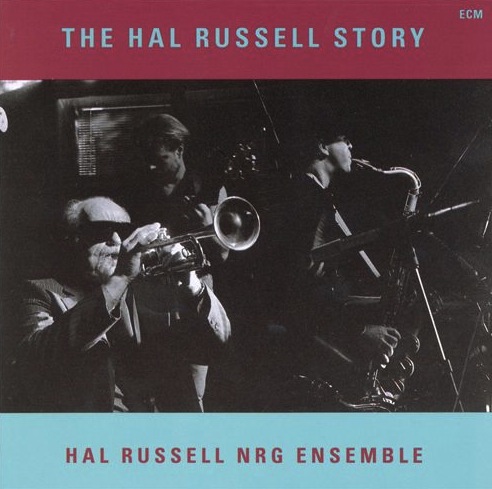
Hal Russell/NRG Ensemble: The Hal Russell Story (ECM 1498)

Hal Russell
NRG Ensemble
The Hal Russell Story

Hal Russell tenor and soprano saxophones, trumpet, drums, xylophone, percussion, gong, narration, vocals
Mars Williams tenor, alto and bass saxophones, toy horns, wood flute, didgeridoo, bells, sounds, narration
Brian Sandstrom acoustic bass, electric guitar, trumpet, toy horns, percussion
Kent Kessler acoustic bass, trombone
Steve Hunt drums, vibraphone, tympani, percussion
Recorded July 1992 at Hardstudios, Winterthur
Engineer: Martin Wieland
Produced by Steve Lake

What do you do when you know too much? 

Improvise!!!

The late and great Hal Russell passed away not five weeks after recording, prophetically enough, The Hal Russell Story, a whirlwind of a tour through the autobiography of one of jazz’s undisputed champions. From the intro, we get Russell’s taste of yore with megaphone amid an engagingly frenetic cyclone of sound, followed by a toy parade in the spirit of the Art Ensemble of Chicago: a romp through childhood’s darkest corners, ending in a trumpet free-for-all and the sketch of a nascent musician caught in the radio waves of life. So begins the 18-part title suite, a pan bursting with golden nuggets of abandon. A bed of drumming supports with mounting intensity a lithe dance of vibes. A swinging sax rises from the depths of a torturously sonorous past. A breezy sort of high-octane energy works its saxophonic magic at every turn with delectable aplomb. Squawks and dark raptures trade verses for curses against some hard-hitting reed work all around. The rhythm section sees Russell eye to eye at every level. Incredible screeches from tenor work over an invisible crowd with utterly attenuated vocal energy. That wonderful rhythm section kicks in at key moments, making headway against the soprano’s ululating tide. Smokier flavors sit side-by-side with empty flutters from bass. From match-lit tributes to late masters to quiet reflections, every nuance speaks as if born again, unsure of the death that gave it life. A growling guitar swept up in unsheathed brass is blown to bits by squealing tenor, letting us down easy into the night, where Miles still wanders, dragging the weighty trailer of his craft. Flowering little suspension bridges of influence and affect bleed into slices of swank. Dramatic pops and scuttling opportunities run rampant. The band’s resolve contracts and expands through haunts and explosions. Freedom principles and fast rules tune themselves to the drama of “Lady In The Lake,” a pensive and strangely declamatory track that nudges us into a distinctive rendition of Fleetwood Mac’s “Oh Well.”

Steve Lake has produced some of ECM’s most exciting recordings, and The Hal Russell Story stands as a crowning achievement. A brilliant album that weaves its personal threads over and under for an honest patchwork. With all of this clear from one studio effort, I can only imagine what the live NRG experience must have been as musicians switched instruments at the drop of a hat in a controlled chaos.

Vaudeville, yes vaudeville (can’t seem to shake the influence).

<< Peter Erskine Trio: You Never Know (ECM 1497)
>> Red Sun/SamulNori: Then Comes The White Tiger (ECM 1499)

Andersen/Towner/Vasconcelos: If You Look Far Enough (ECM 1493)

If You Look Far Enough

Arild Andersen bass
Ralph Towner guitars
Nana Vasconcelos percussion
Audun Kleive snare drum
Recorded Spring 1988, July 1991, and February 1992 at Rainbow Studio, Oslo
Engineer: Jan Erik Kongshaug
Produced by Arild Andersen

Manfred Eicher strikes gold with yet another inspired melding of musical minds. The microphones at ECM’s Rainbow Studio this time are privileged to witness an emotionally powerful session from bassist Arild Andersen, guitarist Ralph Towner, and percussionist Nana Vasconcelos. The session begins with something of a title track in “If You Look.” From this swell of drones and metallic whispers comes “Svev,” a scintillating piece that finds Andersen in a buoyant mood. “For All We Know” is a stunningly gorgeous duet between him and Towner—a match made in heaven. Andersen’s tender spaces are the perfect sky for Towner to spread his careful, classical wings. “Backé” continues this intimate reflection, only now with Vasconcelos’s auguries providing a more focused berth for Towner’s spindly ruminations. Vasconcelos adds a vocal swoon for effect. These two tracks are the heart of the album and could continue for its full length if they wished. “The Voice” begins with Andersen’s sustained calls, drawn out like cloud wisps on the horizon and providing a long-forgotten plain for the rhythm and tackle of Vasconcelos’s well-traveled feet. Andersen dips into some electronic augmentations, sounding like an infant foghorn with melodic growing pains. “The Woman” is a beautiful little duet for percussion and bass that works its tender embrace one muscle of sentiment at a time. Andersen’s deft monologue of serpents and harmonics carries the conversation over into “The Place” at a more urgent pace, working sidelong into an inspiring spiral. “The Drink” is another transportive duet, swaying like a caravan transport in the unforgiving sun. Next is “Main Man,” which jumps back into the rhythmic deep end with some funkier vibes, while “A Song I Used To Play” is a slow and tender build to Towner’s 12-string ebullience. “Far Enough” is another haunting drone of spectral footsteps that brings us into “Jonah,” a bass solo that smiles with all the wonder of new life.

This album is something of a sleeper ECM hit and worth seeking out for fans of any and all of these musicians. Don’t pass it up.

<< Meredith Monk: Atlas (ECM 1491/92 NS)
>> Messiaen: Méditations Sur Le Mystère De La Sainte Trinité (ECM 1494 NS)