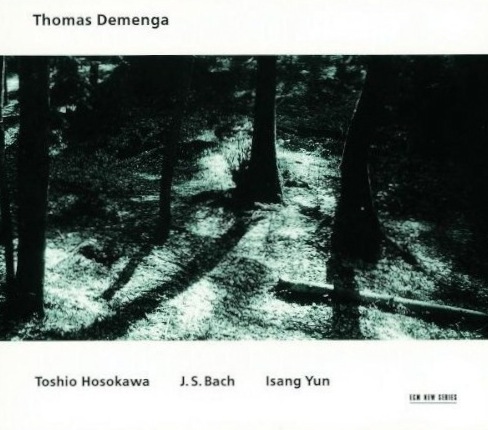
Thomas Demenga: Hosokawa/Bach/Yun (ECM New Series 1782/83)

Thomas Demenga
Hosokawa/Bach/Yun

Thomas Demenga cello
Teodoro Anzellotti accordion
Asako Urushihara violin
Aurèle Nicolet flute
Heinz Holliger oboe
Hansheinz Schneeberger violin
Thomas Larcher piano
Hosokawa/Bach: Suite No. 5 recorded November 2000, Kirche Blumenstein
Bach: Suite No. 6/Yun: Espace I, Gasa recorded December 1998
Engineer: Teije van Geest
Yun: Images (produced by Radio DRS) recorded July 1985, Radio DRS, Zürich
Engineer: Jörg Jecklin
Produced by Manfred Eicher

This album concludes Thomas Demenga’s Bach cycle which, begun in 1986, boldly sought out previously unimagined connections between the Baroque master’s solo cello suites (here, Nos. 5 and 6) and later visionaries. At every step along the way, Demenga has forced not a single hair of his bow in an arbitrary direction, instead finding in each pairing of works and composers a web of simpatico relationships.

Demenga plays the Bach suites a full whole tone down from modern pitch, a tuning contemporaneous with the time of their composition. He even uses unwound strings for a noticeably rawer sound. The Prélude of No. 5 is particularly visceral for it, those opening groans rising from the root of our expectations with withered leaves and rustling secrets. The Courante of the same no longer skips but struggles in an attempt to free itself from the swamps. The Sarabande, however, sings in a way I’ve never known it to before or since. The famous No. 6 Prélude also retains much of its inherent light and bridges over into one of the more heartfelt Allemandes on record. The penultimate Gavotte is also notable for its rustic edge. These are unlike most renditions out there, and for that reason may divide listeners. Either way, I feel as if I have spilled enough virtual ink in Bach’s name to leave my impressions at that and turn to what is most remarkable about this release: the works of Japanese composer Toshio Hosokawa and his mentor, the late Korean composer Isang Yun.

Of Hosokawa’s music, Oswald Beaujean has said, “These sounds, to be sure, never appear in the form of musical imitation. Instead, they are reduced to their essence and always retain something deeply artistic.” And indeed as we wrap ourselves in the silvery veils of In die Tiefe der Zeit (Into the depths of time) for cello and accordion (1994/96), we may not help but feel the ground falling away at our feet. The music pulses like a dying body, a light blinking through a gauze curtain. The overall sound is akin to a Japanese mouth organ with a harmonic outlier skirting the edges of its reedy sound. In it we hear a story of famine, of broken families, of burned villages, of people torn from their places of worship. The accordion (played to weeping perfection by Teodoro Anzellotti) shows us the way through this wreckage, so that we might sit before a cross, steeped in the lessons of trauma.
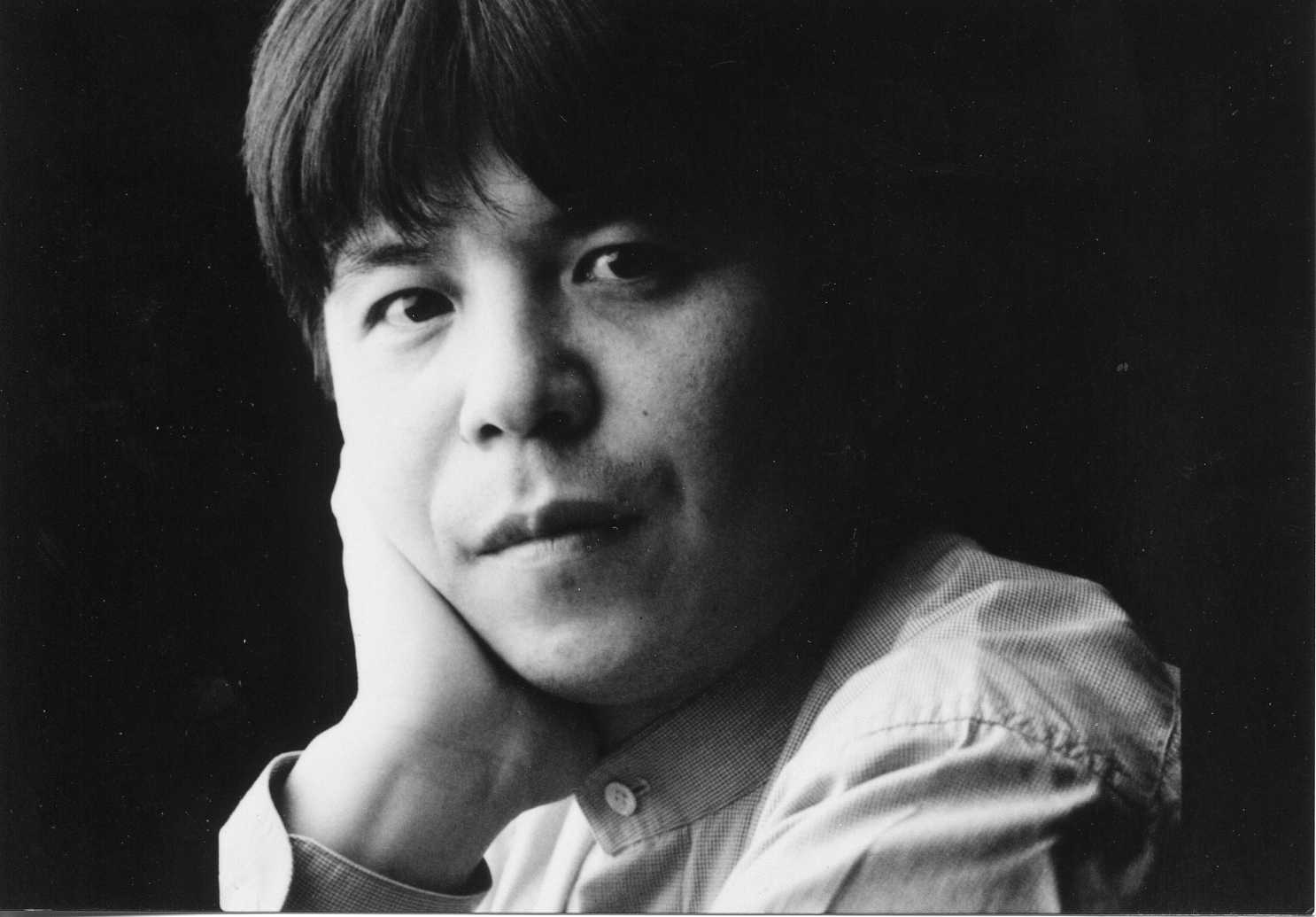
Similarly, the Duo for violin and cello (1998) shows a propensity for swelling, silences, and pauses, though it is far more agitated—a stage of denial that circles an indefinable center. At some moments the instruments seem intent on filling up as much space as they can while at others they beg for that space to fill them in return. This asymptotic push toward silence is a blessing of contemporary classical music, at once sharpening our ears to the world of the microscopic and abolishing the prescriptive master narratives of our histories in favor of fragments. The recording is accordingly porous, attuned to mid- and high-range sounds.

Winter Bird (1978) for violin solo is something of a reprieve from the weighty emotions of all that precedes it. With it Hosokawa manages to bring the subtlety of the shakuhachi to those four humble strings as snatches of melodic energy hop and warble in a cold gray sky brimming with the promise of snow.

Yun’s sound-world is one step removed from time. The works presented here come to us already affected by tortured political past from a man who struggled with his “Eastern” origins and the decidedly “Western” musical paradigms into which he was indoctrinated as a classical composer. Yet these paradigms crumbled as he began to redefine himself in the serial theory of the Darmstadt School, and it was in that aleatoric openness and dematerialization that he came into his own.
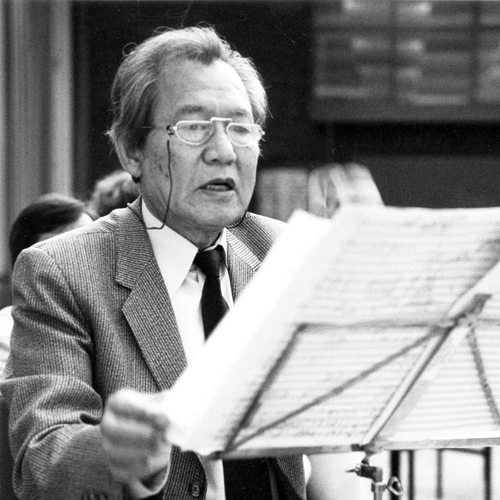
Gasa (1963) for violin and piano is a fine example of his holistic approach. Its balance of disparate languages is precisely what makes it grow. This small slice of intrigue trembles with delicate inversions and implosions, a tone-setting specimen under the microscope, dying for self-awareness.

Espace I (1992) for cello and piano, on the other hand, unravels itself in threads of equal thickness and, being the most recent of Yun’s works surveyed here, reveals a composer at the highest stage of personal development. This piece is more uniformly weighted, for where the counterbalances add up to a denser harmony in Gasa, here the dynamics are pockmarked, fading as the piano grumbles like a belly in want of sustenance.

Images (1968) for flute, oboe, violin, and cello brings the project to an enigmatic close. This music takes shape in block chords and releases embryonic tendrils of life into starry ether. Each tone is given life and therefore the potential to occupy space. The combination of instruments is quite effective, all the more so for the committed musicianship under its employ. Like the album as a whole, it shapes itself as if in dire need of contradiction, turning the mirror just so, thereby allowing us to see that the faces we thought we knew were really just reflections all along.

<< Gideon Lewensohn: Odradek (ECM 1781 NS)
>> Charles Lloyd: Hyperion with Higgins (
ECM 1784)

Kenny Wheeler: Music For Large & Small Ensembles (ECM 1415/16)

Kenny Wheeler
Music For Large & Small Ensembles

Kenny Wheeler fluegelhorn, trumpet
John Abercrombie guitar
John Taylor piano
Dave Holland bass
Peter Erskine drums
Norma Winstone vocal
Derek Watkins trumpet
Henry Lowther trumpet
Alan Downey trumpet
Ian Hamer trumpet
Dave Horler trombone
Chris Pyne trombone
Paul Rutherford trombone
Hugh Fraser trombone
Ray Warleigh saxophones
Duncan Lamont saxophones
Evan Parker saxophones
Julian Argüelles saxophones
Stan Sulzmann tenor saxophone, flute
Recorded January and February 1990 at CTS Studio, London (Large Ensembles) and Rainbow Studio, Oslo (Small Ensembles)
Engineer: Jan Erik Kongshaug
Produced by Manfred Eicher

Canadian trumpeter Kenny Wheeler had been writing for jazz orchestra for three decades before this recording, criminally the only of its kind widely available at the time, was released. With a cast list (mostly veterans of the London jazz scene) to make one swoon, ECM’s first release of the 1990s raised the bar on production, arrangement, composition, and musicianship that had been the label’s prime tenets since its inception in 1969.

It’s easy to praise Wheeler as player, but on Music For Large & Small Ensembles we are given a smorgasbord of his delectable talents as composer. This massive two-disc set begins with The Sweet Time Suite in eight parts. While the cradle of horns in which it opens sounds more like a closing, it is nevertheless coaxing and lovely. In Part II, however, we are introduced to the album’s major running thread: namely, the voice of Norma Winstone, who provides a crystal lining to every motif and, along with guitarist John Abercrombie, adds a Pat Metheny-like charm to many of the darker hues. The roundedness thereof is offset by the added punch of horns, giving us something doubly engaging. Stan Sulzmann’s heady tenor floats up and down the improvisatory ladder with unbound attention and primes us for Winstone’s unparalleled tintinnabulations in Part III. Although Part IV bears dedication to baritone saxophonist Pepper Adams, it’s Evan Parker’s tenor that gets all the attention. Walking a fiery tightrope woven of guitar and cymbals, he navigates a swinging rhythm section toward Dave Holland’s quiet solo at the bass—an exemplary display of dynamic control into the sultry ending. Part V is another audible smile that features fine commentary from pianist John Taylor. Abercrombie’s own sensitive turn opens like an embrace warmed by sunshine. Winstone fashions Part VI into a lullaby, wafting through the air like a folk song into the thermals of altoist Ray Warleigh’s stunning flight. Part VII starts with what at first appears to be unnecessary distraction, only to reveal a profound dialogue between Peter Erskine’s drumming and the round of solos that embraces it. Wheeler’s fluegelhorn is especially engaging here and carries us with quiet confidence into a plush finish.

The second disc is a hefty selection of standalone originals. Of these, the opening “Sophie” is perhaps Wheeler’s finest. The pianism here shines like the sun alongside the joyous cymbal work. But it is the gorgeous baritone solo from Julian Argüellas, along with Wheeler’s own distinctive song, that truly makes this a standout in the collection. It is heavy yet flowing, dancing like fire without the threat of destruction. “Sea Lady” awakens with Parker’s avian reeds, sounding like a Philip Glass riff gone beautifully awry, and brings Winstone’s tender words into the mix at last. Through these she unties a knot with unrequited love and steeps its expectations in shadow. Abercrombie’s own ruminations presage Sulzmann’s forlorn twittering on flute and Wheeler’s vivid narrative. “Gentle Piece” is exactly that, all the more so for Holland’s soft spots and Taylor’s unobtrusive wanderings. Winstone’s lilting motives, wordless yet ever meaningful, speak like the voice of the sun in a dream without light. Another memorable alto solo from Warleigh promises wakefulness before the outro. The album’s remainder is taken up by two phenomenal trio conversation pieces with Wheeler, Holland, and Erskine, and a series of duets between Erskine and Taylor before closing out on the 10.5-minute masterpiece, “By Myself.” Abercrombie jumps through every hoop spun before him, setting off an enlivening round of solos that brings us into Wheeler’s final gesture of exuberance, by which he successfully concludes one of the most ambitious projects of his career.

Music For Large & Small Ensembles offers lush insight into one of jazz’s most exciting musical minds. This is music at the peak of ripeness, bearing fruit for all. It also boasts some of Steve Lake’s best liner notes, which make the physical product worth far more than any digital download available.

<< Edward Vesala: Ode To The Death Of Jazz (ECM 1413)
>> Kenny Wheeler Quintet: The Widow In The Window (ECM 1417)

A Digital Workflow for Classical Music and Opera: eBook review

“In the digital world, portability is everything,” writes David Wank in the introduction to his latest eBook, A Digital Workflow for Classical Music and Opera. I’ve been following David’s informative blog, Classical Weekly, for some months now and was fortunate enough to receive a review copy from him of said eBook. Being a full-time grad student, portability is indeed music to my ears. As regular readers of this blog may know, I do most of my reviewing on the go, listening to albums daily on my iPod while dictating my thoughts and impressions into a digital voice recorder. These I transcribe later and polish as time allows into the finished posts you see here on between sound and space.

For this reason and more, having a clear and accessible archive of my music collection is key. For popular music, this has rarely been a problem. With the exception of compilations, CDs imported into iTunes are easily designated under band names, song titles, and genres. When importing and archiving classical CDs, however, things sometimes get tricky. Should I archive by composer name or performer? If the latter, which performer? Conductor, soloist, ensemble, or orchestra? How will I be able to access exactly the piece I am looking for without confusion? What if two or more composers or performer configurations are represented on the same album? Such are the questions confronting the classical archivist, and this eBook provides cogent and practical advice on how to negotiate these and more. I have worked my way around such issues through much trial and error over the years. I only wish I’d had something like David’s methods on hand from day one.

Most classical enthusiasts will tell you that, outside of attending live performances of course, CDs offer the best listening experience, and neither David nor I would contest this. But in our increasingly hectic culture we tend to do much of our listening through headphones and car speakers. In addition, CDs are not permanent resources. Regardless of how well one cares for them, accidents can and do happen, and with the technology widely available to the common consumer to create digital archives, there’s no reason why one shouldn’t take advantage. That being said, this book is less about meta-tagging (I, for example, have all of my 1000+ ECM albums archived in iTunes under the genre “ECM” rather than as jazz, classical, world, fusion, folk, etc.) and more about the creation and organization of a high-fidelity classical and opera library at near-CD quality without compromising too much in the way of valuable hard drive space. Still, there is plenty of tagging advice sprinkled throughout that will be of use to anyone.

Computer knowledge requirements are minimal: if you can create, rename, and move folders, you’re golden, and for those still intimidated David offers 30-day personalized support to all purchasers of the eBook. And while the methods outlined therein are geared toward iTunes and iPod users, one can certainly use any preferred combination of player and management software.

David’s process involves three basic steps: 1) ripping the original CDs as high-quality files and importing these into a designated holding directory, 2) editing the filenames and folders as needed, and 3) moving the finished archive into iTunes. While Step 1 will require (free) external software, there is in this Third Edition an iTunes-only workflow which can be performed entirely “in house.” While the latter option, even at 320kBit/s, will not give you quite the same quality, it will save a step or two. As someone who has ripped all of his CDs over the years for archiving purposes, I found this method to be the most applicable.

One cannot simply follow my summation above, however, and expect stellar results. The key is in David’s well-thought-out subtleties and ease of explanation. David has clearly spent countless hours refining his process and the eBook is an ideal tool for those whose audio collections seem to grow, like mine, of their own accord. He walks you through the steps of working with the appropriate third-party software, getting the most out of your tagging and folder options, and working with either pre-existing or to-be-ripped archives.

I feel obligated to reiterate his advice about backing up everything before attempting such a feat of organization. This is a tedious and time-consuming process that, in the rare instance of a skipped step or two, can backfire, but if followed to the letter the results will be more than worth the effort.

You may purchase a copy of David’s eBook here for $5.95.

Thank you…

I began this blog two years ago on a whim and out of a desire to share my love for a label and its music that have shaped me since that first fateful encounter in my teens. My goal, as will be familiar to you, is to review every ECM album there is. I am now proud to say that, with over 600 reviews complete (300,000 words and counting!), I am at the halfway point to getting there. I couldn’t have done this without constant support from all of you who have been reading faithfully and sharing your enlightening comments, anecdotes, and stimulating debates. This has been one of the most fulfilling learning experiences of my writing and listening life, and I look forward to bringing you the second half and beyond as ECM continues to chart new paths on this quest between sound and space in which we all share. I thank you all, and stay tuned…

Tyran
Spring 2012

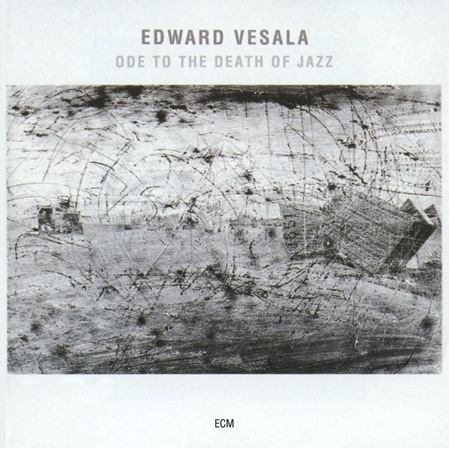
Edward Vesala: Ode To The Death Of Jazz (ECM 1413)

Edward Vesala
Ode To The Death Of Jazz

Matti Riikonen trumpet
Jorma Tapio alto saxophone, bass clarinet, flute
Jouni Kannisto tenor saxophone, flute
Pepa Päivinen soprano, tenor and baritone saxophones, flute, clarinet, bass clarinet
Tim Ferchen marimba, tubular bells
Taito Vainio accordion
Iro Haarla piano, harp, keyboards
Jimi Sumen guitar
Uffe Krokfors bass
Edward Vesala drums
Recorded April/May 1989 at Sound and Fury Studio, Helsinki
Engineer: Jimi Sumen
Produced by Manfred Eicher and Vesala

If jazz is a body, then Edward Vesala is its ligament of fascination. Flexing and creaking with the passage of emotion into life and life into silence, the drummer’s disarming soundscapes never fail to intrigue, to say something potent and new. In spite of its tongue-in-cheek title (I cannot imagine Vesala trying to make a grand statement here), Ode To The Death Of Jazz is, strangely, one of his more uplifting exercises in sonic production.

The title of “Sylvan Swizzle” sets the bar in both tone and sentiment, opening in a smooth and winding road of flute, woodwinds, percussion, and harp. Textural possibilities bear the fruit of the ensemble’s explorations in somatic sound: an exercise in pathos, to be sure, if only through the eyes of something not human. The space here is dark yet flecked with iridescence, sporting yet bogged down by infirmity, vivacious yet weak in the eyes. With every change of title comes a change of scenery. “Infinite Express” thus moves us out of those caves and onto an evening dance floor populated by the demimonde of the upper crust. As the big band plays, each socialite shares with the other what it does not have in itself. The pliant reed work and watery splash (the album’s greatest moment) make for an unexpected give and take. “Time To Think” is both a question and its answer. Vesala constantly redefines its brooding atmosphere with subtle commentary. A mystical solo piano works its way through these tides, giving us pause for reflection. The bizarre call and response that opens “Winds Of Sahara” gives way to a distorted train ride through landscapes both electronic and acoustic, its Elliott Sharp vibe on point. The metallic drones and throated horns of “Watching For The Signal” thread tree branches whose leaves rustle like detuned guitars in the forest’s harp music. This beautiful track is one of Vesala’s finest and should reward the listener who has struggled thus far. “A Glimmer Of Sepal” is another fascinating detour. Featuring an accordion wrapped in the embrace of a tango dipped in the consequence of regret, it harbors in its nest of shadows not eggs but glimmers of light in a time when desperation calls for sanity. “Mop Mop” is the set’s requisite dose of whimsy and comes off like an Art Ensemble of Chicago outing, replete with percussive asides and an electronic seasoning packet thrown in for good measure. Last is “What? Where? Hum Hum,” which drops us headfirst into an old jazz scene, where lace and bowties shed their skins as the night presses on. The sax solo wrenches out its emotional hang-ups and throws them to the dance floor to bleed, wither, and go still.

Whether or not Ode signals the death of jazz or any other genre is moot, for it has been speaking its own language the entire time. That being said, and despite the evocative associations the album has inspired in me, it does seem somewhat restrained as Vesala efforts go (and maybe this is the point). The real strength here, though, is the fine interweaving of electronics in a relatively large group setting. Vesala newbies will want to start with the masterful tides of Nan Madol before holding this conch shell to their ears.

<< Walter Fähndrich: Viola (ECM 1412 NS)
>> Kenny Wheeler: Music For Large & Small Ensembles (ECM 1415/16)

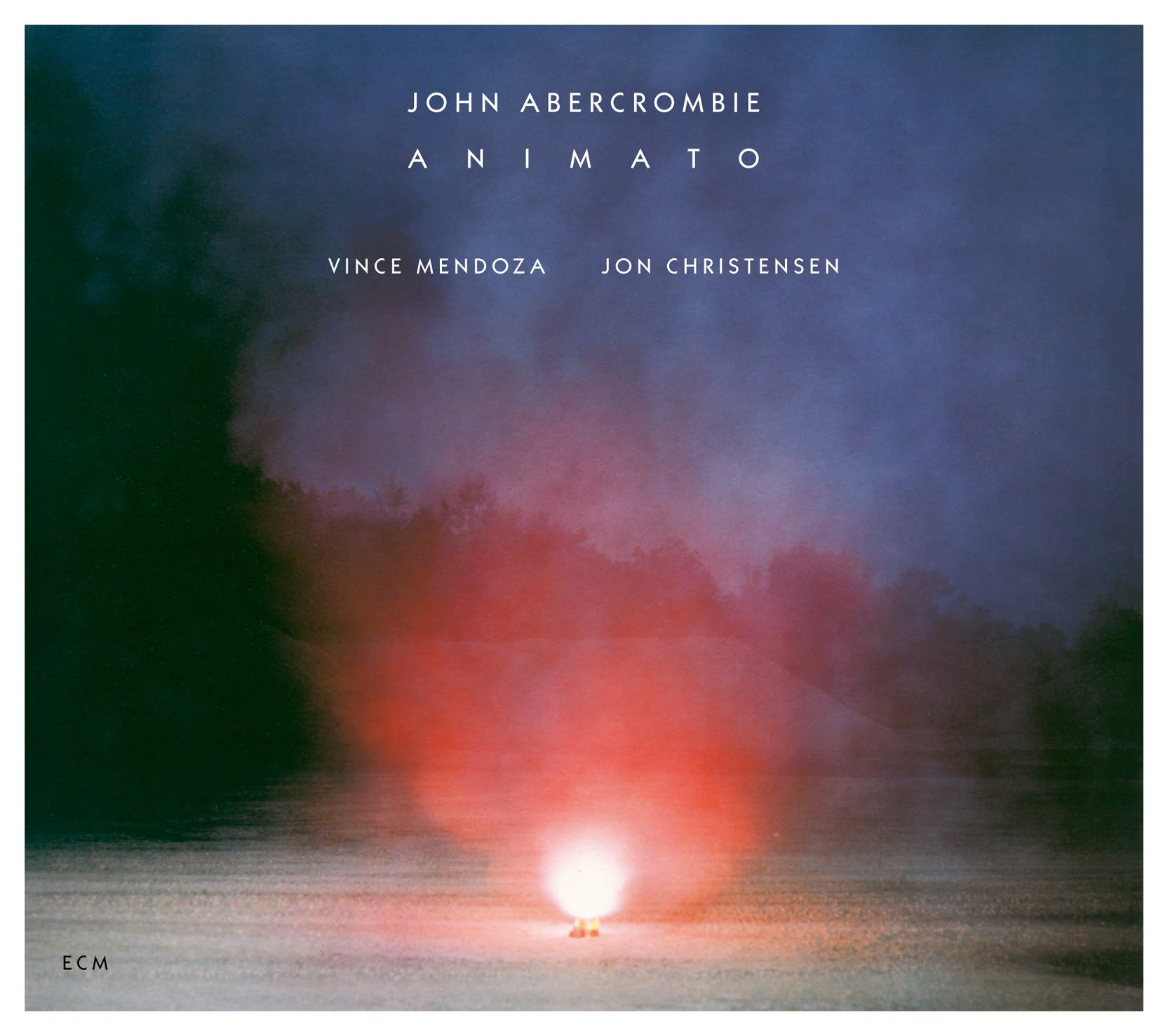
John Abercrombie: Animato (ECM 1411)

John Abercrombie
Animato

John Abercrombie guitar, guitar synthesizer
Jon Christensen drums, percussion
Vince Mendoza synthesizers
Recorded October 1989 at Rainbow Studio, Oslo
Engineer: Jan Erik Kongshaug
Produced by Manfred Eicher

Despite the fact of John Abercrombie headlining this curious little album called Animato, the finished product is a real showcase for drummer Jon Christensen and synthesizer virtuoso Vince Mendoza. The latter, who wrote the bulk of the album’s music (the only exceptions being the group improv that begins the set and the Jon Hassell-esque strains of Abercrombie’s “Bright Reign”), fleshes out some of the strokes Abercrombie was already beginning to paint with his synth augmentations in years past. Still, the guitarist is a major melodic force on this date. Where “Right Now” rises from the depths with the torch in his hands, swirling around a fiery center, self-contained yet extroverted, “Single Moon” floats his tenderness over a bass of electronic goodness. Like a skilled R&B singer, he plumbs the ballad to new depths, each new stratum accentuated by the warmth and timeless energy of Mendoza’s tasteful atmospheres. In this vein, the sequencer qualities of “Agitato” make for a bed of ashes from which the guitar rises like a phoenix and duets with drums in powerful conversation amid gorgeous synth lines and a classically inflected refrain. After the swelling interlude of “First Light” we come into the bubbling abstractions of “Last Light,” in which Abercrombie dances like fire on water. The darkly anthemic “For Hope Of Hope” is an audible mirage throughout which Christensen proves a fantastic painter of colors, even as Mendoza deepens them in a continuous pall of time and narrative experience. We end with a lullaby in “Ollie Mention.” This is perhaps Abercrombie at his most sensitive yet somehow spirited as he tumbles over comforting waves into the final recession of the tide.

The inclusion of Mendoza on this album was a stroke of genius. On the one hand he is an extension of what Abercrombie already implies, while on the other he emotes with such distinctness that one feels the session pushed to new territories with every touch. Together these musicians bring a storyteller’s art to wordless songs, hollowing a vein of shadow through which the blood of dreams runs bright.

<< Dave Holland Quartet: Extensions (ECM 1410)
>> Walter Fähndrich: Viola (ECM 1412 NS)

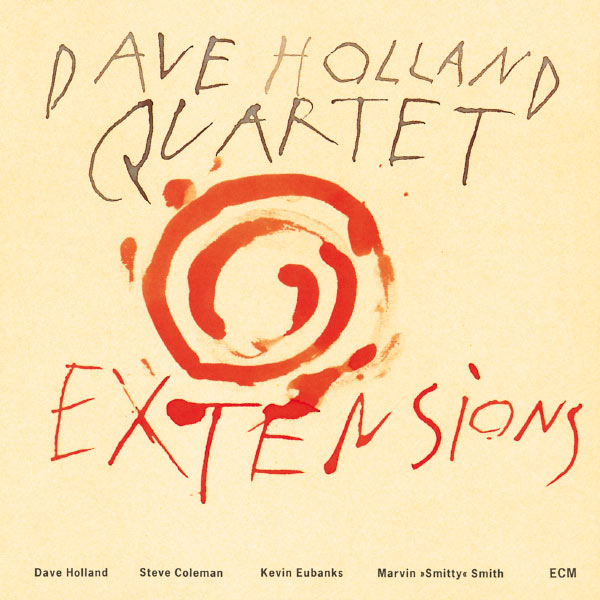
Dave Holland Quartet: Extensions (ECM 1410)


Dave Holland Quartet
Extensions

Dave Holland bass
Steve Coleman alto saxophone
Kevin Eubanks guitar
Marvin “Smitty” Smith drums
Recorded September 1989, Power Station, New York
Engineer: James Farber
Produced by Manfred Eicher

If you’re like me, then you’re most familiar with this album’s rhythm section from The Tonight Show with Jay Leno. From 1995 to 2006, guitarist Kevin Eubanks and drummer Marvin “Smitty” Smith were the anchors for said program’s house band. I always knew that Eubanks was a talented musician but felt that his insights were often lost in the muddled acoustics of the NBC studio in which they were situated. These conditions also boded ill, in most cases, for the show’s musical acts. In addition, for the most part Eubanks had his distortion turned high in order to achieve a certain brand of punctuation in his bantering with Leno, but I sometimes noticed that when returning from a commercial break he would be finishing a smooth jazz number, the brilliance of which I could only guess at. It wasn’t until I heard Extensions that I realized just how deep that brilliance goes.

Eubanks astounds at every turn of Extensions. Having penned the opening and closing tracks, he has the first and last word on things and brings to the in-between a certain majesty to the scope of his improvisatory paths. His “Nemesis” starts things off just right, giving way from barely plucked stirrings to the controlled vigor of altoist Steve Coleman’s left side drive. Not to be outdone, of course, are Smith and the album’s leader (though you wouldn’t know it from Holland’s many gracious nods to these younger trailblazers), whose interactions give Coleman just the lift he needs to soar with a blistering yet somehow nonabrasive sound. A toffee crisp solo from Eubanks paints here in leaps and somersaults, each a tight circle of deftly contained energy.

Holland himself gives us two tracks, of which “Processional” is the most sumptuous. This arid groove finds the bassist stepping lightly, making way for a starlit solo from Eubanks. Holland opens “The Oracle” with a line so delicate, it almost sounds like a classical guitar. The subtlety of Smith’s stylings at the kit and Eubanks’s bird-like calls work themselves through the curling plumes of windswept dunes, leaving a sonorous trail of footsteps that is redrawn as quickly as it is buried. This nearly 15-minute cut is the highlight of the album and should make a Eubanks believer out of anyone. Holland’s almost spiritually minded solo, detailed like a prayer, still conveys an unparalleled wanderlust before Coleman draws a trail of fire into the refrain. His two tunes, “Black Hole” and “101° Fahrenheit (Slow Meltdown),” are respectively funky and sultry, the latter unveiling fan-chopped smoke and alleys littered with wasted opportunities, singing of a time when one could forget them all in an amber bottle.

The closer, “Color Of Mind,” sports one of Holland’s catchiest bass lines and another astonishing dialogue from Eubanks. It also gives us some downtime with Holland along with Smith, who turns up the heat a notch or two into a sparkling close.

This album is a coming of age in an age of becoming. If ECM’s Touchstones series, of which this is a part, had its own Touchstones, this would be one of them.

<< Berlin Contemporary Jazz Orchestra: s/t (ECM 1409)
>> John Abercrombie: Animato (ECM 1411)

Berlin Contemporary Jazz Orchestra: s/t (ECM 1409)

ECM 1409Berlin Contemporary Jazz Orchestra

Benny Bailey trumpet
Thomas Heberer trumpet
Henry Lowther trumpet
Kenny Wheeler trumpet, fluegelhorn
Paul van Kemenade alto saxophone
Felix Wahnschaffe alto saxophone
Gerd Dudek soprano and tenor saxophones, clarinet, flute
Walter Gauchel tenor saxophone
E. L. Petrowsky baritone saxophone
Willem Breuker baritone saxophone, bass clarinet
Henning Berg trombone
Hermann Breuer trombone
Hubert Katzenbeier trombone
Utz Zimmermann bass trombone
Aki Takase piano
Günter Lenz bass
Ed Thigpen drums
Misha Mengelberg piano
Alexander von Schlippenbach conductor
Recorded May 1989 at Studio 10, RIAS Berlin
Engineer: Sören Pehrs
Produced by RIAS Berlin and ECM

The Berlin Contemporary Jazz Orchestra was begun in 1988 as the brainchild of Alexander von Schlippenbach. A decorated composer and student of B. A. Zimmermann, Schlippenbach is perhaps best known as the founder of the Globe Unity Orchestra, which spurred the 1960s jazz scene into the first of many influential phases. This self-titled album is the BCJO’s group’s debut, recorded when the outfit was all of a year old, and features a stunning array of musicians, including trumpeter Kenny Wheeler, reed man and flutist Gerd Dudek, baritone saxophonist E. L. Petrowsky, bass clarinetist Willem Breuker, and pianist Misha Mengelberg.

The set is a triptych of moods and configurations, of which the first, Ana, comes to us from the mind of Kenny Wheeler. From the somber piano intro, one might think a Keith Jarrett solo concert was in store. This illusion is quickly banished by the wealth of instrumental forces at hand. With horns taking the upper range and arco bass the lower, drums ride the outer circle while a hefty trombone strings along some rounded hits from the band. Between the deftly woven brass tapestry and beautiful solo turn from pianist (and wife of Schlippenbach) Aki Takase, Wheeler dominates the solo-sphere —that is, until Petrowsky’s tenor throws some much-needed fuel into the fire. This slides into an upbeat bridge before ending on a free-for-all and a sparkling piano flourish.

The album’s remainder was penned by Misha Mengelberg, whose keys can be found poking their thoughts here and there. The conventional horn intro of Salz wipes the blackboard clean for the frantic bass clarinet lessons of Willem Breuker—who, along with Petrowsky, is one of the group’s shining stars—and the composer’s own frolicking pianism. Another of the album’s best solos resides herein, this time from the tenor of Dudek, who also threads in a few lines of flute.

The lightly syncopated vertigo that welcomes us into Reef und Kneebus promises the album’s best engagements, but instead turns into an over-long meander between a few stellar points. Wheeler, though, is as engaging as always, and the swing comes back into the picture toward the end. This final piece plays more like a series of unrelated vignettes and feels a touch out of place.

This is a full recording, one that accentuates the breezy rhythm section and keeps the brass well separated. The band blows free and easy and tries its best to keep us out of the compositional rut with some freer gesticulations. A respectable outing that could have stood to be spun blindfolded a few times and loosed unaided, but which nevertheless balances its conscious progressions well.

<< Sidsel Endresen: So I Write (ECM 1408)
>> Dave Holland Quartet: Extensions (ECM 1410)

Alexander Knaifel: BLAZHENSTVA (ECM New Series 1957)


Alexander Knaifel
BLAZHENSTVA

Ivan Monighetti violoncello
Tatiana Melentieva soprano
Piotr Migunov bass
State Hermitage Orchestra
Saulius Sondeckis Principal conductor
Lege Artis Choir
Boris Abalian Artistic director
Recorded March 2006 at St. Catherine Lutheran Church and Capella Concert Hall, St. Petersburg
Engineer: Boris Isaev
Recording supervision: Alexander Knaifel
An ECM Production

Just when we ECM listeners had become lulled in the embraces of Arvo Pärt and Valentin Silvestrov, thinking no others might widen that door further, suddenly we encountered a new visionary: Alexander Knaifel. Although Knaifel shares the spotlight with other such stars of the Soviet avant-garde, his ability to paint with sound is arguably unrivaled among them. To experience his music is to experience the pathos of life itself: sometimes bumpy, even hurtful, but always rewarding with the tranquility of learning. In it one feels the weight of the world balanced like a feather on the breath.

Lamento (1967, rev. 1987) for cello solo is dedicated to the memory of choreographer Leonid Jakobson. And indeed, one can feel the shapely movements of the stage working their way into every facet of this sometimes-challenging work. From the opening series of attacks, chained by silence, to the heart-stopping double stop that carries us into prayer, we hear in it a promissory refrain. With youthful caution it spins from agitation a thread of such transcendent light that one feels blinded by its tonality. What follows skirts the line of harmony and dissonance, finding the divine without need of the Word. Knaifel’s attentive scoring allows us to hear the true interior of the cello. To accomplish this, he externalizes its full dynamic range. This is not a piece that answers its own question, but one that becomes the question itself.

Blazhenstva (1996) for soloists, orchestra, and choir also bears dedication, in this instance to mentor Mstislav Rostropovich in honor of his 70th birthday. It’s astonishing that such a meditative piece can harbor so much conflict, and yet here it is speaking to us in the sonic equivalent of Psalmnody. The voice of soprano Tatiana Melentieva proves to be one of the most heavenly on land, and one Knaifel does not exploit but rather bows to through his music, such that with the entrance of bass Piotr Migunov it reveals cardinal avenues of possibility. As a sustained piano intones, it flows like the text it engenders (Our Lord’s Sermon on the Mount, Mt 5:3-12). This overlaps in unexpected ways while maintaining an antiphonal feeling. Men’s voices make way for altos as a constant sheet of strings forms like ice beneath. Vocal lines stretch before fraying into a holy triad, unwound like Creation returning to its firmament. A cello solo lends finality and grace, as if passing along the wisdom of the Beatitudes through a more terrestrial channel before crossing their vertical transmission.

“Both compositions form a united way,” says Knaifel, and this we can hear without question. If one is death, the other is life, and together they complete a circle that touches us all. The sheer amount of space articulated therein (and on this note one must praise engineer Boris Isaev) envelops the darkness and the light, traveling a way of gray that walks as it breathes.