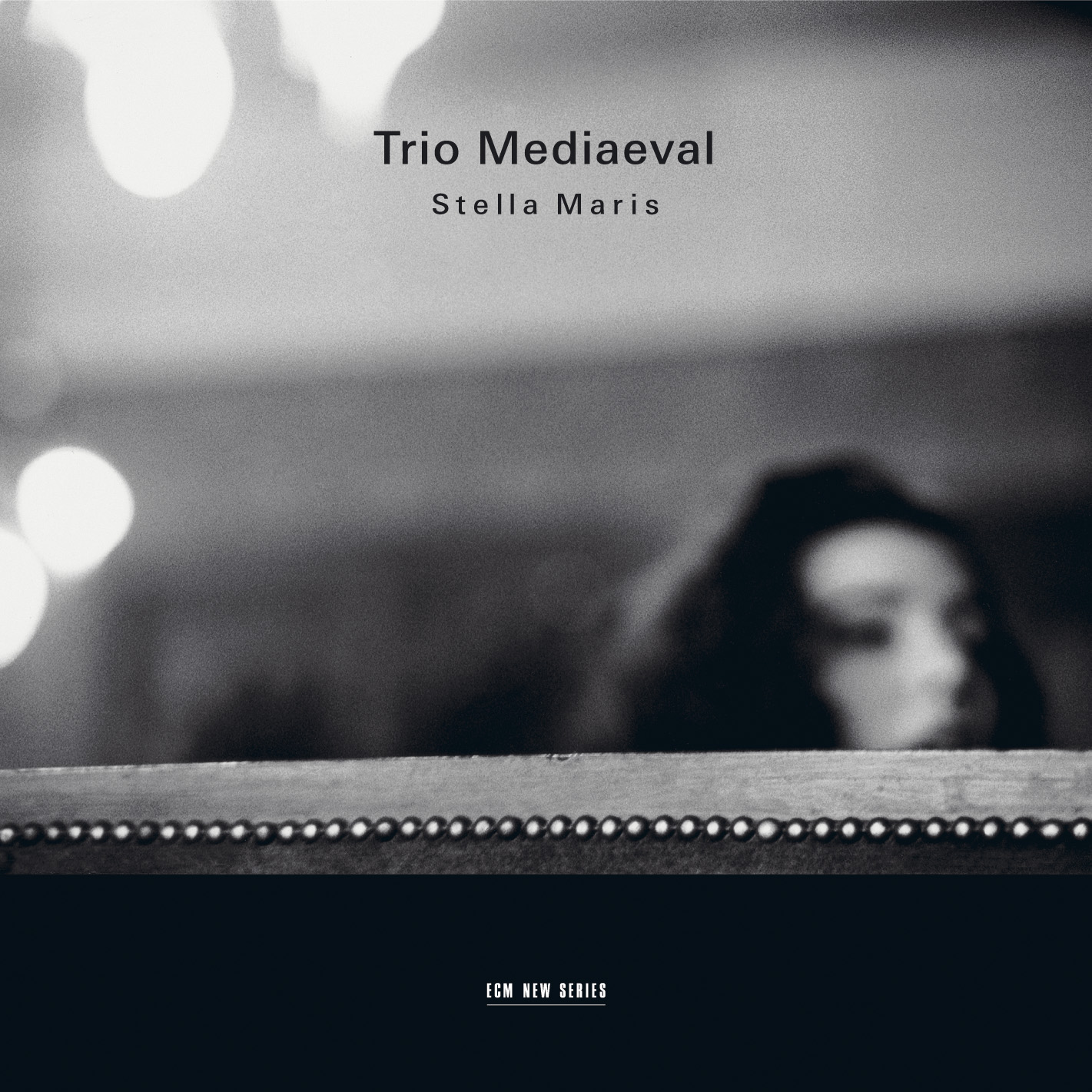
Trio Mediaeval: Stella Maris (ECM New Series 1929)


Trio Mediaeval
Stella Maris

Anna Maria Friman soprano
Linn Andrea Fuglseth soprano
Torunn Østrem Ossum soprano
Recorded February 2005 at Propstei St. Gerold
Engineer: Peter Laenger
Recording producer: John Potter
Executive Producer: Manfred Eicher

For their third ECM outing, the sopranos of Trio Medieaval set their vocal sights to 12fth- and 13th-century French and English (mostly conductus) chants, nestling within these a newly commissioned mass from Korean-born Sungji Hong. That the former (with one exception) performed here were never meant to be sung—or, for that matter, heard—by women at the time of their composition matters not when basking in the vitality of this recording: further proof that music is open to all who touch it, just as those who are touched by it become open to all.

In her liner notes, Nicky Losseff rightly speaks of sweetness, for one cannot help but savor in the fragrant wash of polyphony that is the opening Flos regalis virginalis. This, along with the protractions of Veni creator spiritus and the Beata viscera, comprise some of the program’s most affecting moments. Haunting also are the sustained drone of O Maria, stella maris and the transportive strains of Dou way Robyn.

Yet the most crystalline pillars in this house of mist and time resolve themselves in Hong’s beautiful Missa Lumen de lumine. Written in 2002 and dedicated to the Trio, it grows like vines in ruins grown truer with age. Like the light of its title, this mass is composed of prismatic strands, some of which unify in single threads of chant and others of which refract, visualizing the nature of their own splitting. Between the heavenly Gloria and Agnus Dei, one is left drifting in these precise rhythms and changes. Hong is highly respectful of the texts of the Mass Ordinary and forms of each line a secret braid, ending often with a subtle flourish in the spirit.

Anonymity in music is purity, filled with hope and the sparkle with wisdom. It allows us to strip music of its egotism and appreciate it as something out of place, if not out of time, and therefore of the world. In listening, we become the music’s inhabitants, not in a relationship of power, but of recognition. When paired with a highly composed work like Hong’s, the surrounding chants indeed take on a luminous quality, forever drawn to a heaven of undying voices. This is the magic that Trio Mediaeval brings to every note sung, and this just might be the most intimately appropriate album with which to begin that journey.

John Cage: Early Piano Music (ECM New Series 1844)


John Cage
Early Piano Music

Herbert Henck piano
Recorded December 2002, Festeburgkirche, Frankfurt am Main
Engineer: Markus Heiland
Executive producer: Manfred Eicher

Two years after his benchmark account of the Sonatas and Interludes, German pianist Herbert Henck returns to the music of John Cage for this refreshing program of early works. Henck’s prowess at the keyboard is matched note for note by tenderness, and in these pieces we find both in full order. His ability to render even the most serial works as lusciously as he does more readily accessible works like 1948’s In a landscape is nothing short of astonishing. Of the latter masterpiece he gives an endearing performance that thrums with drawn-out warmth under his touch—an intimate tapestry spread to reveal every tonal stitch blissfully intact.

Yet it is in the miniaturization of such works as The Seasons (1947), heard to great orchestral effect on the selfsame ECM disc, that one finds this artful program’s most enchanting moments. As with much of Cage’s instrumental music, it feels and flows like nature, is at one with certain understandings of universal design. And so, when we listen to a track like Winter, it does not feel like falling snow, or even the whipping winds of a blizzard, but speaks to a rather different sense of climatic change. Neither does Summer swelter. Rather, these pieces embody their elemental forces. From the scattered Preludes alone, we get a sense of the piece’s intense variation in styles, speeds, and modes of articulation, by turns rather mysterious and straightforward, uncompromised. This is music without form, but in being formless becomes ordered, unfolding at the speed of remembrance.

The five-part Metamorphosis (1938) presents us with some of the more playful moments in these selections, following linear melodies down halls of mirrors. Fleeting like the patter of children’s feet, it breathes over into an innocent finality. After the convoluted yet true-to-form little curiosity that is Ophelia (1946), the handful of piano pieces that concludes the album might come across as pedantic were it not for Henck’s distinctly “vocal” approach.

A worthwhile peek into Cage’s world that allows us to see a composer on the brink of finding his way, Early Piano Music is remarkable also for Markus Heiland’s engineering, which captures every nuance of Henck’s playing with a microscopically attuned ear.

Reflections from MCTS 2012

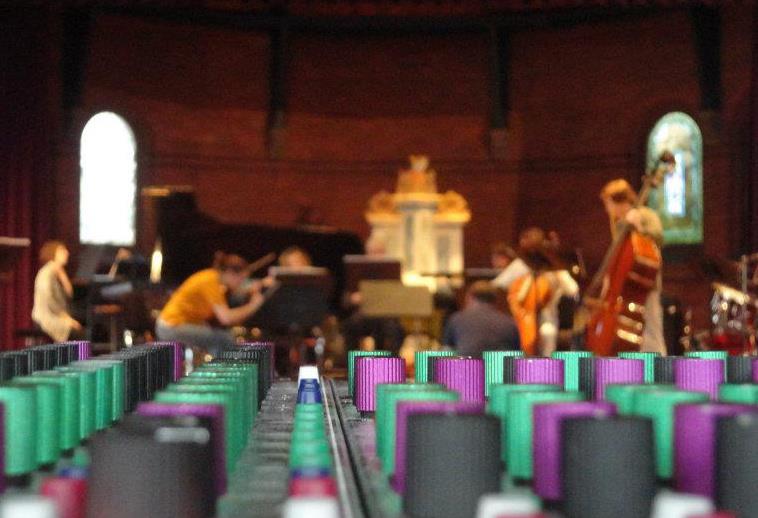
From May 11th through the 13th, I was fortunate enough to participate in what I hope will become the first of a regular academic gig at Cornell University. Music: Cognition, Technology, Society (see my full conference report here) brought together a host of composers, musicians, musicologists, and cutting-edge theorists for three days of intense dialogue, demonstration, and performance. Of the latter, I have written up a diary of impressions regarding two exciting programs of music from, with the exception of Tod Machover, the latest generation of composition students from around the world.

In my ongoing attempts to stay true to the moment, I present the following to you unedited.

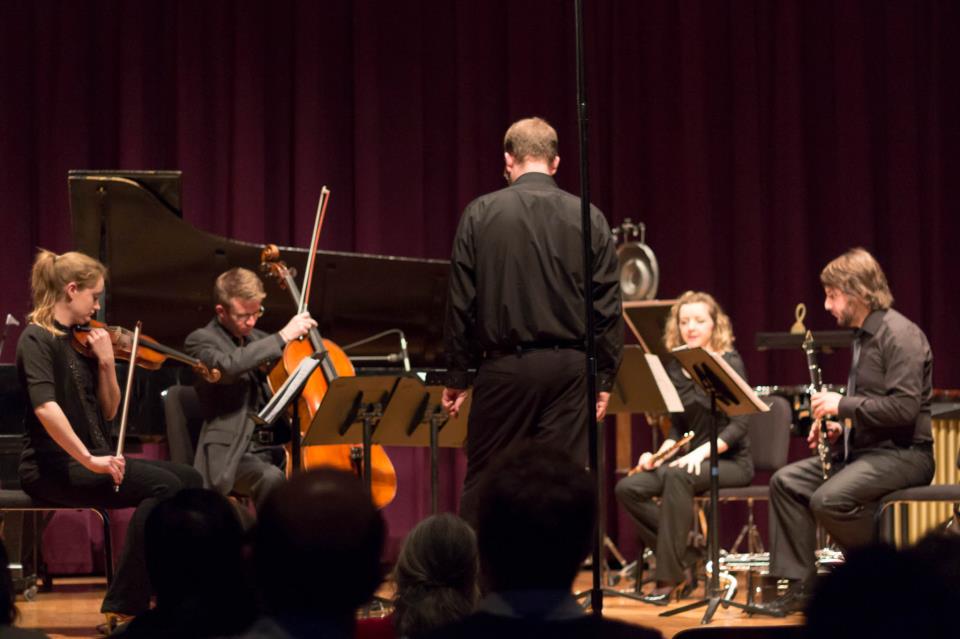
Argento Ensemble
May 11, 2012
Barnes Hall, Cornell University
8:30 pm

Clara Lyon violin
Andrew Borkowski cello
Laura Barger piano
Fiona Kelly flute
Vasko Dukovski clarinet
Matt Gold percussion
with
Wendy Richman viola
Nicholas Walker double bass
John Lathwell oboe
Andrew Zhou electronic keyboard

Sean Friar: Scale 9
Flutter and pause. Fragmented, crystalline flower wilting and reforming itself in a hundred lifetimes. Bristling with the energy of myriad hopes. The clarinet a voice thrown into the cello’s bodily pool, violin droplets kissing the edges of a shimmering veil. Mostly urban, with shades of nocturnal countryside, feet navigating their own obligations amid a playful tangle of traffic and crossed emotional wires, all heading toward a gusty close.

Bryan Christian: Walk
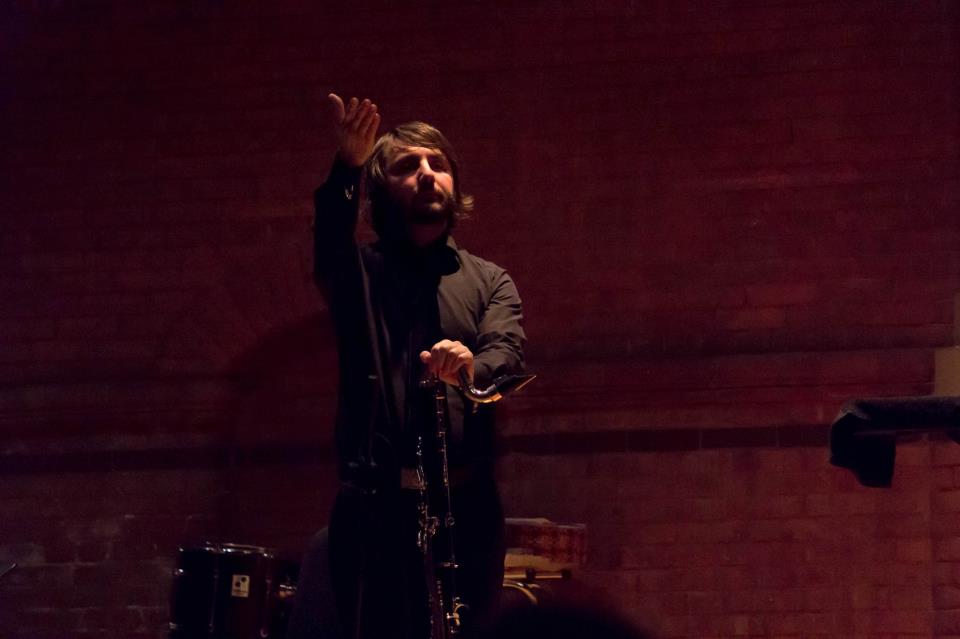
A murky inkswirl of whispers and broken songs, clatter of misted gates. Ring of insect on leaf, the stamping of moonlit intentions carving paths in the deforested wasteland of interaction where wanders the hope of yesterday in the clothing of tomorrow. Memories shriek with banshee-like presence, just long enough to curl their fingernails around the edges of our ears and plant in them seeds plucked from the stamen of infirmity. Visceral percussiveness from bass clarinet keys, breathy augmentations to woodblocks and bells.

Juraj Kojs: Re-route
Bass clarinet’s thrumming burnt ochre—a didgeridoo in the pincers of an oscillating beetle—of bass haunts a scrubbing of electronic flickers. Tearing sheets from a ream imprinted by graphite handsteps.

Eric Lindsay: Town’s Gonna Talk
Throw some Stephen Hartke and Thomas Larcher in a pot, add a dash of backyard gab, and you get this delightful foray into sandy fields and heavily tracked neighborhoods throughout which the baby rattle of progress bleats its weary song amid pointillist loveliness between violin and cello. Peaks in a glorious hoedown of epic proportions. Change rattling in cup, whistling.

Amit Gilutz: Miscellaneous Romance No. 1
Scraping and computer voices (reading missed connections in Ithaca) lead toward an audible map of localized desperation. Perhaps laughter can be recreated, but only shame comes from flesh.

Christopher Chandler: the resonance after…
Gorgeous veils of sound drawn from metallically infused hits. A Gavin Bryars dream stretched to brightest distance. Electronics seamless. Highlight of the concert.

Tod Machover: Another Life
Tangled, diffusion of instrumental favoritism, banded by an alternative electronic flow. Wind writing enhanced by pre-echoed afterlife. A pixilated pastoral for the 21st century.
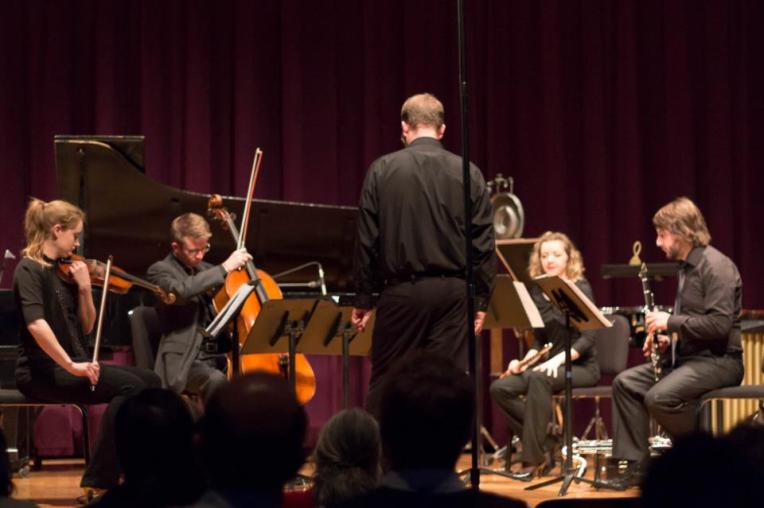
Electroacoustic Music Concert
May 12, 20120
Barnes Hall, Cornell University
8:00 pm

with
Andrew Zhou piano
Peter Van Zandt Lane bassoon
Eliot Bates oud, electronics
Taylan Cihan electronics, speaker elements

Nicholas Cline: Homage to La Monte Young
This bowed metallic dronescape is populated by Giacometti figures wandering in slow motion in search of dawn, finding instead only semblances of moonlight. These they hang around their necks from strings of marrowed intentions, where the body speaks—not in skeletal language but rather with the syntax of time. This feels like stepping into a room filled with Bertoia rods and finding in their whispers a script for human evolution.

Nathan Davis: Ecology No. 8
Wave field, field of waves—hand, ocean, emotion. Correspondence found in the scalar plane: a fish exploded, decoded, and processed into trailing lights, shards of perfect(ed) fluted glasses, each a trail of hyperspace in foreshortened tears. A hundred hypodermics poised at black hole’s edge, waiting to drop their spores into the cytosphere. A lighthouse sweeping its own demise.

Nicola Monopoli: The Rite of Judgment
A police light’s heart, sounded from within every luminescent rectangle. Speaks in tongues wet with static, salivating at the corners with an air of self-disinterest. A butterfly kiss gone gorgeously awry, vault of glottal windows vying for attention where only a blank screen wins.

Christopher Stark: Two-Handed Storytelling
(Birds sing outside the window, curling feathered tongues around the pianistic fist.) Twisted shadow hidden in its fleshy cage. Breath funnels back into itself, embracing the echo like a mouth around food and swallows a wash of crystalline highs. A conversation not for two hands, but for two heartbeats. Stop. Curtain. Draw. Spotlight. Exhale.

Peter Van Zandt Lane: Hydromancer
A flick, a thunk, and a puff of briny stew, trudged in the reverberant spaces of untold dreams. A gate opened at dawn, amphibious yet yearning for human contact. Metronome of water falls down the tarnished stairs of our collective home. The cats in the yard plying us with curiosity, their legs and tails dew-kissed with curiosity. Ping-ponged signal shuffles itself into an intrinsic deck just bursting with the teeth-clenching desire to say hello.

Stelios Manousakis: Megas Diakosmos
Tearing into a bag of microchips, these sonic teeth feed with an overwhelming gesture of disclosure. This beats us with the fallacy of silence, even as it caresses us with a signal’s dying wish. It traces a tonal center where there can be no footprints. A vortex spread flat and rolled into children’s telescopes, bringing us no closer to the reality it refuses to map. The atmosphere weeps sulfur, speaks fire, and draws its fantasies in acid rain. Subterranean bungalows shake themselves free of the inhibitions once slumbering in their cradles. Finish your ash, says the mountain, and you can have some magma to wash it down. It whispers with a force so proximate that it lifts inside us the blindness of a hush. Oh, how nostalgia can taste like noise!

Eliot Bates/Taylan Cihan: Zey-glitch
Testing. Wait and see what lives in the branches of the fig tree. Skipping. Wait and see what dies in the arms of the unborn angel. There are no wings, only nails. Cartilage, calcium deposits, and bone. Double string and single lyre, bleeding faith and healing fire. Hold the gristle of unremembered days and know the feeling of reduction on the palate. I hear the thief, for the thief hears everything I do not.

(All photos by Evan Cortens)


Silent Dominions: Walking the Path with Upshaw and the ACO

Australian Chamber Orchestra
Richard Tognetti artistic director
Dawn Upshaw soprano
Guest musicians for Winter Morning Walks:
Scott Robinson clarinets
Jay Anderson bass
Frank Kimbrough piano
Bailey Hall, Cornell University
April 27, 2012
8:00 pm

Since 1975, the Australian Chamber Orchestra has built a reputation for adventure. For this we can thank longtime director Richard Tognetti, whose eclectic programming has brought the orchestra back on its feet, lending every performance a dynamic edge that few chamber ensembles can match. For Friday’s performance at Bailey, which capped off a successful academic year for Cornell’s premier concert venue, the already phenomenal outfit was joined by soprano Dawn Upshaw, whose voice turned every word sung into a morsel of sonic caramel.


Upshaw

Yet before she even took the stage, I was overjoyed to discover that the ACO was to start us off on a bold foot with selections from George Crumb’s Black Angels. This work was something of a touchstone in my formative explorations of twentieth-century music, and to hear it live at last was thrilling. It may or may not have been the most perplexing facet of the concert for those unfamiliar with the opening blast of Threnody I: Night of the Electric Insects. Horror fans will have recognized it from the 1973 classic, The Exorcist. Yet as I imagine was clear from the reaction of Friday’s audience—which began with a few chuckles of surprise (mingling with some, like mine, of nostalgic recognition) and ended with sighs of wonder—Crumb’s sound-world is less about fear and more about the music hidden in our shadows. The precision of the score also means that the Black Angels experience is carefully marked: we can trust in the composer’s obsessions.

The Five Pieces for Strings of Anton Webern, into which selections from Black Angels were shuffled, may on paper seem a curious weave. Yet as pairings before—with Shostakovich, Fauré, Stravinsky, and, most profoundly, Bach—have shown, the young Darmstadter’s music lends itself to a wide range of company, whose works provide windows, if not mirrors, of interpretation. From the sinewy, ghostly chasms of the opening movement to the whispered conversations of the last, the Five Pieces strike a balance all their own. The fourth and fifth, however, couched one of the evening’s most transcendent turns in the form of Crumb’s God-music, the beauties of which seemed to win over even the most resistant traditionalists. The movement featured tuned crystal glasses, each filled with water and bowed to ethereal effect while a cello wept in solitude, suspended from the stars in a sky blinded by battle smoke and wasted lives. It cried like an operatic scene change, revealing something in the night which can only be played but never sung, lest the voice lose itself in its own spell.

In light of this startling prelude, Maria Schneider’s Winter Morning Walks, written for Upshaw, was like a massage after a grueling work week. For this Schneider drew on the poetry of Ted Kooser, whose unassuming Americana went down like sunset. Improvisation literally took center stage in the form of a jazz trio comprised of clarinet, bass, and piano. The wintry whip of the air struck us in the opener as the trio folded itself into the orchestral batter—a mere taste of the confections to follow. Schneider’s mastery of her palette became evident in the second song, “When I switched on a light,” which evoked the fluttering of moths on the piano’s dampened strings. A similar panache was to be found in the swirls of “I saw a dust devil this morning” and later in the incessant gales of “Our finch feeder,” the latter describing a group of birds struggling against the wind in the name of sustenance. Yet it was the third, “Walking by flashlight,” which was the evening’s highlight. This piece was cinematic to the utmost: an early-morning walk, animals peering out from the bushes at a protagonist who describes his circle of light on the ground as “the moon on a leash.” Lovely improvisations from pianist Frank Kimbrough made the experience all the more sweeping. From the first, one could see the concentration on Upshaw’s face as she attuned herself to every mood and image. Her unparalleled diction and deferential temperament broke the fourth wall and then some, and in the jazzy lows of “Spring, the sky rippled with geese” we were especially amazed by the depth of her range.


Schneider

My inaugural encounter with Upshaw was through her benchmark Nonesuch recording of Samuel Barber’s Knoxville: Summer of 1915. The work remains a personal favorite, and I can only say that the unfettered pastoralism of Schneider’s settings inspired anew what I heard in that first listening. These sentiments flowed logically into the three German lieder that followed intermission. In Robert Schumann’s Mondnacht (Moonlight), Upshaw seemed to bind Heaven and Earth with the power of her voice, while the two songs by Franz Schubert—Geheines (Secret) and the notorious Der Tod und das Mädchen (Death and the Maiden)—contrasted buoyant, flirtatious energy with the darkness of mortality. The latter’s low D rang soulful and true, ending the singer’s tenure for the night on a trail of liquid mercury.

In light of this, Arnold Schoenberg’s Verklärte Nacht (Transfigured Night) turned dusk into midnight. Named after the selfsame poem by Richard Dehmel, its unsung words draw us back to Kooser: “Two people are walking through a bare, cold wood; / the moon keeps pace with them and draws their gaze.” All the drama of a Wagner opera was compressed in this work for strings into a droplet of darkness falling in slow motion amid knots of evening cloud. Between every inhalation and exhalation the orchestra drew a chain of sometimes-overwhelming consummations. Each harbored something of the next, wandering sparkling meadows with moonlit footsteps amid a changing landscape of rustlings and baying winds. In spite of the title, some of Schoenberg’s brightest writing can be found here, and its slow build from stasis into infinity is one of the defining transformations of modern music. The ACO gave it heartrending justice.

Tognetti and company bring a crisp and earthly sound to everything they lay a bow to, and during the encore they drew the shades on their fiery passions with a haunting rendition of Astor Piazzolla’s pensive tango, Oblivion. Yet it was Upshaw whose voice rang clearest in my mind as I left the hall. I couldn’t help but recall the words she sang in the final song of Schneider’s cycle: “This morning the sun stood / right at the end of the road / and waited for me.” So, too, did the shining, life-affirming star of her gift wait for us at the end of this long and winding series, embracing us warmly and with hope on an unseasonably cold evening.

(See this article in its original truncated form at the Cornell Daily Sun.)

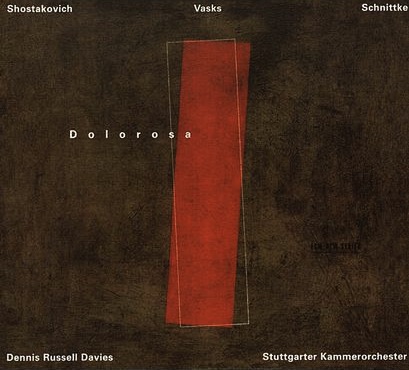
Shostakovich/Vasks/Schnittke: Dolorosa (ECM New Series 1620)

Dmitri Shostakovich
Alfred Schnittke
Peteris Vasks
Dolorosa

Dennis Russell Davies conductor
Stuttgarter Kammerorchester
Recorded June 1996, Mozart-Saal/Liederhalle, Stuttgart
Engineer: Peter Laenger
Produced by Manfred Eicher

Orchestral transcription can be a contentious enterprise, obscuring as it enhances. Yet in rare cases its contours manage to take a shape all their own, living a new life somehow beyond the shadow of the original. Of this transformation we get two fine examples in Dolorosa, a well-conceived program from three distinct compositional minds.

The works are presented in chronological order, with a 1967 orchestration of Dmitri Shostakovich’s String Quartet No. 8 as a “Chamber Symphony” coming first. The arrangement, by conductor and violist Rudolf Barshai (the only one ever approved by the composer), is brilliant in that it avoids masking itself and features a flowing chain of solos. The swell of grief that besets the first movement now feels like a cinematic shift rather than climatic one and leaves a lethargic trace on the second movement. Conductor Dennis Russell Davies takes a conservative tempo on this often-cathartic passage, figuring it as a page manifesting its own ink rather than one furiously scrawled upon. The macabre minuet that follows in the third reaches new dynamic heights in the current version, and allows us perhaps above all to feel what the composer himself read into the energies breathing through it (though, as Richard Taruskin reminds us, the motivations for doing so were questionable, the result of a personal revisionism). The quartet as a whole is an intertextual treasure trove, comprised primarily of snippets of Shostakovich’s own works and those of Wagner and Tchaikovsky, in addition to revolutionary songs such as “Tormented by Grievous Bondage.” Whatever the reason for writing this supposedly autobiographical summary, we can hear in the final two Largos an underlying nonconformity threatening to overtake us with each turn of phrase. But all of it is just so beautiful that one finds it hard to unlock it as a political document.

Those Largos seem to whisper throughout Musica dolorosa. Penned in 1983 by Latvian composer Pēteris Vasks in memory of his sister, it spins from indubitable threads a tapestry to be viewed, experienced, and understood. Though it manifests itself with Shostokovichian pathos, its structures feel relatively smooth to the touch. And when the quietude is at last overtaken by an outpouring of grief, pizzicato accents mark the tempo like an aural tic chipping away at a world that could dispense with life so readily. As the orchestra subsides, violas scrape the edges like tears. This piece does for grief what Erki Sven-Tüür’s Passion does for its eponym.

Alfred Schnittke’s String Trio brings the transcription instinct full circle. Arranged for orchestra in 1987 by Yuri Bashmet as Trio Sonata, it is both the longest piece on the album and the one in least need of commentary. Like Schnittke’s quartets, the trio opens itself up to moments of grandeur, but quickly undermines them with mournful denouements. Proof positive that, despite the expansion that an orchestral arrangement engenders, the music becomes no less introspective and no less intimate, and perhaps delves even deeper into the solitude of its creation.

Shostokovich noted that his eighth quartet, while openly bearing dedication to all victims of fascism, was in fact about himself, about the death of his ideological self after having undergone such intense social pressure to join the Communist party. Yet if we take a quiet walk between the lines of that history, we find a landscape populated with staves and notes like countless others before or since. Our assumptions about Shostakovich as the victim of a sensitive political milieu often color the ways in which we perceive his music, which is perhaps the point: to read is to experience. There is, however, a danger here. One the one hand, hardship in the lives of any of these composers, much less of any others, can hardly be denied. On the other, the music is its own space, which though its attempts to grapple with something in art that cannot be safely engaged in life breathes into our souls without mitigation. In the end, there only the beginning.

<< György Kurtág: Játékok (ECM 1619 NS)
>> Jean Barraqué: Sonate pour piano (ECM 1621 NS
)

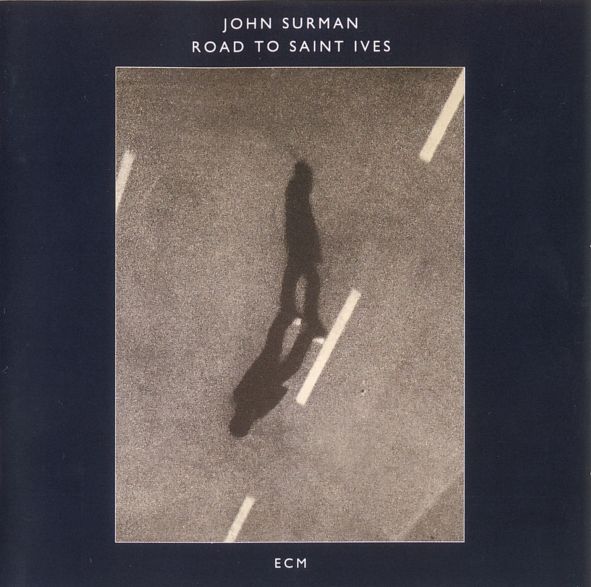
John Surman: Road To Saint Ives (ECM 1418)


John Surman
Road To Saint Ives

John Surman bass clarinet, soprano and baritone saxophones, keyboards, percussion
Recorded April 1990 at Rainbow Studio, Oslo
Engineer: Jan Erik Kongshaug
Produced by Manfred Eicher

Although we might feel tempted to take Road To Saint Ives, one of John Surman’s most stunning solo albums to date, as a portrait of its titular coastal town, Surman states in his liner notes that such is not the case. Aside from the peppering of folk-inspired melodies in the soprano solos, the music breaks its own ground on the way toward unique improvisatory continents. Among those solos, “Polperro” makes for a transportive opener, while the echo effect of “Perranporth” dances on a cloud of whimsy. These solos are the heart of everything that makes Surman such a listeners’ gift. Their quality of tone and pitch speaks of the supremely nuanced command he has over his instruments. Each has the makings of antiquity blown through its core, as if webs of time were being pulled into all-encompassing songs. Surman is likewise a master of the miniature, as exemplified by the album’s shortest track, “Trethevy Quoit,” in which a crunchy flock of low reeds sounds one of the most memorable congregations in the program. Building up from these are the ensemble pieces in which he overdubs a chain of settings. From Michael Nyman-esque forest walks (“Rame Head”) to flirtations with his favored sequencer (“Mevagissey”), he explores the contours of the most lyrical baritone one can imagine. One moment we are gliding through a classic sci-fi cityscape while the next finds us skirting the edge of a piano-infused drone (“Bodmin Moor”). And one can hardly ignore the multifaceted sound of his bass clarinet, which floats playfully on every ripple of “Piperspool” but which weeps liquid gold against the prayerful organ of “Tintagel.” Surman’s lyricism seems to mourn the extent of its own beauty in this, his deepest nod. So too may we lose ourselves in gamelan feel of “Bedruthan Steps,” where that unmistakable soprano darts in and out of every temple as if the entire complex were but an ocean reef, every note a fish that swims its coves as nature itself must breathe.

Like all of Surman’s solo albums, this is a dream made real.

<< Kenny Wheeler Quintet: The Widow In The Window (ECM 1417)
>> Jan Garbarek: I Took Up The Runes (ECM 1419)

Kenny Wheeler Quintet: The Widow In The Window (ECM 1417)

Kenny Wheeler Quintet
The Widow In The Window

Kenny Wheeler fluegelhorn, trumpet
John Abercrombie guitar
John Taylor piano
Dave Holland bass
Peter Erskine drums
Recorded February 1990 at Rainbow Studio, Oslo
Engineer: Jan Erik Kongshaug
Produced by Manfred Eicher

One month after the crowning success of his Music For Large & Small Ensembles, trumpeter/composer Kenny Wheeler gathered a handful of stars therefrom—namely, guitarist John Abercrombie, pianist John Taylor, bassist Dave Holland, and drummer Peter Erskine—into this more succinct yet equally classic date. Abercrombie lays down a particularly soulful beauty in the opening “Aspire,” the first in a program of six Wheeler originals, and sends the frontman’s uncompromising insights into thoughtful ether with the stretch of a trampoline. A solo of sweeping intimacy from Taylor showcases further sensitivity among a quintet so attuned that it might as well be doing this while asleep. We do, of course, find ourselves wide awake in the dazzling light of “Ma Belle Hélène.” One by one, Abercrombie unwraps his charms like the sonic candies they are. Wheeler, meanwhile, adds feathers to the session’s growing wings, uncorking a rush of unbridled melody that elicits one of Holland’s most heartfelt solos on record against some of the cleverest cymbals in the business. A graceful pass from Taylor puts the waxen seal on this love letter to sunlit streets and alleyways. The title track begins with a longing cry from Wheeler, who finds in its descending motives a narrative of spun of cloth and time. Profundity abounds in this solo-sphere, Holland especially drawing inimitable shapes into the fogged mirror of memory, wiping away melancholy away as if it were a dust bunny blown out of sight by a sigh. “Ana” receives a more nuanced treatment here than it did on Wheeler’s outing with the Berlin Contemporary Jazz Orchestra. That same modal intro speaks, sounding more than ever like a soundtrack to a film yet to be made. After a theme articulated in shadows, Erskine and Taylor turn to the light. Abercrombie positively dances on air and, along with Wheeler, carries us into the depths of hope. The swinging “Hotel Le Hot” finds the latter at his bubbling best, cresting the flames of surrender with every squeal. This cut is also noticeable for Erskine’s dizzying flavors. “Now, And Now Again” ends things in a gently rocking cradle for which Wheeler lays on the lyricism thick. Taylor charts the earth where once he stepped, where in his place now hovers only a sonorous ghost of what used to be.

Those who count themselves a fan of Wheeler, ECM, or boundary-crossing jazz in general can chalk this one as unmissable.

<< Kenny Wheeler: Music For Large & Small Ensembles (ECM 1415/16)
>> John Surman: Road To Saint Ives (ECM 1418)

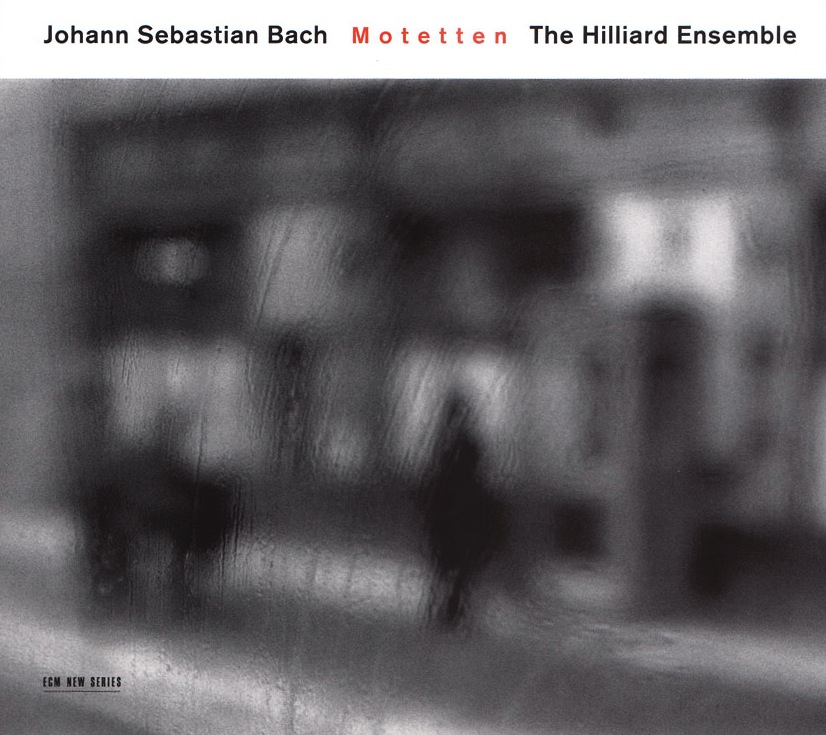
J. S. Bach: Motetten – The Hilliard Ensemble (ECM New Series 1875)

Johann Sebastian Bach
Motetten

The Hilliard Ensemble
Joanne Lunn soprano
Rebecca Outram soprano
David James countertenor
David Gould countertenor
Rogers Covey-Crump tenor, organ
Steven Harrold tenor
Gordon Jones baritone
Robert Macdonald bass
Recorded November 2003, Propstei St. Gerold
Engineer: Peter Laenger
Produced by Manfred Eicher

It was during a concert given by the Tallinn Chamber Orchestra and Estonian Philharmonic Chamber Choir in the fall of 1995 that a Bach motet’s masterful weaves of light and sound first nourished these ears. With infinitely branching listening paths before me, however, I never explored the motets further—that is, until the ECM connection came full circle with this wondrous recording from the Hilliard Ensemble. Or should I say, the Hilliard Ensemble in duplicate, for here the quartet is joined by sopranos Joanne Lunn and Rebecca Outram, countertenor David Gould, and bass Robert Macdonald for a special session in the familiar acoustics of Austria’s Propstei St. Gerold.

Very little is known about the circumstances surrounding the composition of these motets, but as Martin Geck’s liner notes remind us, their significance in Bach’s oeuvre is on par with The Well-Tempered Clavier, equally monumental as examples of counterpoint and absolute harmony. They are, one might say, extra-musical insofar as they express themselves far beyond the words at their core, beyond the note values ascribed to those words, and beyond the constraints that pigeonhole them into meters and divisions. Rather, they lose themselves blissfully in the finer details of their flowering.

From the first threads of Singet dem Herrn ein neues Lied one can feel the utter control these singers possess. Listening to them is like feeling the music being born from Bach’s mind, fresh and free from the pitfalls of excessive scrutiny. Lunn and Outram stand out especially, ringing out over the others like carillon overtones in a music overcome by a melismatic spirituality (listen also for their striking high that ends this opening motet). The shimmering space therein gives us some of the more intimate moments on the disc, nesting in mind and body with all the gentility of an autumn breeze. These motets all end on resolved chords, offering a sign of hope and tranquility in the wake of their roiling seas. On that note one can hardly praise this recording without highlighting the crisp diction throughout. This attention to linguistic color is perhaps what most separates it from those rendered in larger forces. Moments like the “Gute Nacht, O Wesen” portion of Jesu, Meine Freude are as tactile as our own bodies. Others of sheer transcendence abound, as in the final chorale of Fürchte dich nicht, ich bin bei dir and the Alleluia of Lobet den Herrn, alle Heiden. Yet it is in the last, Ich lasse Dich nicht, du sengnest mich denn (often elided from Bach motet recordings, due to its contested authorship), that we find ourselves bathed in deepest calm, for here is the breath turned sacred, that it might begin a life of its own.

Valentin Silvestrov: Symphony No. 6 (ECM New Series 1935)

Valentin Silvestrov
Symphony No. 6

SWR Stuttgart Radio Symphony Orchestra
Andrey Boreyko conductor
Recorded June 2005, Stadthalle Sindelfingen
Engineer: Dietmar Wolf
Executive Producer: Manfred Eicher

I would be surprised if Valentin Silvestrov’s Symphony No. 6 (1994/95, revised 2002) wasn’t someday recognized as being among the more significant of the twentieth century. Dedicated to Ukrainian-born composer Virko Baley, another powerful yet under-recognized voice, it speaks as might time itself. This world premiere recording is still the benchmark, given just the balance of violence and reverie it needs by the Stuttgart Radio Symphony Orchestra under the capable baton of Andrey Boreyko.

This piece, perhaps more than any other in the Silvestrov oeuvre, brings a distinctly programmatic energy to the fore of his craft. The first movement gasps like a hospital patient awakening from a horrible accident, pangs of realization shooting through a strung body arching against the onslaught of memory. The second is in the same vein, only now obscured by breath. Yet the heart of this symphony is its third movement, which over a 25-minute span encompasses all that frames it and more. Its sprawling, flower-like opening fears its own beauty, and so it breaks the mirror and swallows it, shard by shard. And as countless lives flow past, uncaught, unexplored, and unheard, Silvestrov’s omnipresent piano presses down from the sky, the detritus of a sifting pan turned ever so slowly by cosmic hands after being pulled from the Milky Way’s tepid waters. Winds and percussion contribute to the mounting sense of doom, forever dispelled by the occasional ray of sunlight. The aching fourth movement assures us of this chain of hopes. Clusters of starlight move like molten lava, leaving a quiet smolder to speak for their passing and lighting up the night like the flames on the album’s cover. The fifth and final movement continues from the unbroken thread of the fourth, a dangling chain that when pulled unleashes the liquid heart of a cloud, the frustration behind a prayer. It is the symphonic equivalent of a master engineer who with attentive fingers turns the dials of some vast mixing board, so that each element swells into a world in which “staccato” becomes a sin to be vanquished with the all-consuming statement of the almighty afterthought.

Although he does chart earlier harmonic territories in the Symphony No. 6, Silvestrov simultaneously deconstructs the privilege of doing so, expanding upon each harmonic cell with biological persistence. If the above abstractions leave you with little feeling as to what actually transpires over its nearly hour-long course, then this proves only the weakness of my words and not of the music that prompted them. Listen and be moved.