Everyman Band: s/t (ECM 1234)

ECM 1234

Everyman Band

Michael Suchorsky drums
David Torn guitar
Bruce Yaw bass
Marty Fogel saxophones
Recorded March 1982 at Talent Studio, Oslo
Engineer: Jan Erik Kongshaug
Produced by Manfred Eicher

What began as Lou Reed’s backing in the seventies stepped out on its own as Everyman Band, recording this self-titled debut for ECM in 1982. If a group is only as good as its musicians, then the name is a contradiction: not everyone possesses the firepower of Michael Suchorsky on drums, David Torn on guitar, Bruce Yaw on bass, and Marty Fogel on saxophones. The latter brings his idiomatic flair with three originals. Torn steals the show in “Lonely Streets,” a smoldering trek through nocturnal fires and other hidden conflagrations. Fogel spikes this punch with his own choice poisons. Yaw keeps up at every turn of phrase, and keeps us “On the Spot” with a memorable bass line, around which Fogel herds Torn’s flock in tight circuits. “Fatt Blatt” weighs in with a heavy tenor solo before the quartet pulls its best funk off the rack in a monochromatic swing. Yaw has his moment in the sun before diving back into the vamp with a vengeance.

Torn hones in with two clicks of his own. “Morals in the Mud” opens the album with a bang, his Strat popping the bubble of our attention with a neon pin, while “The Mummy Club” gives off an airier vibe. A slap bass distinguishes this wobbly palate-cleanser from the rest, as Fogel surfs Torn’s mighty chordal crashes with finesse. Suchorsky and Yaw churn out one tune apiece. “Japan Smiles” has a deeper, headier sound and features some fantastic bass/sax interaction. “Nuclear Suite,” on the other hand, is less direct, and speaks in tongues over a vast dynamic breadth. The appearance of a soprano sax lightens the load considerably. Playful, jaunty rhythms abound, overturning post-apocalyptic rubble for clues to a hidden past. Torn elbows his way through with an incisive solo. Like a slingshot of light into the evening sky for want of a meteor shower, it trails with unnaturally prolonged fire.

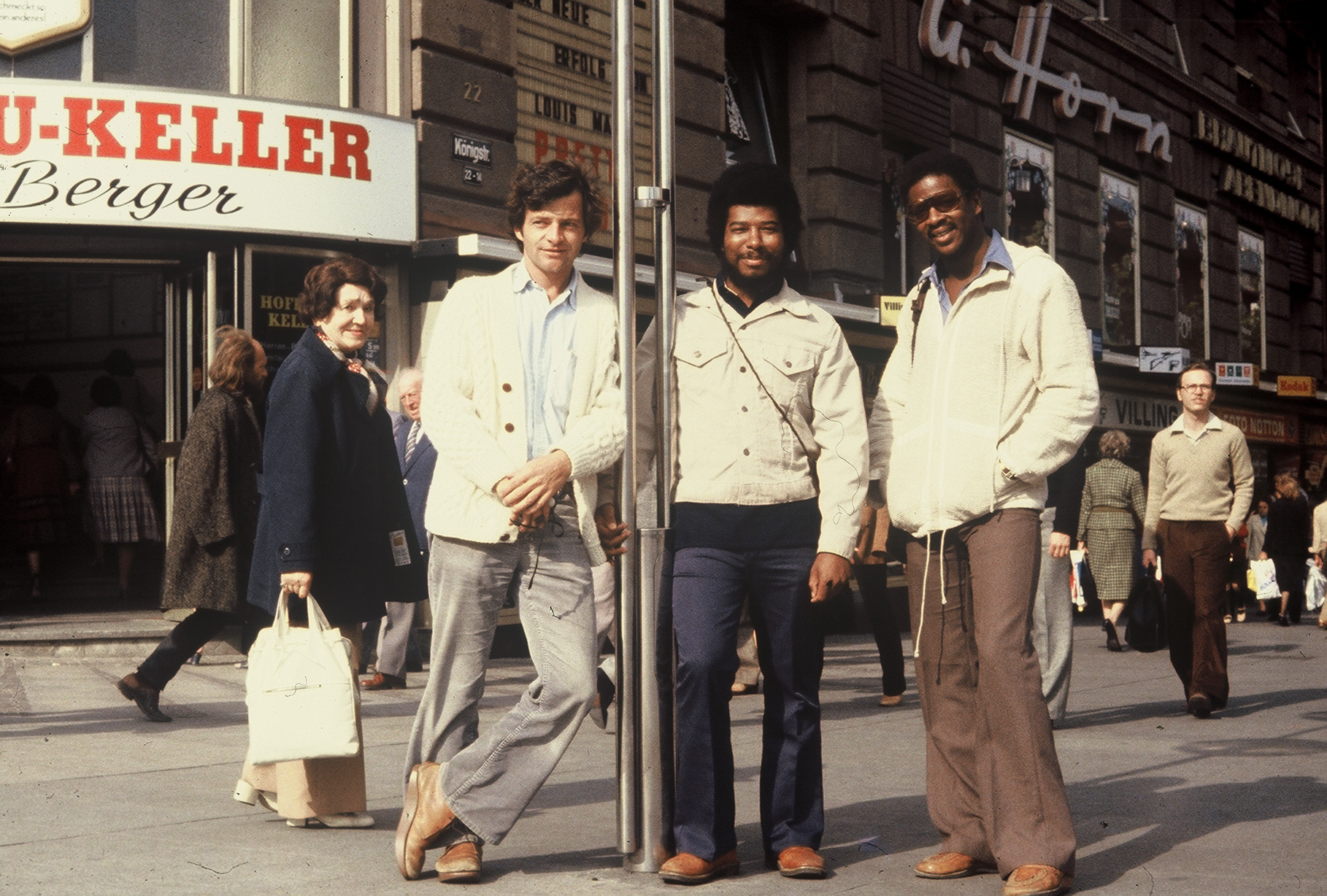
Everyman Band
(Photo by Ralph Quinke)

This album is an all-around solid effort brimming with guttural, after-midnight sounds that are iconic of the very era they tear to shreds. The band’s style is both distant and in our faces. The group shot on the back of LP jacket says it all: a relatively clear foreground lights the naked streets against an impossibly distorted backdrop in a single instantaneous image.

<< Chick Corea: Trio Music (ECM 1232/33)
>> Hajo Weber/Ulrich Ingenbold: Winterreise (ECM 1235)

Goodhew/Jensen/Knapp: First Avenue (ECM 1194)

ECM 1194

First Avenue

Denney Goodhew alto saxophone, flute, bass clarinet
Eric Jensen cello
James Knapp trumpet, fluegelhorn, waterphone
Recorded November 1980 at Tonstudio Bauer, Ludwigsburg
Engineer: Martin Wieland
Produced by Manfred Eicher

“Our procedure is to simply begin.”
–James Knapp

Bringing together reedman Denney Goodhew, cellist Eric Jensen, and horn player James Knapp, First Avenue is a ghostly outlier in the ECM backlist. The project germinated within the American Contemporary Dance Company, which paired spontaneous incidental music with indeterminate movement on stage. As the trio began to branch out and perform as a group, they soon made their way into the studio for this enigmatic session. The pieces have no titles outside of “Band One,” “Band Two,” etc., and perhaps anything more would only be a distraction.

The haunting cries of a waterphone make their first of two appearances on the label (the other courtesy of Marilyn Mazur on Elixir) by way of introduction. From this, we encounter a spacious flowering of alto sax, cello, and horn, sounding much like a Gavin Bryars ensemble piece in its developmental arc. Some tracks (Bands Two and Seven) employ an echo effect which, though dated, is put to utmost creative use here, swirling into a spiral in which the original utterance ceases to exist. Band Three boasts as many overdubbed cellos in a clustered, reactive agitation, while Five is a beautiful piece for two overdubbed saxophones. The latter’s chromatic and lively syncopation make for a most engaging interlude to the overall denser flow. Band Four is more playful, yet somehow regretful, feeling like the soundtrack to a mental breakdown, Darren Aronofsky-style—each hiccup from the cello another pill popped, each horn blast another memory compromised.

Loops and delays abound in the album’s second half. Band Six paints a particularly fluid image of fluted beginnings and muted menageries. Bass clarinet and fluegelhorn bleed darker hues into a cello’s growls and other subterranean minutiae. Each ascendant line drapes its shadow from a barely visible line in a modest exhibition of pellucid musicianship and seamless changes of register. The echoed sax in Band Eight almost sounds as if it were being played backward as undulating cello lines keep it airborne. Abandon builds to stratospheric heights before fading in a final dissolve.

These are supremely harmonic, spacious improvisations that ply the ear with questions that are their own answers. This is intimate, far-reaching, and supremely accessible music drawn from a synergistic wellspring of talent. A more than pleasant surprise as yet unburned in CD form.

<< Surman/DeJohnette: The Amazing Adventures Of Simon Simon (ECM 1193)
>> Shankar: Who’s To Know (ECM 1195)

Heinz Holliger: Violinkonzert (ECM New Series 1890)


Heinz Holliger
Violinkonzert

Thomas Zehetmair violin
SWR Sinfonieorchester Baden-Baden und Freiburg
Heinz Holliger conductor
Ysaÿe
Recorded September 2002, Propstei St. Gerold
Engineer: Stephan Schellmann
Produced by Manfred Eicher
Holliger
Recorded December 2002, Konzerthaus Freiburg
Engineers: Helmut Hanusch and Ute Hesse
Co-production of ECM Records/Südwestrundfunk

The work of Swiss painter Louis Soutter (1871-1942) might have been forgotten were it for the efforts of such artists as Julian Schnabel and Arnulf Rainer, who cite him as a vital influence not only in their own creative lives, but also in the development of modern art at large. With this captivating ECM recording, composer Heinz Holliger pulls that thread just a little farther into the realm of the orchestra. His homage to the artist comes in the form of a Violin Concerto, which bears additional dedication to its performer here, Thomas Zehetmair. The concerto came to being when the composer was commissioned to write a commemorative piece for the 75th birthday of the Orchestre de la Suisse Romande. Once he discovered that Soutter had once been a violinist of the same entity, he needed no further impetus to evoke the artist’s already musical visuality. Holliger penned the concerto in three parts between 1993 and 1995, but later added a 17-minute “Epilogue” based on Soutter’s painting Before the Massacre. In this, Holliger swallows the soloist whole in favor of selfless anti-climax.

Holliger develops, as he is wont to, this sprawling work as if from a single droplet. With its ripple now audible, he combines reflections through which the exigencies of a single art are recast in the color schemes of private exhibition. The soloist, then, becomes a tattered traveler, a weary guide whose footsteps might very well continue to lead us on the right path even in the absence of a body to give them weight and signal. As the instrumentation becomes more self-aware, it conforms to the forces of language. Like a piece of silk surrendered to the wind it takes on the shapes of those forces. It is a sidelong glance, a skewed haunt in dissonant twilight, a ray of light in the trees where there is nothing else to see. The forest folds in on its heart, gnarled and rotting from the inside like a termite-infested house. Yet a certain peace also flows in those veins, something that captures and holds on to the light as nothing else can. Even at the densest moments the instruments sound vitally present as they fractal around the violin’s profoundly internal tracings. Starlight seems to glow from its F holes while in dialogue with hammered dulcimer and a bevy of percussion. It falls at the edge of dawn, spitting fire even as it speaks in ice, dotting the sky with flashes of supernovae, each the size of a pin’s head poked through the backcloth of a swooning catharsis (should the patient reader need a less uncertain comparison, think Berio’s Voci). It is a looming and gravid entity, one furiously alive even as it drains itself backwards into a high-pitched flight, joining a flock of microscopic kin into a universe where the wind rules in silence.

Following Holliger, who says of his Soutter variations, “I make no attempt to translate his painting into music: going out from it, I try to realize a ritual of annihilation,” we cannot simply open the concerto like a music box whose only melody is the cover painting. His is an ode to and of shadows, a gallery of emotional perforations, voices, and obsessions drawn in slow-motion charcoal, then burned to make more. The moment we avert our eyes and ears is when the music begins speaking to us…

Reflecting on Soutter’s life, the last 20 years of which were spent in a mental hospital, we may find ourselves wondering what moved him as a youth before his mind splashed its discoveries of erosion across the page. In the “Ballade” from Eugène Ysaÿe’s op. 27 Sonata for solo violin, which begins the album, we hear that youth epitomized. Its scintillating energy is made all the more visceral for Zehetmair’s flawless diction (a preview of things soon to come), by which he renders a virtuosic bumblebee’s flight (Rimsky-Korsakov need not apply) toward a fury of an ending. Again, the choice is calculated, for Soutter studied with Ysaÿe before replacing bow with brush, music with pigment and sweat. And though the sweat has long evaporated into overcast skies, the pigment remains, an open wound that smells of sound.

Paul Giger: Alpstein (ECM 1426)

1426

Paul Giger
Alpstein

Paul Giger violin
Jan Garbarek tenor saxophone
Pierre Favre percussion
Musicians from Appenzell (Switzerland) silvesterchlauseschuppel, schellenschötter
Recorded 1990/91 at Rainbow Studio, Oslo; 1990 at Trogen
Engineer: Jan Erik Kongshaug
Produced by Manfred Eicher

The first time I heard Swiss violinist Paul Giger, my soul might well have wept. His is a spiritualism beyond the trappings of human politics, a stage populated by human-animal hybrids, faceless musicians, and dancers of many forms. For this, his follow-up album, Giger is joined by saxophonist Jan Garbarek and percussionist Pierre Favre in a sonic portrait of his homeland. Delving into living folk traditions, this trio gives us as wintry a feeling as possible without ever stepping foot in into the Alps. Yet this is no mere sonic postcard, but a concerted effort to flip the land inside out and expose, as from under the logs we overturned as children, the life teeming within.

Anita's Alpstein
(Photo credit: Anita Brechbühl)

This music came into my life when I still had a violin in my hands. At the time, I was struggling with the idea of expressing my inner voice through an external instrument. Hearing Giger showed me it was possible, and this album’s second piece, Karma Shadub (Dancing Star), is something I played quite often in my ultimately futile attempts to emulate a sound that was beyond me. I even performed it once with an interpretive dancer at a high school assembly. Though the violin soon faded from my grasp, I remain ever in its shadow, a humble and open listener of its masters, of which Giger is a nonpareil example. Every dissolve of Karma reveals new visual combinations, each so rudimentary, so fundamentally alive. Garbarek’s throaty call dovetails with Giger’s in a symbiosis of dance and darkness. Alpsegen introduces the album’s first percussive colors. A caravan of metallic nomads, ranging from tambura to cymbals, processes across an ever-widening sound palette. Cowbells recede like ancestors as Giger leaps in evolutionary pirouettes. On Chuereihe, Garbarek revisits the herding calls that enthralled on Dansere, and climbs the peaks into which the cover photography beckons us. Giger’s violin here is sometimes insectile, sometimes onomatopoetic, but always anchored by Favre’s deepening drums. Chlauseschuppel gives us a taste of the Appenzeller bells, rung at the end of every year to ward off foul spirits as the new one is welcomed.

Silvesterchläuse by Vera Rüttimann
(Photo credit: Vera Rüttimann)

When I first heard Trogener Chilbiläbe, which closes the disc, its backdrop of urban sounds led me to believe it had been recorded in a church with the door flung open. Its inspiring solo cycles of fast runs and soaring meditations end with a slam, as if shutting out the noise of the outside world. Only later did I discover that the door in question belongs to a prison cell, and that the piece was recorded in the jail where Giger must serve out a few days of each year for refusing to pay military tax. As insightful as these biographical minutiae are, it is the Zäuerli, a haunting yodel particular to the Alpstein region making three appearances here, that is the album’s lifeblood. In order to evoke its polyphonic splendor via a single instrument, Giger taps his fingers on open strings, eliciting harmonics from within. These hidden voices are his aesthetic soil. As we come to be wrapped in their atmospheric blankets, we are awakened even as we slumber.

Alpstein is a cosmic alignment. Like all of the violinist’s albums, it is markedly different from the rest but digs just as deeply. Giger may not always look to the same future, but he does draw from the same mythic past. His playing is only one step removed from breath, for every stroke of the bow enriches the universe like air to a lung.

<< Kim Kashkashian: Shostakovich/Chihara/Bouchard (ECM 1425 NS)
>> Stephan Micus: Darkness And Light (ECM 1427)

2010 in review

The stats helper monkeys at WordPress.com mulled over how this blog did in 2010, and here’s a high level summary of its overall blog health:

Healthy blog!

The Blog-Health-o-Meter™ reads Wow.

Crunchy numbers

Featured image

About 3 million people visit the Taj Mahal every year. This blog was viewed about 25,000 times in 2010. If it were the Taj Mahal, it would take about 3 days for that many people to see it.


In 2010, there were 247 new posts, not bad for the first year! There were 387 pictures uploaded, taking up a total of 52mb. That’s about 1 pictures per day.

The busiest day of the year was December 26th with 284 views. The most popular post that day was By Catalogue #.

Where did they come from?

The top referring sites in 2010 were orgyinrhythm.blogspot.com, speakeasy.jazzcorner.com, en.wikipedia.org, ecmrecords.com, and dougpayne.blogspot.com.

Some visitors came searching, mostly for ecm new series, paul bley ballads, ecm reviews, ecm records blog, and just music ecm.

Attractions in 2010

These are the posts and pages that got the most views in 2010.

1

By Catalogue # October 2010
1 comment

2

ECM Videos May 2010
5 comments

3

Artists February 2010
1 comment

4

Guest Reviews February 2010
95 comments

5

Jasmine (ECM 2165) May 2010

Giya Kancheli: Magnum Ignotum (ECM New Series 1669)

Giya Kancheli
Magnum Ignotum

Mstislav Rostropovich cello
Royal Flanders Philharmonic Orchestra
Jansug Kakhidze conductor
Recorded December 1997
Produced by Manfred Eicher

Said Mstislav Rostropovich, to whom the opening work of this album is dedicated, of his longtime friend, “His natural element is the deepest mystical sorrow. Olivier Messiaen revealed for me the limitlessness and endlessness of time, and the same is true for Kancheli.” Chronological uncertainty seems to have been a core philosophy for the master cellist, whose sound grew only deeper toward the end of his life. Simi (1995) proves to be an ideal vehicle for his aging, yet ever robust sound. The title is Georgian for “string,” and indeed vibration is its universe. Pauses are left to the soloist’s discretion, and for this performance Rostropovich drew inspiration from Kancheli’s own halted style of speech. The music swirls in a crystal ball that, when occasionally shaken, snows down on a familiar motivic scene. Its imagery is stark and discomforting. A piano opens its chording like the death throes of an unfathomable organism. Brass-laden swells rupture its skin, immediately cauterized by an instrument of divine fire. Yet Simi is not without its hopeful intimations, as in the brief harmonic twinge at the 14’ mark. And while the cello’s presence dominates throughout, it is anything but the self-centered celebrant, comporting itself rather like one in mourning. That being said, the piece’s subtitle, “Joyless thoughts for violoncello and orchestra,” is something of a misnomer, for the cello also presents its own paradox: in the single performer lies the potential for multiple voices, and in the playing one finds undeniable ardor. In this instance, the cello is like a prism through which the composer’s light passes. The orchestra is no longer mere accompaniment, but an unraveling of the soloist’s heartbeat.

Magnum Ignotum (The Great Anonymous), written in 1994 for wind ensemble, double bass, and tape, has become one of Kancheli’s most widely played pieces. The response to a commission for which the composer was asked to incorporate Georgian folk music, Kancheli includes said music unmitigated, except by the technology of tape by which it is deployed. The opening recitation is of an Anchikhati priest, who seems to float above an almost funereal bassoon. Voices return in a 1930s field recording of three old men from West Georgia improvising in a haunting mezza voce called “ghighini.” Despite following a heavy orchestra piece, the modest scoring of Magnum Ignotum brings its own intensity, not least because every melodic line depends on the strength of the breath behind it. Thus invoked, the human body is unfolded through the vocal phenomenon that is the Rustavi Folk Choir, whose heartening rendition of the Trisagion hymn “Tsmindao Ghmerto” (Holy God) folds its hands to a clang of bells.

This is music concerned with its own ephemeral path, always skirting the edge of fleshly existence and the limitations upon which its life hinges. It is a candle flame holding on to its last flickers; it is also the puff of air that pulls it into smoke. An essential release from cover to disc.

<< John Holloway: Unarum fidium (ECM 1668 NS)
>> Bley/Peacock/Motian: Not Two, Not One (ECM 1670
)

Michael Mantler: Review (ECM 1813)


Michael Mantler
Review (1968-2000)

Robert Wyatt voice
Susi Hyldgaard voice, accordion
Michael Mantler trumpet
Bjarne Roupé guitar
Per Salo piano
Mona Larsen voice
Kim Kristensen piano, synthesizers
Jack Bruce voice
Per Jørgensen voice
Don Preston voice, synthesizers
John Greaves voice, bass
Karen Mantler voice, piano
Alexander Balanescu violin
Rick Fenn guitar
Marianne Faithfull voice
Nick Mason drums
Mike Stern guitar
Carla Bley piano, synthesizers, voice
Steve Swallow bass
Larry Coryell guitar
Tony Williams drums
Kevin Coyne voice
Chris Spedding guitar
Ron McClure bass
Terje Rypdal guitar
Jack DeJohnette drums
Don Cherry trumpet
Pharoah Sanders tenor saxophone
Jazz Composer´s Orchestra
London Symphony Orchestra
Balanescu Orchestra
Danish Radio Concert Orchestra
The Danish Radio Big Band
Chamber Music and Songs Ensemble
Radio Symphony Orchestra Frankfurt

Every once in a while, an album comes along that changes our view of what jazz, or any genre for that matter, can be. Review isn’t one of those albums. It’s much better.

One of contemporary music’s most accessible provocateurs, Michael Mantler is like an old friend and an enigma in one. ECM’s vital retrospective compresses over thirty years of his coal-throated sounds into a gallery of jagged diamonds. With a roster to make even the most eclectic enthusiast blush with delight, Mantler assembles a powerful resume of musical forces, intentions, artifacts, techniques, and emotional ammunition. He is the sonic equivalent of a Robert Altman or Peter Greenaway. Like the latter, he works with pictures within pictures, splashes refractions of time and place across his screens, enhances images with the written word. He makes audible the diaries of our intellectual journeys, folds every page into a paper airplane, and launches it from heights far beyond what we ever imagined as children.

From the first moments of the piano-driven, brass-infused jewel of musical concentration that is “Unsaid,” we feel the broad strokes with which Mantler paints, and the perpetual reinvention that cloaks his every move. No single mood dominates from thereon out. “Introductions,” for example, is a scrapbook of varied histories, of dislocation and dying joys, the story of a war-torn world in which home no longer remains a stable category. Against its beautiful harp-infused orchestral background, a kaleidoscope of characters airs its grievances. It’s as if one were to throw into a pot the music of Meredith Monk and Heiner Goebbels and watch what results. As this broth comes to a boil, we get a most potent whiff of unknown spices. Each instrument is its own flavor, adding a dash of autobiography to the thickening brew. This is a stunning piece, one exemplary of Mantler’s genius. “Solitudine / Lontano / L’Illuminata Rugiada / Proverbi” is a chain of laments splashing in the limpid pool of self-awareness, threading circumstance with the wave of a drunken stroll. A mournful violin lays itself down before a pause brings us to the more resolute “Speechless.” An unspoken word rolling off the tongue only when it is too late, it leads us to one of the album’s many insightful instrumental pieces. Said excerpt from “Folly Seeing All This” (1992) lifts its weight as a foot from mud, with no other choice but to step down and repeat the process. “Movie Two” (1977) is another magnificent incident, marked by nimble drumming from Tony Williams, heading a tight rhythm section beneath a crunchy guitar solo from Larry Coryell, not to mention Mantler’s own vividly imaginary trumpeting. A few briefer interludes make their voiceless presences known. “Love Ends (excerpt),” a bittersweet duet for clarinet and piano, is a memory one can’t quite picture. A treat from the unpretentiously titled “Alien” (1985) sports the nostalgic synths of Mothers of Invention keyboardist Don Preston. “Twenty” brims with the youth of its eponymous age. It acerbic electric guitar and heavy bass almost tumble over one another in their search for gold. But then there is “One Symphony” (1998), from which he hear but one fascinating orchestral snippet. Characterized by vibrant energy and mallet-heavy percussion, its jaunty instrumentation titillates at an intersection of the bowed, the blown, and the struck. Echoing pizzicato strings transcend the music’s outer barriers, puncturing its paper-like firmament with simulacra of starlight. “Preview” (1968) is another bundle of archival explosives. Its incendiary tenor sax solo, courtesy of the legendary Pharoah Sanders, runs amok, incurring not a few brass concussions along the way. And as the drums bubble from the earth around him like a latent volcano, Sanders astonishes with the intensity of his (in)difference.

Of all the vocal talent represented here, Robert Wyatt is foremost. His incautious duet with Susi Hyldgaard in “I’m glad you’re glad” is its own wonder. Here, a relationship’s self-reflexivity is thrown in its protagonists’ faces with veiled exclamations of happiness and return. Wyatt reads from Harold Pinter’s play Silence in “Sometimes I See People” (1976), twisting morose obsessions with social growth and fallacies of identity twist into a complicated braid. Another effective reading, this time run through a flange, in “The Sinking Spell” (from Mantler’s 1975/76 The Hapless Child) offers an Edward Gorey tale to the morbid believer in all of us. Its terrestrial charm, set aloft by flights on electric guitar, slingshots its sentiments across the universe toward vocal ends. Backed by none other than Carla Bley, Terje Rypdal, Jack DeJonette, and Steve Swallow, Wyatt stretches until he leaves his own nebular mark in the evening sky. A trio of miniatures—“PSS,” an excerpt from “Comrade,” and “A l’Abattoir”—featuring the voice of Marianne Faithfull makes for some further incisive dramaturgy. Behind a thinly processed veneer, each is a micro-opera of galactic proportions. Jack Bruce lays down his own heavy tracks with the words of Samuel Beckett in “Number Six – Part Four” (1973), in which he is paired with trumpeter Don Cherry. Finally, the lilting strings that introduce “It makes no difference to me” fade into their reverberant chamber behind indecisive voices, wandering in the confusion of split paths like the accordion that continues their journey when they fall silent. A love for recitative underscores these narratively minded pieces in brightest neon.

The real meta-statement, however, lies in “Understanding.” A piece about and of transition, it achieves its resolution through the fallibility of the utterance and its audio redeployment. It is a Tower of Babel laid on its side and spread thin into an auditory crepe. Mantler manages to be both cinematic and literary here, further skirting an undefined space between the two. As a translator myself, I feel this piece reaches for my heart like no other.

Mantler is a musical treasure, a singular voice comprised of many. His is not music that simply speaks to the listener, but music that speaks and listens to itself.

Henri Dutilleux: D’ombre et de silence (ECM New Series 2105)


Henri Dutilleux
D’ombre et de silence

Robert Levin piano
Ya-Fei Chuang piano
Recorded December 2008, Auditorio Radio Svizzera, Lugano
Engineer: Markus Heiland
Produced by Manfred Eicher

The music of Henri Dutilleux, now approaching his 95th year, has been sadly dwarfed by that of Ravel and Debussy, among whom he is often the third wheel in categorical groupings of modern French music. Represented only cursorily on ECM thus far (12 Hommages A Paul Sacher), he at last receives a treatment that is as meticulous as he is. Pianist Robert Levin first met Dutilleux during a 1979 residency at Nadia Boulanger’s Conservatoire Américain at Fontainebleau, since which time the two have maintained close friendship. When producer Manfred Eicher bid Levin (familiar to label listeners as violist Kim Kashkashian’s go-to accompanist) to record a solo recital, Dutilleux’s name emerged early in discussions, though the material needed to be concert tested and approved before the studio would be graced with its bracing refractions.

The Petit air à dormir debout (1981), which begins the disc, is the first of a handful of pieces written for children. Others include 1950’s charming Blackbird and the pensive Tous les chemins… mènent à Rome of 1961, each a pocket of halting lyricism from which both composer and performer lift handfuls of stardust before committing fingers to keys. We see that every note has its place as the galaxy of the programming begins to take shape. The Sonata (1946-48) that anchor’s the disc’s first half is the composer’s Opus 1. It is also a masterstroke of compositional acuity. Every nuance leaps off the page, not least because of Levin’s supremely fluid gestures, as if self-aware. Though one of the composer’s most widely known works, it bristles with fleeting handles of articulation, none of which ever quite holds its shape long enough to be grasped. Dutilleux adds sharp edges to these potentially impressionistic reveries, making them all the more delicate to handle.

Intended as interludes for radio broadcasts, the “Prélude en berceuse” and “Improvisation” from Au gré des ondes (1946), reprised at the album’s conclusion in their completed context, sound like bagatelles from the afterlife. One can almost hear the static that might have surrounded their original appearance. Like Blackbird, Résonances (1965) quickly skitters through Messiaen’s shadow before stumbling over its own light. This is followed by a counterpart of sorts in the form of Figures de résonances (1970/76), for which Levin is joined by wife Ya-Fei Chuang. The two play as one, passionate allies of the melodic thread that binds them. The final section feels like an echo in the ribcage, its strength waning with every heaving breath. Two more fleeting statements, Mini-prélude en éventail (1987) and Bergerie (1946) embrace a triptych of preludes. More like an overcooked pastry than a sandwich, its outer layers flake off at the slightest touch while the center awaits its first tongue to burn. Levin saves the best for last, laying the nostalgia on thick with an homage to Bach and the enthralling Etude that is its partner.

These works are, as Levin stresses in his more than insightful notes, conceived and written “molecule by molecule.” Not only is this music that follows no footsteps, but music that would rather not leave any at all. Levin touchingly dedicates this recording to the memory of Dutilleux’s wife, Geneviève Joy, who passed on just before its final production. An accomplished performer, Geneviève’s own interpretations of her husband’s music, in Levin’s estimation, “provide the lodestar to all of us who seek to follow in her footsteps.” If these performances are any indication, hers must have been downright otherworldly.

Alfred Schnittke/Dmitri Shostakovich: Lento (ECM New Series 1755)

Lento

Keller Quartett
András Keller violin
János Pilz violin
Zoltán Gál viola
Judit Szabó violoncello
Alexei Lubimov piano
Recorded June 2000
Engineer: Peter Laenger
Produced by Manfred Eicher

The Piano Quintet of Alfred Schnittke (1934-1998) begins where many chamber works might end: with the closing of eyes. It is behind these lids, the shadowy backdrops of which form the projection screen of our deepest mortalities, that the music remains. Even the Waltz of the second movement is a doppelgänger, its higher strings haunting the periphery like an epidemic. Such profound banalities are what make this a harrowing, if somnambulate, work. The piano’s role is very much subdued, providing regularity where there is none to be had. Rarely proclamatory, it reveals its deepest secrets when, at the end of the Andante, the sustain pedal is depressed merely for its metronomic effect in want of note value. The album takes its title from the fourth movement, a viscous, writhing creature that never shows its face. After enduring so many scars, the final Moderato tiptoes ever so gracefully around the fallen shards, gathering from each a snatch of light—just enough for a handful.

Schnittke very much admired the late works of Dmitri Shostakovich (1906-1975), of which the String Quartet No. 15, op. 144 cuts deepest. Completed in 1974, two years before Schnittke’s quintet, Shostakovich’s last quartet of a planned 24 consists of six almost seamless Adagios. At 37 minutes, it is the longest of his quartets, if not also the most ponderous. A few shocks interrupt us, as the forced pizzicati of the Serenade, but otherwise we are lulled in the deepening shade of a wilted tree that sways as it ever did at the hands of an unseen breeze. Ironically, the Nocturne provides the earliest intimations of sunrise, throughout which the cello smiles through its tears. A bitter smile, to be sure, but an unforgettable change of expression in the music’s otherwise tense features. We are allowed a single breath before the Funeral March that follows. A tough lyricism pervades, as in cello’s repeat soliloquies, all of which primes us for the cathartic Epilogue, in which is to be had a forgotten treasure, a time capsule buried in childhood and only now unearthed.

Although this is an album drawn in morbidity—Schnittke’s quintet finds its genesis in the death of the composer’s mother, while Shostakovich’s quartet premiered months before his own—it is supremely life-affirming, each work a breathing testament to indomitable creativities. The Keller Quartett, joined by Alexei Lubimov for the Schnittke, lay themselves bare at every turn, wrenching out by far the most selfless performances thus far recorded of this complementary pair.

<< Kim Kashkashian: Hayren (ECM 1754 NS)
>> Joseph Haydn: The Seven Words (
ECM 1756 NS)