Gary Burton: Seven Songs For Quartet And Chamber Orchestra (ECM 1040)

1040 X

Gary Burton
Seven Songs For Quartet And Chamber Orchestra

Gary Burton vibraharp
Michael Goodrick guitar
Steve Swallow bass
Ted Seibs drums
NDR-Symphony Orchestra
Michael Gibbs conductor
Recorded December 1973 in Hamburg
Engineer: H. Ruete
Produced by Manfred Eicher

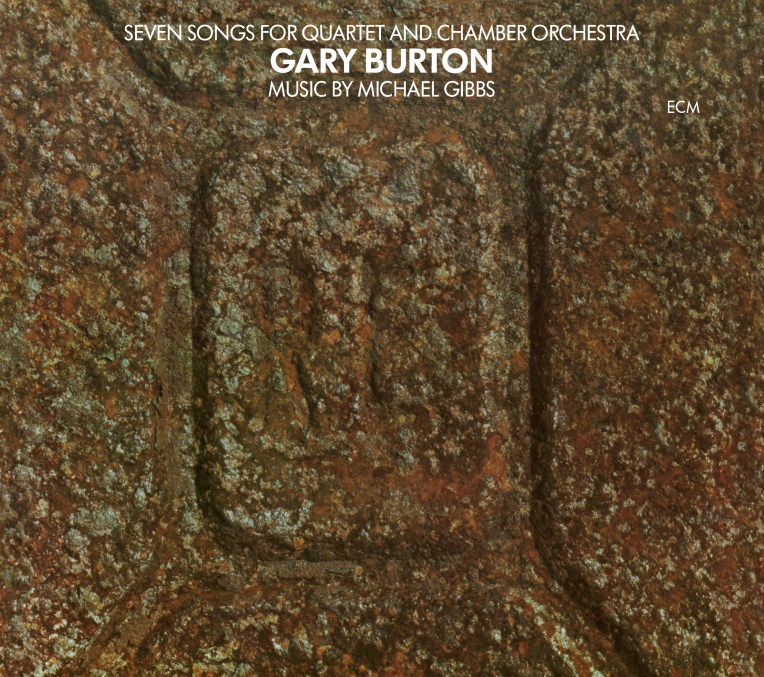
If one were to draw a line between the ensemble aesthetics of Eberhard Weber and Keith Jarrett, then one might plot the compositions of orchestral jazz legend Mike Gibbs somewhere along the way. Born in 1937 in what was then Southern Rhodesia, and a graduate of Boston’s Berklee College of Music, Gibbs has laid down a musical path as diverse as his travels. On Seven Songs for Chamber Orchestra, one gains vision of a mind looking not so much to cross over into uncharted waters as to expand the inclusivity of jazz’s already broad topography. At the heart of this project is Gibbs’s most famous student, the inimitable Gary Burton, who presents a lovingly realized program of his mentor’s own design. “Nocturne Vulgaire” sets the album’s plaintive tone with a groundswell of strings, into which Burton drops his mercurial sound. This delicate blend of mallets and bows continues unabated in “Arise, Her Eyes” (Steve Swallow), the only non-Gibbs number on the album. Mick Goodrick’s steady strums and Ted Seibs’s cymbal-heavy drumming make the most of the tender “Throb,” as Burton’s vibes glow like phosphorescent blood in the piece’s ambulatory body. “By Way Of A Preface” spins the album’s densest song. Its abstract beginnings carry over into a gorgeously perpetual solo from Goodrick, while Swallow makes his memorable mark in the pensive confines of “Phases.” The vast open fields that underlie “The Rain Before It Falls” give way to the chromatic wonders of “Three,” in which Burton and Goodrick’s relays emerge with all the inevitability of a final word.

This is a dream album for admirers of both Burton and Weber, combining as it does the former’s dulcet precision and the latter’s lush arrangements, and is therefore well worth tracking down (a CD-reissue is long overdue). Burton’s ability to carry a tune to fruition is only enhanced by Gibbs’s affected settings, which hardly make a dent in their emotional reserves. If jazz is about discovering the integrity of every lifted voice, then certainly Seven Songs rises from its murky waters with just a few of many unheard treasures.

<< Dave Liebman: Lookout Farm (ECM 1039)
>> Jan Garbarek: Witchi-Tai-To (ECM 1041)

Dave Liebman: Lookout Farm (ECM 1039)

ECM 1039

Dave Liebman
Lookout Farm

Dave Liebman soprano, tenor saxes, alto c flute
Richard Beirach electric, acoustic piano
Frank Tusa electric, acoustic bass
Jeff Williams drums
John Abercrombie acoustic, electric guitar
Armen Halburian percussion
Don Alias congas, bongos
Badal Roy tablas
Steve Sattan tamburine, cowbell
Eleana Sternberg voice
Recorded October 10/11, 1973 at Generation Sound Studios
Engineer: Tony May
Produced by Manfred Eicher

Saxophonist, flutist, and all-around wunderkind Dave Liebman—who only last year received an NEA Jazz Masters lifetime achievement award for his tireless efforts in music and instruction—made his ECM debut with Lookout Farm, his first of only two albums for producer Manfred Eicher as leader (the other being the enthralling Drum Ode; he would also guest on Steve Swallow’s Home some six years later) and a trendsetter for fledgling improvisers seeking their voices in the seventies and beyond. Here, he is joined by a telepathic ensemble that includes regulars Richie Beirach and John Abercrombie, in addition to a pointed percussion section. Abercrombie’s quasi-flamenco arpeggios open the evocative “Pablo’s Story.” Liebman leads in on flute, establishing an intimate flywheel from which is spun a most democratic mosaic of intersections, solos, and rhythmic ecstasy. Liebman (switching to soprano sax) and Beirach provide the skeleton of the track’s flexible physiology. An intuitive pattern of tension and release ensues, thus maintaining a solid unity throughout. Frank Tusa’s understated yet richly emotive bass lines bring out a vital inner depth, and one can hardly remain static during the hand-drummed interlude. “Sam’s Float” introduces a more hardened sound, cut to the core by Leibman’s alto squeals and Abercrombie’s biting electricity. The 24-minute “M.D./Lookout Farm” closes this humble set of three. The first half turns down the lights with its elegiac piano and tender reeds, while the title half transports us with Jeff Williams’s downright flammable drumming.

A spectacular sense of curiosity would seem to be de rigueur in Liebman territory, its infectiousness inescapable. This is a milestone album, not only for the liberating musicianship and timeless sounds, but also for its production value. With Lookout Farm, Eicher channeled the reverberant specter that has haunted the label’s sound ever since, and with it an entirely new way of listening emerged.

A pilgrimage for the ECM enthusiast.

<< Art Lande/Jan Garbarek: Red Lanta (ECM 1038)
>> Gary Burton: Seven Songs For Quartet And Chamber Orchestra (ECM 1040)

Terje Rypdal: What Comes After (ECM 1031)

ECM 1031

Terje Rypdal
What Comes After

Terje Rypdal guitars, flute
Barre Phillips basses
Jon Christensen percussion, organ
Erik Niord Larsen oboe, English horn
Sveinung Hovensjø electric bass
Recorded August 7/8, 1973 at Arne Bendiksen Studio, Oslo
Engineer: Jan Erik Kongshaug
Produced by Manfred Eicher

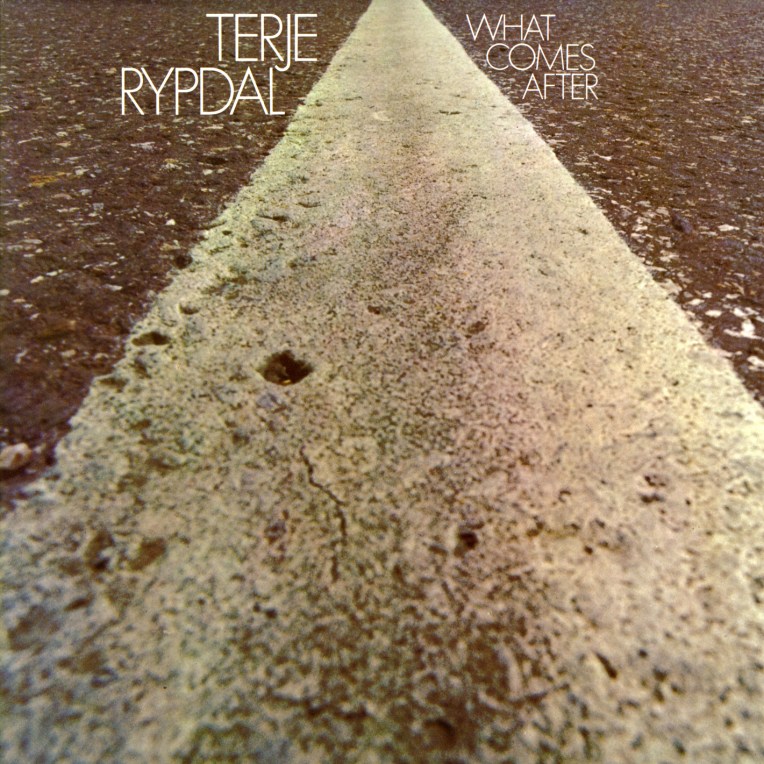
Terje Rypdal’s What Comes After, his second for ECM as frontman, is more about what came before. An exquisite diversion from the dustier billows of his later work, it charts much of the same territory as its self-titled predecessor, only this time with a tighter supporting roster. Sveinung Hovensjø lays down the dominant bass line that is “Bend It,” an atmospheric 10-minute opener that lulls us into its nocturnal crawl. The bowed bass of Barre Phillips and Jon Christensen’s subtle drum work adorn long-form improvisations from Rypdal as he wrenches out an ever-changing dialogue from the repetitive core. “Yearning” reprises the sinewy oboe (played here by Erik Niord Larsen) of Rypdal’s self-titled effort and features him in a rare acoustic turn. The jangly percussion makes for a mystical, if all too brief, experience. The see-sawing melodies and tender bass solo of “Icing” extend this feeling of isolation and memory before the delicate rimshot of the title track slinks metronomically through Rypdal’s mounting ruminations. “Séjours” marks the oboe’s standout return in one of the album’s most thoroughly realized tracks, while “Back Of J.” leaves us with a sparse final word, Rypdal unplugged and unhurried.

Albums like this allow us to appreciate the ways in which artists grow. ECM’s consummate electric guitarist has worn many hats, and perhaps none so many as in his formative years. Here, he feeds off his surroundings, even as he strays in equally fruitful directions, always harboring an innate awareness of where he is grounded. A wonderful place to start for initiates and strangers alike.

<< Gary Burton: The New Quartet (ECM 1030)
>> Ralph Towner: Diary (ECM 1032)

Jan Garbarek: Triptykon (ECM 1029)

ECM 1029

Jan Garbrek
Triptykon

Jan Garbarek soprano, tenor and bass saxophones, flute
Arild Andersen bass
Edward Vesala percussion
Recorded November 8, 1972 at Arne Bendiksen Studio, Oslo
Engineer: Jan Erik Kongshaug
Produced by Manfred Eicher

Jan Garbarek’s third album for ECM is a free, though by no means easy, trek through indeterminate territories. “Rim” breaks into light with the mournful saxophonic cries that thread the entire set. Arild Andersen dots Garbarek’s auditory cloth with almost vocal ink stains. We find Garbarek in a uniquely agitated mode, showing both great restraint and willful shifting in his performance. This is an arresting track, as sublimely depressing as it is soulful. The title denotes “frost” in Norwegian, and describes Edward Vesala’s icy percussion to a T. In “Selje,” Garbarek opts for a wooden flute against a thawed backdrop of bass and wind chime-like glockenspiel: a mystical aside to an otherwise forward projection.

“J.E.V.” breaks from the album’s expansive palette with a more flatly recorded sax intro. The appearance of bass and drums merely underlines the music’s hesitancy, at once assured and unaware of its future paths. “Sang” (Chant) is another subdued interlude, featuring a bass sax caught in a silken web of percussion and bass. The title track unravels like a herding song picked apart piece by piece, its remnants scattered along the base of a low mountain to the tune of an intriguing bass solo. “Etu Hei!” screeches and pounds its way into being before the Norwegian folk song “Bruremarsj” is rendered in a tense bondage of sax and bowed bass, closing with a flutter of wing beats in the final drum break.

In spite of its many abstractions, Triptykon is rife with melody and movement. It’s almost as if a distant relative were singing traditional tunes that everyone else in the family has forgotten. Though drunk with nostalgia and slurred speech, his voice is so genuine that one can hardly fault him for straying a bit off the beaten path. With repeated listenings, one begins to distinguish such thematic material from its improvised surroundings, thereby rendering any challenges this album sets before us much deeper in their returns.

<< Paul Motian: Conception Vessel (ECM 1028)
>> Gary Burton: The New Quartet (ECM 1030)

Ralph Towner with Glen Moore: Trios/Solos (ECM 1025)

ECM 1025

Ralph Towner with Glen Moore
Trios/Solos

Ralph Towner guitar, piano
Glen Moore bass
Paul McCandless oboe
Collin Walcott tabla
Recorded November 27/28, 1972 at Sound Ideas Studio, New York City
Engineer: George Klabin
Produced by Manfred Eicher

Essentially an Oregon album under a different name, Trios/Solos consists mainly of Ralph Towner originals culled from the group’s Vanguard sessions. The opening “Brujo” is anchored by Towner’s twelve mighty strings and the late Collin Walcott’s tabla stylings, leaving a winding crevice through which Glen Moore works his whimsical bass. “Noctuary” features Paul McCandless on oboe, soaring loosely through the Towner/Moore fulcrum before the trio ties itself into a tightly improvised not. The Bill Evans tune “Re: Person I Knew” stands out in a gorgeous rendition. Towner doubles on piano and 12-string—laying down a sound that would soon crystallize into his classic ECM album Solstice—as Moore lurks in the background. “Raven’s Wood” continues the same configuration, only this time with nylon, darkening its pastoral modality with nocturnal visions.

Despite the intimate wonders of these trios, the album’s titular solos abound with some of its most focused and furthest-reaching moments. Moore’s “A Belt Of Asteroids” is a curious one at that. Seeming at first out of place in its present company, it carefully peels open the album’s outer layers with every twang. The remainders feature Towner doing what he does best. Take the compact “Suite: 3×12,” a carefully thought out composition in which his palpable picking and love for harmonics shines through at every turn, not to mention his consistently progressive energy. The last of the three movements is more aggressive in its attack and wound around a precise rhythmic core. “Winter Light” is heavily steeped in 6-string nostalgia, lonely but content in its solitude. “1×12” is, by contrast, a run along a blazing trail. Lastly, we have “Reach Me, Friend,” a snapshot of expectation that breathes with audible resolve.

As the driving force behind the album, Towner’s technique is mellifluous as usual, forging an aerial sound that constantly surveys the untouched lakes shimmering below like mirrors in the brilliance of his execution. Despite the lush performances throughout, the imagery is all so viscerally sere. And while there is no danger in what we see, there remains a threat unseen, lingering just beyond the horizon, quelled only by the arrival of the morning sun.

<< Gary Burton/Chick Corea: Crystal Silence (ECM 1024)
>> Stanley Cowell Trio: Illusion Suite (ECM 1026)

Keith Jarrett/Jack DeJohnette: Ruta and Daitya (ECM 1021)

ECM 1021

Keith Jarrett and Jack DeJohnette
Ruta and Daitya

Keith Jarrett piano, electric piano, organ, flute
Jack DeJohnette drums, percussion
Recorded May 1971 at Sunset Studios, Los Angeles
Engineers: Rapp/Wieland
Produced by Manfred Eicher

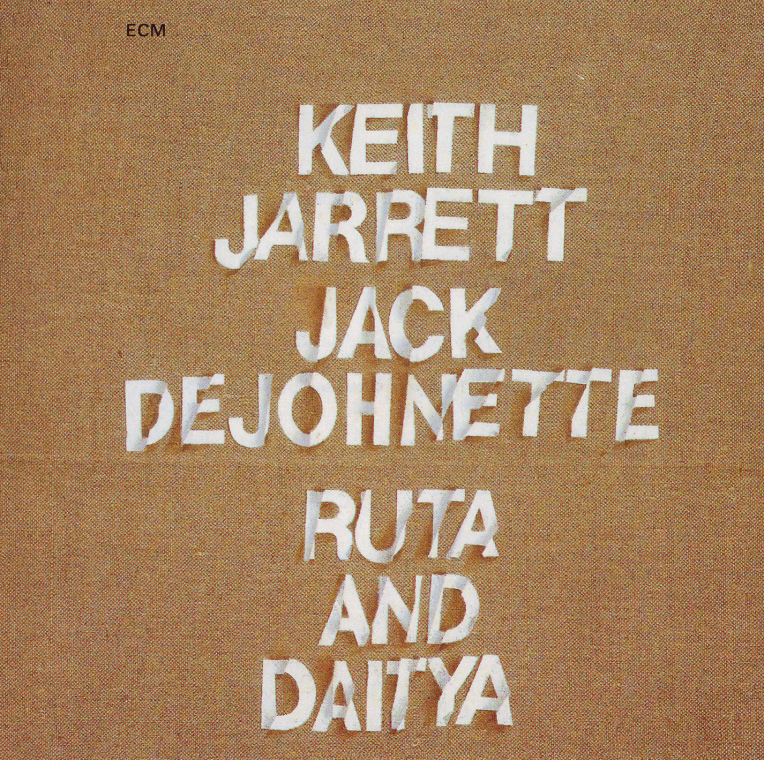
Keith Jarrett and Jack DeJohnette, who continue their formidable partnership to this day, join forces for an early and unique collaboration. This being the tail end of Jarrett’s electric period with Miles Davis, Ruta and Daitya marks an archivally important transition into his imminent acoustic pilgrimages. “Overture Communion” captures our attention from the start with a funky, wah-wahed electric piano, warmly guiding us into the album’s exciting, yet somehow always plaintive world. The title track shakes things up with a spate of hand percussion as Jarrett flutes a more abstract improvisation than the one that began the album, though to no less captivating effect. When Jarrett abandons flute for piano, a markedly different shape brands itself into the foreground. In doing so, something gets obscured. It’s not that instruments from such seemingly disparate geographies cannot tread the same path, but simply that they don’t speak to each other as complementarily. Thankfully, Jarrett’s return to flute, this time of bamboo variety, puts us right back into the conversation. DeJohnette takes up a standard drum kit for “All We Got,” a cut that runs around in circles, even as it rouses us with its gospel-infused aesthetic. Jarrett finds himself acoustically redrawn in “Sounds of Peru.” Piano and hand drums work magically this time around as the duo hones further the groove it has been searching for. Jarrett opens up his playing, giving DeJohnette a wider berth in which to lose himself. No longer do the drums skirt the periphery, but frolic in the territory proper. There is even what amounts to a percussion solo as Jarrett coos in the background with delight, thus preparing him for an inspired passage that grinds bass notes in counterpoint to his running right hand. In “Algeria,” Jarrett sings into the flute again, leaving me to wonder why we don’t hear him on the instrument more often, though perhaps its linearity is somewhat limiting to a musician with such expansive hands (hence, his propensity for polyphonic playing). “You Know, You Know” brings us full circle to the electric piano for a more laid-back coolness before we end with “Pastel Morning,” a beautiful meditation on the electric piano. In the absence of punchy distortion, it sounds almost like a vibraphone, its gentler capacities allowed to float of their own accord.

The album’s title is a curious one, and offers at best a rather opaque X-ray of the conceptual skeleton it sheathes. Ruta and Daitya refer to two island-continents, remnants of the second cataclysm to befall the great island of Atlantis. Both were populated by races of titans, known as “Lords of the Dark Face” as a means of indicating their ties to black magic. If we are to believe Madame Blavatsky, who in her second volume of The Secret Doctrine outlines their genealogical significance in her mystical, albeit highly racialized, account of creation, the Egyptians inherited the cosmological legacy of the Ruta Atlanteans, as supposedly evidenced in the similarities of their Zodiacal beliefs. Whatever the origins, there is much to ponder in Ruta and Daitya. The sensitive pianism for which Jarrett is so renowned is in full evidence throughout, though for me his flute playing really sells the album. Jarrett proves himself more than adept and plays with an addictive sense of abandon. DeJohnette, meanwhile, enchants with a melodic approach to his kit, especially in his use of cymbals.

ECM 1021 LP
Original cover

This isn’t an album I would necessarily recommend to those just starting their Jarrett or ECM explorations. For what it is—a meeting of two consummate musical minds—its importance is a given. While perhaps not as consistently inventive as other likeminded projects (see, for example, the phenomenal Charles Lloyd/Billy Higgins effort Which Way Is East), it is certainly more hit than miss, and strikes this listener with the ambitions of its musicians’ reach every time.

<< Chick Corea: Piano Improvisations Vol. 2 (ECM 1020)
>> Chick Corea: Return To Forever (ECM 1022)

Circle: Paris Concert (ECM 1018/19)

ECM 1018_19

Circle
Paris Concert

Anthony Braxton reeds, percussion
Chick Corea piano
Dave Holland bass, cello
Barry Altschul percussion
Recorded February 21, 1971 at the Maison de l’O.R.T.F, Paris
Engineer: Jean Delron
Produced by Manfred Eicher

The short-lived Chick Corea outfit outdoes itself in this 1971 live recording. A delicate piano intro primes us for an extended rendition of Wayne Shorter’s “Nefertiti” to start. Once Braxton throws himself on top of incoming bass and drums, however, what began as contemplative awakening quickly turns into a spastic jaunt into more upbeat territory. The gnarled unity of the quartet paints in bold strokes, all the while flirting with total breakdown. Braxton’s perpetual motion and uncompromising tone make a superb tune out of a great one. “Song For The Newborn” gives Holland a moment in the spotlight. Swaddled in all the innocence of its title and bound by a mature sense of structure, this is an engaging interlude to the Braxton/Corea duet that follows. Corea’s frenetic style in the latter works its way through a host of rhythmic options before settling into a row of block chords. Braxton’s heady phrasing tears a page from the book of Coltrane, while his solitary diversions crackle with the urgency of a broken mirror, as yet unframed by the bastion of mundanity. Altschul delights in “Lookout Farm,” in which he dives headfirst into his percussive arsenal. The tinkling of icicles and cowbells in an open field give way to an extended solo, thus providing ample segue into “73 506 Kelvin 8,” a beautifully convoluted organism that could only come from the mind of Braxton. Below its cacophonous surface pulsates a vast network of instrumental veins, through which flows the passionate immediacy that is Circle’s lifeblood, and from which Holland’s rapture sings with detail and imagination. “Toy Room ­- Q&A” (Holland) boasts Corea in notably fine form, leaving plenty of elbowroom for Braxton to flex his reeds. The freer aesthetic crashes in on itself by the end, leaving us craving a familiar foothold. This, we get in the standard “No Greater Love,” capping things off with notable turns from all.

Corea busts out with some of his most captivating fingerwork, proving himself finely attuned to the mechanisms of his caravan at every rest stop along the way; Braxton’s “Pharaonic” sound titillates the ear; and one could hardly ask for a tighter rhythm section at one’s side. As a collective unit, Circle doesn’t so much make music out of as inhabit its raw melodic materials. This recording is a lasting testament to a vibrant formative period for ECM. The audience’s enthusiastic reactions give the listener the feeling of being present in the making of history.

<< Keith Jarrett: Facing You (ECM 1017)
>> Chick Corea: Piano Improvisations Vol. 2 (ECM 1020)

Barraqué: Sonate pour piano (ECM New Series 1621)

Jean Barraqué
Sonate pour piano

Herbert Henck piano
Recorded July 1996, Festburgkirsche, Frankfurt
Engineer: Andreas Neubronner
Produced by Manfred Eicher

The legacy of French composer Jean Barraqué (1928-1973) has at last been given its due berth. Pianist Herbert Henck, never one to bow out from a challenge, went through considerable efforts to annotate a viable score (a task that amounted to no less than 125 handwritten pages) from which he could extract this notoriously elusive piece. As this fine disc clearly attests, these efforts have paid off tremendously. The reputation of Barraqué’s Sonate pour Piano would seem to precede any listener’s (or performer’s) familiarity with its sounds. Composed between 1950 and 1952, it plots the multivalent trajectories of the composer’s foundational Serialism into deeper and more formidable territories. Despite the redactions to which it is often confined—namely, Pierre Boulez’s Second Piano Sonata and Beethoven’s “Hammerklavier”—any kinship therein is immediately overcast by the roiling clouds of the work’s uniquely idiosyncratic climate. Thus is his allegiance to twelve-tone rows selectively severed in favor of an approach that is at once enigmatically liminal and highly integrative, as much about erasure as it is about inscription.

The nearly 50-minute work, in two movements, finds its voice in a Pleiadean cluster, as if one were poking a pin into the balloon of the universe and notating everything that came spilling out. Through this porous barrage of galaxies, binary stars, and black holes, the music can only go where gravity bids it to go. Pianistic lows grumble with the weight of time’s inevitable progression, while highs sparkle like meteorites hitting an invisible atmosphere. What seems at first a perplexing experiment slowly fractures into its own auditory urtext. The sonata’s structure is ever unstable, discomforting, and discontented. In it, we see ourselves stripped of age and ideological concern, dropped headlong into a phantom of aberration. We encounter an increasing number of silences, which only coalesce with time into the piece’s final vacuity.

This is, presumably, not music that you will ever find humming to yourself. Rather, its melodies burrow deep into the subconscious, if not spring from it directly, lodging themselves where no other sound dares follow. Henck negotiates the technical minutiae of this piece with his usual erratic grace. He draws out individual notes with crisp punctuation, such that each emerges as a magnetic node to which the drive of surrounding tones becomes attracted. Every gesture seems to blow harder onto embers that would much rather fade, coaxing as much glow as can be had before ashes are all that is left.

<< Shostakovich/Vasks/Schnittke: Dolorosa (ECM 1620 NS)
>> Cain/Alessi/Epstein: Circa (ECM 1622
)

Michelle Makarski: Caoine (ECM New Series 1587)

Michelle Makarski
Caoine

Michelle Makarski violin
Recorded June 1995, Propstei St. Gerold
Engineer: Stephan Schellmann
Produced by Manfred Eicher

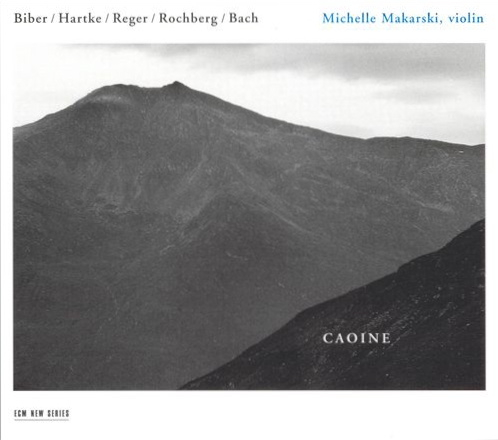
With such varied artists as Paul Giger, John Holloway, and Thomas Zehetmair vying for the violin enthusiast’s attention, ECM has revitalized the solo program perhaps more than any other label. Yet nowhere has it found such a colorful proponent of new and established repertoire alike as American musician Michelle Makarski. For Caoine, her first solitary ECM effort (she had previously appeared as soloist in Keith Jarrett’s Bridge of Light), Makarski has assembled a unique collection of music to be discovered. The program opens with the formidable “Passacaglia” of Heinrich Ignaz Franz Biber, a composition whose methods and melodies are one in the same. What seems on the surface purely etudinal breeds its own robust musicality without ever flaunting itself as such. Its ostinato of G, F, E-flat, D is repeated 65 times, each successive variation requiring deeper attention on the part of the performer. Being one of the earliest extant paragons of solo violin literature, it is perhaps the ideal meta-statement with which to begin such an album. Although the piece employs the full gamut of techniques available to the virtuoso at the time of its composition (ca. 1670), the result is solemn and rich in cosmological potency. The visceral title track is by Stephen Hartke, one of America’s most distinctive composers who has seen minimal but vital representation on ECM. The title itself (pronounced “keen,” from which the English word of the same spelling is derived) is a Celtic word referring to, in the composer’s words, the “wail or dirge sung by professional mourners in old Ireland.” Hartke’s almost folkloristic approach nestles comfortably in its surroundings. It seems to round itself into an emotive orifice, projecting its cries through funereal motions with all the tenacity of a genuine inner grief. After this catharsis, Max Reger’s “Chaconne” (1910) returns our attention to the Baroque. While blatantly indebted in Bach, Reger follows his own bold trajectory in this rather demanding piece. Makarski negotiates its many turns with just the right balance of force and finesse, not to mention an expert control of harmonics. Selections from George Rochberg’s 50 Caprice Variations (1970) pave the way to a tender performance of Bach’s first Partita (1720). The Variations speak in their own idiosyncratic vocabularies, never afraid to admonish and alleviate in the same breath. Nos. 41 and 42 stand out for me, the former for its Prokofiev-like syncopation and the latter for its high metallic sheen. These deconstructions of Paganini’s Caprice No. 24 speak directly to Rochberg’s essayistic fixations. As intertextual as they are self-negating, they comprise an homage individually wrapped in bite-sized morsels. As for the Bach, Makarski has felicitously chosen my favorite among the composer’s Sonatas and Partitas. Her performance of the captivating Allemande comes through with refined grace and rhythmic economy through to the sparingly realized finale.

What links these pieces is an appreciation of the originary motif as an aesthetic not necessarily of size, but more accurately of scale, mining the paradox of its highly expansive potential through the process of recapitulation. This is encapsulated most beautifully in the final track, in which Bach unpacks, not unlike Biber, a staggering amount of information from a mere handful of ordered gestures. Makarski’s profound recital is built as much around the variation of theme as around the theme of variation, pulling its red thread gracefully through four centuries of musical history in the span of a single CD.

Alternate cover

<< Egberto Gismonti: Meeting Point (ECM 1586)
>> Louis Sclavis Sextet: Les Violences de Rameau (ECM 1588)