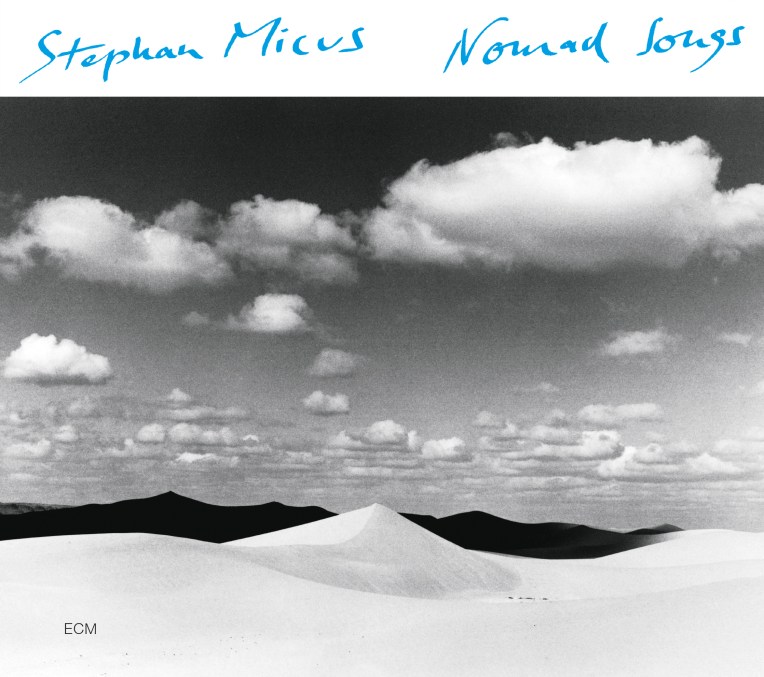
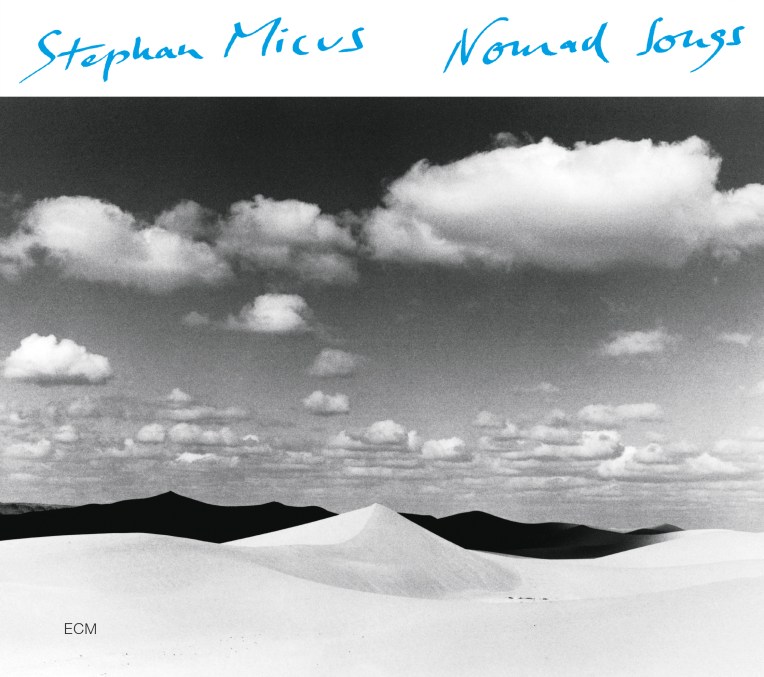
Stephan Micus: Nomad Songs (ECM 2409)

2409 X

Stephan Micus
Nomad Songs

Stephan Micus ndingo, genbri, steel-string guitar, suling, voice, nay, rewab, rabab, twelve-string guitar, fourteen-string guitar, tin whistle, shakuhachi
Recorded 2012-2014 at MCM Studios
An ECM Production
U.S. release date: August 7, 2015

Pundits often speak of “going green” as if all it involved were more considerate allocation of resources and regulation of harmful industry. Yet with this comes the responsibility of creating more resources in turn and balancing injury with abundance. Greenness entails awareness of Earth in all its forms, physical and metaphysical alike. The music of Stephan Micus engages both persuasions, enriching the inner lives of those fortunate enough to hear it while encouraging a harmonious and, above all, creative relationship with the environment. A consummate traveler and student of traditional instruments from nearly every continent, Micus has drawn inspiration from a staggering variety of locations, but that makes him no mere collector checking off items on some cultural itinerary. Instead, he modifies these instruments to suit his needs and manifests his connections to them through truly original compositions, all while replenishing what the world has gifted him, and then some.

Micus has had a long association with ECM Records, known for its rigorous production standards (typically recording, mixing, and finalizing an album in three days) but which has come to give the German multi-instrumentalist free reign to record in his home studio and send in the master(ful) tapes for postproduction. Despite being his 21st album for the label, Nomad Songs is no less thoughtful than the 20 previous. If anything, it’s a return to the most essential forces of his physics: push and pull. This is not to imply conflict but balance in the music, whereby seemingly contradictory actions flow into one another in the manner of the tide, expanding and recessing to the beat of an invisible drum. Which is perhaps why Micus plays, for the first time on record, the genbri, a bass lute used by Gnawa of Morocco as an instrument of healing and, in his hands, a percussive force throughout these sequences. Also new is the ndingo, a kalimba-like instrument favored by the San, an indigenous people of Botswana stripped of their nomadism by African nation states. The album’s title thus has dual meaning, tracing Micus’s own itineracy and honoring those deprived of it.

“Everywhere, Nowhere” opens the 11-part odyssey with a duet between the two newcomers. The resonant buzz of the ndingo, enhanced by means of a wooden sounding box, is as organic as a human-made instrument can be. Like the throat of one who has sung for eons, it reveals lifetimes of knowledge with every utterance. The genbri, in the enlarged form heard here, could almost be mistaken for an upright bass and as such takes Micus in lucid directions, unveiling a little of the mystery of his expressions. Only one other piece, “The Spring,” features this same combination of roots and leaves. Like a row of people walking hand in hand through the night, it sneaks away into the hope of a future without hierarchy.

Such respect has always been at the core of the Micus soundscape: his music may be openly visual but is temporal at heart, compressing and decompressing long stretches of time as if they were matter to be molded. A kindred message prevails in the album’s two solitary pieces. “The Blessing” is a vocal solo that meshes Micus’s spontaneous language with wayfaring melody, yet it is the 12-string guitar of “The Stars” that acts the part of storyteller. Brief, delicate, and ending in sparkling harmonics, it is a meteor shower reduced, as the sky would have it, to a play of light against the yawn of night.

Whether pairing steel-string guitar and the Balinese recorder known as a suling (“Leila”), or two Irish tin whistles, played simultaneously (“Sea Of Grass”), the duo pieces are less conversational than they are integrational. These, too, glance back to Micus’s earliest work. In characteristic fashion, the more instruments he adds, the more uniform his sound becomes. The gamelan qualities of the three ndingo in “Under The Chinar Trees” mesh exceptionally well with shakuhachi and voice, making for one of the most beautiful experiences he has ever committed to record, while appearances by the Egyptian nay (“The Feast” and “The Promise”) and a 14-string guitar of Micus’s own design add fire and water in equal measure. The rewab (long-necked lute of the Uyghur people of Western China) and rabab (Afghan lute) expand the plectrum-heavy palette, culminating with guitars in “The Dance,” in which the rabab’s shamisen qualities pave an alluring detour.

Not only is this some of Micus’s finest work; it is also the most enchantingly recorded and mastered. Listening to it, one can hardly be surprised that his last name is an anagram of “music,” because everything he touches turns into nothing less. His gestures open arteries by linking them to a universal blood flow, in which the aneurisms of supernovas and the embryos of planets weave a path that he treads, for all a sage, crushing nothing beneath his feet except denial of eternity.

(See this article as it originally appeared in RootsWorld online magazine, from which you may also link to a sample track.)
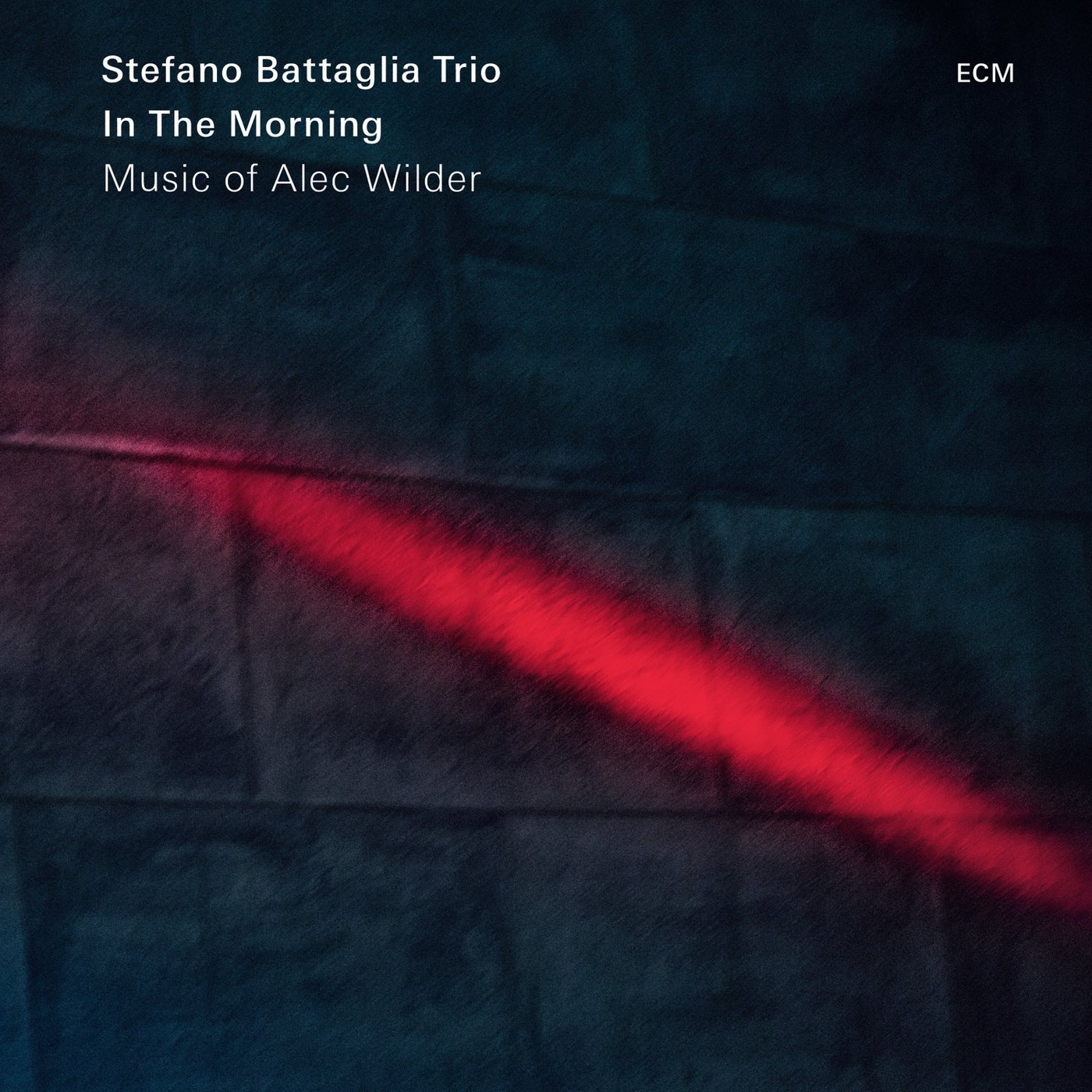
Stefano Battaglia Trio: In The Morning (ECM 2429)

In The Morning

Stefano Battaglia Trio
In The Morning – Music of Alec Wilder

Stefano Battaglia piano
Salvatore Maiore double bass
Robert Dani drums
Recorded live April 28, 2014 at Teatro Vittoria, Torino
Engineer: Stefano Amerio
Concert produced by Torino Jazz Festival
Artistic director: Stefano Zenni
Album produced by Manfred Eicher
U.S. release date: August 28, 2015

Pianist Stefano Battaglia and his trio with bassist Salvatore Maiore and drummer Roberto Dani have redefined the capabilities of the jazz trio by going inward. Each of these musicians is capable of engrossing power, but expresses that power by increasingly vulnerable means. This is also the trio’s strength: in finding the gentlest persuasion into a tune, effects thereof linger as unbreakable memories.

Battaglia’s has always been a thematic trio. Having oared mythical waters in The River of Anyder and the follow-up Songways, they now take on the music of American popular songwriter Alec Wilder (1907-1980) in a set of seven tunes arranged by the bandleader. In this album’s press release, Battaglia recalls his early encounters with Wilder by way of Keith Jarrett, who had recorded such songs as “While We’re young” and “Moon And Sand” with his trio. One listen to the Battaglia’s trio take on the latter tune, and you’ll realize that, while they might not have the depth of output of Jarrett’s, there’s no denying their contributions will be deemed every bit as significant when ECM’s entire history is one day taken into account. Levels of phrasing, immediate structure, and narrative in this 2014 live recording are no less indicative of genius.

Battaglia Trio
(Photo credit: Caterina di Perri)

Wilder was proficient across genres, composing not only popular but also art songs, opera, musicals, film scores, and chamber music. If any claim to eclecticism can be read into his oeuvre, it will also be found in Battaglia’s approach to interpretation. His enchantment translates into an enchantment all its own. Such is obvious in the title track alone, which links the first in the concert’s chain of exquisite realizations. With its arid and rolling heartbeat, this morning song proceeds evenly for the most part, though half-step dissonances add a feeling of recoil and the sweet pain of trekking through uncharted improvisation. This tune also shows the trio at its most egalitarian. Even the bass solo seems to arise from among like elements in a slowly churning pool of energies—a matter of focus over form.

“River Run” opens with bass harmonics, shallow percussion, and dampened piano, all working a spidery craft into focus until botanical artistries emerge. Battaglia opens the keyboard like a book whose pages are thumb-worn by former journeys yet whose ink still glistens with the musings of this one. And while each album has shown the evolution of the trio as a unit, Dani in particular has grown into a master colorist. The way he wanders while sharing the spirit of Battaglia and Maiore’s interlock is astonishing here, perhaps more the result of committing to the moment than of arbitrary forethought.

At just over four minutes, “When I Am Dead My Dearest” occupies the least space of the set list, but with no loss of scope. Of all the tracks it is the most songlike, an etude of quality over quantity. From the shortest the trio moves to the longest. “The Lake Isle Of Innisfree” is an album unto itself, a dramatic piece that moves from abstraction to photorealism over the course of 16 minutes. The center cushions a bass monologue in the attention of an audience so rapt it hardly seems to be there. Battaglia’s re-entry is as drum-like as Dani’s is pianistic as both work these waters into a foam, exhaled along the shoreline through malleted cymbals.

“Where Do You Go?” is another beauty, swimming with ideas beneath its combination skin. Battaglia gives fullness to every utterance and allows the trio to land as surely as it takes off. Last is “Chick Lorimer,” which rearranges Wilder’s setting of Carl Sandburg into a wordless but no-less-poetic expression of freer textures. The trio closes the door with magic, leaving us spellbound for having partaken of its affinity.

(To hear samples of In The Morning, please click here.)

Manu Katché: Touchstone For Manu (ECM 2419)

Touchstone for Manu

Manu Katché
Touchstone For Manu

Recorded 2004-2012
Produced by Manfred Eicher
U.S. release date: August 7, 2014

Whenever we say artists have “left their mark,” we tend to mean they’ve taken something away from the surface of the context in question and left something of themselves in its place. In the case of drummer Manu Katché, however, it’s as if he has left a shadow behind—a melodic spirit, if you will—through which one might come to appreciate the glow of his music. The fact that ECM already had a fixed set of 40-album “Touchstones” series yet determined that Katché was deserving of his own outlying nod confirms this status: fully a part of the ECM canon yet always catching a thermal to the next horizon.

Touchstone For Manu is not only significant for Katché’s subtle grooves and intimate hooks, but also for attracting an all-star cast of musicians to join him in the journey. Trumpeters as diverse as Mathias Eick, Tomasz Stanko, and Nils Petter Molvær variously grace his jet streams, while saxophonists Jan Garbarek, Trygve Seim, and Tore Brunborg underscore the former’s silver with streaks of gold. Guitarist Jacob Young casts his quiet nets of influence, while pianists Marcin Wasilewski, Jason Rebello, and Jim Watson bring their distinctive touches to bear on the improvisational quotient. Bassists Slawomir Kurkiewicz and Pino Palladino round out the guest list, with Katché as maître d’.

Katché portrait
(Photo credit: Gildas Bouclé)

The starter is “Song For Her,” one of three tracks off his second ECM leader date, 2007’s Playground. For one who’s composing is prone to aerial atmospheres, this is an ideal place to start. Eick’s trumpet is a fine vehicle both here and in “So Groovy,” which in title and realization might as well be Katché’s mission statement. Proof also that, while these may sound to some like nothing more than simple exercises, a closer listen reveals the depth of talent needed to express their simplicity. The tonal purity of the musicians involved is no small feat, and to give this music the attention it deserves requires of the would-be Katché interpreter total commitment to feel and structure. Just listen to the synchronicity of Kurkiewicz and Katché as they navigate the changes, and Wasilewski with them as he dabs his spontaneous commentary during a stretch of downtime. Such decisions require a tactile, careful ear. In “Morning Joy,” too, we feel that artfulness of participation, and find further evidence of Katché’s diversity. He can linger with languor, laugh in slow motion, and soar on wings of memory rather than of matter.

Before the first and second tunes of this playground, however, we zoom out to reveal the 2005 ECM debut, Neighbourhood. As my first encounter with the drummer, it has always been a personal favorite, but regardless of your album affiliations it’s difficult to deny “Number One” as one of his most exquisite tracks on record. For starters, it boasts the finery of a dream band, fronting Stanko and Garbarek over two thirds of the Wasilewski trio and Katché’s metronome. The set-up to its piano-driven groove shows patience, tracing rims and cymbals in preparation for “Take Off And Land.” The pianism is top-flight, as are contributions all around, each playing an equal role in a macramé of forces.

From Katché’s 2010 Third Round we get the uninterrupted triptych of “Keep On Trippin,’” “Senses,” and “Swing Piece.” These represent the more upbeat of Katché’s albums, and one brimming with happiness. Palladino’s electric bass is a welcome color change next to that organic kit, and has a more focused sound in trio with Rebello’s piano. Young’s guitar and Brunborg’s soprano add water and light, respectively, in the first tune, while the second and third, smooth as an ice skater’s blade, take the leader’s egalitarian aesthetic to new depths.

When Katché gave an interview to NPR about his 2012 self-titled album, he discussed, among other things, the importance of tuning his drums throughout the recording process. I’ll never forget reading an online comment by someone who balked at this idea, claiming it as the mark of a “musical imposter.” Trolls will be trolls, but it bears elaboration to say that many drummers across genres, cultures, and time periods have relied on the benefits of tuning to match their instruments with others in an ensemble. Where, for example, would an entire tradition of Indian tabla playing be without it? Or, for that matter, the western classical orchestra, in which the timpani—which Katché studied at the Paris Conservatory—must be precisely tuned to suit the needs of the score. The tuning is obvious from the three selections of that album here. Just listen to the way in which his snare and cymbals seem to sing in “Running After Years,” a track that further shows Katché at the height of his compositional powers, blending all the characteristics of his previous efforts into a fresh and all-inclusive sound. Molvær is an ideal addition to the drummer’s evolving nexus, his resonant horn careening through the clouds with an attunement all his own, as Brunborg’s tenor traces parabolas alongside Molvær’s plane trails and Watson’s pianism reminds us of the earth we’ve left behind.

In “Slowing The Tides,” Molvær employs a technique made famous by Jon Hassell, adding harmonies by singing through his trumpet. Watson’s Hammond organ, here and on the final track, “Bliss,” adds simmering heat. Katché’s robust beat engenders wry twists from Watson, playing us out from a program of shape and shift. So are we reminded that no fireworks are needed to create wonderment in rhythm. Sometimes, a groove just needs room to grow.

John Potter: Amores Pasados (ECM New Series 2441)

2441 X

John Potter
Amores Pasados

John Potter voice
Anna Maria Firman voice, Hardanger fiddle
Ariel Abramovich lute
Jacob Heringman lute
Recorded November 2014 at Rainbow Studio, Oslo
Engineer: Jan Erik Kongshaug
Produced by Manfred Eicher
U.S. release date: July 17, 2015

In his liner note to Amores Pasados, former Hilliard Ensemble tenor John Potter puts forth the notion that perhaps the wall between popular song and so-called art song, which even just a century ago were one and the same, is an arbitrary one. Such is the contradiction behind his latest project, as inevitable as it is unusual. In a musical climate where singers shackled by marketing to particular genres branch out into others at their peril—a climate in which “world music” still rings like a derogatory term for non-professional, non-western curiosities—it may be difficult to conceive of a time when melodies we take for granted as part of the classical soundscape were once “popular,” belonging as much to the theatrical stage as to the troubadour’s lips. Contrary to the pop songs of the 20th century, by which the roles of lyricist and composer have all too often ridden divergent streams of commodity, songs once fell fully within the purview of laypeople at a time when notions of artistic integrity had yet to hammer a wedge between “professionals” and “amateurs.” This dynamic would now seem to have undergone a dramatic reversal via singing competition shows like The Voice, but even there the purpose is to produce the next generation of underdogs, whose underlying ambition is to buy into the professionalism they seek, often at the expense of at least one vital organ of their creative bodies. They must be the complete package: looking and acting the part into which they will be groomed if they are to succeed beyond the ephemeral glory that makes them visible. Amores Pasados, then, represents a rare—and all the more so for being successful—attempt to blur the lines between the old and the new, performing modern folksongs with an antique spirit and older songs afresh, along with more recent balladry by pop/rock legends John Paul Jones (bassist of Led Zeppelin), Tony Banks (keyboardist of Genesis), and Sting.

Amores portrait

The arrangements are Potter’s own, and find a choice companion in Swedish soprano Anna Maria Friman. Friman’s journey as part of the vocal ensemble Trio Mediaeval has since 2001 graced ECM with a series of eclectic recordings, all under the mentorship of Potter himself, and so their rapport is duly felt here. Joining them are lutenists Ariel Abramovich and Jacob Heringman, making for a multi-national roster.

The album’s first three songs comprise its titular suite, featuring Spanish Golden Age poetry set to music by Jones. It begins with the full quartet in “Al son de los arroyuelos.” As Potter and Friman harmonize over interlocking lutes, it’s clear that a new age of song has begun. The haunting “No dormiá,” for its part, has what Potter calls an “Arvo Pärt-like sparseness” which “defies categorisation of any sort,” and indeed reminiscent of the Estonian composer is its organic evolution from single-note chants to polyphonic blossoming. These give depth to a droning horizon, brushing in trees, mountains, and setting sun. Should it fall under any generic label, let it be: haunting. “So ell encina” finishes the triptych with a relay of understated power between the two singers.

Much of the album is, however, clearly in the tradition of that most famous purveyor of Elizabethan love songs, John Dowland (1563-1626). And while his music is nowhere to be found here (leave that to Potter’s earlier Dowland Project, also well documented on ECM), Dowland looms large, especially in this album’s closer, “Bury me deep in the greenwood,” by Sting. Sting’s 25-year obsession with Dowland led him to take up the lute and to release the Dowland-centered Songs from the Labyrinth on Deutsche Grammophon in 2006. Although “Bury me deep” is commercial in origin, having originally been written for director Ridley Scott’s 2010 reboot Robin Hood, it best captures the spirit of its influences through an exquisite sensitivity of both melody and lyric, being the only of the modern songs herein in which both come from the same pen.

For context we are presented with three specimens by Dowland contemporary Thomas Campion (1567-1620). “Follow thy fair sun” and “The cypress curtain of the night” are both heard in their original versions, and again with new music by Banks. The former glide off the tongue of Friman (what a joy to hear her as a solo artist), whose shaping of imagery is as evocative as the verses themselves. “Oft have I sighed” completes the Campion tour with quintessential languishing. As for Banks’s “Follow” and “Cypress,” they express the balance of self-loathing and -resolution of the original lyrics through soulful composing. The second song, with its lilting changes and Potter’s melodious diction, is especially memorable for its arpeggios (recalling the Prelude of Bach’s first cello suite) and unexpected ending.

Also unexpected are the chord changes of two early 20th-century songs: “Sleep,” with words by John Fletcher (1579-1625) and music by Peter Warlock (1884-1930), and “Oh fair enough are sky and plain” with words by A. E. Housman (1859-1936) and music by E. J. Moeran (1894-1950). Both work seemingly within the Dowland frame, but color outside the lines like the roots of a tree that grows wherever it will. Moeran’s is the most surreal of the album, sprouting leaves in winter and dropping them in spring.

Two versions of “In nomine,” the lone surviving composition of one Picforth, beyond whose 16th-century flourishing hardly anything is known, regale with their circularity and Celtic knot structure. Each is something of a palate cleanser for the ear, a baptism by hearth after the rain along the way.

To the seasoned ear, the distinction between older and newer songs will be rather obvious. This does nothing to undermine the integrity of the project. If anything, it strengthens that integrity, because the goal here is not to disguise itself as the past by way of compositional pantomime, but to own up to the trends of the present while paying respects to what has informed it. Whichever direction it may ultimately choose in the listener’s mind, one can hardly walk away from Amores Pasados without feeling its communal heartbeat. And perhaps this is the album’s truest goal—namely, to invite all who wish to sing, regardless of elitist approval, to enjoy the gift of creation (and creating) together, yielding a unity of voices across all lines drawn.

(To hear samples of Amores Parados, click here.)

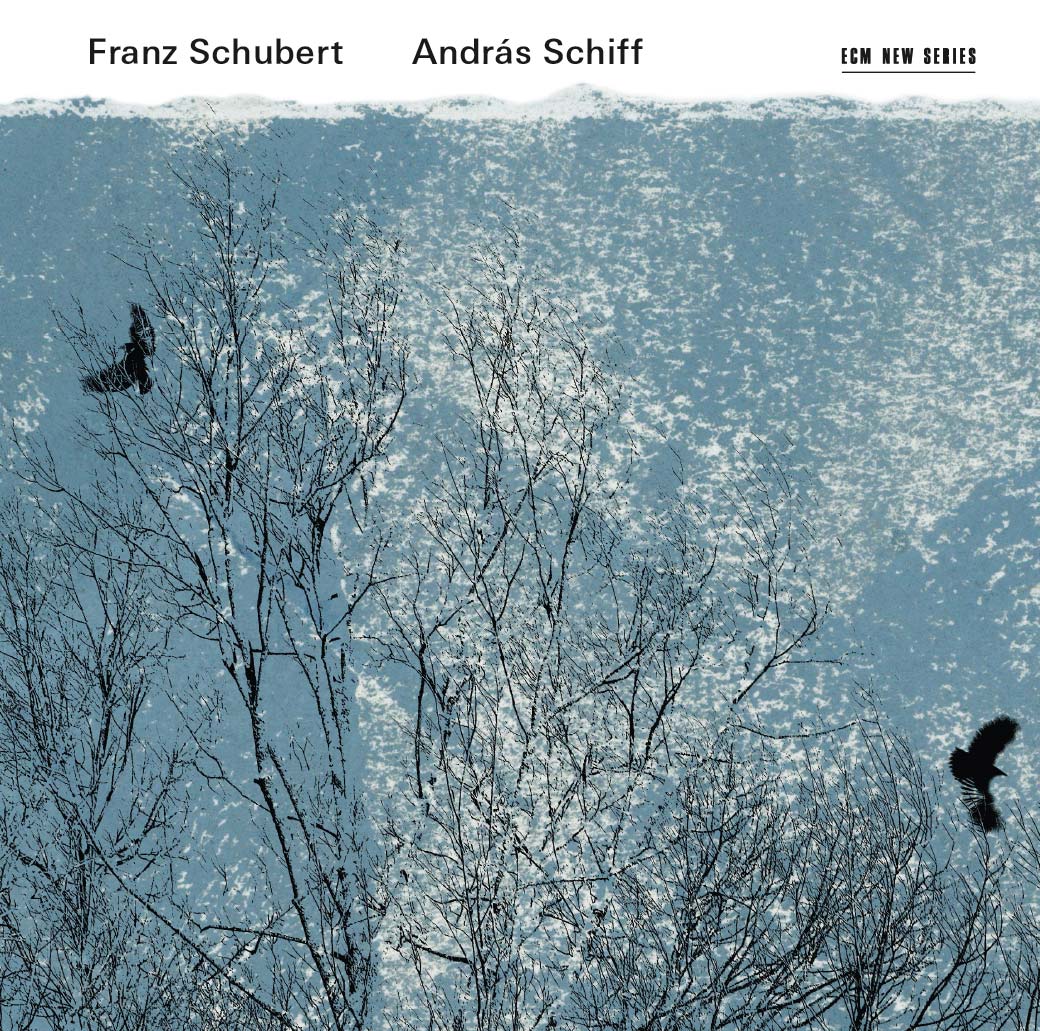
András Schiff: Franz Schubert (ECM New Series 2425/26)

Franz Schubert

András Schiff
Franz Schubert

András Schiff piano
Recorded July 2014, Kammermusiksaal H. J. Abs, Beethoven-Haus, Bonn
Engineer: Stephan Schellmann
Production coordination: Guido Gorna
Tuning and technical assistance: Georg F. Senn
Executive producer: Manfred Eicher
U.S. release date: 2 June 2015

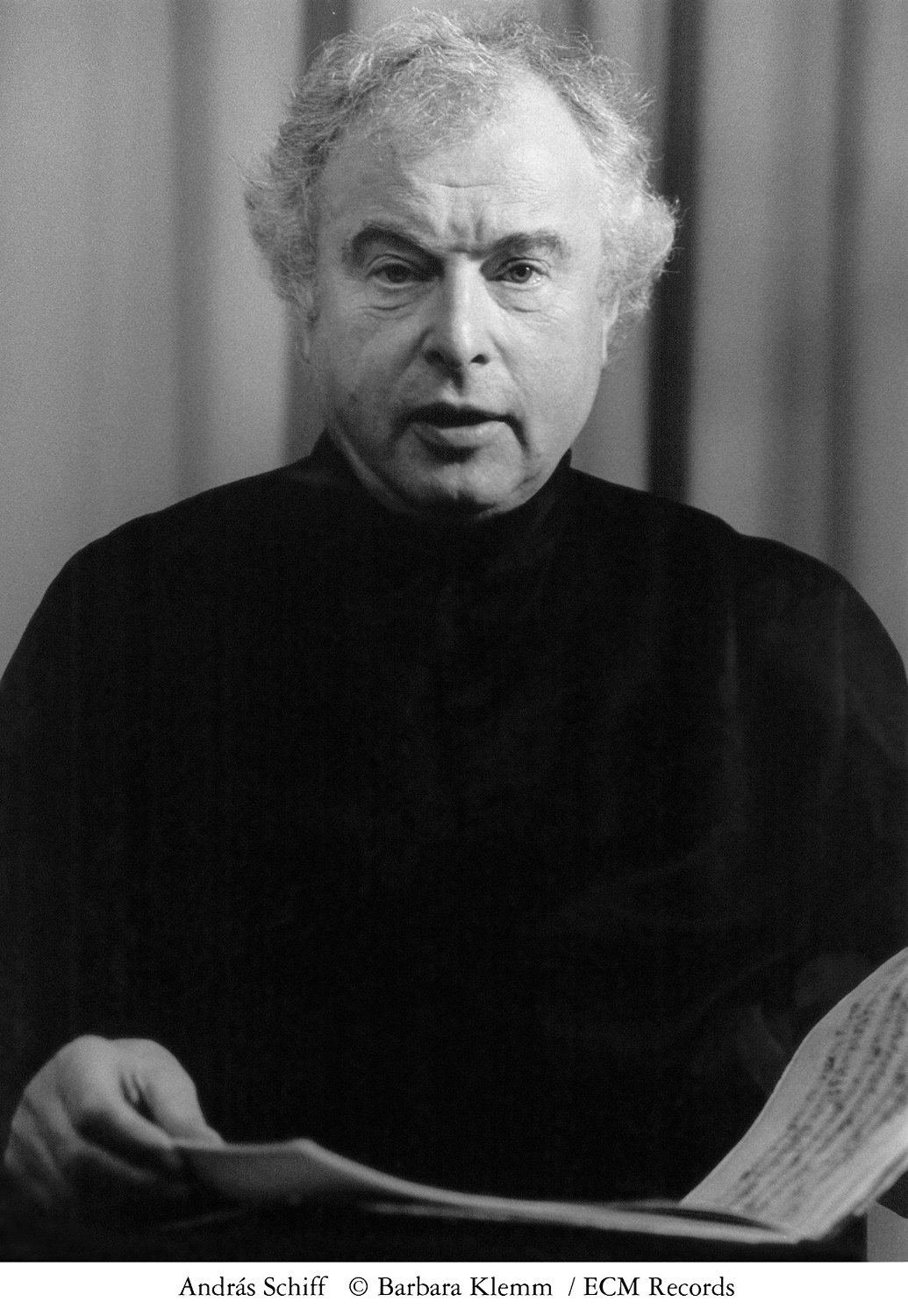
While András Schiff has reinforced the worthiness of Bach and Beethoven at the piano over a sprawl of recordings for ECM’s New Series, he has also carved out a hallowed space for the music of Franz Schubert, beginning in 2000 with a recording of the C-major Fantasies and now deepened with this composer-titled collection. In his liner text, “Confessions of a Convert,” Schiff discusses the transition to “authenticity” via historically minded performance, a movement that popularized use of period instruments and, ironically enough, the newness they brought to canonical repertoires. “There is an astonishing wealth of old keyboard instruments hidden in museums, foundations and private collections, many of them in prime condition,” he writes, speaking after his transformation from skepticism to advocacy. “Getting to know them is essential for the student, the scholar, the musician: it is a condition sine qua non. Playing on fortepianos—and on clavichords—should be compulsory for all pianists. Their diversity is amazing.” Even more amazing is the diversity of Schiff’s willingness and ability to adapt to these changing colors, to treat each as having equal value in the keyboard spectrum. For this recording he plays a fortepiano, built by Franz Brodmann in Vienna around 1820, which Schiff has owned since 2010. Attentive listeners will recognize it as the very one employed for the second version of the pianist’s Diabelli traversal, also for ECM. Once again, engineer Stephan Schellmann underscores the intimate life of this instrument.

Schiff

The Sonata Nos. 18 in G major and 21 in B-flat major serve as centerpieces. An overall translucence pervades the first, and the opening movement, marked “Molto moderato e cantabile,” gains purchase by the fortepiano’s immediacy, which ensures that even the greatest leaps never forget where they came from. Schubert’s propensity for quietude is on full display, contrasting fragile highs with muddier lows. And while Schiff’s Brodmann might at first seem better suited to the Andante, it proves itself to be just as capable pulling off the half-tucked rolls of the Minuet. And the concluding Allegretto? Let’s just say that, if the sound, in combination with Schiff’s artful handling of it, hasn’t won you over by this point, then the album just might not be for you.

The Sonata in B-flat major, widely considered to be the pinnacle of Schubert’s writing for piano, feels not so much new as renewed, given access to muscles it might not otherwise exercise on a modern grand. If the G-major Sonata felt at best quasi-Beethovenian, then this one begs a more genuine comparison. From the low trills that interrupt with periodic hints of foreboding in the first movement to the flexion of the final Allegro, there’s more than enough for the comparatist to savor. Nowhere else, with the possible exception of the Four Impromptus (op. 142), is the fortepiano’s potential so evident. The seesawing between minor and major in the Andante and the spirited undercurrents of the Scherzo, and all the subtleties required to make those dynamics felt, come naturally to the instrument, which I daresay adds a boldness all its own by virtue of its focus.

Schiff’s reckoning of the op. 142 proves there’s still much to discover in these robust pieces. Each impromptu has its own charm, but the second, an Allegretto in A-flat major, proves the need for a tactful performer. Schiff balances its understated seeking with immediacy, all the while through his pacing lifting the music beyond an exercise in mere pathos. Some of the most dramatic moments of the album can be found here, barely eking out over the captivations of the Andante that follows it to round out the center.

Even in the shade of these gargantuan sonatas, the popular Moments musicaux hold their ground. In Schiff’s handling, they come across with spontaneity and breadth. Each has its own captivation, but the Andantino in A-flat major is a most remarkable vehicle for the fortepiano’s middle register. By the final movement, these beauties are swimming in fresh disclosures.

Not to be outdone, however, are two chosen miniatures. The Ungarische Melodie (Hungarian Melody) in b minor introduces the program with evocative subtlety, while the Allegretto in c minor, written for the departure of a friend, populates more spacious melodic tenements. Both contain a wealth of emotional pigments. Between the azure flash of a dramatic pause and the rusty ochre of hindsight, not a single piece piece of the puzzle feels out of place.

If this is your first time encountering Schubert’s piano works, it may just become a reference recording. If you come to it with familiarity, especially by way of Schiff’s nine-course feast on Decca, then you will want to keep it for comparison and discovery with all the rest. And to be sure, even putting aside questions of instrument, this recording is by nature historically informed, because it is itself history in the making.

(To hear samples of Franz Schubert, please click here.)

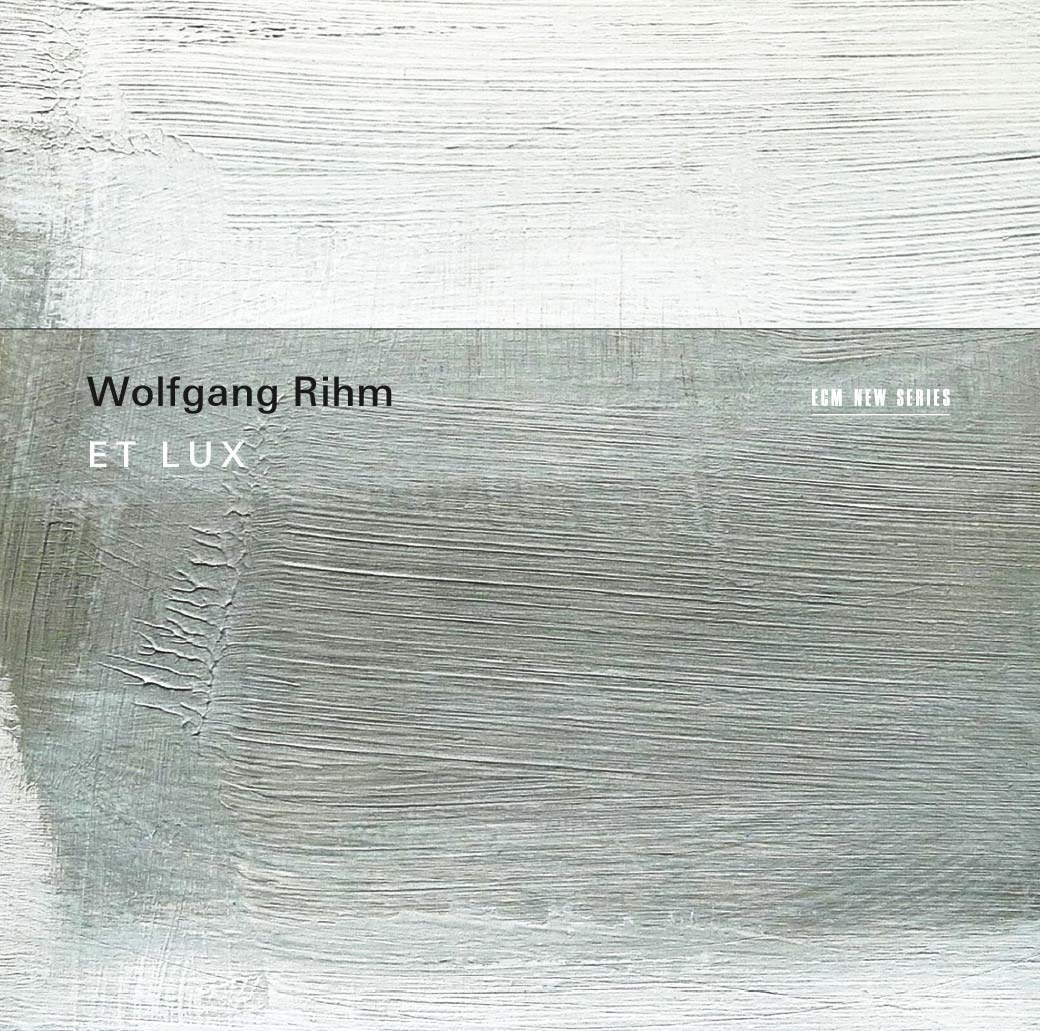
Wolfgang Rihm: ET LUX (ECM New Series 2404)

Et Lux

Wolfgang Rihm
ET LUX

Huelgas Ensemble
Minguet Quartett
Paul Van Nevel director
Recorded February 2014, Augustinus Muziekcentrum, Antwerpen
Engineer: Markus Heiland
Mixed January 2015 in Lugano by Markus Heiland and Manfred Eicher
Produced by Manfred Eicher
U.S. release date: 2 June 2015

ET LUX is an hour-long composition for vocal ensemble and string quartet (2009) by Wolfgang Rihm that situates fragments of the Latin Requiem Mass in cells of sustained chords and spectral wanderlust. Although originally written with the Hilliard Ensemble and Arditti Quartet in mind, the performance here is in more than capable hands. The Minguet Quartett, approved interpreters of the composer’s string quartets, and the Huelgas Ensemble (which doubles the scored voices to eight) illuminate every fiber of this tapestry like sunlight through a castle window.

For a composer so prolific (with over 400 works to his name), it’s only natural that again Rihm should cast once glance backward for every two forward, ending up suspended somewhere between the poles of question and answer, and proving them to be the event horizons of an arbitrary dichotomy. It is music that neither invites nor rejects, but places the listener (and composer) in a space where choices are the only true materiality. Hence the cellular nature of the piece, in which selective phrases serve as requiems unto themselves.

As Paul Griffiths observes in the album’s liner text, “What we have here is not music remembered but music remembering.” Attribution of such sentience to notes on a page is no metaphorical trick. It speaks, on the surface, to the music’s body of antiquity and clothing of modernity, and beyond that to their entanglement among the bramble of performance and the flourishing of listening. In the manner of Alexander Knaifel, the instruments sing as much as the human voices. This, of course, requires a human touch. Still, the inner life of ET LUX is not provided but enhanced by that touch.

The keyword, in both the writing and the playing, is “tactile,” as if both forces were bound by flesh and spirit alike. The quartet breathes, close to silence yet pregnant with words all the same, bringing its own voices to bear upon the passage of time. Each instrument must treat the space as it is treated: as an element of malformed crystal, whose light exists only for as long as it is uttered to be. The effect is such that, even when punctuating the darkness with spikes of pizzicato flash, harmonies merely disperse and regroup, taking on semblance of something newborn.

An astonishing amount of variety pervades a work so slow-moving yet which bypasses pathos toward the development of deep, if sometimes tense, relationships. Moments approaching beauty are inevitably peeled away from expectation, leaving us to reckon with a more true-to-life distortion of textual fantasy. Instead of treating the Mass as a poem or liturgical given, it retraces shards of it until each is self-reckoning. The mystery of faith becomes a reflection of itself.

As the piece goes on, the dynamic between voices and strings becomes mutually divergent, at once developing inward and outward. A prayerful mode gives way to fire, and further to snowy textures. Pulses emerge, morph, and overlap, but disclose little of their intentions. The clearest answer, then, is in the dark, sublime ending; a movement into new beginning, but in which direction is left open to interpretation.

Elina Duni Quartet: Dallëndyshe (ECM 2401)

2401 X

Elina Duni Quartet
Dallëndyshe

Elina Duni voice
Colin Vallon piano
Patrice Moret double bass
Norbert Pfammatter drums
Recorded July 2014, La Buissonne, Pernes-les-Fontaines
Engineers: Gérard de Haro and Nicolas Baillard
Produced by Manfred Eicher
U.S. release date: 2 June 2015

When we left that day
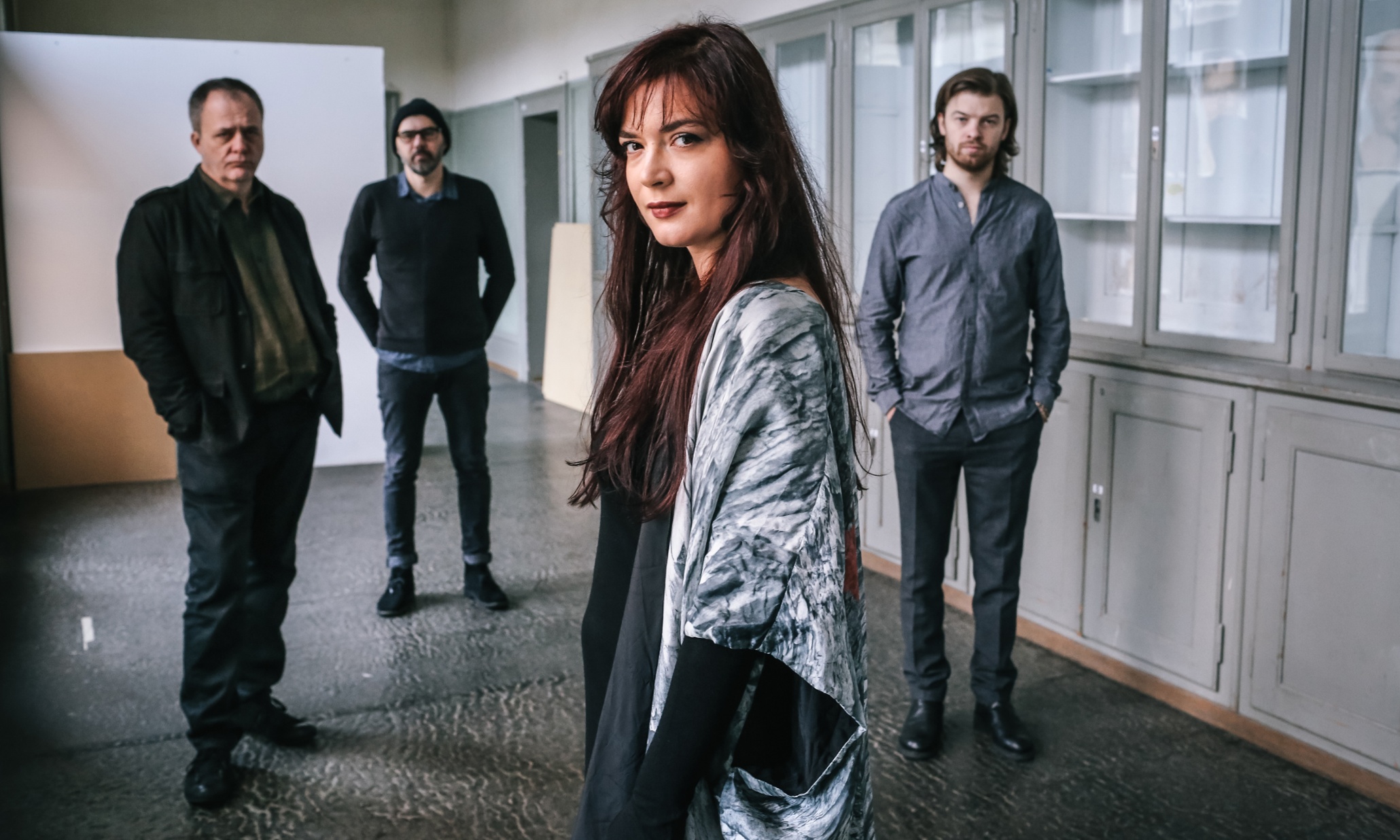
losing sight of our land
all the men with one big sigh
called their women with a cry…

“Exile has always been humanity’s burden and love its faithful companion,” writes Elina Duni in a liner note for Dallёndyshe (The Swallow), follow-up to her ECM debut, Matanё Malit. Once more joined by pianist Colin Vallon, bassist Patrice Moret, and drummer Norbert Pfammatter, Duni presents a compelling new set of jazz-infused folk songs from her birth land of Albania, each wrapping its narrative arms around the primal losses of families and lovers broken by separation. With more lucidity than ever, she uses her voice to weave stories of uncompromising intimacy, a feeling only enhanced by the sensitivity of her bandmates. That said, the roles of her musicians aren’t merely programmatic, but pulse like vital organs of the present arrangements.

Elina Duni Quartet
(Photo credit: Nicolas Masson)

Much of that vitality is to be found in Vallon’s pianism, which casts its melodic nets far and wide throughout “Ylberin.” The title makes reference to rainbows, a nickname given to men by the women they’ve left behind. By a similarly ephemeral sense of beauty, Vallon expands Duni’s vocal colors to the indefinable gradients between them. As in “Unë në kodër, ti në kodër” (Me on a hill, you on a hill) that follows it, the lyrics only thinly disguise a vehemence toward separation. Through these songs, Duni puts herself in the hearts of those forced into seclusion, cursing the rifts of years as her sorrow approaches a state of ashes.

Pfammatter’s drumming borrows its tools of expression from those same interstices, moving through the Byzantine channels of “Ti ri ti ti klarinatë,” an onomatopoetic gem from the Arvanites of Greece, with the surety of a vine along a wall, and rustling through the brush of “Delja rude” (Sheared Sheep) like an open wind. The latter is an album highlight and points to the cathartic nature of this music. In a press release, Duni indeed claims an affinity with the blues, noting, “One of the fascinating things about music of the Balkans, in a lot of the folk music, is the idea that the pain has to be sung. And in singing you go beyond it.” This feeling of transcendence is especially audible in the bassing of Moret, who binds his pages with openness, whether bringing lucid attention to the gently propulsive “Bukuroshe” (Beautiful Girl) or drawing a bow crosswise to the low drums of “Kur të pashë” (When I Saw You), a traditional tune from Kosovo.

All three musicians tell parallel stories throughout the album, no less lyrical than Duni’s—not only reflecting on the narrative at hand but also drawing connections to times and places beyond observable borders. Yet it is Duni who carries the most potent magic in her satchel, into which she reaches and flings the cloud paintings of two modern songs onto canvas. Album opener “Fëllënza” (The Partridge) was written by singer and poet Muharrem Gurra, a trailblazer of Albanian popular song, and is the most embodied of the set. Like the partridge itself, it survives on barest trills and cautious movements, each more graceful than the last. Here we encounter a maternal voice for the world, seeking to use its hands for protection alone. “Sytë” (The Eyes), with music and lyrics by Isak Muçolli, is another classic, this one made famous by legendary Albanian singer Nexhmije Pagarusha. Duni brings out its innermost qualities in an attempt to part a veil of tears.

Music video for “Sytë” (with English subtitles):

But it is in the older songs where her heart carries the most blood to its destination. Duni stands, for all a melodic tower, in “Unë do të vete” (I am going to go) and “Nënë moj” (O, Mother), around which improvisational gatherings abound, while the whispered frame of “Taksirat” (The Mishap) snakes its way through desert grooves. Yet nowhere is her yearning so tangible as in the title song, which comes from the Albanian diaspora of Italy and treads nakedly to the sole accompaniment of piano. The voice is a landscape all its own, Duni seems to say, and my footprints are all that remain. Each has note value, and your soul will be the next one to sing it.

(To hear samples of Dallëndyshe, please click here.)

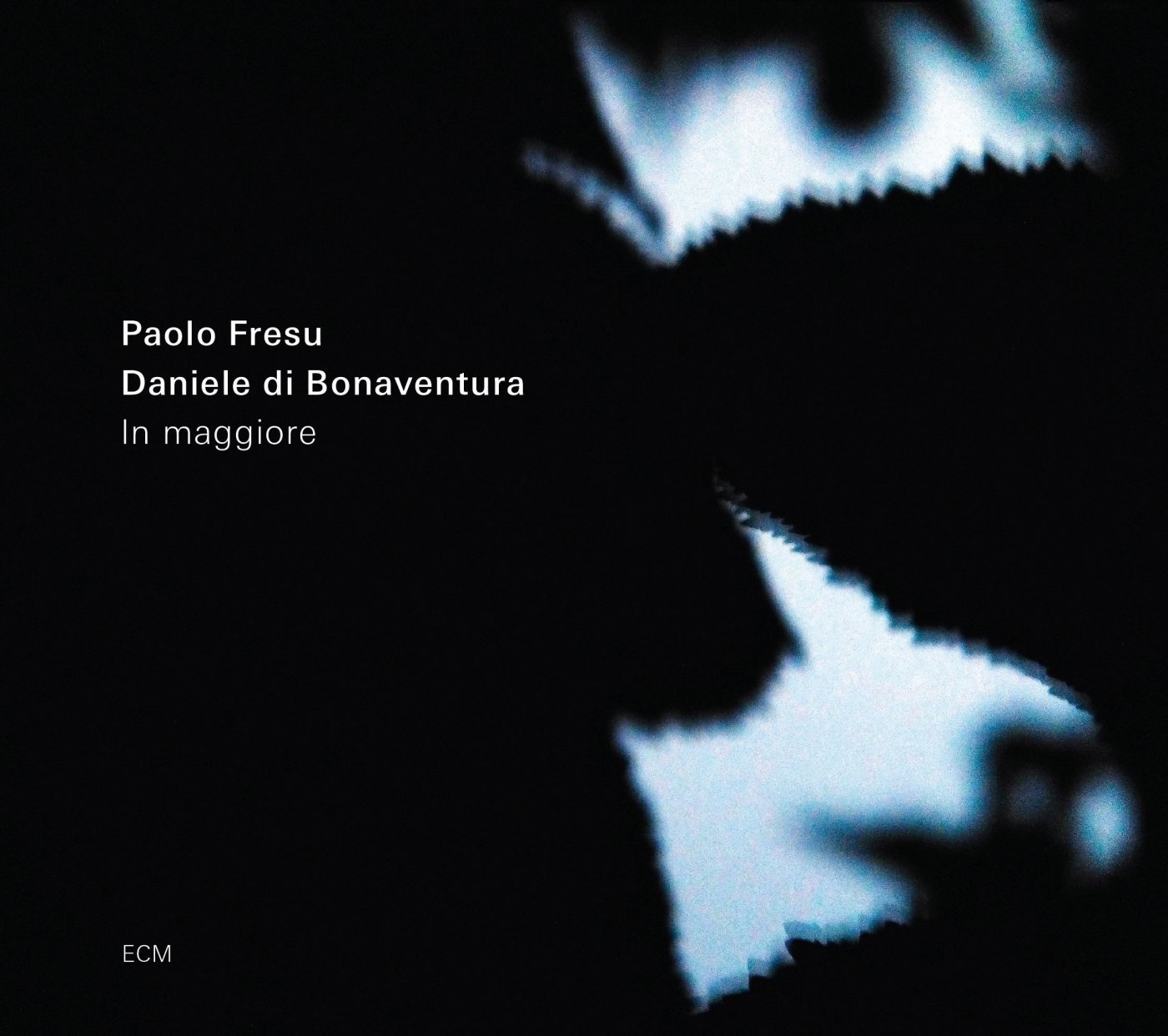
Paolo Fresu/Daniele di Bonaventura: In maggiore (ECM 2412)

In maggiore

In maggiore

Paolo Fresu trumpet, flugelhorn
Daniele di Bonaventura bandoneón
Recorded May 2014, Auditorio Stelio Molo RSI, Lugano
Engineer: Stefano Amerio
Produced by Manfred Eicher
Release date: 20 March 2015 (Europe only)

Trumpeter Paolo Fresu hails from the island of Sardinia, bandoneonist Daniele di Bonaventura from the coastal town of Fermo on the Italian mainland. Water and land may separate their origins, but together they make music so unified that a single landscape is enough to define them in this context. Their first ECM appearance on Mistico Mediterraneo placed their collaboration at the center of a project fusing improvisation with Corsican chant. With nothing but air between them here, they create a chant all their own, a language that breathes in and sings out.

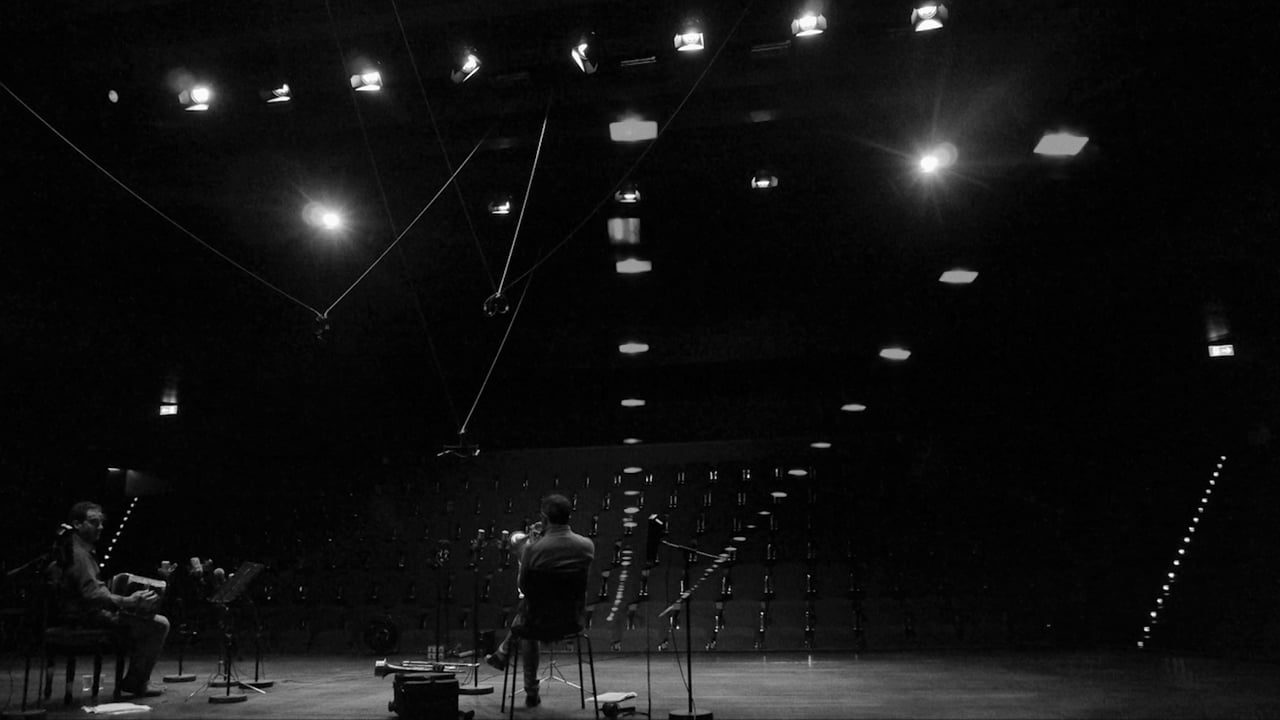
“Da Capo Cadenza” is the first of three tunes by di Bonaventura. Fresu’s lucid colorations cross every tee of the composer’s bellowed writing. The feeling of cinema is so strong here, it’s no wonder that the recording session should be the subject of Italian filmmaker Fabrizio Ferraro’s documentary Wenn aus dem Himmel, which turns the creation of this music into a meditation on spatial crossings.

Wenn aus dem Himmel still

This set opener is also a fine example of flugelhorn virtuosity, not in terms of technical flourish (a given) but of emotional integrity. His way with a horn lends itself to poetry, but versifies with a style that shades any description of it. To experience its atmospheric range, listeners need only immerse themselves in the duo’s take on Brazilian composer Chico Buarque’s “O que será,” last heard on an ECM album of the same name by Stefano Bollani and Hamilton de Holanda. The version here follows a progression that characterizes many on this album, building from caution to confidence as it gathers momentum into the Chilean resistance song ”El pueblo unido jamàs serà vencido” of Sergio Ortega. Despite, if not because of, the delicacy with which Fresu and di Bonaventura breeze through these changes, a raw, underlying power begins to emerge.

Fresu deepens the flugelhorn in three tunes from his own pen, including “Calmo” and the title track, both lyrical highlights. The latter tune closes out a disc that, despite its general quietude, stays on in the memory as a blast of renewable energy. As Fresu’s final note trails into non-existence, it carries into tomorrow the certainty of another sunrise. Other highlights from this darker instrument can be found in the freely improvised “Sketches” and delightful, if somber, take on “Quando me’n vò” from Puccini’s La Bohème. It is music that has lived many lives before, and lives again, as it will ever onward.

Close to center is di Bonaventura’s “Kyrie Eleison,” a wordless solo moves with the quiet strength of a hymn. Beyond it are tracks that employ muted trumpet, which at Fresu’s fingertips invokes early Miles Davis, even as it oozes a distinct charisma. Along with his own “Ton Kozh” and di Bonaventura’s “La mia terra,” Uruguayan singer-songwriter Jaime Roos’s “Se va la murga” stands as an album touch-point. The latter is lovingly arranged and awakens percussive details from within the instruments. By it is revealed an inner pulse that binds their art within the acoustics of the Lugano recording studio in which they find themselves transfixed for this enchanting hour. Di Bonaventura carries enough weight in his bellows to support the grandest sweeps from Fresu and, by the same token, enough airiness to guide his lightest feathers, unbroken, to shore.

More playful elaborations make the four minutes of Neapolitan composer Ernesto de Curtis’s “Non ti scordar di me” (Do not forget me) pass by with the wistfulness of youth itself, thereby enhancing the nostalgic hope of the title. But nowhere does the muted trumpet speak so forthrightly as in “Te recuerdo Amanda.” This aching melody by Chilean songwriter Victor Jara flows through brass like time itself, bypassing layers of history to let its voice be known. And, really, that’s the essence of this music. It is so personal that it becomes relatable on a purely human scale, shed of politics and origins until only the musicians and audiences remain, bound by mutual recognition that life is infinitely more important than its hindrances.

(To hear samples of In maggiore, please click here.)